28 December 2007

The Meaning of oṃ maṇipadme hūṃ

In my last essay on this all important mantra I summarised the findings of Alexander Studholme on the origins of the oṃ maṇipadme hūṃ mantra, and some interesting facets of the identity of Avalokiteśvara in the Karandavyuha Sutra.

One of the main questions that Westerners ask when they come across something like a mantra is "what does it mean?" Donald Lopez, in Prisoners of Shangrila, outlines the progress of the Western understanding of the meaning of oṃ maṇipadme hūm over the centuries. One feature of the Western commentaries on the mantra is that the Westerners are convinced that the Tibetans do not know the meaning of the mantra. This is an example of what Edward Said called "Orientalism" - an attitude of disdain towards Asians who did not conform to European norms, and assessments of Asian culture from those norms. Eurocentrism certainly comes across as arrogant and over-bearing in relation to oṃ maṇipadme hūṃ.

The first European interpretation of the mantra dates from 13th century when William of Rubruck reported that the Tibetans chanted "om mani baccam" which is "God, thou knowest". Over the years such basic mis-hearings, and mis-interpretations were the rule. Interpretations such as "Lord forgive my sins", "O god Manipe, save us" followed. In the 18th century the Jesuit Ippolito Desideri who actually learned Tibetan published his interpretation of the mantra as "O thou who holdest a jewel in Thy right hand, and art seated on the flower Pêmà", which may just capture one of the senses of manipadme . However with the coming of scientific philology, in part inspired by the discovery of the Sanskrit Grammarians, a new interpretation emerged. In 1831 Heinrich Julius von Klaproth explained that padmè was padma in the locative case (i.e. in the lotus) and that the mantra means: Oh! The jewel is in the lotus, Amen. From this time on some variation on "The Jewel in the Lotus" became the standard meaning of the mantra. [1] Of course o and hūṃ are always difficult since they are not words in the way that maṇi and padma are, and so they are treated differently, but maṇi and padma become standardised in English language works as two words with padme in the locative case.

The apotheosis of this, orientalist, interpretation is perhaps represented by Lama Govinda's book "The Foundations of Tibetan Mysticism", in which the mantra is explicated over the course of 300 pages. Lopez notes that despite its title it is "based on no Tibetan text", but draws on "the Upanishads, Swami Vivekananda, Arthur Avalon, Alexandra David-Neel, and especially the tetralogy of Evans Wentz". "Lama Anagarika Govinda" always brings to mind Harold Bloom's quip about Freudian Literacy Criticism being like the Holy Roman Empire - not Holy, not Roman, and not an Empire. Perhaps it would equally apply to "Foundations of Tibetan Mysticism". Even Robert Thurman a scholar/practitioner in the Gelug tradition adopts "The Jewel in the Lotus" as the explanation of the mantra in his book Essential Tibetan Buddhism. As Lopez notes, no Tibetan text is ever cited to justify this reading.

As early as the 1950's David Snellgrove pointed out that maṇipadme is not two words but a single compound. Maṇi is uninflected, and maṇipadme is not the locative, but a vocative of the feminine form maṇipadmā. The compound is according to Sten Konow (quoted by Lopez) a bahuvrīhi compound which means "O Jewel-lotus" Alexander Studholm critiques this gloss, and by referring to a number of similar expression in Mahāyāna literature concludes:
"The expression should be parsed as a tatpurusa, or "determinative," compound in the (masculine or neuter) locative case, meaning "in the jewel-lotus," referring to the manner in which buddhas and bodhisattvas are said to be seated in these marvellous blooms and, in particular, to the manner in which more mundane beings are believed to appear in the pure land of the buddhas". [2]
This I think sorts out the grammatical issues, although without reference to traditional Tibetan exegesis. Ironically, given the effort that has gone into answering it, Western scholars and Buddhists may have been asking the wrong question. Faced with a mantra the tradition doesn't ask "what does it mean?" it asks "what does it do?". The mantra in the Kāraṇḍavyūha Sūtra is said to result in rebirth in one of the hair pores on Avalokiteśvara's body. This alternate destination to the usual pure land, is probably influenced by Puranic traditions, but has the same advantages as a pure land. The Kāraṇḍavyūha Sūtra likens chanting the mantra to a pre-existing tradition of calling to mind of the name of a Buddha or Bodhisattva (nāmanusmṛti). That is to say that the mantra is an invocation of the deity, and offers similar protection to that offered in the Saddharmapuṇḍarika, to the one who calls out the name of Avalokiteśvara.

A much more important approach to "meaning" in esoteric traditions is to take the individual syllables one at a time and establish connections with other sets of six such as the six realms. Avalokiteśvara appears in each of the realms to save the beings there from the particular kinds of suffering that afflict beings in them. When they do address the semantic meaning of maṇipadme, it seems that Tibetan texts read it as jewel-lotus. This fact may have been of very little importance in Tibet however, as the mantra is a invocation of Avalokiteśvara, and what else does one need to know?

However this is not to say that the "jewel in the lotus" interpretation is wrong. It is a powerful image, completely consonant with Buddhist principles, and has inspired many people over the years. It may be a case for Sangharakshita's expressed preference for bad philology with good doctrine being preferable to good philology and bad doctrine. It is bad philology, but since the function of the mantra is more important than it's "meaning" the semantics are actually of only minor interest.

Another way of understanding what the mantra does, and which may help us to understand how the chanting of sounds, the semantic content of which may be completely obscure for the person chanting them comes from Ariel Glucklick's phenomenological study of Tantric magic. Magic, he says:
"is based on a unique type of consciousness: the awareness of the interrelatedness of all things in the world by means of simple but refined sense perception… [magical actions, such as mantra chanting] constitute a direct, ritual way of restoring the experience of relatedness where that experience has been broken" [3]
The idea here is not that the mantra affects anything in the outside world - the distinction of inside/outside has no ultimate meaning in Buddhist epistemology in any case - it addresses the sense of relatedness. In the case of illness this awareness is itself healing. In the case of the incessantly chanted mantra is maintains the empathetic link with all beings, and no doubt produces a sense of wholeness and well-being. There is nothing overtly mystical in this explanation as Glucklich adds. "It is a natural phenomenon, the product of our evolution as a human species and an acquired ability for adapting to various ecological and social environments".[4] This is no to deny benefits which go beyond the understanding of science and scholarship. But here at least is an explanation which allows the materialistic Western the leeway they might need to unselfconsciously engage in mantra chanting without worrying about metaphysics. Mantra works on any number of levels, some of which are undoubtedly comprehensible to the modern Western intellect.

Notes.
  1. Lopez, D. S. (jr.) 1988. Prisoners of Shangri-la : Tibetan Buddhism and the West. Chicago University Press. p.114ff.
  2. Studholme, Alexander. 2002. The origins of oṃ maṇipadme hūm : a study of the Kāraṇḍavyūha Sūtra. Albany : State university of New York Press. p.116
  3. Glucklich, Ariel. 1997. The End of Magic. New York : Oxford University Press. p.12
  4. Ibid., p.12.

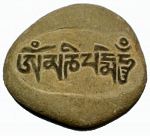
For the oṃ maṇipadme hūṃ mantra in a variety of scripts see the Avalokiteśvara Mantra on visiblemantra.org.

image from: He's the Wiz!

22 December 2007

The origins of oṃ maṇipadme hūṃ

mani stone visiblemantra.org

The earliest text which contains the most famous of all mantras is the Kāraṇḍavyūha Sūtra. The title means "the casket containing the magnificent array", with the implication that it is the magnificent array of Avalokiteśvara, the Bodhisattva associated with the mantra.

Alexander Studholme has challenged the view that the Kāraṇḍavyūha is a very late and corrupt Mahāyāna text, and established that the Kāraṇḍavyūha is likely to have been written in Kashmir in the late 4th or early 5th century. This is by no means early in the development of the Mahāyāna and post dates the emergence the main themes such as Madhyamika and Yogacara, but not so late as previously thought.

The Kāraṇḍavyūha shows definite Puranic influences, especially from the Skanda Purāṇa of the Śaiva tradition. The Kāraṇḍavyūha, for instance, re-presents material from the Śaiva version of the story of the Vāmana-avatāra of Viṣṇu. Vāmana is a dwarf who asks a king for land. The king grants as much land as he can pace out in three paces. Vāmana transforms himself into a giant and covers the whole earth in one pace, and all of heaven in the second! In the Skanda Purāṇa this is presented as a morality play to encourage generosity, and so it is in the Kāraṇḍavyūha. Also in the Kāraṇḍavyūha, Avalokiteśvara appears as a bee in imitation of story about Śiva. Studholme says: "The sūtra clearly reflects a close interaction with a non-Buddhist religious milieu that is predominantly Śaivite, but one which is also respectful of the Vaiṣṇavite tradition." [1] His conclusion is that while the evidence of direct borrowing is limited and relatively weak, the evidence for influence and interaction is indisputable.

In the Kāraṇḍavyūha Avalokiteśvara is portrayed as Iśvara or Lord, and this is a title particularly associated with Śiva. Avalokiteśvara is also addressed as Maheśvara - Great Lord - three times. Several times Avalokiteśvara is described as the cosmic puruṣa which is a reference to the Puruṣa Sukta from the (Ṛgveda X.90). In a related text Avalokiteśvara is described as Nīlakaṇ(ha - blue throated - another of Śiva's epithets. Although Avalokiteśvara appeared well before the Kāraṇḍavyūha, for instance in the 24th chapter of the Saddharmapuṇḍarika Sūtra which may date back to the 1st century BCE, in the Kāraṇḍavyūha he seems to be consciously being given the attributes and names of Śiva. Avalokiteśvara's thousand armed form has Vedic and Puranic precedents despite the fact that no images of this form have been found on Indian soil - although Chinese images existing as early as the 7th century.


This ambiguity is heightened by Studholme's presentation of information about the very name Avalokiteśvara. The much later verse version of the Kāraṇḍavyūha may be the source of the explanation of Avalokiteśvara as "the lord (iśvara) who looks down (avalokita)" which has become the standard way of glossing it. However Studholme notes that before the 7th century the name seems to have been different. In fact the standard Chinese rendering Kwan Yin (觀音) is not a translation of Avalokiteśvara, but of Avalokitasvara which we would translate as he who is aware (avalokita) of sounds (svara). Avalokiteśvara in Chinese would be Kwan tzu-tsai (觀自在). The fact Kwan Yin has been retained as the popular name of Avalokiteśvara in China suggests it was well established before the change. This usage is confirmed by 5th century fragments of the Saddharmapuṇḍarika, and is used in various Chinese translations and dictionaries. [2]

How did Avalokiteśvara take over Śiva's name and qualities? It is indicated symbolically in the sūtra itself where the two figures meet and Avalokiteśvara congenially converts Śiva to Buddhism. Later, in the Sarvatathāgata-tattvasaṃgraha Tantra, this story becomes a violent confrontation where Vajrapaṇī and Śiva have a battle of magic (through mantras) and Śiva is first killed, and then revivified before converting to Buddhism. We can read this as an admission that yes, the sūtra is borrowing from the Śaivite tradition, but that it is being converted to Buddhism. Studholm shows that the Kāraṇḍavyūha, and the intended use of the mantra, are entirely consistent with the mainstream of Mahāyāna Buddhism.

This type of assimilation and adaptation was the norm in India rather than the exception, and should come as no surprise. Buddhism was no different and many borrowings from Vedic tradition are to be found in the earliest scriptures. The goal of using these forms is two-fold. It is likely that the authors of the Kāraṇḍavyūha were seeking on a purely social level to make converts, to compete with the majority Hindus, and to reinvigorate their own spiritual milieu. On the other hand, the broad goal of Buddhism, i.e., the liberation of beings from suffering, is still uppermost in their minds.

The Kāraṇḍavyūha shows a concern for the upholding of the institutions of celibate monasticism; however, in order to get the teaching of the mantra, monks venture outside the vihara to visit a man who is married with a family, does not keep the precepts, and is dirty. Studholme likens him to a tantric yogin, or a siddha, although the wife and kids really don't fit this picture. In any case, the teaching comes as part of a teaching which involves a mandala (with Amitabha in the centre) and an initiation. Despite all of these references to, and borrowings from the Śaiva tradition. However the Kāraṇḍavyūha "presents the practice [of chanting the mantra] primarily within a scheme borrowed from the bhakti side of the Purāṇic tradition". [3] By this he means that the Kāraṇḍavyūha chiefly presents chanting the mantra in terms of the Pure Land tradition - one calls on the name of a Buddha and is reborn in a pure land (in this case it is one of the worlds which are found in the hair pores of Avalokiteśvara, but which are effectively identical to Sukhāvatī). Contrast this with the traditions which draw on the "śakti" side of the tradition, in which the mantra is part of a ritual magic which transforms the practitioner into a Buddha. Studholme makes no comment on the relation of the Kāraṇḍavyūha Sūtra to the, by then, centuries old dhāraṇī tradition which is a shame.

Oṃ manipadme hūṃ, then, emerges from interactions between monastic Buddhists and lay Hindus in 4th or 5th century Kashmir. The religious goal of these Buddhists is conceived in terms of rebirth in a pure land, not in tantric terms.

To see the oṃ manipadme hūṃ mantra in a variety of scripts see visiblemantra.org.


Notes
  1. Studholme p.34.
  2. You can see this for example in English translations from the Chinese version. Of the three that I could lay my hands on easily all were translated from Kumārajīva's 406 version and the name of Avalokiteśvara is translated by Bunnō as Regarder of Cries of the World; Watson as Perceiver of the World's Sounds; and Hurvitz as He who observes the Sounds of the World - all translations of Avalokitasvara. Hurvitz includes a comparison with the Sanskrit version of the sūtra where the name Avalokiteśvara is used alongside his translation of Avalokitasvara without comment.
  3. Studholme p.103.

Studholme, Alexander. 2002. The origins of oṃ manipadme hūṃ : a study of the Kāraṇḍavyūha Sūtra. Albany : State university of New York Press.
It must be said that this book is an academic text which often labours a point beyond the patience of a general reader, and that it is full of jargon. By which I mean no disrespect for Alex, who was pleasantly surprised when I asked him a question on his book at a public talk and then asked him to sign my copy (a first apparently). It's just that the book is not an introduction to the mantra, but an in-depth study for specialists. Some Sanskrit would be an advantage reading this book.

~~oOo~~

Note 8 Sept 2014
On the name of Avalokiteśvara in Chinese see also: Jan Nattier. 'Avalokitesvara in Early Chinese Buddhist Translations: A Preliminary Survey.' Proceedings of the 5th Chung-Hwa International Conference on Buddhism. Dharma Drum, 2007.
Also note that despite the widespread perception of the meaning of ava√lok spread by Edward Conze it does not mean 'looks down' but 'examines'. See my later essays on the Heart Sutra for more on this. 

14 December 2007

Immanence vs Transcendence

The problem of Immanence v.s. Transcendence is one with relevance to any spiritual tradition, but it has special resonance for Buddhists. Simply put we may say that if Buddhahood is absolutely transcendent then we are cut off from it; and if Buddhahood is absolutely immanent then we are not released from suffering by attaining it. Clearly a Buddhist approach will be to take a middle way. But what are the practical implications of this?

I want to look at some of the approaches to this problem in the history of Buddhism, and show that Kukai came up with a highly creative solution to the problem.

While the Buddha, and perhaps his first few generations of Awakened disciples, lived there was less of a problem with immanence or transcendence because there were living exemplars. However in the Pali texts there is some concern for the way in which one can Awaken. One text which has had a huge influence on the Western Buddhist Order in this regard is the Upanisa Sutta from the Samyutta Nikaya. This text describes a progressive series of steps: suffering, faith, joy, rapture, calm, bliss, concentration, knowledge and vision of things as they are, withdrawal, dispassion, freedom, knowledge of the destruction of the mental poisons. Sangharakshita has called this the spiral path, and it is also sometimes called the 'positive nidanas' (although this is not a traditional term). Bhikkhu Bodhi wrote a pamphlet about the sutta and the idea, using the term Transcendental Dependent Arising after the Nettipakarana. The idea of a progressive path is present in a number of other suttas as well.

The key point here is that through practice - of awareness, of meditation - one can go through a series of stages which culminate in Awakening. The Upanisa Sutta offers an elegant solution to the problem. Unfortunately it seems Buddhists, including the guardians of the Pali Canon, lost sight of this important teaching and so over the centuries had to come up with a number of other solutions.

One Theravada approach is represented by Peter Masefield's book Divine Revelation in Pali Buddhism. Masefield argues that is it necessary to meet a Buddha in person in order to Awaken, that the possibility of becoming Awakened died with the Buddha. His thesis is remarkably easy to refute because although he bases it on a large number of quoted examples from the Pali Canon, he has overlooked many counter examples. Many people become Awakened without direct contact with the Buddha - thousands in the Therigatha alone. The position is one in which the Buddha is absolutely transcendent. We could also adopt a higher criticism approach to counter Masefield's literal reading of the texts as well, but that would take up more space than I have here.

The problem of Immanence v.s. Transcendence underlies the doctrine of the two truths which is central to the later Mahayana. The absolute truth says that Awakening is beyond the reach of language, ie it is transcendent. However if Awakening is absolutely transcendent, then we can not experience it, and so we have the relative truth. The relative truth says language is able to point to Awakening without actually encompassing it, or perhaps that language can describe the path, but not the goal, ie that Awakening is immanent.

The most prominent amongst the later theories is the Tathagata-garbha or Buddha Nature doctrine. In this theory each being already contains a germinal Buddha only waiting for the right conditions in order to manifest. Spiritual progress is often perceived in terms of clearing away defilements which obscure our true nature. The kind of practice most closely associated with this theory are generically called "formless". The quintessential practice is zazen, or 'just sitting'. The 'object' of meditation is simply the play of the experience arising and passing away.

However there are problems with the Buddha Nature theory. Buddha nature is often described as indestructible and eternal. There is a clear conflict with the doctrine which proclaims that everything is impermanent. Also if every being has Buddha Nature and we accept a theory of rebirth, then it creates a problem in that our Buddha Nature must transcend our death(s). How does this Buddha Nature follow us through the cycles of birth and death? Buddha Nature begins to sound all too like the Upanishadic idea of an Atman. A further problem is that it open the way to adopting the wrong view that we are already Awakened and need make no effort to change.

In the early 9th century when Kukai was introducing esoteric Buddhism to the Buddhist intelligentsia of Japan, the general view seems to have been that Buddhahood takes three incalculable aeons to attain. This is a more or less infinite amount of time - from any point of time Awakening is always sometime in the very distant future, and therefore essentially unattainable. The view comes from an over literal reading of Mahayana sutras. Yes the Buddha did have to spend aeons perfecting the perfections, but again the stories of the Pali Canon which show disciples regularly Awakening in very short spaces of time seem to be lost. Since practice cannot result in Awakening, it is directed towards mundane ends such as the prosperity of the emperor and the empire. Another aspect of establishment thinking was that the Dharmakaya was absolutely abstract, that there was no possibility of contact with it - ie that the Buddha was absolutely transcendent in the final analysis.

Kukai's great catch cry was "Awakening in this very existence!". So how did he overcome the immanence/transcendence problem? Kukai's approach was a radical take on the theory of interpenetration which is central to the Avatamsaka Sutra. Although the idea of interdependence is not found in the Pali Canon it is a logical consequence of "things arising in dependence on causes". If everything depends on causes then everything must depend, indirectly at least, on everything else. Kukai believed that interpenetration was the nature of reality and that nothing at all was left out of this, including crucially the Buddhas and Bodhisattvas. If everything is permeated by the Awakened mind of the Buddha, especially in his Dharmakaya aspect, then Awakening is immanent not just in beings, but in every atom of the universe. He seems to have taken to heart the image from the Avatamsaka Sutra which describes the universe as a great sutra, the letters of which are the items of experience (dharmas).

This approach gets around the problems inherent in the Tathagata-garbha approach. If we accept that there is any possibility of Awakening, then we are in contact, however faintly, with Awakening. In this theory practice consists of making the most of our connection by making our body speech and mind conform to those of the Dharmakaya via the medium of mudra, mantra, and mandala.

Kukai rejected the idea of an absolutely transcendent Dharmakaya - largely as far as I can tell on the basis of Nagarjuna's rejection of the validity of the existence/non-existence duality. Although it is incorrect, in his view, to state that things exist, it is equally wrong to say that they do not exist. The relationship is one of dependent arising, of course. It is not always obvious because of his esoteric approach to practice, but in many ways Kukai was a back to basics Buddhist.

The idea that Awakening is possible here and now, is a necessary corrective. It is explicit in the Pali Canon, and contra Masefield, there is no reason to believe that the conditions of the present preclude Awakening. Although I find Kukai's solution to the problem attractive and creative, I also see it as unnecessarily complex. In the absence of the early teaching on progressive conditionality, it is probably the next best thing, and at least it holds open the possibility of the Awakening in the present.


image: Wikipedia
Related Posts with Thumbnails