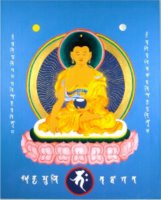
This essay is dedicated to the memory of
Urgyen Sangharakshita (1925-2018)

Urgyen Sangharakshita (1925-2018)
There is a pernicious trend in Buddhist historiography. It is the attempt to smooth out inconsistencies and present Buddhism as far more coherent and unified than it ever was in practice. A prominent manifestation of this is the idea that there really is no difference between the so-called "arahant ideal" and the so-called "bodhisatva ideal". While I'm sure that those who take this approach are sincere in their belief that playing down the differences is a worthy cause, it obscures the reasons the new idea emerged in the first place. Those reasons are intrinsically interesting.
In the last 20 years we have discovered a great deal more about the early Mahāyāna than was previously known. A great summary and assessment can be found in a pair of articles by David Drewes (2010a and 2010b). We now know, for example, that what we call Mahāyāna was actually a rather disparate group of ideas that took centuries to converge. It emerged in monasteries, in all likelihood alongside mainstream Buddhism (though, of course, Mahāyāna became the mainstream, eventually).
By about 200 BCE all Buddhists were starting to reject the early Buddhist doctrines and to quietly rewrite or replace them. In my article on karma (Attwood 2014), for example, I traced the rejection of the idea that karma is inescapable. Later Indian Buddhists did not accept this constraint (niyāma) and modified the doctrine of karma to allow for the consequences of actions to be avoided. One mostly did this using religious practices, especially ritualised confession, though later simply chanting a mantra was thought to literally eliminate all evil karma.
I've shown in previous blog essays that all Buddhists found the sutta version of dependent arising wanting and rewrote it, especially where it appeared to interfere with the working of karma; i.e., where dependent arising says that consequences cannot outlive the conditions for their existence. When this ceases, that ceases.
Awakening as the End of Rebirth
It is repeatedly and frequently stated across the Pāli texts, that awakening is tantamount to the cessation of or the liberation from rebirth. "I will not be born again" is something that arahants frequently exclaim upon awakening. In the Dhammacakkappavattana Sutta (SN 56.11), often referred to as "the first sermon", the Buddha concludes his account of his awakening by saying:
ñāṇañca pana me dassanaṃ udapādi akuppā me cetovimutti. ayam antimā jāti. natthi 'dāni punabbhavo ti. (SN v.423)
A more common refrain, heard across the Nikāyas is this one:This knowledge and vision arose for me: "My liberation of mind is unshakeable. This is my last birth. Now rebirth doesn't exist."
khīṇā jāti, vusitaṃ brahmacariyaṃ, kataṃ karaṇīyaṃ, nāparaṃ itthattāyā tiBirth is ended; the religious life is fulfilled; the task is completed; I'll never be reborn.
No doubt there are variations on these as well, but there is no need to search them out. It is clearly understood that awakening is synonymous with the end of rebirth. So whatever else happens to a tathāgata after death, they are not reborn. And the reason for this is found in the nidāna formulation of dependent arising. For example, in Dasabala Sutta (SN 12:21), “from ignorance as a condition, there is volition” (avijjāpaccayā saṅkhārā), from volition as a condition, there is discrimination (saṅkhārapaccayā viññāṇaṃ)” and so on, up to, “from the condition of birth, there is aging and death” (jātipaccayā jarāmaraṇaṃ), which is said, in this case, to be the origin of the whole mass of suffering (evametassa kevalassa dukkhakkhandhassa samudayo hoti)” (SN ii.28). In the suttas (re-)birth is synonymous with dukkha. To be born, even as a deva, is to suffer. To end suffering one must be completely extinguished (pari-nibbāṇa). Thus the tathāgata is never coming back and that is the way it must be or awakening is not an escape from suffering.
This escape was cause for celebration in the early days of Buddhism. The Buddha was the first man to escape suffering, by escaping rebirth. And in this myth the Buddha shares some features with Yama. We think of Yama as the King of Hell (naraya), but as I showed in my essay on him, he is not a god, but rather a Brahmanical culture hero. Yama's claim to fame is that he was the first man to find his way to the ancestors in the sky (svarga) after death, i.e., to the pitṛloka or "world of the fathers". Yama opened the door to a cyclic afterlife. This is significant, because no other Indo-European culture has a cyclic eschatology (Plato's speculations aside, the Athenian afterlife was not generally cyclic). A cyclic afterlife appears to be a regional feature of cultures in the sub-continent.
The myth of Yama shows the Vedic speaking people adopting this eschatology into their mythos. To be more precise, it shows the Vedic patriarchy adopting the myth - we have no idea how women were placed in this scheme because they are not mentioned. The Vedas are the literature of a group of men who barely gave a thought to women. The Bṛhadāranyaka Upaniṣad is antinomian for many reasons, not least because it shows some women claiming and receiving equal status with the leading male protagonist.
The Buddha is hailed in Buddhist mythology as opening the doors to the deathless by none other than Brahmā, the creator god of the Brahmins of the late Vedic period. The doors to the deathless are open and the Buddha left hundreds, if not thousands of followers behind who were also liberated from rebirth. Many of them had their own students numbering in the thousands. The presence of the Buddha was not necessary while living arahants were able to teach those with "but a little dust in their eyes". Buddhism ought to have prospered on this model. But it did not. And we have no good accounts of why.
The Collapse of Early Buddhism
What is seldom if ever acknowledged is that the Buddhism of the Pāli suttas did not last. It did not do what was needed for the societies in which it persisted. It was once thought that the Mahāyāna was a radical departure from monasticism introduced by lay Buddhists. But this has been put to rest. Mahāyāna grew out of the the monastery. In the early Mahāyāna sūtras the term bodhisatva is applied to full-time, hardcore meditation practitioners aiming at awakening. And this shows that awakening was still seen as a potential, if hard won goal. Amongst the mainstream sects the interest was in the analysis of mental events and theorising about how they contributed to bondage or liberation. Many schools were primarily focussed on śāstras or commentaries which attempted to make something coherent from the dog's breakfast of the Nikāyas. Before the advent of Protestant Buddhism in the 18th and 19th Centuries, all Buddhist sects were primarily focussed on śāstra rather than sūtra; even those sects which advertised themselves as being focussed on sūtras (like the Lotus Sutra sects) still relied on commentaries.
The received tradition was sometimes simply rejected, but more often than not the commentaries present themselves as essentializing the Dharma. By this I mean they present a coherent, and therefore highly partial, account as the whole of the Dharma. What the Buddha (is reported to have) said becomes less important than what he meant, and many people were happy to tell the world what he meant. The rise of the śāstra literature meant that the confusion, incoherent, contradictions, and conflicts of the early Buddhist texts were set aside in favour of a unified view. The problem was that there were at least a dozen different unified views by the beginning of the Common Era.
The Theravāda often collude with naive scholars in pretending to represent early Buddhism. They don't. Modern Theravāda is just that, modern. As with all the other sects, Theravādin monks for many centuries mostly studied Abhidhamma commentaries when they studied at all - even when they spent their lives copying out Pāli texts. They had given up on meditation and they have given up on awakening. As Peter Masefield outlines in his book Divine Revelation in Pali Buddhism (1995), the view had arisen (despite considerable literary evidence to the contrary) that the presence of a Buddha was required for people to awaken. A Buddha was special in being self-awakened (so to speak), but everyone else needed the physical presence of a Buddha. After the Buddha's death, Masefield argues, no more arahants were liberated. Monks did memorise suttas, but they were chanted as magic spells at ceremonies and rites.
Against this we have to weigh the fact that many of the prominent modern Western Theravādin bhikkhus are connected to Thai and Burmese traditions that re-invented meditation in the 18th and 19th Centuries. These monks have long believed that their reinvented tradition maps onto what is found in the suttas preserved in Sri Lanka (though the bhikkhu lineage of that country died out and had to be re-established from Burma twice).
This situation of revised and essentialised teachings was still apparently unsatisfactory to Mahāyānists. There is no normative account of why this was so. However, I can offer my own explanation for this. I think it all begins with the absence of the Buddha.
The Absent Buddha
The arguments I outline below derive from reverse engineering. By looking at the form that innovations take we can get an idea of what problem they were trying to solve. And there is a common thread to many of these innovations. And it is the problem of the absence of the Buddha. It was in this context that new figures began to emerge in the Buddhist imagination as replacement Buddhas, but designed without his "flaws" in mind. Because when Mahāyāna sūtras disparage the arahants, the real target is the father-figure who left and never returned.
Pure Land
Consider the Pure Land schools. The earliest Pure Land Sūtra featured Buddha Akṣobhya in his Pure Land Abhirati. As Jan Nattier (2000) has shown, getting into Abhirati was hard work. Then came Amitābha living in Sukhāvati and he made it easy. The two Sukhāvativyūha Sūtras introduced the idea that one only need call his name in devotion and he'll meet you at death and guide you to Sukhāvati where everything was arranged to perfection (according the patriarchy of the day).
Take a step back and consider the form of this doctrinal innovation. It is predicated on the idea that Śākyamuni is dead and not coming back, and that the next Buddha Maitreya is not going to arrive for some billions of years. We are on our own. Part of the problem is that early Buddhists instituted a rule that there could only be one Buddha in any world at a time. The cultural evolution of the world followed a set pattern. The Buddhadharma had to flourish and die out before a new Buddha could be born to rediscover the Buddhadharma from scratch, since this is a defining feature of a Buddha. The main effect of this invented doctrine is that it raises the prestige of the so-called historical Buddha to its zenith.
I showed, in my article on karma, that raising the prestige of the Buddha was a central concern for Buddhists. Over time, the Buddha became more magical and powerful until he was effectively a god. The prototypical event for this observation was the meeting with Ajatasattu. In the Pāli versions the king is doomed by his patricide. But in the later Mahāyāna retelling, the king is saved from his own evil karma by meeting the Buddha. The mere presence of the Buddha purifies him of patricide - one of the five unforgivable karmas that result in immediate rebirth in Hell.
The unforeseen consequence of gradually raising the prestige of the Buddha is that it began to appear to make awakening in his absence impossible. And his absence was an established fact. The authors of the Pure Land texts, some of the earliest Mahāyāna texts, simply invented parallel universes with immortal Buddhas who could arrange for us to jump the tracks and be reborn in this alternate universe - the apotheosis of the Buddha. While Akṣobhya was a task-master, Amitābha was a soft touch. He only required your devotion. We know the metaphysics of this set up. Amitābha is a god, pure and simple. Sukhāvati is Heaven. We are sinners who can only be saved via the intervention of an external agency (or "other power") not touched by the sin of the world.
Pure Land became one of the leading forms of Buddhism in the world and remains in that position some 2000 years later. The reasons for its popularity are not hard to fathom. It is an undemanding form of Buddhism, most of the work is done for you by an magical immortal father figure, in the afterlife. He just wants you to love him and most of us love our Daddy (or want to).
The Evolution of the Bodhisatva
It's too early I think to have a proper history of the bodhisatva since we are really just getting used to the new information about their true relevance in early Mahāyāna. But we can take a similar reverse engineering approach to the mature concept of bodhisatvas like Mañjuśrī, Vajrapāṇi, or Avaklokiteśvara. The most important feature of the mature concept of the bodhisatva is that they are enlightened but take rebirth.
Why do we need the awakened to come back? On one hand the answer is obvious. We want our loved ones to come back to us. The Vedic speakers were entranced by the aboriginal Indian idea that after death one would be reborn amongst one's ancestors just as many Westerners are in love with the idea of people "coming back". We have an incurable nostalgia for the dead. We want to see them alive and well again. Belief in an afterlife has been linked to burying bodies with grave goods, the practice of which is arguably as old as modern humans, if not older (though the first undisputed evidence dates from around 40,000 years ago).
On the other hand, it speaks to a deep seated insecurity. Living teachers simply did not create the required confidence in the Buddhist population of India. And this can have two main causes. Firstly, the standard of teaching may have declined, leaving students doubting the efficacy of their practice regimes. Secondly, and I think more likely, is that the placing the Buddha on a pedestal to raise his prestige had a detrimental effect on Buddhist communities. The higher the Buddha got, the lower human teachers were and the closer relatively to their human students.
This problem is not particular to India or Buddhism. When you raise the goal of religion to the zenith and talk about it in absolutist terms; when the goal is perfection, then no human being can ever come close. In fact, even if most teachers are fantastic, the one who goes bad seems to taint all of them. In this process, the goal becomes unreachable and any attainments that humans do achieve are down played by comparison to perfection; while imperfects that show up confirm suspicions.
So yes, we do see arahants being talked down to and mocked in degrading fashion in some Mahāyāna sūtras. Perhaps this is not because they are not awakened; they are arahants, after all, and thus very much awakened. Perhaps it is because they fall short of some imaginary perfection that has been set up in opposition to mere human awakening. That is to say, it is not because people were falsely claiming to be arahants as is sometimes suggested, but that Mahāyānists allowed themselves to be fooled into thinking that perfection was attainable on some level, just not by human beings. Mahāyāna is delusional in the way that all theology is delusional. It sets up an impossibly high standard, insists on judging people (harshly) by that standard, and in the absence of any human exemplars, transfers its devotional feelings onto imaginary magical beings.
The result is the classic matter/spirit duality. I have discussed this in some detail in the past, analysing the metaphors involved and showing how they form an interlocking set of ideas that self-reinforce (like a cybernetic feedback loop). I also extended this in a series of essays on the idea of "spiritual" looking at the language and power relations involved in organisations which frame themselves as "spiritual" (see Bibliography). This duality has powerfully shaped all religions which tend to favour the (imaginary) spirit side of the equation.
In some forms of Buddhism, this duality contrasts the bodhisatvas as pure beings made of light with dirty humans made of shit. For example, Śāntideva goes on an extended rage about the disgusting human body in his celebrated work on Mahāyāna, the Bodhicaryāvatāra. It covers two pages in the definitive translation by Skilton and Crosby. The language is harsh and hate-filled. Buddhists attempt to excuse the tirade as a skilful means (upaya) but to me it is inexcusable; the epitome of unskillfulness. It is born out of a deep-seated hatred based on a matter-spirit duality.
Other Approaches
I think these two examples demonstrate the principle. We might also cite tathāgatagarbha doctrine, as a way of making the Buddha present in his absence. Or the passage from early on in the Golden Light Sutra in which the Buddha is proclaimed to be immortal (he only appeared to die). Or the idea of everything being interpenetrated by the dharmakāya, the true form of the Buddha, magically above change and decay (i.e., permanent). Or the idea that one can imagine oneself to be a Buddha already and magically transform oneself into a Buddha in reality (while avoiding delusions of grandeur and other mental problems).
We also know that around the same time the first images of the Buddha appear in Gandhara and Mathura. In the 2nd century BCE, the Greco-Bactrian kingdom of Gandhara had been conquered by a group of pastoralists known by their Chinese ethnonym 月氏 Yuèzhī. They appear to have had caucasian features (judging by portraits on coins) and to have spoken an Iranian language. However they also adopted many local norms as well, including, possibly, the Buddhist religion. The resulting Kushan Empire was a melting post of Persian, Greek, Yuezhi, and Indian ideas, attitudes, and practices. Perhaps it was coming into contact with theism (Zoroastrianism) that made the Buddhists in that region aware that the absence of the Buddha was problematic? In any case it was amidst this milieu that images of the Buddha as a man were first made.
We also know that around the same time the first images of the Buddha appear in Gandhara and Mathura. In the 2nd century BCE, the Greco-Bactrian kingdom of Gandhara had been conquered by a group of pastoralists known by their Chinese ethnonym 月氏 Yuèzhī. They appear to have had caucasian features (judging by portraits on coins) and to have spoken an Iranian language. However they also adopted many local norms as well, including, possibly, the Buddhist religion. The resulting Kushan Empire was a melting post of Persian, Greek, Yuezhi, and Indian ideas, attitudes, and practices. Perhaps it was coming into contact with theism (Zoroastrianism) that made the Buddhists in that region aware that the absence of the Buddha was problematic? In any case it was amidst this milieu that images of the Buddha as a man were first made.
Having identified the pattern we can see how it makes sense of a range of innovations over time.
Presence
Everywhere Buddhists demand the presence of the Buddha or they resign themselves to despair and give up on awakening (as the Theravādins did before they reinvented meditation). And this is no accident. Where do we find a principle of required presence in Buddhism? We find it precisely in the doctrine of dependent arising. The idea was initially to describe the arising of suffering in the presence of sense experience. And it does an OK job of this for an Iron Age idea. But before long Buddhists began to treat it as a theory of everything. It is as though a Freudian were to argue that the world is structured into world-ego, world-id, and world-super ego, and that cosmic sex is the driving force of every process in the universe. For all I know there are Freudians who think like this, but I bet they have never tried to rewrite the equations of classical mechanics to show how sex is the basic force in the universe.
Once you take dependent arising to be a theory of everything then it is only logical that awakening requires the presence of an awakened teacher. Because without the necessary condition, the effect cannot arise. But the underlying condition for all awakening in Buddhist mythology is the Buddha. If this is so then the presence of a Buddha is a requirement for a world in which there is awakening.
We don't know how the argument went because the Mahāyānists did not show their working. They might have reasoned that since there are awakened people then a Buddha must be present somehow, and since that Buddha is not physically present he must be present in some other form: corporeal in a parallel universe, or incorporeal in ours. Or they might have reasoned from the physical absence of the universe combined with a desire that awakening were possible again, believing that it currently was not.
However, this way of thinking also misunderstands awakening. No matter how many different ways we say it, Buddhists always end up thinking of extinction as something; or as arising. Cessation is the right word. The point is that sensory experience stops when we withdraw from attention from it. Trivially, if I am focussed on writing, the outside world fades from my mind. And, more profoundly, when we use concentration techniques to bring about the complete cessation of sensory experience, aka emptiness. The use of emptiness as a metaphor was about the worst road Buddhists could have taken. It was a disastrous philosophical blunder because it led to Buddhists thinking of emptiness in metaphysical terms rather than as the simple absence of sense experience.
Absence of sense experience is essential to awakening. And yet we made Buddhism all about the presence of the Buddha. The former is Buddhadharma, the second is mere religion (and no better than any other religion which invokes the presence of a father figure).
Conclusion
Arguments, scholarly, religious, or increasingly both, that seek to minimize the distinction between arahant and bodhisatva, however sincere in their motivation, damage our understanding of the history of ideas in Buddhism. Such approaches actively prevent us from asking interesting questions about why Buddhism changed and if we never ask the questions, we never answer them. Whether or not the new ideas were totally novel or evolutions is of course interesting. And yes, we can often find precursors in the Pāli texts; texts that were composed and edited over centuries that overlapped with the emergence of the new doctrines.
We scholars, especially, have to resist the urge to bowdlerise our presentations of the history of ideas in Buddhism. However, Buddhists can also benefit from an interest in the actual history of our religion. We cannot understand a cultural phenomenon (or really a set of phenomena) if we refuse to see anything that sits outside normative accounts. To be sure, the real story is complex and convoluted. It does not fit neatly into a six week university teaching block. But it is worth telling nonetheless.
Let's face it, what makes history interesting is conflict. Without it, history is boring. Pretending that there was no conflict in Buddhist history is a gross mistake. Sure, religions all present significant figures as saints, but so what? This is not interesting at all, because people are not saints. The fact that all Buddhists repudiated the teachings that had been ascribed to the Buddha is perhaps the most interesting fact about Buddhism. But no one ever says that this is what happened. The least interesting story—the hagiographical version—dominates both academy and temple. Yawn. The story is trite, tedious, and simply untrue. The telling of it tendentious and smacks of insecurity. All too often it is the rhetoric of persuasion rather than the rhetoric of truth.
We have to be willing to see change ("everything changes") and to ask why things change. Cultures and doctrines change for reasons and it only seems reasonable to enquire as to those reasons. Buddhism is not special in this regard. We need to be willing to face up to the fact that the Buddha died and is not coming back.
Sadly, my teacher Sangharakshita died this week, aged 93. He had a good life, all things considered: he was a good friend to hundreds of people and he inspired hundreds of thousands of people to practice the Buddhadharma (our movement operates in India where social movements happen on vast scales). I'm not suggesting that he was a saint, but on balance he did a great deal of good and most people who met him were glad of it. He was loved. But he's gone and he's not coming back. As I loved him, so I mourn, but I'm not interested in fantasies of his reincarnation and return. I don't want false comfort. The Triratna Buddhist Order is well placed to carry on providing a context for practising the Buddhadharma that combines a good deal of tradition with some conscious modernism. We could do better, but Sangharakshita gave us a robust organisation. Succession is long settled and nothing much will change now that his suffering is ended. Now is the time for practice.
vayadhammā saṅkhārā appamādena sampādethāAll experience is perishable; sensual sobriety is the way to succeed.
(the supposed last words of the Buddha. DN ii.156)
~~oOo~~
Bibliography
- The Body in Buddhism. 02 January 2009
- Evolution: Trees and Braids. 27 December 2013
- Metaphors and Materialism. 26 April 2013
- Spiritual I: The Life's Breath. 06 June 2014
- Spiritual II: Frames. 13 June 2014
- Spiritual III: Demesnes of Power. 20 June 2014.
- A Taxonomy of Afterlife Beliefs. 17 June 2011
- Yama and Hell. 13 March 2015
Attwood, Jayarava. 2014. Escaping the Inescapable: Changes in Buddhist Karma. Journal of Buddhist Ethics, 21, 503-535.
David Drewes. 2010a. Early Indian Mahāyāna Buddhism I: Recent Scholarship. Religion Compass 4/2: 55-65. DOI:10.1111/j.1749-8171.2009.00195.x https://www.academia.edu/9226456/Early_Indian_Mahayana_Buddhism_I_Recent_scholarship
David Drewes. 2010b. Early Indian Mahāyāna Buddhism II: New Perspectives. Religion Compass 4/2: 66-74. DOI:10.1111/j.1749-8171.2009.00193.x https://www.academia.edu/9226471/Early_Indian_Mahayana_Buddhism_II_New_perspectives
Masefield, Peter. 1995. Divine Revelation in Pali Buddhism. Paul & Co Pub
Consortium.
Consortium.
Nattier, Jan. 2000. "The Realm of Aksobhya: A Missing Piece in the History of Pure Land Buddhism". Journal of the International Association of Buddhist Studies 23 (1), 71–102.
Skilton, A and Crosby, K. 2008. The Bodhicaryāvatāra. Oxford University Press


 , is due out soon.