
 |
| NZ troops at Gallipoli NZ Listener |
Recently a man has been in the news. Mr Kember was rescued from being abducted in Iraq. He apparently did not express sufficient gratefulness to the army for rescuing him. His reasoning was, apparently that the army were the cause of his kidnap in the first place, and that had they not invaded Iraq a lot of killing and suffering might not have happened. This is all up for debate in the media and one can hear, see or read a variety of opinions on the subject. Will of ThinkBuddha.org has written some very salient articles on conditionality recently (1, 2, 3) . Isn't it interesting how, by focusing on different aspects of the infinite web of conditions, we can come to polar opposite conclusions about an event.
I wanted to look at one aspect of this web of conditions. The 25th of April is ANZAC Day in New Zealand (and in Australia). This is an interesting public holiday. On the surface it is a simple commemoration of the dead in both World Wars, and in particular the first. Below the surface however is another current. Ask any New Zealander and they will tell you that the New Zealanders' sense of identity as distinct from the English emerged during this time. Gallipoli stands out as representing the New Zealand experience of WWI - a futile, strategically useless attack on what may have been the strongest part of the Turkish defences. What Churchill was thinking is not clear to most people, and we might speculate that perhaps his heavy drinking started well before he became Prime Minister. The New Zealanders, who were, it must be said a minority on the beaches at Gallipoli, came to see themselves, like I do, as not English. Having spent four years living in England I can tell you that I get daily reminders that I am in a foreign culture.
ANZAC Day then is a day which celebrates national identity. And that identity has been bound up from the beginning with the military. Our National Anthem beseeches God to protect us from the shafts of strife and war.
About 12 years ago I became a Buddhist. Having spent my teenage years being convinced that Ronald Raygun was going to start a nuclear war with Russia, I didn't think much of the military. Buddhism reinforced these views. I became quite rabidly anti-military. I probably even, without any sense of irony, became angry about the activities of the military. I celebrated the father of New Zealand poet James K. Baxter. Archibald Baxter was a 'conshie', a conscientious objector, who refused to fight. He was tried, convicted and sent to the front in France. One of his punishments was to suspended by his thumbs above the trenches to provide the enemy with target practice. He survived and wrote a little book about it. I was deeply moved by Baxter's story, and convinced about the utter brutality of the army, and that there was nothing positive about the military at all.
Then one day I was walking down the main street in Auckland. I hadn't registered that it was close to ANZAC Day, and was a bit surprised to find myself watching a parade of old soldiers, some marching, some riding old military vehicles. Something made me look at these men. I saw old men, a bit stiff, a bit sombre, looking ahead, all wearing their medals. They had a sad dignity about them. And then something clicked and I saw how these men, these flesh and blood humans, had fought in wars half way around the world. They did so for different reasons. Some would have believed in the course, signed up and experienced a sense of fervour perhaps. Others would have been less willing. All survived but had watched friends and comrades being killed. I found myself moved by the sight of them. Tears welled up. These men had fought for me, foolishly perhaps, but they did so, and I felt some empathy for them.
Later I came across something written by Dharmacari Subhuti. He gave my relatively incoherent emotional response a more reasoned basis. Subhuti reminded me that I enjoy considerable freedom. That freedom was won, in part at least, by those old soldiers fighting Hitler in Europe. Whatever the rights and wrongs, whatever the conditions, I knew that I should feel grateful that some men had laid down their lives so that I could enjoy my freedoms today.
So I've come to have a more complex view of the military. I'm still resolutely opposed to violence, and to the use of force. But I recognise that others are not, that there are other people who are quite willing to use violence, and who are willing to fight, to kill, to achieve their ends. And I acknowledge that I want to be protected from being attacked and killed. So while I personally try to refrain from any acts of violence, and try to immediately confess any acts which stray into that territory, I would be a hypocrite if I maintained the view that the military is entirely evil. It would be hypocritical because I benefit from it.
The situation today is far from morally clear - we westerners appear to be benefiting from wars of aggression in the Middle East. I don't pretend to understand all of the arguments, and don't have space to go into any of that here. But I want to acknowledge that men and women have killed and died, so that I may enjoy the freedom to practise the religion of my choice - of which non-violence is the highest value. And that is one of the greatest koans of our times.
~~oOo~~


 , that Buddhist society was originally tripartite with the full-timers being either forest dwellers or settled monastics. We could say this reflects a social structure in India where the Brahmanas were relatively settled, and the Shramanas tended to dwell alone and wander about. Even if Reggie had not pointed this out, it is obvious if you spend some time reading the Pali Canon that there are indeed two quite distinct lifestyles amongst the bhikkhus. One constantly comes across the advice to dwell alone in the forest meditating, at the same time one reads about bhikkhus living enmasse in viharas.
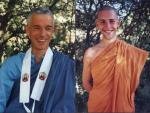 Sangharakshita spent nearly twenty years living in India, was ordained as a bhikkhu, and had plenty of opportunity to observe modern day bhikkhus. And what he saw was a lot of men going through the motions, shaving their heads, wearing robes, and refraining from meals after noon, but not actually attempting to Awaken. Although there may have been exceptions, formalism seems to have been the rule. We get a hint of why from Peter Masefield, an academic and Theravidan Buddhist, in his book Divine Revelation in Pali Buddhism, where he concludes that without the direct intervention of a Buddha that Awakening is impossible, and within a generation of the Buddha's parinibbana Arahants would have died out. Actually Masefield, despite his voluminous citations, has overlooked a vast number of examples which contradict his conclusions and the book is deeply flawed, although still in print. But if Awakening is not possible, then what is the point? The Tibetan Buddhists that Sangharakshita met did seem to have a living Buddhism. Despite the fact that many of them were not following the vinaya to the letter, or at all, they had a depth of practice that inspired Sangharakshita.