02 July 2006

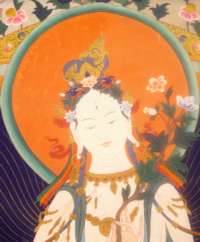
White Tara's Realm

White TaraI'm just back from a week on retreat at the Rivendell Retreat Centre. It was very good to get away and experience life on retreat again. There were several stand out features of this retreat. It began with an all comers weekend looking at the Bodhisattva White Tara. Monday to Friday was an order retreat with only four of us staying on. We immediately plunged into a more intensive program of meditation, reflection and puja - immersing ourselves in the visualisation practice that we all share.

The four of us were relative strangers, two of the others were friends already, but I had not met the others, and neither had the fourth person. We were a mixed bunch: 3 men, 1 woman; 1 married with a family, one living with a partner, one living in a Buddhist community and celibate, one lodging but in a long term relationship; 1 homosexual, 3 heterosexual; 1 ordained 10 years, 3 ordained 2 years or less; two with tattoos, and 2 without. The week was extremely harmonious, and every one contributed both domestically and ritually. I was doing 3 hour-long sits, plus a long puja in the evening, as well as a lot of calligraphy, the others were doing more sitting. We were in silence from evening until lunch every day, and mostly doing our own thing when not meeting for meals or collective practice. It all just flowed naturally as though we had all known each other for many years.

I don't think that under other circumstances we would have come together at all, let alone in the way that we did. Every morning we chanted the Three Refuges and the ten precepts, and after a day or two it seemed to me that this was the root of everything. That we, a disparate bunch of strangers, could come together in the way we did was due to our common, explicit commitment to the Three Jewels. Not only did we give voice to that commitment in Pali evey morning, we spent our days making that commitment manifest and effective. And it was delightful. It was my first experience of the Western Buddhist Order in this way - as I'm just over one year old in the order. If we are all sincerely Going for Refuge to the Three Jewels, then we can have a rapport which goes beyond the incidental circumstances of our lives, beyond any superficial differences.

Of course we were all devotees of White Tara and this helped. The visualisation practices associated with White Tara are especially beautiful. Some of our pujas included the sadhana visualisations and created a real sense of being in Tara's realm. Over the shrine was a large White Tara Thangka and at times it did seem to shine with a kind of inner light. White Tara is, of course, white in colour. Her main characteristics are that she sits in the Vajrasana (or Diamond posture) which I associate with repose, stability, imperturbality. Her right hand is stretched out in the mudra of supreme giving, and Tara gives what you most need. Her left hand is held to her heart, lightly grasping a spray of blue night lotuses: the mudra is fearlessness and one of the special attributes of Tara is that she saves us from fear. In each palm, in the soles of her feet, and in the centre of her forehead are eyes so that she has 7 in all. The eyes represent Tara's wisdom which sees things as they really are. Sometimes they are said to enable Tara to see what needs to be given where. Also associated with wisdom are the five gems that she wears in a tiara in her hair - the five wisdoms of the Buddhas are her decoration. Finally above her head, or sometimes actually tucked into her headress, is Amitayus (Infinite Life) who is a reflex of the Buddha Amitabha (Infinite Light) the red Buddha of the western quarter who represents compassion. The symbolism is very rich! As with all Bodhisattvas, White Tara's body is made of light, and she appears in the clear blue sky of Shunyata seated on white lotus.

It's difficult to pin down exactly what the status of Bodhisattvas is. Are the real in the sense that this table top is? Or are they just imaginary? Or are they gods or angels or devils? I don't have the answers to those questions. I certainly have felt White Tara's presence in my life, and once or twice caught a glimpse of her. In setting out to meet her I go through the usual meditative process of calming my mind and body down, and engaging my imagination. But an actual meeting with Tara goes beyond imagination and takes on a life of it's own. It's as though the imagination is simply a gateway into another realm...

All in all it was a very positive week, which I certainly needed. A year on from ordination I received a very strong confirmation that despite any difficulties I may encounter, that I am on the right path, and in the right Order, and even in the right country (for now). I felt a lot of gratitude to Sangharakshita, Sona, Nagabodhi and my other spiritual friends and teachers; and to my protectress, Tara.


om tare tuttare ture svaha

11 June 2006

Hope

Self-portraitI've been going through a rather bleak, albeit creative, period lately - a bit of a crisis really. My dilemma is that I have a day job which pays the bills but which is dull and uninspiring, and I have this other job which involves managing my various websites, writing raves, and doing various art and music projects, which is enormously inspiring and fulfilling, but which currently doesn't pay anything. Actually that's not quite right because my 'hobbies' actually cost me money. Much of my 'work' is not self-centred, but involves creating resources for my my Sangha - a Yahoo discussion group here, an online newsletter there, and most recently an extensive website on the calligraphy of mantras and seed syllables.

And I find it difficult to see how I can turn my 'work' into a livelihood. As well as being worn out from doing two jobs, and feeling stuck, I have experienced quite a lot of despondency lately. I'm told, but have never found the source, that despondency is a form of laziness. That it's just giving into self-pity. And that is true to some extent. But to me there is something more to it. I think despondency is failure to see that things change.

Which brings me to my theme this week. In order to maintain my energy and enthusiasm in the face of adversity I have to believe that I can win, that I can through my labours at least make headway against the current which drags me along - the current of worldly values, of conformity, of negativity, of greed, hatred and delusion. And why? Because if there is no possibility of making progress then striving is pointless. Back in the days before ethics committes, a bunch of psychologists tormented dogs by giving them electric shocks. Some were able to stave off being shocked by doing some action such as pressing a lever. However if the lever stopped working, they soon gave up trying. The dogs just became gibbering wrecks who cowered in corners and accepted the torture with a whimper - ie the dogs understood that nothing they did could stop the torture, and they just gave up. I'm thankful that we now have ethics committees, but it I think this example, gross as it is, graphically illustrates the point. We need hope that things can change and/or that we can change them.

Now this identifies me as someone who does not hold with the style of Buddhist practice in which there is no goal, no need to do anything, just be, blah blah. There are a number of ways in which I find this approach unsatisfactory. When I have asked people espousing this view why they bother to practice I have never had a sensible answer. And this is crucial because these people often practice a lot. Why bother to spend all that time sitting if there is no point? Anyway I ain't one of them.

The possibility of making progress - how ever we define progress - is important. This kind of basic Buddhism really works for me: there is suffering (yes there sure is!); there is a source of suffering which is ______ (choose your poison); there is an end to suffering, which involves removing the poison; the way to end suffering is the Noble Eight-fold Path. Leaving aside a detailed exposition on the Eightfold path, isn't that a great concept for anyone who is suffering? That suffering can end is highly motivating for me. The Eeyores who focus on the first of the Noble Truths, are missing the whole point. The Noble Truths as a set really do get me excited because they offer hope. They acknowledge suffering (unlike some of the 'no goal' kin, who also espouse a sort of no 'suffering' deal as well) and then they offer some hope that suffering - this present suffering as well as any possible future suffering - can stop.

At this point we're just taking it on faith. It sounds good, and we've got the cheque book out and we're keen to sign up to this whole Eightfold Path deal. Can't wait. But the Dharma isn't quite like that. What happens next is a bit more refined. Someone, or maybe even a book, says "OK, do a little of 'this', and see what happens". 'This' may be meditation, or sutra chanting, or basic mindfulness, or puja, or just being gratuitously kind and generous. So we do a little, and we find that ... we feel a bit different... a bit better/happier/saner (or whatever). Now this is really exciting because not only do we have Sacred Scripture, and Holy Water, and maybe some exotic guru, but we have actual personal experience of the path working for us. We don't need to believe anything which makes no sense, which feels wrong, or which runs counter to our experience - perhaps this is why Buddhism got a reputation as a rationalist philosophy. Actually some of the practices are pretty weird, and some of the traditional beliefs are just as dodgy as anything in the Bible, but the important thing is not what you believe or don't believe, it's how you practice and the fruits of that practice.

I think the most important insight that comes from practice is that actions have consequences - ie what we do, or don't do, influences the future. The world is not just a totally random series of events, and neither is it rigidly determined. We have influence to the extent that we choose our actions, and we have choices to the extent that we are aware. And, I would say, we have hope to the extent that we are aware and able to make choices.

So when I lose sight of this important insight - that things change, and that I can at the least influence that change - then I just give up and, like those poor bloody hounds, sit in a corner and whimper. This is Mara temporarily winning the battle against the Bodhisatta (if I may be so bold as to cast myself in that role). Fortunately I seem to have some kind of keel these days that flips me right-side up after a bit. I call this Saddha - the faith that things can change and that I can influence that change in the direction of Awakening. Saddha, is a specific kind of hope born of practice and observation. This is the benefit of practice, that a habit of awareness gives you choices in any situation. In any life the winds of the world can blow strongly, and temporaily overwhelm us. But by building up awareness over years, we lay down a keel that will right us eventually.

It's good to be right-side up again, and to be full of hope and inspiration. Awareness is revolutionary, eh!
Related Posts with Thumbnails