 I've been meaning to write something about the Sangha refuge for some time. The topic arose in the comments of a post on politics by Will Buckingham of thinkBuddha.org. I was arguing that one could not Go for Refuge to the Sangha of ordinary people, but only to the Arya or Noble Sangha. In response Will said:
"the problem is that, here and now, I have no idea who is arya in this doctrinal sense and who is not. Try as I might, I can only see more or less ordinary people. So where do I go for refuge? To go to refuge to an idea of the aryasangha seems to be rather limiting."There are many possible rejoiners to this and I want to offer a couple of them. I think it is worth re-emphasising at this point that I believe, following my root teacher Sangharakshita, that Going for Refuge to the Three Jewels is the definitive Buddhist act, it is central to what Buddhism is, and it the unifying factor in all Buddhist practices. Going for Refuge is a hermeneutic device through which all of Buddhism may be understood. So this is not a trivial subject.
So, firstly if one is concerned not to Go For Refuge to an idea of something, then one must perforce Go for Refuge to something which is more than an idea, something which exists beyond the confines of our minds. This is much trickier than it seems at first. Of course one doesn't want to Go for Refuge to an idea, but when one starts to analyse one's experience, then what else is there? We interface with the world via our senses, and we perform mental gymnastics to make some sort of sense of the overwhelming jumble of impressions that flood in on us. In fact we do not ever simply relate to things as they are unless we see things as they are, and I don't know about you, but I don't think I'm quite there yet. So in Going for Refuge to something, we are constrained somewhat by the fact that we only have our mental pictures of things, coloured by our biases and conditioning. We only have ideas about things, we don't have things in themselves. This is a paraphrase of Yogacara idealism, which I would temper with a dose of Madhyamika logic: just because things are not real, doesn't mean that they are unreal. So we are left with a dilemma here. The solution, for me, is to Go for Refuge to my highest idea, my Ideal: the best and most wonderful idea that I can conceive of. I suppose that Will might say that this is hardly a satisfactory solution, and the practical help that a group of people offer is invaluable. But I think this is to mix two different arguments: ie the necessity of Going for Refuge, and the necessity of having Spiritual friends. I would say that both are important.
Personally I have already discovered the fallibility of the people in my Sangha - it never takes long does it? We might believe that our local Buddhist group can provide a refuge from Samsara, but I know of no one for whom this is a reality. We inevitably find our group wanting, and perhaps we go to another group seeking a refuge. And not finding it there, we move on again. For a refuge to be a true refuge, it must actually offer refuge. And what is a refuge? The Oxford Dictionary definition is quite simple: shelter from pursuit or danger or trouble. In the Buddhist sense we need shelter from craving, hatred, and delusion. So for a person, or group of people, to offer shelter from craving, hatred and delusion, they must have substantially overcome these evil influences in themselves. And this is as good a definition of the Arya Sangha as any I can think of. The Arya Sangha are those beings who have substantially overcome craving, hatred and delusion.
However this still leaves Will with a dilemma which he states thus: try as I might, I can only see more or less ordinary people. I sympathise with this to some extent. When I look at people I see... people. So where does one look in order to find beings who are a little more than ordinary? I look in two places. Firstly I look in the Buddhist scriptures, and especially in the Pali Canon. The Majjhima Nikaya is a good place to start since the people in them are quite recognisable in human terms, and against this backdrop the Buddha and the Arahants stand out, and shine. For some people the Mahayana Sutras are a great source of inspiration, but personally I find them a bit over the top, and less than respectful to some of my Pali Canon heros like Sariputta.
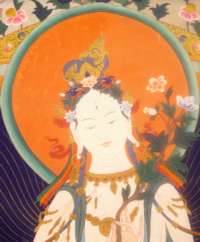
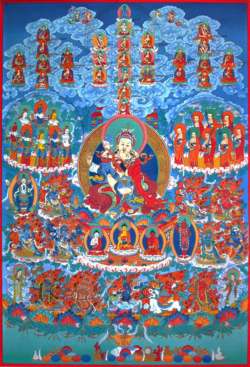
The other place I look is to my own imagination. I see the imagination as a threshold. Sometimes it's just 'fancy' and I'm just making stuff up. But other times my imaginings can begin to take on a life of there own, and I find myself in another realm. I thought the movie of C. S. Lewis's Narnia story a lot of sentimental bullshit with no great moral or logic, but I am struck just now by the metaphor of the wardrobe as a doorway into another realm where different rules apply and mythical creatures live. Funnily enough Will has just had a novel accepted for publication (Sadhu!) and is not a good novel a doorway into another realm, which through the application of imagination, we may inhabit for a little while? I find this quality of being transported will draw me back again and again to certain books: The Lord of the Rings, the Dune Trilogies, A Wizard of Earthsea, The Glass Bead Game, The Name of the Rose &c. The imagination, one might say, is the threshold of the Sambhoghakaya, and with some work one can begin to visit that realm and meet the Buddhas and Bodhisattvas "face to face" - many of the great Buddhist seers, such as Nagarjuna and Asangha, received teachings in this way, and the contents of these visions virtually define the Mahayana!
And of course the Buddhas and Bodhisattvas are reaching out to us all the time, waiting for us to to make contact with them. They are there in the tiniest mote of dust, and in the great oceans; in the sun and moon and stars; they are there in the rising and passing away of all things; the Buddha's voice is present in all sounds, and it is constantly singing the song of impermanence. If only we can open our hearts to them they are there. One doesn't see them with the eyes, one 'sees' them with the heart.
So why settle for less?