 This week I'd like to write about kaji. The word, as I have come to know it, is used by Kūkai in his writings as the Japanese equivalent of the Sanskrit word adhiṣṭhāna which literally means “basis". Kaji is translated by Yoshito Hakeda, in Kūkai : Major works as "grace". Now normally I get a but huffy about Christian words being used to translate Buddhist terms. So if I see abhiṣeka being translated as 'baptism', then I have this voice in my head going: nooooo! Sometimes it's out loud even. But in this case I rather like grace as a translation. Without getting into dictionary definitions I find that grace brings to mind two qualities: firstly bestowing of blessings, and secondly refinement and elegance.
Kukai explains kaji like this: ka is the compassion of the Buddha pouring our like the rays of the sun (Vairocana is an epithet of the sun in India); ji is the receptiveness of the devotee which accepts and retains the light of compassion as water retains the rays of the sun. Alternatively it is the faith (Japanese Shinjin, Sanskrit shraddha) of the devotee. So Buddhism works, in this way of talking about it, because the Buddhas offer to bestow a blessing on us, and we in turn need to be graceful in accepting, or even to be able to accept, that blessing.
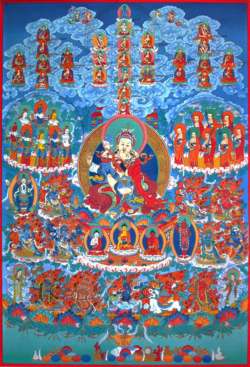
The blessing of the Buddhas pours out everywhere, all the time, is sensible in every phenomena, it is in other words Shunyata, or Tathata. This seems to me to be the main point of departure from the Christian idea of God and grace. As I understand it God is supposed to sit up in heaven dispensing grace according to some scheme that cannot be understood, and that is meant to be taken somewhat literally. Kukai however seems to have a more sophisticated view of his god. Mahavairocana is all: all forms are his body, all sounds are his voice, and all mental activity is his mind, all being are simple manifestations of Him. He is omnipresent, omnipotent, omni-everything else. He is represented in human form in two main ways, according to which mandala is being referred to, with differing mudras and symbols; or he is depicted as particular Sanskrit syllables, particularly 'a' (the short 'a' sound as in the English word 'cut'); or as a symbol, such as a dharmachakra, on it's own. But at no time does one get the feeling that Kukai understands Mahavairocana to actually be these things. When he's banging on, as he does, about the Preaching of the Dharmakaya Buddha, I think we can be pretty sure he did not think of Mahavairocana as a radiantly white youth sitting on a lotus and actually talking. That image is there, but everything points to it as a symbol of some deeper reality. He says: "The subject is the object; the object the subject. The seeing is the seen, and the seen is the seeing. Nothing differentiates them" [Hakeda. Kukai : Major Works p.229-30].
The receptivity of the disciple, or ji, was what I was on about last week. As practicioners what we are doing, from this point of view, is opening ourselves up to experience the ka, the blessing of the Buddhas. Through practice we try to align ourselves with the Buddhas, to get onto their wavelength, and to 'be' like them, to the extent that they can be said to 'be' - it's more a matter of transcending being and non-being. And I think that to describe what we do as a cultivating grace works quite well really. We try to move gracefully, to speak gracefully, and, most difficult of all, to think gracefully. I must say that most days I feel about as graceful as a three legged mongrel dog, but I can appreciate the principle. And I can observe people who are more graceful than I and appreciate that grace that they have. The Buddha left a lot of instructions for acting gracefully. Most important to me are the Dasakusaladhamma - the Ten Graceful Ways of Acting, or as we call them in the WBO, somewhat prosaically I now realise, the "Ten Precepts". They re-occur several times in the Pali Canon, but interestingly enough the Shingon School also adopt the same list of ten as precepts. These precepts give a general outline of the way to act gracefully in body, speech and mind. Sangharakshita's The Ten Pillars
 is a better exposition of the precepts than I could give so if you want to follow this subject up just read his book.
Between us and the Buddhas, then, is a constant interaction, a transaction even. Kaji, Grace, is not the capricious gift of a God whose motivations defy understanding, on a servant who does not even deserve it: rather the Grace of the Buddhas is always given, to all without exception, in every place, at all times and in very moment; we need only have to become receptive to it in order to partake of it. This process is quite straight forward and open to everyone to pursue, although it is not always easy. The process is to train ourselves in gracefulness, to be graceful, and to become ever more graceful.