
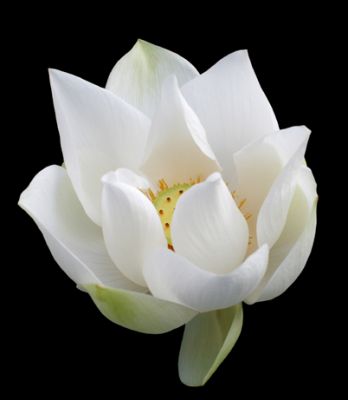
 The colour white has a very interesting range of associations. In Herman Melville's book Moby Dick the white whale became the focus for all the rage and hatred of Captain Ahab. Melville devoted a chapter of Moby Dick to exploring the negative symbolism of white: the white of pus and maggots and putrefaction for example. However we more often associate white with purity and cleanness in a ritual sense. Virgin brides are married in white. Fresh snow is also sometimes referred to as virginal. The Pope wears white. Being the opposite of black, it symbolises good, light, positivity, and space. From India we have the wonderful image of the while lotus rising unstained up from the mud. White light may be split into the colours of the rainbow by a prism, or a rain drop; but the same process in reverse combines the colours of the rainbow back into pure white light: an important observation for our understanding of the White Rite. The White Rite is the rite of purification - or more traditionally the rite of pacification. This rite is used to pacify impulses arising from greed, hatred and delusion, hence the association with purity. In the more mundane sense the white rite is also to pacify demonic forces in the world around us.
In terms of the mandala the white figure sits at the centre. There are a number of Buddhas and Bodhisattvas who appear in white forms, the most important being Vairocana, Avalokiteshvara and White Tara. The white figure at the centre of the mandala possesses and integrates all of the qualities of the other figures - Love, Fearlessness, Wisdom, Abundance; and yet adds some new subtle quality that is difficult to quantify. Vairocana - the Illuminator - is an ancient Indian figure who predates Buddhism by many centuries. He is the sun, of course, in its most benign aspect. Spiritually he illuminates the darkness of ignorance. Holds the dharmacakra, which identifies him with the Dharma - it is not that he possesses or teaches the Dharma: no, he is the Dharma.
The wisdom of Vairocana is known as the Wisdom of the Dharmadhatu (dharmadhātujñāna). Dharmadhatu is synonymous with śūnyatā, tathatā, and the dharmakāya: i.e. it stands for the Reality Principle. These Buddhist technical terms are rather abstract and abstruse, and do not really convey much. Indeed it is sometimes said that one cannot say anything definite about the dharmakāya. Which leaves us with a puzzle: if this wisdom is so abstract as to be inconceivable, then of what practical value is it to us. In terms of the Tantric Rites, how might we bring this quality into our practice? I have explored a number of ways to do this. As I mentioned in my essay on the Red Rite, I do not follow the tradition closely because it is not easy to see how the old magical rites would work in a modern context.
Purity in Buddhism is equated with purity of intention, since it is intention which underlies actions (karma), and it is the results of actions that prevents us being truly free. So one aspect of the Wisdom of the Dharmadhatu is moral purity - in Buddhist terms keeping the precepts. In terms of the ten precepts followed by members of the Western Buddhist Order (and in Shingon) this means: kindness, generosity, contentment, truthful kindly harmonious helpful speech, and tranquillity (non-greed), love, and wisdom. Each time we exercise our moral judgement, each time we decline the act that we know will lead to suffering, we are exercising the White Rite. Of course if we do find ourselves acting unskilfully we can confess it to some appropriate person. This too is an example of the White Rite - the experience, and acknowledgement of remorse can be a powerfully transformative practice. This of course has nothing to do with guilt or atonement. Remorse is simply turning the moral spotlight on our own actions. Neither has it to do with sitting in judgement on others.
Something that Kūkai writes about in connection with the dharmakāya gives us another clue to the White Rite. He says that all forms are the body of the Dharmakāya Buddha, all sounds are his voice preaching the Dharma, and all mental activity is his Awakened mind. This sounds a little theistic at first, but Kūkai was not suggesting that Vairocana is a creator god, but pointing towards something more subtle. All things are marked by impermanence, insubstantiality and unsatisfactoriness. So everything can be said to be of the same nature. If we anthropomorphise the metaphor then we may say that everything is a manifestation of Vairocana, who is reality itself, who is the very impermanence of all things. Putting this into practice we can try to see the Buddha everywhere, hear the Dharma everywhere, and cultivate a sense of identification with every living being. To give a more concrete and contemporary example: we know that human impact in the environment is causing problems. So each time we consciously, for example, minimise our own impact by recycling, or reusing, or using low energy light bulbs - then we are acknowledging the truth of interconnectedness and exercising the White Right. This is interesting because it suggests that the colour of the Buddhist environmental movement might be white rather than green which has quite different traditional associations.
We know that Tantra adopted the old Vedic magical principle of bandhus or associations between levels of reality. So in each quarter of the mandala there is a Buddha who has a colour, and various other associations. At the other end of the scale there is a kleśa - a defilement - associated with each Buddha. In the case of Vairocana the defilement is ignorance. This kind of ignorance is sometimes known as viparyasa or topsy-turvy views. We see the impermanent as permanent for instance or the painful as pleasant. The White Rite is concerned with dispelling this kind of ignorance. We can only doing this by paying attention. After my first brush with the Dharma I wrote this in my journal, although I no longer recall the source, that an aspect of suffering is "a desperate will to live unrelated to serious or systematic attempt to understand what life actually involves". Practising Buddhism is precisely the opposite - it is an attempt to live on the basis of a serious and systematic attempt to understand what life involves. And this again is the function of the White Rite.
As with the Red Rite I'm suggesting here that the magical tantric rites can operate in an everyday way. In this case every time we acknowledge and act in accordance with the way things are - when we choose to act skilfully, when we see ourselves as interconnected, or when we try to see more directly how things really are - that is the White Rite in action. This is Buddhism as the path of purification.


