
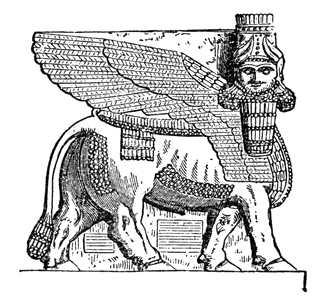
 Some people will be aware that when Buddhism flowed out of India it went West as well as East. The huge Buddha statues at Bamiyan in Afghanistan are a result of this, as are, apparently the Arabian Nights stories which are based to some extent on the Jataka tales. But few people will know that there was some traffic in the other direction.
It should come as no surprise really. The Khyber Pass continues to be the main route into and out of Pakistan in the North-west. But the evidence for this inflowing of traffic is all rather sketchy. I want to discuss two main items here: the presence of Babylonian Omens in the Dīgha Nikāya; and aspects of the Arapacana Alphabet.
Some years ago now the late Professor David Pingree noticed that the first sutta of the Dīgha Nikāya, the Brahmajāla Sutta, contained a list of omens. The context is that the Buddha is spelling out to the bhikkhus that he considers divination and the interpreting of omens as wrong livelihood for a bhikkhu. The reasons for this are not clear but I suspect that it was one of many ways in which the Buddhist sangha tried to make itself distinctive from a. laymen, and b. ascetics from other traditions. The interesting feature of this list is that in both form and content it very closely resembles a Babylonian omen manual preserved in cuneiform writing in what is now Iran. Professor Pingree closely compares the items on the two lists and the order in which they appear and concludes that they are practically identical. Now we know the date of the cuneiform writing since it is pushed into clay and it very definitely pre-dates Buddhism in India. It's widely known amongst historians, and largely overlooked by Buddhists, that the Achaemanid Empire was in control of much of what is now Pakistan at the time of the Buddha (even allowing for the disputes over his dates). Interestingly the Pāli commentaries tell us that kings of Magadha used to send their sons to Taxila to be educated in administration and other disciplines, and Taxila at the time was a Persian enclave. At some point one or other of these young nobles must have either returned with the knowledge of these omens, or with someone else possessed it. Another scholar speculates that the Buddha's father employed Chaldean (ie Persian) magicians though I think this is not supported by the evidence.
The Achaemanids were defeated and their empire destroyed by Alexander the Great whose own empire did not outlive it's creator by very long. It took a few generations for the Persians to regroup. By the time the Sassanian Persians were starting to make their presence felt, Gāndhāra had become one of the most important centres for Buddhist innovation and inspiration. The Persians by this time had abandoned the elaborate cuneiform script and begun to use a form of Aramaic. It is this Aramaic script which forms the basis for the earliest known Indian script: Kharoṣṭhī. Kharoṣṭhī is written right to left, and it has several characters in common (and with the same phonetic value) as Aramaic. It also only has one sign for initial vowels which is modified using diacritic marks to produce the full range of Indian vowels. This is because the Semitic Languages which employ Aramaic scripts do not allow words to begin with a vowel. The vowel sign in Kharoṣṭhī is modelled on, and is used like, a consonant. This is interesting in itself since Gāndhāra is probably the place where writing was first used in India, and it is one of the places where Buddhists first began to write down sutras.
Richard Salomon has shown with some certainty that the Arapacana alphabet is simply the Gāndhāri alphabet. He has hinted (to me in an email) that he knows why it is in the order that it is, which is different from other Indian alphabets, but as yet has not published his thoughts on this. One of the things about the Arapacana alphabet is that it is frequently associated with a series of verses in which a keyword starting with each letter of the alphabet either begins the line, or features prominently in it. Although the Indians did impose meter on their writings very commonly, and although collections of verses, such as the Vedas or the suttas in the Saṃyutta Nikāya, are arranged numerically, I am not aware of any other alphabetical list. But there are a number of Manichean hymns and Hebrew Psalms which are. So it seems as though the Arapacana was influenced by Semitic ideas via the Persians. What is more Jan Nattier has observed that the Arapacana verses are the earliest verses associated with the word "dhāraṇī", and could in fact be the original dhāraṇī. It is obvious that the alphabetical verses were a mnemonic aid, and so this accords with what is said about dhāraṇīs later. Actually it is interesting to note that most dhāraṇīs serve no obvious mnemonic function, and the association with memory is just a conceptual legacy. The conclusion here is that Persian influences were behind the creation and adoption of dhāraṇīs by Buddhists in Gāndhāra. I cannot prove this, but it is one explanation which fits the known facts.
The contact between India and the West, especially via the Khyber Pass is underplayed I think. More research might turn up more evidence of the cultural exchanges that took place and the way they shaped Buddhism over the years. It will reinforce the nascent realisation that Buddhism was not so different from other Indian religions in it's assimilation of ideas, concepts, and practices from the others.
Further Reading
Nattier, J. 2000. A few good men. (University of Hawaii Press)
Pingree, David.
- 1963. Astronomy and Astrology in India and Iran. Isis. vol.54 (2), p.229-246.
- 1998. Legacies in astronomy and celestial omens in The Legacy of Mesopotamia (Oxford University Press,) p.125-137
- 1991. Mesopotamian omens in Sanskrit paper presented at La Circulation des biens, des personnes et des idées dans le proche-oriet ancien. Actes de la XXXVIIIe Recontre Assyriologique Internationale. Paris, 8-10 juillet. (Paper is in English)
- 1990. New evidence for a Gāndhārī origin of the arapacana syllabary. Journal of the American Oriental Society. Apr-Jun, Vol.110 (2), p.255-273.
- 1993. An additoinal note on arapacana. Journal of the American Oriental Society. Vol.113 (2), p.275-6.
- 2006. Kharoṣṭhī syllables used as location markers in Gāndhāran stūpa architecture. Pierfrancesco Callieri, ed., Architetti, Capomastri, Artigiani: L’organizzazione dei cantieri e della produzione artistica nell’asia ellenistica. Studi offerti a Domenico Faccenna nel suo ottantesimo compleanno. (Serie Orientale Rome 100; Rome: Istituto Italiano per l’Africa e l’Oriente, 2006), pp. 181-224. [many thanks to Dr Salomon for sending me a copy of this paper]


