27 June 2008

Mantra, Magic, and Interconnectedness.

At the heart of the practice of mantra is the idea that everything is interconnected. Although the idea is not apparent in early Buddhist teachings it is strongly associated with the Mahāyāna Avataṃsaka Sūtra, and with the Buddhism that centres around it, often known by the Chinese equivalent: Huayen. The Avataṃsaka coalesced in the 3rd century though it is thought to be a composite work that accumulated parts over time. However the idea that everything is interconnected was not new to India at the time, but goes back to the earliest religious text: the Ṛg Veda.

In the Vedas the cosmos is divided into three realms: human, god, and intermediate or sky. The earliest gods were personifications of the awesome forces of nature: the sun, storms, and fire... The ancients believed, for instance, that a single principle linked all things which were hot or bright: the sun, fire, digestion, and even the spark of imagination. This particular principle was called Agni - sometimes referred to as the "god" of fire. Even in our technologically advanced times we are still subject to nature (think global warming!): how much more so were our ancient forebears! They desired control over the sun and the monsoons, and developed a kind of magic technology for doing so. The very early Vedic poets acted as shamans who were directly in contact with the gods and the Vedic hymns are records of their conversations with the gods, or their prayers to them. They became the keepers of the the sacred fire. The Agni was the hermetic messenger and fire was an exchange medium: sacrifices were transformed by the fire into smoke, and this was carried upwards to the gods who could consume it in that form. In return the gods were compelled to respond favourably.

The key to effective rituals was the "bandhu" or connection between this world and the god realm. By manipulating the bandhu at this end, changes could be wrought at the other end. The priests were masters of the bandhu, and a great deal of the vast exegetical literature on the Vedas is devoted to listing or explaining bandhu. As with many ancient cultures knowledge at this time was based on resemblance and relationship; our own approach to knowledge relies on difference and isolation. A bandhu worked because something in this world resembled something in the other world. It can be difficult for us moderns to understand this, as we are attuned to seeing differences. To the ancients a metaphor might have seemed far more substantial for instance: they would never have said, as we might, that it's "just a metaphor". They understood the concept of metaphor, but took the relationship to be far more substantial than we do.

The late Vedic period saw the internalisation of the rituals, which were then carried out in imagination - thereby inventing meditation. The Buddha was born into this time, and studied for a time with Late Vedic sages, known as śramaṇas. The Buddha explicitly rejected the various forms of Vedic ritual, both external and internal, and substituted his own practices which emphasise a balance of blissful tranquillity and penetrating insight. Although he taught that all experiences arise from causes, he did not make the link between all experiences to explicitly talk about interconnectedness.

By the 3rd century some Buddhists were using the kinds of images of interconnectedness that have become familiar - Indra's net of jewels which each reflect all of the others for instance. In the 6th century a great synthesis of religious ideas occurred, partly in response to a breakdown in social and political order as the Gupta Empire was smashed by the Huns. Many of the old Vedic ideas were assimilated into Buddhism and key amongst these was the idea of bandhu. One sees this, for instance, in the Tantric explanation of the Avalokiteśvara mantra. The syllables are not considered as linguistic units, but as representing the six realms of existence, and the six manifestations of the Bodhisattva in those realms, etc.

It can be difficult for us to see how this medieval Indian idea makes sense. In "The End of Magic" Ariel Glucklich describes his research amongst the Tantric magicians of present day Benares. Working through the various Western ideological explanations of magic he rejects them all in favour of an explanation which relies on a sense of interconnectedness. Having done field work amongst Tantric healers in Banares, Glucklich concludes that:
Magic is based on a unique type of consciousness: the awareness of the interrelatedness of all things in the world by means of simple but refined sense perception... magical actions... constitute a direct, ritual way of restoring the experience of relatedness in cases where that experience has been broken by disease, drought, war, or any number of other events. (The End Of Magic, p.12)
I think that Glucklich has had a penetrating insight in this statement and one that we can relate back to Tantric Buddhism generally. Crucially to my mind he insists that what he calls the magical experience is neither a mystical nor a metaphysical concept.
It is a natural phenomenon, the product of our evolution as a human species and an acquired ability for adapting to various ecological and social environments. (The End Of Magic, p.12)
Some work remains to be done to adapt Glucklich's work to the Buddhist context: we need to see it in the light of Buddhist psychology for instance, and the Buddhist view of reality and experience; and we also need to make clear how mantra works in this framework. I am confident that it can be done because at the heart of the matter is interrelatedness.


Reference

image: my Facebook "friend wheel"

20 June 2008

Persian Influences on Indian Buddhism

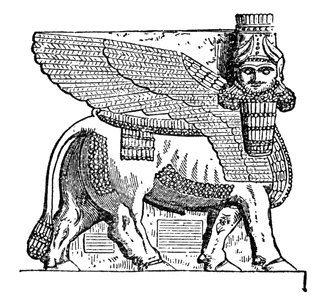
Some people will be aware that when Buddhism flowed out of India it went West as well as East. The huge Buddha statues at Bamiyan in Afghanistan are a result of this, as are, apparently the Arabian Nights stories which are based to some extent on the Jataka tales. But few people will know that there was some traffic in the other direction.

It should come as no surprise really. The Khyber Pass continues to be the main route into and out of Pakistan in the North-west. But the evidence for this inflowing of traffic is all rather sketchy. I want to discuss two main items here: the presence of Babylonian Omens in the Dīgha Nikāya; and aspects of the Arapacana Alphabet.

Some years ago now the late Professor David Pingree noticed that the first sutta of the Dīgha Nikāya, the Brahmajāla Sutta, contained a list of omens. The context is that the Buddha is spelling out to the bhikkhus that he considers divination and the interpreting of omens as wrong livelihood for a bhikkhu. The reasons for this are not clear but I suspect that it was one of many ways in which the Buddhist sangha tried to make itself distinctive from a. laymen, and b. ascetics from other traditions. The interesting feature of this list is that in both form and content it very closely resembles a Babylonian omen manual preserved in cuneiform writing in what is now Iran. Professor Pingree closely compares the items on the two lists and the order in which they appear and concludes that they are practically identical. Now we know the date of the cuneiform writing since it is pushed into clay and it very definitely pre-dates Buddhism in India. It's widely known amongst historians, and largely overlooked by Buddhists, that the Achaemanid Empire was in control of much of what is now Pakistan at the time of the Buddha (even allowing for the disputes over his dates). Interestingly the Pāli commentaries tell us that kings of Magadha used to send their sons to Taxila to be educated in administration and other disciplines, and Taxila at the time was a Persian enclave. At some point one or other of these young nobles must have either returned with the knowledge of these omens, or with someone else possessed it. Another scholar speculates that the Buddha's father employed Chaldean (ie Persian) magicians though I think this is not supported by the evidence.

The Achaemanids were defeated and their empire destroyed by Alexander the Great whose own empire did not outlive it's creator by very long. It took a few generations for the Persians to regroup. By the time the Sassanian Persians were starting to make their presence felt, Gāndhāra had become one of the most important centres for Buddhist innovation and inspiration. The Persians by this time had abandoned the elaborate cuneiform script and begun to use a form of Aramaic. It is this Aramaic script which forms the basis for the earliest known Indian script: Kharoṣṭhī. Kharoṣṭhī is written right to left, and it has several characters in common (and with the same phonetic value) as Aramaic. It also only has one sign for initial vowels which is modified using diacritic marks to produce the full range of Indian vowels. This is because the Semitic Languages which employ Aramaic scripts do not allow words to begin with a vowel. The vowel sign in Kharoṣṭhī is modelled on, and is used like, a consonant. This is interesting in itself since Gāndhāra is probably the place where writing was first used in India, and it is one of the places where Buddhists first began to write down sutras.

Richard Salomon has shown with some certainty that the Arapacana alphabet is simply the Gāndhāri alphabet. He has hinted (to me in an email) that he knows why it is in the order that it is, which is different from other Indian alphabets, but as yet has not published his thoughts on this. One of the things about the Arapacana alphabet is that it is frequently associated with a series of verses in which a keyword starting with each letter of the alphabet either begins the line, or features prominently in it. Although the Indians did impose meter on their writings very commonly, and although collections of verses, such as the Vedas or the suttas in the Saṃyutta Nikāya, are arranged numerically, I am not aware of any other alphabetical list. But there are a number of Manichean hymns and Hebrew Psalms which are. So it seems as though the Arapacana was influenced by Semitic ideas via the Persians. What is more Jan Nattier has observed that the Arapacana verses are the earliest verses associated with the word "dhāraṇī", and could in fact be the original dhāraṇī. It is obvious that the alphabetical verses were a mnemonic aid, and so this accords with what is said about dhāraṇīs later. Actually it is interesting to note that most dhāraṇīs serve no obvious mnemonic function, and the association with memory is just a conceptual legacy. The conclusion here is that Persian influences were behind the creation and adoption of dhāraṇīs by Buddhists in Gāndhāra. I cannot prove this, but it is one explanation which fits the known facts.

The contact between India and the West, especially via the Khyber Pass is underplayed I think. More research might turn up more evidence of the cultural exchanges that took place and the way they shaped Buddhism over the years. It will reinforce the nascent realisation that Buddhism was not so different from other Indian religions in it's assimilation of ideas, concepts, and practices from the others.

Further Reading

Nattier, J. 2000. A few good men. (University of Hawaii Press)

Pingree, David.
  • 1963. Astronomy and Astrology in India and Iran. Isis. vol.54 (2), p.229-246.
  • 1998. Legacies in astronomy and celestial omens in The Legacy of Mesopotamia (Oxford University Press,) p.125-137
  • 1991. Mesopotamian omens in Sanskrit paper presented at La Circulation des biens, des personnes et des idées dans le proche-oriet ancien. Actes de la XXXVIIIe Recontre Assyriologique Internationale. Paris, 8-10 juillet. (Paper is in English)
Salomon, Richard.
  • 1990. New evidence for a Gāndhārī origin of the arapacana syllabary. Journal of the American Oriental Society. Apr-Jun, Vol.110 (2), p.255-273.
  • 1993. An additoinal note on arapacana. Journal of the American Oriental Society. Vol.113 (2), p.275-6.
  • 2006. Kharoṣṭhī syllables used as location markers in Gāndhāran stūpa architecture. Pierfrancesco Callieri, ed., Architetti, Capomastri, Artigiani: L’organizzazione dei cantieri e della produzione artistica nell’asia ellenistica. Studi offerti a Domenico Faccenna nel suo ottantesimo compleanno. (Serie Orientale Rome 100; Rome: Istituto Italiano per l’Africa e l’Oriente, 2006), pp. 181-224. [many thanks to Dr Salomon for sending me a copy of this paper]


19.10.2012 Eisel Mazard recently wrote a blog post about a story that occurs in both the Jātakas and Herodotus. The latter attributes the story to the Persian king Darius, which may indicate that it is originally a Persian story. The link is a bit tenuous, but if a Persian story also ends up in a Jātaka then it is another thread connecting Persia and Buddhist India.
Related Posts with Thumbnails