
 The Madhupiṇḍika or Honeyball Sutta* is one of the most important texts in the Pāli Canon. In it the Buddha's maternal uncle Daṇḍāpāni asks what the Buddha teaches. The name Daṇḍapāni may well be a joke since it means rod in hand, or even the punishing hand, and the Buddha replies that he teaches in a way that on does not quarrel with anyone in the world. But more specifically and more importantly he teaches a way to be free of craving, to be detached from sensual pleasures. Some of the bhikkhus find the sermon a bit terse and so they ask Mahā Kaccāna, who is known as the foremost expounder in full of brief sayings of the Buddha, to give a further explanation. He says:
‘‘Cakkhuñcāvuso, paṭicca rūpe ca uppajjati cakkhuviññāṇaṃ, tiṇṇaṃ saṅgati phasso, phassapaccayā vedanā, yaṃ vedeti taṃ sañjānāti , yaṃ sañjānāti taṃ vitakketi, yaṃ vitakketi taṃ papañceti, yaṃ papañceti tatonidānaṃ purisaṃ papañcasaññāsaṅkhā samudācaranti atītānāgatapaccuppannesu cakkhuviññeyyesu rūpesu. MN i.111.It translates roughly as
"dependent (paṭicca) on the eye and forms, eye-consciousness arises: these three together constitute contact (phassa), which causes sensations (vedanā). Sensations are perceived (sañjānāti), and perceptions are reflected on (vitakka**), and reflections proliferate (papañceti). Because the eye is always recognising forms, a man is beset by ideas about, and definitions of, what is proliferated".The formula is repeated for the other senses and the mind. Now the precise meaning of papañca is still disputed by scholars, but it is generally taken to mean something like "mental proliferation". I think of it as something like associations. By linking present experience with associations we create the stories we tell ourselves about the experiences we are having. So we have a sensation, and the register it and reflect on it, and we then associate that with past experiences, and expectations, and habitual responses, and the result is that we incorporate the sensation into our personal narrative - what we might call our 'world' (loka). Not that much, if any, of this happens consciously.
The Buddha had earlier explained that
‘‘Yatonidānaṃ, bhikkhu, purisaṃ papañcasaññāsaṅkhā samudācaranti. Ettha ce natthi abhinanditabbaṃ abhivaditabbaṃ ajjhositabbaṃ. Esevanto rāgānusayānaṃ, esevanto paṭighānusayānaṃ, esevanto diṭṭhānusayānaṃ , esevanto vicikicchānusayānaṃ, esevanto mānānusayānaṃ, esevanto bhavarāgānusayānaṃ, esevanto avijjānusayānaṃ, esevanto daṇḍādāna-satthādāna-kalaha-viggaha-vivāda-tuvaṃtuvaṃ-pesuñña-musāvādānaṃ. Etthete pāpakā akusalā dhammā aparisesā nirujjhantī’ti. MN i.110
"As to the ideas about, and definitions of, what is proliferated which assail a man: if there are no objects of pleasure, nothing to welcome, or to cling to then the bias towards pleasure is left behind, the bias towards reactivity is left behind, the biases towards views, uncertainty, comparisons and conceit, the desire for continued becoming, ignorance are left behind; giving out punishments, fighting, quarrels, disputes, contention, blame, slander and lying are left behind. These evil unskilful states are completely destroyed."So here the Buddha is rather tersely explaining that being caught up in our own stories about the 'world' (really our own 'world') we are led to actions which are harmful to us and others. In order to give up these states we have to stop seeking out pleasure, stop being fixated with it, and stop clinging to it. This is a subtle point which might be mistaken for a kind of dour puritanism.
The problem is not pleasure per se. Pleasure is not bad. It is our attitude towards pleasurable experiences which causes us difficulties. Sensations are largely involuntary - if not in a deep sleep then we constantly experience sensations over which we have little control, except perhaps which sensations we focus on. We are surrounded by objects of the senses, and we are constantly in contact with them. We swim in sensory experience just like a fish in water.
The problem is the stories we tell ourselves, mostly unconsciously, about the nature of these sensations. These stories come from our surrounding culture, our social group and from our families. We are this kind of person, but not that kind. We like this kind of thing and not that kind. Some of us are so convinced about their story that we will kill on the basis of these beliefs, but all of us will quarrel and fight, and on occasion will be unskilful in order to defend our 'world'. Unfortunately we are so strongly inculcated with these views that we don't even see them as views, let alone question them. Where people do question them, they often seem to lack the vision to find a better answer.
In fact most of us don't get along very well without pleasure. Some of us go a bit mad when we deny ourselves pleasure. The middle way is not to deny or indulge in pleasurable sensations, but to see sensations, and experiences for what they are. Experiences - ie the coming together of sense, object and consciousness - are impermanent. Even if the stimulus behind a sensation remains constant, our relationship to it changes. A good example is tinnitus - the constant ringing in the ears that many of us have due to listening to loud music. It is constant, but sometimes we notice it and sometimes not; sometimes it is annoying or even exasperating, sometimes it is neutral. Experience shifts and swirls and each moment of awareness is different from the next.
As I explained last week [How is Suffering created?] - we associate happiness with pleasure. This is one of the most dangerous stories that we tell ourselves, one of the most destructive associations we make. Because it makes pleasure important to us. We'll fight to get it, fight with those we perceive as denying it to us, and fight to hold on to what we have. We don't even imagine that pleasure being a vedanā (ie a mental event) is impermanent. We welcome pleasure and we cling to it, or try to. What Kaccāna does is to put this in the context of the mechanics of experience. Pleasure is not something we have control over, not something we can hold on to.
Likewise we are reactive towards painful experiences. I think we need to be clear that if you're literally on fire then it is vital to put out the flames. But painful sensations are as involuntary as pleasurable. Having been burned we should be ready to experience the pain of the burn. This is a huge ask at times. Sometimes the pain of the moment is too much to bear, as I wrote about in my essay [When awareness is too much to bear]. But the problem is that when we try to suppress awareness of some sensations we are less alive to our experience. Denial creates unconsciousness which becomes a vicious circle - and how vicious this can become is obvious to anyone tuning into the news media.
So we have these biases: thirst for pleasure, reactivity towards pain, and this is both a result of, and a condition for, the continuation of the stories we tell ourselves about what we are experiencing. But since the stories aren't consistent with the nature of experience, then we find ourselves constantly being disappointed or confused. Part of the Buddhist method is to slow down and just pay attention to that raw experience. If necessary label it: pleasant, painful, neutral. And watch our reaction to it - drawn towards, react away? It's usually one or the other. The aim of this stage of practice is to attain equanimity towards experiences, in order to prepare us for the next step, which is to start getting into the workings of the process.
Notes
* Madhupiṇḍika Sutta, Majjhima Nikāya no.18 (PTS MN i.111.). In the translation by Bikkhus Ñāṇamoli and Bodhi it is on pg 201. It is also translated by Bhikkhu Thanissaro on Access to Insight with a lengthy and useful introduction.
** Vitakka and reflect have very similar etymologies. See my essay Communicating the Dharma.
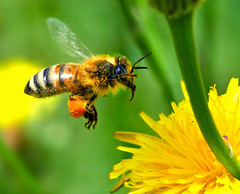
image: honey bee from autan on Flickr.


