17 July 2009

Do we have a choice?

Recently Matt Quinn commented on my post "Who Craves?" He asked a very good question and in answering it I found myself edging over into rave mode and realised that it would be a good topic for a stand-alone blog post. I had said "An interesting conclusion here is that we aren't personally responsible for the arising of craving (or hatred) in the present. There can be no doubt that we are responsible for our present actions, ..." and Matt's question draws out an interesting point:
"It seems that you are saying we don't choose whether or not we crave, but we do choose how we act. Have I understood you correctly? If so, then I would like to ask whether you consider choices (or actions) to arise dependent upon conditions just as craving does? If this is the case, then why am I responsible for the former and not the latter? If this isn’t the case, then why isn’t it the case?"
The question is basically the question of free will. Are our choices in response to craving and hatred really choices or are they a matter of karma playing itself out?

There are many ways to approach this. So let's start with cause and effect. Craving is an effect of previous choices. Choices cause craving (or not). The fact that we do crave influences our choices - but it does not determine them. When craving is present we are strongly drawn to the object we desire, but we are not inexorably or invariably drawn to it. Experientially you will know this to be true - sometimes you can say no to desire. This choice, according to Buddhism, is always present, and it is what distinguishes the human state from other possible states of being.

My understanding of free will is that it is silly to insist on absolutes - the debate in the West is often in terms of do we have it or not, and this is framed by a dispute within Christianity, as well as a dispute between Christians and Humanists. This is not a debate I'm inclined to join on it's own terms as it is framed in terms of a world view I don't share. I suggest that it is more useful to ask this: "to what extent are we free to choose?" Our choices are conditioned by our previous choices - the technical term for this is saṃskārā. If we make the same kind of choice many times it becomes habitual, and habits are hard to break, saṃskārās are these habits compounded over lifetimes. Even addictions, where there is very little choice, however, are able to be overcome given good conditions. People can and do change. I know I've seen it for myself, and so the question becomes how much can we change, and under what conditions, and in what directions?

Sometimes rather than exercising free will we might talk about setting up positive conditions for change. By this I mean conditions which encourage mindfulness and emotional positivity. The traditional way of talking about the wheel of life is that most of it is just inevitable, almost like an automatic process: so if you are born, then you die, and are reborn; if you have the sensory equipment then you have sensory experiences. And the rest is just details. But there is a possible gap in the process. It is between sensation (vedanā) and craving (taṇha). It is just possible to experience the pleasurable sensation and not experience the desire to possess it. If this were not possible then we could never say no to desire.

In breaking free of craving we do not break the cycle all at once. At first we weaken the reaction. So when there is no mindfulness we experience the pleasurable sensation, and reach for it without thinking. When we have some mindfulness however there is a possibility of not reaching for the object. We may feel the desire to reach out for the pleasure (to try to obtain, maintain, or retain it: the -tain part comes from Latin tenere "to hold"), but we stifle the desire and in doing so we experience a little bit of freedom - a taste of freedom. We can build on this until we have more and more freedom to not try to obtain the object of desire. We find that this makes us more content. Often you get a taste of this on retreat where the conditions are good for mindfulness and desire naturally reduces. Then the task becomes the breaking of desire itself which means we go beyond being mindful of our sensations and reactions, and trying to hold in mind the process itself, and try to see into that process to see through it - this is the literal meaning of vipassanā, to see through.

Early Buddhist texts identify two trends in conditionality. In one we simply act on craving, hatred and confusion and this sustains those very qualities. Acting on craving leads to more craving. In the second we act on some positive impulse - the two main one's in the texts are faith (saddha) and non-remorse (avippaṭisāra) - then this leads to positive consequences that in turn set up the conditions for more positive consequences. At some point we are making so many positive choices that there is no scope for craving. So we have two ways to deal with craving - to reduce and eliminate it through mindfulness; or we can overwhelm it with positivity. Sangharakshita has called the first path cyclic, and reactive; and the second spiral, and creative.

Note that one strain of Buddhism - descending from the Japanese thinker Shinran - came to the conclusion that there is so little choice that individual will is insufficient and that all we can hope for is rescue by a Buddha as set out in the Sukhāvati-vyūha Sūtras where Amitābha makes a series of vows to save all beings. This kind of faith based approach to Buddhism is very popular in East Asia, and indeed it is important in the West in the form of Nichiren and Soka Gakkai - the latter being an offshoot of the former. However, even within that kind of framework it is up to the individual to develop their faith, so even there we are not free of actually having to make choices.

In fact we are always making choices and decisions even if only unconsciously. It can't be avoided. Scientists have begun to show that animals do make limited choices, but we may still generalise and say that the characteristic of animals is that they simply respond to stimulus and act without reflective thought or self-reflection. Human beings are many orders of magnitude ahead of our animal cousins in that we have the ability to reflect on our actions and to examine our motives for acting. We are moral beings, whether we like it or not, and our actions have moral consequences. In order to fully take up our humanity we must engage with this fact and at least begin to take responsibility for our actions. Though addicted to pleasurable sensations (and we may say the avoidance of unpleasant sensations) we have a choice.

Our instincts are honed for a much less sophisticated and technologically simple world and often do not serve us in the present. The natural desires for example for sex, for sweet and fatty foods, and for social status are hyper-stimulated in our societies. So every relationship is sexualised, we are fat, and we constantly struggle for status through grooming and/or combat. Nietzsche famously said that man is a tightrope stretched between the animal and the 'over-man'. We retain some of our animal characteristics, but we are capable of being so much more. As followers of the Buddha we conceptualise this 'more' as 'Buddhahood', as being liberated from greed, hatred and confusion. And the key is that we do have a choice, and each positive choice we make gives us more choice in the future.

image: cartoon from www.marriedtothesea.com.

10 July 2009

Kūkai's journey to China : Kentōshi Ships and Weather

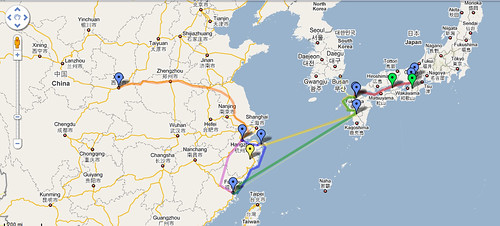
To see my Google Map click here


One of the marvels of modern technology is that we have easy access to all kinds of information. I've been trying to visualise Kūkai's journey to China and to understand the scale of it. Using the internet I was able to locate a journal article which discusses the detail of the journey, then using Google Maps I have been able to visualise it and get a sense of the scale of it. The route outlined here relies on an article by Robert Borgen in Monumenta Nipponica.*

Kentōshi (遣唐使), which means 'Envoy to the Tang' i.e. mission to Chinese court of the Tang (T'ang 唐) dynasty,** was used to describe both the people and the ships they went on. We don't have much definite information about the vessels, but it is assumed that they were built on the model of the Chinese junk which were developed in China during the Han Dynasty (220 BCE - 200 AD) which were being used for ocean voyages by the 3rd century. Such Chinese ships visited Japan for trade. We know that the Japanese and the Koreans definitely used Chinese junks as models for later ships. It's often stated that because the ships had a flat bottom and no keel that they could only use the sails when the wind was directly behind them. However the boats used a very large rudder which projected well below the bottom of the ship, and did much the same job as a keel, i.e. it stopped the wind pushing the boat sideways when sailing to windward. They could probably have managed to sail close hauled at between 45-60° to the wind. Which in fact means that they could sail in much the same way as an early square rigged European ship such as Magellan had sailed around the world in.

The idea that the Japanese were poor sailors seems to be an assumption related to their decision to sail in the typhoon season, but as I pointed out in an earlier post (Why did Kūkai sail in summer?), the Japanese envoys were concerned to get to the Tang court on New Years day in order to offer their tribute at the appropriate time, and this must have over-ridden the concerns of the sailors. In fact the Japanese were highly attuned from ancient times to the annual changes to their climate wrought by the monsoon, and I find it very unlikely indeed that they did not understand the wind patterns. Note also that by Kūkai's time, in the early 9th century, envoys from the nation of Po-hai (north of Korea) to Japan regularly timed their journeys to take advantage of seasonal winds.

It's very often stated that the winds were against the ships sailing across the sea to China, but the prevailing wind during the summer monsoon in that region is from the south-east. This means that the Kentōshi ships, sailing south and west, were most likely cutting across the wind - a favourable geometry for sailing. With a wind from the south-east (135°) they could probably have sailed in any direction from say 0° - 75° and 195° to 360°. In fact a line joining Tanoura to Ming-chou is at about 252-3° which in sailing terms is a 'close reach' and probably well within the capabilities of the ships.

It is quite unlikely that they could have made the journey at all if they had to row ships that probably weighed over 100 tons all the way, and it does not seem so unreasonable to me that they relied on sails most of the time - even sailing north from Fu-chou to Ming-chou. Note that all four ships of the mission survived a typhoon, some of them two typhoons, and a 500 mile ocean crossing so they must have been reasonably well built. European ships of a similar size and square rigged could make about 5-7 knots, and, allowing for variable wind conditions and given that they would have paused during the night when they could, I initially guessed that they might average about 20 or 30 miles per day.

Previous missions would have made a quick jump across the straights of Korea probably via Tsushima Island, a journey of about 150 miles with a longest stretch of open water of about 35 miles. On a good day the Kentōshi ships could have sailed that distance in a single long day. From there the boats would have hugged the coast all the way to China. However in the 7th century Japan's long term enemy Silla had, with the help of Tang China, unified the whole Korean peninsular under their rule, leaving the Japanese with no bases on the mainland and a more powerful antagonist as neighbour.

The four Kentōshi ships left from Naniwa (modern day Ōsaka) and headed for Hakata (Fukuoka) on Kyūshū Island, a distance of 330 miles most of which is in the usually pacific Inland Sea. Note however that in 803 when the mission first sailed the boats were almost wrecked by a (rare) storm in the Inland Sea. From Fukuoka the ships hugged the coast of Kyūshū down to Tanoura (since merged into Ashikita), the last stop before heading west across the East China Sea. We don't know how good the navigation techniques were at this time, though simply sailing west would mean hitting China at some point, but the ships ideally would make land near the modern city of Shanghai or north of there. They left from Tanoura on the 6th day of the 7th month of Enryaku 23 (ca 14 August 804).

Of the two ships that completed the journey in 804 Ship Two is said to have taken about two months to get to Ming-chou (near modern Ningpo). Now here is a puzzle: Abe, Hakeda, and others give this time frame, but Abe says that the Vice Ambassador who lead Ship Two died in Ming-chou on the 25th day of the 7th month of Enryaku 23. This is a mere 19 days after leaving Tanoura. So, assuming this is not a misprint, either the Vice Ambassador died at sea less than half-way across, or Ship Two made very good time crossing the 540 miles, averaging about 30 miles a day. The latter figure is not unreasonable if they met no more storms, and my other assumptions are correct.

Ship One, the ship that Kūkai was on, took much longer to make the crossing, coming to land on the 10th day of the 8th month (ca 17 September 804) after 34 days at sea. They landed near the city of Fu-chou, in Fukien province (modern day Fuzhou, Fujian). It is sometimes said that this was 1000 miles south of where they intended to be, however the map above makes it clear that the distance from Fu-chou to Ming-chou by sea is about 390 miles, and by land about 360 miles to Hang-chou (using a route something like that suggested by Borgen). In a straight line Ship One covered about 750 miles in the crossing, which means they averaged at least 22 miles per day. In fact we know that they didn't go in a straight line because they were blown off course by the typhoon.

On the return journey (late June early July of 805) which was apparently without major incidents Ship One took nineteen days to make landfall at Tsushima (the island in the Strait of Korea); while Ship Two took twenty eight days to arrive at Hizen on Kyūshū Island. This is about 29 and 19 miles per day respectively - quite comparable to the outward journey suggesting that 20-30 miles per day is a good measure of the average speed of the ships.

typhoon over the East China Sea
Typhoon Tokage near Japan
Image Courtesy NASA Earth Observatory
Typhoons make a rather wavy line as they progress towards Japan from the Pacific Ocean, typically they follow the prevailing winds which spiral out from a massive region of high pressure over the Pacific and into a low over continental Asia. In August the typical typhoon would swing around Kyūshū and head up the Sea of Japan - though a lot of variation has been observed. As the typhoon approached the wind would have swung around initially from the south-west, to the west - the winds swirl in anti-clockwise to the centre, and have become a tight knot by the time they reach Japan. On the western side of the storms the winds are blowing more or less to the south and this explains how Ship One might have been sent far southwards. Ship Two somehow escaped this. The trailing edge of the typhoon seems to have blown Ships Three and Four eastwards back to Japan, though this suggests that there was already a significant distance between them and Ships One and Two by this stage.

Borgen's article is an important source of information about ships 3 and 4 from the Kentōshi flotilla - but that is another story. Hopefully you can see that using Google maps in this way really does makes the scale of the journey clearer, and you find my route plausible where I have supplied details not vouchsafed by history. The historical sources are vague on the construction and design of the ships, but I hope my reinterpretation of the Japanese as intelligent and able boat builders and sailors is both welcome and sound - I hate it when historians assume that people are stupid because they (the historians) don't understand what was going on!


Notes
* Borgen, R. The Japanese Mission to China 801-806. Monumenta Nipponica, Vol 37(1), 1982, p.1-28. In this article I also indirectly cite or use information from: Abé, Ryūichi. The Weaving of Mantra: Kūkai and the Construction of Esoteric Buddhist Discourse. (Columbia University Press, 2000); and Hakeda, Y.S. Kūkai : major works : translated and with an account of his life and a study of his thought. (New York : Columbia University Press, 1972).
** I tend to use the Pinyin version of Chinese transliteration with Wade-Giles equivalents in parentheses at the first occurrence. If there is only one transliteration it is Wade-Giles and I don't have a Pinyin version. Some names have changed substantially since Kūkai's time.

For other materials related to Kūkai and his voyage see my Kūkai bibliography.

Aug 2010 Update.

Since writing this essay I have studied the Diary of Ennin (Ennin, E.O. Reischauer (Translator] Diary: Record of a Pilgrimage to China in Search of the Law) paying particular attention to his records of wind and sailing directions. Although he records about a dozen combinations, the ships he sails on never seem to sail into the wind, and only run before it. It now seems more likely to me that the ships couldn't manage anything more than a broad reach - about 45° either side of the wind direction, i.e. that they could not use a head wind. I've noted that the prevailing wind at the time of year is from the South-East (or perhaps the East) and this may tally with their leaving from quite far south on Kyūshū - they expected to make leeway to the North while travelling West. Although my lines on the map are straight it seems likely the storm blew them far to the south, and that they then sailed North/N' West to make landfall. I have no idea if the could accurately determine latitude.


Related Posts with Thumbnails