14 August 2009

Lest We Forget

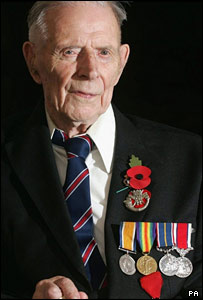
Harry PatchIn Britain last week 'we' were been saying farewell to 111 year old Harry Patch. Although most of us had never heard of him a month ago Patch, and 113 year old Henry Allingham who also died recently, had fought in World War One. Patch had been the last British man alive to have seen active services in the trenches, and had been very critical of war. "It wasn't worth it" he said. He had kept quiet about his wartime experiences until quite recently, but felt compelled to speak out when he realised that he was one of the very few left with first hand experience and that the rest of us were in danger of forgetting just how stupid is all was.

Politicians and military people seem to feel no irony in lauding Patch and repeating his sentiments as noble and reasonable. War, according to Harry Patch, is "organised murder"; and, I would add, not very well organised in most cases. Asked what Patch would have made of the conflict in Afghanistan, Chief of the General Staff, Sir Richard Dannatt, is reported to have said: "He would recognise there is an inevitability that when relations break down often fighting ensues." Would he? He was quite unequivocal in life, but Dannatt would have him be something of a pragmatist in death. Perhaps death brings a new perspective on organised murder?

In Afghanistan and Iraq Western soldiers are engaged in daily battles - many of these 'soldiers' are only teenagers. They were sent there to kill and be killed by these same politicians, and at least in the case of the Iraq war we can be reasonably sure that they lied about the reasons for starting the war. The avowed purpose of invading Afghanistan was to break the regime of the Taliban which harboured terrorists, and to disband Al-Qaeda and capture it's leader, former US Ally, Osama bin Laden. It has done none of these. The result of both conflicts has been civil war, with western forces in the middle. The media here daily report on the individual deaths of British Soldiers, but tens of thousands of local people have died and they continue to bear the brunt. The objective is nowhere in sight, and is being subtly replaced by something more achievable. By the end of the process the government will say that they achieved their objectives because by then the objectives will have become whatever was achieved. They will be rather like bankers receiving bonuses when the banks they ran went bankrupt.

Why are people in the Middle east - in Afghanistan, Iraq, Iran, etc - fighting back? Don't we offer the world prosperity and democracy and all the benefits these imply? Why are they so ungrateful? I don't have time to go over the whole history but I could summarise it by saying that the West has always sought only it's own prosperity in dealing with these nations and usually at their expense; we have frequently connived and plotted against the people - Western governments have propped up and armed(!) authoritarian regimes which were anti-democratic.* The flat truth is that Western governments, especially the governments of the UK and the US, cannot be trusted. Hell, even we the people no longer trust our own governments to be truthful and fair-dealing. The current wars are just typical behaviour for our nations. 'We' still think it's worth it. So we pay lip service to Patch and continue to start wars.

There are several reasons I seldom write about politics and politicians. I think that paying attention to them only encourages them - they are like sociopaths who misbehave in order to get attention. Secondly, though I can navigate some subjects with confidence, I find politics baffling. It's usually better to say nothing under these circumstances. Thirdly I see this blog as a way for me to work through my thinking on Buddhism and the Dharma, and frankly I fail to see how the Dharma can help with politics. All of which tends to put me in a bad mood, but the hypocrisy of warmongering politicians seemed to need some kind of comment.

In order for the Dharma to make a difference individuals must recognise the need for change, realise that the Dharma represents the best way forward, commit themselves to practice and persevere over quite a long period of time. One must resist the temptations of materialism and the crush of peer pressure and strike out on one's own. Conditions are generally against this kind of life, against this kind of inquiry. The political arena is particularly unsuitable for taking up the spiritual life because it is popularist, combative and materialistic.

One might argue that spiritual leaders can make large scale changes. One does see charismatic spiritual leaders able to mould the thinking and behaviour of their followers, but this usually involves abdicating personal responsibility and self-awareness. What often happens is that immature people follow blindly, and then at a later stage have a violent reaction against the authority figure and blaming them for their own weakness of will. How well we know this scenario in Western Buddhism! As Buddhists we are in a dilemma - we benefit from a stable society with freedom of religion (just as in the Buddha's time!), and yet in order to participate in the political process which ensures those freedoms we inevitably compromise our values. I don't know how to resolve this.

Let us not forget nor dishonour our dead, nor forget why they were killed. I do feel compassion for those who gave their lives, and those whose lives were taken against their will. This feeling has grown since I came to live in the UK where war is real in a way that it never seems to be in New Zealand. Let us also remember the history of conflicts and what lead our countries into conflict. These are days when we know the price of education but not the value of it, and this makes us very short sighted. History would seem to be more vital than any subject at present. Let our schools teach the history of Western involvement in Afghanistan, Iraq and Iran (and and the rest of the world) openly and honestly so that we may learn the lessons of history - that arrogance, double dealing and greed will breed hatred and mistrust; that as we have sown, so we are reaping. Perhaps we should not be so quick to resist the popular notion of karma - what goes around, comes around - in the case of politicians? They seem to believe that the consequences of one's actions can be avoided by skilful manoeuvring - they don't personally go to war.

Hopefully I won't feel compelled to write about politics for a long time to come.


Notes
* A useful summary of Western involvement in Iraq/Afghanistan/Iran can be found in Wheen, Francis. How Mumbo Jumbo Conquered the World : A Short History of Modern Delusions. Harper 2004. Especially chapter 7 'Us and Them'.

image: Harry Patch from Sailing to Byzantium.

07 August 2009

Beauty vs Sensuality

A Street Car Named Desire Movie PrintToday's text, the Nibbedhika Sutta*, does not begin "thus have I heard" and it does not tell us where the Buddha was staying. This oversight may be a puzzle because we sometimes hear that this is how all suttas begin. Actually many texts in the Aṅguttara and Saṃyutta Nikāyas lack this distinctive introduction. We get no preamble this time, the Buddha just launches straight in, saying:
Nibbedhikapariyāyaṃ vo, bhikkhave, dhammapariyāyaṃ desessāmi
I will teach on the subject of insight, Bhikkhus, an explanation of the principles.
Nibbedhika means 'penetrating, piercing, scrutinising, sharp'; dhamma here most likely means The Dhamma, that is the Dhamma (capital Dh), as law or principle, the teachings of the Buddha. Pariyāyaṃ is an interesting word. The root is √yā meaning 'going, moving' which also gives us the word yātrā meaning a journey expedition, or a pilgrimage. √yā is a derivative of the Indo-European root √ei, from which we get the English word 'ion' (via the Greek ienai 'go,') - so called because the ionised atoms in a solution move towards an electrode of opposite charge. The prefix pari- usually means 'around' so the underlying meaning is 'to go around'. So it comes to mean something repeated - such as a ritual or a mantra - and via this 'teaching' since teaching was done by repetition. It is drawing on a central metaphor in Indian culture - the way that things repeat themselves according to certain laws or principles and the rituals that base themselves on this repetition; the way that stories are told again and again in the same way; and also the way that oral teachings are handed down through repetition. As such it can refer to the going around, or what makes things go around, ie "what is going on". The -ya suffix indicates adjectives which have the sense of 'relating to'. So pariyāya is relating to what goes around, or the underlying principles of what goes around. As such we could see dhammapariyāya as a play on words, because dhamma shares much of this semantic field. The abhidhamma used pariyāya as a label for a more figurative (i.e. metaphorical) discourse as opposed to something more literal, but I'm not sure it applies to this sutta as the ideas are quite straight forward.

Basically the sutta looks at various factors of experience and analyses them in terms of cause (nidānasambhavo), difference (vemattatā), result (vipāko), cessation (nirodho) and way to bring about cessation (nirodhagāminī). In many ways it's quite a straight-forward Buddhist text on conditionality. It's similar to many other presentations, especially those related to the Four Noble Truths. However amidst this rather arid analysis is a few lines of verse. I find Pāli verse difficult to translate, but having seen someone else's translation I knew I wanted to have a go because the message of these lines of verse is rather striking.
Saṅkapparāgo purisassa kāmo,
Na te kāmā yāni citrāni loke;
Saṅkapparāgo purisassa kāmo,
Tiṭṭhanti citrāni tatheva loke;
Athettha dhīrā vinayanti chandanti.
The passion for his own thoughts is the desire of a man,
Not those beautiful aspects of the world.
The passion for his thoughts is the desire of a man:
The beautiful aspects of the world remain just so,
Though the wise give up desire.
As I say I found this striking if only because the Pāli texts rarely use this kind of language. An important distinction, a very important distinction, is being made here. This is a rare reference to beauty and it's response is not the usual rhetoric - that what we find beautiful is in fact ugly. Here the beauty of the world is not denied, but admitted. The word I am translating as beauty, by the way, is citra - you won't find this in the Pali Text Society's Pali-English Dictionary (which I usually refer to as PED following scholarly convention). I found it in the Vipassana Research Institute dictionary which accompanies their Pāli Canon CD. The word is the same in Sanskrit where the primary meaning is 'conspicuous, excellent, distinguished; conspicuous, excellent, distinguished, bright, clear, bright-coloured' but covers senses such as 'variegated, agitated, manifold, strange, extraordinary'. In short it describes the world (loka) in all it's strange and wonderful forms.

Note though that the beauty itself, the world itself, is not the problem. The problem is, in Pāli, saṅkhappa-rāgo. Rāga is quite near in meaning to our word 'passion', especially used in it's now somewhat archaic sense of something by which one is overcome. The word is often used in reference to the martyrdom of saints when they die horribly for instance. These days we see passion in more positive light, as the strong motivations and feelings to act or appreciate something - whether it be art, politics, injustice, a lover, or football. The present usage hides the often involuntary aspect of passion which is still present. We are frequently not in a position to choose what we are passionate about. The etymology of rāga shows us that it derives from the root √raj 'shining', and means 'colour, hue, dye' especially red. Red is the colour of passion, of arousal, but also of anger (red faced) and intolerance (red necked). [see also my blog on the Red Rite]

And the thing that a person (purissa, literally 'a man') is passionate about is their saṅkappa. PED defines sankappa as 'thought, intention, purpose, plan'. I can't resist one more etymology because kappa (Sanskrit kalpa) is from √kḷp which has the distinction of the being the only Sanskrit verbal root to contain the vowel 'ḷ'. Kḷp in fact suggests 'ordering' and with saṃ- is in Sanskrit: 'to bring about, to desire, to produce' (saṃ- changes to saṅ- when followed by k). Switching back to Pāli it seems as though the literal meaning has been colonised by a figurative one which only relates to the mental sphere. So what a person is passionate about, or overcome by, is what is produced in their own minds, what is desired in their own minds - in relationship to the beauty in the world.

A corollary of this is that removing anything beautiful from the world, or scorning the beautiful is not going to solve the problem, because the problem is not with the world, but it is with how we see it and respond to it. My own teacher has extolled the virtue of beauty even, because art - great art anyway - can lift your consciousness and being to a higher level. If fact his definition of art focuses on this potential for raising us up. Natural beauty also can refresh and inspire us. We need not be too puritanical about beauty. We need not be puritanical at all, just observe what our mind is doing in response to the world and make rational decisions on what we have observed.

The image which comes to mind for me is a moth dancing around a candle flame. While the candle flame is far from permanent, it does to some extent represent a fixed point around which the moth flies it's crooked path. Beauty in the world is just like this - it remains (tiṭṭhati) as the text says - and the problem is that our moth-like minds are enthralled by it, and occasionally we fly into the fire and are burned by it. Like the moth however we often do not learn from this, but fly at it again and again because the light seems irresistible.

Fortunately we are not moths and we do, as I pointed out a couple of week ago [Do we have a choice?], have some choice in how we respond to the world, the light is resistible. So the wise person (dhīra) gives up desires (chanda). That is to say that the wise person reflects on their responses to sensory stimulus and figures out that the basic, inbuilt, habitual responses just don't bring happiness or fulfilment; and so they re-evaluate their relationship to seeking pleasure. I plan to say more about this in a couple of weeks.


Notes
* Nibbedhika Sutta. AN 6.63. (PTS: A iii 410). My translations. Also translated by Bhikkhu Thanisarro @ Access to Insight, and by Piya Tan @ Dharmafarer.


Image: Marlon Brando and Vivien Leigh in A Street Car Named Desire. Dr Marco's High Quality Movie Scans.
Related Posts with Thumbnails