04 December 2009

Aspects of the Hundred Syllable Vajrasattva Mantra I


Siddhaṃ writing on palm leaf from 11th century Nepal. A section of the Aṣṭasāhasrika Prajñāpārimtā Sūtra
In my annotated translation of the Hundred Syllable mantra I tried to convey what the Sanskrit text of the mantra was and how it might be translated [1] - I did this in such a way as to open up the meaning and allow anyone to produce their own wording. There is a lot more to say about this mantra. Here I want to look at why the mantra might have been misread to produce a garbled version.

Tantric Buddhism is generally agreed to have begun in the 7th century in India. It continued to develop until Buddhism died out in India, and long afterwards in the surrounding nations of Bhutan, Ladhakh, Nepal and especially in Tibet. Having been conveyed to China and the far east, this stream of transmission (and back transmission) was cut off with the demise of the Silk Rd, and the collapse of the Tang dynasty in the late 9th century. Some scholars see the much earlier dhāraṇī tradition as being "proto-tantric", but this is like saying that flour is proto-cake.

Tantras were on the whole composed in Buddhist Hybrid Sanskrit, with the exception of the Kālacakra Tantra which was composed in Classical Sanskrit. BHS is an inflected vernacular language which has been modified to be more like Sanskrit. This was a general trend and even Pāli has been Sanskritised to some extent. My view is that mantras are also in BHS rather than Classical Sanskrit - the -e ending on so many words being not, as many scholars assume, a feminine vocative, but a masculine nominative singular. [See words in mantras that end in -e].

Writing during this time was somewhat different to present day. The script in widespread use in Northern India at the time is known by several different names but is now generally called Siddhaṃ (perfected) or Siddhamātṛka (matrix of perfection). A version of this script, adapted for writing with a Chinese calligraphy brush, is preserved in the Chinese Tripiṭaka for writing mantras - even when they are also transliterated into Hanzi. The Tibetan script dbu-can (pronounced Uchen) was designed on an early model of the Siddhaṃ script. In the latter part of the Tantric period the script which is now often no referred to simply as Sanskrit, but which is more correctly called Devanāgarī (City of Gods) began to supplant Siddhaṃ.

A feature of texts of this period is that syllables were not grouped into words, but written individually with little or no punctuation. In order to read a text like this one had to have a very good knowledge of Sanskrit word endings. Here is the Vajrasattva mantra written as it might have been in the 10th century in Devanāgarī:
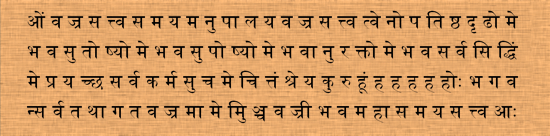

Some of the mistakes that crept into the Vajrasattva mantra over time, or perhaps even all at one time, seem to me to be the result of misreading rather than mishearing. Note that Tibetan writing is open to the same kinds of difficulties in reading. Take this segment for instance:
व ज्र स त्त्व स म य म नु पा ल य = va jra sa ttva sa ma ya ma nu pā la ya
As I noted in my translation there are several ways to clump the syllables into words. The first four naturally form the name of vajrasattva. But this leaves sa ma ya ma nu pā la ya. If we are versed in Tantra but not so much in Sanskrit we might be attracted to the word samaya. Because this is a mantra we may not be expecting formal grammar, so we might take that as a unit. This leaves us with manupālaya. This is not well formed Sanskrit, but it has familiar parts (exlpained in my translation). I can't say how often as a neophyte Sanskritist I have fallen into a similar trap. The problem is that when a word ends in -m and the next word begins with a- the two are combined into a single syllable ma for the purposes of writing. So sa ma ya ma nu pā la ya is actually samayam anupālaya 'uphold the agreement'. In spoken Sanskrit this error would be less likely to occur.

A more crucial error in reading occurred further along.
स र्व क र्म सु च मे चि त्तं श्रे य कु रु = sa rva ka rma su ca me ci ttaṃ śre ya ku ru
This phrase is at the heart of the use to which the mantra is put - the purification of karma. Let me review what I think may have been the procedure for understanding this based on my own experience of reading an unfamiliar Sanskrit text. Keep in mine that we know this is a mantra and mantras seldom follow grammatical rules so we're not expecting to see grammar. Several familiar words stand out: sarva (all), karma (action), cittaṃ (mind) kuru (make). This leaves some bits and pieces. Some thought shows that śreya is related to the word śrī, and that me is 'me' or 'mine'. We're left trying to explain su ca. Suca (often spelt sucha to avoid the confusion on how to pronounce c in English) isn't a word, but it is similar to words related to √śuc 'to gleam' figuratively 'to clean or purify'. The basic form is śocati, past-particple śukta, infinitve śuktum, 2nd person singular imperative śoca. Close enough for a mantra. So sarva karma suca me by this process means 'purify all my karma'. And cittaṃ śreya kuru means 'make the mind more śrī'.

In fact su goes with sarva-karma to give the locative plural sarvaskarmasu and the ca is the copulative particle 'and'. Sarvakarmasu ca means 'and in all my actions', and the rest me cittaṃ sreya kuru means 'make my mind more śrī'. Śrī has a very broad range of meaning and I chose 'lucid' because that conveys the sense of light which underlies śrī as well as being an auspicious state of mind.

Well formed Classical Sanskrit sentences do not just form at random. The chances of taking any series of syllables, gathering them into clumps, and finding sentences is vanishing small. Garble is far more likely, and more commonly encountered in mantras. This means that the best explanation is that the formal Sanskrit we find in the mantra when we fiddle with word breaks is very likely the original text. Given that the mantra was composed in Classical Sanskrit it suggests that it may well be from the same milieu that created the Kālacakra Tantra.

A corollary of this is that the mantra only gained its association with the purification of karma after it had been garbled and that this was not the original use of the mantra. [2] Not only that, but the way the message is garbled suggests to me that the mantra was passed on without an explanation at some point, and then later on an exegesis was composed based on the mis-read rather than a mis-heard Sanskrit text. Indeed I wonder whether the text was passed on in written form because an oral tradition would have preserved the Sanskrit rhythms of speech that would have made this kind of mistake quite unlikely. I would imagine that this did not happen on Indian soil.

This finding of the original text, and my conjecture about it, creates a significant tension with the received tradition which revolves around purification of karma. In my next post on this subject I will explore some implications of this tension, and look at the theme that emerges into the foreground when the spurious reference to purity is removed: samaya.

Notes
  1. In my translation I relied heavily on notes by Dharmacārī Sthīramati aka Dr Andrew Skilton published privately as: Sthiramati (aka Andrew skilton). 'The Vajrasattva Mantra : notes on a corrected Sanskrit text'. Order Journal. vol.3 Nov. 1990.
  2. In this article Sthiramati makes it clear that a great deal of work remains to be done on the history of this mantra. Several fragments appear in other contexts for instance. I don't have the resources to carry out this research but perhaps someone else will one day (it might make a good dissertation).

27 November 2009

New Articles on Dhāraṇī

Kharoṣṭhi Alpabet

Gāndhārī Alphabet in
the Kharoṣṭhī script
It was with some anticipation that I began to read Ronald Davidson's new review article in the Journal of Indian Philosophy on the meaning of dhāraṇī in Mahāyāna Buddhism - a subject in desperate need of an overhaul. However Davidson seems to have misunderstood crucial aspects of the system of practice in which early dhāraṇī was located. My comments will mainly concern his understanding of the Arapacana alphabet, especially as it occurs in the Large Perfection of Wisdom Sutra, [1] however I flag up wider concerns as well.

Davidson proposes the idea that the main point of the words associated with the Arapacana is to draw attention to how the letters can support (carry √dhṛ) meaning - thus linking dhāraṇī with the type of esoteric speculation in the early Upaniṣads and Tantric Buddhism. He explicitly denies the other and more natural possibility that the letters are mnemonics for words and concepts. His contention seems to be that the relationship must be this way around because in some texts different words are associated with the letters. The existence of variations on the theme in different texts surely suggests a technique widely used in different contexts, rather than incoherence or simple polysemy.

There are two main objections to Davidson's thesis. He argues that the words indicated by the syllables are intended to help the student remember the alphabet. Even if we put aside the fact that the Gāndhārī alphabet continues to be used even when the rest of the work is composed in Sanskrit, and can therefore be of little practical use for learning there are deeper problems with the idea that the Arapacana developed in this way. Davidson uses same example already put forward by B.N. Mukherjee, though he seems unaware of this: a is for apple, b is for bear etc. But stop and think about this. A in the Arapacana, even in the very early versions, is for anutpannatva. This is an abstract noun from anutpanna (not-arising) meaning 'not-arising-ness'. In fact this is one of the most complex abstract ideas of Indian philosophy which cannot be easily understood outside the context of many years of instruction in Buddhist thinking. The other 4o odd letters stand for equally complex abstract concepts. Can Davidson really believe that such an abstruse abstract notion would be of use to a learner trying to memorise the alphabet? Surely this would be an impediment rather than a helpful mnemonic device! When we teach the alphabet we use concrete examples. I note that the children's Devanāgarī chart I picked up last time I was in India uses concrete examples as well: e.g. a is for anāra (pomegranate) and bha is for bhālū (bear).

It makes much more sense to think of the letters as a mnemonic for the concepts, not the other way around. Davidson suggests that literacy in the India world at this time was low, but even if literacy was low in the rest of the world generally, Buddhist monks in Gandhāra probably all learned basic reading and writing, since the reading of texts had by then become a fundamental monastic skill. Indeed Buddhist monks were the primary vector for literacy in most of Central, Southern and South-East Asia as the persistence of Brahmī derived scripts testifies!

More broadly the very presence of such lists and this level of abstraction speak of a written rather than oral culture. I've written about the probable Persian influence the alphabetical list, and that was a literate culture without any doubt, and their writing formed a model for the Kharoṣṭhī script [see: Persian Influences on Indian Buddhism]. However here I'm particularly thinking of the characteristics of oral cultures enumerated by Walter Ong - "an oral culture has no vehicle so neutral as a list... [oral cultures are] situational rather than abstract, unavoidably using concepts but again within situational frames of reference that are 'minimally abstract'." [2]

The other objection is broader. If we look at the words indicated by the Large Perfection of Wisdom Sutra, and most other versions of the Arapacana [3] then we see that they are all related to śūnyatā - the notion that experiences are neither existent nor non-existent, that they have no independent existence (svabhāva). This is the heart of the Perfection of Wisdom approach to practice. Indeed taking the Arapacana in context with other statements in the sūtra [4] we can see that they form the basis of a insight meditation practice - by reflecting on various aspects of śūnyatā one comes to see the true nature of experience, and is liberated. The texts emphasise the sameness (samatā) of each of the syllables, not because of the inherent polysemy of letters making them interchangeable which they plainly are not, but because the concepts which they stand for show the practitioner the truth about experience being śūnyatā - śūnyatā is the common characteristic (i.e. the basis for the sameness) of all experience. Davidson seems to have lost sight of Nāgārjuna's polemics against ontology, not to mention the Buddha's.

What I think Davidson is doing is reading the texts with a particular result in mind, specifically that the word dhāraṇī can best be understood as meaning code/coding. I wholeheartedly agree that other contemporary writers have erred in emphasising the mnemonic function of dhāraṇī generally or in maintaining the fiction that dhāraṇī are somehow 'summaries' of the text they appear in. The mnemonic function is restricted solely to the Arapacana context, though it clearly is a mnemonic in this context contra what Davidson says. I do not believe that I have seen any dhāraṇī that comprehensibly summarises a text - though of course this has not stopped people producing ad hoc/post hoc exegesis on the basis that dhāraṇī are somehow summaries. Witness the many and varied readings of the Heart Sūtra mantra for instance - most of which are mutually contradictory!

A far better attempt, though more limited in scope, was published by Paul Copp in 2008. [5] Copp explores the way the word is used in Chinese translations of the Bodhisattvabhūmi and the Treatise on the Great Perfection of Wisdom Dazhidu Lun (大智度論). Copp shows that the basic meaning of the word dhāraṇī in these contexts can best be understood as 'grasp' - used in the sense of grasping the meaning, holding in memory, keeping in mind, etc. I concur. Just as the various meanings dharma (which I explored in Dharma - Buddhist Terminology) can be understood in terms of 'foundation' used literally, abstractly and metaphorically. It remains for Copp to show how his ideas fit into a much broader context, but his views seem more promising. I certainly prefer Copp's method of working from the texts to see what the word must mean in context, than Davidson's reading the meaning into the text.

From the point of view of a practitioner Davidson's error is perhaps an understandable one. For him the ideas do not seem to be tied into the practical use that is made of them: Buddhism is an intellectual system to be studied and understood in contemporary Western terms. No doubt he understands that Buddhists practice Buddhism, but the deeper implications of this pragmatism are not apparent. The impracticability of teaching an alphabet with recondite abstractions is only the most obvious sign of this.

One useful thing in Davidson's article is his survey of the history of the Western commentary on dhāraṇī - this threw up a few references I had not come across before. But that history is a bit depressing - it is a history of misunderstandings and the clash of Western preconceptions with Buddhist preoccupations. We're still trying to disentangle ourselves from that train wreck and in my opinion Davidson is pulling in the wrong direction.


Notes
  1. The Large PoW Sutra was translated by Conze but for variety of reasons the translation is less than satisfactory: for instance Conze was not working from an edited text and freely used passages from other versions in 18,000 and 100,000 lines where his manuscript (which itself has many faults) let him down. He also rearranged the text to suit subject headings from the Abhisamayālaṅkāra. Dutt's edition of the Sanskrit is flawed in the Arapacana sections with some doubling of syllables (which may be why Conze did not use it). Dutt was editing the text in the years before Salomon demonstrated that it was a real Alphabet. KIMURA is bringing out an edited Sanskrit text (see below) but the crucial part with the Arapacana is in the volume which has not yet been published. However some other related passages are available and I am working on translated them with my rather haphazard Sanskrit. - return to article
  2. [my italics] Walter J. Ong. Orality and Literacy, cited in Lopez, Donald S. Elaborations on Emptiness, p.33. - return to article
  3. The Arapacana in the Gandhavyūha Sūtra is the major exception. In this version the keywords do not relate to the alphabet at all indicating that the point of the exercise has been missed in this case. In this case the exception proves the rule. - return to article
  4. See for instance passages at p.162, 488-9, and especially p.587 in Conze's translation. I wonder if these scatter references were once more closely associated? - return to article
  5. Davidson may have been writing before Copp published, but does not seem to be aware of the article. - return to article

Bibliography
  • Conze, Edward (trans.) The Large Sutra on Perfect Wisdom. University of California Press, 1975.
  • Copp, Paul. Notes on the term Dhāraṇī in Medieval Chinese Buddhist Thought. Bulletin of SOAS. 71 (3) 2008: 493-508.
  • Davidson, Ronald. 'Studies in Dhāraṇī Literature I: Revisiting the Meaning of the Term Dhāraṇī'. Journal of Indian Philosophy. 37 (2) April 2009: 97-147.
  • Dutt, N. Pañcaviṃśatisāhasrikā Prajñāpāramitā Sūtra: edited with critical notes and introduction. London, Luzac & Co, 1934.
  • KIMURA Takayasu : Pañcaviṃśatisāhasrikā Prajñāpāramitā. Tokyo: Sankibo Busshorin 1986. Vols II-V (vol I forthcoming) Online: http://www.sub.uni-goettingen.de/ebene_1/fiindolo/gret_utf.htm#PvsPrp
  • Lopez, Donald J. 1996. Elaborations on Emptiness: Uses of the Heart Sūtra. Princeton University Press.
  • Mukherjee, B. N. 1999. Arapacana: a mystic Buddhist script in Bhattacharya, N. N. (ed) Tantric Buddhism. New Delhi: Manohar Publishers & Distributors. p.303-317.
See also my Arapacana bibliography.
Related Posts with Thumbnails