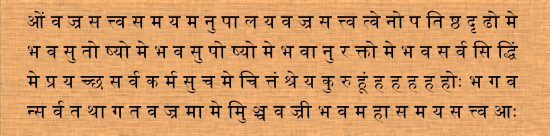
Having dealt with some of the issues of the linguistics of the mantra [1], I want now to look at the mantra as a text. While in the Tibetanised version the main theme is taken to be purification of karma, in the corrected Sanskrit one of the other themes emerges into the foreground: samaya. Samaya is our relationship (or agreement or meeting place) with Vajrasattva, the embodiment or personification of the Dharmakāya.[2] I want to explore the nature of this relationship in various terms which will demonstrate some continuities.
Firstly let me say a quick word about the purification of karma. I showed in my published paper on confession [3] that from the point of view of early Buddhism willed actions (karma) inevitably produce results (vipaka). The fruits of actions cannot be eliminated or 'purified'. However they can be mitigated and I cited several texts which explore how this happens. In a footnote to that article I also noted that in later versions of the Samaññaphala Sutta this doctrine began to change. Whereas in the Pāli the story of King Ajātasattu confessing to the Buddha that he has killed his father is only the frame for a larger doctrinal exposition, in the surviving Sanskrit fragment and three Chinese translations Ajātasattu's confession is the main focus. In the Pāli version there is no way to prevent the devastating effects of his actions (patricide is one of the five unforgivable acts), and the commentary on the story tells us that at death he goes straight to the Hell of Copper Kettles. The later versions all make his meeting with the Buddha transformative and state that, to varying degrees, Ajātasattu is released from the effects of his 'unforgivable' actions. Indeed it seems that this became an important theme in Mahāyāna Buddhism and is epitomised by the Tantric Vajrasattva as purifying through the recitation of his mantra.
The theme of samaya is distinctively Tantric, though it has resonances with earlier traditions. Samaya, as I have explained, means 'agreement, meeting, meeting place' and could also be translated as relationship. The idea is brought out quite poetically in Kūkai's expositions on kaji (Sanskrit adhiṣṭhāna) which I wrote about some time ago as grace. The idea is that it is not just the practitioner reaching out towards a remote and disinterested goal, but that the Dharmakāya is doing it's bit to reveal itself. Lest we become too theistic about it I want to unpack this idea.
In the Heart Sūtra is says that all dharmas are marked by emptiness (sarvadharmāḥ śūnyatā-lakṣanā). This is entirely in keeping with the earliest (pre-abhidharma) notions on the nature of dharmas. Dharmas are the units of experience, both the information from the senses, and the mental aspects consciousness such as memory, associative and inductive thinking. Experiences, the focus of discussions of dependent arising, have no ontological status - they are not solid existence 'things', nor are they non-existent. As Nāgārjuna observed the terms existent and non-existent do not apply to dharmas (and therefore to experience). All that we know and are conscious of results from contact between objects and sense organs giving rise to dharmas - in this sense the word means 'foundation'.
However we do not treat experience this way: we take it far more seriously than this, as existent and important. We spin stories about it which we believe and invest with value, a process known as prapañca. Hence we make our fundamental errors which lead to suffering.
Now the samaya with the Dharmakāya says something like: if you seek, you will find. In other words the true nature of experience is always able to be discerned, it can't be permanently hidden from us. If we go about it the right way, we will see through (vipaśyanā) our delusions. This is an important aspect of Buddhist faith. The guarantees that Awakening is possible come in many forms amongst which Tathāgata-garbha, so-called Buddha nature, stands out as a good example. Buddha nature, like this samaya, is designed to set your mind at ease about the possibility of your liberation. Likewise the samaya uses the model of an agreement between two parties to assure us that we can realise the Dharmakāya.
I see the mantra as a dialogue, or even perhaps as a dramatisation of this relationship. On the one hand the chanter is reminding Vajrasattva, as an embodiment of the nature of experience, of his side of the relationship: we need the possibility of gaining insight into the true nature of experience to remain open to us, so that we can be liberated.
On the other hand the seed-syllables are Vajrasattva's response to us. Vajrasattva reminds us that it is we who project onto experience. That he, i.e. the nature of experience, is always available to us, and that in fact nothing can ever change that. Śūnyatā, pratītyasamutpāda, Buddha Nature, etc: these are all ways of pointing to the nature of experience - saying the same thing in different ways. Vajrasattva replies in non-linear, non-rational fashion because typically it is very difficult to think straight about this subject. Typically we are completely caught up in, or intoxicated with (pramāda), our stories and we cannot really think outside that narrow context. In Tanric terms oṃ āḥ and hūṃ represent not just our mundane body, speech and mind, but also the Three Mysteries (trighuya) the 'body', 'speech', and 'mind' of the Dharmakāya which are communicated through his use of mudrā, mantra, and maṇḍala. These three also become the technology by which we align our body, speech and mind with the Dharmakāya and become enlightened. The nectar of the deathless (both words translate as amṛta) is always available for beings in saṃsāra!
Notes
- I've dealt with the mantra from a linguistic point of view in two previous posts:
- The Hundred Syllable Vajrasattva Mantra - includes the Sanskrit text and my annotated translation.
- Aspects of the Hundred Syllable Vajrasattva Mantra I - speculating about the process by which corruptions occur in a mantra/text like this.
- The Hundred Syllable Vajrasattva Mantra - includes the Sanskrit text and my annotated translation.
- Samaya is a complex term. It also covers our relationship with our guru, and with all sentient beings. Samaya can additionally mean 'vow', that is the vows that taken in conjunction with abhiṣeka. There are many different explanations.
- Did King Ajātasattu Confess to the Buddha, and did the Buddha Forgive Him?' Journal of Buddhist Ethics. Vol 15, 2008.