
08 January 2010

Mystical Grammar - oṃ & auṃ

oṃ in the Siddhaṃ script
oṃ in the
Siddhaṃ script
For the ancient Indians grammar was one of the major paradigms for understanding how the universe functioned. One product of this is in the understanding of the seed syllable (bījākṣara) oṃ in the Vedic and then the Hindu traditions.[1] The earliest references to oṃ are in the Yajur Veda. This Veda was composed sometime after 1000 BC but before the Buddha. In some rituals the hotṛ Brahmin shouts oṃ at the end of the invocation to the god being sacrificed to (anuvākya) as an invitation to partake of the sacrifice.

The analysis of oṃ as being made up of three parts (a + u + ṃ) originates in the Sanskrit grammarian tradition but is given ritual or religious significance in the post-Buddhist early Upaniṣads, especially the Māṇḍūkya and Praśna Upaniṣads. Let's look at how this works.

Vowels may be monophthong or diphthong - made up on a single sound (short or long), or made up of two sounds (short or long). Linguists might describe a diphthong as beginning on one vowel sound and ending on another. The vowels of Sanskrit can divided up like this:

shortlong
monophthongsa i u ṛ ḷ
अ इ उ ऋ ऌ
ā ī ū ṝ
आ ई ऊ ॠ
diphthongse o
ए ओ
ai au
ऐ औ

Note that the anusvāra (ṃ) and visarga (ḥ) are often counted as vowels, but practically they are modifications of existing vowels: nasalisation and aspiration respectively. They can be applied to any of the vowels. The long vowel ḹ (ॡ) is a theoretical possibility but in practice is never used.

The vowel o is a diphthong which is made up of two sounds: a + u. However note that the vowel au is a long diphthong which is analysed as ā + u. The two vowels o and au sound quite different: o sounds like o in hope; au sounds like ou in sound. Similarly e can be thought of as a + i: and ai as ā + i. Technically (and metrically) e and o are long vowels. In Sanskrit the Proto-Indo-European short vowels e and o converged with a (which helps to explain why a is far more common than other vowels). Since there is no short e or short o in Sanskrit there is no need to write the long vowels as ē and ō, though this would be more consistent.

It is necessary to understand these distinctions in order to understand some sandhi phenomena, because in some cases o actually behaves as a+u. The conjugations of the verbal root √bhū 'to be' offer a good example. This is a class 1 verb and forms a stem in -a with guṇā (strengthening) of the root vowel: so bhū (with guṇā) > bho; and when we add the stem vowel -a we get the stem form bhava; and the 3rd person singular is bhavati. What happens here is that the o in bho is treated as a + u, and the addition of -a invokes sandhi rules governing when two vowels meet - in this case u + a > va: ie bha+u+a > bhava. (This kind of thing is what makes learning Sanskrit difficult).
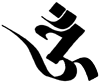

auṃ written in the Siddhaṃ script

auṃ
in the
Siddhaṃ script
From a purely technical point of view we can see that the analysis of o as a + u does not justify writing oṃ as auṃ using the long diphthong. Note that the syllable auṃ written in Siddhaṃ (left) looks like the modern Hindu ॐ which is frequently transliterated as auṃ, and suggests that some confusion about this crept into Hindu discourse. Buddhist texts did not adopt the practice of writing oṃ as auṃ as far as I have been able to discover.

Another purely technical point is that the notation oṃ indicates a nasalised o vowel. This should rhyme with the French 'bon', not with the English 'bomb'. In fact this distinction seems to have been lost for some time, and oṃ (ओं) is regularly pronounced as om (ओम् ) even in India (i.e. with the bilabial rather than the pure nasal). Note also that au is the vowel sound in the English word 'sound'. So auṃ should not sound like oṃ and vice verse.

These jejune distinctions were important to the Indian grammarians because it was thought that the Vedas were divinely inspired, eternally unchanging and true, texts. They were transmitted orally, and after some centuries the vernacular Sanskrit language was significantly different from Vedic [2] which lead to scholars making a thorough investigation of the language - both canonical and vernacular at around the time of the Buddha. It was important to get the pronunciation right if the meaning was to be preserved. Changing the pronunciation was unthinkable.

By the time the early Upaniṣads were being composed (beginning ca 800 BCE) there was quite a lot of interest in the relationship between words and reality. The existence of eternal, true words gave this a particular flavour. Also note that the word for 'true' and 'real' was the same: sat. It was the authors of the Upaniṣads, especially the Chāndogya (CU), who began to make the connections between syllables and aspects of the cosmos, though this seems to have been a natural development of the idea of correspondences (bandhu) between the macrocosm and the microcosm which was also a preoccupation in the Vedas. Oṃ in CU text is seen as a single syllable and equated with the udgītha, that is with the chanting of the sāman or hymns of the Sāma Veda. In other texts oṃ is associated with brahman. Then later, in the last century BCE, the technical breakdown of o into a+u was given esoteric significance. A key passage from the Māṇḍūkya reads:
so 'yamātmādhyakṣaramoṅkāraḥ | adhimātra pādā mātrā mātrāś ca pādā akāra ukāro makāra iti || ManU 1.8

On the subject of syllables, this syllable 'oṃ' is the ātman; on the subject of metre, the feet are the metre, and the feet are the syllables a, u, and ma. (my translation)
Here oṃ, the ātman, is likened to 'śloka' the poetic metre (mātra [3]) consisting of four lines or 'feet' (pādā) of eight syllables, with each of the lines likened to a constituent phoneme. The Māṇḍūkya then spells out the esoteric correspondences of the constituent phonemes. The fourth foot (pādā) is said to be without a phoneme (amātra) and ineffable (avyavahāraya).

I'm not aware of any canonical Buddhist text which restates the Vedic breakdown of oṃ into a+u+ṃ, though Kūkai does break hūṃ into ha+a+ū+m suggesting that the technique was not unknown to him. [4] For Buddhists the esoteric significance is typically based on the Arapacana acrostic which was originally a mnemonic for remembering aspects of an extended reflection on śūnyatā, for example: akāra (the syllable a) is the first syllable; which reminds us of the key word anutpanna (non-arising); and the full reflection subject is akāro mukhaḥ sarvadharmāṇāṃ ādyanutpannavāt (the syllable 'a' is an opening because of the primal quality of non-arising of all mental phenomena). Various versions of the Arapacana exist, the earliest date from around the 1st or 2nd century CE.

This method of analysing mantras is far more significant in understanding the function of a mantra than the words in the mantra. For instance Kūkai always seems to have broken down words (even sūtra titles) into syllables in order to understand their esoteric significant. In Tibetan Buddhism the fact that the Avalokiteśvara mantra has six syllables which enables it to match up with the six realms of conditioned existence is probably more important than the understanding of the word maṇipadme (which has been central to Western exegesis of the mantra).

~~oOo~~

Notes

  1. This distinction is a bit vague. I call the religion Vedic which is primarily based directly on the three Vedas (Ṛg, Sāma, Yajur) excluding the Atharva (which is a distinct tradition I think) and which is focussed on the sacrifice: it's main gods were Indra, Agni, and Soma - though several dozen deities were propitiated. Hinduism is a complex of various religious ideas and practices where the Vedas have faded into the background and practice is focussed on devotion (bhakti) or with Tantric rites (śakti): prominent Gods are Śiva, Viṣṇu, Brahmā and the mother goddess in many forms especially Lakṣmi and Kāli. This is of course a massive over-simplification. What seems important is to mark that there have been tectonic shifts in India religions over the millennia.
  2. Vedic is the most common name for the language of the Vedas. It has a number of differences from Classical Sanskrit which was codified by Pānini in the 5th or 4th century BCE.
  3. Note the phonetic similarity with the English word - both come from the same Indo-European root meaning 'to measure'.
  4. see Ungi gi in Hakeda Major Works p.246ff

Further Reading

01 January 2010

All Dhammas

My text today is the Mūlaka or Roots Discourse, a short sutta from the Aṅguttara Nikāya. [1] In it the Buddha advises his bhikkhus what to say if asked by other wanderers (paribbājakā): what is the root (mūla) of all things? How do they arise (sambhava)? What is their origin (samudaya)? Where do they meet (samosaraṇo)? What is the foremost (pamukha)? Who should rule them (pateyya)? Who is higher (uttara)? [2] What is their essence (sāra) ? Where do they merge (ogadha)? And where do they conclude (pariyosāna)?

These kind of questions are quite common in the Buddhist texts. Once you see the answers you can see that they are cliché questions which elicit stock answers in formulaic terms. This kind of question actually has quite a long history in Indian religion. During the development of the Ṛgveda (which was composed ca 1500-1200 BCE probably on the basis of an existing oral tradition) the visionary poets (ṛṣi) would ask each other enigmatic questions. A good ṛṣi would be able to come back with an clever answer and might be selected to carry out the all important sacrifice. [3] These kinds of questions were called 'brahman' (grammatically neuter) . The same word came to mean the absolute enigma of existence: the Brahman which manifested as ātman in the microcosm of the human being. The personification of brahman was the creator God Brahmā (masculine). The name of the ritualist inheritors of the Vedic texts came to be 'brāhmaṇa', often Anglicised as Brahmin(s). Brahma also took on the mean of 'sacred' and was used in Buddhist terms like brahmavihāra, brahmacarya, and brahmaloka. The controversial bhikkhu who ordained four women recently is called Brahmavaṃso with no apparent irony - vaṃsa is 'race, clan, family, tradition, lineage' so the name means something like 'the race of the sacred' or having a 'sacred lineage'.

Such questioning became a feature of Indian religious life - holy men would challenge each other to answer enigmatic questions about the mysterious nature of existence, and sometimes wagered that they, and their followers, would all convert to the the religion of the one with the best answer. Obviously in the Mūlaka Sutta the procedure has become completely formulaic, but it echoes the ancient tradition. The questions asked here are quite reminiscent of similar questions in in the Bṛhadāranyaka Upaniṣad, for instance, and it is thought by many scholars that the Buddha knew this strand of Brahminical teaching, if not the actual text that has come down to us.

So, onto the Buddha's answers:
chandamūlakā, āvuso, sabbe dhammā, manasikārasambhavā sabbe dhammā, phassasamudayā sabbe dhammā, vedanāsamosaraṇā sabbe dhammā, samādhippamukhā sabbe dhammā, satādhipateyyā sabbe dhammā, paññuttarā sabbe dhammā, vimuttisārā sabbe dhammā, amatogadhā sabbe dhammā, nibbānapariyosānā sabbe dhammā’ti

Desire is the root of all experiences, they arise from attention, their origin is contact, they meet in sensation; concentration is the foremost of experiences, all experiences are mastered by being mindful, wisdom is higher than all experiences, their essence is liberation, all experiences merge in the deathless, and conclude with nibbāna.
We need to pause here to consider what is meant by dhammā - the plural of dhamma. As I recently discussed there are many possible meanings. [4] However finding the word in the plural and in this context narrows it down considerably. It has to mean 'things' or 'mental objects'. Bhikkhu Bodhi opts for 'things'. This is natural since it follows tradition, but I wonder if it really makes sense? Is every 'thing' rooted in our desire - is a mountain, is that ball point pen? Well, no. So 'things' is more likely to refer to the subjective end of existence - hence I've translated it as 'experiences', though dhammas are the units of experience (I'm still searching for a good term for this - qualia?). Regular readers will be familiar with this quirk of mine, but I think it is worth insisting on because the Buddhadhamma makes more sense generally speaking if we adopt this point of view.

I want to look at this text in terms of the 'truths of the nobles' (ariyasacca) [5]: dukkha, samudaya, nirodha, magga.

The Buddha repeatedly stated what his teaching was about: it was not about God, or Heaven, or about any kind of absolute; it was not about how the universe began or will end. In fact he dismissed all of these subjects out of hand. The Buddha said that his teaching was about dukkha, it's cause, it's end, and how to end it. By dukkha the Buddha means all unenlightened experiences - ranging from physical pain, to the various disappointments of life, to existential dissatisfaction with the world of the senses. As I said in my commentary on Dhammapada verses 1 & 2: "Dukkha, then, is the opposite of nibbāna". In today's text the Buddha suggests that desire is at the root of all of this. Desire directs our attention which leads to contact with objects of the senses, which in turn give rise to sensations (vedanā). The text leaves unspoken the fact that it is sensations we crave, that we think of as able to last, able to satisfy desire. This is demonstrably not the case, but the idea is rooted very deeply. (I've speculated that in fact it gave an evolutionary advantage earlier in the history of the species - see Why Do We Suffer?). So these are the first two truths of the nobles: dukkha, samudaya - pain/disappointment/disatisfaction, and it's cause.

The Mūlaka Sutta deals with the third and fourth truths in the opposite order, ie with the way to end dukkha first, and then the cessation of it. Sticking to the usual order, how does this text deal with the cessation of dukkha? Firstly it says that wisdom (paññā) is higher (uttara) than other dhammas; that the essence of dhammas is liberation, they merge in the deathless and conclude with nibbāna. Paññā (Sanskrit prajñā) here is a dhamma - an object of the manas or mind. Contra to more mystical approaches to describing the enlightenment experience this is saying that there is an important cognitive aspect. Paññā is knowledge about the nature of dhammas, it is the meta-knowledge of the nature of all dhammas as anicca, dukkha and anatta - impermanent, unsatisfactory and insubstantial. Indeed the statement that the essence (sāra) of dhammas is liberation may well prefigure the Mahāyāna idea that all dharmas are marked by śūnyatā (sarvadharmāḥ śūnyatā lakṣanā - The Heart Sūtra). The conclusion of dhammas comes with the extinction (nibbāna) of desire. At first sight this could be considered nihilistic - it seems to be saying that all dhammas, all experiences simply cease - and we need to say something about this. However I think what is meant here is that dhammas all have this characteristic of anicca and that if we noticed this in any dhamma, we can see it in all dhammas and this leads us inexorably towards nibbāna - paraphrasing somewhat I might phrase it that the conclusion we come to is the extinction of greed, hatred and delusion. This extinction is the end-point of suffering and disappointment because we know the true nature of experience and cannot be disappointed by it.

The way to liberation is condensed into two statements in this text: concentration (samādhi) is the foremost of experiences, all experiences are mastered by being mindful (sati). We could go further and sum this up as meditation is the way to liberation. I'm aware that some people dispute this, but as a scholar it seems clear enough to me that the Buddha's completely consistent message is that meditation is indispensable. My experience suggests that concentration is invaluable as a prelude to insight reflections - else the requisite focus, clarity, continuity of purpose and positivity are simply not enough to go deeper. Here, all dhammas are mastered by sati 'recollection'. Sati can be taken as mindfulness (awareness) generally or as one of the ten recollection (sati or anusati) meditations. I think what's intended here is the twofold distinction between samatha and vipassana. Samādhi being synonymous with the former, and sati with the latter - I'm thinking especially of the Satipaṭṭhāna style meditations.

No doubt other ways of interpreting this text are possible. I'm always intrigued, however, by the way that one formulation can be used to understand another. I think the possibility is open because all of the various formulations represent various approaches to Buddhist practice which stem from a common principle. The underlying similarity has been much clearer since taking on board Sue Hamilton's observation that the Buddha was always talking about experience. Scholars call a way of interpreting texts a hermeneutic - from the Greek hermeneuein 'to interpret'. The God Hermes was a messenger and god of speech and writing. Our hermeneutic can condition what we understand a text to be saying. The experiential hermeneutic is a key that unlocks many doors.


Notes.
  1. Mūlaka Sutta AN x.58; PTS A v.106. My translations. Also translated by Bikkhu Bodhi Numerical Discourses of the Buddha (anthology) p.250-1. Pāli text from http://www.tipitaka.org/romn/
  2. uttara is the comparative degree of ud- (English 'up', or 'upwards') i.e. 'higher'; while uttama is the superlative 'highest'. Bodhi translates this as a superlative.
  3. There are some superficial similarities here with the monastic debates held in Geluk monasteries.
  4. See my trilogy on the word dharma/dhamma:
  5. Following K.R. Norman I take ariyasacca to be a tatpuruṣa compound meaning 'truth of the noble(s).'


image: Buddha head in banyan tree roots, Thailand. [original]
Related Posts with Thumbnails