04 February 2011

Action and Intention III

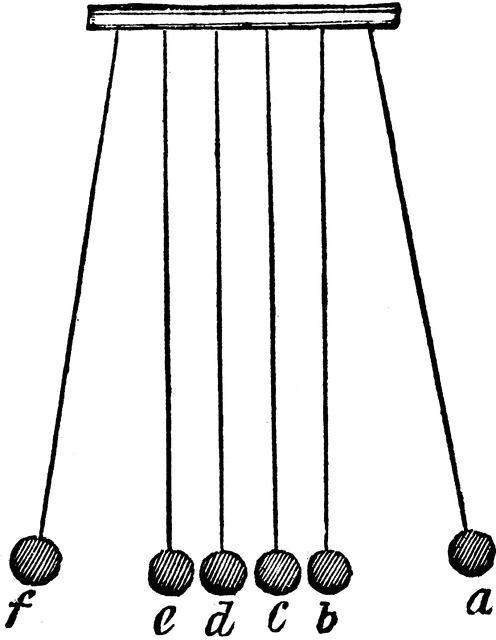
Newton's cradle REGULAR READERS WILL KNOW that I harp on about the Buddha's equation of intention and action - cetanā and kamma. More than one person has noted that this equation only occurs once in the Canon. This uniqueness makes us uneasy about putting so much weight on the phrase - surely if an idea was centrally important then it would be mentioned more frequently? I agree with this, and I have been on the look out for more references which discuss kamma and cetanā. I found an interesting passage in the Cetanā Sutta (SN 12.38, S ii.65-66). The first paragraph of the sutta translates as:
At Sāvatthī. What you think about (ceteti), monks, what you plan for (pakappeti), and what obsesses (anuseti) is the condition (ārammaṇa) of the persistence (ṭhiti) of cognition (viññāṇa). When there is a basis, there will be cognition. With persistence and growth of conscious there will future rebirth in a new existence. With future rebirth there will be future birth, old-age and death, grief, lamenting, misery, dejection, and trouble. Thus is the origin of the whole mass of disappointment.
The other paragraphs deal with a partial and complete cessation of disappointment, as simple negatives, so I'll just focus on this paragraph. Here the verb ceteti is the origin of the action noun cetanā. I said in my first post on ethics and intention:
Cetanā derives from the root √cit which also gives us the words citta 'mind' and cetas 'thought'... The root √cit is defined in the dictionary as "knowing; thought , intellect , spirit , soul", but also "to perceive , fix the mind upon , attend to , be attentive , observe , take notice of"; and "to aim at , intend , design; to be anxious about , care for; to resolve". So √cit concerns what catches our attention on the one hand, and what we move towards on the other; or, what is on our minds, and what motivates us (emotions are what 'set us in motion').
In Sanskrit the two roots √cit 'to perceive' and √cint 'to think' are different enough to be thought of as distinct, though Whitney does acknowledge that √cint appears to derive from √cit. PED draws out the difference by seeing √cint as an active voice (parasmaipāda) form with a nasal infix (like for example √muc 'to free' > muñcati 'he releases'); and √cit as a medial or reflexive form (ātmanepāda). Originally the reflexive form was for verbs affecting oneself, while the active form was for verbs affecting others - like, for instance the difference between 'I go' and 'he goes' (the word is the same but the form is different) - though this semantic distinction is largely lost in both Classical Sanskrit and Pāli even when the form persists.

Pāli citta is further confused with Sanskrit citra 'to shine'. So when the Buddha says Pabhassaramidaṃ, bhikkhave, cittaṃ (AN 1.51) what most people miss is the pun. Citta means both 'thought' and 'shine' and the phrase could equally be read - 'this thought is radiant', or 'this shiny-thing is radiant'. The context does incline towards reading 'mind', but the ambiguity and pun are obvious to a Pāli speaker.

cetanā is an abstract noun from active form (cinteti 'to think') and PED defines: 'the state of ceto [mind] in action, thinking as active thought'.

Now in the passage quoted above Bhikkhu Bodhi, very much the Buddhaghosa of our time, draws attention to the relationship of ceteti with cetanā by translating it as 'what one intends'. (Connected Discourses p.576). Bhikkhu Thanissaro (on Access to Insight) follows suit, and and Maurice Walsh opts for 'what one wills'. Why? First there is the title of the sutta - cetanāsuttaṃ - though, as I understand it, most of the titles in SN were added later. Secondly ceteti is paired with two other verbs pakappeti 'to plan' and anuseti 'to obsess over' and in Pāli these kinds of appositions are usually synonyms reinforcing each other. PED specifically mentions this group of three 'to intend, to start to perform, to carry out' (s.v. cinteti meaning b.)

Buddhaghosa's commentary glosses
Ettha ca 'cetetī'ti tebhūmakakusalākusalacetanā gahitā

And here ceteti refers to having grasped the good and evil intentions of the three levels of being (i.e. kāmaloka, rūpaloka, arūpaloka). [1]
I'm slightly wary here. My argument would be supported by simply agreeing with Buddhaghosa and the modern translators who have clearly followed him. But my understanding of the philology and the context makes me want to translate ceteti as 'thinks about', with the understanding that we are drawn to or away from objects as we find them pleasant or unpleasant only as an implication. I don't like 'intends' as a translation here, even though it would suit my rhetorical purposes better. There is a third possibility in PED which is that under some circumstances ceteti can mean 'to desire' though this requires the object of desire to be in the dative case. Our situation the object is abstract 'what' (yaṃ) but not in the dative.

In any case ceteti is one of three activities, three mental activities, which provide a basis (ārammaṇa) of the persistence (ṭhiti) of cognition (viññāṇa) and therefore for rebirth in the future (āyatiṃ punabbhavābhinibbatti). This is interesting because we're not talking about a condition for the arising of cognition here, but for its persistence. Once cognition is arisen it is sustained by what we think about, plan for, and obsess over - which is to say that once a cognition arises in our minds (through contact between our sense faculties and sense objects) it is we who sustain them through actively keeping them in mind. Seeing things this way I struggle to see how cognition generally can be said to arise from ignorance (avijjā) in a single step, and it makes those versions of the nidāna chain which leave out this connection (especially the Mahānidāna Sutta) even more attractive.

The connection with kamma is that the persistence of viññāṇa, through ceteti is what makes rebirth possible. For early Buddhism viññāṇa provides the continuity from life to life. Through our ceteti we ensure rebirth; so here ceteti is kamma, is the kind of action that results in rebirth. The confirmation is rather indirect, and not unambiguous, but it is there.

~~oOo~~


Notes
  1. For those interested in such things the analysis of this compound - tebhūmakakusalākusalacetanā - is interesting. Firstly I take kusalākusala as a dvandva compound - kusala-akusala 'good and bad'. Then I take kusalākusala to form a karmadhāraya compound with cetanā (i.e good and bad intentions). Bhūmaka is a tadhitha compound or secondary derivation from bhūma (=bhūmi) + -ka (an adjectival suffix); and tebhūmaka is a dvigu form of karmadhāraya compound - 'having three grounds or levels'. Then finally kusalākusalacetanā forms a tatpuruṣa compound with tebbhūmaka 'the good and evil intentions of the three levels'. One can see that compounds like this are a very succinct way of writing as they convey a lot of grammar implicitly, but you wouldn't expect them in an oral literature because it's more difficult to parse such long compounds orally. It also assumes that we know what 'the three levels' refers to.
image: Clipart ETC

28 January 2011

Love and the Ordered Universe

The idea that the universe is non-random, above all that the universe follows rules analogous to human social rules that we can understand and follow in order to get along, is one of the most pervasive human myths and an important idea in most religions. Indeed we could define myth in this sense as a story or narrative which conveys the sense of an ordered universe, and in what way the universe is ordered (i.e. myth is descriptive); and religion as attempts to ensure we follow the laws implied by an ordered universe (i.e. religion is prescriptive). In ancient India this order was called first ṛta and then dharma.. In some tellings of Greek myth first there was khaos - an unordered, unstructured void - and then the ordered universe, the kosmos, was brought into being.

Since the European Enlightenment it has been discovered that mathematical models can describe aspects of the world very accurately. Simple equations such as F=ma or E=mc2 tell us a great deal about how matter behaves, and what to expect from it in the future - matter appears to 'obey' these 'Laws'. In the course of my education I studied these physical laws in great detail, and personally demonstrated many of them. But along the way I began to see that my education in science consisted in being presented with a series of increasingly sophisticated models, none of which was true in any absolute sense, and none of which did much for my angst. The Laws of physics are useful and accurate descriptions of matter under most circumstances, but they do not meet every need.

Just because we perceive order, does not mean that there is order. Hopefully readers will recall the movie A Beautiful Mind. It no doubt romanticised the experience of madness, and yet it highlighted something about the human mind. Our mind sees patterns - we are pattern recognition sensors of the highest sensitivity. In fact we tend to see order where there is none. Give a human being a random array of points of light (like, say, the stars) and we fill it with a bestiary and a pantheon that reflects everything that we care about. Given random events we will see connections. In the movie John Nash becomes obsesses with and delusional about patterns, but this was a natural faculty gone haywire, not simply a product of madness.

One could also say that religion is simply our collective hopes and fears writ large and projected out onto the universe: our worst fear is that the universe is devoid of rules, or else utterly determined by rules; the hope is that there are enough rules to make life predictable, not too many as to make it stultifying. We want to be free to act, to choose, to experience novelty; but not too much. We want to know that the sun will rise each day, that the seasons will appear in due course, that the crops will grow and ripen; that we will have enough food and water, that predators will not carry us or our loved ones away etc. Most of these are not very sophisticated and reflect our evolved biological needs rather than our intellectual longings. Our societies overlay this with a veneer of sophistication, but our actual needs haven't changed in millennia, just the strategies for meeting those needs. As social primates it's important for us to establish social rules and hierarchies and for everyone to keep to them in order to fulfil our social needs. Hence we see the personified forces of nature as a celestial society, or as in ancient China as a celestial empire. The gods of course are not observed to obey the same social rules as humans, but never the less we discern order amongst them and do what we can to facilitate that order through sacrifice and prayer (all gods are similar in needing to be propitiated in order to behave - rather like over-sized toddlers). Many gods are effectively alpha-male primates in the sky - demanding submission and the best food. It seems irrational until you look at, say, chimp behaviour (I highly recommend reading Jane Goodall's In the Shadow of Man for instance). Part of the reason that apparently irrational religion is so very popular is that it speaks directly to deep human needs.

I wonder if this mismatch between our basic biology and intellect may be behind the mismatch between ordinary people and intellectuals? Recently I watched TED video of Richard Dawkins exhorting his audience to militant atheism. One of the points he makes is that amongst members of the American Academy of Science less that 10% believe in a god. When you compare that to members of the public it's more like 75% of people believe in a god. Dawkins quotes (ex)president Bush as saying an atheist could not be a patriot. Atheism is, however, the largest category of religious belief in the USA after Christianity - outnumbering Judaism, Hinduism and all other religions put together. But atheists have no political voice in the USA. I thought that was a very interesting point.

Intellectuals can generally see that the idea of a creator god is not credible, and it is interesting that Christian intellectuals back off from anthropomorphic versions of god even when they cannot give up the idea altogether. Ordinary people are harder to convince because they still project their hopes and fears onto the universe. And they want the universe to care. A caring universe is often personified as a loving mother or father (I don't recall any culture describing the universe/nature as a favourite aunt or uncle for instance).

The universe described by scientists seems not to care about us. I had an important realisation about this some years back when I used to surf on the rugged West Coast beaches near Auckland, New Zealand (especially Piha). These beaches are potentially dangerous and every year several people drown there, though with care they provide excellent surfing and swimming. The waves just roll in to their own rhythm, and they do not hesitate to drown the incautious. The sea does not glory in killing people, or regret one getting away. The sea is completely and utterly indifferent to us. When you float around on it for hours at a time, several days a week for a couple of years this becomes apparent. The ocean is magnificent, beautiful, fascinating, and thrilling, but it is not alive, not sentient. The ocean does not care, because it cannot. Caring is something that humans do.

I believe the universe is like this also. The universe does not care about us. It is not an ethical universe (i.e. it has no bias towards 'good') but one which is not aware at all, let alone aware of us and our needs: the universe is largely inanimate and driven by physics and chemistry. This might sound bleak or hard, scientists are often accused of being cold, but I'm not finished. Because the wonder is that self-aware beings can and do care. Sure, other animals experience consciousness and emotions so some extent. I don't deny that. But humans have this ability to rise above circumstances that no other animal possesses. We have an ability to be altruistic not possessed by other beings - for instance we help strangers, and can turn enemies into friends. In effect it is humans that provide the love, the caring, and the emotional warmth in the universe because they are products of consciousness, especially self-consciousness.

In response to one group of Brahmins who were concerned about the afterlife (Tevijja Sutta DN 13), the Buddha described a series of meditations in which one radiates positive emotions for all beings. One first of all radiates general goodwill, friendliness, love. One makes no distinctions between any beings, but imagines all beings everywhere being happy and well. Then we imagine that all people in need getting what they need, all the ill and unhappy beings becoming well and happy. Then we imagine ourselves celebrating along with everyone who has good fortune. And finally we radiate equanimity - a pure positivity not dependent on circumstances, but which arises out of our identification with all beings everywhere. What finer use of the imagination is there? It is no coincidence that the Buddha named this group of practices brahmavihāra (dwelling with god) and said of them that dwelling on the meditations was like dwelling with, or perhaps as, Brahmā (the creator god - usually depicted with four faces looking in the cardinal directions). The name was probably aimed at Brahmanical theists whose religious goal was brahmasahavyata 'companionship with Brahmā'. In response to concerns about the afterlife the Buddha simply teaches us to love without bounds in the here and now (as the Karaṇīya Mettā Sutta says).

The Buddha's point is much the same as I have been saying. The universe, god if you will, is not the source of friendliness, love, caring, compassion. We are. Love is a human quality that emerges from our consciousness. It is up to us to provide this quality. It's a big job, and so we must set about it systematically, and collectively. Else we may fail, and we all know what that failure looks like. Fortunately we have ways of developing these qualities, and we have exemplars to inspire us. All we need do really is allow ourselves to be inspired, and have a go at the practices.
Related Posts with Thumbnails