
 I HAVE BEEN READING The Ego Tunnel: The Science of the Mind and the Myth of the Self
 by Thomas Metzinger. It is a book with some flaws, which I'm not going to dwell on, but on the whole Metzinger presents a fascinating theory of consciousness, selfhood, and self-consciousness. Metzinger is a philosopher, so is concerned to give an overview and to create a coherent narrative of consciousness, but his source materials are the findings of neuroscience, along with his own out-of-body experiences and lucid dreams. The combination is intriguing because though he fits in with a scientific, even materialistic, world-view, he seeks a theory of consciousness which takes his unusual experiences seriously and explains them. This may make him unique in the field.
His opening sentence declares that he is setting out to convince us that there is no such thing as a self. In this he follows in the footsteps of Antonio Damasio whose book The Feeling Of What Happens
 I highly recommend. I want to come back to Metzinger's theory of consciousness in subsequent blog posts, but here to talk about a point he makes in passing in his chapter the 'Empathetic Ego'.
Recently neuroscientists discovered two related facts about the link between behaviour and the brain. When we see an object, groups of neurons associated with motor activity are active. These are called canonical neurons. When we perceive objects part of us is relating to them by imagining potential physical interactions, by how we might manipulate them. I'm reminded here of George Lakoff & Mark Johnson's theory of metaphor. They say that the metaphors which underlie our abstract language and thought are related to our physical interactions with the world. Hence we can say that we grasp an idea meaning that we understand the concept. (See Metaphors We Live By
 ).
).On the other hand we know that some neurons associated with motor activity -- called mirror neurons -- light up whether we are doing the action ourselves, or whether we are observing someone else doing it. In particular these mirror neurons seem to be active when we witness emotional states in other people and feel empathy with them. It seems that mirror neurons are involved in modelling the posture, gesture and facial expression we see in others, in order to understand the kinds of feelings we associate with that physical arrangement. This ability to sense emotions in others is quite accurate, and important for us social primates.
Metzinger speculates that these two types of neurons might have been associated with the development of communication and I want to run with this idea, and sketch out an idea about how language might have evolved.
Once we move beyond the very simple forms of animal life - the single celled organisms - and look at the way animals communicate there are clearly hierarchies. We all release chemical messengers, e.g. hormones, and these are sensed with the mouth and nose, or have a physical effect on us. The other form of communication shared by all animals is posture - and posture is one of the basic activators for the canonical and mirror neurons. Posture can communicate attitude - aggression, receptivity (for mating), submission or dominance. But not much beyond this. Think of reptiles.
Subtlety begins to emerge when we employ three other forms of communication. Over posture we note that reptiles will sometimes reinforce posture with sound, although reptilian sounds don't add much to the message. Birds developed elaborate postural displays, and added more complex sounds to the mix. These sounds mainly seem to transmit the the message conveyed by posture -- e.g. territorial displays, or receptivity to mating -- but over a broader area. In other words, birds can broadcast their posture. Mammals, however, are capable of producing more sophisticated sounds, though these are still related to fairly basic 'emotions' like fear, contentment, receptivity, and aggression.
Some mammals added gesture, a more subtle form of posture, to the mix. Gesture allows for more nuanced communication. Then primates in particular added facial expression to this mix. With these one can communicate a wider range of emotions. Scholars have come up with many lists of basic emotions which overlap but do not converge. However, any list would contain some common items, for instance: anger, joy, sadness, fear, disgust, surprise, desire. All of these, and many variations can be accurately communicated without any words through posture, gesture, tone of voice, and facial expression.
With posture, non-language verbal sounds, gesture, and facial expression we can communicate the full range of human emotions. However there is not much scope for abstraction, no possibility of communicating outside the immediate present. And in fact we share this level of communication with other primates. We do know that chimps are capable passing on knowledge of tool use, of planning, and getting others to cooperate in group actions that require forward thinking - war and hunting. So this level of communication is quite sophisticated, but language is orders of magnitude more sophisticated again.
Language sits on top of all of this. You would be forgiven for thinking that language existed apart from all of this because linguists seldom make reference to non-linguistic communication, and are often focussed on just the words involved in language, or even just written language. As I mentioned, Lakoff & Johnson have argued that the metaphors which underlie the our abstract though are based in our physical interactions with the world. So native English speakers know the metaphor that up is good (on the whole) and down is bad: e.g. a good mood is up; optimists feel things are looking up etc. (Similar metaphors are found in Sanskrit btw.). Similarly, in discussions we employ the argument is war metaphor: we take sides and defend positions against opponents; a vigorous exchange involves cut and thrust; we line points up and shoot them down; and we win if our points are on target or we exploit a weakness, or lose when our argument is undermined or demolished; we love to drop bombshells, and overturn paradigms, but hate to capitulate and back down. This suggests that language doesn't jut sit on top of the under-layers of physical, emotional communication, but is deeply rooted in them, and perhaps emerges out of them. We can't really consider language separately from gesture for instance, or from posture, or tone of voice.
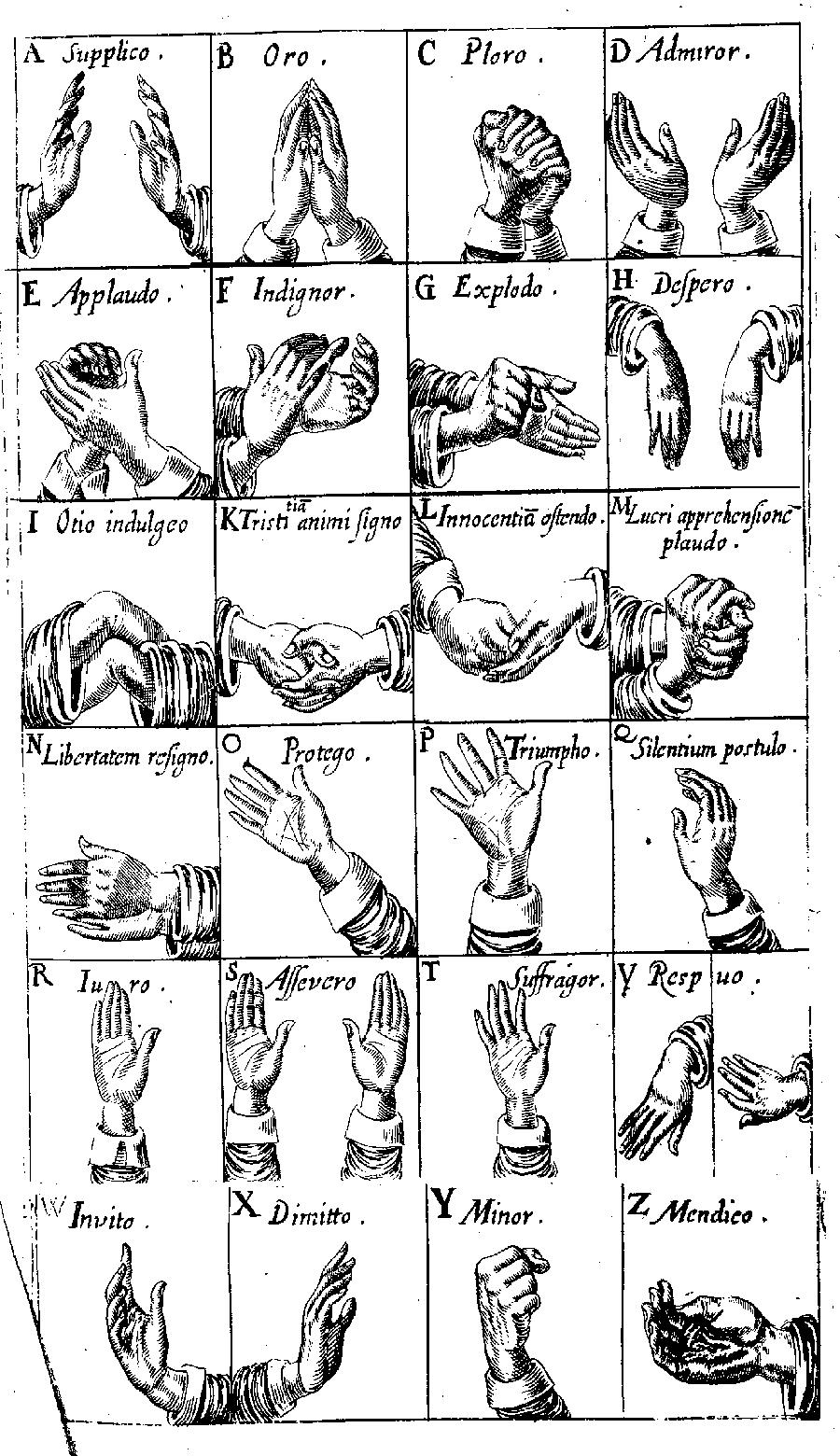
Further support for this idea comes from research on the Brocas area of the brain. This region is intimately connected with language, but is also part of the system that controls motor function in the mouth and hands. V. S. Ramacandran (in his 2003 Reith Lectures) speculated that cross-activation in this area is responsible for the tongue poking out during intense concentration on manual tasks for instance, and that this is related to the evolution of language. Gestures, mouth movements and language are obviously connected. People can communicate complex abstract language with only their hands.
Vocal sounds are, at least some of the time, used symbolically and the study of this phenomenon is called Sound Symbolism or Phonosemantics. The roots of sound symbolism may be in pre-language sounds which communicate emotions, and in mouth movements which either directly interact with an object, or imitate an interaction. In which case we would expect that both canonical and mirror neurons would be involved in the language as well - I'm not sure if anyone has looked at this.
One of the central dictates of modern linguistics is that "the sign is arbitrary". This is usually qualified by saying that it is arbitrary but not random, since clearly conventions of sounds are seen. Sound symbolism takes this further by saying that the conventions are so pervasive and they represent such a high a level of organisation that they cannot be arbitrary. Indeed it would be surprising if verbal sounds were arbitrary in relation to the concept being conveyed because they would exist outside the structure of language itself. Lakoff & Johnson say that abstractions are not arbitrary, but rooted in how we physically interact with the world. Sound symbolism tells us that there is a relationship between a word and it's meaning which is not arbitrary, but related to how verbal sounds function as symbols.
So Metzinger's theory is interesting because we can construct a plausible narrative about the evolution of communication around it, and it links up with other interesting ideas about the brain, the mind, and the evolution of language. It can incorporate many different observations, and it dovetails with other theories of embodied awareness and communication. It certainly seems to tie together many of my own interests. Though I note that one reviewer of The Ego Tunnel complained that "Grandiose philosophy is so 19th-century". [1] So perhaps Metzinger and I, with our interest in such "grandiose philosophy", are out of step with contemporary philosophy - but there have been few ages when being out of step with contemporary philosophers has been a bad thing. Personally I think Metzinger is ahead of his time.
This is not idle speculation on my part, nor only a side line. This idea has been bubbling away in my Buddhist brain because I am fascinated by Buddhist mantra. Mantras are said to be sound symbols, and I'm interested in how verbal sounds function as symbols. I believe that this sketch of a theory, or something very like it, might begin to explain the effectiveness of Buddhist mantras both as a collective, devotional practice, and in individual meditative practice -- without resort to the supernatural.
~~oOo~~
Note
- Flanagan, O. (2009). Review: The Ego Tunnel by Thomas Metzinger. New Scientist, 201(2700), 44.
image: Rhetorical gestures. Wikimedia.


 I
I
