
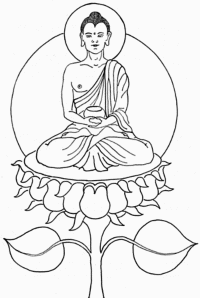
 IN THE TRIRATNA MOVEMENT, like many other Buddhist groups, we celebrate the Buddha's awakening about now, to coincide with the 2nd full moon after the Vernal Equinox. We call this festival Buddha Day, and it is trined with Dharma Day, two full moons later in July, and Sangha Day in November (a non-traditional date I think). I note that my local centre is celebrating Wesak this year instead of Buddha Day, and that Wesak has been creeping into our vocabulary. To my consternation I note that our main website has Wesak as the name of this festival as well.
The word buddha is, of course, the past-participle of the verbal root √budh 'to understand, to wake up'. It's often said that Buddha is a title, but in fact it is a description. In calling Gautama 'the Buddha' we are saying that he is someone who has woken up or understood. On Buddha Day we celebrate the fact of his having woken up.
Wesak, usually pronounced with wes to rhyme with 'mess' by English speakers, is the Sinhalese (corrupt) pronunciation of the Pali name of the 2nd lunar month of the ancient Indian calendar. In Sanskrit it is vaiśākha, and in Pali vesākha. The full title should be in Sanskrit vaiśākha-pūrṇimā and in Pali vesākha-puṇṇamī. The name itself has little spiritual significance. Vaiśākha means 'connected with visākha' and visākha means 'branched or forked' from vi- (divided, originally from dvi 'two') and sākha (a branch). And pūrṇimā means 'full moon.' So it just means the full moon day of the second lunar month, in an archaic calender that called the Spring Equinox New Year.
Most South-East Asian countries follow the Sinhalese by calling the festival some phonetic variant of the Pali vesākha. Burma, apparently, uses their own name for the same lunar month: Kason. The rest of the Buddhist world which celebrates the festival usually opt for a local name. In Japan it is hanamatsuri (花祭), literally 'flower festival'. In Tibet they say sagé dawa (sa ga'i zla ba ས་གའི་ཟླ་བ) which is also just the name of the lunar month in which the festival occurs, though their calendar is a bit different. And so on.
So there's nothing special or particularly significant about the name Wesak. The direct equivalent would be calling our festival "May Full Moon"or just "May", and mispronouncing the words slightly.
In India two different Sanskrit terms are used. 1. buddha-pūrṇimā 'Buddha full moon' - where pūrṇimā, again, means 'full moon'; and 2. buddha-jayantī 'the Buddha's victory', where jayantī means 'victorious'. I'm not sure why the feminine is used, but it clearly comes from the present participle jayanta 'victorious' of the verb √ji 'to conquer'. These two at least have the advantage of stating explicitly that they celebrate Gautama having awakened, and jayantī is really quite descriptive. The festival celebrates the Buddha's victory over dukkha ( or death, or Māra, etc.), and it just happens to be on the full moon day of the second lunar month of the old Indian calendar because that's the traditional date.
Calling the festival Buddha Day, as opposed to one or other of the Asian Buddhist terms, was doubtless part of Sangharakshita's conscious break with traditional Buddhism in the late 1960s. In a recent communique to the Triratna Movement he said:
The Triratna Buddhist Order and Community is not a continuation of the Tibetan tradition, or of any other particular Buddhist tradition. The particular iconographic, theoretical, and ritual frameworks of Tibetan or other traditions are not our reference point. This should be plain from the imagery, ceremonies, and rhetoric in common use in the Triratna Buddhist Community.When I asked him what he though about this creep towards using Wesak he replied:
"So far as I am concerned, it is Buddha Day, to correspond with Dharma Day and Sangha Day. I don’t know how the term Wesak has crept in. It was, however, in common use among English Buddhists, mainly Theravadins, many years ago. I think the Buddhist Society still uses the term."It's been suggested to me, in a discussion about this issue on Facebook, that one of reasons for using Wesak is that everyone is doing it. And yet for four decades we have been critical of this kind of group-think, of doing things just to fit in. I don't find this reasoning very convincing. It's clear that we are celebrating the Buddha's enlightenment, and not any particular traditional observance.
I've given some thought to this matter and have wondered whether the drift into using a traditional title for the festival is symptomatic of the commodification and commoditization of Buddhism. Commodification is the process of assigning monetary value to something that has previously been priceless: a move from social value to market value. This is one of the most potent forces in Western society at present - so that we truly are in a position these days to know 'the price of everything and the value of nothing' (Oscar Wilde. Lord Darlington, Act III). Commoditization on the other hand is when a different brands of a product become indistinguishable to the consumer. This tends to cancel out decisions based on features and causes consumers to decide on price - often leading to price wars.
If you go to a good book store they will have several dozen books on Buddhism, not to mention CDs and DVDs. Old classics go out of print and an endless stream of new books come out each year. Few of them add much to the gene pool. Most recycle what are becoming clichés. At the same time Buddhism is repackaged as lifestyle advice and sold under various guises. Although some centres operate on a donation basis, most of us have mortgages to pay, so our classes cost money. Of itself this is not necessarily a bad thing. But there is little in the popular imagination to distinguish what we do, from what the local Yoga centre, or the local Mindfulness centre do. The market for meditation and wisdom teachings is becoming commodified. This is fuelled by monism - the belief that all spiritual traditions aim at one truth, that beneath the surface "all is one", and all religions are essentially the same. I don't think price, more than distinctive teachings, drives choices about which tradition we get involved with, but I do think things like physical proximity and convenient opening hours do.
On one hand perhaps some of us buy into the 'all is one' meme, and just want to get along with everyone? Perhaps we don't feel so confident these days and seek safety in numbers? Perhaps we ourselves have lost a sense of our distinctiveness, or perhaps we are afraid that in asserting our distinctiveness we risk rejection by traditional Buddhists (with more accusations of arrogance)? Perhaps we just are not really individuals in the full sense, and are too easily swayed by the popular.
On the other hand the best response to a commoditized market place is to increase the value of the product - so most of our centres offer a range of services. In addition to more or less secular meditation courses, as well as basic classes on Buddhism, and more in-depth and explicitly Buddhist instruction, we teach Hatha Yoga, Tai Chi, Mindfulness Based Stress Reduction. You also get access to a community of like minded individuals. And of course part of community life is collective practice and celebrations.
So the response and the situation are both complex. And I don't mean to suggest or imply that Triratna Buddhists knowingly or willingly pursue commodification and commoditization - I think the opposite is true, we generally resist it. It's happening around us though, and because it is the mindset of the wider society, we can't help but be influenced to some extent. Most of the people we interact with tacitly support this kind of change because it means that they are materially better off, at least in the short term. We probably unconsciously participate simply by being members of a particular kind of society and culture. I think it's important that we be aware of this trend and resist it. But we also need to resist the blending in and settling down tendency. Our movement began as an explicit break with tradition. We need to be wary of treating tradition as a fall back. Falling back on tradition would be a disaster for us.
And I think adopting the name Wesak is a bit like this. It's not the result of a conscious consensus to change. There's been no discussion about it. We're expressing a sense of lack, or even, from what some people say, a sense of discomfort or even dislike. I'm playing this up a bit to make a point. But also I happen to be in contact with a number of people, almost none of whom are part of our movement, who are very excited about breaking with tradition. They call themselves 'secular Buddhists', or even 'non-Buddhists', and they write wonderful searing polemics of tradition. Forty years ago what Sangharakshita did was radical and caused a stir in the establishment; and yes, even some hatred. His polemics made him very unpopular in some circles (e.g. Forty-Three Years Ago, and Was the Buddha a Bhikkhu?) Right now that same attitude is becoming hot. Once we were the world leaders in this, now we appear to be choosing to fit in. I was attracted to the Triratna Community for many reasons, not least of which was that it was and is a community. But I also liked the zeitgeist, the zeal and zest, as well as the idealism and ideals. I wanted to believe. 18 years on I'm older and more cynical, and perhaps a little wiser.
I hope I'm not merely being cynical in criticising the use of Wesak. It's not a name that speaks to me the way that Buddha Day does. Some of my friends feel differently and it occurred to me that public holidays here in the UK are rather prosaically named. In New Zealand we have Waitangi Day, ANZAC Day, The Queen's Birthday, Labour Day which are full of meaning and history for us. "The May Bank Holiday" doesn't ring any bells for me, while Buddha Day is familiar territory. For Brits it's the other way around.
If I thought anyone would take any notice, I would suggest we have it on the same date each year, the way that Shingon Buddhists celebrate Kūkai's birth on the 15th of June (15th day of the 6th month in the Japanese lunar calendar); or, say, on the second Sunday of May each year. Make a clean break of it. However we seem to be sentimental about the archaic Indian lunar calendar, even when we have almost no comprehension of it. I have to confess that every fact I cite about it here is recently looked up for the purposes of writing this.
The second full moon after the Vernal Equinox of 2011 is on Tuesday 17th May, and that is when I will be celebrating Buddha Day - the Triratna Movement festival celebrating the the Awakening of the Awakened One.
~~oOo~~


 In this post I want to look at a theme that I explored in my recent talk at the London Buddhist Centre (available on