
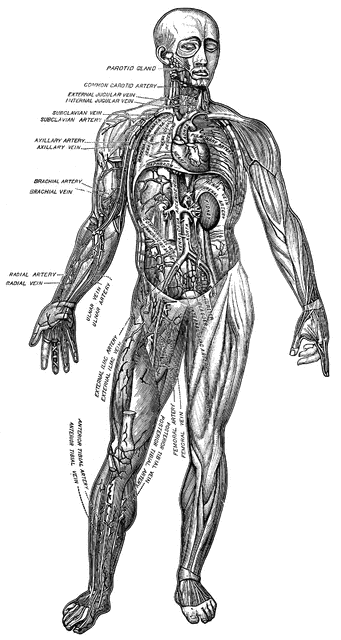
 PHILOSOPHER THOMAS METZINGER is interesting for a number of reasons. For one thing he has had a number of out-of-body experiences - spontaneous, waking and vivid - and he takes such experiences seriously. He says that any theory of consciousness must account for such experiences or it is "just not interesting". For Metzinger the sense of being an autonomous self is a consequence of the particular way the brain models its surroundings and interactions with them. In particular the proprioceptive or kinaesthetic sense is important in providing a locus of experience. Proprioception is the felt sense of our body - the sum total of information about muscle and tendon tension throughout the body, as well as information from the inner ear about orientation. It is proprioception that allows us to locate ourselves in space without seeing ourselves. Our sense of self, of being a self, is intimately tied to this internal model of the body.
Even when there is no actual limb to feel -- if one is amputated, or through a congenital defect never develops -- we may still have an image of it in our heads. Metzinger quotes the example of a woman born with no arms or legs who none-the-less experiences four phantom limbs with varying degrees of vividity. Phantom limb pain in amputees is a common problem. And how can something that does not physically exist cause us pain? Only if we have a mental representation of it, and it registers the mismatch between the representation and the reality in terms of pain.
In addition there is a visual map of the body generated in the brain. I've noticed, for example, that in learning Tai Chi I often have to look down at my feet to see where they are. My internal proprioceptive map is a little unreliable at times. So my visual sense helps to correct that - once I visually check where my feet are currently, I can correct their orientation and internally 'see' where they actually are, and feel what that is like, and hopefully learn to keep better track of them. Having to look at one's feet is rather a disadvantage in moving about, but in martial applications is potentially fatal. No doubt this is a modern malfunction, as it is hard to imagine our clumsy footed hunter-gatherer ancestors surviving long enough to breed.
It is possible for one or other of these internal maps to over-ride the other. As is shown by the rubber hand experiment we can integrate inanimate objects into our body image, a case of the visual over-riding the proprioceptive sense; and similarly in Phantom-limb Syndrome it is possible to have a felt sense of a limb where there is none to see (or feel). Sometimes a phantom limb will feel paralysed and V.S. Ramachandran has used mirrors to give a visual illusion of the missing limb moving which allows it to be re-animated in the mental model. Sometimes we can integrate an entire virtual body into our body image as in experiments carried out by Olaf Blanke in association with Metzinger (See Guardian 17.2.11 which likens Blanke's work to the Avatar movie where people 'inhabit' virtual bodies).
Metzinger has plausibly theorised that out-of-body experiences occur when the proprioceptive and visual models of the body lose synchronisation. They are most frequently associated with trauma which may account for the mismatch. The felt sense is of floating, while the visual sense is actually unchanged. Apparently the visual information available during waking out-of-body experiences is still just that of the physical eyes - one doesn't see one's own face for instance. It is not that we are receiving information from some other source, only that we feel our point of view as disconnected from its usual location. In a related phenomena we can feel a sense of presence near us (typically behind). This is the result of a similar process. It is ourselves we sense, but we feel dislocated from our visual sense, and so the felt sense becomes 'other', often interpreted as a 'spirit' for instance. I know several people who've had this kind of experience, and who interpret it as confirmation of the presence of supernatural beings.
I prefer Metzinger's explanation of the phenomena without in any way denying that an experience was had, or felt to be somehow significant at the time. I'm not convinced by explanations involving supernatural phenomenon because it is possible through direct brain stimulation (as sometimes happens in operations for severe epilepsy) or through stimulation of the brain using magnets against the skull, to cause these experiences to happen. An out-of-body experience can be physically induced using electro-magnetism to stimulate brain cells, and this reduces the likelihood of a supernatural cause to almost zero in my view. Recent studies have shown that the drug Ketamine can also induce out-of-body experiences, presumably also by disrupting the synchronisation of the various body maps in the brain. The explanation of the effect is found in the workings of the brain. The interpretation of the experience -- i.e. what it means to the person having it -- seems to depend on the context, and the preconceptions of the person having the experience.
I prefer Metzinger's explanation of the phenomena without in any way denying that an experience was had, or felt to be somehow significant at the time. I'm not convinced by explanations involving supernatural phenomenon because it is possible through direct brain stimulation (as sometimes happens in operations for severe epilepsy) or through stimulation of the brain using magnets against the skull, to cause these experiences to happen. An out-of-body experience can be physically induced using electro-magnetism to stimulate brain cells, and this reduces the likelihood of a supernatural cause to almost zero in my view. Recent studies have shown that the drug Ketamine can also induce out-of-body experiences, presumably also by disrupting the synchronisation of the various body maps in the brain. The explanation of the effect is found in the workings of the brain. The interpretation of the experience -- i.e. what it means to the person having it -- seems to depend on the context, and the preconceptions of the person having the experience.
During the late 1980s I became fascinated with F. M. Alexander and his 'technique'. I read all of his books, and all of the then available literature; and I had several dozen lessons in the technique. It is remarkable. Though it can be difficult to communicate what the Alexander Technique is or does, the gist is that Alexander discovered through trial and error that his proprioceptive sense was unreliable, and was able to retrain it by careful observation of his own movements using a mirror. Alexander thought that many ailments and malaises were caused by poor functioning of the body due to a corrupted proprioceptive sense, and indeed many people trained in his technique do enjoy better health generally. For instance your typical Westerner slumps, has rounded shoulders, and carries excess tension in their neck muscles (and doesn't know where his feet are!). This causes postural imbalance, breathing difficulties, back pain, and in the long term contributes to poor functioning, and probably emotional disturbances (though some would point the causal arrow in the opposite direction when it comes to emotions). In an Alexander Technique lesson one learns to retrain the proprioceptive sense through subtle physical interactions with a teacher who has an accurate proprioceptive sense. These interactions are very similar to some of the subtle techniques used in Tai Chi during sticking and push hands to sense the 'root' of a partner. It's something that has to be felt and is very difficult to put into words.
A mismatch between proprioception and vision can, in extremis, cause us to have out-of-body experiences. Most of us do not have such experience, but we do have these everyday minor glitches when we habitually slump or lose track of our feet. There is not enough disturbance to strongly effect our awareness -- no shifting of our point of view for instance -- but there is an effect. It clearly is a problem, and typically it becomes gradually worse over our life time. This suggests that as we try to find the best way to live in the modern world that attention to this problem needs to be considered.
Some kind of physical training which emphasises proprioceptive awareness rather than simply cardiovascular fitness or muscle mass, and in particular refines the accuracy and synchronisation of this sense with other aspects of our internal self model, would seem to be a desirable companion to any mind training techniques we use. We have a number of options from various disciplines. We can use Chinese Tai Chi, or Indian Yoga for instance; but from the West we also have Alexander Technique and the Feldenkrais Method which work more explicitly with proprioception without the more metaphysical and symbolic elements of Asian approaches. This doesn't exhaust the list. All temperaments are catered for.
This is a more prescriptive argument than I would usually make. I usually aim for understanding of a principle, or how to read a text; I'm not usually saying what to do on the basis of that understanding or reading, even if I think it's obvious what everyone should do. But for me there is a stronger sense of imperative about this theme of physical education because it is so clearly the direct cause of a lot of misery, and relatively easily dealt with. We had a subject called "Physical Education" at school, but though it involved being physical, moving around or playing sports, there was little or no education. By contrast many music schools now routinely give their students Alexander Technique lessons to ensure that poor body use does not result in repetitive strain injuries. Prevention is both better and cheaper than cure. And actually the practices are fun. If you aren't currently doing some form of body education along the lines I've been writing about, I would recommend that you start. The benefits are legion.
mens sana in corpore sano
nοῦς ὑγιὴς ἐν σώματι ὑγιεῖ
आरोग्यवन्मनः आरोग्यवच्छारीरे
~~oOo~~
nοῦς ὑγιὴς ἐν σώματι ὑγιεῖ
आरोग्यवन्मनः आरोग्यवच्छारीरे
~~oOo~~
See also:
- How the Brain Recognizes Its Body: How do we know which hands are own own? Scientists zero-in on the explanation.
- Out-of-body experiences linked to neural instability, biases in body representation. ScienceBlog.


 I
I 