
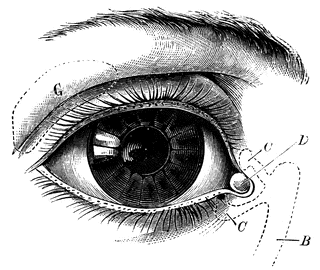
 I'VE COMMENTED BEFORE on the episode where the Buddha speaks to Bāhiya in a post entitled "In the Seen...". He begins the famous speech with: "in the seen, only the seen; in the heard only the heard...". This is somewhat cryptic, but I noted that I had found another sutta which acts as a commentary on the Bahiya incident: The Māluṅkyaputta Sutta is in the Saṃyutta Nikāya (SN 35.95 PTS: S iv.72).
My translation of part of the text says:
Having seen a form with mindfulness [sati] forgotten,
attending to the delightful appearance;
Experiencing an impassioned mind,
and remaining attached to that;
In him numberless sensations multiply from that form,
Covetousness and worry impair thinking.
Thus suffering is heaped up and nibbāna is said to be remote.
The gist is that without mindfulness, delight in the pleasures of the senses overcomes our minds and our minds are impaired. As a result we heap up suffering and are unlikely to be liberated - we will remain in thrall to pleasure seeking. Those who are mindful, do not delight in the pleasures of the senses, do not heap up suffering, and for them nibbāna is close.
In contemporary Buddhist presentations we usually find the idea that there is something other than the "seen in the seen" attributed to Brahmins. Compare the text above with this passage from the Chāndogya Upaniṣad (CU)
atha yatraitad ākāśam anuviṣaṇṇaṃ cakṣuḥ sa cākṣuṣaḥ puruṣo darśanāya cakṣuḥ | atha yo vededaṃ jighrāṇīti sa ātmā gandhāya ghrāṇam | atha yo vededam abhivyāharāṇīti sa ātmā abhivyāhārāya vāk | atha yo vededaṃ śṛṇvānīti sa ātmā śravaṇāya śrotram || CU 8.12.4 || [1]
Where the eye gazes into space, that is the puruṣa of the eye. The eye is for seeing. The one who experiences "let me smell this" is the ātman. The nose is for smelling. The one who experiences "let me say this" is the ātman. The voice is for talking. The one who experiences "let me hear this" is the ātman. The ear is for hearing.
atha yo vededaṃ manvānīti sa ātmā | mano 'sya daivaṃ cakṣuḥ | sa vā eṣa etena daivena cakṣuṣā manasaitān kāmān paśyan ramate ya ete brahmaloke || CU 8.12.5 ||
The one who experiences "let me think this" is the ātman. Mind is its divine eye. [The ātman] sees the delights and pleasures of the world of Brahmā, with this divine eye, the mind. [2]
Here CU is proposing that there is something other than the seen in the seen. In the seen we find 'the one who sees', which here is described as both puruṣa 'person' and ātman 'self' - the two are synonymous.[3] It is this ātman which, through the divine eye, sees the pleasures of the world of Brahmā/brahman (the word could mean either the creator god, or the universal essence; a distinction entirely lost in the Buddhist Canon). Elsewhere we find that this self is to be sought within the heart (i.e. through introspective meditation) and having once identified it, it becomes one's whole world (idaṃ sarvaṃ). The analogy I use is that when one falls in love, one's lover becomes one's whole world. We might also think of a meditator absorbed in samādhi, where the samādhi itself becomes their whole world.
Buddhist critiques of this kind of material are probably familiar to Buddhist readers. CU seems to propose that there is an 'entity' behind experience, an experiencing 'person' or 'self' which has the experiences. Discovering this self within oneself is what enables the seer to be liberated. However note that there is a discrepancy. The Brahmin does not aim to see the delights of this world. This is confirmed in many passages throughout CU as well as other Upaniṣads. Ordinary desire and the delights of this world are as much an anathema in the early Upaniṣads as they are in early Buddhist texts. The Brahmin ascetic aims at union with brahman, and thereby escape from saṃsāra. However the Buddhist criticism focusses on paying attention to delights of the senses. Is it because they deny the possibility of anything behind the senses, or have they just missed the point? I think it's not out of the question that the Buddhists simply did not understand the main points of the Upaniṣads and that the beliefs being criticised were not in fact held by Brahmins. Indeed as far as I can see such beliefs are not even attributed to Brahmins in the Pāli texts.
The Buddhist critique of ātman rests on the idea that, as an immanent aspect of brahman, it is substantial, permanent and makes us happy when we find it. Although the idea does not occur in the suttas, compare this description of nibbāna from the canonical Cūḷaniddesa:
Nibbānaṃ niccaṃ dhuvaṃ sassataṃ avipariṇāmadhammanti asaṃhīraṃ asaṃkuppaṃ.
"Nibbāna is permanent, constant, eternal, not subject to change, indomitable, unshakeable." [4]
Such a statement is common enough in Buddhism. How is this different? The essential difference here is that Buddhists assume Brahmins to be speaking literally, and take their own almost identical statements metaphorically. This assumption goes unchallenged amongst Buddhists. Why? I suggest that it is because of deep seated prejudices against, and antipathy towards, Hinduism. Our identity as Buddhists is bound up with rejecting Hinduism - even if only nominally. However I do not believe that the Brahmins were speaking literally. Rather, I'd say they were struggling to put into words their own meditation experiences, and were themselves inventing a new metaphorical language to do so, and rejecting their own 1000 year old traditions in the process. There's no a priori reason to assume unsubtly or stupidity on the part of Brahmins. In fact Brahmanical thinking of this period is scintillating and full of subtlety. A few centuries later the Buddhists of India adopted precisely the same kind of essentialist metaphor for tathāgatagarbha! Buddhists also posit a faculty other than the six senses—with no name I've been able to discover—which can discern nibbāna or "the Unconditioned" [sic] or "things as they really are". How is this different from the 'eye' which sees the brahmaloka? Note that Buddhists also adopted this Brahmanical idea of the brahmaloka, but again they took it literally. Which suggests that they simply did not understand the idea. The Buddhist criticisms of those seeking rebirth in the brahmaloka are wide of the mark, and more or less irrelevant from the point of view of the Upaniṣads. This is not to say that criticism is not possible, only that early Buddhist texts are wholly unconvincing in their criticism.
I am not suggesting that there is no difference in the doctrinal positions of Buddhism and Brahmanism. Clearly there are differences. However Buddhists have long exaggerated and distorted these differences. Modern Buddhists, like their ancient counterparts, seem largely ignorant of the Upaniṣads or the nuances in them. And as I come to better understand them myself, I am becoming increasingly doubtful about the idea that Buddhist doctrine is a reaction against Upaniṣadic Brahmanism: one can hardly react against what one is ignorant of. This raises interesting questions which I hope to address in the future.
For an inspiring and vivid account of the Brahmanical religion I heartily recommend this book:
William K. Mahoney. The Artful Universe: An Introduction to the Vedic Religious Imagination.I must warn traditionalist Buddhists however: this book may cause you to experience sympathy and respect for Brahmins, which could be detrimental to your Buddhist faith.State University of New York Press.
~~oOo~~
Notes.
- Chāndogya Upaniṣad. Sanskrit text from www.sub.uni-goettingen.de.
- My translation follows Valerie Roebuck's which is more literal than Patrick Olivelle's.
- As an aside I would once again like to point out the mad way we capitalise these words when they are in a religious context. We want to say that 'Self' is somehow different from, more important than, 'self'. Capitalising suggests either something substantial (a thing), or something transcendental (beyond our ability to sense or understand). Sometimes, paradoxically, both . Neither is very helpful. The Sanskrit 'ātman' is ambiguous, and the ambiguity is part of the fun. If we try to make clear a distinction when our source text is (perhaps deliberately) ambiguous we are not doing justice to the text: ātman means 'body, and self, and the immanent aspect of brahman.' And especially in the early Upaniṣads all three meanings are found. If we try to fix it as one or other we lose nuances, and we may in fact obscure the meaning.
- The CST version of the Pāli Canon does not include PTS page numbers for this text. It is from the commentary on the Pārāyanānugīti gāthā from the Sutta-niptāta. CST p.201.


 From the Buddhist point of view one of the important things about