
Attwood, Jayarava. (2017). ‘Epithets of the Mantra’ in the Heart Sutra. Journal of the Oxford Centre for Buddhist Studies, 12, 26–57. http://jocbs.org/index.php/jocbs/article/view/155
~o~
 |
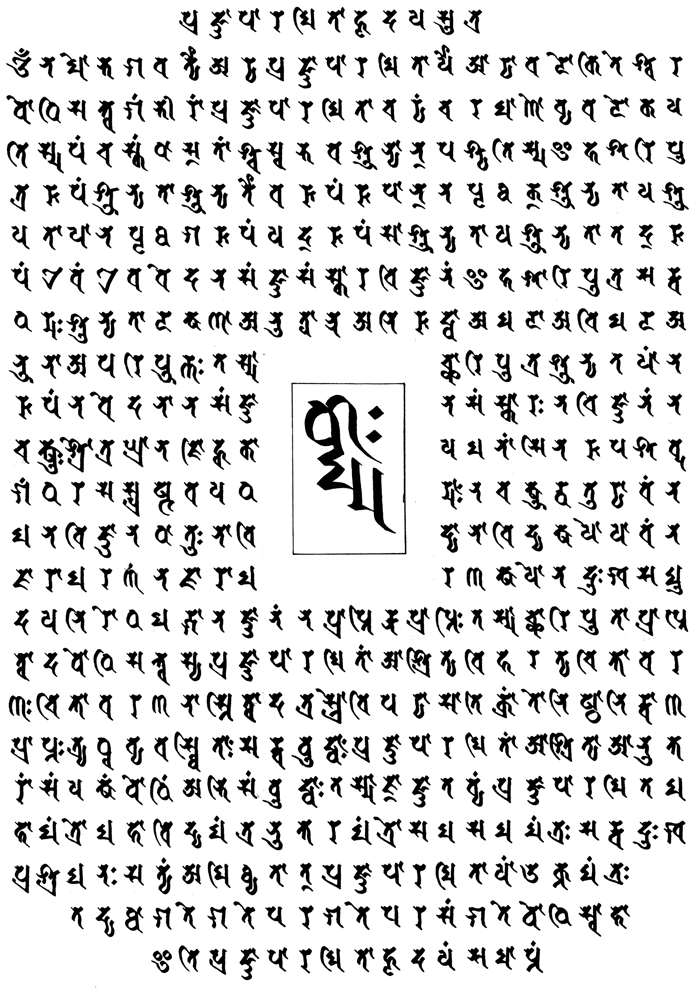
| Karaṇḍamudrā dhāraṇī |
The subject of this note is the epithets of the mantra. The section we're interested in reads:
tasmāj jñātavyam prajñāpāramitā mahāmantro mahāvidyāmantro ‘nuttaramantro ‘samasama-mantraḥ
Therefore, it should be known that the perfection of wisdom is a great mantra, a mantra of great insight, an unexcelled mantra, an unequalled mantra
For Conze these are epithets of the Buddha applied to a mantra as a way of conveying the magical power of the mantra: "The prañāpāramitā... is here envisaged as a spell" (1973: 101-104). The epithets in question are those from the familiar itipi so gathā that Triratna Buddhist Community members will know as the Buddha Vandana. In Pāli:
iti pi so bhagavā arahaṃ sammāsambuddho vijjācarana sampanno sugato lokavidū anuttaro purisadammasārathi satthā devamanussānaṃ buddho bhagavā ti
As we can see by simple comparison Conze is stretching things somewhat with this comparison. Of the Heart Sutra terms only anuttara 'unexcelled' has an actual parallel and it is a rather common superlative applied to any and all Buddhist ideals.
Nattier cites two letters sent to her by Nobuyoshi Yamabe. Yamabe San completed a PhD at Yale in 1999 and is the author of several books on Buddhism. Yamabe identified a number passages in Chinese which closely parallel the Heart Sutra epithets. Nattier adds two extra passages to those identified by Yamabe. We'll begin with the passage found in the Aṣṭasāhasrikā Prajñāpāramitā Sūtra (Aṣṭa). This text is the basis for the Pañcaviṃśatisāhasrika Prajñāpāramitā Sūtra (Pañcaviṃśati) and is therefore of some interest. Also the existence of a clear Sanskrit text allows us some insight into another matter.
故知般若波羅蜜多,是大神咒 ,是大明咒,是無上咒,是無等等咒,
Gùzhī bōrěbōluómìduō, shì dàshén zhòu, shì dàmíng zhòu, shì wúshàng zhòu, shì wúděngděng zhòu,
Therefore know the perfection of wisdom, the great magical mantra, it is the great knowledge mantra, unsurpassed mantra, an unequalled mantra,
般若波羅蜜多 bōrěbōluómìduō is a transliteration of prajñāpāramitā. A short digression here. The Middle Chinese pronunciation of 般若波羅蜜多, reconstructed from rhymes, but lacking information on tones, would have been ban ya ba ra mil da. As we will see shortly the Aṣṭa is written in Classical Sanskrit. However the transliteration banya suggests a spelling more like Pāli paññā than Sanskrit prajñā. Baum and Glass's interim Gāndhārī Dictionary record several spellings of prajñā from the Gāndhārī Dhammapada: praña, prañaï, prañaya. The transliteration of prajñā is quite standard across genres. I can find only one variant: 鉢若 bōruò, Middle Chinese balya. It seems the initial syllable was not heard or seen as a conjunct /pra/ by early Chinese translators even when we can be reasonably sure the text used it.
神 shén is a term from Daoism that is sometimes used to translate Sanskrit ṛddhi 'supernatural power' or even deva. Generally is means 'supernatural, divine' or 'magical'. It's missing from all of the Sanskrit versions of the text, which opens the possibility that it was added to the Chinese after the Sanskrit text was created.
Yamabe identified a counterpart from the Chinese Aṣṭa, early 5th century CE, translation by Kumārajīva (T 8.227 843b25-27) reads:
般若波羅蜜是大明呪,
般若波羅蜜是無上呪,
般若波羅蜜是無等等呪
Bōrěbōluómì shì dà míngzhòu,
bōrěbōluómì shì wúshàng zhòu,
bōrěbōluómì shì wúděngděng zhòu.
Prajñāpāramitā is a great vidyā (明呪),
Prajñāpāramitā is an unsurpassed vidyā (呪),
Prajñāpāramitā is an unequalled vidyā (呪).
As in the last essay, one doesn't need to know Chinese to see that these are the identical characters, except that the anomalous 是大神咒 shì dà shén zhòu is absent. If one knows that Chinese languages, like English, are subject-verb-object languages, one can even guess that 是 means 'is'. Also note that in the Aṣṭa the last syllable of prajñāpāramitā is left off, which is typical. The reason for translating 明呪 míngzhòu and 呪 zhòu as vidyā becomes apparent when we look at the Sanskrit text below. Note also the substitution of 呪 zhòu for 咒 zhòu, on which I will say more below.
The Sanskrit version of this text has been edited by Vaidya (p.36, line 30-p.37 line 7 = Conze 's translation p.108-109). This is one of the best attested texts of Buddhist Sanskrit literature. I have seen and handled the beautiful Cambridge manuscript (Add 1643) dated to 1015 CE, which forms the basis of the critical edition. It's written in Classical Sanskrit with just a few Prakritisms. The edition by Vaidya has been digitised, from which I take the following (placing each sentence on a new line to facilitate reading):
mahāvidyeyaṁ kauśika yad uta prajñāpāramitā|
apramāṇeyaṁ kauśika vidyā yad uta prajñāpāramitā|
aparimāṇeyaṁ kauśika vidyā yad uta prajñāpāramitā|
anuttareyaṁ kauśika vidyā yad uta prajñāpāramitā|
asameyaṁ kauśika vidyā yad uta prajñāpāramitā|
asamasameyaṁ kauśika [vidyā] yad uta prajñāpāramitā|
O Kauśika, the perfection of wisdom is certainly a great spell.
O Kauśika, the perfection of wisdom is certainly an immeasurable spell.
O Kauśika, the perfection of wisdom is certainly a measureless spell.
O Kauśika, the perfection of wisdom is certainly an unsurpassed spell.
O Kauśika, the perfection of wisdom is certainly an unequalled spell.
O Kauśika, the perfection of wisdom is certainly a peerless spell.
Kauśika is one of the epithets of the Vedic God Indra, usually called Śakra (Pāli Sakka) in Buddhist texts, who plays an important role in early Buddhism and is one of the main interlocutors of the Aṣṭa. The context here is the Perfection of Wisdom per se. Both apramāṇa and aparimāṇa mean 'not-measured or measureless'. Similarly both asama and asamasama mean 'without equal'. I translate vidyā here as 'spell', as the context shows that the idea is something to be spoken or chanted that has magical powers. There is an irreducible element of magical thinking in these texts that is inherent in their pre-scientific world view. It's nothing to be embarrassed about.
Note that the word in Sanskrit is vidyā throughout, and not mantra or dhāraṇī. Here we see 明呪 míngzhòu translating vidyā. Note that in the Heart Sutra epithets we get the sequence 大明咒,無上咒,無等等咒. In the context of the Heart Sutra the tendency is to see 明 as an extra character: the great 大 knowledge 明 mantra 咒. We know from the Aṣṭa passages that 明呪 means vidyā, so we ought to read 大明咒 as 'great vidyā'. And this means that 咒 is a shorthand reference to vidyā. The character 明 is being dropped from the other epithets, not added to only one of them.
Note that the word in Sanskrit is vidyā throughout, and not mantra or dhāraṇī. Here we see 明呪 míngzhòu translating vidyā. Note that in the Heart Sutra epithets we get the sequence 大明咒,無上咒,無等等咒. In the context of the Heart Sutra the tendency is to see 明 as an extra character: the great 大 knowledge 明 mantra 咒. We know from the Aṣṭa passages that 明呪 means vidyā, so we ought to read 大明咒 as 'great vidyā'. And this means that 咒 is a shorthand reference to vidyā. The character 明 is being dropped from the other epithets, not added to only one of them.
This passage from the Aṣṭa is a slightly more elaborate version of what we find in the Heart Sutra. Now compare the parallel passage in Kumārajīva's translation of the Pañcaviṃśatisāhasrikā Prajñāpāramitā Sūtra (T 8.223).
是般若波羅蜜是大明呪,是無上明呪。Though Nattier notes that the relevant chapter is missing from earlier editions of the Sanskrit, it is found twice in the more recent Sanskrit edition produced by Takayasu Kimura (vols 2&3). Kimura has edited the earlier Sanskrit text of Dutt and referenced both the Chinese and Tibetan translations to produce a new Sanskrit edition based on the same late Sanskrit manuscripts used by Dutt. So we cannot be entirely sure that Kimura has not, once again, back translated an existing Chinese passage into Sanskrit to fill a perceived void. In any case the two passages are:
Shì bōrěbōluómì shì dàmíngzhòu, shì wúshàng míngzhòu.
The prajñāpāramitā is a great vidyā, an unsurpassed vidyā.
mahāvidyaiṣā kauśika yad uta prajñāpāramitā, anuttaraiṣā kauśika vidyā yad uta prajñāpāramitā. (Vol. 2-3:55)
evam ukte bhagavān śakraṃ devānām indram etad avocat: evam etat kauśikaivam etat, mahāvidyeyaṃ kauśika yad uta prajñāpāramitā, anuttareyaṃ kauśika vidyā yad uta prajñāpāramitā, asamasameyaṃ kauśika vidyā yad uta prajñāpāramitā.
(Vol. 2-3:70)
The second of these more closely matches what we find in the Sanskrit Heart Sutra with three epithets: mahāvidyā, anuttara vidyā, and asamasama vidyā. It also alerts us to a further occurrence in Kumārajīva's Pañcaviṃśati (T. 223) at p. 286b28 (unnoticed by Yamabe or Nattier)
Vidyā has a number of connotations. Clearly both Aṣṭa and Pañcaviṃśati are applying the word to the prajñāpāramitā per se, not to the mantra (as we typically read the Heart Sutra). Vidyā derives from the verbal root √vid 'to know, to discover' (cognate with 'wise, wisdom' etc). Sometimes you'll see vidyā translated as 'science' but the whole context is pre-scientific so this is anachronistic. No body of knowledge before ca. 1700 fits today's definition of science, which is not to say that there was no valid knowledge, only that it could not be considered scientific until the scientific method ha been invented during the European Enlightenment. Vidyā means knowledge in a particular field: knowledge of the Vedas, knowledge of political governance etc. Knowledge cultivated through learning and experience, rather than divinely inspired knowledge or insight. It also have a magical connotation. Knowledge in the sense of vidyā bestows control over the subject studied, when one thoroughly knows a subject one is said to have "mastered" it. Ironically we are stuck using 'wisdom' for prajñā, which means (and is cognate with) knowledge; and 'knowledge' for vidyā, which is cognate with wisdom.
Although vidyā later becomes, at times, almost synonymous with mantra, at the time the Aṣṭa was composed, and probably even the Pañcaviṃśati, Indian Buddhists still probably thought of mantras as the spells mumbled by Brahmins (for money) at ceremonies. The Pāli texts contain a few passages making it clear that the chanting of mantras is un-Buddhist (DN 1 [i.9]; SN 7.8, SN 28.10, Sn 480). By contrast the chanting of parittās, or protective texts, was already established as a popular Buddhist practice in the Milindapañha, which predates the Aṣṭa.
般若波羅蜜是大明呪、無上明呪、無等等明呪。Again we see from comparing Chinese with Sanskrit, that 明呪 translates vidyā and here it is not abbreviated to 呪 but spelt out each time. If the core part of the Heart Sutra comes from the earlier passage of the Pañcaviṃśati then this passage suggests that the epithets were also borrowed, probably from this passage. Except that it is clear from the context that these epithets are not describing the mantra, but the perfection of wisdom itself. We associate the epithets with the mantra because the word mantra appears in the Sanskrit Heart Sutra. The word is used just twice in the Aṣṭa and not at all in the Pañcaviṃśati (suggesting perhaps that the Aṣṭa occurrences are interpolations).
Bōrěbōluómì shì dàmíngzhòu, wúshàng míngzhòu, wúděngděng míngzhòu.
The prajñāpāramitā is a great vidyā, an unsurpassed vidyā, an unequalled vidyā.
Although vidyā later becomes, at times, almost synonymous with mantra, at the time the Aṣṭa was composed, and probably even the Pañcaviṃśati, Indian Buddhists still probably thought of mantras as the spells mumbled by Brahmins (for money) at ceremonies. The Pāli texts contain a few passages making it clear that the chanting of mantras is un-Buddhist (DN 1 [i.9]; SN 7.8, SN 28.10, Sn 480). By contrast the chanting of parittās, or protective texts, was already established as a popular Buddhist practice in the Milindapañha, which predates the Aṣṭa.
The parittā practice may well be connected to the idea of the saccakiriyā (Skt satyakriyā) or 'truth act'. This practice, attested in for example the Pāli Aṅgulimālā Sutta, insists that plainly and clearly stating a truth can alter reality. Aṅgulimālā, for example, uses a saccakiriya to ease the pain of a women and baby experiencing a difficult childbirth. Many other examples are found in Pāli. Some scholars have attempted to link the practice to similar ideas in Vedic culture. There is even a suggestion that some aspects of the power of truth are Indo-European. Holding a red-hot axe-head is a test of truth in both Vedic and Celtic literature for example. It may be that by chanting a sacred text aloud, sacred texts being true by definition, that one might avoid calamity or avert disaster. As mentioned last week, this was how Xuánzàng used the Heart Sutra.
Nattier cites the example of the word for mantra as an example of a back translation. Her thesis is that the order of textual production was like this:
- Sanskrit Pañcaviṃśati
- Chinese translation Pañcaviṃśati
- Chinese Heart Sutra - short text
- Sanskrit Heart Sutra - short text
- Sanskrit Heart Sutra - long text
- Chinese Heart Sutra - long text
We can see that Nattier's theory explains the changes that occur in the word vidyā. In this case the Sanskrit Pañcaviṃśati (itself based on Aṣṭa) uses the word vidyā. Kumārajīva translated this as 明呪 míngzhòu, the usual translation of vidyā. The Heart Sutra first uses 明咒 míngzhòu then abbreviates to 咒 zhòu; where 咒 zhòu is a homonym for 呪 zhòu meaning dhāraṇī (or mantra). This is then back translated as Sanskrit mantra. The change from 呪 zhòu to 咒 zhòu might have occurred for any number of reasons, not excluding simple error based on similarities of sound and graphic form.
It is interesting to note here that T 250 (attributed to Kumārajīva) has 明呪 míngzhòu in each of the epithets, which conforms to the general pattern of Kumārajīva's translations noted above. Nattier's conclusion regarding T 250 is "[it] was based not directly on his version of the Large Sūtra, but on citations from the sūtra contained in the Ta chih-tu lun*" (187).
At the time the Heart was composed in China we might expect the key term to be dhāraṇī, since the mid seventh century date proposed by Nattier slightly predates the arrival of Tantra in China, while dhāraṇī texts, such as the Karaṇḍamudra Dhāraṇī depicted above, were and to some extent still are, a central aspect of Chinese Buddhism. The first Sanskrit version of the Heart Sutra was produced in India, probably in the late seventh or early eighth century at a time when Tantra was in full swing. These dates coincide for example with Stephen Hodges' proposed dates for the composition of the Sarvatathagata-tattvasaṃgraha. In such an environment mantra might have be the natural translation of 咒. Hence find a mantra where we expect not to and, according to my own definitions, where we might expect to find a dhāraṇī.
It is interesting to note here that T 250 (attributed to Kumārajīva) has 明呪 míngzhòu in each of the epithets, which conforms to the general pattern of Kumārajīva's translations noted above. Nattier's conclusion regarding T 250 is "[it] was based not directly on his version of the Large Sūtra, but on citations from the sūtra contained in the Ta chih-tu lun*" (187).
* i.e. T 25.1509 大智度論 Dàzhìdù lùn (Mahāprajñāpāramitāśastra) Attributed to Nāgārjuna and translated by Kumārajīva.Dàzhìdù lùn itself shows signs of partly Chinese authorship: "Some of the most notable evidence provided by Chou is that the Dazhidu lun’s commentary on the Mahaprajñaparamita Sutra follows Chinese word order rather than Indian..." (McBride 332-333)
At the time the Heart was composed in China we might expect the key term to be dhāraṇī, since the mid seventh century date proposed by Nattier slightly predates the arrival of Tantra in China, while dhāraṇī texts, such as the Karaṇḍamudra Dhāraṇī depicted above, were and to some extent still are, a central aspect of Chinese Buddhism. The first Sanskrit version of the Heart Sutra was produced in India, probably in the late seventh or early eighth century at a time when Tantra was in full swing. These dates coincide for example with Stephen Hodges' proposed dates for the composition of the Sarvatathagata-tattvasaṃgraha. In such an environment mantra might have be the natural translation of 咒. Hence find a mantra where we expect not to and, according to my own definitions, where we might expect to find a dhāraṇī.
This is further evidence that the Heart Sutra is synthetic, which is to say it was constructed in China from a variety of sources, probably by a devotee of Avalokiteśvara in the 7th century. Now on the basis of a comparison with the Sanskrit sources, there is an argument for revising this portion of the Sanskrit text:
tasmāj jñātavyam prajñāpāramitā mahāmantro mahāvidyāmantro ‘nuttaramantro ‘samasama-mantraḥ,becomes
tasmāj jñātavyam prajñāpāramitā mahāvidyā anuttaravidyā asamasamavidyā.
It should be understood that the perfection of wisdom is great knowledge, supreme knowledge, peerless knowledge.
~~oOo~~
Bibliography
- Conze, Edward (1973). The Perfection of Wisdom in 8000 Lines and its Verse Summary. San Francisco: City Lights.
- Takayasu Kimura (2010). Pañcaviṃśatisāhasrikā Prajñāpāramitā Vol. I-1, Tokyo: Sankibo Busshorin 2007. Online: http://fiindolo.sub.uni-goettingen.de/gretil/1_sanskr/4_rellit/buddh/psp_1u.htm [Input by Klaus Wille, Göttingen, April 2010].
- McBride, Richard D, II. (2004) 'Is there really "Esoteric" Buddhism?' Journal of the International Association of Buddhist Studies. 27(2): 329-356.
- Nattier, Jan (1992). 'The Heart Sūtra : a Chinese apocryphal text?' Journal of the International Association of Buddhist Studies. 15 (2) 153-223. Online: http://archiv.ub.uni-heidelberg.de/ojs/index.php/jiabs/article/view/8800/2707
- Vaidya, P. L. (1960) Aṣṭasāhasrikā Prajñāpāramitā. The Mithila Institute of Post-Graduate Studies and Research in Sanskrit Learning. Online: http://www.dsbcproject.org/node/8242


 he emphasises the abhiṣeka or initiation in particular because the abhiṣeka is the ür-ritual which underpins all of Tantric Buddhist practice. In Japan, prior to the arrival of Kūkai and Saichō with genuine Tantric Buddhism, some Tantric elements were present: images, dhāraṇī and mantra, and even texts such as the Mahāvairocana Abhisaṃbodhi Tantra. However, in the absence of the Tantric paradigm and organising principles, these elements did not add up to Tantric Buddhism.