23 May 2014

Vitalism: The Philosophy That Wouldn't Die

It's very much part of the modern Buddhist landscape to read passionate polemics against materialism/physicalism or "scientism" or even rationalism. However these polemics typically come with philosophical baggage. All too often the anti-Materialist is a Vitalist; the anti-Scientist is a Fideist; and the anti-Rationalist is a Romantic. Which is to say that in the argument over what constitutes right-view many, far too many, Buddhists are not arguing for the Middle-Way, but are repeating 19th Century Western arguments over the perceived faults of the science of the day and, consciously or unconsciously, adopting philosophical positions that are also of doubtful compatibility with Buddhism.

I say 19th century advisedly. My colleagues often seem to be stuck in a time warp when it comes to science. One of my colleagues recently cited Schopenhauer as having "refuted materialism", but Schopenhauer's key work The World as Will and Representation was published in 1848, 11 years before Darwin's On the Origins of Species. He died in 1860. So what did he even know about modern Materialism? Almost nothing. 

We now have some nascent critique of Romanticism in Western Buddhism with David McMahan's book The Making of Buddhist Modernism (which I would make required reading for all Western Buddhists) and Thanissaro's useful essay The Roots of Buddhist Romanticism. Very few Buddhist writers are openly Fideist (Dharmavidya being one recent exception) and we at least have a widely understood critique of blind faith, even if it's not something we all live by. So it seems to me that there is a gap around the issue of Vitalism and how it informs polemics against Materialism. In this essay I will begin to develop a critique of Vitalism specifically for Buddhists.


What is Vitalism?

Vitalism is a doctrine which argues that living things are distinguished from non-living things by a vital spark, an élan vital, life-force or living essence. The idea has a long history and is explicit in the works of some ancient Greek philosophers. In Indian terms this would equate to jīva 'the life force' (from √jīv 'to live').

If you've ever seen the corpse of a loved one, you'll probably have some sympathy for this view. For example seeing my father's corpse in 1990 led me to reflect that though the body was clearly his in every respect, that he himself seemed to be missing. Although even then I did not believe in a soul, the experience is still one that I find unsettling to recall. The Vitalist argues that what is missing is precisely the jīva.

Clearly the idea of a vital essence has much in common with a soul, though a vital spark might be less individualised and personalised. On the face of it, any view which endorses the idea of a jīva ought to be incompatible with Buddhism, but it is apparent that many Buddhists are also Vitalists.


Science and Vitalism

urea
Wikimedia
18th Century Vitalists argued that organic molecules associated with life would not be able to be synthesised from non-living matter. This hypothesis was disproved in 1828 when a German chemist, Friedrich Wöhler, reported that he had synthesised urea from cyanic acid and ammonia. Urea is a by-product of amino acid metabolism in mammals and a significant component of mammal excretions (birds excrete the related substance uric acid). It is the most common source of nitrogen in fertilisers for plants. Since 1828, virtually every molecule associated with living things has been synthesised in a laboratory from basic components.

Vitalist scientists once believed that one could prove the existence of this essence by weighing a body before and after it died. In the early 20th century this approach was put into practice by Dr Duncan MacDougall, though his results were inconclusive and his methods now look suspect. Dr MacDougall weighed his patients, bed and all, and the measurement error on his scales was sufficient to obliterate information at the level he claimed to be measuring. However neither Wöhler's discovery, nor any subsequent chemistry, nor MacDougall's failure completely destroyed the appeal of Vitalism, indeed in some circles it positively thrived.

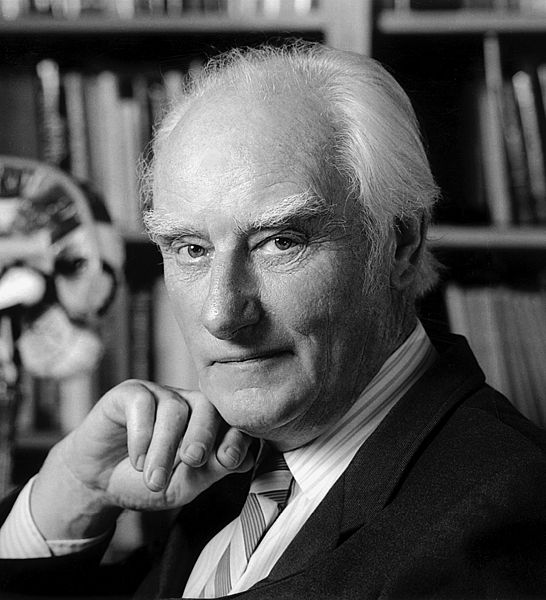
Many scientists have been focussed on continuing to undermine vitalism. For instance In a talk to Royal Society in March 2014 Dr Christine Aicardi described Francis Crick, one of the co-discovers of the structure of DNA, as an "anti-vitalist activist". Early in his career Crick had identified three problems related to disputes between Vitalists and Materialists (or between ontological dualists and ontological monists):
  • The frontier between living and non-living
  • Consciousness and the mind/brain question
  • The origin of life. 
Francis Crick
His first 27 years of scientific life (1949-1976) were spent at Cambridge exploring the first problem, where he helped to discover the structure of DNA and it's role in life and received the Nobel Prize. It's less well known, because his biographers down play it, but he spend the next 28 years (1976-2004) at the Salk Institute, San Diego helping to establish the scientific study of consciousness. In both places Crick joined the field at the beginning, when the mainstream attitude to them was frequently dismissive or even derogatory: molecular biology in the 1950's was seen as a quixotic discipline. Crick was instrumental in establishing both disciplines on a sound footing and getting the establishment to take it seriously.

It's even less well known that Crick briefly collaborated with Dr Leslie Orgel on the question of the origins of life. The two of them investigated the Panspermia theory that life arrived on earth from an extra-terrestrial source. But he decided to leave this area to Orgel. Aicardi argues that Crick's working life can be seen as vigorously pursuing an anti-Vitalist agenda and indeed as making a significant contribution to discrediting Vitalism, at least amongst scientists.

DNA
Francis Crick is a household name because his 1953 collaboration with James Watson, Maurice Wilkins and Rosalind Franklin in determining the structure of the DNA molecule earned the 1962 Nobel Prize in Medicine for Crick, Watson and Wilkins. Franklin died in 1958, aged only 37, and the Nobel Prize cannot be awarded posthumously. DNA was suspected to be involved in heredity since it is concentrated in the cell nucleus, but with the structure solved it could be seen how it was involved. We now know that the DNA contains codes for making proteins that perform a variety of structural and functional roles in a living cell. DNA and its close relative RNA are responsible for carrying information about how to build cells in all life on earth.

Defining the structure of DNA was an extraordinary breakthrough in our understanding of life. From it we have come to understand a huge amount about the function of living cells and what distinguishes a living cell from a dead one. We can now manipulate DNA at will, transferring genes from one organism to another, creating new genes. Recently an entirely artificial chromosome was synthesised and shown to be functional in a living cell. Of course we still have much to learn, but the distance between living and dead organisms, once thought to be an unbridgeable gulf, is now just a short hop. What we've discovered however is that complexity occurs at every level we examine. A living cell has tens of thousands of different proteins all doing vital work, each protein is itself a marvel of complexity. The problem of reverse engineering such a complex system is formidable. Ascertaining the structure and function of single proteins is the kind of work for which scientists have received Nobel Prizes. However it would seem to be only a matter of time before perseverance results in entirely synthetic "living" organisms. As one scientist said recently: "the conceptual unification of biology with physics and chemistry is now underway." - Aeon

But the Vitalist is loath to acknowledge the significance of these discoveries. They persist in the axiom that there is a fundamental difference between living matter and dead matter. So while the refutation of the basic propositions of Vitalism means is has been eliminated from the laboratory, it persists in the general population.

Presented with facts, Vitalists retreat into the unknown and base their truth claims on propositions that cannot be tested. This is also known as the God of the Gaps Argument. Whenever some advance in science means they are put to the test, and inevitably shown to be wrong, they simply retreat further into the unknown and make a different truth claim. As one prominent astrophysicist commented recently, the God of the Gaps argument suggests that "God is an ever receding pocket of scientific ignorance..." (YouTube) The God of the Gaps Argument is generally considered to be a poor argument for God and bad Theology. 

Since the idea of a jīva has been severely undermined by science, and since it was never very attractive to Buddhists in any case, the Buddhist Vitalist tends to focus on consciousness as the vital essence of living things. Traditionally Buddhists embrace a dualism between mind and body as expressed in nāma-rūpa or in rūpa versus the four 'mental' skandhas. The Salla Sutta refers to bodily (kāyika) and mental (cetasika) experiences. And since bodily transmigration is clearly out of the question, interest falls on the mind even though early Buddhist texts reject the idea that consciousness itself transmigrates.

Of course Buddhists argue against a direct transference and adopt the language of conditionality: the last moment of consciousness in one being gives rises to the first moment of consciousness in another. But how this is achieved is unknown. The idea is sketched out with metaphors, but the underlying reality the metaphors describe remains opaque and incomprehensible. The incomprehensibility allows for the Mind in the Gaps equivalent of the God of the Gaps argument. 


Science and Consciousness

The question of what is meant by the word consciousness is itself a book length project. I've explored this question to some extent in previous essays: especially What is Consciousness Anyway? One of my colleagues once remonstrated with me quite vehemently that "the study of matter will never tell us anything about consciousness!" This is very similar to the Vitalist argument argument about chemistry. In the early 19th Century the speculations of Vitalists concluded that there must be some fundamental difference between living matter and dead matter. Scientists showed that there is only one kind of matter and it all obeys the same rules. We can speak of living and dead organisms, but not of living and dead matter. Matter is just matter, it is neither living nor dead. "Life" is a property that is apparent only at higher levels of complexity and organisation. 

However the study of consciousness is still in its infancy compared with chemistry. Crick joined the Salk Institute in 1976 when the scientific study of consciousness was still seen as suspect, unscientific and even risible by the establishment. This kind of fact seems to be forgotten by those who argue that the only reason paranormal research is not taken seriously is the hostility of the establishment. What establishes a new field of study as bona fide is good science, replicable results and sound theories that make accurate predictions. The field of paranormal research has failed to do good science, and their theories make no accurate predictions. Indeed the paranormal field has been the victim of a number of high profile hoaxes: e.g. Project Alpha, crop circles, Uri Geller (still in business despite being exposed as a fraud!), the 100th monkey effect , and the Fox Sisters. In many cases the exposure of fraud has not deterred some believers from taking the supposedly paranormal effect as real. (See also my essay: On Credulity)

Crick on the other hand was instrumental in establishing two completely different fields about which the mainstream was doubtful, cynical and dismissive. Crick was able, in both cases, to produce results which forced the establishment to take notice. Another fine example of this is (my hero) Lynn Margulis, who fought for years against not only paradigmatic mainstream hostility, but also rampant sexism, to have Symbiogenesis accepted as a fact. It is now found in every biology textbook, but the original paper was rejected by fifteen academic journals. These days paranormal researchers publish in their own in-house journals and where the critique of the mainstream cannot reach them because when it does it generally debunks both their methods and conclusions. The 100th Monkey Hoax is one of the better examples of this. 

To-date the scientific study of consciousness has largely focussed on the way that consciousness is altered by brain injuries and other insults to the integrity to the brain. Even at this early stage we know that an ontologically dualist explanation of consciousness seriously struggles to explain what we observe. Clearly consciousness is tightly correlated with brain activity with a good deal of function/location specificity. Chemicals and highly location specific brain injuries create predictable breakdowns in the functioning of the mind. As imaging techniques become more sophisticated we are also starting to get glimpses of brain activity associated with various tasks (though it is very much early days).

If, as the Vitalist often argues, consciousness is able to completely separate from the body (and by implication the brain) then why does brain damage inevitably negatively impact on consciousness? No explanation which calls for an absolute distinction between mind and brain can account for this phenomenon in a coherent way.


Brains

As with the chemistry of life it's useful to start small. So scientists study small organisms with only a few neurons into order to assess the roles of the various structures involved. For example the OpenWorm project has mapped all of the cells of a particular kind of microscopic nematode worm. This organism contains 302 neurons and 95 muscle cells. On this scale they are able to map every single cell and all of the connections between cells: the somatic nervous system (282 neurons) contains 6,393 chemical synapses, 890 gap junctions, and 1,410 neuromuscular junctions. Such a map is called a connectome. Studying the organism at this level will give us a much clearer picture of how a nervous system creates behaviour. Scientists boldly claim that the computer models of the organism themselves constitute artificial life-forms, and while the enthusiasm is understandable, this is probably overstating things a little.

Partial Human Connectome
Since the structural units of the nematode are more or less the same as the structural units of a human brain - the difference is in the complexity of our brains - modelling the nematode's nervous system ought to give us insights into our own brains. The effects of scale are bound to introduce differences however - our brains have 100 billion neurons with 100 trillion connections. The emergent properties of systems this complex are impossible to predict.

Similar work is being done at a variety of levels. Larger scale maps of the human connectome are now emerging and recently a new technique for preparing brain tissue has revealed a 1:1 scale map of every neuron and synapse in a mouse brain (watch the video!). Meanwhile the Blue Brain Project is simulating individual cortical columns (as seen on TED) millions of which make up our neo-cortex.

However the Vitalist can dismiss all of this with one sweep of the hand because for them studying the brain will not reveal anything about subjective consciousness. Vitalists also argue that we'll never know what it is like to experience the world from someone else's point of view. I don't accept this for a simple reason that was evident to early Buddhists as well. Most of us are highly skilled at modelling emotional states using empathy - we do not simply guess what another person is feeling, we actually have the same experience as they do. How do we know it's the same? We communicate about what the experience is like and there are aspects of experience that are universal. A skilled story teller can make their audience laugh, cry, boil up in anger or cringe in fear. This could not happen if inner-states were truly unique. The fact is that we do know what it's like to have a point of view which is not our own. Some of us a better at it than others, but the ability is available to some extent to all social animals.


Conclusion

It's more than a century since any scientist took Vitalism seriously. It's not a theory that makes accurate predictions and has been shown to be inaccurate in many ways and on many occasions. However Vitalism still has its appeal outside the laboratory, especially with religious people. It appeals to that part of us that is disturbed by the idea of our own death, an area of particular concern to religion. The idea that human beings, often over and above other kinds of life, contain a vital spark, an essence, a jīva that not only animates us in this life, but which survives our physical death and makes an afterlife possible is an enticing prospect. If at the same time we are ontological dualists, with a predisposition to reject the impure material world then some kind of pure animating spirit is almost a requirement. The attraction of Vitalism is obvious. But the life ought to have gone out of Vitalism by now. It has been refuted time and again. Vitalism is like a philosophical zombie, suffering from partial death syndrome. 

Vitalism, like other non-materialist doctrines, survives and prospers by appeals to the unknown and unknowable. The truth claims of Vitalists by necessity lie just outside the province of scientific knowledge, where-ever the boundary happens to lie. The fact that Vitalism is found to be flatly wrong whenever the frontiers of knowledge advance is of no concern to anyone who can retreat into the unknown. Despite the fact that Vitalism has repeated been proved an inaccurate worldview, Vitalists still claim it cannot be proved wrong. Thus Vitalism is more in the realm of theology than science these days.

For Buddhists the attraction is not so much in physical Vitalism - the distinction between living and dead matter; as in psychological Vitalism - the interest is in sentience and in how that can be transferred (along with habits and memories) from one being to another. Explaining this is usually at least implicitly Vitalist - the metaphor of one fire kindling another is explicitly Vitalist. This view can easily come to the point of arguing that consciousness is what animates the living being.

~~oOo~~


The next essay in this series on Vitalism will look more closely at the transition from dead to living.

16 May 2014

Water, water everywhere...

I've been thinking a lot about how a failure to understand science affects the arguments against materialism. In Buddhism we often make the argument that you cannot understand Buddhism unless you have practised it. By the same token we might argue that unless one has practised science one can hardly be expected to fully understand it. And as a result many people have naive and unsophisticated views about what science is.

If more people had a positive experience of discovering empirical laws for themselves in school that we might be having a very different discussion about religion and science right now. Unfortunately most of us learn science in large classes aimed at middling students, from average teachers who may or may not have become jaded by the grind of the job. In the end most of don't actually learn any science. But for me learning science was always a joy. I want to see if I can communicate something of this.

Take the humble substance, water. Water is remarkable stuff. We all know this. We might know that ⅔ of the earth is covered in it, and that our bodies are 80% water. We know that it's essential to life of earth, that in many ways it is the medium for life. Most scientists believe that life on earth must have started in water. The properties of water are:
  • Water is a liquid at standard temperature (20°C) and pressure (1 atmosphere). 
  • Under STP it freezes, i.e. becomes a solid, at 0°C STP; and it boils, i.e. becomes a gas, at 100°C. 
  • Water is an excellent solvent and able to dissolve most minerals.
  • Water is an electrical conductor and with even small impurities can be an excellent conductor.
  • Liquid water has a high-surface tension so that it forms relatively large drops. 
  • Water is moderately chemically stable - it doesn't easily react with other chemicals. 
  • Water ice can take as many as 15 different forms depending on the conditions.
  • Water vapour is a major contributor to the greenhouse effect. 
The water molecule is represented by the chemical formula H2O. This means that each water molecule contains one oxygen atom and two hydrogen atoms. The two hydrogen atoms attach to the oxygen on one side about 105° apart from each other. I look at the reasons for this shortly.


But how do we know all of this? Isn't it all just some theory? Well, no. It's not all "just theory". It certainly involves interpretive theory, but most of it is either from direct observation, or deductions from indirect observations. I'll try to explain how we know about the water molecule.


electrolysis
If we pass an electric current through water (a process called electrolysis), gas bubbles form at each of the electrodes and the amount of water is reduced. If we collect the gasses we can discover that they are oxygen and hydrogen. Hydrogen was isolated and characterised by Robert Boyle in 1671. Oxygen a century later by Carl Wilhelm Scheele in 1772 (published in 1777). If we mix hydrogen and oxygen and provide a spark to kick things off, then in an explosive reaction they recombine to form water and nothing else. (I've done this and it is quite spectacular!) Boyle showed that any gas at a given temperature and pressure will occupy the same volume - this is an empirical law that holds true for all gases. When we electrolyse water we get twice as much hydrogen gas as oxygen gas. Hence we deduce that in water there is twice as much hydrogen as these is water. Hence the chemical formula: H2O.

2 H2 + O2 ⇌ 2 H2O

If we use pure water this is always true. Impurities do change the result slightly. But anyone can take a battery and two wires and pass electricity through water and see bubbles forming. And bubbles at one electrode will always behave like oxygen (for example will make a flame glow brighter) and bubbles at the other will always behave like hydrogen (react explosively with air), and there will always be twice as much hydrogen as oxygen. Always.

One of the important things to note is that water has properties as a compound that neither of it's component parts, oxygen and hydrogen, have or even hint at. That two gases would combine to form a liquid with entirely different physical and chemical properties is an important observation. With 20th centuries theories we not only understand this but have successfully predicted the properties of new elements and compounds. 


emission spectra
If we heat these gases till they are incandescent and start giving off light (in the same way that a heated filament does) or pass an electric discharge through them (as in a fluorescent light bulb) then we examine the spectrum of the light given off we will find characteristic frequencies of light (called an emission spectrum). We all know what sodium vapour lamps look like - the characteristic bright yellow light comes from hot sodium atoms. In fact hot sodium atoms give off two precise wavelengths of visible light, both in the part of the electromagnetic spectrum we perceive as yellow. The colours of fireworks are produced in a similar way: certain metallic elements give off specific colours when hot: strontium, a deep red; cobalt, blue; copper, green and so on. Mixing a little strontium in the gunpowder makes the explosion glow red. So we can also test for hydrogen and oxygen by measuring the light that they give off. This is also how we know the composition of distance stars - characteristic frequencies tell us the kind of elements present, and relative brightness tells us the proportions.

The structure of the water molecule is deduced by combining information from many sources. For example we might look at the six-fold (hexagonal) symmetry of snow flakes. There's only a limited number of configurations of molecules that could produce this shape. Or we can take a crystal and shine X-rays through it and measure how the X-ray beam is scattered. Different kinds of crystal give characteristic scattering patterns. This was how Rosalind Franklin deduced that DNA must be a helix. (here is her original 1953 paper). In fact water-ice can form with 15 different crystal structures depending on the temperature and pressure when it forms. (See Ice: phases)

We can also deduce something important from what kinds of substances water will mix with and what it will dissolve. For example we know that water and alcohol mix completely and can only be separated out by distillation - which involves boiling the mixture. Ethyl alcohol boils at 78°C so it boils first and turns into a gas that drifts away from the liquid. However water will not mix with oily substances. Water will dissolve rock given time, but not wax. 

NASA
There's a neat trick you can do that helps to explain this. We all know about static electricity. If you rub plastic with a natural fabric the difference in electrical properties causes a transfer of electrons and the build up of a static electrical charge. If you wear nylon clothing your whole body can build up a charge that discharges when you touch another person or a door handle (for example). If you charge up a balloon with a good amount of static by rubbing it on someone's clean dry hair (which is entertaining in it's own right) and bring it close to a stream of water, the stream will bend towards the balloon. It turns out that water is able to be attracted by an electric charge. But oils and fats are not.

CO2 
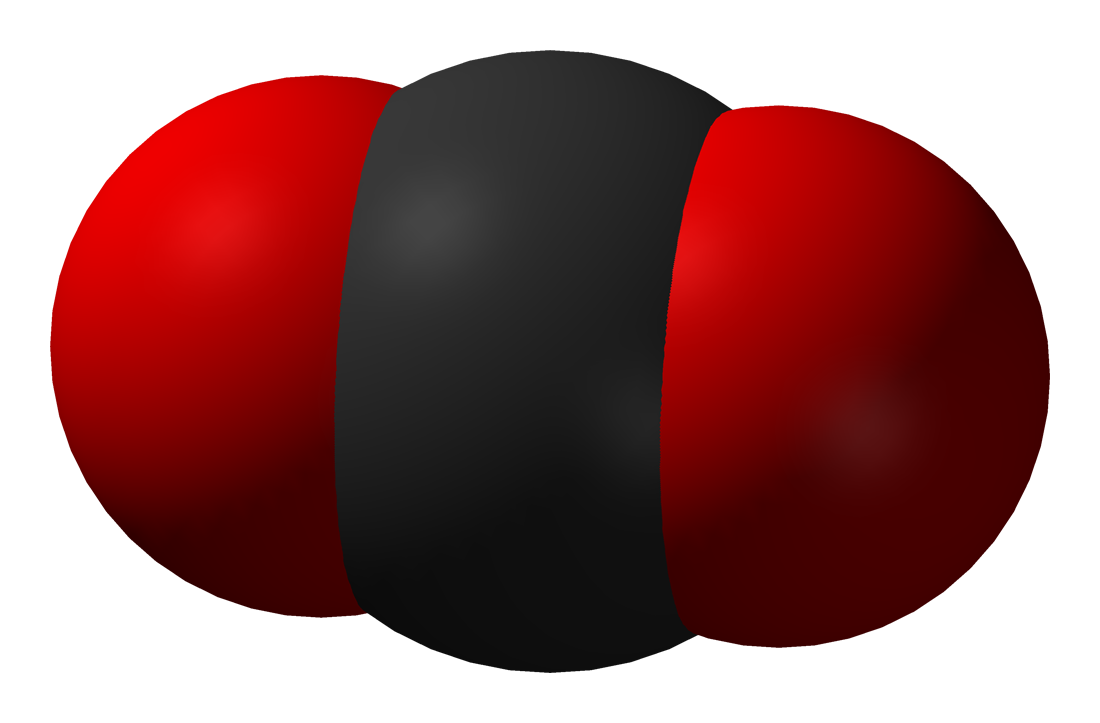
If the water molecule were symmetrical it would not be able to be attracted by an electric charge. Carbon dioxide is symmetrical and not subject to static, which is why one ought to use a CO2 extinguisher on an electrical fire and not water (which conducts electricity). The conclusion we get from all of this is that water molecule must be asymmetrical, giving it a slightly negative charge at one end and a slightly positive charge at the other. Thus we can deduce that the two hydrogen atoms must both be on one side of the molecule. By looking at snowflakes and other ice-crystals and by measuring just how susceptible pure water is to electrical attraction we can get a pretty good idea of how asymmetrical the molecule is.  The best estimate for the angle between the two hydrogen atoms is 104.5°.

We can get a better understanding of water by comparing similar compounds, especially those involving atoms nearby in the periodic table. For example might look at hydrogen compounds of carbon, nitrogen and fluorine on the same row, and sulphur in the row below. If we look at how each of these elements combine with hydrogen we find that carbon forms a compound CH4, (methane); nitrogen forms NH3 (ammonia) and fluorine forms FH (hydrogen fluoride). So there is a pattern here: 4, 3, 2, 1. Sulphur forms a compound H2S (hydrogen sulphide; aka rotten-egg gas), just as oxygen combined with hydrogen in a 2:1 ratio. In fact one of the reasons sulphur is in the same column of the periodic table is precisely because it forms H2S and not H3S  or HS.


Clearly the naming conventions are a bit mixed - common names, legacy chemical names, and modern notations compete. If FH is called "hydrogen fluoride" despite the formula being FH "fluorine hydride". If they fit the pattern above H2O and H2S really ought to be OH2 (oxygen dihydride) and SH2 (sulphur dihydride) but they never are.

By comparing the physical properties of all these we get further insights. CHis a gas at room temperature, highly combustible in oxygen but otherwise quite chemically stable, and insoluble in water. NHis also a gas at room temperature, strongly reactive with other chemicals, and is highly soluble in water. FH boils at 19°C; it is highly water soluble forming hydrofluoric acid and extremely reactive (hydrofluoric acid is used for etching glass which is not touched by concentrated sulphuric or nitric acids).

Thus we can deduce that carbon with its fourfold symmetry forms a more stable molecule. And we known that carbon forms more kinds of compounds than any other element - it is the basis of organic chemistry.

If 4 objects surround a fifth symmetrically they occupy the points of a tetrahedron - the internal angle between each would be 120°. So as a first approximation we might expect NHto be a tetrahedron minus one point (or a three sided pyramid with N at one apex). Again, if the H atoms in NH3 were evenly distributed around the Nitrogen we'd expect different properties (e.g. less soluble in water). For the two H atoms in a water molecule to be about 120° apart. In fact as I said they turn out to be 104.5°.

The mathematical models for atoms predict that each electron will have a distinctive energy. But also they will allow for pairs of electrons with different "spin" (an abstract physical property the consequences of which are observable in subtle experiments, but which would take a long time to describe). Hydrogen has only one electron and is highly reactive with almost anything that can accept an electron. Helium atoms with two electrons are very reluctant to form any chemical bonds. They occupy opposite ends of the first row of the periodic table. It turns out that if we add a third electron, as in lithium (Li) then we once again get a highly reactive atom. But atomic carbon with six (2 + 4) electrons is relatively stable and fluorine with nine (2 + 7) electrons is once again highly reactive and neon with 10 (2 + 8) electrons is almost completely inert.

The pattern is consistent with different types of orbitals for electrons. The first (s) orbital takes 2 electrons and is more or less spherical. The second (p) orbital takes 8 electrons, in 4 pairs. We can guess from the kinds of molecules they form (and the crystal structures of those molecules) that these orbitals form a tetrahedron. (In fact there is a difference between atomic and molecular electron orbitals, but we'll focus on the molecular orbitals). The shape of these orbits are relatively inflexible which is partly why water and ammonia are asymmetrical.  

Wikimedia
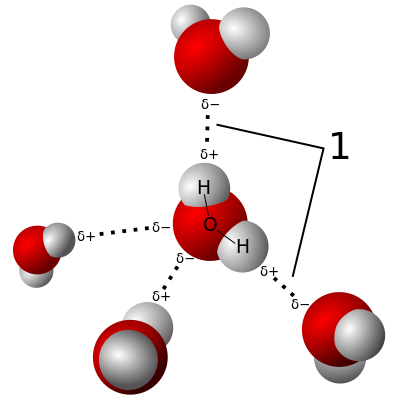
In any case we now roughly know the shape of the water molecule and its electrical characteristics. And we can begin to relate these to some of its physical properties. For example the fact that water molecules are not symmetrical means that one end of the molecule as a slight negative charge and one end (the side with the two hydrogen atoms) has a small positive charge. This accounts for water's electrical conductivity. It also means that water molecules exert a weak attraction on each other - known as a "hydrogen bond" (indicated by a Greek delta δ in the picture). The positive ends of water molecules are attracted to the negative ends of others. This accounts for the surface tension of water. Water is very cohesive. In fact compared to similar liquids (methane, ammonia, or hydrogen sulphide as liquids) then water has a very high boiling point - indeed the other substances mentioned are all gases at room temperate. Ammonia NH3 boils at -33°C and hydrogen sulphide H2S boils (becomes a gas) at -60°C! So H2S is very different indeed from H2O. In order to break the attraction between water molecules one has to use a great deal more energy than to break the attraction between hydrogen sulphide molecules which are more or less the same shape. This also means that weight for weight water can absorb a lot of heat, which makes it useful as a cooling fluid in a variety of settings. 

With the dawn of the 20th century mathematical models of atoms began to become more sophisticated and were able not only to explain the behaviour of atoms and molecules, but to make predictions. One of which was that a molecule like water would have many different ways it could vibrate: rolling, tumbling, spinning on its one symmetrical axis, stretching bonds symmetrically and asymmetrically, flexing the two bonds. And many others. And each of these modes of vibration was calculated to have a specific energy. It turns out that the energies of these modes of vibration fall in the infra-red/microwave part of the electro-magnetic spectrum. By shining infra-red light through water, and sweeping the frequency we can see what frequencies get absorbed, corresponding to making the water molecule wiggle, and refine the theory with observations. (See also Water Absorption Spectrum).


vibrational modes of the water molecule.
click image to see animation.
Spinning water molecules is also the explanation for how microwave ovens work. The microwave was patented in 1945 by Raytheon, though in fact it was discovered by mistake when a scientist working on radar melted his chocolate with his equipment. Apparently the first food to be deliberately cooked in a microwave oven was pop-corn. Water molecules spin around at ~ 2.4GHz (in the microwave part of the spectrum). Light at that frequency is absorbed by water molecules and translated into spinning, which manifests as heat (at the molecular level heat is equivalent to the speed of motion). Thus by shining microwave frequency "light" at 2.4 GHz on anything which contains water (like food) we can make it heat up.  

Bucky ball
The theory also explained in detail why certain molecules took certain shapes and why for example the fourfold symmetry of methane was a particular stable configuration. By comparing theory to observation for all of the elements we have developed a very sophisticated description of the chemical compounds we know about. But it also enables us to predict new chemical compounds and to understand how we might make them. Buckminster-fullerene, so-called "bucky-balls", a form of carbon molecule with 60 carbon atoms arranged in hollow sphere with a structure like the domes designed by Buckminster-Fuller (or like a football), were synthesised using this knowledge. This knowledge has also helped to explain the structure and function of complex molecules like cortisone, oestrogen and testosterone.

Quantum mechanics makes for an even more detailed description of molecule although with detail comes complexity. Some of the insights of quantum theory have helped in understanding the electrical behaviour of semiconductors and super-conductors. But to return to water.

The unusual ability of water to remain in the liquid state that make it the idea medium for life. Similarly the ability of water to dissolve a range of gases, minerals and many organic compounds (sugars, alcohols, amino-acids, etc) without changing them chemically, make it the ideal medium for mixing a huge range of different chemicals such as we see in living cells (compounds which number well into the tens of thousands).

This is only the briefest of surveys of what I remember from a few years of studying chemistry applied to a single, though important and interesting molecule. We now have detailed descriptions of all of the 96 naturally occurring elements, many of the artificially created elements, and millions of chemical compounds and reactions. These descriptions underpin most of the industrial processes that have made the developed world wealthy. If you're inside and you look around, the products of this knowledge will surround you: from the structural materials of your house, to the paints and other decorative elements. 

Vanillin.
Wikimedia
In my 3rd year organic chemistry class we had two major practical tasks. In the first term we were handed a vial of white powder and asked to find out what it was using any means available to us. Using chemical and spectroscopic (scanning the stuff with infra-red light) and nuclear-magnetic resonance methods I determined that my unidentified white powder was vanillin, one the the two main compounds responsible for the smell and taste of vanilla. It could not be another compound. The evidence was completely specific. The conclusion was not the product of a narrative or a worldview. If anyone else had accurately tested it, at any time and place, they would have also have found vanillin.

Coumarin
Wikimedia
The second task was to synthesise a compound called coumarin from basic laboratory reagents. Coumarin and its many related organic compounds are partly responsible for the smell of freshly grass (there are others). So the first sign of success in the synthesis - which requires a number of separate stages of chemical reaction - was the pervading smell of freshly cut grass. As it happens coumarin is also a white powder and I took my product home to make my room smell nice. The smell of freshly cut grass pales after a while. And I was able to specify in great detail, exactly how and why the recipe worked.

So when people scoff at science I find it very peculiar. When people say it's just one narrative amongst many or than there is no objectivity in science, or (worse) that everything we know from science is subject to change, I can't help thinking that only a really ignorant person could say something like this. I've personally used all of the techniques mentioned above, done the practical experiments and derived the empirical laws. But I'm not the only one. Many people have done just the same and got exactly the same results. It really does work, and it really doesn't matter what you believe about the nature of the universe. If you look, this is what you'll find, but even if you don't look this is still how thing are!
(See also Seriously, The Laws Underlying The Physics of Everyday Life Really Are Completely Understood). 
I don't think anyone who has not done chemistry, had the practical insights into chemistry, at this level or beyond, can really understand what it's like.

~~oOo~~


Here is another account of water with prettier pictures: water.
Related Posts with Thumbnails