 |
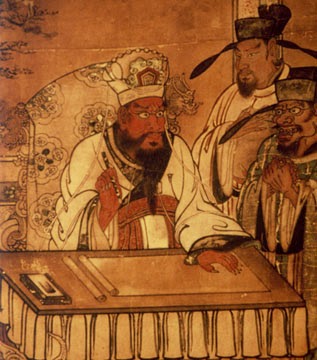
| Japanese Yama (Enma) as a Confucian administrator. |
As we saw in an earlier essay, Yama has a twin sister Yamī. In fact the most likely meaning of the name Yama is 'twin'. Yama has a counterpart in Iranian myth called Yima and, in Avestan myth, the incest of the twins helps to found the human race. In the Ṛgveda the brother resists incest with his sister. I've written about the curious fact that the Pali suttas record that the Śākyas claim descent from a sibling incest mating, which I take to be evidence of their connection to Iran (see Possible Iranian Origins for the Śākyas and Aspects of Buddhism). Brother-sister incest was common amongst ancient Iranian royalty, a practice I believe them to have adopted on the Egyptian model. Some scholars have tried to link Yama to the Norse Ymir, but this is disputed.
Yama in RV 10.14 has two messengers which are brindle-coloured, four-eyed dogs (sārameyaú śuvā́nau caturakṣaú śabálau) with flared nostrils (urūṇasā́v). They wander among men, satisfying themselves on the breath of life (asu). However they are also keepers of the path (pathirákṣī) and watch over men (nṛcákṣasau). Note that some authorities think that śabala (brindle) is cognate with Greek ḱerberos (spotted), the name of the Hades's 3-headed watchdog. Hades named his dog "Spot". The Buddhist Yama also two messengers though their form as dogs seems not to be mentioned.
Yama as we know him in early Buddhist texts is the ruler (rājan) of the rebirth destinations known as Niraya (Pali) or Naraka (Pāḷi & Sanskrit). PED derives niraya from nis+√i 'to go down' (nis- followed by a vowel become nir-). PED also cites a parallel in Buddhist Hybrid Sanskrit, though this is not listed in Edgerton's BHSD. However relating this to Classical and Vedic naraka is not straight forward. The vowels a and i are not interchangeable and the prefix nis or nir cannot simply become nar. It might work if there was an ancestral term such as nṛ or nara a real word meaning 'man, hero, person'. In secondary formations the vowel ṛ is strengthened to ra or ar. The word nṛ derives from an Indo-European root *ner and via Greek (a-nēr > andr) is the source of words such as androgynous, polyandrous, and philander. It comes into Sanskrit again as √nṛt 'to dance' (from the connotation of vigour). A naraka would then be something belonging to men or people, or heroic. And we can imagine Prakrit representing this as niraka. The substitution of -ya for -ka is conceivable as both can be adjectival. But this doesn't explain the nature of niraya/naraka. PED lists the etymology of naraka as "doubtful". I'll come back to this question after surveying the literature on Yama and Hell.
Yama in the Ṛgveda.
As a place of extreme suffering, the levels of Naraka are often referred to as "hell realms". One of the key early sources for the story of Yama as king of the afterlife is Ṛgveda 10.14.2:
yamó no gātúm prathamó viveda
naíṣā́ gávyūtir ápabhartavā́ u |
yátrā naḥ pū́rve pitáraḥ pareyúr
enā́ jajñānā́ḥ pathíyā ánu svā́ḥ || 10.14.2 ||
Yama was first to discover this pasture that cannot be taken away.
Where our ancestor crossed over, all the born follow, by their own path.
As described here Yama seems to have been a man (or perhaps an earthly king) who was the first to discover the pitṛloka and be reborn (in heaven) along with his ancestors. Later in the Upaniṣads this is described as 'the world won by the ancestors' (pitṝṇāṃ jitaloka BU 4.3.33). Whether we should take this literally as representing the introduction of the idea of rebirth into Vedic cosmology or as a cosmogonical myth is not clear. Rebirth, though not absent as previously thought, is far from prominent in the Ṛgveda. Since rebirth is not a feature of Indo-European eschatology generally, it may be that as Indic speakers moved into the sub-continent they adopted a rebirth eschatology based on indigenous models. Rebirth does seem to be a regional feature of India thought. So taking this as a myth based on historical events is not entirely far-fetched.
There is a description of Yama's realm in a hymn to Soma (Ṛgveda 9.113.7-11). There an inextinguishable light (jyótir ájasraṃ) shines. It is a realm that is deathless and imperishable (amŕ̥te loké ákṣita). There heaven or the sky is bounded (avaródhanaṃ diváḥ) or perhaps "the inner apartment". It is the place where the dead are satisfied with sacrificial offerings (svadhā́ ca yátra tŕ̥ptiś ca). The refrain prayer of the Kavi in the deathless realm (amŕ̥te loké) is mā́m amŕ̥taṃ kr̥dhi "make me deathless". Which seems to be a prayer to be allowed to stay in Yama's realm instead of being reborn. As we will see in a subsequent essay the Ṛgveda is ambiguous on the question of the afterlife. This description is consistent with Vedic conceptions of heaven more generally. Thus the ancestors (pū́rve pitáraḥ), in this sūkta, seem to live in heaven.
We do find hell in the White or Śukla Yajurveda (30.5).
Yama in the Garuḍa Purāṇa (4th century CE?) is more like the Buddhist king of Hell as we find him in the Buddhist texts. The dead person is taken by the "High Way" and assumes a body formed from the funeral offerings (piṇḍa) and "feels hungry by day and night". The messengers of Yama are now torturers (Cuevas 271).
There is a description of Yama's realm in a hymn to Soma (Ṛgveda 9.113.7-11). There an inextinguishable light (jyótir ájasraṃ) shines. It is a realm that is deathless and imperishable (amŕ̥te loké ákṣita). There heaven or the sky is bounded (avaródhanaṃ diváḥ) or perhaps "the inner apartment". It is the place where the dead are satisfied with sacrificial offerings (svadhā́ ca yátra tŕ̥ptiś ca). The refrain prayer of the Kavi in the deathless realm (amŕ̥te loké) is mā́m amŕ̥taṃ kr̥dhi "make me deathless". Which seems to be a prayer to be allowed to stay in Yama's realm instead of being reborn. As we will see in a subsequent essay the Ṛgveda is ambiguous on the question of the afterlife. This description is consistent with Vedic conceptions of heaven more generally. Thus the ancestors (pū́rve pitáraḥ), in this sūkta, seem to live in heaven.
We do find hell in the White or Śukla Yajurveda (30.5).
bráhmaṇe brāhmaṇáṃ kṣatrā́ya rājanyàṃ marúdbhyo váiśyaṃ tápase śūdráṃ támase táskaraṃ nārakā́ya vīraháṇaṃ pāpmáne klībám ākrayā́yā ayogū́ṃ kā́māya pum̐ścalū́m átikruṣṭāya māgadhám ||
For Brahman (Priesthood) he binds a Brahman to the stake; for Kshatra (Royalty) a Râjanya; for the Maruts a Vaisya; for Penance a Sûdra; for Darkness a robber; for Hell a homicide or a man who has lost his consecrated fire; for Misfortune a eunuch; for Venality an Ayogû; for Kâma a harlot; for Excessive Noise a Mâgadha. The Texts of the White Yajurveda, tr. Ralph T.H. Griffith, [1899], at sacred-texts.comIn the Śatapatha Brāhmaṇa (8th-6th century BCE?), as in the Bṛhadāraṇyaka Upaniṣad (sometimes considered to be an extra chapter of the ŚB), the dead are rewarded or punished according to their performance of the rituals. (Cuevas 271). By the time of the early Upaniṣads however the performance of rituals was seen as inferior to the performance of seeking ātman in one's heart (sometimes referred to as an internalised ritual). Ritual only leads to continued rebirth, whereas realisation of identity with ātman/brahman allowed the practitioner to escape birth and death all together. However there is still no sign of an afterlife destination in which wrong-doers are punished.
Yama in the Garuḍa Purāṇa (4th century CE?) is more like the Buddhist king of Hell as we find him in the Buddhist texts. The dead person is taken by the "High Way" and assumes a body formed from the funeral offerings (piṇḍa) and "feels hungry by day and night". The messengers of Yama are now torturers (Cuevas 271).
Is there Hell in the Ṛgveda Veda?
Accounts of the afterlife in the Ṛgveda are far from unambiguous. Scholars have identified five Ṛgveda passages that might be a reference to hell: 2.29.6, 7.104.3, 9.73.8-9. 10.14.10-11, and 10.152.4 (Stausberg 2000: 219). The most suggestive passage is in sūkta 7.104 which calls on Indra and Soma to destroy an evil sorcerer (yātu) also called demon (rakṣa). In gāthā 3 the poet called on Indra and Soma:
índrāsomā duṣkŕ̥to vavré antár
anārambhaṇé támasi prá vidhyatam |
yáthā nā́taḥ púnar ékaś canódáyat
tád vām astu sáhase manyumác chávaḥ || 7.104.3 ||
O Indra and Soma, the evil doers were hurled into a pit which is beginningless darkness.
Not one returns from there, may your rage overpower them. [My translation]
Understanding this requires us to look at the context (a series of curses wishing harm and ill on an enemy) and the grammar of the sequence vavré antár anārambhaṇé támasi prá vidhyatam. The various translators produce similar translations:
- Stausberg "... throw them forth the evil doers into the enclosure, into the anchorless darkness."
- Doniger "... pierce the evil-doers and hurl them into the pit, the bottomless darkness."
- Griffiths " plunge the wicked in the depth, yea, cast them into darkness that hath no support,"
It seems Stausberg is struggling with the vocab: 'anchorless' as a reading of anārambhaṇa is peculiar. Ārambhaṇa means 'take hold of, seize; beginning, commencement'. As an adjective anārambhaṇa must mean something like 'beginningless', or as we would say "bottomless". Also vavra is a place of hiding or concealment, a cavern, cave or hole (from √vṛ 'to conceal') so enclosure also seems peculiar. Doniger is trying too hard here, she elects to use both meanings of pra√vyadh, i.e. 'pierce' and 'hurl' (293), where 'hurl' seems sufficient. Griffiths seems to grasp the phrase, but his pseudo-Biblical language is anachronistic. If we step through the structure of padas a & b:
índrāsomā duṣkŕ̥to vavré antár anārambhaṇé támasi prá vidhyatam |
The verbal form, prá vidhyata, is a passive past participle. Note that in Vedic the pre-verb is not always directly connected to the root. In Classical Sanskrit this would be pravidhyata. Indra and Soma are addressed using the vocative case. They are being asked to do the action of hurling (pra√vyadh) [verbal form] the patient, i.e. evil doers (duṣkṛta), into (antar) a hole/pit (vivra) which is darkness (tamas). It is ambiguous on the face of it whether it is a pit which is bottomless or the darkness which is beginningless (and presumably endless). However in RV 1.182.6 (below) we find anārambhaṇé támasi and 'pit' substituted by waters (apsu) suggesting that 'beginningless darkness' was intended.
I don't see why any translators might have chosen to refer to vivra with the definite article. Why "the pit"? It makes this seem like a reference to a known entity. Which pit is the text referring to? In fact no such pit exists in the text. It makes a great deal more sense, given that we have no definite referent, to use the indefinite article 'a pit'.
So the poet is simply asking his gods to bury his enemies in a dark bottomless hole so that they cannot return. This perhaps leaves open the possibility that this poet believed in rebirth and he wanted his gods not only to kill his enemies, but to prevent them from being reborn (a more comprehensive curse! He also requests that the gods burn, crush, shatter, scorch, kill, exile, cut down the same enemies. This does not seem to be a reference to Hell, the poet wishes the gods to punish his enemy in the here and now rather than in the afterlife; if anything he wants to deny them an afterlife. The poet is saying "O Lord, smite my enemies." It's a common theme in these ancient tribal scriptures. We find similar curses in the Old Testament of the Bible and the Avestan Hymn to Mithra.
In his discussion Stausberg highlights RV 1.182.6 which uses some of the same terminology:
ávaviddhaṃ taugriyám apsú antár anārambhaṇé támasi práviddham |
cátasro nā́vo jáṭhalasya júṣṭā úd aśvíbhyām iṣitā́ḥ pārayanti ||
Four ships most welcome in the midst of ocean,
Urged by the Asvins, save the son of Tugra,
Him who was cast down headlong in the waters,
Plunged in the thick inevitable darkness. [Griffiths]
However the context is very different. Tugra is rescued after being "cast into the bottomless darkness of the waters" (apsú antár anārambhaṇé támasi práviddham). Our conclusion is the complete opposite of Stausberg's. The two passages are linguistically similar in describing a hole and the deep ocean as bottomless and dark, but there's still no hint of a post-mortem destination.
RV 10.14 is a key sūkta for Yama and also contains some references that have been read as referring to Hell. However they don't mention any of the usual ideas associated with Hell. Indeed the suggested passages end with "grant him good-fortune and health, O King." (rājan svastí cāsmā anamīváṃ ca dhehi) Which doesn't sound much like Hell.
RV 2.29.6 makes a request to several pairs of gods—the twin Ādityas, Varuṇa & Mitra, Indra & Maruts—to be forgiven failings and to be saved the destruction of wolves (nijúro vŕ̥kasya), and from a pit (kartā́d) and from falling (avapada). The later two don't seem to be construed together, the request is phrases as "from a pit" (in the ablative singular). Note that this is a different word for a pit and it has absolutely no context that might relate it to hell.
RV 9.73.8-9 looks more promising. In this sūkta Varuṇa, guardian of the cosmic order, (r̥tásya gopā́) is asked to drive the hated ones, who don't perform the rites, into a pit (ávā́juṣṭān vidhyati karté avratā́n 8d) and those who are incompetent with fall into a pit (átrā kartám áva padāti áprabhuḥ 9d), unlike the wise (dhī́rāś). The word for pit is karta as in RV 2.29. However is the pit anything supernatural here, or is it a pit?
Finally 10.152.4 In pada b Griffiths reads ádharaṃ gamayā támaḥ as "Send [him] down to nether darkness" but adharaṃ and tamaḥ are not in the same case. If tamaḥ here is a noun, and the verb is √gam 'to go' then (as in the Life of Brian) the verbs of motion take the accusative: tamam. Here tamaḥ is a nominative singular. "Nether Darkness would translate" adharam tamam, but not adharam tamaḥ. If we take the pada as a whole:
yó asmā́m̐ abhidā́sati ádharaṃ gamayā támaḥ
He who is dark (yo tamaḥ), treating us as inferior (asmā́m̐ abhidā́sati ádharaṃ) should be made to go (gamayā).
Thus again the relationship to Hell is less than tenuous. And this sums up all of the evidence for Hell in the Ṛgveda. We can be fairly certain that the Ṛgveda has no conception of a afterlife realm of punishment that corresponds to Hell. We need to look more closely at what kind of afterlife the Ṛgveda does know: i.e. the pitṛloka, discovered by Yama, and the devaloka.
Pitṛloka & Devaloka.
Initially the pitṛloka and the devaloka were more or less on the same level even when they were distinguished. It seems that the devaloka was not initially thought of as an afterlife destination. Humans were not reborn as gods. This may be a Buddhist innovation. Cuevas notes that the pitṛloka came to be demoted in height and status, becoming associated with the antarīkṣa (for the significance of vertical spatial metaphors see Metaphors and Materialism). By the time of the early Upaniṣads the pitṛloka is associated with "the moon, darkness, sacrificial activity and rebirth" whereas the devaloka is associated with "the sun, light, knowledge and immortality" (Cuevas 272). This is particularly seen in the passages regarding the five fire knowledge (pañcāgnividyā) that describe a number of after-life paths and destinations. By contrast going to the devas becomes the first step on a journey out of saṃsāra that culminates in going to Brahman.
 |
| click to embiggen |
For a culture which sees the performance of ritual as determining one's afterlife destination there appears to be little or no need for a concept of Hell. The Vedas hint at a bad destination for enemies of the Brahmins, but it's not until the world is ethicised that an afterlife which punishes wrong doing is needed. And by punishment I mean something beyond the withholding of paradise from the inept ritualist. How and when Hell becomes part of Vedic cosmology and eschatology is not entirely clear and I have only a few scattered references to work from. There's not much to indicate that one could return to the human realm having been in Hell.
If we do not see hell as an afterlife destination in the Ṛgveda, then the obvious question is when do we see it in Indian literature? This is not a question I can answer yet.
We can now come back to the question of the meaning of niraya/naraka. In seeking to understand the word, such etymology as there is has sought a connection to Hell. However as we see originally Yama's loka was original not an underworld place of suffering at all. Indeed it was a place in the sky where one experienced (presumably joyful) reuniting with one's ancestors. It became the destination for men (nṛ) who performed the correct rituals. As such a name which was a collective adjective based on nṛ i.e. naraka or nāraka would make sense. We could then explain niraya as a dialectical variation. Against this explanation is the lack of any parallels. All the words starting with nir- in PED are derived from the suffix nis-. This fact suggests that niraya and naraka are two unrelated words. My hunch, however, is that they are related.
Hell in Zoroastrianism
Based on ideas first put forward by Michael Witzel I've speculated that the impetus to escape from a once happy rebirth eschatology was also influenced by Iranian (i.e. Zoroastrian) ideas. The vector for these ideas being an influx of Iranian tribes, including the Śākyas, whose culture gave rise to śrāmaṇa religions. Since we do not see Hell in Vedic, it's possible that the idea of Hell came from this same source. In order for this to be true the Vedic speaking people's had to leave Iran before the advent of Zoroastrianism which is difficult to date, but generally placed at about 1000 BCE.
However Hell is barely mentioned in the oldest Zoroastrian scriptures. As the Encyclopedia Iranica (EI) says:
The Iranian twin of Yama is a mythic King called Jamšid aka Yima. He is a culture hero, a king who ruled the world in a Golden Age. "Yima is said to be like the sun to look at among men (huuarə.darəsō maṧiiānąm; Yasna 9.4) and his life is immortal and “sun-filled” (xᵛanuuaṇt, Yasna 9.1)," (EI). As with Yama, the Iranian Yima is the son of a solar figure (Skt. Vivasvant, Av. Vīuuaŋᵛhant, “the one who shines far and wide”, and in this aspect he "made the world immortal",. How Yima bequeathed immortality and why humans are no longer immortal are not told in older texts and several versions of the story exist in later texts. Stories which connect Yima to Hell come rather late in the piece.
However Hell is barely mentioned in the oldest Zoroastrian scriptures. As the Encyclopedia Iranica (EI) says:
Hell is not explicitly mentioned in the Gathas. There are only allusions made to it, if not in Yasna 31.20, at least in Yasna 46.11, where it is said that the soul and the daēnā of the wicked arriving at the Činwad Bridge (Av. činuuatō pərətu) will be guests in the “house of falsehood” (Av. drūjō dəmānā-), and in Yasna 51.13.The word hell, literally bad existence (Av. daožaŋᵛha-, Pahl. dušox, Pers. duzaḵ) only occurs in the later Avesta.When Hell is mentioned it is a place of torture in recompense for bad thoughts, words and deeds. Unfortunately for my conjecture the time-line is not yet clear, but the indications are that Hell developed at around the same time in Iran as it did in India.
The Iranian twin of Yama is a mythic King called Jamšid aka Yima. He is a culture hero, a king who ruled the world in a Golden Age. "Yima is said to be like the sun to look at among men (huuarə.darəsō maṧiiānąm; Yasna 9.4) and his life is immortal and “sun-filled” (xᵛanuuaṇt, Yasna 9.1)," (EI). As with Yama, the Iranian Yima is the son of a solar figure (Skt. Vivasvant, Av. Vīuuaŋᵛhant, “the one who shines far and wide”, and in this aspect he "made the world immortal",. How Yima bequeathed immortality and why humans are no longer immortal are not told in older texts and several versions of the story exist in later texts. Stories which connect Yima to Hell come rather late in the piece.
There are three references in the narratives above to Yima going to Hell: for his sins, in order to close the door to Hell so that death would be kept out, and in order to bring the paymān(ag) [right measure] out of Hell. (EI)Paymān "is characteristic of Zoroastrian ethics and is discussed at length in the Middle Persian texts" (EI). So while the connection to Hell is not entirely clear, Yama is a figure common to both Indian and Iranian myth, giving him considerable antiquity. And in both mythic systems he is associated with extending the lives of humans: Yama through rebirth, and Yima through immortality. However both meet with a downfall: Yama becomes the ruler of Hell, and Yima sins and is sent to Hell as punishment. That there should be commonality in the earlier versions of the myth is not unexpected since we already know of parallels between the Ṛgveda and the Avesta, but that that developments of the myth should continue to follow parallel paths is intriguing.
Yama in Buddhist Texts
Yama is mentioned in only a few texts. In an earlier essay on the history of Kamma I wrote:
Consider the Devadūta Sutta (MN 130, M iii.178) which explains how after death a being who has behaved badly might be reborn in hell (niraya); there they will be seized by the guardians of hell (nirayapālā), dragged before King Yama and cross-examined about their evil conduct of body, speech and mind. Unable to account for themselves, they are then condemned to horrific tortures which are graphically described. It is emphasised that "as long as that evil action is not destroyed, he does not die" (na ca tāva kālaṅkaroti yāva na taṃ pāpakammaṃ byantīhoti).
This is one of the most important occurrences. Another slightly different version of the story is found at AN 3.36, showing once again that the Pāḷi Canon is an incompletely merged anthology drawing on multiple retellings of the source material.
At SN 1.49 those who are stingy or hinder alms gathering are said to be reborn in Hell, as an animal or in Yama's realm (Nirayaṃ tiracchānayoniṃ, yamalokaṃ upapajjare), which is interesting. Recall that the departed (preta) where originally on their way to Yama's realm (yamaloka) to live with their ancestors (pitṛ), but the pretas became a kind of being in purgatory. Thus yamaloka here, as distinguished from niraya, might refer to the pretas. Bodhi also concludes this, but we don't know. Buddhaghosa's commentary is silent at this point.
At SN 1.33 we find Yama mentioned in an udāna uttered by a devatā:
Finally Yama receives a passing mention: DN 13 (i.246) in a list of Vedic devas. This is not much to go on. Yama is a rāja, who rules over Hell, questions the souls of the dead, and has some messengers. This is broadly speaking the Vedic Yama.
Thus despite his later prominence in Buddhist myth, Yama is actually quite a marginal figure in the Nikāyas. Anālayo notes in his study of the Majjhimanikāya that Yama's role in the Buddhist texts has been reduced from active to passive so as to avoid a conflict with the doctrine of karma (2011: 748 n.303). Most of the later stories and images seem to depend on the Devadūta Sutta. This text was translated into Chinese five separate times (EA 32.4, T 86, T 42, T 43, MA 64) and there are a number of partial parallels ( T 24*, T 25*, T 212.9*, T 741*, DA 30*). The variations are discussed by Anālayo (2011: 747-53). A translation of MĀ 64 can be found in Bingenheimer, Anālayo and Bucknell (2013: 407).
At SN 1.49 those who are stingy or hinder alms gathering are said to be reborn in Hell, as an animal or in Yama's realm (Nirayaṃ tiracchānayoniṃ, yamalokaṃ upapajjare), which is interesting. Recall that the departed (preta) where originally on their way to Yama's realm (yamaloka) to live with their ancestors (pitṛ), but the pretas became a kind of being in purgatory. Thus yamaloka here, as distinguished from niraya, might refer to the pretas. Bodhi also concludes this, but we don't know. Buddhaghosa's commentary is silent at this point.
At SN 1.33 we find Yama mentioned in an udāna uttered by a devatā:
Yo dhammaladdhassa dadāti dānaṃ,
Uṭṭhānavīriyādhigatassa jantu;
Atikkamma so vetaraṇiṃ yamassa,
Dibbāni ṭhānāni upeti macco ti.
The one who gives the gift of the received DharmaThe river Vetaraṇī is mentioned only one other time in the Suttanipata, Sn 674. It appears to be a river in Hell itself that the evil-doers fall into, and thus not much like the Styx, contra Bodhi in his translations notes on SN (2000: 364-5 n.67).
Obtained though exertion and devotion
He crosses over Yama's river Vetaraṇī
That mortal one approaches the heavenly regions.
Finally Yama receives a passing mention: DN 13 (i.246) in a list of Vedic devas. This is not much to go on. Yama is a rāja, who rules over Hell, questions the souls of the dead, and has some messengers. This is broadly speaking the Vedic Yama.
Thus despite his later prominence in Buddhist myth, Yama is actually quite a marginal figure in the Nikāyas. Anālayo notes in his study of the Majjhimanikāya that Yama's role in the Buddhist texts has been reduced from active to passive so as to avoid a conflict with the doctrine of karma (2011: 748 n.303). Most of the later stories and images seem to depend on the Devadūta Sutta. This text was translated into Chinese five separate times (EA 32.4, T 86, T 42, T 43, MA 64) and there are a number of partial parallels ( T 24*, T 25*, T 212.9*, T 741*, DA 30*). The variations are discussed by Anālayo (2011: 747-53). A translation of MĀ 64 can be found in Bingenheimer, Anālayo and Bucknell (2013: 407).
Māra
It's worth saying a few words about Māra here, though he deserves his own essay. In contrast to Yama who presides over Naraka, Māra is an unrelated figure apparently emerging from non-Vedic tradition, along with Yakṣas and a goddess of good fortune known as Sirī (Skt. Śrī). The name derives from the causative form of the verb √mṛ 'die'; present verb mṛyate, causative mārayati. Thus māra is literally 'causing to die', or 'killing'. He's also known by the epithet pāpima 'evil one'. Māra is sometimes said to preside or rule over saṃsāra, and one of his biggest concerns is that people will escape saṃsāra. In this sense he stands for the repeated deaths that one must undergo in saṃsāra and all the associated grief. Māra uses the weapons of saṃsāra (desire, aversion, confusion), often in personified forms (his daughters represent desire and his army aversion). However though it might seem obvious to link Māra with Yama, there seems to be no connection between the two in practice. Yama is not evil in the way that Māra is. However Yama is sometimes written of as a personification of death, where he is called Mṛtyu 'Death'.
~~oOo~~
Bibliography
Ṛgveda texts taken from the metrically restored text by Karen Thomson and Jonathan Slocum.
Anālayo (2011) A Comparative Study of the Majjhima-nikāya. Volume 2 (Studies of Discourses 91 to 152, Conclusion, Abbreviations, References, Appendix). Dharma Drum Publishing Corporation.
Bingenheimer, Marcus. Anālayo & Bucknell, Roderick S. (eds) (2013) The Madhyama Āgama (Middle Length Discourses) Vol. 1. (Taishō Vol. 2, no. 26). Bukkyo Dendo Kyokai America.
Cuevas, Bryan Jaré. (1996) 'Predecessors and Prototypes: Towards a Conceptual History of the Buddhist Antarabhava.' Numen 43(3): 263-302.
Doniger O'Flaherty, Wendy. (1981) The Rig Veda: An Anthology. Penguin
Jurewicz, Joanna. (2008) 'Rebirth eschatology in the Rgveda. In search for roots of transmigration.' Indologica Taurinensia: The Journal of the International Association of Sanskrit Studies. 34: 183-
Skjaervo, Prods Oktor. (2012) 'Jamšid i. Myth of Jamšid.' Encyclopaedia Iranica. Vol. XIV, Fasc. 5, pp. 501-522. http://www.iranicaonline.org/articles/jamsid-i
Stausberg, Michael (2000). “Hell in Zoroastrian History.” Numen 56: 217-253. http://michaelstausberg.net/old_site/Texts/Stausberg%20Hell%20Numen%2056.pdf