25 February 2006

The Last Words of the Buddha

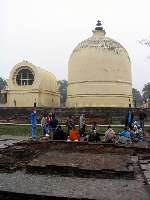
Image of a group of FWBO and TBMSG people on pilgrimage in front of the Parinibbana Stupa and Temple in Kushnigar
This blog post summarises a longer
essay on the Buddha's Last Words.
Last week we celebrated the Buddha's Parinibbana - his final death. The tradition tells us that nothing can be said about the existence or non-existence of the Blessed One after death. The cycle of birth and death, of suffering, has stopped for him. An account of the last days of the Buddha is contained in the Mahaparinibbana Sutta. Towards the end of the sutta the Buddha brings together any disciples in the area, and asks them if they have any doubts. None do. Then the Buddha gives them, and us, a final message:
vayadhammā sankhārā appamādena sampādethā
all things are perishable, through vigilance Awaken!
The full explanation of my translation is too long for this article, but I would like to look at one part of it: the word 'appamaadena'. This word is in the instrumental case so indicates the means by which an action is to be accomplished. It is by appamāda that sampādethā (from a verb, sampādeti, meaning firstly ‘to procure, to obtain’, and secondarily 'to strive'). Appamāda is translated in various ways but 'vigilance' seems to have become standard. However vigilance is not a perfect fit.

Appamāda has three parts: a + (p)p + mada.

The Pali English Dictionary gives two senses for mada: 1. intoxication, sensual excess; 2. pride, conceit. I'm going to focus on the first sense in this article.

Pa is a prefix which indicates forward motion in applied sense often emphasising the action as carried on to a marked degree or even beyond it’s mark. So if mada is drunk, then pamāda is blind-drunk! (the extra p is a common artefact in Pali compound words)

A is a prefix which makes a word mean the opposite.

So appamāda is not-blind-drunk. If you look through the Pali suttas you will see that appamada is used in connection with the objects of the senses: sights, sounds, smells, tastes, touchables, and thoughts. So in practice appamāda means not-blind-drunk on the objects of the senses. Isn't it true that we are easily intoxicated by the objects of our experience? Aren't we in fact mostly caught up in this world of our senses? Or a lot of the time aren't we caught up in the world of our thoughts? So the Buddha's final message was, sober up with regard to the senses and thoughts - don't let yourself get carried away. That's the way to strive, to obtain the goal, to Awaken!

Before we have much familiarity with spiritual practice it can hard to grasp that there is experience which is not centred on the senses. If we eliminate the five physical senses, and the mental sense which comprehends thoughts: then what is left? Nothing? We live in hedonistic times when it can seem that the pleasures of the senses is what makes life meaningful. Or we might spend our time avoiding sensations which we don't enjoy. The Buddha's final message is pointing away from the senses, but towards what?

In meditation we can take two basic approaches to the senses. We can just sit and watch the play of experience, and try not to get get caught up in it. This approach is sometimes likened to watching clouds drifting about the sky. One just sits and watches them coming and going, and doesn't invest any energy in them. Another approach is to actively withdraw from sensual experience through concentration on an object - frequently the breath. Doing this we find that in withdrawing from sense data our experience is blissful, and more satisfying. We may lose the sense of having a body, even lose the sense of having thoughts. The experience of meditation shows us that there is an alternative to being drunk on sensual data.

Both of these approaches to the senses open up all kinds of new possibilities to us. This is not easy to put into words, especially in English because we simply don't have the vocabulary. Pali and Sanskrit terms can help, but they are unfamiliar to people outside Buddhist circles. The Pali word jhana (sanskrit dhyana), for instance, is one that has been used for these states which go beyond the world of the senses. There are texts which describe the experience - often using similes. But the experiences are quite accessible, to some extent at least, for most people who are willing to meditate regularly.

So there is experience which is not mediated by our senses. But why does the Buddha use his last words to direct our attention towards this experience? Bliss is all very well, but is that really all that spiritual practice is about? The answer comes from the first part of his statement. It is because the nature of all things perceived by the senses (sankhārā) is to perish (vaya). Another possible translation of vayadhamma might be 'guaranteed to disappoint'. The objects of the senses as fascinating as they are, do not satisfy us. They are transient. By being focused on them we are constantly being disappointed, constantly let down, and it's a real drag isn't it?

So to sum up: if we want happiness (and we all do), then we need to free ourselves of addiction to intoxication with the objects of the senses, including thoughts, which are guaranteed to disappoint us. The reality of spiritual practice for most of us is that we can only slowly untangle ourselves from the senses, from thoughts. It's not easy because from the first we are totally immersed in this experience. But it is possible, and definitely worth it.

See also: my calligraphy of the Buddha's last words on visiblemantra.org.

18 February 2006

Belief: we are what we think.

examing beliefIn this second look at the subject of belief I'd like to examine a more positive aspect. I was sparked off by a BBC Radio program in the same week as a New Scientist issue (28 Jan 2006) with several articles about belief. Both sources had quite a lot to say about the belief in medical treatments.

Recently medical researchers have become much more interested in the placebo effect. This is the phenomena in which the belief that one has been given an effective medical treatment can have a beneficial effect, even when one is given a placebo, or dummy treatment. Placebo is Latin for "I shall be accepted". What is becoming clear is that the placebo effect is really quite remarkable. It is not a figment of our imagination and it can produce startling physical changes in our body. Covertly given placebo medicines do not work. The strength of the effect seems to be linked to expectations and strength of belief. One scientist thinks that it may be beneficial to err on the side of gullibility: "If you miss the tiger hidden in the grass, then you are always dead. If you always see tigers, you are always running away, but you're not dead". New Scientist p.39

Kathy Sykes, a scientist who investigated alternative medical treatments for a BBC documentary says in the Radio interview: "the power of placebo is enormous". She sites several examples including people who received placebo knee surgery and did just as well as those who had received the full treatment. The result, she suggests, may be down to the brain's expectation and reward system.

I have written about the way that I was able to think myself into a fight or flight response - with adrenaline charged, heart pumping fear! So what we believe is starting to look pretty important isn't it? The impact of belief is not simply psychological, but physiological.

The first line of the Dhammapada goes "manopubbangamaa dhammaa". The literal translation is something like 'mind precedes phenomena'. It's not a trivial exercise to translate this short phrase because mano and dhamma are complex terms that have no exact counterpart in English. But in a sense we could translate it by the phrase "you are what you think". It's not saying that thoughts literally create phenomena, that idea would not become current for several hundred years after the Dhammapada was composed. It is more of a psychological statement. Mano indicates the thinking mind, as distinct from more general consciousness (vijñana) or the heart (citta) in the poetic sense - although these terms can and are used interchangeably, and in different ways at different times. We can think of mano as that aspect of consciousness that supports opinions and views.

What's being said, then, is precisely that we can think of ourselves as being happy, as being free of suffering, and that it will have an effect. The modern research on the placebo effect confirms that this is the case. Buddhism of course goes further and says that if you wish the same for all beings, then that also is possible! The research tells us that the placebo effect is very powerful, and related to the strength of belief. If we believe that Buddhist practice will help us be better people, happier, more loving, then it probably will. If we believe the opposite then that is probably true as well. I'm not saying that practice is all placebo effect, but I think most experienced practitioners would agree that one's attitude to practice is vital. If you believe it won't work then you will have an uphill battle.

There were two words for belief in Pali: saddha means something like 'to place the heart upon'. We place our heart upon what we value. What we value is down to belief. Saddha is usually translated as faith. Ditthi means view or what we would call opinion or attitude. Our ordinary views and opinions weigh us down, cause us suffering. We place our heart on things that can never be satisfying. By reflecting on our views, by comparing what we believe to our actual experience of the world, we can come to what the Buddha called samma-ditthi or Perfect View. This is often translated as right-view, but samma is a bit stronger in connotation than 'right' suggests. When we see things as they really are, then we begin to place our heart upon the things that will really satisfy us. We will, in the traditional idiom, Go for Refuge to the Three Jewels.

Buddhism offers us a plethora of methods to observe our own beliefs, and to bring them into line wit Reality. These range from simple observation, through directed meditation, up to elaborate rituals. We may think of them as technologies of belief. Two weeks ago I suggested that all Buddhist methods amount to ways of paying attention. Paying attention, in the way I have described it, enables us to see how our beliefs condition our experience, to have a vision of Reality, and to enable us to align ourselves with that Reality. The tradition tells us that it is possible to entirely align one's beliefs with Reality: we call this Awakening.

Last week I pointed out where we can come unstuck in belief. This week I've pointed out how belief can work to help us. Given the way humans work we cannot avoid belief. I don't think it's possible to believe in nothing - that in itself is a belief! At worst we can be a victim of what we believe, at best we can radically change what we believe so that our world is forever transformed. The choice is ours.
Related Posts with Thumbnails