
 Here are two follow up notes to previous essays, one on the -e ending in mantras, another on the name Gotama; and lastly a brief note on dating the Canon.
1. The -e Ending in Mantras.
In March 2009 I wrote Words in Mantras That End in -e. In that essay I revisited some of the ideas about what the -e ending might signify, especially with respect to the Heart Sūtra mantra. Kern, Conze and other Sanskritists have seen it as a feminine vocative singular, though of course there are other grammatical possibilities. [1] I speculated that the -e ending was simply a masculine nominative singular, and that the mantras were composed in a region of India which employed that ending as opposed to Classical Sanskrit -as/-aḥ or Pāli -o. Recently I stumbled on an article by Signe Cohen which adds something to the picture. I know Cohen from her excellent linguistic analysis of the Upaniṣads: Text and Authority in the Older Upaniṣads. This book is particularly important for the understanding it brings of the internal struggles apparent especially in the Bṛhadāranyka Upaniṣad which has Yajurveda sages in direct competition and victorious over Ṛgveda sages. However in 2002 Cohen published a short article on the -e ending:
On the Buddhist Hybrid Sanskrit/Middle Indic Ending "-e" as a 'Magadhism', Acta Orientalia Vol. 63 (2002), p.67-9.This article points out that although the -e form for the masculine nominative singular does indeed occur in the North East of India, it is in fact far more widespread. This has partly been obscured as editors of Sanskrit texts have 'corrected' the text for critical editions. Patrick Olivelle complains of the same problem with the Upaniṣads in his article:
'Unfaithful transmitters: philological criticism and critical editions of the Upaniṣads,' in Language Texts and Society, Firenze University Press, 2005. (p. 285f) [originally published in Journal of Indian Philosophy 26, 1998: 173f.]Western Editors, believing Indian pandits to be incompetent, silently emended unusual spellings. However as Olivelle points out, those pandits were far from incompetent, likely to be well versed in Pāṇini, and to know a 'wrong' form when they saw one. Indian scholars tended to preserve dialectical and archaic variants, being inherently more conservative in relation to texts they saw as sacred. To the European scholar of a certain era nothing but their own objectivity was sacred. While we may not accept the pandits explanations of such variant forms (which are frequently ascribed to the peculiarities of Vedic or given mystical significance) they were at least not so over-confident as to 'correct' them. As such, modern critical and printed editions of the Upaniṣads often obscure the history of the text by removing evidence, and reproducing previously corrected texts without question.
Cohen notes that in fact the -e form is found all over North India, and especially in Sanskrit loan words in Tocharian. She concludes:
"The common assumption that the -e ending is an Eastern Dialect form must be seriously questioned. Rather than being a specifically Eastern Dialectical feature found sporadically in other parts of India due to eastern influence, it appears that the -e ending was widespread, especially in Buddhist Sanskrit, that it must be considered a standard form, next to the -o ending." [p. 68; my italics]My conjecture is that Buddhist mantras were composed in Prakrit or Buddhist Hybrid Sanskrit rather than Classical Sanskrit, and that words ending in -e in mantras are simply nominative singular forms, the gender of the words in the mantra having no relationship to the gender of the deity - and in the case of the Heart Sūtra there is no deity anyway.
~~~~
2. The Name Gautama
In my essay What Was the Buddha's Name? I drew attention to the quirk of history which left the Buddha, a kṣatriya by tradition but possibly a non-āryan, with an ostentatiously Brahmin gotra-, or clan-name: Gautama (meaning 'descended from Gotama, the one with the most cows go'). However more than half a century ago D.D. Kosambi offered a different take on this subject in a review published in 1953:
D.D. Kosambi. 'Brahmin Clans'. Journal of the American Oriental Society, Vol. 73, No. 4 (Oct. - Dec., 1953), pp. 202-208.He points to two brief Pāli passages which suggest that Gautama (Pāli: Gotama) is not the Buddha's gotra name. The first is from the Therīgāthā verses of the Buddha's maternal aunt and foster mother. She says (Th 2 162)
Bahūnaṃ vata atthāya, māyā janayi gotamaṃ;Kosambi's point here is that the names Māyā and Gotama are on the same level - i.e. they are both first names. This is to read the text quite literally, and I'm a bit doubtful about doing that. Compare for instance the case of the Brahmin boy Uppatissa, son of Rūpasārī, better known as Sāriputta 'son of (Rūpa)sārī'.[2] However Kosambi points out that neither does the Buddha's wife become known as Gotamī in any tradition. The fact that Mahāpajāpati, his mother's sister, is called Gotamī also suggests that it is not the Buddha's clan-name since the names pass pass down patrilineally (though I think Kosambi here is thinking in terms of Brahminical social rules which required Brahmins to marry outside their gotra). Kosambi also notes that bhikkhus are sakiyaputta not gotamaputta. He does not attempt to explain why the future Buddha might be named after Vedic sages however, which still strikes me as odd.
Truly for the many, Māyā gave birth to Gotama
Kosambi's other text is the Pabbajjā Sutta [Sn 3.1] in which King Bimbisāra asks the Buddha where he is from. The Buddha replies that he comes from the country of Kosala, and:
Ādiccā nāma gottena, sākiyā nāma jātiyā;The phrase only occurs once in the canon, but elsewhere the Buddha says that the Sākiya consider rājā okkāka their ancestor [Ambaṭṭha Sutta, DN 3, PTS D i.92-3] and Pāli okkāka is Sanskrit ikṣvāku a king of the ādityā [P. ādiccā] gotra. The suggestion then is that the Buddha's name was in Sanskrit Gautama Ādityā; and Pāli Gotama Ādiccā. The Buddha is also sometimes called Āṅgirasa which according to the Dictionary of Pāli Names was a tribe which included the Gautama gotra. My reading of some of the DOPN references suggests that āṅgirasa was being used as an adjective (e.g. 'shiny like the sun') rather than a name. Against the passage above Kosambi also cites the Mahāpadāna Sutta [Dn 14, PTS ii.3]
Tamhā kulā pabbajitomhi, na kāme abhipatthayaṃ.
Called Ādiccā by clan, called Sākiya by caste [jāti]
I went forth from that family, not longing for pleasures.
Ahaṃ, bhikkhave, etarahi arahaṃ sammāsambuddho gotamo gottena ahosiṃ.This phrase occurs 3 times in the suttas, all in the Mahapadāna. Kosambi refers to this as "the first interpretation of Gotama as the Buddha's gotra name... obviously a late formation under Brahmin influence". Indeed it is so obvious that Kosambi provides no evidence for his conjecture, nor does he consider the possibility that both statements about gotra are "late formations". Contrarily we find the name Gotama being used in the last two chapters of the Sutta-nipāta which are generally considered to be the oldest layers of the Pāli Canon.
I bhikkhus, now worthy, fully awakened, was of the Gotama gotra. [3]
It is still a puzzle as to why the Buddha even has a gotra name, let alone a Brahmin one (which both Gautama and Ādityā are). He was not a Brahmin. I don't think Kosambi solved the mystery, but he provided an interesting additional view point. One last observation of my own is that though the Buddha meets Brahmins from many other gotra lineages, he never seems to meet a Gautama Brahmin. This is despite the fact that the two ancestors Gotama and Bharadvāja are mentioned together in Bṛhadāranyka Upaniṣad 2.2.4, and Gautama the Buddha meets more than a dozen Brahmins from the Bhāradvāja lineage, who mostly seem to live in Kosala (see e.g. DN 3, 13, 27, 32, but throughout the nikāyas).
18 Aug 2011
I've been looking at Brahmins in the Canon and thinking about the Buddha's Brahmin surname. No other males with the gotra name "Gautama" are found in the Pāli Canon, though there are several women. I think the facts we have might be explained if the Buddha's mother and her sister were of the Gautama clan, and married Sudhodana who was a Śākya. Gautama in other words is actually Gautamaputra, Son of Gautamī; on the same model as Śāriputra is the Son of (his mother) Śārī.
6 Sept. Extra note
In the Garbhadhātu Maṇḍala of the Shingon school, associated with the Mahāvairocana Abhisaṃbodhi Tantra (MAT), there is a figure called Gautama (or Gotama; Japanese: Kudonsen 瞿曇仙). This is the Vedic Gautama and he attends on the god Agni. Adrian Snodgrass suggests that he is the subject of many hymns in the Ṛgveda, though this is not correct as far as I know. He is, however, credited as the author of some of them. Snodgrass translates from Dainichikyōsho (Śubhakarasiṃha's commentary on the MAT):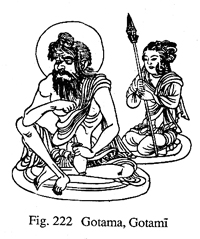
Snodgrass, vol.2 p. 471
"The hermit-ascetic Gotama [sic], flying in the sky at well, let fall two drops of sweat upon the earth, and the earth gave birth to sugar cane. Warmed by the sun, the sugar cane gave birth to two children, who became Śākya kings"*These two are the progenitors of the clan which 'Siddhartha' was born into. Gautama has a consort called Gautamī. I have not yet found the connection between the 'sugar cane' clan (Kansho) and the Śākya clan, though it may rest on a Chinese (mis)translation. In any case it that MAT includes the Vedic Gautama alongside the many other Vedic gods and important figures. Note that this story glosses over the fact that Gautama is a brahmaṇa, while the Buddha is usually referred to as a kṣatriya.
* see Snodgrass, Adrian. The Matrix and Diamond World Mandalas in Shingon Buddhism, vol. 2, p. 470.
~~~~
3. Dating the Canon.
The Assalāyana (MN 93) is a lengthy discussion between the eponymous Brahmin and the Buddha about the claim by Brahmins to be the best class (brāhmaṇo'va seṭṭho vaṇṇo). [4] Amongst the various arguments the Buddha puts forward is the relativist argument that some countries only have two classes, viz. ayyo and dāsa, i.e. noble and slave. [MN 93.5] These two countries (janapada) referred to are Yona and Kamboja. Various maps put Kamboja in different places, but it was supposedly north and west of Gandhāra. Shrimali centres it on the Kabul River (which flows through the Hindu Kush mountains from what is now Afghanistan to join the Indus) [5] Yona is thought to refer to Bactrian Greeks even further west. As the DOPN says:
The name is probably the Pāli equivalent for Ionians, the Baktrian Greeks. The Yonas are mentioned with the Kambojas in Rock Edicts v. and xii of Asoka, as a subject people, forming a frontier district of his empire.These Greeks are thought to have been descendants of garrisons left by Alexander of Macedon. And this gives us our date. [6] At the time of the Buddha the Persian Achaemanids ruled as far east as the Indus River - i.e. including Gandhāra. We can confidently date Alexander's Indian campaign as part of his assault on and destruction of the Achaemanid Empire, to 327-326 BCE. If yona means 'Greek', then MN 93.6 cannot have been written before this date. Dates of the Buddha are less certain but the most recent research points to his death being circa 400 BCE, some 70 odd years before Alexander. Greek cultural influence remained for some time with post-Mauryan Dynasty Gandhāra being ruled by what is termed an 'Indo-Greek' dynasty from ca. 180 BCE - 10 CE. Greek aesthetic ideals heavily influenced Gandhāra art for some centuries, so that the first anthropomorphic images of the Buddha, produced in that region during the Kushan period (ca. 75-241 CE) showing obvious Hellenistic features.
Note 7 May 2017 - to the best of my knowledge the Greeks never used Ionian as a general label. It was always a specific reference to Greeks who lived in Ionia - modern day Turkey. Moreover, the Greeks in question were Macedonians from Macedonia and that is probably how they referred to themselves. However, the Persians may have used Ionian as a general term for Greeks. If the Pāḷi Canon is using a Persian term for Greeks then this suggests that it was incorporated before Alexander. In which case the date goes back to being very vague indeed.
~~||~~
Notes
- for instance -e can signify a masculine or neuter locative singular of a noun or past-participle in -a, such as gata (past-participle of gacchati).
- I don't want to multiply examples needlessly but Moggallana's given name was Kotila (after his village, just as Upatissa was called after his village). Kassapa (tortoise) is a very common name in Pāli perhaps because it was a gotra name as well. It seems that calling people by clan or family names, or epithets was a common practice.
- Note that Walsh translates this as a present (I am) when the verb is clearly past-tense; the Buddha left his clan, class, and caste behind when he went forth.
- D ii.148. Note that he continues "the other class is defective" (sometimes in this pericope the plural is used 'the other classes'). The Pāli being: hīno añño vaṇṇo. Here the term hīna is clearly being used pejoratively in a caste context. See also my Hīnayāna Reprise.
- Shrimali, Krishna Mohan. The Age of Iron and the Religious Revolution : c.700-c.350 BC. (A People's History of India: 3A). New Dehli, Tulika Books. 2007. Map p.85.
- I haven't found any reference to this fact, but I presume someone else has already noticed this.


