
 |
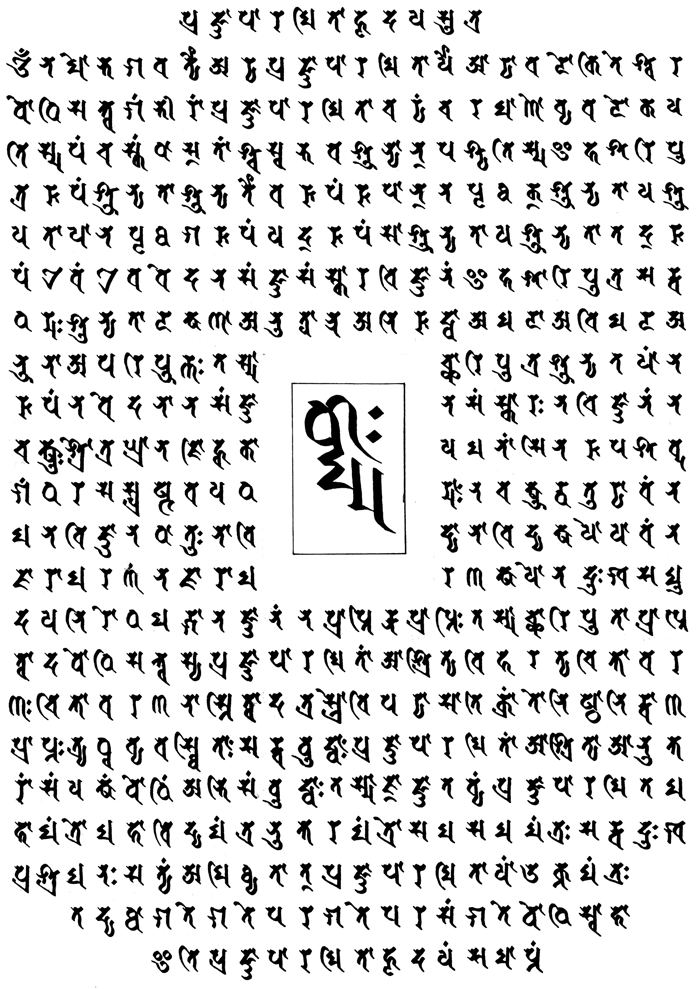
| My calligraphy of Heart Sutra Siddhaṃ script |
- Extracts from Kumārajīva's translation of the Pañcaviṃśatisāhasrikā Prajñāpāramitā Sūtra (T 8.223; ca. 5th century).
- Elements drawn from the devotional cult of Avalokiteśvara (觀自在 Guānzìzài).
- The cult of dhāraṇī chanting, and a mantra probably drawn from existing Chinese texts.
The first element is quite well covered in the literature, especially as Jan Nattier (1992) focusses on this part of the text in her reconstruction of its provenance. My next essay will address a lesser known aspect of this issue which is buried in Nattier's footnotes. The second element deserves a little more attention, but is covered briefly in Nattier (174-5). This essay will largely focus on the third element.
In her long essay on the origins of the Heart Sutra, Jan Nattier notes (footnote 52 & 53) that two other scholars have found mantras similar to the Heart Sutra mantra in other places in the Chinese Tripiṭaka. One of these references is particularly significant as it seems to pre-date the composition of the Heart Sutra itself. This essay will present the Chinese source texts for these mantras. Before dealing with these mantras, we need to pay some attention to the dhāraṇī cult itself, and try to establish some terminological boundaries.
The cult of dhāraṇī chanting is sometimes placed in the context of Tantric Buddhism, but I think this is a mistake. It is true that mantras are a feature of Tantric Buddhism. However, as Ryūichi Abé. has shown, Tantric Buddhism requires certain elements to be present in order to be Tantric. In The Weaving of Mantra he emphasises the abhiṣeka or initiation in particular because the abhiṣeka is the ür-ritual which underpins all of Tantric Buddhist practice. In Japan, prior to the arrival of Kūkai and Saichō with genuine Tantric Buddhism, some Tantric elements were present: images, dhāraṇī and mantra, and even texts such as the Mahāvairocana Abhisaṃbodhi Tantra. However, in the absence of the Tantric paradigm and organising principles, these elements did not add up to Tantric Buddhism.
he emphasises the abhiṣeka or initiation in particular because the abhiṣeka is the ür-ritual which underpins all of Tantric Buddhist practice. In Japan, prior to the arrival of Kūkai and Saichō with genuine Tantric Buddhism, some Tantric elements were present: images, dhāraṇī and mantra, and even texts such as the Mahāvairocana Abhisaṃbodhi Tantra. However, in the absence of the Tantric paradigm and organising principles, these elements did not add up to Tantric Buddhism.
Abé is trying to revise the history of Japanese Buddhism, but he has enunciated an important hermeneutic for discussing the presence or absence of a mode of Buddhist thought. For example: if a person bows before a Buddha statue, burns incense, and chants oṃ maṇipadme hūṃ, but has no knowledge of why Buddhists do such things, does this make them a Buddhist? These are simply decontextualised actions with no intentional underpinning. They are Buddhist in externals only. A similar argument is simmering away with respect to the Jon Kabat Zinn inspired mindfulness treatments. Does the teaching of mindfulness amount to teaching Buddhism, or does it lack key elements, such as "going for refuge", that render the teaching non-Buddhist? Some Buddhists who teach mindfulness argue that they are teaching Buddhism when they teaching mindfulness. Others argue that the lack of context for the practice, particularly the absence of Buddhist metaphysics, means this is a beneficial secular practice that does not conduce to liberation.
In any case, the point is that although dhāraṇīs were incorporated into Tantric Buddhism, there is nothing in the dhāraṇī sūtras or the chapters inserted into larger texts such as the Saddharma-puṇḍarīka or Survabhāṣotama, to indicate a Tantric context. The first hints of Tantra associated with a mantra seem to be found in the Kāraṇḍavyūha Sūtra according to Alexander Studholm's study of that text, which includes an account of something like an initiation, though it still lacks the central features of the abhiṣeka ritual. The point of chanting dhāraṇīs seems largely to have been protection from malign forces or entities. And thus they have much more in common with the Theravāda practice of parittā chanting than with Tantric practice (at least with respect to the Tantric Buddhism practised by Kūkai). It's not until they are incorporated into rituals centred on the abhiṣeka, that they become Tantric. This criteria is common to other elements that were incorporated, not least the elements from Vedic ritual. No one, to my knowledge, argues that Vedic fire rituals were "proto-Tantric".
Nattier points to the opinion of Fukui Fumimasa (1981. Source text is in Japanese) that the name of the Heart Sutra in Chinese is 心經 Xīnjīng, literally "heart sūtra", but that 心 xīn (heart) here connotes dhāraṇī rather than 'pith' and that the text might well be a chanting text, i.e. a dhāraṇī text. We know from Xuánzàng's record of his journey to India that he used the text as a protective measure against unseen malevolent spirits. The title of the short text in Sanskrit, Prajñāpāramitāhṛdaya, does not include the word sūtra, and it seems likely that the original, short text was not considered as a sūtra. That transition probably happened in India when the traditional elements of a sūtra, such as the beginning evaṃ maya śrutaṃ... and the appreciation at the end were added. Another reading of 心 is "gist" with the idea that rather than Heart Sutra, the meaning is Gist Text, with the text representing the gist of Prajñāpāramitā.
The dhāraṇīs of the pre-tantric Mahāyāna texts are often radically different in form from the mantras of later Tantric Buddhism. Of course there is a huge amount of variation and cast-iron definitions are difficult to construct.
Defining Mantra and Dhāraṇī
Tantric mantras have a number of structural features in common: a beginning (usually oṃ); a name or function; and a final seed-syllable.
Defining Mantra and Dhāraṇī
Tantric mantras have a number of structural features in common: a beginning (usually oṃ); a name or function; and a final seed-syllable.
Typically Tantric mantras begin with oṃ (not auṃ) which served to mark what follows as a mantra. However in the earliest fully-fledged Tantra, the Mahāvairocana Abhisaṃbodhi Tantra, the mantras all begin namas samanta-buddhānāṃ or namas samanta-vajrānāṃ. The ending -ānām indicated the genitive plural case (of the Buddhas). However, in Prakrits (including Pāli) the dative case (to or for the Buddhas) endings began to be replaced by the genitive case endings. Here ending is the usual genitive, but the sense is dative and the words mean "homage to all Buddhas/vajras".
What follows oṃ can be the name of a deity (oṃ amideva hrīḥ, oṃ vajrapāṇi hūṃ, oṃ vagiśvara muṃ) or relate to a function in the ritual, especially purification with the śūnyatā mantra or the Vajrasattva mantra. Names of deities are sometimes in the dative case, or in a kind of faux dative created by the addition of -ye to the end of the word: oṃ muni muni mahāmuni śākyamuniye svāhā. The correct dative of śākyamuni is śākyamunaye (final i is replaced by aye)
Tantric mantras typically end with a seed-syllable (bījākṣara) related to the deity or with svāhā. Sometimes the seed-syllable is specific to the deity, or to the "family" they belong to. Mantras of the vajra family typically end in hūṃ, while the padma family often end in hrīḥ. At other times it seems unconnected to other considerations. For example oṃ maṇīpadme hūṃ is a padma family mantra. Some mantras incorporate dhāraṇī style features into them which would include the Heart Sūtra mantra and the Tārā mantra (oṃ tāre tuttāre ture svāhā). The variety of mantras is partly due to their being a number of systems existing in parallel.
What follows oṃ can be the name of a deity (oṃ amideva hrīḥ, oṃ vajrapāṇi hūṃ, oṃ vagiśvara muṃ) or relate to a function in the ritual, especially purification with the śūnyatā mantra or the Vajrasattva mantra. Names of deities are sometimes in the dative case, or in a kind of faux dative created by the addition of -ye to the end of the word: oṃ muni muni mahāmuni śākyamuniye svāhā. The correct dative of śākyamuni is śākyamunaye (final i is replaced by aye)
Tantric mantras typically end with a seed-syllable (bījākṣara) related to the deity or with svāhā. Sometimes the seed-syllable is specific to the deity, or to the "family" they belong to. Mantras of the vajra family typically end in hūṃ, while the padma family often end in hrīḥ. At other times it seems unconnected to other considerations. For example oṃ maṇīpadme hūṃ is a padma family mantra. Some mantras incorporate dhāraṇī style features into them which would include the Heart Sūtra mantra and the Tārā mantra (oṃ tāre tuttāre ture svāhā). The variety of mantras is partly due to their being a number of systems existing in parallel.
Dhāraṇī by contrast seldom begin with oṃ and almost never end in a seed-syllable. They almost always end with svāhā. The word svāhā is the Vedic equivalent to the Hebrew amen. It is used in the Yajurveda to solemnise offerings: one makes an offering of rice mixed with ghee to the fire while chanting, for example "agnaye svāhā" or 'For Agni, amen' (Taittirīra Saṃhitā 7.1.14.1). The content of the dhāraṇī is a string of words or sounds which seldom reference names of deities, and frequently include nonsense words such as hilli, huru often with repetition and ringing the changes of the first syllable: hilli hilli milli milli. There is a tendency to use words ending in -e. Various theories have been proposed to explain this phenomenon, but my opinion is that the -e ending is a Prakrit masculine nominative singular. This probably also applies to the well known oṃ maṇipadme hūṃ mantra. A feature of dhāraṇī, then, is the use of Prakrit or Buddhist Hybrid Sanskrit.
Typical dhāraṇīs from the Saddharmapuṇḍarikā Sūtra:
anye manye mane mamane citte carite same samitā viśānte mukte muktatame same aviṣame samasame jaye kṣaye akṣaye akṣiṇe śānte samite dhāraṇi ālokabhāṣe pratyavekṣaṇi nidhiru abhyantaraniviṣṭe abhyantarapāriśuddhimutkule araḍe paraḍe sukāṅkṣi asamasame buddhavilokite dharmaparīkṣite saṁghanirghoṣaṇi nirghoṇi bhayābhayaviśodhani mantre mantrākṣayate rute rutakauśalye akṣaye akṣayavanatāye vakkule valoḍra amanyanatāye svāhā.
iti me iti me iti me iti me iti me; nime nime nime nime nime; ruhe ruhe ruhe ruhe ruhe| stuhe stuhe stuhe stuhe stuhe svāhā.
There is a world of difference between these two dhāraṇī and most Tantric mantras.
The Heart Sutra Mantra
The Heart Sutra mantra is clearly referred to as a mantra by the text. But it has more features in common with dhāraṇī in form and content. It's lacks the opening oṃ for example, though some traditions have simply added one. The repetition and play of sounds in gate gate pāragate pārasaṃgate is typical of dhāraṇī. Why then does the text refer to this as a mantra? I will look more closely at this issue in the next essay.
Meanwhile let us compare the Heart Sutra mantra with the three mantra/dhāraṇī listed in Nattier's footnotes as being similar. Of these T 12.387 大方等無想經 Dàfāngděng wúxiǎng jīng (Mahāmegha Sūtra), identified by Fukui (1981), is important because it was translated in the early fifth century, two centuries before the proposed date for the composition of the Heart Sutra.
Mantras and dhāraṇīs are typically not translated by the Chinese, but the sounds are represented using characters for their pronunciation. Unfortunately it can be very difficult to reconstruct the Sanskrit from a Chinese transliteration. For example the character 卑 bēi has been used to transliterate the Sanskrit syllables pra, pre, pe, pi, vi, and vai. Note that I'm using Pinyin Romanisation in these posts, which often does not reflect pronunciation at the time the texts were composed. The language of the day is referred to as Middle-Chinese (MC). Where relevant and possible I will indicate the MC pronunciation
The Heart Sutra Mantra
The Heart Sutra mantra is clearly referred to as a mantra by the text. But it has more features in common with dhāraṇī in form and content. It's lacks the opening oṃ for example, though some traditions have simply added one. The repetition and play of sounds in gate gate pāragate pārasaṃgate is typical of dhāraṇī. Why then does the text refer to this as a mantra? I will look more closely at this issue in the next essay.
Meanwhile let us compare the Heart Sutra mantra with the three mantra/dhāraṇī listed in Nattier's footnotes as being similar. Of these T 12.387 大方等無想經 Dàfāngděng wúxiǎng jīng (Mahāmegha Sūtra), identified by Fukui (1981), is important because it was translated in the early fifth century, two centuries before the proposed date for the composition of the Heart Sutra.
Mantras and dhāraṇīs are typically not translated by the Chinese, but the sounds are represented using characters for their pronunciation. Unfortunately it can be very difficult to reconstruct the Sanskrit from a Chinese transliteration. For example the character 卑 bēi has been used to transliterate the Sanskrit syllables pra, pre, pe, pi, vi, and vai. Note that I'm using Pinyin Romanisation in these posts, which often does not reflect pronunciation at the time the texts were composed. The language of the day is referred to as Middle-Chinese (MC). Where relevant and possible I will indicate the MC pronunciation
The dhāraṇī in question is:
竭帝 波利竭帝 僧竭帝 波羅僧竭帝波羅卑羅延坻
三波羅卑羅延坻 婆羅 婆羅 波沙羅 波娑羅 摩文闍 摩文闍
遮羅帝 遮羅坻 波遮羅坻 波遮羅坻 三波羅遮羅坻
比提 嘻利 嘻梨 薩隷醯 薩隷醯 富嚧 富嚧 莎呵
jiédì bōlìjiédì sēngjiédì bōluósēngjiédì bōluóbēiluóyánchíFortunately for us some markers are clear at the beginning. The Mantra in the Heart Sutra in Chinese is:
sānbōluóbēiluóyánchí póluó póluó bōshāluó bōsuōluó mówéndū mówéndū
zhēluódì zhēluóchí bōzhēluóchí bōzhēluóchí sānbōluózhēluóchí
bǐtí xīlì xīlí sàlìxī sàlìxī fùlú fùlú shā hē
揭帝 揭帝 般羅揭帝 般羅僧揭帝 菩提 僧 莎訶
jiēdì jiēdì bānluójiēdì bānluósēngjiēdì pútí sēng shāhē
One does not need to understand the characters to see that many of them graphically match up between the two mantras above, especially at the beginning. The opening characters of both are very similar. Both 竭帝 jiédì and 揭帝 jiēdì are transliterations of Sanskrit gate (the difference in pronunciation is a matter of tone). MC pronunciation in both cases was gal (with a hard g sound).
The first words in the Mahāmegha Sutra mantra are: jiédì bōlìjiédì sēngjiédì bōluósēngjiédì which most likely represent Sanskrit: gate parigate saṃgate paragate. The Mahāmegha mantra ends 莎呵 shāhē; the Heart Sutra has 莎訶 shāhē; both represent svāhā. Note the graphic similarity of 呵 and 訶 which have the same pronunciation, he, in MC.
A little note here that the mantra in Xuánzàng's version of the Heart Sutra (T 8.251) has an extra out-of-place character, 僧 sēng, between bodhi (菩提 pútí) and svāhā (莎訶 shāhē). Even though this is probably the oldest version of the text, it is not without problems!
A similar dhāraṇi is also found in T. 21.1353 東方最勝燈王陀羅尼經 Dōngfāng zuìshèng dēngwáng tuóluóní jīng (First-radiance Knowledge King Sūtra = Sanskrit Agrapradīpadhārāṇīvidyarāja-sūtra). As in T 12.387 the dhāraṇī shares opening elements with the Heart Sutra mantra using the same transliterating characters.
The gate gate mantra itself, with the same transliteration, is found in T 18.901 陀羅尼集經 Tuóluóní jí jīng (Dhāraṇī Collection Sūtra). This was translated ca. 653 CE which is around the same time that Nattier proposes for the composition of the Heart Sutra. Note also that it is a collection of dhāraṇī (陀羅尼 Tuóluóní) rather than mantra. The presence of a dhāraṇī in a collection is not conclusive evidence that it existed detached from the Heart Sutra before its composition, but it at least shows that dhāraṇīs can be detachable. It's quite possible that similar examples may turn up with further examination.
阿 竭帝 波羅竭帝 波羅僧竭帝
a jiédì bōluójiédì bōluósēngjiédì
a gate paragate parasaṃgateHere the character 阿 is often used for the Sanskrit short 'a' vowel and thus may reference the idea of the perfection of wisdom in one letter, or more precisely the fact that all dharmas are empty of self existence (sarvadharmāḥ svabhāvaśūnyatāḥ) because they are unarisen (anutpanna). See also The Essence of All Mantras; and Sound, Word, Reality.
The gate gate mantra itself, with the same transliteration, is found in T 18.901 陀羅尼集經 Tuóluóní jí jīng (Dhāraṇī Collection Sūtra). This was translated ca. 653 CE which is around the same time that Nattier proposes for the composition of the Heart Sutra. Note also that it is a collection of dhāraṇī (陀羅尼 Tuóluóní) rather than mantra. The presence of a dhāraṇī in a collection is not conclusive evidence that it existed detached from the Heart Sutra before its composition, but it at least shows that dhāraṇīs can be detachable. It's quite possible that similar examples may turn up with further examination.
It seems that, not only is the core of the Heart Sutra an extract, but the "mantra" might also be an extract from a dhāraṇī. It might be thought that the fact that the Heart Sutra is a mash-up of bits from other texts invalidates the text. However the composition method closely resembles many Pāli texts which are clearly constructed from pre-existing elements that can be found scattered around the Canon. Far from being unusual, the Heart Sutra is following standard Buddhist procedure. Even the subsequent addition of a proper sūtra introduction is in keeping with general Buddhist practice.
In my discussion of cladistic methods applied to studying manuscripts, I argued that it would help to iron out biases. Another bias that Buddhist Studies faces is the prejudice in favour of texts with Indian "originals". In my essay Which Mahāyāna Texts? I outlined an observation made in another publication by Jan Nattier about which Mahāyāna texts are prominent in the West. The existence of a Sanskrit manuscript is one of the influential factors likely to bring a Mahāyāna text to prominence. The fact is that the Heart Sutra is broadly accepted as a genuine masterpiece of Buddhist thought. Commentaries from across the spectrum of Buddhist schools adopt the Heart Sutra as an epitome of their thought. Is a text any less authentic because it was not composed in India? It is true that Buddhists believed that the text was of Indian origin and that was an element in popularising it. Now that we know differently will Buddhists have to abandon this text? I think there is no question of abandoning the text, but the necessary adjustments might be quite difficult. One sign of this is the rejection of the Chinese origin thesis by Red Pine in the introduction to his translation and commentary on the Heart Sutra. Though his reasoning is spurious, it is none-the-less interesting to see how difficult Buddhists find it to absorb information like this.
One of the reasons for writing about Nattier's work is that it has yet to penetrate to the heart of popular imagination and the discussion about textual origins is in its infancy. Such writing raises questions for Buddhists. If we take scholarship seriously, then we are forced to examine our own beliefs and sometimes to admit that our beliefs are based on false assumptions such as authenticity being related to India.
One of the reasons for writing about Nattier's work is that it has yet to penetrate to the heart of popular imagination and the discussion about textual origins is in its infancy. Such writing raises questions for Buddhists. If we take scholarship seriously, then we are forced to examine our own beliefs and sometimes to admit that our beliefs are based on false assumptions such as authenticity being related to India.
~~oOo~~
The Tibetan canonical versions of the Heart Sutra both include tadyathā in the mantra itself. I've looked at this generally in Tadyathā in the Heart Sūtra - the inclusion of tadyathā 'like this' in the mantra is like actors speaking stage directions out loud. One of the versions also interpolates oṃ into the mantra as do some of the Nepalese manuscripts.
Bibliography
I've already written about the mantra of this text a couple of times:
I've already written about the mantra of this text a couple of times:
- Words in Mantras that end in -e (see also Some Additional Notes).
- Heart Sūtra Mantra. (on my mantra website).
All Chinese texts from CBETA.
- Abé, Ryūichi (1999). The Weaving of Mantra: Kūkai and the Construction of Esoteric Buddhist Discourse. New York: Columbia University Press.
- Fukui Fumimasa (1981) Hannya shingyô no rekishiteki kenkyû. [= Historical studies of the Buddhist scripture Prajñaparamita-hrdaya or Heart Sutra.] Tōkyō: Shunjūsha.
- Nattier, Jan (1992). 'The Heart Sūtra: a Chinese apocryphal text?' Journal of the International Association of Buddhist Studies. 15 (2) 153-223. Online: http://archiv.ub.uni-heidelberg.de/ojs/index.php/jiabs/article/view/8800/2707
- Studholme, Alexander (2002). The origins of oṃ manipadme hūṃ : a study of the Kāraṇḍavyūha Sūtra. Albany: State university of New York Press.


 , and Ken McLeods's
  . The first is American and the second British. Intrusion is probably the more frightening vision since it is not very far in the future and reads like a plausible extrapolation of the current trends. Disengagement has allowed Neoliberals to take over the world's governments. Life is not going to improve under these conditions. To be disengaged from politics is abandon self-responsibility.