15 February 2008

Confession in Buddhism

Confession in Buddhism is somewhat different than in Catholicism as we can see in the story of the fruits of the homeless life. (Sāmaññaphala Sutta - DN 2 *). In this story the conscience of King Ajāttasattu is pricking him - after all he has killed his mother and father and usurped the crown! He decides that a visit to a holy man might help him sleep better at night. After quizzing his courtiers on who to visit he decides to go to see the Buddha. As they approach they must abandon their transport and go on foot into the jungle. Since the Buddha is staying with a great company of monks, the King thinks he should be able to hear them, but all is silent - the murderer is worried about being assassinated himself! However they come into the presence of the Buddha and after a long talk Ajāttasattu goes for refuge to the Buddha as a lay follower, and then confesses his murderous actions. The Buddha's response, to the king in the first place, and to the bhikkhus after he has gone, highlight the two very important aspects of confession in Buddhism.

The Buddha says to the king:
"Indeed, King, transgression [accayo] overcame you when you deprived your father, that good and just king, of his life. But since you have acknowledged the transgression and confessed is as is right, we will accept it. For he who acknowledges his transgression as such and confesses it for betterment in future, will grow in the noble discipline."
The word accayo literally means "going on, or beyond", and in the moral sphere, means acting outside the established norms - so transgression is quite a good translation.

However once the king departs, the Buddha says to the bhikkhus:
"The king is done for, his fate is sealed, bhikkhus. If the king had not killed his father... then as he sat there the pure and spotless dhamma-eye would have arisen in him."
The King leaves feeling much relieved, having unburdened himself, having experienced remorse, and resolved to do better in the future. This is the benefit of confessing. It brings the unskilful act to consciousness and helps us to see the consequences of the action, and by reflecting like this we are less likely to act unskilfully in the future. The King is actually better off that he was. On the other side the Buddha was able to just hear his confession. Perhaps not everyone would be able to hear about someone killing their parents and maintain their equanimity, but the Buddha can. He is able to see that despite the crime, that the King is genuinely remorseful, and that it is important to witness that and encourage it. The past is gone, we can't change it, but we can change now and experience liberation in the future.

However notice that Buddha does not absolve the King. He does not because he cannot. The fruits of the action cannot be neutralised. Indeed if he had not committed the heinous act (patricide was considered a very horrible crime in ancient India) he would have experienced Insight (the opening of the dhamma-eye) after listening to the Buddha.

Equally the Buddha does not rub it in. He does not tell him, "OK you confessed, but you're still going to suffer". The Buddha is not cruel, he acknowledges a small goodness for what it is, and lets the King depart without much comment. However he does not let the opportunity pass to reinforce his message for the bhikkhus. He did not want them to think they could simply confess and get away with things. As a King, Ajāttasattu had a lot of responsibilities, and it is clear that he placed these above self-knowledge or liberation. He wanted to be the king so badly that he murdered his parents. The bhikkhus, however, have ostensibly abandoned worldly concerns and are supposed to be devoting themselves to attaining liberation. They cannot afford to be casual about the consequences of their actions. So the Buddha drives home the message by pointing out that the King is "done for" - the implication is that the consequences of his actions are going to be severe, that even a face to face meeting with the Buddha cannot save him from a great deal of suffering in the future. Most likely he is repeatedly reborn in hell realms.

There is another important point here. At the beginning of the story the king is restless, tormented by his conscience, and even a little paranoid. Unconfessed unskilfulness weighs on our conscience. We feel guilty and we fear punishment. The Buddha knows there is no need to punish Ajāttasattu as he is suffering in the present, and will continue to suffer in the future. This is a very difficult idea for Westerners. We are inculcated with the idea that guilt demands punishment. Society demands that someone who transgresses must have some harm inflicted upon them. We do not believe in an ethical universe in which everyone must live with the consequences of their actions, and in which evil definitely results in pain for the evil doer. This is not enough. We want to see justice (ie punishment) in the here and now. Christians also abrogate the notion that judgement for sins is God's prerogative. In fact the threat of punishment makes confession, makes taking full responsibility for our actions, all the more difficult. It is only when the threat of punishment is removed that we can fully confess our actions, experience remorse, and take the necessary actions to make amends or to prevent a repetition. Given that so few people wholeheartedly take on Buddhist ethical precepts, it may mean that we have limited opportunities for confession in the Buddhist sense. We may also have to exercise patience with those who seek to inflict harm on us as punishment. There is a lot more that could be said on the issue of culpability and justice from a Buddhist point of view but it must wait.

To sum up: in Buddhism one is encouraged to confess to someone who is able to receive the confession, this is important. Our confessor should at a minimum understand the ethical precepts we follow, and ideally should have some experience in following them. The point of confession is to experience remorse, to reflect on the consequences of our actions, with the hope that it helps us to restrain ourselves in future. In practice this results in a sense of relief. Confession does not, and cannot absolve us from responsibility for our actions, the consequences of which will still manifest. If we take Buddhist practice seriously then we try to behave ethically. An important aspect of this is to acknowledge our failures and to learn from them. Confession is indispensable in this process.


*translations are from Walsh, M. The Long Discourses of the Buddha. (Boston : Wisdom, 1995) p.91ff. There are some problems with the translation that I will regale you with in a separate essay. They don't affect my conclusions.

image: a king who got his crown illegitimately meets a holy man... from Daily Mail

08 February 2008

The Anger Eating Yakkha

Browsing through the Pali Canon one often stumbles upon wonderful little oddities. This story from the Samyutta Nikaya leapt out at me while I was looking for something else. It is a story told by the Buddha to the bhikkhus while staying in the Jeta Grove...

Once an ugly yakkha sat himself down on the throne of Sakka, Lord of the Devas (also known as Indra in Vedic mythology). The various devas were appalled by this gauche behaviour and started to grumble and complain. But the more they grumbled and complained the more the yakkha became handsome and comely, more and more graceful. Confused the devas go and find Sakka and tell him what has happened. And Sakka said to them: "that must be an anger eating yakkha! ".

Sakka goes to the now handsome and good looking yakkha, arranges his robe over one shoulder, kneels down on his right knee and with his hands raised in greeting. Then three times he repeats: "I dear sir, am Sakka, Lord of the Devas." As he spoke thus, the yakkha became smaller, and more ugly. He got more and more ugly, and more deformed until he disappeared completely! Sakka then gives voice to these verses:
I am not one afflicted in mind,
Nor easily drawn by anger's whirl.
I never become angry for long,
Nor does anger persist in me.

When I'm angry I don't speak harshly
And I don't praise my virtues.
I keep myself well restrained
Out of regard for my own good.
Isn't this wonderful? The sutta is not much longer than my summary, and most of that is repetition. The structure of this sutta is much like an Udana - a prose story followed by two pithy gathas with a simple message. The moral is simple and straightforward - it echoes many other texts which advise on how to deal with anger. One thinks for instance of the lines from the Metta Sutta which enjoin us never to wish suffering on another even though we are angry. As far as I know this is the only occasion when an "anger eating yakkha" is mentioned in the Canon.

It brings to mind the Dhammapada verse (v.5) :
Anger never ceases through anger
Anger only ceases through love
This is an eternal law.
We could see the anger eating yakkha story as a parable illustrating this principle. The way to diffuse anger is not to meet it with anger, but to see that anger feeds on anger. If we meet an angry person with anger we escalate the situation. It's hard to be around an angry person and feel safe though - angry people can be unpredictable and even dangerous. I find I just want to get some distance between me and an angry person. If I'm responding to anger with anger then this is perhaps the best strategy. Words said in anger are often regrettable. Sakka proclaims that he keeps himself well restrained, that even if he does become angry he does not allow anger to persist.

In Tantric Buddhism emotions like anger are considered to be part of the path. Anger is related to Wisdom, is transformed into Wisdom through practice. The advantage of this approach is that it recognises the energy involved in anger, and how it can be harnessed in pursuit of our spiritual goals. However I think one needs to be very careful with this approach. One might attempt to justify unskilful behaviour on the basis that anger is "just energy" for instance. If we go around acting out anger then that is not going to help anyone, and indeed will hurt other people and ourselves. In early Buddhism anger is seen as aversion to some experience which one does not want to have. It is better to allow the experience to happen and cultivate equanimity towards it. I prefer to err on the side of caution in the case of anger and find the early Buddhist approach more helpful.

Reference.
SN 11.22. Bikkhu Bodhi. 2000. The connected discourses of the Buddha : a translation of the Samyutta Nikaya. [1 vol. ed.] Boston : Wisdom. p.338-9. [= PTS S i.237f.]


image: blogs.cisco.com (tweaked)

01 February 2008

Meditating on Arapacana

In Nov 2007 I led an evening on the Arapacana Alphabet at the Cambridge Buddhist Centre which involved a led meditation and a talk which looked at the recent research on Arapacana, especially the work of Dr Richard Salomon. In order to lead the meditation I took the text of the verses associated with the Arapacana in the Large Perfection of Wisdom Sutra, and attempted to put them into an idiom which conveyed what I perceived to be the intention in a way that would be familiar to an FWBO audience.

For the purposes of this exercise I decided to use "experience" as a translation of "dharma" - that is dharma in its aspect as phenomena or element, and in particular mental phenomena or element. I also made the caveat that in a meditation one often makes categorical statements which are not meant to literally describe Reality, but simply to be the subject of reflection. Finally I had to admit that this is simply my reading of a text, and that as far as I know there is no living tradition of meditating in this way.

We began with some samatha meditation focussing on the body and breath. Then having calmed down and become concentrated to some extent we reflected on each of the letters (or more accurately syllables) in turn, although only the first five: a ra pa ca na. As you may know each letter is the initial letter of a word in Sanskrit, which fits into a sentence that provides a reflection on the nature of experience. My method will become more clear as we look at the examples.

The letter A (the short vowel sound in the English word cut), according to the text, is a door to the insight that all dharmas are unproduced from the very beginning (adyanutpannatvat). I take this to mean that even though we undeniable have experiences, no 'thing' - no ontologically solid and lasting entity - arises as a result. So rather than thinking, for instance, there is "the in-breath" and "the out-breath", we can reflect that there is no 'thing' called breath, there is just the experience, the physical sensation of breathing. Instead of thinking in terms of "this feeling is in my body", try to think in terms of "there is a physical feeling". Using verbs rather than nouns helps this I think. Focus on the experience, that is the flow of sensations and perhaps mental activity, rather than extrapolating from the experience to something solid.

RA is a door to the insight that all dharmas are without dirt (rajas). In this stage of the meditation we reflect that although we have experiences which are either pleasant or unpleasant or neutral, the feeling tone is not intrinsic to the experience. Something done once might be pleasant, but done a dozen times may be unpleasant; one day it might thrill us, the next it might bore us. Experience is just experience, and therefore it is "pure". We tend to be attracted to pleasant, and repulsed by the unpleasant. We want to hold onto what attracts us, and to push away what is unpleasant. It is these attempts at holding and pushing away which cause us to suffer, not the bare experience of pleasant or unpleasant. Ultimately experience is just experience.

PA is a door to the insight that all dharmas have been expounded in the ultimate sense (paramārtha). This aspect took me a little time to understand. What I think it means is that when you reach out to determine what underlies experience, or what lies behind it, you can only have another experience. So for instance although I feel embodied I might want to confirm that I have a body. I might reach out my hand and touch myself - this is simply a touch sensation; or I might look down at my body, and this is simply a sight sensation. It's as if we look behind the mirror to see if we can find the object in the mirror, only to find another mirror. This is the true nature of things, the ultimate (paramartha) explanation - we are immersed in experience, and there is nothing beyond this.

CA is a door to the insight that the decrease (cyavana) or rebirth of any dharma cannot be apprehended, because all dharmas do not decrease, nor are they reborn. Because we now know that no 'thing' arises, then we should see that the corollary is that no 'thing' ever ceases. The best we can say is there is experience. Once we start trying to talk about this experience, or that experience; my experience or your experience we are already dividing things up (vijñana) and attributing thingness to them. If there is just experience, then what is it that arises, what that dies?

NA is a door to the insight that the Names [i.e. nāma] of all dharmas have vanished; the essential nature behind names cannot be gained or lost. Since all we can be aware of is a ceaseless flow of experience, changing from moment to moment, how could any name apply to anything. By the time we have though of a name, the experience has passed and been replaced by another. The very act of conceiving a name is simply a mental experience.

There are of course another 39* letters in the Arapacana alphabet and each was associated with an aspect of experience and meditated on in turn. At the end however the text makes it clear that one is to contemplate how each letter is merely a facet of a larger truth, that each letter is in the long run identical in meaning to all the others. All experiences are impersonal and impermanent. And they are all we have.

One thing I did not mention in my talk was the way in which this meditation practice developed after the Large Perfection of Wisdom text. In the Mahavairocana Tantra the meditation begins in the same way (although substituting the Sanskrit consonants for the Gandhari ones), but then one imaginatively places the letters around the body while visualising oneself as the Buddha. The Sarvatathagatatattvasamgraha Tantra pares the whole thing down to just meditating on the letter a. It is this latter meditation which became important in Shingon, and other Vajrayana lineages - the whole shebang boiled down to contemplating that no things arise.

A recording of my talk and the led meditation are available on the Cambridge Buddhist Centre website. See also other things I've written on the Arapacana Alphabet.

15/3/08. I've just added a page to visblemantra.org which pulls out the bits of the Pañcaviṃśatisāhasrikā Sūtra related to the Wisdom Alphabet meditation, with a few added comments.


*Various versions of the alphabet differ. There are 44 in the Large Perfection of Wisdom Sutra, although the same text when discussing the meditation practice talks about the 42 letters! Other texts have 43 letters. The variation is likely to be related to difficulties representing the sounds of Gandhari from a Sanskrit perspective.

image: alphabet by Kukai from visiblemantra.org

26 January 2008

Ritual Purity or Rank Superstition?


Many Indian ideas about ritual purity, especially with respect to the body, have made their way into contemporary Buddhism. I want to look at a few examples of this. An examination of the origins of these ideas in Brahminical thought may be cause to re-assess the relevance in contemporary Buddhism.

Feet
A couple of years ago I was showing a friend of a friend (a follower of Tibetan Buddhism) some of my thangka paintings. One of these hung at the foot of my bed so I could see it first/last thing. "You don't sleep with your feet pointed at that do you?" - there was a note of shock in the question. "It's very bad karma" she said. I pondered this for some time before coming to any understanding of it. I knew already that Buddhists were not supposed to point their feet at shrines. But why? Because in India the feet are considered ritual impure. But again why? The feet are ritually impure partly because they are in contact with the earth, and the dirt and shit that cover it. But again why the ritual impurity? I think it goes back to the famous Purisa hymn in the Rig Veda. In this cosmogonic myth the four social groups - Brahmins, Ksatreyas, Vaishyas, and Shudras - are born from the various parts of Brahma's body. It later versions it is Prajapati's body. The Shudras, serfs, are born from Brahma's feet. The Shudras are not the lowest rung on the Hindu scale, but they are the lowest rung of the people who are not considered outcasts or untouchable. Shudras are not permitted to enter temples, nor to hear the sacred mantras. This is so much a part of Indian culture - one touches the feat of a respected elder in greeting for instance - that even the new Buddhists honour it though they are frequently from backgrounds which high caste Hindus consider beyond the pale, so ritually polluting that their touch requires elaborate purification rituals involving ironically cow shit and piss. When in 1923 Dr Ambedkar drank from a tank in a Brahmin village, they tipped a load of cow shit into it to "purify" it!

But feet are not ritually polluting in Western cultures. Although foot odour is universally considered uncool at best, it is the odour not the foot itself that offends. The foot is by contrast sometimes even an object of desire in the west! Where I come from it is de-rigour, and completely natural, to go about in bare feet in summer. So why am I adopting this Brahminical value into my practice of Buddhism, which if anything denies the validity of notions of ritual purity?


Right shoulder to stupa
In the centre of the warehouse I worked in two years ago is a 7m high stupa which is both beautiful and impressive. Buddhists traditionally keep a stupa, or any revered object or person, to their right-hand side. Some people who work in the warehouse go to elaborate lengths to go around the stupa clockwise, to keep right shoulder to the stupa. Some go about it quietly, while others are (at times) vocally critical of people who dare to go anti-clockwise, showing their left-side to the stupa. But why I asked? What is the point? Because, I was told, it is traditional. I am not superstition person and I found this puzzling. Again I think this goes back to Brahminical ideas of ritual purity. Even today in India the left hand is impure because it is used for cleaning the anus after taking a dump. The Indians use water and not toilet paper for this. So the left hand is unclean, often quite literally, and one eats with the right. Hence if you revere someone you keep your left hand away from them. Additionally the outcastes were required to dress with their left shoulder uncovered, while the higher castes uncovered their right shoulder - this uncovering the right shoulder is a constant, if entirely incidental, theme of the Pali Canon.

Now I'm right handed and I wipe my arse with my right hand. So by the logic of ancient India my right side is impure and I should either go clockwise around the stupa, but walk backwards; or go the other way. But after I wipe my bum I wash my hands and consider them clean at that point. No literal or ritual pollution! My own belief that it is the quality of awareness of the significance of the stupa which is important - and I can go any way around the thing if I have the right attitude.

Tantra and ritual impurity.
My other example emerges out of the antinomian practices of the Tantra. Antinomian means "released from moral obligations". It originates in a Christian context, but with reference to Indian religion it relates to actions which are ritually impure. So the tantric yogin chooses a consort from the untouchable castes, frequents a cremations ground and messes about with bones and skulls, and consumes meat, alcohol and sexual fluids. These are some of the most polluting things a caste Hindu could do. The point is that the Buddha does not make distinctions like pure/impure . So the yogin experiences these intensely polluting activities with a view to maintaining their equanimity in the face of very strong provocation, to overcome their cultural conditioning around the notion of pollution. For the first time there is a sense of cross-over with western culture. We too have taboos around death that mean human remains are disposed of very purposefully, and according to laws and special customs. However contact with death is not ritually polluting as it is for the Brahmin - it does not require lengthy ritual cleansing for instance. Meat eating, drinking liquour, and even the odd mouthful of sexual fluid, are not particularly taboo in western society. Having sex with a low class person might be seen as tacky in some circles, but again not ritually polluting in a way that requires ritual cleansing.

So it would seem that adopting Indian antinomian practices which are entirely "nomian" (if there is such a word) in the west is a bit pointless. And yet the shrines of Westerners, and Westerners themselves, are adorned with skulls, and bones, and other reminders of death - although I think the significance is lost on most people who simply see them as reminders of impermanence. We make a big deal about the "left handed" tantra, which once again invokes the Indian left-hand-bum-wiping thing and involves acting out polluting actions, and contrast it with right-handed tantra in which one only imagines doing the dirty thing. But to us those things aren't dirty, we aren't ritually polluted by them. Some things we may find unethical, and in that case we may feel remorse if we eat meat or drink liquor, it is not the same thing as ritual pollution.

I doubt that traditional Buddhists reading this are going to want to change the tradition. Some of these things go very deep - are embedded in our canons of scripture for instance. But the Buddha was quite critical of superstition (mangalikā) and we can read for instance the Mangala Sutta as a critique of superstition and a call to just practice the Dharma - i.e. to make yourself pure by good behaviour, not through rituals; have good fortune (also mangala) through reaping the benefits of good behaviour, not through omens, divination, or other superstitions and/or rituals. Let us not turn back the clock on the age of reason in adopting this ancient religion, let us investigate the origins of superstitions and decide whether they are still relevant, and move on if they are not.


image: www.clear-vision.org

19 January 2008

Locating Tantra in Historical Narratives

SamanatabhadraScholars are still at odds with each other, and with traditional Buddhist narratives, on the issue of when tantric Buddhism came into being. This essay is an overview of an emerging narrative which relocates Tantra in history, away from representing it as the death throes of Buddhism, but without accepting traditional stories which trace Tantra back to the time of the Buddha in 5th century BCE Indian.

From probably the 2nd century sutras began to appear which contained and were focussed upon a form of protective magic. These "dharani sutras" were to prove very popular in China. A little later, perhaps the 4th century, dharani style mantras began to be interpolated into well known Mahayana Sutras, particularly the Lotus, Lankavatara, and Golden Light Sutras. The Golden Light Sutra contains an obvious predecessor of the five Buddha mandala. Indeed there is an alternative version of the Golden Light, which was translated into Chinese earlier than the version which formed the basis of the English translation by Emmerick, and in that alternate and possibly older version, it is clear that a visualisation meditation is intended. By the early 5th century a more or less clear version of a tantric initiation appears in the Karandavyuha Sutra, and mantras were aimed at gaining rebirth in the Pure Land. However scholars agree that a fully formed Tantra definitely can be found in the mid 7th century - this being marked especially by the composition of the first systematic tantric text the Mahavairocana Abhisambodhi Tantra in which mantras are properly a tool for Awakening for the first time.

The early presence of various elements, such as mandalas and mantras (of a sort) which were later adopted by tantric Buddhists, has given rise to the misleading nomenclature "proto-tantra". If for instance the use of mantras constitutes "proto-tantra" then the entire Vedic tradition is proto-tantric. The term is meaningless. It makes more sense to just say that the mantra is Vedic. Similarly Tantra incorporated aspects of Shaiva practice - which is not proto-tantric, it is Shaivite. Ronald Davidson argues in his book Indian Esoteric Buddhism that despite the presence of some elements of tantric Buddhism in earlier periods, that a fully formed tantric movement came into being, quite suddenly, in the mid 7th century. This, he argues, was a response of Buddhism to the political and social chaos resulting from the destruction by the invading Huns of the Gupta Empire with it's extensive trade networks and many wealthy lay merchants.

Early Western scholars struggled to understand the history of Buddhism in India and came to some conclusions, that in retrospect look quite suspect. Some contemporary scholars have argued that this is because those 19th and early 20th century people were applying ready made historical narratives to India rather than observing what was there. The argument is that protestant critiques of the Catholic Church, which were in turn based on the understanding of the story of the Roman Empire were in operation. English and German scholars especially were expecting to find a three act narrative: an original Buddhism based on the founders own words and preserved in a canon of texts; a mature period of consolidation and missionary activity; and a period of decline and descent into idolatry and moral turpitude. Theravada Buddhism was shoe-horned into the first category largely, perhaps, because they had an intact canon and celibate clergy. Mahayana Buddhism was seen as a degeneration, for introducing elements of devotion, but did at least coincide with the spread of Buddhism to Central and East Asia. Tantra however was not even Buddhism, it was a distortion of the rational message of the Buddha, and the "pure" conduct of the Theravada monks.

However as research has filled in the gaps in history, and as methods especially in anthropology have become more sophisticated another picture emerges. There have been streams of Theravada Buddhism which have remained vital, and these fortunately have flourished in the west. However generally speaking the Buddhism of traditional Theravadin countries is moribund: the bhikkhus do not seek Awakening or even meditate; and when not lost in the abstruse categories of abhidhamma they are meddling in politics. This is not to say that early Buddhist methods (don't mention the 'H' word) were not effective if practised, only that the keepers of the texts ended up preferring to chant them as protective spells rather than put the contents into practice (a tendency that can be seen in every type of Buddhism in every county). Where they are practised the most ancient methods are as effective as any that came later, and some of the most inspiring Buddhists in contemporary times have roots in Theravadin reform movements.

The Mahayana is said to have emerged in part as a response to the formalism of early schools of Buddhism which emphasised scholasticism and had drifted into thinking of dhammas as actually existing (a subtle form of eternalism). A closer look tells us that there were many often competing Mahayanas. Arguments continue on exactly when and where Mahayana ideas began to emerge, but Gandhara with influences from Greek, Persian and Central Asian invaders must be at the top of the list of contenders - Indian writing kicked off here, as did making images of the Buddha, both of which had enormous effect on the Mahayana. Many Mahayana ideas - especially regards the Perfection of Wisdom - display links with this part of the world. Ironically some scholars have begun to refer to early, non-Mahayana, Buddhism as "mainstream", when that name more properly belongs to the Mahayana as it was amongst these communities that the Buddha's message was kept alive and constantly renewed, whilst conservative early schools preserved their canon, they did nothing with it.

Finally, and in full contrast to the Western view of it, tantric Buddhism was a reinvigoration of a waning Indian Buddhism which was reeling from incursions from the Huns - whose cousins were heading west to wreck Rome. Trade networks broke down and with it large scale support for monasteries where Buddhism was centred. Social chaos meant a change in priorities and required something new from the religious communities of India. The result was a brilliant synthesis of many existing elements providing both an invigorated search for Awakening, and a powerful protective magic - the two essential elements of (Indian) religion, which despite rationalist views had been present in Buddhism right from the beginning (to judge by our scriptures anyway). Buddhism, let alone Tantric Buddhism, did not survive the subsequent invasion of the Islamic Arabs and Turks that followed the collapse of the Guptas, and when Nalanda was sacked in the 12th century Indian Buddhism was already dead on it's feet. But Buddhism continues to thrive in adjoining areas such as Ladak, Bhutan, and Tibet right down to the present. The Chinese eventually ousted Tantric Buddhism, but it did survive in Japan in part by syncretising with Pure Land Buddhism and creating a strong power base in the laity.

Contra the views of scholars in the 19th and early 20th centuries then, a new view is emerging which looks at Buddhist history in a different light. Theravada far from being pure "original" Buddhism is a quiet, stagnant backwater; Mahayana carried the spiritual impetus of Buddhism forward and out of India into Central and Eastern Asia, and west as far as Persia as well! However it foundered in the breakdown of post Gupta Indian society. Tantra in this view, far from being a degeneration, was a vitally needed renewal in times of maximum upheaval and uncertainty - a positive revitalising response to changing times, rather than a fall into decay. While Buddhism in for example Sri Lanka mouldered (and the ordination lineage died out twice!), Buddhism in Tibet churned out saints and seers by the dozen.

The "original" spirit, the living heart of Buddhism was never situated in formalised rituals and preserved texts, though this view exists in Buddhism and helped to reinforce Protestant presumptions: it was and is in the hearts and minds of Buddhist practitioners striving for Awakening. Some of that spirit has been transplanted into "Western" soils now and we will see whether it can continue to grow.

11 January 2008

Sir Edmund Hillary -- 1919-2008.

I grew up in small town New Zealand. Although I had my trials and tribulations, Taupo in the 60's and 70's was a great place to grow up. There was a more or less constant skirmish going on in our neighbourhood between the Pakeha kids and the Maori kids - which I look back on as being more to do with social conditions than race. We were the targets for their anger. But apart from that you could wander the streets without fear. If child abuse, rape, and murder were happening then as kids we were blissfully unaware of it. We walked to school and played in the street - something that no one seems to do anymore, at least in England.

Out the back of Taupo is a lump of a mountain, partially covered in forest. Tauhara hovers at the edges, a shy presence that looks over the town, but does not loom even though the foot hills are only a few minutes drive away. In those days one could climb it - the walk being difficult but rewarding. These days local Maori prefer people not to walk on the mountain, which is a shame. From the top one can see for many miles in every direction. At the far end of the lake, perhaps 100 kilometres away are the triplet of volcanoes, two of which - Ngauruhoe and Ruapehu - have erupted in my lifetime. The third, Tongariro, like Tauhara, is dormant. Maori legend has it that they are were a tribe of mountain beings who lived and loved in the area long before humans arrived. Standing on the lake front, the view to the west is obscured by high hills. To the east one can catch a glimpse of the Kaimanawa ranges - often with snow on their peaks in winter. We knew that our lake - 26 miles across - was, and is, in the caldera of a much larger volcano which last erupted around the time of Christ devastating much of the North Island along the way.

Later I moved to Auckland which is a city of a million plus people sprawling over a huge area. To navigate one triangulates using one or more of the many small volcanic hills scattered around. Most of the 63 volcanic vents in the area are just holes in the ground, some filled with water, but several rise high enough to be features of the landscape, and to offer spectacular 360 degree views of the city.

One other mountain looms large in my childhood memories: Everest. This is because in 1953 - 13 years before I was born - a great ox of a man called Ed finally reached the summit of the highest mountain in the world. Ed was a Kiwi, of course. There aren't many real heros in New Zealand history, and in those days we would not have considered Maori heros like Te Whiti o Rongomai one of ours. Ed was our hero. A genuine world class hero. In those days nothing much local was world class, and we probably still suffer from an inferiority complex. But Ed. He was our man. Tenzin Norgey was always acknowledged as having been with him , but in our minds it was Ed who did it, Tenzin kind of helped him along. (I think now that we didn't really give Tenzin enough credit and that a kind of naive racism was at work). To the rest of the world Ed became "Sir Edmund". But that was much too grand for us, and for him, and so he was always just Ed Hillary - nothing much needed to be said because this guy was the first to climb Everest, and after that... well we don't (or didn't) like to to get too carried away with praise and celebration. But everyone knew, and we were proud as can be of Ed. Ed was the fulfilment of the myth of the New Zealand Man, perhaps another reason why we tended to overlook Tenzin. Although most New Zealanders won't have read a book called "Man Alone" by John Mulgan, it somehow came to define a romantic ideal which all of our fore-fathers aspired to. It was about one man pitted against society, and then pitted against nature. He was rugged, self-reliant, and not bound by social conventions. Our version of the Hollywood cowboy I suppose only a lot less glamorous! Ed on Everest was the apotheosis of the "man alone" myth - although obviously he was never alone. Myths are funny like that.

Ed was renowned for his modesty - a true humility which meant that he was uncomfortable of people making a fuss about his achievements. This quality is highly admired in the New Zealand man. And so we loved him all the more. Returning to base camp he reported said, laconically "well... we finally knocked the bastard off". In truth Ed was neither the best climber on the team, nor the first choice for the ascent. But when the first team turned back, Ed got his chance. My image of him is an a large and very strong man, with a huge heart. He was never going to give up, was absolutely driven. He just ploughed straight up there. Of course this is a romantic view. But he was big and strong and determined. I think this almost caused a disaster in Antarctica where he drove his team to a dangerous exhaustion - it was difficult to keep up with Ed.

Much of what I know is the kind of thing that one absorbs from popular culture, from primary school projects, and from watching TV. Ed was often on TV. After Everest he carried on climbing and lead some expeditions, but it was his work with the Sherpas that maintained his profile. After all having climbed the biggest mountain, there isn't much kudos in climbing a smaller one. However Ed began to go out to Nepal and started trying to raise the quality of life for the Sherpas. He built schools and hospitals, often with his own hands. And it was for this also that we loved him. New Zealanders love the under-dog, I suppose because of that old inferiority thing. And then best way to sort anything out is to get stuck in and build something, eh. Someone said on the radio this morning, that he went to Nepal 120 times! In 1985 the government acknowledged his defacto role and appointed him High Commissioner to India, Nepal, and Bangladesh. He was active in New Zealand as well. Always helping people.

There is a Maori proverb that goes something like:
If you are going to bow down;
Let it be to a mighty mountain.
Ed was a mountain of a man. I never met him or anything, but in New Zealand anyone famous is one of your mates, even one of the family. Ed was not just one of us, but the best of us. He embodied all the virtues a New Zealand man should have, and as far as I know none of the vices. The rest of the world will probably remember him as the first man to reach the summit of Everest - if the news coverage of his death here in England is anything to go by - but back home he will always be more than that. He was an icon. There are very few people who are so virtuous that you naturally admire them, want to follow them, be like them. Ed was like that. He was good in the down-home sense of the word. Honourable, generous, kind, humble. These are the virtues I pursue as a Buddhist of course. Ed was my first exemplar of these virtues. I know that high up in the Himalayas - the abode of snows - that the Buddhist Sherpas will be chanting mantras, doing puja, and praying for his fortunate rebirth. For one who has lived so well, I think there need be no anxiety about his future; if I am anxious at all it is because one of the great spirits of our age has left the world, and for all the good he did, the world seems a darker place than ever and we need men like him all the more.

Kia ora, kia kaha, Ed. Haera ra. Farewell. We'll miss you.

vajrasattva mantra for Sir Edmund Hillary


image of Ed by Graeme Mulholland via Wikipedia.

04 January 2008

Religion in India and the West

In studying Buddhism and its interactions with other religions I have been repeated struck by how different the Indian situation was and is from the West. I'm going at attempt to characterise the two situations by looking at two businesses. The Indian religious milieu is to my mind like the micro-computer market in the 1970's and 80's. Whereas Western Religion is like the telecommunications market. Both of these are dominated by an large monopolistic corporation, but the models are quite different.

Christianity has towered over the religious landscape of Europe and it's colonies for centuries now. For many years it was not only the local state sanctioned monopoly, but a Europe wide monopoly so powerful that it could dictate to kings. Heterodoxy was not tolerated. It strikes me that a similar situation existed in the US for most of the 20th century. The Bell System (aka AT&T) company's domination of the telecommunications market was near total. They owned the infrastructure for the entire telephone network, and entry into the market was virtually impossible except for a few very small niches. Bell used it's monopoly position, even used illegal practices, to stifle competition - resulting in a lawsuit by the Department of Justice. The Catholic Church too was concerned to stifle competition. We know that they used terror, torture, and murder to maintain their dominant position. The crusades were as much about making a profit as liberating the Holy Land.

If we follow this image then he break up of the Bell Company in the mid 1980's due to it's misuse of monopoly powers is matched in European Christianity by the reformation and the advent of competition in the form of Protestantism. Luther was protesting in particular about the selling of indulgences - the church offering to do the job of God (i.e. forgiveness of sins) and for a pay-off. Bell was attempting to use its enormous power to get a grip related technologies such as the fledgling computer industry. In both cases the upshot was a limitation on the power of the monopoly and the making of room for dissent/competition. Like Bell, the Church continued to be powerful. Like the Church, Bell continued to seek ways to expand their power by moving offshore and finding new markets in developing countries.

Taking this one step further I see the cellphone as equivalent to the rising popularity of both fundamentalism and non-aligned Christianity. The new technology was slow to start because it was expensive, but with the major infrastructure investment paid off, it is now cheap to offer cellphone services, and because these are closely linked to the aspirations and desires of the people, the uptake is massive. One can choose to subscribe, or to "pay as you go". Not only has the technology changed, but the market is open to competition, so that there are many cell-phone companies (which shops everywhere!). Fundamentalism was initially less popular for different reasons, but the popularity is similar to the cell-phone market now. They focus on a simple message (c.f. text messages) and focus on personal connections (with god and each other) and community. (I've previously argued that cell-phones are all about community.) Land-lines are still popular but will continue to decline in the face of increasingly personalised services, and evolving technology. Religion in the West is increasingly individualistic.

In India the story is very different. The Brahmins are still the arbiters of orthodoxy in India and this is because of an accident of history. The original inspired utterances of the sages came to be codified in a language which only Brahmins understood which helped to create and sustain their hegemony. Compare this with the beginnings of Microsoft. Bill Gates was already in business when he bought the operating system that would become known as MS-DOS, and then in a coup forged an agreement with IBM to have it installed on all of IBM's computers. The phenomenal success of IBM micro-computers made Gates a fortune. Microsoft has never been considered the best operating system by anyone involved in computers, but it is the most widely used, and dominates the market. Non-industrial software that does not work on Microsoft is destined for a small niche market.

This original success showed the way. Microsoft frequently expands by buying products from a successful start-up, re-branding it, and putting a lot of effort into marketing. The biggest example of this is Internet Explorer - now the most widely used Web-browser software. IE started life as a modified and re-branded version of the early web-browser Mosaic (now defunct). This is also the strategy of the Brahmins. The assimilation of Shiva is an example of this, but the cult of Vishnu is even more striking. Each of the 10 Avatars of Vishnu is a god from a smaller cult, incorporated into the Brahminical pantheon - including the 9th, Gautama Buddha, whose message is summed up by Vaishnavites as "be kind to animals". Microsoft also prospered by hiring successful programmers from other companies. So Charles Simonyi the designer of the early Xerox word processor "Bravo" joined MS in 1983 to create MS-Word which offered many of the same features. The Brahmins used this strategy as well. When they assimilated another cult they made the priests honorary Brahmins.

For many years Microsoft maintained it's dominance because it's software could run on any computer which used the MS operating system, and this was, because of licensing deals, any computer made by IBM, or later any computer which worked in the same way (what we used to call IBM clones). Equally the Brahmins made sure that every ritual, ceremony, and rite of passage in India required the chanting of Vedic mantras, and only they knew them.

While both religious hegemonies have maintained their dominance in the face of competition the fundamental strategies have differed. We humans, I observe, have two basic strategies when confronted with "the other" - that is with strangers, with people who are different. We of course prefer not to be confronted, but when we are we have these two basic responses which are exemplified by Christianity and Brahmanism. The Christian church on the whole has reacted by stamping out heresy. This has softened somewhat but the attitude is still entrenched. A high profile example of recent times is the Anglican/Episcopal Church's response to homosexual Bishops. The homosexual is defined as other, and while there have been many accommodations this seems to be the line beyond which some Christians are not willing to go. In the Catholic church woman are the other. We can attribute this to biblical fundamentalism, but this is to miss the essentially human response I think. After all many of the Bibles strictures are regularly overlooked - the prohibitions against usury for instance, or the setting up of market places in churches for instance (every cathedral in the UK has a shop in it!).

In India the response is quite different. The other is not destroyed if some kind of arrangement can be reached. More often than not the other is assimilated. Various cults that were distinctly non-Vedic, have quietly been welcomed to the fold - "all is one, god is good". Perhaps it is the advantage of having a pantheon rather than a monotheon, but again this is a basic human response to otherness - try to make the other one of us by conversion. If they are willing to become "us" then that's OK. Witness the concerns about immigration in the UK today - the word assimilation is heard on a daily basis in the news - the concern is "will they become English, or will they make us change?" It is worth noting that neither Islam nor Christianity have yet been assimilated in India. Is this because they do not follow the same response to otherness?

Buddhism follows the general Indian pattern. Many of the forms and conventions of Vedic India were co-opted by Buddhists in the early days. There is also a perceptible Jain influence. Later puranic Hinduism was a source. Sometimes this influence was a reaction against something by Buddhists and an attempt to create a distinction, but other times some chunk of Indian culture is lifted bodily out of it's context and "converted". Many of the Vedic/Hindu gods appear in Buddhist scripture for instance as converts to Buddhism. Indra continues to have an important role in Buddhist texts long after he has waned in the Hindu world! On the other hand this assimilation has lead to problems for Buddhists down to the present. Buddhists have had to waste a lot of energy in India arguing that Gautama is not an avatar of Vishnu. Buddhism has at times succumbed to the take over attempts - the two are equally mixed in Nepal for instance; and in front of the main temple in Wat Po, Bangkok is a Shiva lingam covered in fresh gold leaf offerings. Present day Indian Buddhists also face hostility to their conversion from Hindu Nationalists on top of assimilation attempts - paradoxical as that sounds. Buddhists marriages were recognised in Maharashtra only in 2007.

Of course both of these comparisons are over simplifications but I think they give the flavour of the differences in the religious cultures of Europe and India.

28 December 2007

The Meaning of oṃ maṇipadme hūṃ

In my last essay on this all important mantra I summarised the findings of Alexander Studholme on the origins of the oṃ maṇipadme hūṃ mantra, and some interesting facets of the identity of Avalokiteśvara in the Karandavyuha Sutra.

One of the main questions that Westerners ask when they come across something like a mantra is "what does it mean?" Donald Lopez, in Prisoners of Shangrila, outlines the progress of the Western understanding of the meaning of oṃ maṇipadme hūm over the centuries. One feature of the Western commentaries on the mantra is that the Westerners are convinced that the Tibetans do not know the meaning of the mantra. This is an example of what Edward Said called "Orientalism" - an attitude of disdain towards Asians who did not conform to European norms, and assessments of Asian culture from those norms. Eurocentrism certainly comes across as arrogant and over-bearing in relation to oṃ maṇipadme hūṃ.

The first European interpretation of the mantra dates from 13th century when William of Rubruck reported that the Tibetans chanted "om mani baccam" which is "God, thou knowest". Over the years such basic mis-hearings, and mis-interpretations were the rule. Interpretations such as "Lord forgive my sins", "O god Manipe, save us" followed. In the 18th century the Jesuit Ippolito Desideri who actually learned Tibetan published his interpretation of the mantra as "O thou who holdest a jewel in Thy right hand, and art seated on the flower Pêmà", which may just capture one of the senses of manipadme . However with the coming of scientific philology, in part inspired by the discovery of the Sanskrit Grammarians, a new interpretation emerged. In 1831 Heinrich Julius von Klaproth explained that padmè was padma in the locative case (i.e. in the lotus) and that the mantra means: Oh! The jewel is in the lotus, Amen. From this time on some variation on "The Jewel in the Lotus" became the standard meaning of the mantra. [1] Of course o and hūṃ are always difficult since they are not words in the way that maṇi and padma are, and so they are treated differently, but maṇi and padma become standardised in English language works as two words with padme in the locative case.

The apotheosis of this, orientalist, interpretation is perhaps represented by Lama Govinda's book "The Foundations of Tibetan Mysticism", in which the mantra is explicated over the course of 300 pages. Lopez notes that despite its title it is "based on no Tibetan text", but draws on "the Upanishads, Swami Vivekananda, Arthur Avalon, Alexandra David-Neel, and especially the tetralogy of Evans Wentz". "Lama Anagarika Govinda" always brings to mind Harold Bloom's quip about Freudian Literacy Criticism being like the Holy Roman Empire - not Holy, not Roman, and not an Empire. Perhaps it would equally apply to "Foundations of Tibetan Mysticism". Even Robert Thurman a scholar/practitioner in the Gelug tradition adopts "The Jewel in the Lotus" as the explanation of the mantra in his book Essential Tibetan Buddhism. As Lopez notes, no Tibetan text is ever cited to justify this reading.

As early as the 1950's David Snellgrove pointed out that maṇipadme is not two words but a single compound. Maṇi is uninflected, and maṇipadme is not the locative, but a vocative of the feminine form maṇipadmā. The compound is according to Sten Konow (quoted by Lopez) a bahuvrīhi compound which means "O Jewel-lotus" Alexander Studholm critiques this gloss, and by referring to a number of similar expression in Mahāyāna literature concludes:
"The expression should be parsed as a tatpurusa, or "determinative," compound in the (masculine or neuter) locative case, meaning "in the jewel-lotus," referring to the manner in which buddhas and bodhisattvas are said to be seated in these marvellous blooms and, in particular, to the manner in which more mundane beings are believed to appear in the pure land of the buddhas". [2]
This I think sorts out the grammatical issues, although without reference to traditional Tibetan exegesis. Ironically, given the effort that has gone into answering it, Western scholars and Buddhists may have been asking the wrong question. Faced with a mantra the tradition doesn't ask "what does it mean?" it asks "what does it do?". The mantra in the Kāraṇḍavyūha Sūtra is said to result in rebirth in one of the hair pores on Avalokiteśvara's body. This alternate destination to the usual pure land, is probably influenced by Puranic traditions, but has the same advantages as a pure land. The Kāraṇḍavyūha Sūtra likens chanting the mantra to a pre-existing tradition of calling to mind of the name of a Buddha or Bodhisattva (nāmanusmṛti). That is to say that the mantra is an invocation of the deity, and offers similar protection to that offered in the Saddharmapuṇḍarika, to the one who calls out the name of Avalokiteśvara.

A much more important approach to "meaning" in esoteric traditions is to take the individual syllables one at a time and establish connections with other sets of six such as the six realms. Avalokiteśvara appears in each of the realms to save the beings there from the particular kinds of suffering that afflict beings in them. When they do address the semantic meaning of maṇipadme, it seems that Tibetan texts read it as jewel-lotus. This fact may have been of very little importance in Tibet however, as the mantra is a invocation of Avalokiteśvara, and what else does one need to know?

However this is not to say that the "jewel in the lotus" interpretation is wrong. It is a powerful image, completely consonant with Buddhist principles, and has inspired many people over the years. It may be a case for Sangharakshita's expressed preference for bad philology with good doctrine being preferable to good philology and bad doctrine. It is bad philology, but since the function of the mantra is more important than it's "meaning" the semantics are actually of only minor interest.

Another way of understanding what the mantra does, and which may help us to understand how the chanting of sounds, the semantic content of which may be completely obscure for the person chanting them comes from Ariel Glucklick's phenomenological study of Tantric magic. Magic, he says:
"is based on a unique type of consciousness: the awareness of the interrelatedness of all things in the world by means of simple but refined sense perception… [magical actions, such as mantra chanting] constitute a direct, ritual way of restoring the experience of relatedness where that experience has been broken" [3]
The idea here is not that the mantra affects anything in the outside world - the distinction of inside/outside has no ultimate meaning in Buddhist epistemology in any case - it addresses the sense of relatedness. In the case of illness this awareness is itself healing. In the case of the incessantly chanted mantra is maintains the empathetic link with all beings, and no doubt produces a sense of wholeness and well-being. There is nothing overtly mystical in this explanation as Glucklich adds. "It is a natural phenomenon, the product of our evolution as a human species and an acquired ability for adapting to various ecological and social environments".[4] This is no to deny benefits which go beyond the understanding of science and scholarship. But here at least is an explanation which allows the materialistic Western the leeway they might need to unselfconsciously engage in mantra chanting without worrying about metaphysics. Mantra works on any number of levels, some of which are undoubtedly comprehensible to the modern Western intellect.

Notes.
  1. Lopez, D. S. (jr.) 1988. Prisoners of Shangri-la : Tibetan Buddhism and the West. Chicago University Press. p.114ff.
  2. Studholme, Alexander. 2002. The origins of oṃ maṇipadme hūm : a study of the Kāraṇḍavyūha Sūtra. Albany : State university of New York Press. p.116
  3. Glucklich, Ariel. 1997. The End of Magic. New York : Oxford University Press. p.12
  4. Ibid., p.12.

For the oṃ maṇipadme hūṃ mantra in a variety of scripts see the Avalokiteśvara Mantra on visiblemantra.org.

image from: He's the Wiz!

22 December 2007

The origins of oṃ maṇipadme hūṃ

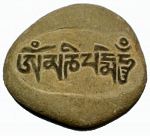
mani stone visiblemantra.org

The earliest text which contains the most famous of all mantras is the Kāraṇḍavyūha Sūtra. The title means "the casket containing the magnificent array", with the implication that it is the magnificent array of Avalokiteśvara, the Bodhisattva associated with the mantra.

Alexander Studholme has challenged the view that the Kāraṇḍavyūha is a very late and corrupt Mahāyāna text, and established that the Kāraṇḍavyūha is likely to have been written in Kashmir in the late 4th or early 5th century. This is by no means early in the development of the Mahāyāna and post dates the emergence the main themes such as Madhyamika and Yogacara, but not so late as previously thought.

The Kāraṇḍavyūha shows definite Puranic influences, especially from the Skanda Purāṇa of the Śaiva tradition. The Kāraṇḍavyūha, for instance, re-presents material from the Śaiva version of the story of the Vāmana-avatāra of Viṣṇu. Vāmana is a dwarf who asks a king for land. The king grants as much land as he can pace out in three paces. Vāmana transforms himself into a giant and covers the whole earth in one pace, and all of heaven in the second! In the Skanda Purāṇa this is presented as a morality play to encourage generosity, and so it is in the Kāraṇḍavyūha. Also in the Kāraṇḍavyūha, Avalokiteśvara appears as a bee in imitation of story about Śiva. Studholme says: "The sūtra clearly reflects a close interaction with a non-Buddhist religious milieu that is predominantly Śaivite, but one which is also respectful of the Vaiṣṇavite tradition." [1] His conclusion is that while the evidence of direct borrowing is limited and relatively weak, the evidence for influence and interaction is indisputable.

In the Kāraṇḍavyūha Avalokiteśvara is portrayed as Iśvara or Lord, and this is a title particularly associated with Śiva. Avalokiteśvara is also addressed as Maheśvara - Great Lord - three times. Several times Avalokiteśvara is described as the cosmic puruṣa which is a reference to the Puruṣa Sukta from the (Ṛgveda X.90). In a related text Avalokiteśvara is described as Nīlakaṇ(ha - blue throated - another of Śiva's epithets. Although Avalokiteśvara appeared well before the Kāraṇḍavyūha, for instance in the 24th chapter of the Saddharmapuṇḍarika Sūtra which may date back to the 1st century BCE, in the Kāraṇḍavyūha he seems to be consciously being given the attributes and names of Śiva. Avalokiteśvara's thousand armed form has Vedic and Puranic precedents despite the fact that no images of this form have been found on Indian soil - although Chinese images existing as early as the 7th century.


This ambiguity is heightened by Studholme's presentation of information about the very name Avalokiteśvara. The much later verse version of the Kāraṇḍavyūha may be the source of the explanation of Avalokiteśvara as "the lord (iśvara) who looks down (avalokita)" which has become the standard way of glossing it. However Studholme notes that before the 7th century the name seems to have been different. In fact the standard Chinese rendering Kwan Yin (觀音) is not a translation of Avalokiteśvara, but of Avalokitasvara which we would translate as he who is aware (avalokita) of sounds (svara). Avalokiteśvara in Chinese would be Kwan tzu-tsai (觀自在). The fact Kwan Yin has been retained as the popular name of Avalokiteśvara in China suggests it was well established before the change. This usage is confirmed by 5th century fragments of the Saddharmapuṇḍarika, and is used in various Chinese translations and dictionaries. [2]

How did Avalokiteśvara take over Śiva's name and qualities? It is indicated symbolically in the sūtra itself where the two figures meet and Avalokiteśvara congenially converts Śiva to Buddhism. Later, in the Sarvatathāgata-tattvasaṃgraha Tantra, this story becomes a violent confrontation where Vajrapaṇī and Śiva have a battle of magic (through mantras) and Śiva is first killed, and then revivified before converting to Buddhism. We can read this as an admission that yes, the sūtra is borrowing from the Śaivite tradition, but that it is being converted to Buddhism. Studholm shows that the Kāraṇḍavyūha, and the intended use of the mantra, are entirely consistent with the mainstream of Mahāyāna Buddhism.

This type of assimilation and adaptation was the norm in India rather than the exception, and should come as no surprise. Buddhism was no different and many borrowings from Vedic tradition are to be found in the earliest scriptures. The goal of using these forms is two-fold. It is likely that the authors of the Kāraṇḍavyūha were seeking on a purely social level to make converts, to compete with the majority Hindus, and to reinvigorate their own spiritual milieu. On the other hand, the broad goal of Buddhism, i.e., the liberation of beings from suffering, is still uppermost in their minds.

The Kāraṇḍavyūha shows a concern for the upholding of the institutions of celibate monasticism; however, in order to get the teaching of the mantra, monks venture outside the vihara to visit a man who is married with a family, does not keep the precepts, and is dirty. Studholme likens him to a tantric yogin, or a siddha, although the wife and kids really don't fit this picture. In any case, the teaching comes as part of a teaching which involves a mandala (with Amitabha in the centre) and an initiation. Despite all of these references to, and borrowings from the Śaiva tradition. However the Kāraṇḍavyūha "presents the practice [of chanting the mantra] primarily within a scheme borrowed from the bhakti side of the Purāṇic tradition". [3] By this he means that the Kāraṇḍavyūha chiefly presents chanting the mantra in terms of the Pure Land tradition - one calls on the name of a Buddha and is reborn in a pure land (in this case it is one of the worlds which are found in the hair pores of Avalokiteśvara, but which are effectively identical to Sukhāvatī). Contrast this with the traditions which draw on the "śakti" side of the tradition, in which the mantra is part of a ritual magic which transforms the practitioner into a Buddha. Studholme makes no comment on the relation of the Kāraṇḍavyūha Sūtra to the, by then, centuries old dhāraṇī tradition which is a shame.

Oṃ manipadme hūṃ, then, emerges from interactions between monastic Buddhists and lay Hindus in 4th or 5th century Kashmir. The religious goal of these Buddhists is conceived in terms of rebirth in a pure land, not in tantric terms.

To see the oṃ manipadme hūṃ mantra in a variety of scripts see visiblemantra.org.


Notes
  1. Studholme p.34.
  2. You can see this for example in English translations from the Chinese version. Of the three that I could lay my hands on easily all were translated from Kumārajīva's 406 version and the name of Avalokiteśvara is translated by Bunnō as Regarder of Cries of the World; Watson as Perceiver of the World's Sounds; and Hurvitz as He who observes the Sounds of the World - all translations of Avalokitasvara. Hurvitz includes a comparison with the Sanskrit version of the sūtra where the name Avalokiteśvara is used alongside his translation of Avalokitasvara without comment.
  3. Studholme p.103.

Studholme, Alexander. 2002. The origins of oṃ manipadme hūṃ : a study of the Kāraṇḍavyūha Sūtra. Albany : State university of New York Press.
It must be said that this book is an academic text which often labours a point beyond the patience of a general reader, and that it is full of jargon. By which I mean no disrespect for Alex, who was pleasantly surprised when I asked him a question on his book at a public talk and then asked him to sign my copy (a first apparently). It's just that the book is not an introduction to the mantra, but an in-depth study for specialists. Some Sanskrit would be an advantage reading this book.

~~oOo~~

Note 8 Sept 2014
On the name of Avalokiteśvara in Chinese see also: Jan Nattier. 'Avalokitesvara in Early Chinese Buddhist Translations: A Preliminary Survey.' Proceedings of the 5th Chung-Hwa International Conference on Buddhism. Dharma Drum, 2007.
Also note that despite the widespread perception of the meaning of ava√lok spread by Edward Conze it does not mean 'looks down' but 'examines'. See my later essays on the Heart Sutra for more on this. 

14 December 2007

Immanence vs Transcendence

The problem of Immanence v.s. Transcendence is one with relevance to any spiritual tradition, but it has special resonance for Buddhists. Simply put we may say that if Buddhahood is absolutely transcendent then we are cut off from it; and if Buddhahood is absolutely immanent then we are not released from suffering by attaining it. Clearly a Buddhist approach will be to take a middle way. But what are the practical implications of this?

I want to look at some of the approaches to this problem in the history of Buddhism, and show that Kukai came up with a highly creative solution to the problem.

While the Buddha, and perhaps his first few generations of Awakened disciples, lived there was less of a problem with immanence or transcendence because there were living exemplars. However in the Pali texts there is some concern for the way in which one can Awaken. One text which has had a huge influence on the Western Buddhist Order in this regard is the Upanisa Sutta from the Samyutta Nikaya. This text describes a progressive series of steps: suffering, faith, joy, rapture, calm, bliss, concentration, knowledge and vision of things as they are, withdrawal, dispassion, freedom, knowledge of the destruction of the mental poisons. Sangharakshita has called this the spiral path, and it is also sometimes called the 'positive nidanas' (although this is not a traditional term). Bhikkhu Bodhi wrote a pamphlet about the sutta and the idea, using the term Transcendental Dependent Arising after the Nettipakarana. The idea of a progressive path is present in a number of other suttas as well.

The key point here is that through practice - of awareness, of meditation - one can go through a series of stages which culminate in Awakening. The Upanisa Sutta offers an elegant solution to the problem. Unfortunately it seems Buddhists, including the guardians of the Pali Canon, lost sight of this important teaching and so over the centuries had to come up with a number of other solutions.

One Theravada approach is represented by Peter Masefield's book Divine Revelation in Pali Buddhism. Masefield argues that is it necessary to meet a Buddha in person in order to Awaken, that the possibility of becoming Awakened died with the Buddha. His thesis is remarkably easy to refute because although he bases it on a large number of quoted examples from the Pali Canon, he has overlooked many counter examples. Many people become Awakened without direct contact with the Buddha - thousands in the Therigatha alone. The position is one in which the Buddha is absolutely transcendent. We could also adopt a higher criticism approach to counter Masefield's literal reading of the texts as well, but that would take up more space than I have here.

The problem of Immanence v.s. Transcendence underlies the doctrine of the two truths which is central to the later Mahayana. The absolute truth says that Awakening is beyond the reach of language, ie it is transcendent. However if Awakening is absolutely transcendent, then we can not experience it, and so we have the relative truth. The relative truth says language is able to point to Awakening without actually encompassing it, or perhaps that language can describe the path, but not the goal, ie that Awakening is immanent.

The most prominent amongst the later theories is the Tathagata-garbha or Buddha Nature doctrine. In this theory each being already contains a germinal Buddha only waiting for the right conditions in order to manifest. Spiritual progress is often perceived in terms of clearing away defilements which obscure our true nature. The kind of practice most closely associated with this theory are generically called "formless". The quintessential practice is zazen, or 'just sitting'. The 'object' of meditation is simply the play of the experience arising and passing away.

However there are problems with the Buddha Nature theory. Buddha nature is often described as indestructible and eternal. There is a clear conflict with the doctrine which proclaims that everything is impermanent. Also if every being has Buddha Nature and we accept a theory of rebirth, then it creates a problem in that our Buddha Nature must transcend our death(s). How does this Buddha Nature follow us through the cycles of birth and death? Buddha Nature begins to sound all too like the Upanishadic idea of an Atman. A further problem is that it open the way to adopting the wrong view that we are already Awakened and need make no effort to change.

In the early 9th century when Kukai was introducing esoteric Buddhism to the Buddhist intelligentsia of Japan, the general view seems to have been that Buddhahood takes three incalculable aeons to attain. This is a more or less infinite amount of time - from any point of time Awakening is always sometime in the very distant future, and therefore essentially unattainable. The view comes from an over literal reading of Mahayana sutras. Yes the Buddha did have to spend aeons perfecting the perfections, but again the stories of the Pali Canon which show disciples regularly Awakening in very short spaces of time seem to be lost. Since practice cannot result in Awakening, it is directed towards mundane ends such as the prosperity of the emperor and the empire. Another aspect of establishment thinking was that the Dharmakaya was absolutely abstract, that there was no possibility of contact with it - ie that the Buddha was absolutely transcendent in the final analysis.

Kukai's great catch cry was "Awakening in this very existence!". So how did he overcome the immanence/transcendence problem? Kukai's approach was a radical take on the theory of interpenetration which is central to the Avatamsaka Sutra. Although the idea of interdependence is not found in the Pali Canon it is a logical consequence of "things arising in dependence on causes". If everything depends on causes then everything must depend, indirectly at least, on everything else. Kukai believed that interpenetration was the nature of reality and that nothing at all was left out of this, including crucially the Buddhas and Bodhisattvas. If everything is permeated by the Awakened mind of the Buddha, especially in his Dharmakaya aspect, then Awakening is immanent not just in beings, but in every atom of the universe. He seems to have taken to heart the image from the Avatamsaka Sutra which describes the universe as a great sutra, the letters of which are the items of experience (dharmas).

This approach gets around the problems inherent in the Tathagata-garbha approach. If we accept that there is any possibility of Awakening, then we are in contact, however faintly, with Awakening. In this theory practice consists of making the most of our connection by making our body speech and mind conform to those of the Dharmakaya via the medium of mudra, mantra, and mandala.

Kukai rejected the idea of an absolutely transcendent Dharmakaya - largely as far as I can tell on the basis of Nagarjuna's rejection of the validity of the existence/non-existence duality. Although it is incorrect, in his view, to state that things exist, it is equally wrong to say that they do not exist. The relationship is one of dependent arising, of course. It is not always obvious because of his esoteric approach to practice, but in many ways Kukai was a back to basics Buddhist.

The idea that Awakening is possible here and now, is a necessary corrective. It is explicit in the Pali Canon, and contra Masefield, there is no reason to believe that the conditions of the present preclude Awakening. Although I find Kukai's solution to the problem attractive and creative, I also see it as unnecessarily complex. In the absence of the early teaching on progressive conditionality, it is probably the next best thing, and at least it holds open the possibility of the Awakening in the present.


image: Wikipedia

07 December 2007

Creativity and Imagination

Creativity is an important quality in the spiritual life, and one I think that is quite poorly understood. There is a categorical difference between being artistic and being creative. Making art in whatever medium is the most high profile, and generally considered to to be the most valuable manifestation of creativity. Not everyone has the talent, dexterity, or the patience to be an artist, but still, everyone is creative. In this post I want to explore some of my ideas about creativity, and to show that creativity is a universal human activity, not confined to art making.

Let's start with a definition. What is creativity? Creativity is the ability to look for, find, and realise, new possibilities. I see creativity as a process that has phases and requires different attitudes and skills in each. The process of creativity has these stages: generating, filtering, focussing, moving towards, internalising.

All of our minds are capable of drifting, of being erratic, of jumping around. The infamous monkey mind. I take two contradictory positions on this. Firstly I celebrate my monkey mind because what it is doing is generating possibilities and ideas. Most of us filter out 90% of what our mind generates as non-sense or not needing to be above the threshold of awareness. The artist however pays closer attention to the 'noise' their mind generates because in it lurk all kinds of new possibilities, new combinations of familiar things. The Buddhist position, my second viewpoint, views the monkey mind as a kind of disaster in progress and seeks to calm it down. A calm and controlled mind is free to move in any direction, and we can choose which direction it moves in. So meditation brings in a tension for me. I know that periods of my life which are difficult, chaotic even, are also the times when I can be incredibly productive in my art - which suggests heightened creativity. Too much chaos and the mind becomes incoherent of course, but equally too much calm might mean a reduction in the flow of ideas. However meditation can make me more observant, more able to sustain my gaze which is an important creative skill, but it is an aspect of the second phase of the creative process.

We always have more options than we can choose from. We are always receiving more sensory data than we can possibly process. We are usually flooded with stray thoughts and memories, each of which produces a cascade of association. So we filter what is in our awareness, sometimes through habit, or cultural conditioning, or perhaps because of personal biases, but mostly from necessity. If we were suddenly able to be aware of literally everything that is going on in our bodies and minds we would be swamped and overwhelmed. However we can always do with being a little more aware. Being creative means paying attention to our internal psycho-physical process. Paying attention to what attracts and repels us, what fascinates and what bores. Either extreme may be where the pay-off is. The tension of anticipation of change can make boredom exquisite. People who are more obviously creative are probably more aware of this process and more willing to entertain seemingly silly or ridiculous information arising from his process. They have looser criteria, or can allow the filters to be less restrictive for periods of time. Some people attempt to use drugs for this purpose, but my experience suggests that in such cases people are creative despite the drugs, not because of them.

Once I picked up the exhaust manifold from an old engine lying by the side of the road. As I turned it over I thought - "Snoopy!". It suddenly looked like a beagle sitting with his head hanging. More profoundly William Blake saw the universe in a grain of sand. Objects in our environment can be the grit in our minds to create pearls of creativity. Having seen something interesting in the stream of output from their churning mind, the artist then gives it their full attention. This is where meditation and art really start to work together because samatha (calming) meditations are excellent for aiding this process. Creativity means we can hold an idea in our thoughts and walk around it, explore it, see where it wants to go, follow it a little way into the future in our imagination. I've come to see this as an important aspect of imagination. The ideas just come, just stand out from the flotsam and jetsam of our minds, but to explore them takes imagination.

I think of imagination as my sense of the future. In memory we examine past experience, in imagination we try to predict what a future experience will be like. This is very advantageous on a practical level - it enables us to plan ahead, to try out a new experience a little to see whether we think it is worth expending energy on. When it comes to art, the artist is usually working from a mental design. When Michelangelo was asked by a child what he was doing in his workshop, he replied "there are angels trapped in these blocks of stone, and I'm trying to set them free". Imagination is not the source of creativity, it is a skill that enables us to take advantage of a natural situation. It allows us to mentally develop an idea when it occurs to us, if it gets past the filters. Imagination can be developed through use.

The next thing in the creative process is a response to our mental creation - we have had the new idea, made it stand out from the background noise, explored and navigated it, and now we must move towards it. We have to act on the idea. In art of course this usually means making some kind of object. Or we might bake a cake, plant a bulb in the garden, make a witty comment in the moment, or simply stand for a few minutes to look at a sunset. All of these seem to me to arise out of the creative process as I understand it. This phase often calls for persistence. Thomas Edison is famously quoted as saying that "invention is 1% inspiration and 99% perspiration". I'm frequently complemented on my art works. Sometimes people will say "I wish I could paint". I definitely get the sense that they wish to be able to conjure a painting out of nothing. When I have an idea for a painting I generally spend quite a bit of time thinking about it. I might look at art works, or read some books which will inspire me or give me ideas about techniques. Then I will start drawing. This can take some time because I'm not a skilled draughtsman. I struggle with proportion and line. I struggle with shading and colour. It takes a lot of work to get a drawing that will form the basis of a painting. Then I have to transfer the drawing to a canvas or board. The act painting is tedious and takes a long time. I make a lot of mistakes which must be corrected laboriously. It takes many hours, days and weeks to make a painting that I feel happy about. I most certainly do not conjure anything out of thin air.

This is the last phase of the creative process - learning or internalising. Having conceived of and executed a creative act we try to reflect on the experience. Sometimes we can reuse what we've learned, and apply it to other situations and it has a concrete practical value. Other times it's a one off and highly ephemeral. But whatever the utility of what we have learned we allow ourselves to absorb the experience.

The most obvious application of creativity in the spiritual life is the conceiving of, and pursuit of positive change. In the field of ethics for instance we can be creative by allowing for more subtle choices in complex situations - we can allow for more possibilities, explore the potential consequences, move pro-actively towards our best option, and finally to learn about the consequence of our actions. Each phase of the creative process is important and benefits us in it's own way.

30 November 2007

The Cult of the Book and Western ideas of Canonicity

American Scholar Gregory Schopen makes the interesting observation that the study of Buddhism contains a curious anomaly. Buddhologists have always had two sources of information about the history of Buddhism: texts and material remains. However despite the existence of epigraphical and archaeological evidence, Buddhologists have set this aside and focuses on texts, taking texts as the sine qua non of the history of Buddhism, and of what Buddhism is. Western Buddhists have conspired with scholars because of a traditional tendency to fundamentalism with regard to texts, we have picked up our Asian teachers' faith that a sutra was always the literal word of the Buddha: thus have I heard.

Anyone educated in the sciences, as I was, will be familiar the refrain that one can only draw conclusions from what one observes. At school one almost always knew what was supposed to happen in a science experiment - but my teachers always insisted that I write up what actually happened and account for any discrepancy between that and what was expected. As the humanities have invaded the sciences - creating the "social sciences" - they could be expected to take on this dictum. However Schopen makes it clear that Buddhologists have not done this. In the rare cases where non-textual information is considered, it is always secondary to texts, and where it conflicts with texts it is set aside as an aberration.

Schopen takes a rather provocative stance in response to this situation - motivated perhaps in part by a desire to stimulate discussion, or perhaps it is frustration? For instance Schopen claims in his book Bones, Stone, and Monks that there is no evidence for a canon of writings before the 5th century. No canon is mentioned in any reliably dated source before this time Although the canon refers to it's own creation at an early date, it has become apparent over the years that the Pali Canon reflects a highly sectarian set of views, and is concerned with establishing the legitimacy of a form of Buddhism which is current in the 5th century in Sri Lanka. Another claim which Schopen makes is that the canonical texts reflect an idealised history, a way of life which no one has ever followed. Where there is material evidence on the lifestyle of monks and nuns it always contradicts the texts. For instance it is axiomatic that the Sangha did not own property, and yet inscriptions on stupas up and down India show that the donors that paid for the monuments were frequently the same monks and nuns who owned no property. Indeed coins are a common find in monastic ruins, and the means for minting coins have been found in at least one! The idea that monks did not own property is contradicted by the evidence of archaeology.

It has been interesting over the years being a member of the FWBO and seeing the vehement criticism of Sangharakshita for having the temerity of teaching things which were not strictly canonical and still calling it Buddhism. For instance Sangharakshita has made creative use of the metaphor of evolution to illustrate his thinking on the spiritual life. This kind of heterodoxy is condemned in some circles as "not Buddhism". Why? Because it is not in a traditional text - although it could be argued that Sangharakshita is simply restating an idea which is explicit in the Pali Canon, in the Upanisa Sutta for instance, but that would be to play the fundamentalists game. Oddly, for an Indian religion, written texts have become the arbiters of orthodoxy - a situation which I would argue runs counter to the long history of religion in that country.

So why is it that Buddhologists and Buddhists have privileged texts? Schopen claims to detect the spirit of Protestantism behind it. During the formation of the Protestant movement one of the defining disputes was over the status of practices. Amongst other things Catholics were accused of idolatry because of the worship given Mary and the Saints. The Protestant response was to turn to biblical fundamentalism in order, not only to distinguish themselves from Catholics, but to justify their heterodoxy by claiming to be more orthodox that the orthodox. Recall the violent repression of heterodoxy which characterised the Catholic Church over the centuries: heretics were not only persecuted they were tortured and horribly executed. If the justification for dissent came from the Bible itself, well perhaps it might prevent a red-hot poker in an uncomfortable place!

The same scenario probably would not have happened in India. The hegemonic religious caste of India has never been hostile to heterodoxy in the same violent way. When the Brahmins felt threatened by a competing faith they adopted what I call the Microsoft Approach: buy-out, rebrand, and market as an innovation. And so Shiva, the ancient cult, was soon adopted as Brahminical and Shaiva priests made honorary Brahmins. If you look at the avatars of Vishnu you will find a number of local cults - gods in the form for instance of a tortoise, a fish, a boar, a dwarf - incorporated. Indeed the 9th incarnation of Vishnu is the Buddha himself, relegated to telling us to be kind to animals. "All is one; God is good".

And so we have the interesting situation at present. Scholars of history have accepted the inevitable and more or less abandoned the project of creating a history out of the sacred texts. Anthropologists have decided they are more interested in what people do, than what they believe; beliefs are interesting in so far as they result in behaviour - a sentiment I believe the Buddha might have endorsed. Of course linguists are OK because they are interested in the language rather than the message. But Buddhists maintain a kind of fundamentalism about Buddhist texts. No point of view is valid unless punctuated by a quote from the Pali Canon (I know I am guilty of this!) Taking the Pali Canon as an example we know that it has been translated at least once (into Pali), that is has been edited rather clumsily at times, and that the current collection is attested only in the 5th century. The canon shows that it's preservers had preoccupations which were not always shared by the contemporaries, and that by the time writing came into being there were multiple competing interpretations of some of the most fundamental doctrines - such as the status of dharmas. It seems clear that the composition of news texts was a constant activity for Buddhists by the time that they began to employ writing in perhaps the 1st century BCE. The newly composed texts often gave considerable space to denouncing their heterodox co-religionists in the most base terms (I believe for instance that hinayana has caste-ist overtones and can be equated with insults such as "nigger" in contemporary vocabulary). And these are the texts to which we Buddhists yoke ourselves, mostly quite uncritically.

Don't get me wrong. I love the Buddhist scriptures, and value them both as spiritual inspiration and as literature. But I believe that what we Buddhists actually do is far more important than what we believe. The scriptures may well contain echoes of the words of the Buddha, but there is no substitute for practice, and the instruction of a more experienced spiritual friend. If, in the end, what works is in contradiction to the texts, then we must follow our insights, as the composers of the later Buddhist texts did. Buddhism is founded on principles, not on texts. Buddhist fundamentalism can never be justified in terms of Buddhist principles.


Further Reading

Harrison, Paul. 1995. Searching for the origins of the Mahayana : what are we looking for? Eastern Buddhist. 28(1), p.48-69.

Schopen, G. 1991. Archaeology and Protestant presumptions in the study of Indian Buddhism. History of Religions. 31(1), p.1-23.

Schopen, G. 1997. Bones, Stones, and Buddhist Monks : Collected Papers on the Archaeology, Epigraphy, and Texts of Monastic Buddhism in India Honolulu : University of Hawai’i Press.

Schopen, G. 1999. The bones of a Buddha and the business of a monk : conservative monastic values in an early Mahayana polemical tract. Journal of Indian Philosophy. vol. 27, p.279-324.

Wedemeyer, Christain, K. 2001. Tropes, typologies and turnarounds : a brief genealogy of the historiography of tantric Buddhism. History of Religions. 40(3), p.223-259
Related Posts with Thumbnails