29 August 2008

Dhammapada 5 - 6

na hi verena verāni, sammantīdha kudācanaṃ
averena ca sammanti, esa dhammo sanantano

pere ca na vijānanti, mayamettha yamāmase
ye ca tattha tato sammanti medhagā

Not by hatred are hatreds calmed at any time
By non-hatred they cease, this teaching is primeval

And others don't realise that we should be restrained.
But if they do realise this, then they will settle quarrels.
Verse 5 is one of the most famous Buddhist aphorisms. Hatred is like fuel on the fire, it only leads to more hatred. These two verse continue the theme established in verses 3 and 4: that we are never justified in holding a grudge. Vera, translated here as hatred can also mean "revenge, hostile action." It's actually related to the term vīra which usually translates as "hero" but can also mean something like "mighty". Avera then is the absence of hatred: "friendliness, friendly, peaceable".

The verses tell us that this idea is sanantano or "primeval, or "of old, for ever, eternal", the word being related to the Latin senex, and the English senile. So it could mean that the teaching is old, or that it will always apply.

Either way it is an important principle. And those who know this principle restrain their hatred (line 6a). Actually the first line of verse 6 is difficult to translate because the word yamāmase seems only to occur once (a hapax legomenon), and is of unclear etymology. I have followed K.R. Norman in reading it as an optative of √yam a verbal root meaning 'restraint'. Others relate it to the god of death Yama, and make the line say something like: Others do not know that we must all face death. There is good and useful Dharma in this approach. It reminds us that our future destination depends on our conduct in this life. If we indulge in hatred the traditions suggests that we are destined for the hell-realms. I would say that being angry has a hellish quality anyway. [see also Jayarava Rave. 08-02-2008: The Anger Eating Yakkha] That said however, the idea of restraint seems to fit the context a little better I think.

Although it is clear that the text is saying not to hold grudges, and that when one feels anger one should restrain oneself, it's not entirely clear how one might do that from these verses. There is such a plan in the Aṅguttara Nikāya however (sutta V.161). Here we find five methods for dealing with grudges:
  • Practice the brahma-vihāra meditations. If you feel hatred towards someone then try to cultivate the opposite: ie love, compassion, equanimity. (the text suggests mettā, karuṇā, and upekkhā but leaves out muditā and so counts this as three methods). We could call this 'cultivating the opposite'.
  • Pay the person no attention, give no thought to them. This is sometimes called the "blue sky mind" approach - don't feed the feelings and they will subside.
  • Reflect on the consequences. Particularly reflect that whatever bad thing that person has done to you, they will have to experience the fruit of that action which will be painful for them!
There is an obvious link between non-hatred (avera) and loving-kindness (mettā), so cultivating mettā could well have been what the Buddha meant in this case. When we cultivate love, the opposite of hate, then hate cannot find a purchase in our hearts. I suspect that muditā or sympathetic joy was left off the list because it would be difficult to cultivate towards someone to whom you grudge happiness. Best to start with simply not hating them, build towards love, and then perhaps we can take joy in their joys.

A more active form of the blue sky approach which I find quite useful is to think about something else. Many of my raves for this blog have resulted from me taking up a subject to reflect on precisely to stop my attention wandering onto less helpful subjects.

Reflecting on the consequences is also, effectively, reflecting on the Dharma. This is inherently positive. In Dhammapada 3-4 we saw that hatred is never a good thing - that the effects on us of entertaining anger are always negative. So reflect on the consequences of that person shouting at you, or bashing you. As I noted last week, our culture is one in which we seek to punish (ie inflict harm upon) anyone who breaks the law. But since some one who abuses us will suffer anyway, is there really a need to inflict more suffering on them. The question is: "would seeing another person suffer make us happy?" If we see that other person as a human being, then we will not feel joy at their suffering. We know what suffering feels like. We know how unbearable it can be. We know that if we inflict pain because we are angry, that person will become angry and inflict pain also. This has to stop. We must try to stop the cycle of anger and harming. Really reflecting on the causes and consequences of anger and hatred is quite sobering. If we reflect on what might have led a person to want to harm us, we will find fear and anger at the root of it. If we wonder why are they experiencing fear and anger, then we will see that they too have been victims of other people's fear and anger. They have learned this wrong lesson that we seem to teach everyone - that despite what we may say, anger and lashing out are legitimate responses some times.

I recall in Michael Moore's film, Bowling for Columbine, Mike was interviewing a PR man at Lockheed-Martin the massive weapons manufacturing business. They were standing in front of a very large missile, one that could only be used to strike at many people a very long way away (i.e. a weapon of mass destruction). He held his arms wide and his hands open, in the classic gesture of honesty, and said that he did not understand why these boys, who had gunned down many of their school mates, would resort to violence to resolve their problems. Why indeed? A very large missile, designed to deliver weapons of mass destruction is just the result of coordinated hatred, and of course our leaders do often resort to violence to solve their problems with the help of weapons manufacturers like Lockheed-Martin. And we often allow the emotions like hatred to persist in our minds. Of course we might take our revenge by something as simple as withdrawing our affection, or by doing something we know to be annoying. We might not be using a missile to kill thousands of people, or a handgun to kill our classmates. But it is only the scale that is different. If we were angry enough, and someone put a gun in our hand... well sometimes perhaps it doesn't pay to dwell on the consequences for too long. Just enough get the message and move on.

There is a definite sense in these early texts of working to eliminate negative or harmful mental states. There is none of the psycho-babble about allowing your anger to have expression or find an outlet. This is because from the Buddhist point of view the angry thought harms you, and any action undertaken with anger in mind will cause harm (viz my post on Dhammapada 1 - 2). Hatred is harmful so do what you can, whatever you have to, in order for it to subside. There is also no sense in early Buddhist texts of just thinking of anger as 'energy' as some Tantric traditions might do. Sure, there is energy: but are we alert enough, aware enough, Awake enough to refrain from hurting when we are angry? Not in most cases I think. Not without a great deal of training, and a great deal of mettā. Better to err on the side of caution with anger. It can be insidious. We can find ourselves justifying little cruelties to ourselves and others on the basis that "it's just energy", or "it's for their own good". Better to just nip it in the bud.

Bearing grudges only makes you miserable, and you are probably holding onto the possibility of harming someone in return for the harm they caused you. Hatred is never pacified by hatred - it never has been and it never will be. It is only by the opposite, by avera - non-hatred, that hatred is pacified. The good news is that by not bearing grudges, by not holding out for revenge, the hate will subside in you. When hate subsides it makes room for other more positive emotions. Dwelling in mettā all the time is equated with nibbāna in many texts.


See also my commentary on Dhammapada v.1-2, and v.3-4

22 August 2008

Dhammapada verses 3 - 4

akkocchi maṃ avadhi maṃ ajinji maṃ ahāsi me
ye ca taṃ upanayhanti veraṃ tesaṃ na sammati

akkocchi maṃ avadhi maṃ ajinji maṃ ahāsi me
ye ca taṃ n'upanayhanti veraṃ tesaūpasammati

"He abused me, he beat me, he overpowered me, he took from me."
In those who bear these grudges hatred is not stilled

"He abused me, he beat me, he overpowered me, he took from me."
In those who don't bear these grudges hatred settles and ceases.

akkocchi is verbal abuse, while avadhi is physical abuse. ajini comes from the root ji which means "to have power" or "to conquer" and so can mean overpowered, conquered, vanquished. Āhara is the past tense of hara "to take" and me is probably the genitive, so āhara me literally means "he took mine" - it is most often translated as "robbed me" or "stole from me". Sangharakshita has pointed out that the second precept against "taking the not given" has a broader frame of reference - it is not just stealing material things, but taking from someone anything which they have not willingly given you - their time or energy for instance.

These verses are said to have been spoken by the Buddha approximately 25 centuries ago. What this immediately tells us is that some things have not changed. Back then people shouted abuse at each other, they physically attacked each other. Some people tried to dominate their fellows. Some people took things that weren't theirs or that they were not entitled to. I find this quite a thing to reflect on. In 2500 years the human species as a whole has not evolved at all in the ethical sphere. So much for progress. Fortunately some individuals have evolved, and as individuals we all have the potential to evolve ethically and spiritually.

These two verses are only the bear bones of a manifesto for an ethical evolution, even perhaps a revolution. What they are fundamentally saying is that bearing hatred (vera) towards someone is never justified, no matter what they have done to you. This is not what we have learnt in our lives, not what we do on the whole, and seems almost shocking on first contact. Hatred in all it's manifestations is never justified. There is no righteous anger in Buddhism, no room for righteous indignation. Both terms are oxymoronic according to the Buddha. Most of us feel justified in being angry about something or someone, and about cultivating that anger, keeping it alive, feeding it, allowing it to fester. But the Buddha says no to all of this. Never allow anger to persist.

Because we are human our first response to being shouted at, or hit, or if someone tries to overpower us, or take our stuff, may be fear; but anger is usually not far behind. This is understandable. We can see anger is helpful for survival: it marshals our energy reserves (by preparing the body for action) and moves us away from danger, or prepares us to fight for survival. Most often there is nothing we can do about our physiological response to a threat - the reaction is instinctive, and most of us might not be alive today if that response had not kicked in at some appropriate moment in the past.

It is important not to beat yourself up for getting angry. Angry is instinctual. The verb in the second line of each verse is upanayhati which means: 1. to come into touch with; 2. to bear enmity towards, grudge, scorn. I've translated as "bear a grudge" because this seems the most useful way to approach it. For most of us it's not the initial reaction that is problematic, it is the ongoing anger, the grudge, the holding onto hurt, the contemplation or seeking of revenge.

When we hold on to hateful thoughts what happens? One thing is that while we replay the images or the conversation in our head we continue to re-experience the physical responses associated with the event. Say someone shouts at us, and there is an altercation. Our body prepares for action: the adrenal glands release adrenaline into our blood; our heart rate jumps and blood pressure rises; muscles tense ready for action. This can all happen in a moment, and yet it takes quite a few minutes to allow everything to settle back to a resting state. If we constantly replay the events in our minds, then we stir our bodies up, we may even vividly re-experience the the upset or even trauma of an event. Our bodies may continue to maintain a state of alertness for danger, of readiness for action, without ever fully relaxing. Over a long period of time this can be quite damaging to our body and our mind: one thinks of heart problems for instance, or of clinical depression. So holding onto hateful thoughts might be bad for our health in the long term.

Another possibility is that we become "an angry person". When we are constantly stimulating anger in ourselves, we feel angry, and we look angry: we scowl, we frown and grimace. We SOUND angry! Our body language communicates anger as well. Other people will be aware of this incipient hatred and experience it as a threat. It is quite clear to us when someone is angry, and we all know from experience that angry people are the ones who shout and hit, who try to overpower us, and so what do we do? We avoid them. It's only logical to avoid angry people - it is self preservation. Compare for instance the Rev. Iain Paisley with the Dalai Lama. Who would you rather spend time with? One very angry man (though admittedly much less so these days) and one who despite provocation does not express anger (in public at least). What's more people who are angry find it hard to communicate: even if you have something reasonable to say, you'll find that people are much less willing to listen if you are angry (unless perhaps they are angry about the same thing). So if you're angry a lot you're likely also to be lonely.

Holding grudges and exacting revenge prolongs conflicts and creates the conditions for more and more people to be harmed. We've all of us been harmed by someone, and probably all done harm even if only inadvertently. As the proverb goes: if an eye for an eye, and a tooth for a tooth were really the rule; we would all be blind and toothless. The cycle has to stop somewhere. Why not with you, in you, right now?

On a deeper level there is the underlying tendency to refuse painful experiences. We can't avoid some unpleasant sensations. It makes sense to avoid pain if it is avoidable, but sometimes we must simply have a painful experience. At the very least we are all going to die, and then we must be prepared to hold that pain in our awareness just as we would a pleasurable sensation. Holding of grudges suggests that somewhere in our being we are saying "it's not fair", and we are holding back from experiencing the pain of that injustice. This is a wrong view of the world. Such a view causes us constant disappointment. Of course it isn't fair if someone shouts at us or bashes us. But life isn't fair. Experiences arise in dependence on causes, and we must constantly be trying to see this process in action whether we enjoy the experience or not.

So I think it's clear that bearing grudges is counter-productive by any rational criteria - whether or not you believe in rebirth, or Awakening, or other traditional Buddhist beliefs. What these verses do not tell us is the "how". How can we possibly not hate the person who has inflicted harm on us? The next two verses go into this little, and I'll deal with them in my next post along with some help from another text.

See also my commentary on Dhammapada v.1-2.

15 August 2008

Dhammapada verses 1 - 2

mano pubbaṅgamā dhammā manoseṭṭhā manomayā
manasa ce paduṭṭhena bhāsati vā karoti vā
tato naṃ dukkham anveti cakkaṃ va vahato padam

mano pubbaṅgamā dhammā mansoeṭṭhā manomayā
manasa ce pasannena bhāsati vā karoti vā
tato naṃ sukham anveti chāyā va anapāyinī

Mind precedes experience, mind is foremost, [experience is] mind-made.
If, with a corrupt mind one speaks or acts:
From this disappointment and suffering follow as the wheel, the foot of the ox.

Mind precedes experience, mind is foremost, [experience is] mind-made.
If, with a clear mind one speaks or acts:
From this happiness and well-being follow like an inseparable shadow.
This is a fairly literal translation which largely retains the structure of the Pāli. Two interesting philological features are pointed out by K.R. Norman and John Brough with regard to these verses. Firstly the word anveti appears to be a Sanskritisation. Norman suggests that Pāli would usually resolve the consonant cluster nv to nuv, but here it doesn't. Secondly Brough (p.243) points out in his notes to the Gāndārī Dhammapada that vahatu (vahato being the genitive case) is an archaic word not in the Pali Text Society's Pali-English Dictionary. The word means ox, and vahato padam is “foot of the ox”, where pada is also used in it’s archaic sense of "foot", as opposed to it's later more abstract meaning "word" as in the title of the Dhammapada: "the word of the doctrine".

The archaic forms suggest age, but the Sanskritisation may also indicate later editing or composition. Perhaps an old image re-used? Interestingly the Pāli commentators (Sri Lanka, ca 5th century) seem to have understood the sense of “vahato padam” but not the words, so come to the right conclusion by some tortuous arguments. This is evident in many Dhammapada translations which treat vahato as a present-participle meaning something like "bearer".

In these verses the terms mano and dhammā (nominative plural) are twinned, as are sukha and dukkha, and paduṭṭha and pasanna. Mano and dhammā in this context are the mind which senses mental "objects", and those "objects" or dhammas. This is the more specific meaning of mano, which is sometimes also used synonymously with other words for "mind" such as citta and viññana. Dhamma has such a wide range of meanings that it can be misleading to settle on one in particular, but here does seem to indicate the mental phenomena which the mind senses - in these cases it is usually written in lower-case. Note also that mind here includes the emotions, and other subjective experiences. Mano also coordinates the mental responses to the information coming in from the five physical senses. I have chosen the word "experience" as a translation of dhamma in this case because it covers both the mental and physical aspects. I have justified using "experience" to translate dhamma in other contexts as well, particularly in my essay on the Buddha's Last Words.

Mano is that part of us that cognizes experience, that part of us that knows we are experiencing. And these verses are saying that mano comes first. But why? Other Buddhist models of the psyche suggest that mind, in the sense of citta, arises in dependence on contact of sense organ with sense object. It is important not to get caught up in the various models here. This is a pragmatic teaching. Mind comes first in these verses because mental states determine actions, and therefore consequences. The Buddha famously said: Cetanāhaṃ, bhikkhave, kammaṃ vadāmi - I say, monks, that intention is action [A vi.63]. This is why we must focus on the mind.

Actions arising from a mind which is paduṭṭha (spoiled, rotten, corrupt, literally "made bad") lead to dukkha - which I translate as "disappointment". However actions which are directed by a mind which is passana (clear, bright, good) result in sukha or bliss. The latter term is one which was in use before the Buddha. Brahman, the universal absolute has three characteristics: being, consciousness, and bliss (sukha). Brahman is also nitya (Pali nicca) or eternal. So in a Brahminical context sukha has a connotation of the goal of the spiritual life: union with Brahman. I think the Buddha may well have been employing sukha as a synonym for nibbāna - drawing on the Brahminical imagery as we know him to have done in many other cases. Despite this I have translated sukha as happiness and well-being. References to underlying Brahminical metaphors are often confusing to modern Buddhists who are frequently ignorant of the Brahminical context of some of the Buddha's sermons. Happiness here though does mean true happiness, the highest happiness, the bliss of nibbāna.

Dukkha, then, is the opposite of nibbāna. This gives it a much broader scope than is usually suggested by translations such as "suffering". When we read "suffering" we tend to think of physical pain or injury. But dukkha characterises all unenlightened experience. At this point you may be thinking "aha! Jayarava has fallen into that old trap of stating, contra the Dharma itself, that everything is suffering". However I am making a more subtle point. Not every experience is physically painful, but we the unenlightened have habitual tendencies which make even pleasure a disappointment. This operates at the level of immediate responses to vedana or sensations. Typically when we experience a pleasant sensation we want it to last, and when we have an unpleasant sensation we want it to stop now. We seek out pleasure, and avoid pain. I have argued at length in my essay on the Buddha's Last words that it is at this level of experience that dependent arising is really important. It is experiences (sensations including mental sensations and our responses to physical sensations) that are impermanent (anicca). The disappointment (dukkha) comes because we fail to grasp the nature of experience - we think of it as, or desire it to be, lasting (nicca). Because experiences (dhammā) are impermanent (anicca) they are disappointing (dukkha). The argument showing how this ties in with the doctrine of anattā would take a bit long to spell out, but it relates to the Brahminical idea about ātman being Brahman in the microcosm, and therefore necessarily having sukha as a characteristic - anything which has dukkha as a characteristic cannot be the ātman. A purely psychological understanding of ātman as simply 'ego' is, I think, a bit limited.

The verses are saying that we experience dukkha if our mind is corrupt. That is, if we fail to see and understand the nature of experience (yathābhūta-ñāṇadassana), then suffering follows, just as the wheel follows the ox which draws the cart - as the wheel follows the foot in the simile of the verses. The image for sukha is subtly different. If our mind is clear and bright (pasanna) then we see things as they are, and bliss cleaves to us. For dukkha the sense is that one thing follows another, and the two are distinct. A shadow however is simply an extension of our body - the shadow moves with us, moves as we move, instantaneously. Our shadow is inseparable (anapāyinī literally not-going-away). Apāyinī can also connote "a falling away (in conduct)" or "transient state of loss or woe after death" [PED sv apāya] so that anapāyinī (not-apāya), like sukha, suggests the goal of the Buddhist life: not falling away from good conduct, not falling into state of loss or woe.

So mind is first, mind is foremost, and things are said to be mind-made because mind determines the results of our actions. Those results are experienced as vedana (pleasant, unpleasant, or neutral sensations) and it is our response to vedana that determines whether we experience 'being' as dukkha or sukha, ie saṃsāra or nibbāna. If we fail to understand our existential situation we can expect only dukkha. Of course Buddhism offers us a plethora of tools for the job of waking up, and tells us that everyone can wake up. So while unawakened experience is disappointing, it is not the only possibility. There is every reason for optimism.


~~oOo~~

References
  • Brough, John, ed. The Gandhari Dharmapada (London: Oxford University Press, 1962).
  • Norman, K.R., trans. The Word of the Doctrine (Oxford: The Pali Text Society, 1997).
See also my commentary on Dhammapada v.3-4


Note: 26 Aug 2019

Agostini, Giulio. (2010). 'Preceded by Thought Are the Dhammas': The Ancient Exegesis on Dhp 1-2. Buddhist Asia 2. Papers from the Second Conference of Buddhist Studies Held in Naples in June 2004. Edited by Giacomella Orofino and Silvio Vita. Italian School of East Asian Studies, Kyoto 2010. https://www.academia.edu/4084875/Preceded_by_Thought_Are_the_Dhammas_The_Ancient_Exegesis_on_Dhp_1-2

The most ancient retrievable understanding of (DHp 1-2) is that 1. mental action precedes bodily and verbal actions (dharmā), 2. among them, mental action is the most important one, and 3. they are prompted by mental action. All Buddhists would accept these statements, and it will suffice to quote Vasubandhu’s Abhidharmakośa IV 1c-d: cetanā mānasaṃ karma tajjaṃ vākkāyakarmaṇī ‘mental action is volition, and what arises from it are verbal and bodily actions’. (24)

08 August 2008

The Apparatus of Experience

Sue Hamilton's book Early Buddhism a New Approach is not an easy read, but it is very rewarding. I found in it a doctrinal confirmation and clarification of my intuitions about the Dharma. I had been asking myself - what is it that arises in dependence on causes? (Jayarava Rave 8 April 2008) My answer had shifted from "things" to "experiences". This is reflected also in my translation of the Buddha's last words: "all experiences are disappointing..."

Central to Hamilton's book, and building on her earlier published work is a re-examination of the canonical references to the khandhas (Sanskrit skandha). These are typically described as encompassing the whole human being - there is nothing outside of the khandhas. Hamilton demonstrates that actually the khandhas are not meant to literally encompass the whole being, but do make up the minimum required apparatus for experience: hence "apparatus of experience". I like this little phrase and its implications very much.

A quick digression here to a suggestion by Prof. Gombrich about the translation of khandha - again from the Numata Lectures and appearing in his forthcoming "What the Buddha Thought". Khandha is most often translated by words such as aggregate, group or category, or (by Conze) as 'heap'. Gombrich points to the Pāli term aggikhandha meaning "a blazing mass". Khandha often occurs in the compound upādānakhandha where it is frequently translated as "aggregates of clinging". Gombrich links it to the extended fire metaphor used by the Buddha and suggests "blazing mass of fuel" (upādāna meaning literally fuel.) The khandhas, then, are a mass of fuel which, as the Fire Sermon ( Ādittapariyāya Sutta literally: The way of putting things as being on fire) tells us are on fire with the fires of greed, hatred and delusion.

The khandhas then are part of the mechanism keeping us in saṃsara, they are the "mass of fuel" that burns, and Nibbāna is the extinguishing of that fire - though the fuel itself can remain at this point as the term upādi-sesa-nibbāna "extinguishing with a remainder" suggests. It is rather a squeeze to fit every facit of the human being into just these five categories, and Hamilton manages to make a lot more sense of them as a kind of minimal requirement for experience - she takes the idea of nothing existing outside the khandhas as a metaphorical reference to the fact of experience: that everything we can know comes to us through the senses.

To have experience at all we must have a living body (rūpa). This is the vehicle for consciousness and the locus of experience. Without a living sensing body we would not receive sensory data - recall that the sense organ must be involved for contact to take place.

Having met with sensory data (vedanā) we process it: we become aware of and identify the sensation (saññā), we categorise it and name it (viññāṇā), and we respond affectively to it (saṅhkāra). This is a very cut down psychology, a minimalist account of consciousness, but it contains all that is necessary for continued experience, that is to say for continuation in samsara. And this is the process, this continuation in samsara which the Buddha constantly tells people is the focus of his teachings. Asked about all manner of metaphysical and philosophical teachings, the Buddha replies that he only teaches about the process of experience and how to end it.

Hamilton is saying, in effect, that later Buddhist tradition have taken this teaching a little to literally when they say things like: "These are the five aspects in which the Buddha has summed up all the physical and mental phenomena of existence". [Nyanatiloka : 98] Everything is not literally summed up, it is just that this is the necessary apparatus (to use Hamilton's terms) for all experience. All of experience - of whatever kind - is sensed, processed and acted upon through the khandhas. It is in this sense that the set is a complete description of the human being, not literally. It makes the assumption that we are what we experience, and as I have discovered, any attempt to get behind experience to confirm it involves some other sensory experience. One image that occurs to me for this is that we cannot get behind the mirror to see if anything is there because we always see a new mirror.

All this is not to say that some kind of objective world does not exist. I think the level of consensus that is possible on what is being experienced suggests very strongly that there is some kind of objective world. However I would argue that since we must always rely on our senses in any attempt to establish the status of the objective world, that such attempts are meaningless - they cannot provide a definitive answer one way or the other. I've come to believe that it was this that the Buddha was trying to get people to understand. Take for example the short Sabbaṃ Sutta in the Saṃyutta Nikāya. In this text the Buddha says that "the all" (sabbaṃ) is the eye and forms, the ear and sounds, the nose and smells, the tongue and tastes, the body and the felt, the mind and dhammas. (SN 35.23 = Bodhi : 1140). There is nothing outside of this "all". This is an explicit confirmation of what I've been saying. To take this to be an ontological statement - that outside of this "all" there is nothing - is to miss the point. It does not make sense as ontology, but as an epistemology it is very useful. All that we can know are 'objects' of the senses (including the mental sense), that is to say all we can know is what we experience - and the khandhas are the apparatus of experience.

I think this has profound implications for how we practice and teach the Dharma. For one thing I think we should abandon talking about dependent arising in terms of "things arising in dependence on causes" - there are no things only experiences. It would be more accurate to say that "experiences of things arise in dependence on causes". This then allows us to focus on the experience of dependent arising, rather than trying to locate some object which is arising. So many of our metaphors for dependent arising involve "things". But because of the way we function - through and only through experience - there are in effect no things arising.


References
  • Bodhi. 2000. The connected discourses of the Buddha : a translation of the Saṃyutta Nikāya. Boston : Wisdom Publications.
  • Hamilton, Sue. 2000. Early Buddhism : a new approach. The I of the beholder. Richmond, Surrey : Curzon.
  • Nyanatiloka. 1980. Buddhist dictionary : manual of Buddhist terms and doctrines. (4th ed). Kandy, Sri Lanka : Buddhist Publication Society (2004 reprint).

image: JAKIMOWICZ Fabien - belfry clock mechanism

01 August 2008

Which script?

Indian languages, and in particular Sanskrit, may be unique in that there is a distinct separation between the language and the scripts used to write it. Over the centuries a number of scripts and variation have been particularly important in preserving Buddhist texts. Buddhists were, like their Brahmin counterparts, initially reluctant to employ writing for the preservation of texts that were composed and transmitted orally. But eventually in several places, notably Sri Lanka and Gāndhāra, the sūtras were committed to writing. Here are the broad outlines of the development of Indian writing as it relates to Buddhist texts in roughly chronological order.


The first script to be used for writing Indian languages was Kharoṣṭhī beginning in the 3rd or 4th century BCE. It was used for several hundred years to write the local dialects, but also Sanskrit. Kharoṣṭhī was used in Gāndhāra in North West India (what is now the Pakistan shading into Afghanistan - i.e. Taliban country) and in central Asia. It shares many features with the Aramaic used by Persian administrators at the time when they were influential in that region, and most scholars accept that Aramaic was probably the model for Kharoṣṭhī. It was both carved in rock and written with pen and ink on birch bark. Quite a number of early Buddhist texts survive in Sanskrit and in the Gāndhārī Prakrit (roughly the vernacular dialect of Gāndhāra). A Gāndhārī version of the Dhammapada survives for instance, and several other texts which parallel the Pāli but with interesting mostly minor differences. These texts have helped to flesh out our knowledge of the different early schools of Buddhism.


Brahmī was the first truly indigenous Indian script. The name means simply "God" - Brahmā having been adopted as a creator god by this point. It was a definite improvement on Kharoṣṭhī in having individual signs for initial vowels, and greater variation between characters which made it more readable. My guess however is that it was designed for carving rather than writing per se. The signs are simple, geometric and quite linear. Aśoka (mid to late 3rd century BCE) used this script for most of his rock edicts - a few were in Kharoṣṭhī or Aramaic, and one was in Greek reflecting the local usage in the far West of his imperium. Probably most Buddhist texts were written in this script in Eastern and Central India until the 3rd century CE.

An early south Indian variety of Brahmī became very important. The Sinhala script emerges around the 2nd or 3rd centuries BCE and was used to commit the Pāli Canon to writing. It shows the rounded letter forms characteristic of writing designed for palm leaves with their pronounced grain that could be easily punctured.

In the North the Gupta script (so-called because it emerged during the Gupta Era, ca 3rd - 6th centuries) also derives from Brahmī. It shows the influence of pen and ink writing (probably still on birch bark). Versions of the Gupta script were used throughout North Indian and central Asia to transmit Buddhist texts. Many of the early Buddhist texts going to China would have used this script or one of its Central Asian variants. Some use of decorative writing - what we might call calligraphy - began to appear at this time.


Siddhaṃ was initially a word written in the top left hand corner of any piece of writing in the Gupta period, meaning perfection or accomplishment. However as the script changed and the letters became more elaborate Siddhaṃ (or more fully siddhamātṛka) began to be the name of the script. By the collapse of the Gupta Empire (under attack by Huns) in the 6th century the script had become distinct. However it continued to undergo development for several centuries. Two forms are commonly seen nowadays that I call "Chinese brush style", and "Japanese pen style". The latter appears to be a further refinement of the Indian script, while the former is influenced in it's form by the demands of writing with a brush. This script was important in the East as the medium of the early Tantric texts. What's more Tantric Buddhism initially inherited Vedic injunctions to preserved accurate pronunciation of letters and so the Indic script was preserved especially in the case of mantras - they can still be seen in the modern Taisho version of the Chinese Tripitaka for instance. Siddhaṃ calligraphy was elevated to a fine art by the Japanese. While Kūkai introduced Siddhaṃ to Japan and produced some fine works, the modern popularity derives from an 18th century revival. Siddhaṃ is mainly used for writing mantras and bījas these days, although shakyo or sutra copying has not completely died out - the Heart Sūtra being a favourite text.

An early variant of Siddhaṃ formed the model for the Tibetan Uchen (dbu-can) script which is now the main script used in printing Tibetan works. It further developed into many variants more suited to hand-writing for instance. We can deduce from it's description of the vowel 'e' (which is an inverted triangle representing the yoni) that the Hevajra Tantra still looked to the Siddhaṃ script as its model of writing.

The earliest appearance of Devanāgarī (देवनागरी literally "City of God") is about the 8th century but it did not supplant Siddhaṃ as the main script for writing Sanskrit in North India until about the 10th or 11th century. Many late Buddhist texts, such as later Tantras would have been written in Devanāgarī. Sadly the fluidity of the relationship is lost on most people and the Devanāgarī script is often referred to by the uninitiated as "Sanskrit" - as in "can you right this in Sanskrit for me". Devanāgarī has proved to be remarkably stable - with only minor changes occurring since it was adopted. It has been adapted for writing Hindi and as Hindi is the most prominent of the official languages of India, it is widely used through the sub-continent. Pakistan has adapted the Arabic script fro writing Urdu though it is very similar to Hindi.


Two other scripts which are frequently used in Buddhist contexts are the closely related Lantsa and Ranjana, from Tibet and Nepal respectively. These are often assumed to be identical but this is not true. They emerged in about the 11th century and are both are still in use for ceremonial or decorative purposes. Tibetan texts will often have the Sanskrit title in Lantsa as well as dbu-can at their head.

Although these scripts are all related and all descend from Brahmī originally, knowing one does not always afford insights into reading the others. Some letters such as ṭa stayed remarkably stable, whereas others such as ja changed quite radically over time. Tibetan Uchen retains an archaic form of na which disappeared from India, while other letters are similar to more modern forms, and some appear only loosely based on an Indian precursor. Since conjunct consonants (such as jña or ṣṭha) are written combined into a single glyph and each script does this in slightly different, and sometimes idiosyncratic ways (for instance in Devanāgarī श + री = श्री).

Writing was probably introduced to India by Persian invaders who had themselves absorbed the techniques from other conquered peoples, especially the Aramaeans who were a semitic race that has since disappeared but left a huge legacy. It is thought that parts of the Old Testament of the Bible were composed in Aramaic and that it may have been Jesus's mother tongue. The Aramaic roots of Indian writing are most clear in Kharoṣṭhī. However it was not long before Indians adapted the art of writing to their own languages, and subsequently Indian Buddhists helped to establish the written word in vast swathes of the East including Tibet, Burma, Sri Lanka, and most of South East Asia. Indian scripts influenced the development of the Kana scripts in Japan and the Hangul script of Korea.

Images from Visible Mantra scripts page.

25 July 2008

Dating the Buddha

Almost two years ago now I attended a series of lectures by Prof. Richard Gombrich which I find still resonating around in my psyche. One of the things Prof. Gombrich talked about was his disappointment that his article in which he had discovered the 'true' dates of the Buddha had not attracted any attention from the scholarly community. That oversight has now been corrected in a recent article by Charles Prebish in the Journal of Buddhist Ethics, which he co-founded with Damien Keown.

Prebish reviews the many contributions, including his own, over the years and spells out the conclusions to date which are not unanimous. In fact there are four chronologies:

The long chronology
This puts the death of the Buddha at 544/43 BCE and is accepted only by the Theravada tradition and not by scholars. The main reason for doubting it is that it gives dates for Aśoka that conflict with the evidence from his rock edicts - he was evidently crowned in 268 BCE give or take a year, and therefore a gap of 60 years remains unaccounted for.

The corrected long chronology
Prebish glosses over this date which appears to simply subtract the 60 years and give dates of 484/483 BCE. It seems as though this date became widely accepted

The short chronology
This date relies on texts which state that the coronation of Aśoka was exactly 100 years after the parinibbana, meaning that the Buddha died in 368 BCE. However the problem here is that all ancient texts are not in agreement over the elapsed time. One says 116 years, another 160 years. It is however supported by archaeological evidence and gained some heavy weight supporters.

The Dotted Chronology
The idea here is that when Upāli finished collected the Vinaya immediately after the Buddha's death he placed a dot on the manuscript. Each subsequent year a further dot was added to keep track of the years. The obvious flaw in this theory is that the vinaya was initially memorised and not written down until some centuries later. For at least 300 years there was no manuscript to place dots on.
Gombrich's answer to the problem of dating the Buddha came from a reassessment of the dates conveyed in records of Upāli successors as vinayadharas. The age at which each pupil was ordained, memorised the vinaya and died is recorded in a number of texts. Traditionally ages of monks are counted from their ordination, but Gombrich argues that in this case the ages where counted from birth. For one thing if the traditional chronology is used most of the monks would have lived into their 90's and one to 105. By counting the years from birth Gombrich is able to construct a plausible time frame for the lineage that does not contradict other known dates such as the coronation of Aśoka. This process yields a date of 404 BCE for the parinibbana with a margin of error of plus seven years or minus 5 years. Prebish seems happy to accept 404 BCE as the date.

Though Prebish accepts Gombrich's date for the parinibbana he believes that Gombirch was in error in his dating of the councils which rests on much shakier ground. In fact it involves making an assumption about the traditional date of 100 years between the first and second Buddhist councils that is not supported but only makes sense in the light of traditional historical narratives. After having dealt with the precise lifespans of the vinayadharas Gombrich makes the assumption that the 100 years is a round figure and suggests that it was in fact more like 60 years since that produces a better fit.

Prebish argues for letting the new chronology stand without altering the span between the councils. One of the consequences of this new chronology is that it places Aśoka front and centre in the first major split amongst the Sangha. The historical king is likely to have presided over the unofficial "non-canonical" council (recorded in some texts as occuring between the 2nd and 3rd councils) which resulted in the first Sanghabheda or schism. 18 years later Aśoka may well have convened the 3rd council at Pāṭaliputra (the Aśokan capital city) in order to try to "reaffirm Buddhist orthodoxy" in his new role as Dharmarājā.

An earlier article by Prebish and Jan Nattier makes it seem likely that it was the Sthaviravādins who split first, and the Mahāsaṃghikas who represented the conservative mainstream. The issue seems to have been the number of rules which the Sthaviravādins were seeking to increase. Evidence for this is the number of rules in the various surviving Pratimokṣa Sūtras with the Mahāsaṃghikas having the least.

This is a brief gloss of Prebish's article which is available on the internet (link below) and is recommended if you have an interest in Buddhist history. The original Gombrich article is less easy to get hold of - try an interlibrary loan if you don't have access to a major University library.


Bibliography
  • Gombrich, Richard. 1992. "Dating the Buddha: A Red Herring Revealed." In Die Daiterung des Historischen Buddha Volume 2, edited by Heinz Bechert, Vanden-hoeck & Ruprecht, 237-259.
  • Nattier, J and Prebish, C. "Mahāsāṃghika Origins: The Beginnings of Buddhist Sectarianism." History of Religions, 16, 3 (February, 1977), 237-272.
  • Prebish, Charles. 2008. "Cooking the Buddhist Books: The Implications of the New Dating of the Buddha for the History of Early Indian Buddhism", Journal of Buddhist Ethics, vol.15,

18 July 2008

Which Mahāyāna texts?

It is frequently observed that the proportion of Mahāyāna texts which have been translated into English even once is only small compared to the number in the Chinese Canon. Certain texts have received much greater attention than others, even amongst those available in translation, and are now taken as being normative - that is that our Western understanding of what the Mahāyāna as a whole was saying is based on a subset of those texts available to us in English.

In the introduction to her translation of the Ugraparipṛcchā Jan Nattier makes some observations about this which I would like to highlight. Her comments are in the context of noting that at one time the Ugraparipṛcchā was an important text. It has multiple translations into Chinese, and is cited extensively in anthologies such as Śantideva's Śikṣāsamuccaya. Some explanation of why such a central text has received so little attention in the West seemed to be required.

Nattier notes that texts are more likely to have been translated into English if they have two features: firstly if there is a extant Sanskrit text; and secondly if they have been influential in Japanese Buddhism. Here's a list which will be familiar to students of Mahāyāna.
  • Saddharmapuṇḍarika
  • Suvarṇabaṣottama
  • Sukhāvatīvyūha (both long and short)
  • Avataṃsaka
  • Vimalakīrti
  • Prajñāpāramitā Sūtras - especially Hṛdaya, Vajracchedika, Aṣṭāsahaśrika, and Pañcavimsatisahaśrika
  • Laṅkāvatāra
Only a handful of Mahāyāna texts survive in Sanskrit including all (I think) of the above. Part of the reason for the interest in Sanskrit texts is the focus of Western scholars on "original Buddhism". Westerners, partly influenced by higher criticism of the Bible, are aware of layers in the Buddhist canon, and are motivated to find the "original" text. The idea is that anything from a later period is not authentic, but this is making many assumptions which are not sustainable, nor would they necessarily be accepted by Buddhists. We know that the Heart Sūtra, for instance, was most likely composed in China, but this does not make it any less profound, nor undermine its widespread influence across many Buddhist sects. Buddhists can be fundamentalist about texts, but on the whole it is contrary to the spirit of the religion to be so. The Dharma is anything which helps us realise the truth.

However we need to balance this against Nattier's own comments just a few pages later with reference to Chinese translations from Sanskrit:
In short, when reading any given line of a Chinese Buddhist sūtra - excepting perhaps those produced by someone like Hsuan-tsang, who is justifiably famous for his accuracy - we have a roughly equal chance of encountering an accurate reflection of the underlying Indian original or a catastrophic misunderstanding. (Nattier : 71)
We are a little better off with Tibetan texts because they started later and had better reference works but -
even here, however, we frequently encounter visual, grammatical, or (less commonly) aural misunderstandings (Nattier : 71 n.36)
The solution is to compare extant versions of a text, and a key task for the scholar is to construct an edited (i.e. corrected) text which is pressumed to accurately represent the "original". Unfortunately the extant Sanskrit manuscripts which are seldom much older than a few centuries, are prone to the same problems. Viz Conze's comments on the Nepalese manuscripts of the Large Prajñāpāramitā Sūtra which he describes as "execrable". Leaving aside scribal and translator errors we also know that Buddhist texts frequently changed over time, chapters and sometimes whole independent sūtras, were added or subtracted, chapters were rearranged, and interpolations of all kinds were made by well meaning editors. The fact is that whatever the language of the text it will be far removed in time from its author. So it is that we welcome the work of Jan Nattier and others like her who are translating a wider range of text and drawing attention to the issues of the history of our texts, and the problems of translating them.

The second factor in whether or not a text is popular in the West is whether it is influential in Japanese Buddhism. This is a result of collaborations between the West and Japan which commenced in 1868 (with the Meiji Restoration). Influential Western Scholars such as Max Muller, and Hendrik Kern began to take Japanese students: the former was responsible for many first translations of Mahāyāna Sūtras, while the latter produced the only translation of the Saddharmapuṇḍarika from Sanskrit.

However there is a third factor because it is obvious that amongst these few texts, some have greater prestige than others. Nattier cites the Laṅkāvatāra for instance, translated and promoted by no less an authority than D. T. Suzuki as one text which has not had the kind of influence that might have been expected - we still only have Suzuki's rather flawed translation in English for instance. Compare this with the influence of the Saddharmapuṇḍarika which has many English translations, as does the Vimalakīrti, and the Heart Sūtra. Nattier suggests that these texts, and perhaps the Sukhāvatīvyūha texts, have a greater prominence because they:
"portray the Buddhist messages in terms congruent with certain core western values such as egalitarianism (e.g. the universal potential for Buddhahood according to the Lotus), lay-centred religion (e.g., the ability of the lay Buddhist hero of the Vimalakīrti to confound highly educated clerics in debate), the simplicity and individuality of religious practice (e.g., the centrality of personal faith in Amitābha in the Sukhāvatīvyūha), and even anti-intellectualism (e.g., the apparent rejection of the usefulness of rational thought in the Heart Sūtra, the Diamond Sūtra, and other Perfection of Wisdom texts). (Nattier : 6)
To which list we might add the factor of an "other power" centred soteriology perhaps! In the case of what is in the West an influential sūtra, the Saddharmapuṇḍarika, it is in fact far from being representative or typical of the Mahāyāna - in fact the opposite it true. And yet it has had a huge role in defining the Mahāyāna as it is understood in the West.

Nattier sees her study and translation as an antidote to the prevailing parochialism of the West, and as an attempt to restore a once important sūtra back to its rightful place in the Buddhist canon. Reading it we have to acknowledge that our ideas about the development of the Mahāyāna have been based on too narrow a field of sources and the Ugra challenges our preconceptions.

Bibliography

  • Nattier, Jan. 2003. A few good men : The Bodhisattva path according to the Inquiry of Ugra (Ugraparipṛcchā). University of Hawai'i Press.
A selection of Mahāyāna sūtras translated in to English, including some lesser known texts is available at www4.bayarea.net/~mtlee/. Image from that page.

11 July 2008

Dhāraṇī - origins, meaning, and usage.

The word dhāraṇī is a characteristically Buddhist term at times synonymous with mantra, and at others seeming to have it's own special significance. In this short essay I want to examine the word, and the main ways it is used.

The word dhāraṇī, according to Edgerton's dictionary of Buddhist Hybrid Sanskrit, does not occur outside of texts written in BHS. This point is sometimes summarised as "does not occur outside of Buddhist texts", but Edgerton's point is more specific and that specificity has some possible consequences. We need to be aware here of the shifting and uncertain nature of BHS. BHS is in fact a Prakrit language that was in the process of being Sanskritised. By which we mean a vernacular North Indian dialect was being regularised in it's grammar to conform to the ideals of linguistic form represented by Classical Sanskrit*. As such BHS shows considerable variation in grammar and spelling especially in the area of inflections - the suffixes added to words to indicate the grammatical relationship between them.

Buddhist texts cover a spectrum:

  • Texts written in relatively pure Prakrits (the Gāndhārī texts for instance),
  • Texts written in Pāli, a somewhat artificial "church language" constructed from several Prakrits.
  • Texts in which the Prakrit has begun to be Sanskritised
  • Texts in which the process of Sanskritisation is well advanced
  • Texts in more or less pure Classical Sanskrit (e.g. Aśvaghoṣa's Buddhacarita)
In fact there is a word in Sanskrit - dhāraṇa. It means, according to Monier-Williams:
"holding, bearing, keeping (in remembrance), retention, preserving, protecting, , maintaining, possessing, having".
This is so close to the uses of our word that I am somewhat surprised that the literature supplies no argument for distinguishing the two terms. Remember in BHS spelling is variable. In Tibetan the word is frequently translated, again according to Edgerton, as "gzuṅs, literally, "hold, support". This suggests that the Tibetans understood dhāraṇī to by synonymous with dhāraṇa. My linguistic knowledge is not sufficient to press the point, but it seems so obvious that I wonder why no one more qualified has not dealt with this issue.

Jan Nattier suggests that the earliest use of the term dhāraṇī occurs in relation to the Arapacana Alphabet (Nattier : 292) - now known to be the alphabet of the Gāndhārī Prakrit. This alphabet, uniquely in India, was used as a mnemonic device, a kind of acrostic where each letter stood for a keyword, which then became the subject of a phrase. By the time of the Pañcaviṃśatisāhasrikā Prajñāpāramitā Sūtra (ca. 2nd century) this technique was being used as a memory aid for a meditation on aspects of śunyata. From this usage we find the word dhāraṇī associated with mnemonic devices - many writers insist the dhāraṇī is always a mnemonic device. However a glance over some of the many dhāraṇī's preserved in, or as, texts will quickly make this identity much less certain. Most dhāraṇī apparently have no mnemonic features, i.e. they do not appear to stand for other things. They do employ many of the prosodic features of poetry in order perhaps to help them be memorable, but they do not seem to, as some authors would have us believe, "summarise the text to which they are attached". More often a dhāraṇī bears no apparent relationship to a text, even when it is strongly associated with a text - as in the very prominent case of the Heart Sūtra where interpretations of what the mantra means are as numerous as are commentaries on the text. That there is no consistent exegetical tradition associated with any of these dhāraṇī only serves to confirm this impression.

Like mantras dhāraṇī come in a variety of forms. In early Buddhist texts markers at the beginning such as 'oṃ' or 'namaḥ samanta buddhāṇāṃ' are missing. dhāraṇī can be strings of words, frequently all with the same grammatical ending (usually the feminine vocative). An example from the Saddharmapuṇḍarīka Sūtra is:
Anye manye mane mamane citte carite same samita viśānte muke muktame same avishame samasame jaye [kṣāye] akṣāye akṣaīne śānte samite dhāraṇī ālokabhāshe pratyavekṣāṇi nidhiru abhyan taranivishṇe abhyantarapāriśuddhi utkule mutkule araṭe paraṭe sukāṅkṣaī asamasame buddhavilokite dharmaparīkṣaite saṃghanirghoshaṇi [nirghoshanī] bhayā-bhayaviśodhani mantre mantrākṣāyate rule rutakauśalye akṣāye akṣāyavanatāye [vakkule] valoda amanyanatāye [svāhā]. (Bunnō : 329) **
Such strings make frequently use of poetic devices such as alliteration, repetition, and often make use of phonetic variations on a theme. These are clearly visible in the first line of the dhāraṇī above. Alternatively they may be strings of syllables which do not make words. Again from the Saddharmapuṇḍarīka:
iti me iti me iti me iti me iti me ni me ni me ni me ni me ni me ruhe ruhe ruhe ruhe ruhe stuhe stuhe stuhe stuhe stuhe [svāhā]. (Bunnō : 331)
Here the effect is of repeated sounds, which to my ear suggests some kind of sound symbolism. On a Buddhist online forum one member suggested that they represent coded coordinates for some object like a stupa, but as far as I know this is pure speculation. Though the argument is similar to ones made by Subhash Kak about codes in the Ṛgveda.

Another kind of dhāraṇī reads like a poem or prayer to a particular deity. These are more like the Vedic mantra in literary character - here we could translate dhāraṇī as "hymn" just as many Vedic scholars do for mantra. These dhāraṇī are part of an extant Buddhist tradition which is rooted in Pure Land ideas: chanting the dhāraṇī invokes the saving power (or vow) of the Buddha or Bodhisattva, delivering the chanter either from some immediate misfortune, or ultimately from the suffering of saṃsara altogether.

One oddity of the way the word dhāraṇī is used is that it can be both the means to the goal, and the goal itself. One chants a dhāraṇī in order to be protected or gain insights; however some texts talk about the acquisition of dhāraṇī as one of the results of the Bodhisattva's practice. The Lotus Sūtra deities offer dhāraṇī to be memorised and chanted for protection, while the Pañcaviṃśatisāhasrikā has the Bodhisattva attaining dhāraṇī : in this case dhāraṇī almost seems to be synonymous with samādhi, and note that this is sometimes how the word dhāraṇa is used in the Upaniṣads (see for example Deussen : 389f)

It is frequently assumed that dhāraṇī, and the Pāli paritta texts, are simply precursors to mantra. However I'm not convinced that there is a continuity here. Some of the popular dhāraṇī texts did end up being considered to be "kriya tantras" by later Tibetan exegetes, but there is nothing in the content of these dhāraṇī, nor in the context in which they occur, to suggest that they function like mantras in the Tantric sense. This identification has lead some scholars, for instance Robert Thurman, to argue for very early dates for Tantric texts, when other evidence makes it seem very unlikely.

A more thorough exploration by a qualified scholar is eagerly awaited, although I am not presently aware that any scholar of Buddhism is taking an interest. I speculate that a closer analysis of the evidence will reveal a more subtle interplay of religious ideas and impulses at work, and make it clear that dhāraṇī and paritta are not in origin at least, simply mantra by another name. The word dhāraṇī came into play in a time and place of innovation: in the 1st-2nd centuries in Gāndhāra, under foreign rulers (the Kuṣans), during which period also the first images of the Buddha were made, and the Mahāyana began to be mainstream. However it was quickly taken up by the Buddhist world - new ideas appear to have spread quickly at this time, perhaps due to extensive trading networks. The term then appears to have undergone a process of evolution over several centuries until the advent of Buddhist mantra proper, probably in the 7th century, when it was subsumed under that rubric. Traditional explanations of what makes dhāraṇī distinctive lack this historical perspective, while contemporary accounts have jumped too quickly to the conclusion that similarity equals sameness.


Notes.
  • * Where I do not qualify it the word Sanskrit will mean specifically Classical Sanskrit from now on.
  • ** Square brackets in this and the next quote indicate that the author has reconstructed the Sanskrit original from a Chinese text, and it is speculative. Note there is a Sanskrit text but it is very late and not necessarily more accurate.

Bibliography.
  • Bunnō, K. et al. 1986. The threefold Lotus Sutra : Innumerable meanings ; The lotus flower of the wonderful law ; meditation on the bodhisattva Universal Virtue. Tokyo : Kosei Publishing.
  • Deussen, Paul. 1906. The philosophy of the Upanishads. (trans. by Geden, A. S.) New York, Dover Publications, 1966.
  • Nattier, Jan. 2003 A few good men : the Bodhisattva path according to 'The inquiry of Ugra' (Ugraparipṛcchā). University of Hawai'i Press.

image: dhāraṇī in the Siddhaṃ script, calligraphy by Jayarava.

04 July 2008

Non-lexical utterances, stobhas, and mantra

In researching the background to Buddhist mantra I inevitably began to read about Vedic mantra. There is a lot more research on Vedic mantra and on the whole it is more interesting than research on Buddhist mantra, so far. Reading up on the Vedic tradition has given me an appreciation of the Vedic literature which is of surpassing beauty and profundity at times. I think we Buddhists tend to write off the other Indian scriptures but that is our loss. The Vedic tradition stands in relation to Indian culture rather like the Ancient Greeks do to Europe.

If you do read up on Vedic mantras you will find that mantra originally meant one of the hymns to the gods as exemplified and recorded in the Ṛgveda. The date of this text is disputed rather vigorously and sometimes hotly, but it seems likely that it was compiled around 1500-1200 BCE, probably out of an already existing oral literature. As the verses (or ṛk) began to be used ritually two things happened. Firstly an exegetic literature began to be composed to explain how, where, and when to use the verses in the rituals; and secondly the verses themselves were reframed. For my purpose today I want to draw attention to the Sāmaveda which reframes the Ṛgvedic verses by setting them to music. Verses sung or chanted to these rhythms and tunes as called sāman.

One of the key features of sāmans is the insertion of syllables to alter the metre of the original. These syllables are called stobha. Stobha can be one or two syllables. One list of stobha is:
ā (e)re hā-u is phat as hā hṃ iṭ pnya auhovā hahas ho-i kāhvau um bhā hai hum kit up dada hā-i hup mṛ vava (e)bṛ ham hvau nam vo-I (e)rā has ihi om (Staal Vedic Mantras p.61)
Recently I was revisiting some websites about the sounds that people make during conversations - which the researchers call "non-lexical utterances" or "conversational grunts". The interest in these sounds came out of research into human-computer interfaces. Here is a list of non-lexical utterances on one site:
ai hh-aaaah iiyeah okay nuuuuu ukay uam uumm yeahh am hhh m-hm okay-hh nyaa-haao um uh uun yeahuuh neeu ao hhh-uuuh mm ooa nyeah um-hm-uh-hm uh-hn uuuh yegh nuu aoo hhn mm-hm ookay o-w umm uh-hn-uh-hn uuuuuuu yeh-yeah ohh aum hmm mm-mm oooh oa ummum uh-huh wow yei yeah eah hmmmmm mmm ooooh oh unkay uh-mm yah-yeah yo ehh hn myeah oop-ep-oop oh-eh unununu uh-uh ye yyeah achh h-nmm hn-hn nn-hn u-kay oh-kay uu uh-uhmmm yeah ah haah huh nn-nnn u-uh oh-okay uuh uhh yeah-okay ahh hh i nu u-uun oh-yeah uum uhhh yeah-yeah (Reponsive Systems Project)
The list could be supplemented from popular music (think James Brown for instance!), or for that matter from serious vocal music, which also use non-lexical syllables to pad sentences or verses to fit a metre. These non-lexical sounds function as feedback to the speaker, and are uttered in concert with the speaker in order to let them know that they are being heard and understood. A lot (but not all) of the information conveyed by these non-lexical sounds is contained in the prosodic aspects of speech - tone of voice, inflection - along with non-verbal signals such as facial expression, hand gestures, and body posture. These can indicate the attitude of the listener to what is being said, and how they feel about it.

While we cannot confirm this, it seems reasonable to surmise that stobhas were drawn from non-lexical sounds amongst Vedic speakers at the time. This further suggests that stobhas not only help a verse to conform to a metre or rhythm, but may also have served another pragmatic function when chanted in sāmans. They may have been imitating prosodic elements of speakers of the time, incorporating information about responses to the sāman within it. It may be possible for a suitably qualified person to test this idea.

It is the conclusion of some researchers into mantra, Fritz Staal being the leading light, that because mantra contain non-lexical sounds, that they are "meaningless". We would have to agree that sounds like oṃ, āḥ, and hūṃ do not have dictionary definitions, they do not refer to any "thing". However it's clear that Staal et al have been too narrowly focussed on semantics. Languistics may be focussed on words, but human communication involves very much more, and a great deal of communication may take place without any words at all. We can even make words mean the opposite of their dictionary meanin: I can say "I like your new haircut", while implying the exact opposite in an unequivocal way through the use of facial expression and vocal inflection for instance. (This is known technically as conversational implicature)

After the Ṛgvedic period mantras began to make more use of non-lexical sounds. Staal sees this as a persistence of primitive pre-linguistic sounds into the present: they are like bird song, animal noises, or the burbling of infants, and quite meaningless. They are the caveman grunts of popular imagination, retained by Indian religious leaders for ritual purposes. If we for a moment accept Staal's hypothesis his analysis of those kinds of sounds is grossly oversimplified since all three of these phenomena are far from meaningless if one knows how to listen. Worse still Staal appears to be making some unfortunate, rather "orientalist", implications about the subjects of his studies. This inelegant hypothesis is untestable, and does not open the way to further research. It certainly does not chime with the experience of mantra. Kūkai goes to the other extreme and counts every mantric syllable as being infinitely meaningful, and being the starting point for elucidating all knowledge and experience. In this he is adopting a world view which has its basis in the Avataṃsaka Sūtra. A full explanation of Kūkai idea deserves it's own essay, and goes beyond what I am suggesting here. Not that I disagree, but I am looking for intermediate steps that make sense in a contemporary context.

Stobhas used in sāmans may well have been the model for the use of non-lexical syllables in mantra although this would be difficult to prove. They do bear a resemblance to non-lexical sounds used meaningfully in conversation by contemporary English speakers (and others). But even if they did not what it suggests to me is that we can look for meaning in ways that might not be obvious, and still not have to stray into metaphysics and mysticism. It may be that no explanation in these terms can fully comprehend mantra. That is not a problem. But in attempting such an explanation I think we can shed a lot more light on this subject, and make it more accessible in the process. The "mantras are meaningless" mantra is a dead end as far as research goes, and as far as elucidating the persistence of mantra over several millennia in Indian religious contexts.


References
image: The Reading Genie - "Say ah!"

27 June 2008

Mantra, Magic, and Interconnectedness.

At the heart of the practice of mantra is the idea that everything is interconnected. Although the idea is not apparent in early Buddhist teachings it is strongly associated with the Mahāyāna Avataṃsaka Sūtra, and with the Buddhism that centres around it, often known by the Chinese equivalent: Huayen. The Avataṃsaka coalesced in the 3rd century though it is thought to be a composite work that accumulated parts over time. However the idea that everything is interconnected was not new to India at the time, but goes back to the earliest religious text: the Ṛg Veda.

In the Vedas the cosmos is divided into three realms: human, god, and intermediate or sky. The earliest gods were personifications of the awesome forces of nature: the sun, storms, and fire... The ancients believed, for instance, that a single principle linked all things which were hot or bright: the sun, fire, digestion, and even the spark of imagination. This particular principle was called Agni - sometimes referred to as the "god" of fire. Even in our technologically advanced times we are still subject to nature (think global warming!): how much more so were our ancient forebears! They desired control over the sun and the monsoons, and developed a kind of magic technology for doing so. The very early Vedic poets acted as shamans who were directly in contact with the gods and the Vedic hymns are records of their conversations with the gods, or their prayers to them. They became the keepers of the the sacred fire. The Agni was the hermetic messenger and fire was an exchange medium: sacrifices were transformed by the fire into smoke, and this was carried upwards to the gods who could consume it in that form. In return the gods were compelled to respond favourably.

The key to effective rituals was the "bandhu" or connection between this world and the god realm. By manipulating the bandhu at this end, changes could be wrought at the other end. The priests were masters of the bandhu, and a great deal of the vast exegetical literature on the Vedas is devoted to listing or explaining bandhu. As with many ancient cultures knowledge at this time was based on resemblance and relationship; our own approach to knowledge relies on difference and isolation. A bandhu worked because something in this world resembled something in the other world. It can be difficult for us moderns to understand this, as we are attuned to seeing differences. To the ancients a metaphor might have seemed far more substantial for instance: they would never have said, as we might, that it's "just a metaphor". They understood the concept of metaphor, but took the relationship to be far more substantial than we do.

The late Vedic period saw the internalisation of the rituals, which were then carried out in imagination - thereby inventing meditation. The Buddha was born into this time, and studied for a time with Late Vedic sages, known as śramaṇas. The Buddha explicitly rejected the various forms of Vedic ritual, both external and internal, and substituted his own practices which emphasise a balance of blissful tranquillity and penetrating insight. Although he taught that all experiences arise from causes, he did not make the link between all experiences to explicitly talk about interconnectedness.

By the 3rd century some Buddhists were using the kinds of images of interconnectedness that have become familiar - Indra's net of jewels which each reflect all of the others for instance. In the 6th century a great synthesis of religious ideas occurred, partly in response to a breakdown in social and political order as the Gupta Empire was smashed by the Huns. Many of the old Vedic ideas were assimilated into Buddhism and key amongst these was the idea of bandhu. One sees this, for instance, in the Tantric explanation of the Avalokiteśvara mantra. The syllables are not considered as linguistic units, but as representing the six realms of existence, and the six manifestations of the Bodhisattva in those realms, etc.

It can be difficult for us to see how this medieval Indian idea makes sense. In "The End of Magic" Ariel Glucklich describes his research amongst the Tantric magicians of present day Benares. Working through the various Western ideological explanations of magic he rejects them all in favour of an explanation which relies on a sense of interconnectedness. Having done field work amongst Tantric healers in Banares, Glucklich concludes that:
Magic is based on a unique type of consciousness: the awareness of the interrelatedness of all things in the world by means of simple but refined sense perception... magical actions... constitute a direct, ritual way of restoring the experience of relatedness in cases where that experience has been broken by disease, drought, war, or any number of other events. (The End Of Magic, p.12)
I think that Glucklich has had a penetrating insight in this statement and one that we can relate back to Tantric Buddhism generally. Crucially to my mind he insists that what he calls the magical experience is neither a mystical nor a metaphysical concept.
It is a natural phenomenon, the product of our evolution as a human species and an acquired ability for adapting to various ecological and social environments. (The End Of Magic, p.12)
Some work remains to be done to adapt Glucklich's work to the Buddhist context: we need to see it in the light of Buddhist psychology for instance, and the Buddhist view of reality and experience; and we also need to make clear how mantra works in this framework. I am confident that it can be done because at the heart of the matter is interrelatedness.


Reference

image: my Facebook "friend wheel"

20 June 2008

Persian Influences on Indian Buddhism

Some people will be aware that when Buddhism flowed out of India it went West as well as East. The huge Buddha statues at Bamiyan in Afghanistan are a result of this, as are, apparently the Arabian Nights stories which are based to some extent on the Jataka tales. But few people will know that there was some traffic in the other direction.

It should come as no surprise really. The Khyber Pass continues to be the main route into and out of Pakistan in the North-west. But the evidence for this inflowing of traffic is all rather sketchy. I want to discuss two main items here: the presence of Babylonian Omens in the Dīgha Nikāya; and aspects of the Arapacana Alphabet.

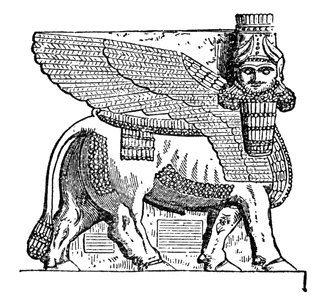
Some years ago now the late Professor David Pingree noticed that the first sutta of the Dīgha Nikāya, the Brahmajāla Sutta, contained a list of omens. The context is that the Buddha is spelling out to the bhikkhus that he considers divination and the interpreting of omens as wrong livelihood for a bhikkhu. The reasons for this are not clear but I suspect that it was one of many ways in which the Buddhist sangha tried to make itself distinctive from a. laymen, and b. ascetics from other traditions. The interesting feature of this list is that in both form and content it very closely resembles a Babylonian omen manual preserved in cuneiform writing in what is now Iran. Professor Pingree closely compares the items on the two lists and the order in which they appear and concludes that they are practically identical. Now we know the date of the cuneiform writing since it is pushed into clay and it very definitely pre-dates Buddhism in India. It's widely known amongst historians, and largely overlooked by Buddhists, that the Achaemanid Empire was in control of much of what is now Pakistan at the time of the Buddha (even allowing for the disputes over his dates). Interestingly the Pāli commentaries tell us that kings of Magadha used to send their sons to Taxila to be educated in administration and other disciplines, and Taxila at the time was a Persian enclave. At some point one or other of these young nobles must have either returned with the knowledge of these omens, or with someone else possessed it. Another scholar speculates that the Buddha's father employed Chaldean (ie Persian) magicians though I think this is not supported by the evidence.

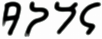
The Achaemanids were defeated and their empire destroyed by Alexander the Great whose own empire did not outlive it's creator by very long. It took a few generations for the Persians to regroup. By the time the Sassanian Persians were starting to make their presence felt, Gāndhāra had become one of the most important centres for Buddhist innovation and inspiration. The Persians by this time had abandoned the elaborate cuneiform script and begun to use a form of Aramaic. It is this Aramaic script which forms the basis for the earliest known Indian script: Kharoṣṭhī. Kharoṣṭhī is written right to left, and it has several characters in common (and with the same phonetic value) as Aramaic. It also only has one sign for initial vowels which is modified using diacritic marks to produce the full range of Indian vowels. This is because the Semitic Languages which employ Aramaic scripts do not allow words to begin with a vowel. The vowel sign in Kharoṣṭhī is modelled on, and is used like, a consonant. This is interesting in itself since Gāndhāra is probably the place where writing was first used in India, and it is one of the places where Buddhists first began to write down sutras.

Richard Salomon has shown with some certainty that the Arapacana alphabet is simply the Gāndhāri alphabet. He has hinted (to me in an email) that he knows why it is in the order that it is, which is different from other Indian alphabets, but as yet has not published his thoughts on this. One of the things about the Arapacana alphabet is that it is frequently associated with a series of verses in which a keyword starting with each letter of the alphabet either begins the line, or features prominently in it. Although the Indians did impose meter on their writings very commonly, and although collections of verses, such as the Vedas or the suttas in the Saṃyutta Nikāya, are arranged numerically, I am not aware of any other alphabetical list. But there are a number of Manichean hymns and Hebrew Psalms which are. So it seems as though the Arapacana was influenced by Semitic ideas via the Persians. What is more Jan Nattier has observed that the Arapacana verses are the earliest verses associated with the word "dhāraṇī", and could in fact be the original dhāraṇī. It is obvious that the alphabetical verses were a mnemonic aid, and so this accords with what is said about dhāraṇīs later. Actually it is interesting to note that most dhāraṇīs serve no obvious mnemonic function, and the association with memory is just a conceptual legacy. The conclusion here is that Persian influences were behind the creation and adoption of dhāraṇīs by Buddhists in Gāndhāra. I cannot prove this, but it is one explanation which fits the known facts.

The contact between India and the West, especially via the Khyber Pass is underplayed I think. More research might turn up more evidence of the cultural exchanges that took place and the way they shaped Buddhism over the years. It will reinforce the nascent realisation that Buddhism was not so different from other Indian religions in it's assimilation of ideas, concepts, and practices from the others.

Further Reading

Nattier, J. 2000. A few good men. (University of Hawaii Press)

Pingree, David.
  • 1963. Astronomy and Astrology in India and Iran. Isis. vol.54 (2), p.229-246.
  • 1998. Legacies in astronomy and celestial omens in The Legacy of Mesopotamia (Oxford University Press,) p.125-137
  • 1991. Mesopotamian omens in Sanskrit paper presented at La Circulation des biens, des personnes et des idées dans le proche-oriet ancien. Actes de la XXXVIIIe Recontre Assyriologique Internationale. Paris, 8-10 juillet. (Paper is in English)
Salomon, Richard.
  • 1990. New evidence for a Gāndhārī origin of the arapacana syllabary. Journal of the American Oriental Society. Apr-Jun, Vol.110 (2), p.255-273.
  • 1993. An additoinal note on arapacana. Journal of the American Oriental Society. Vol.113 (2), p.275-6.
  • 2006. Kharoṣṭhī syllables used as location markers in Gāndhāran stūpa architecture. Pierfrancesco Callieri, ed., Architetti, Capomastri, Artigiani: L’organizzazione dei cantieri e della produzione artistica nell’asia ellenistica. Studi offerti a Domenico Faccenna nel suo ottantesimo compleanno. (Serie Orientale Rome 100; Rome: Istituto Italiano per l’Africa e l’Oriente, 2006), pp. 181-224. [many thanks to Dr Salomon for sending me a copy of this paper]


19.10.2012 Eisel Mazard recently wrote a blog post about a story that occurs in both the Jātakas and Herodotus. The latter attributes the story to the Persian king Darius, which may indicate that it is originally a Persian story. The link is a bit tenuous, but if a Persian story also ends up in a Jātaka then it is another thread connecting Persia and Buddhist India.

13 June 2008

It's up to us!


Christ has no body now but yours
No hands, no feet on earth but yours
Yours are the eyes through which He looks
compassion on this world
Christ has no body now on earth but yours.

attributed to Saint Teresa of Avila (1515-1582)
(unsourced and possibly apocryphal)


I recently accompanied my mother to a church service at King's College. Durelle is a Christian and wanted to go to church on Sunday anyway. I am interested in the King's College Chapel as a beautiful sacred space, and in the wonderful choral music that accompanies services there. It happened to be Whit-Sunday (or Pentecost) , an important Christian festival, and as such a guest speaker gave the lesson. Professor John Harper focused on creativity as a manifestation of the descent of the Holy Spirit. I did not find this particularly convincing, but I was quite taken by the quote that he gave from St. Teresa. I immediately saw that replacing "Christ" with "the Tathāgata" would make for an interesting exercise:
The Tathāgata has no body now but yours
No hands, no feet on earth but yours
Yours are the eyes through which He looks
compassion on this world
The Tathāgata has no body now on earth but yours.
This resonates for me. Although the Buddha's have vowed to save us (from ourselves) it seems to me that we cannot afford to be complacent. In order to keep the Dharma alive we must be the hands and feet of the Buddha. Some time ago I wrote a post on the idea of Grace in Buddhism - based on a translation of the Japanese kaji (Sanskrit: adhiṣṭhāna) as "grace". This rather beautiful teaching says that spiritual practice is a two way process: the Buddhas and Bodhisattvas do what they can for us, and our part is to be receptive to what they are offering.

Sangharakshita has said that an image for the spiritual community is the 1000 armed Avalokiteśvara - each of us being a hand of the Bodhisattva of Compassion, reaching out to help, provided with an eye in order to see where help is most needed. Avalokiteśvara's 1000 arms reach out to embrace all beings.

The call to action can be quite daunting. After all how can we mere mortals take up the burden of a Buddha? My approach to is to try to make a clear distinction between the ideal and what I'm capable of in practice. The ideal is universal loving kindness. The practice may be not acting out an angry impulse, or conversely doing something gratuitously generous. Such things may not "save" anyone, but they contribute to a better world. If everyone was making this kind effort then it really would be a better world. And in the long run generosity, kindness, selflessness etc are liberating.

In terms of our local Buddhist community I think this means helping others as best we can. Not everyone is skilled enough, or temperamentally suited to teaching, but those who are need to be supported. Reaching out to people who want the Dharma is demanding, and doing it without a supportive Sangha behind you is much more so - as those pioneers taking the Dharma to new towns or countries will know. Often just an enthusiastic presence at a centre can make a difference. It did for me when I first went looking for meditation instruction. Members of our community will need assistance from time to time, in all sorts of ways, and it is up to us to help them.

Compassion also means forgiving people. Forgiving them for letting us down, or even for harming us. And justice which involves harming or humiliating the other is no justice at all - the Karaṇiya Mettā Sutta makes this clear. We need to be rational about this also. If someone has harmed us, then it may not be sensible to be around them unless they have undergone a big change and sincerely renounced harm. It may be best to avoid someone who is violent. However it is important to try to see the suffering that the violent person is creating, and reflect on the consequences for them. If we wish harm or suffering on them then we too will reap the same fruit.

The quote above may be apocryphal, but this does not reduce it's applicability. As Buddhists we aim to follow the Buddha; we aim to be like him; to emulate his fine qualities and graceful bearing; we aim to in the long run become a Buddha ourselves.

image: St Teresa of Avila

06 June 2008

Mettā Sutta translation

This is a new translation, not simply a paraphrase of an earlier translation. I have attempted to use contemporary idiom and reasonably sensible English syntax. The original is in verse, but I haven't tried to reproduce the meter. The Karaṇīya Mettā Sutta occurs in the Sutta Nipāta (Sn 1.8 = PTS: Sn 143-152).

I've speculated, in another post, that the sutta might once have stopped at verse nine, but an extra verse was added as a result of a lost metaphor.


The Karaṇīya Mettā Sutta.


If you know what is good for you, and what to do about it,
Having understood what true happiness is,
Then this is what you would do:

Be practical, straight forward, direct and honest
Be polite and accept advice graciously
Be tender hearted and not arrogant
Be contented, with moderate appetite, and needs easily met
Be easy going
And do not take on many responsibilities
Be grounded and in control of yourself
Be prudent and not reckless or impulsive
And don’t go chasing after status
Never do even the slightest thing that would result in a bad conscience,
Or give the Wise cause to reprove you.

May they have happiness and peace
May all beings be happy in themselves
Whatever living beings there are,
Those suffering and those released from suffering, leaving none out
All beings of whatever size or shape
Fine or coarse, refined or rustic
Seen or unseen
Beings in remote places, and those around you
Those already born, and those about to be born
May all beings be happy in themselves

Not humiliating, or despising, anyone anywhere
And never, though angry, or experiencing anger,
Never wish suffering for another
Just as a mother would give her life to protect her only child
Likewise include all beings everywhere in your heart and mind
With loving kindness for all the world
In all directions of space, unobstructed, peaceable and without enmity
The heart embraces all.

Whatever you are doing, in every activity
As far as is humanly possible sustain these reflections
To do so, it is said, is to dwell with god right here and now!

Hold your opinions lightly, and be virtuous and good
See things as they really are
And having given up addiction to sensuous pleasures
You will surely not have to suffer rebirth again.
Related Posts with Thumbnails