18 March 2011

Complexity & Simplicity in Doctrine


THIS IS A DIAGRAM showing the Canonical variants of paṭicca-samuppāda in both its lokiya (left) and lokuttara (middle) forms along with the bojjhaṅgas or factors of awakening (right) which have some cross-over. The lokiya being more usually know as the 'nidānas', or in the Triratna movement the 'cyclic nidānas'. The lokuttara known as the 'Spiral Path', the 'positive nidānas', or 'progressive conditionality'. I have started calling them the upanisās and hope to popularise this. I constructed this diagram because I like to think visually - certain relationships are easier to see graphically - and because I had some new (free) software to play with in the form of the Visual Understanding Environment. If you click on the image you can see the full sized version which is 7578 x 3591 px.

When paṭicca-samuppāda is taught in traditional circumstances it is typically not this very complex view that is taught. What is taught is a synthesis which irons out all of the complexity and condenses all of the variation into the standard 12 nidānas, and usually leaves out the upanisās all together. Even in the Triratna Order, which emphasises the upanisās as being of central importance, we only teach the version found in the Upanisā Sutta (SN 12.23).

This raises two questions I think. Firstly why is the canonical account of paṭicca-samuppāda so complex, and even contradictory? Secondly, why is the presentation of paṭicca-samuppāda so simplified and coherent?

I can think of several reasons why paṭicca-samuppāda might be complex. Both scholars and buddhists believe that paṭicca-samuppāda is a general principle which can be expressed in a variety of ways. The general principle is that 'things' arise in dependence on conditions. I've critiqued this view (see A General Theory of Conditionality? and Paṭicca-samuppāda: a Theory of Causation?), but in the end I think it is inevitable that we see the general nature of the principle of conditionality. And any general principle can be illustrated using a variety of concepts, images and metaphors. So we might expect to find complexity. There is also the generally acknowledged idea that the Buddha responded to individuals, explaining things in a language, and at a level, which they could understand. This might explain some of the variation, and a certain amount of contradiction. The Buddha had the goal of liberation in mind, but allowed for any number of paths to get there. Anything which conduces to liberation is Dharma! (see What is Buddhism?) Some of the contradictions are in the order of development in the morality part of the upanisās section of the diagram. These don't amount to show stoppers, but are just different ways of presenting the dynamics of morality. I've confessed to other confusions concerning the lokiya side of things which I think are more serious problems with the model.

Another reason for complexity is that the composition and transmission
of these texts, and their collation into a Canon, took place over several centuries. It also seems likely that variations emerged in different communities - what we might these days call transmission lineages. Evidence for these lineages can be found where the same story occurs in different versions. Look for instance at the story of Vaseṭṭha and Bharadvaja in DN 27, MN 98, and Sn 3.9 (and compare with DN 13 as well) - these suggest to me one story remembered different ways. Some scholars (especially Tillman Vetter, following Eric Frauwallner) have speculated that the 12 nidānas were originally two sequences that that have been joined together. One of the supporting observations they make is that there are several Canonical sequences that begin with taṇha (e.g. SN 12.52), though to suggest that this is somehow 'original', rather than merely fragmentary is actually quite doubtful - especially in light of all of the other fragments of doctrine floating around the Canon! Joanna Jurewicz and Richard Gombrich have suggested that especially the first four of the 12 nidānas were added to a shorter sequence in order to satirise Vedic cosmogony because these terms have a particular resonance for Brahmins [1]. This idea of historical process may be the only way to make sense of the various fragments, or sequences that skip steps.

The complexity of the Canonical accounts of
paṭicca-samuppāda are comprehensible, and even predictable under the circumstances. But why has the tradition condensed all this to a single set of 12 nidānas, ignored variation and dropped the upanisās all together?

Obviously it makes teaching about paṭicca-samuppāda a lot easier to present it in a simplified version. The discussion of all of the variations is time consuming and is potentially confusing. So there are didactic or pedagogical reasons for beginning with a simple version. I don't understand, however, why the simple version became the only version. If the tradition goes to all the trouble to preserve this vast corpus of literature, why did it lose interest in the detailed content of that literature? After the synthesis produced by Buddhaghosa there seems little interest in critical scholarship in the Theravāda until the modern era, and that was stimulated by the Western critical traditions. And in the Mahāyāna they seem to be immersed in sorting out the significance of their own doctrinal innovations to pay much attention to these basic issues. We seem to have mistaken the map for the territory at some point.

One of the interesting quirks of history is the complete loss of the upanisā sequence in received traditions. Though the sequence occurs once in the Visuddhimagga (Vism i.32) it is given no prominence. As far as I know it does not feature in Mahāyāna texts at all, nor in contemporary Theravāda presentations of the Dhamma. [2] Sangharakshita speculates that it was a preference for via negativa arguments - what he polemically calls "one-sided negativism" [3] - that the upanisā sequence was lost sight of, but in fact we do not know the answer to this conundrum. The full recovery of the teaching has not yet been completed either, because all present published accounts of the upanisā sequence rely on the Upanisā Sutta (SN 12.23) and as I argue in my essay
on the upanisā sequences (Onramps to the Spiral Path - pdf) this sutta is not representative of the other Canonical accounts.

It also seems that one of the functions of religion is to provide some certainty, or at least the illusion of certainty. A nice, simple model of reality suggests that life or the universe is actually simple and that certainty is possible. Presenting a simplified model as a beginning is fine, however in many quarters the knowledge that it is only a simplified model seems to have been forgotten. I suggest that this is a symptom of not studying our own texts - we tend to take our knowledge of Buddhism from contemporary accounts of commentarial traditions, precisely because they are simplified and easier to understand. Most people do not seek complexity, they seek simplicity; and most of us are uncomfortable with uncertainty.

Complexity is difficult to communicate or understand. One of the best ways for dealing with complexity is to look for patterns. So in the diagram above we see that many factors repeat in the various schemes, and that they clump together in related categories: many of the elements are to do with morality for instance, while others are related to meditation. So we describe the complex situation in simpler terms - the threefold path of morality, meditation and wisdom is one useful scheme for organising the complexity we find in the Pāli Canon. This is technically called a reductive explanation - and most Buddhist doctrine is highly reductive. It is important to remember that a reductive explanation only simplifies the explanation for the purposes of communication, it does not reduce the phenomena in any way. Ironically, there seems to be a prejudice against reductionism amongst many Buddhists, perhaps because of a tendency to forget about the distinction I've just made. Every conceptualisation involves some reduction of complexity, and Buddhism as communicated in texts is always reductive, always trying to communicate meaningfully about the complexity of human experience, through simplifications, generalisations, and broad categories. This is not a problem unless we take the reductive explanations literally. As
Alfred Korzybski said: the map is not the territory.

Books and articles are still being written about the Dharma to supplement a commentarial tradition stretching back in all likelihood to the time of the Buddha himself. Contemporary scholars have yet to reach a full consensus regarding the complexity of the nidāna sequences, but the complexity of the upanisā sequences has received almost no scholarly attention. My own essay on the upanisā sequence is not intended for an academic audience, but aims to provide a scholarly account for the Triratna Order (I reference in-house documents and discussions that would no doubt be disqualified in an academic journal). The idea of lokuttara paṭicca-samuppāda is still mostly a lost idea.


~~oOo~~


Notes
  1. Joanna Jurewicz's idea is summarised in chapter 9 of Richard Gombrich's book What the Buddha Thought. I think Gombrich overstates the importance of Jurewizc's discovery. It is interesting, but it's not obvious that the sequence was formulated primarily as a parody. There is unexplored complexity here!
  2. There are two exceptions that I know of. Bhikkhu Bodhi wrote Transcendental Dependent Arising (1980) in response to Sangharakshita's The Three Jewels. Ayya Khema wrote about the Spiral Path in When the Iron Eagle Flies (1991) and, as she was a personal friend of Sangharakshita, I suspect she also got the idea from him.
  3. Sangharakshita (1993) A Survey of Buddhism. 7th ed., Windhorse, p.136.

The latest version of the diagram is on my dependent arising webpage, where you can also find partial versions of the diagram, and some other essays. I've printed it on A1 paper, and it is just readable. A0 would be better.

11 March 2011

A Theory of Language Evolution (with a footnote about mantra)

I HAVE BEEN READING The Ego Tunnel: The Science of the Mind and the Myth of the Self by Thomas Metzinger. It is a book with some flaws, which I'm not going to dwell on, but on the whole Metzinger presents a fascinating theory of consciousness, selfhood, and self-consciousness. Metzinger is a philosopher, so is concerned to give an overview and to create a coherent narrative of consciousness, but his source materials are the findings of neuroscience, along with his own out-of-body experiences and lucid dreams. The combination is intriguing because though he fits in with a scientific, even materialistic, world-view, he seeks a theory of consciousness which takes his unusual experiences seriously and explains them. This may make him unique in the field.

His opening sentence declares that he is setting out to convince us that there is no such thing as a self. In this he follows in the footsteps of Antonio Damasio whose book The Feeling Of What Happens I highly recommend. I want to come back to Metzinger's theory of consciousness in subsequent blog posts, but here to talk about a point he makes in passing in his chapter the 'Empathetic Ego'.

Recently neuroscientists discovered two related facts about the link between behaviour and the brain. When we see an object, groups of neurons associated with motor activity are active. These are called canonical neurons. When we perceive objects part of us is relating to them by imagining potential physical interactions, by how we might manipulate them. I'm reminded here of George Lakoff & Mark Johnson's theory of metaphor. They say that the metaphors which underlie our abstract language and thought are related to our physical interactions with the world. Hence we can say that we grasp an idea meaning that we understand the concept. (See Metaphors We Live By).

On the other hand we know that some neurons associated with motor activity -- called mirror neurons -- light up whether we are doing the action ourselves, or whether we are observing someone else doing it. In particular these mirror neurons seem to be active when we witness emotional states in other people and feel empathy with them. It seems that mirror neurons are involved in modelling the posture, gesture and facial expression we see in others, in order to understand the kinds of feelings we associate with that physical arrangement. This ability to sense emotions in others is quite accurate, and important for us social primates.

Metzinger speculates that these two types of neurons might have been associated with the development of communication and I want to run with this idea, and sketch out an idea about how language might have evolved.

Once we move beyond the very simple forms of animal life - the single celled organisms - and look at the way animals communicate there are clearly hierarchies. We all release chemical messengers, e.g. hormones, and these are sensed with the mouth and nose, or have a physical effect on us. The other form of communication shared by all animals is posture - and posture is one of the basic activators for the canonical and mirror neurons. Posture can communicate attitude - aggression, receptivity (for mating), submission or dominance. But not much beyond this. Think of reptiles.

Subtlety begins to emerge when we employ three other forms of communication. Over posture we note that reptiles will sometimes reinforce posture with sound, although reptilian sounds don't add much to the message. Birds developed elaborate postural displays, and added more complex sounds to the mix. These sounds mainly seem to transmit the the message conveyed by posture -- e.g. territorial displays, or receptivity to mating -- but over a broader area. In other words, birds can broadcast their posture. Mammals, however, are capable of producing more sophisticated sounds, though these are still related to fairly basic 'emotions' like fear, contentment, receptivity, and aggression.

Some mammals added gesture, a more subtle form of posture, to the mix. Gesture allows for more nuanced communication. Then primates in particular added facial expression to this mix. With these one can communicate a wider range of emotions. Scholars have come up with many lists of basic emotions which overlap but do not converge. However, any list would contain some common items, for instance: anger, joy, sadness, fear, disgust, surprise, desire. All of these, and many variations can be accurately communicated without any words through posture, gesture, tone of voice, and facial expression.

With posture, non-language verbal sounds, gesture, and facial expression we can communicate the full range of human emotions. However there is not much scope for abstraction, no possibility of communicating outside the immediate present. And in fact we share this level of communication with other primates. We do know that chimps are capable passing on knowledge of tool use, of planning, and getting others to cooperate in group actions that require forward thinking - war and hunting. So this level of communication is quite sophisticated, but language is orders of magnitude more sophisticated again.

Language sits on top of all of this. You would be forgiven for thinking that language existed apart from all of this because linguists seldom make reference to non-linguistic communication, and are often focussed on just the words involved in language, or even just written language. As I mentioned, Lakoff & Johnson have argued that the metaphors which underlie the our abstract though are based in our physical interactions with the world. So native English speakers know the metaphor that up is good (on the whole) and down is bad: e.g. a good mood is up; optimists feel things are looking up etc. (Similar metaphors are found in Sanskrit btw.). Similarly, in discussions we employ the argument is war metaphor: we take sides and defend positions against opponents; a vigorous exchange involves cut and thrust; we line points up and shoot them down; and we win if our points are on target or we exploit a weakness, or lose when our argument is undermined or demolished; we love to drop bombshells, and overturn paradigms, but hate to capitulate and back down. This suggests that language doesn't jut sit on top of the under-layers of physical, emotional communication, but is deeply rooted in them, and perhaps emerges out of them. We can't really consider language separately from gesture for instance, or from posture, or tone of voice.

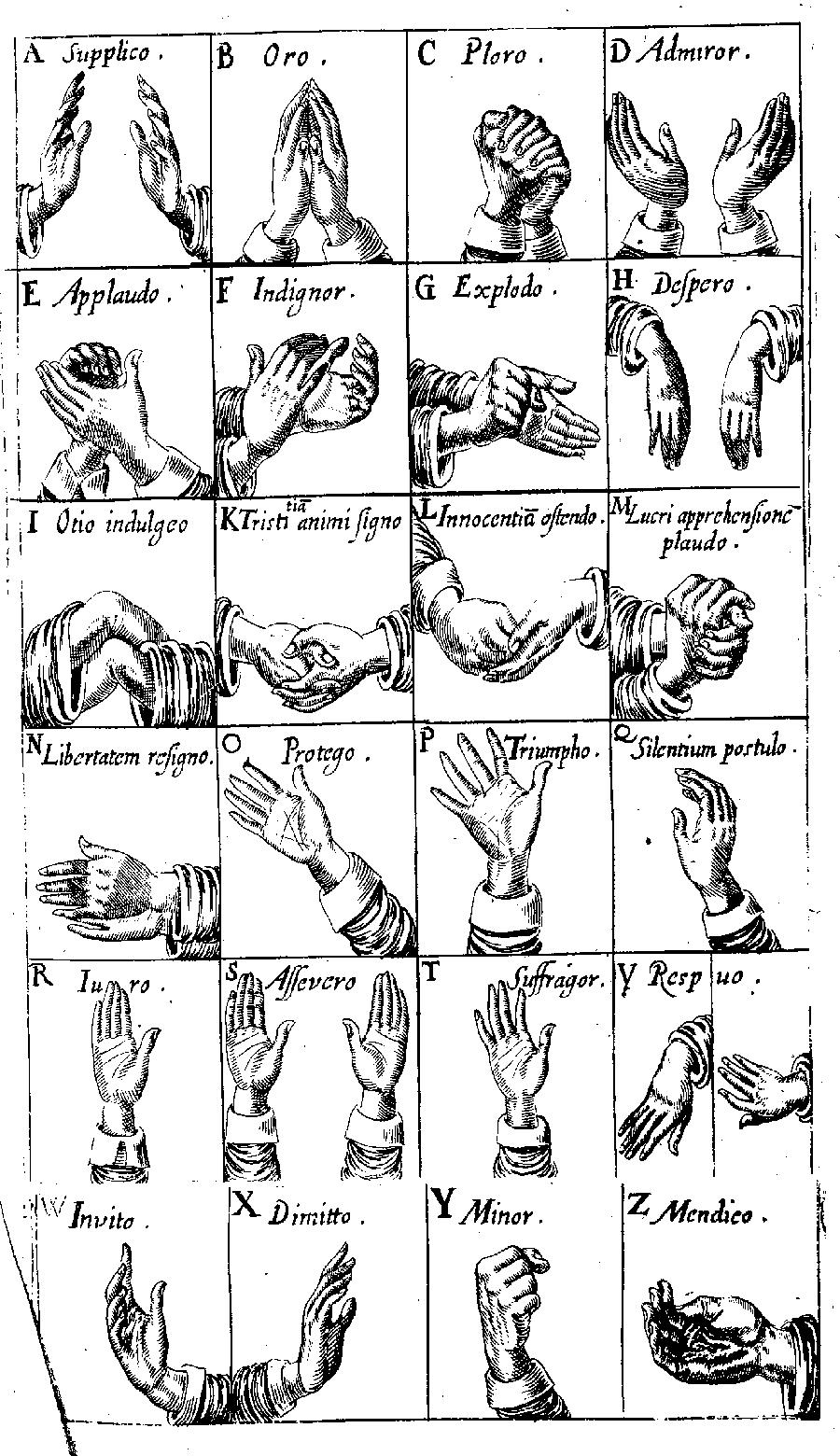
Further support for this idea comes from research on the Brocas area of the brain. This region is intimately connected with language, but is also part of the system that controls motor function in the mouth and hands. V. S. Ramacandran (in his 2003 Reith Lectures) speculated that cross-activation in this area is responsible for the tongue poking out during intense concentration on manual tasks for instance, and that this is related to the evolution of language. Gestures, mouth movements and language are obviously connected. People can communicate complex abstract language with only their hands.

Vocal sounds are, at least some of the time, used symbolically and the study of this phenomenon is called Sound Symbolism or Phonosemantics. The roots of sound symbolism may be in pre-language sounds which communicate emotions, and in mouth movements which either directly interact with an object, or imitate an interaction. In which case we would expect that both canonical and mirror neurons would be involved in the language as well - I'm not sure if anyone has looked at this.

One of the central dictates of modern linguistics is that "the sign is arbitrary". This is usually qualified by saying that it is arbitrary but not random, since clearly conventions of sounds are seen. Sound symbolism takes this further by saying that the conventions are so pervasive and they represent such a high a level of organisation that they cannot be arbitrary. Indeed it would be surprising if verbal sounds were arbitrary in relation to the concept being conveyed because they would exist outside the structure of language itself. Lakoff & Johnson say that abstractions are not arbitrary, but rooted in how we physically interact with the world. Sound symbolism tells us that there is a relationship between a word and it's meaning which is not arbitrary, but related to how verbal sounds function as symbols.

So Metzinger's theory is interesting because we can construct a plausible narrative about the evolution of communication around it, and it links up with other interesting ideas about the brain, the mind, and the evolution of language. It can incorporate many different observations, and it dovetails with other theories of embodied awareness and communication. It certainly seems to tie together many of my own interests. Though I note that one reviewer of The Ego Tunnel complained that "Grandiose philosophy is so 19th-century". [1] So perhaps Metzinger and I, with our interest in such "grandiose philosophy", are out of step with contemporary philosophy - but there have been few ages when being out of step with contemporary philosophers has been a bad thing. Personally I think Metzinger is ahead of his time.

This is not idle speculation on my part, nor only a side line. This idea has been bubbling away in my Buddhist brain because I am fascinated by Buddhist mantra. Mantras are said to be sound symbols, and I'm interested in how verbal sounds function as symbols. I believe that this sketch of a theory, or something very like it, might begin to explain the effectiveness of Buddhist mantras both as a collective, devotional practice, and in individual meditative practice -- without resort to the supernatural.

~~oOo~~

Note
  1. Flanagan, O. (2009). Review: The Ego Tunnel by Thomas Metzinger. New Scientist, 201(2700), 44.

image: Rhetorical gestures. Wikimedia.

04 March 2011

Is Buddhism Just Navel Gazing?

IT IS SOMETIMES ASSUMED THAT BUDDHISM is an introspective path, best suited to dreamy, inward looking, introverts. After all we spend a lot of time on omphaloskepsis, or navel gazing, don't we? And the ideal Buddhist is often portrayed as a solitary, reclusive meditator. Buddhism can easily be seen in terms of personal psychology or self development. I would like to challenge this notion by looking at Buddhist meditation.

Buddhism broadly speaking offers two kinds of meditation: samatha and vipassanā (Sanskrit śamatha, vipaśyanā). Samatha comes from the root √śam 'to be calm, quiet, to rest'. In samatha meditation we are trying most of all to calm down, and to steady our mind. This in no way involves rumination or dwelling on one's inner world. The archetypal practice is one which involves 'watching' the sensations of breathing, allowing the sensations to fill one's awareness (hence to be mind-full). Note that I do not say "the breath". It is helpful to get away from "the breath" as an entity (what is that in any case?) and to orientate oneself towards the experience of breathing as a dynamic procession of sensations presenting themselves to our conscious awareness. The sensations of breathing offer a good meditation subject because they give feedback on one's state of calm, they change at a pace which does not excite, and they are primarily proprioceptive - i.e. felt as changes in muscle tension in the body - which helps to draw attention away from the primary modes of interacting with the world - sight and hearing. When we allow our minds to be full of these sensations, follow them closely but in a relaxed way, we begin to experience changes in our awareness.

On a good day we find that we are no longer pulled towards other experiences, or towards our own mental chatter. We find that we naturally settle into a relaxed, but focussed state. By attending to experience wisely we can deepen this state until other sensations cease to resister in our mind, and there is only the increasingly subtle experience of breathing. This state can go very deep, and is often described as beautiful, expansive, open, and blissful. One can experience physical rapture, but also other internally generated experiences with a sensory character such as visual imagery. Although we have withdrawn our attention from the world, we find a world within which is at once gloriously alive and yet very refined and subtle. The technical term for this kind of experience is jhāna (Sanskrit dhyāna).

Sometimes Buddhists will frown on talking about meditation experience - straight-forwardly saying that one has experienced jhāna for instance can be seen as "boasting" or "making a claim". This is unfortunate because experiencing a concentrated mind is relatively ordinary, and certainly within reach of anyone who seriously practices meditation in a supportive context. I'm no great meditator and I have had these kinds of experiences. The Buddha's prohibition for the monks is against falsely claiming to be an arahant, and as far as I know there is no traditional prohibition on discussing the experience of various jhānas, nor on claiming to be an arahant if one actually is an arahant. At times a useful discussion is stifled by literalism or over-reacting. I should also say that some Buddhist traditions are distrustful of jhāna. Because it is pleasurable it can become a distraction. I know several people who can easily get into these states, and some of them do say that it can become an end in itself. However my own teachers have always emphasised that jhāna is a means to an end, not the end in itself. Concentrated meditation leaves one feeling calm, happy, and peaceful. Regular meditation encourages psychological integration. The fact of getting concentrated is not in itself very significant or spiritual advanced, but concentration and absorption are useful in preparing the mind for meditation in the second sense.

The essential counterpart to concentrated meditation is vipassanā often translated as 'insight'. The term derives from √paś 'to see' and with the prefix vi- means 'seeing through' - i.e. not insight but through-sight. Using 'insight' as a translation has the unfortunate connotation that we are seeing inside ourselves, suggesting introspection. But what we are doing is seeing through our self not seeing into it. Again this kind of meditation doesn't really involve introspection.

In this style of meditation one reflects on some aspect of experience - the tradition provides a number of templates for this. We might for instance reflect on impermanence, or on suffering. We might reflect on the way things arises in dependence on causes. Other styles of vipassanā practice include visualisations of a Buddha, koan practice, or simply sitting and watching the play of experience. Reflecting this way we aim to see the way experience unfolds, to understand why we feel and think the way we do, not by by dwelling on the content of our own thoughts, but by trying to get underneath this and see how the thoughts that we have depend not so much on the sensations we have, but on the stories we tell ourselves about them. The medium is the message.

This is not like rumination. We don't get hooked on the content of our thoughts, in fact we aim for the precise opposite - to get unhooked from the content of our thoughts. This is why jhāna practice is so useful. With a mind prepared by jhāna meditation we are in a very advantageous position to observe the workings of our mind without being caught up in the content of our thoughts and feelings. Being calm and content we can just be with what we find in our minds. We can also sustain our focus on the subject far more easily.

I don't know much about Zen meditation, or other 'just sitting' or formless practice styles, but as I understand it the formless practices combine samatha and vipassanā aspects. I won't say more, but I do think that formless practice can just about fit into the paradigm I've outlined. And of course meditation is not the only practice. There are also intellectual, ethical, and devotional aspects to Buddhism which are important.

Where a Buddhist can usefully do a little introspection is in the area of ethics. By this I do not mean thinking about morality in the abstract. We cannot really see how Buddhist ethics works by considering hypothetical cases. Buddhist ethics simply asks us to reflect on our own behaviour, and especially our relationships with other people. How do we observe that our behaviour affects those around us? How do we observe it affecting our own minds? We will particularly notice the effects on ourselves in the form of the hindrances to meditation. So if we want to spend time thinking about ethics we can reflect a little on what hindrances to concentration we are currently meeting. Unethical behaviour sets up conflicts and tensions, or scatters our energies which we experience as restlessness, torpor, craving, or aversion. There is often something we can do or cease doing that will be helpful in moving us towards a less conflicted, more alive state of mind. We need not be at the mercy of hindrances.

I hope it's clear that introspection has a role in Buddhism, but that it's role is not predominant, and that in meditation we are not being introspective per se. Of course one will need some self-knowledge, to understand one's own temperament in order to sustain an effective practice. We need to understand our own habitual tendencies in order to effectively counteract them or reinforce them as appropriate. But this knowledge comes as a by-product of attempts to engage with Buddhist practices, and as we interact with other people. The fact that being generous and regulating our behaviour towards others are firmly at the base of Buddhist practice, shows that a lot of self-centred navel gazing is out of place.


~~oOo~~
Related Posts with Thumbnails