13 September 2013

Who Translated the Heart Sutra into Sanskrit?

Xuánzàng 
This is the third in a series of essays exploring Jan Nattier's thesis that the Heart Sutra was composed in China in about the 7th century. The last two essays have looked at some of the sources for what ended up in the text. The other main issue addressed by Nattier is the question of who translated the text into Sanskrit. I think it's fair to say that this is still a mystery, but the text itself has some clues. 

Let's begin by looking more closely at some of the Sanskrit phrases. Many scholars by now have noted that the Sanskrit used in the Heart Sutra is rather unidiomatic at times. I can assure you that translating the Sanskrit text as it stands is not always easy! It was perhaps this awkwardness that hid a basic grammatical error in the first paragraph which I discovered at the end of last year. In this essay I outline some Chinese idioms identified by Nattier in the Sanskrit Heart Sutra, and show how this supports her Chinese origins thesis and puts some limits on who could have translated it into Sanskrit. Coming out of this examination are concomitant proposals to improve the Sanskrit text, which will be in next week's essay. 

In making the case that the Heart Sutra was composed in China, Nattier points to a number of idioms that seem more at home in China than India. For example the phrase niṣṭhā-nirvaṇa is rather awkward in Sanskrit. The Chinese 究竟涅槃 jiùjìng-nièpán is more natural. The last two characters render nirvāṇa while the first two mean 'finally attain' (Nattier has "literally 'ulimate[ly] nirvāṇa"). Nattier comments "[this phrase] is attested in a number of other Buddhist texts, and might well be described as standard (even idiomatic) Buddhist Chinese." (178).

The difficulty of this term can perhaps be exemplified by Edward Conze's equivocation with respect to it. The first two versions of his critical edition (1948) and (1967) have niṣṭhā-nirvāṇa, but (1975) has niṣṭhā-nirvāṇa-prāptaḥ. Conze has added the past participle prāptaḥ 'attained' (from pra√āp 'attains') to nirvāṇa extending the compound. This choice is ironic because the text earlier says na prāptiḥ 'no attaining' (this is a verbal noun from the same root)So why choose prāpta? The obvious answer is that it appears in some of the mss. Looking at the footnotes of Conze's 1967 critical edition (confirmed from my own observations in most cases) we find these variant readings:
Nabcdikm: nistanirvāṇaprāptaḥ
Ne: nirvvaṇaprāptās
Jab, Ccg: niṣṭhanirvaṇaḥ
Cae: tani nirvāṇam prāpnoti
Cg: niṣṭhanirvāṇā
Thus those mss. which supplement niṣṭhanirvāṇa, supplement it with a verbal form from pra√āp. But prāptaḥ doesn't make sense because the text itself rules it out. This, plus the fact that many mss. leave it out and Conze himself left it out in his first two versions of the critical edition, suggest that it was inserted later to help make sense of the text precisely because niṣṭhanirvāṇa alone is so awkward. It's extremely unlikely that the text was composed with the phrase niṣṭhanirvāṇa in Sanskrit.

In Pāli we find a strikingly similar idiom, though only in a single text, Gaṇakamoggallāna Sutta (MN 107):
Appekacce kho, brāhmaṇa, mama sāvakā mayā evaṃ ovadīyamānā evaṃ anusāsīyamānā accantaṃ niṭṭhaṃ nibbānaṃ ārādhenti, ekacce nārādhentī’’ti. (M iii.4)
When, O Brahmin, my disciples are advised and instructed by me, some do indeed succeed to the ultimate goal nibbāna, and some do not succeed. 
Note that the verb here is a causative from ā√rādh 'to suceed, attain, accomplish' rather than pra√āp. The Chinese counterpart, Madhyāgama 144, was translated ca. 397 or 398 CE probably from Gāndhārī. In Chinese the verb is 得 de 'get, obtain, etc'. Thus where there is a verb in a similar Indic phrase it was supplied by some Chinese translators. 

Nattier argues that no one would use niṣṭhānirvāṇa (with no verb) when composing a text in Sanskrit, but that the same idiom is right at home in Chinese, thus the Sanskrit reflects a Chinese original. Recall that, in the case of those sections known to be from the Pañcaviṃśati, the Sanskrit wording has almost invariably changed after going through Chinese. In the next essay we will see that Kumārajīva used the phrase 究竟涅槃 to translate several different Sanskrit phrases, and show that there are several that are better candidates than niṣṭhānirvāṇa. This in turn provides us with possible improvements to the Sanskrit Heart Sutra. 

Another phrase that stands out is satyam-amithyatvāt. Conze (1975) takes poetic flight in translating this phrase: "...in truth, for what could go wrong", but this is not grounded in the text. Satyam is easy enough, it means 'truth' and being a neuter word is in either the nominative or accusative singular. The preceding phrases are the epithets of prajñāpāramitā, discussed last week, and we might therefore suppose that here satyam is predicated of prajñāpāramitā. That is to say that we would naturally read this as saying that prajñāpāramitā is true. The fact of being true is of considerable importance to Buddhists. 

The other word amithyatvāt is much more troublesome however. The word mithyā is a contracted form of mithūyā and means 'inverted', or 'contrary' and thus 'false'. The root is √mith which Whitney's Roots glosses as 'alternate and altercate'. The term is often paired with samyañc (from saṃ + √añc 'to bend') which becomes samyak or samyag in actual use. Samyañc roughly means 'to go with' and mithyā 'to go against'. The form amithyatvāt has a prefix and a suffix, and a case ending. We add -tva to create an abstract noun, mithyatva meaning 'a state of being false' or 'falseness'. This is negated by the prefix a- so that amithyatva means 'a state of being true, truthful', however it's typical to retain the Sanskrit morphology and render a word like this as 'non-falseness' or 'a state of not being false'. Finally the whole word is in the ablative case, indicated by the ending -āt, which tells us the reason for the action of a verb (the verb here being a tacit 'to be').

Putting it all together we may say that satyam amithyatvāt literally means 'it is true because of non-falseness' or even 'it is true because of [its] truth'. This is as awkward in Sanskrit as it sounds in English. Nattier assures us that the Chinese version 真實不虛 zhēn shí bù xū is "entirely natural in Chinese" (177). Nattier suggests it means "genuine, not vain". 虛  can mean 'false, worthless; empty, hollow, vain'.

The suggestion is that satyam amithyatvāt is like the common idiom "long time no see". This phrase is thought to have derived from a Chinese greeting and to retain the Chinese grammar. It may be compared to Mandarin phrase 好久不見 (hǎojiǔ bù jiàn), which can be translated literally as "long-time, no see". 

However, as I will show next week, this is not in fact an artefact of back translation from Chinese, but the result of a poor decision by Conze in creating his critical edition. There were other options available to Conze from his manuscripts that would have made more sense, despite being minority readings.

Finally compare this line:
na rūpaṃ na vedanā na saṃjñā na saṃskārāḥ na vijñānaṃ
With these:
na cakṣuḥśrotraghrānajihvākāyamanāṃsi.
na rūpaśabdagandharasaspraṣṭavayadharmāh.
The former is just what we would expect from a Buddhist text. Buddhists are not afraid of repetition, especially not where the longer Perfection of Wisdom texts were concerned, and so use na in each case. The latter two lines look unusual (and the 'infelicity' was spotted for Nattier by highly experienced Sanskritist Richard Salomon. See 214: note 57). Nattier quotes from the Gilgit ms. of the Pañcaviṃśati: "na cakṣur na śrotram na ghrāṇam na jihvā na kāye na manaḥ". Compare the Pañcaviṃśati version from Kimura's edition (2007):
na cakṣurāyatanaṃ na rūpāyatanaṃ (no eye base, no form base).
na śrotrāyatanaṃna [na] śabdāyatanaṃ
na ghrāṇāyatanaṃ na gandhāyatanaṃ
na jihvāyatanaṃ [na] rasāyatanaṃ
na kāyāyatanaṃ [na] spraṣṭavyāyatanaṃ
na manaāyatanaṃ [na] dharmāyatanam,
The Chinese Heart Sutra has:
無眼、耳、鼻、舌、身、意;
Wú yǎn, ěr, bí, shé, shēn, yì;
No eye, ear, nose, tongue, body, or mind;
And this in turn precisely follows the Large Perfection of Wisdom Text of Kumārajīva except in the matter of punctuation, all of which was added by later editors: 
無眼耳鼻舌身意 (T 8. 223 p.0223a18.6). 
It seems reasonably clear that na cakṣuḥśrotraghrānajihvākāyamanāṃsi reflects Chinese syntax with a single negating particle for all of the items being negated. Sanskrit syntax would give each item it's own negative particle as we see from the Sanskrit Pañcavīṃśati.

For Nattier the weight of evidence suggests that the Heart Sutra is a back translation from Chinese to Sanskrit. However this is only the most obvious conclusion of her investigation. There is a further conclusion from these facts that Nattier does not explicitly draw, but which is implicit given the facts.

The composer of the Sanskrit Heart Sutra was probably a Chinese speaker

For Nattier the main suspect in the mystery of who composed the Sanskrit Heart Sutra is Xuánzàng. He lived at about the right time, travelled to India and learned Sanskrit at about the right time. Thus he had the opportunity and the means. He was also known from his memoir of travelling to India to have been a devotee of the text. 

Nattier invites us to imagine that Xuánzàng had arrived in India only to find that the Indian monks had not heard of this text. Upon learning the language would he not be tempted to compose a version in Sanskrit? Early in my own attempts to learn Sanskrit, the Heart Sutra was one of the first texts I looked at precisely because it is familiar and concise. As I mentioned in my last essay, an Indian provenance was crucial to the authenticity of a Buddhist text in China. The whole point of Xuánzàng's journey to India was to return with authentic Indian texts. To discover that one's favourite text was not extant in Sanskrit might tempt the most scrupulous monk to compose a new Sanskrit "original".

Xuánzàng was unlikely to have composed the Chinese Heart Sutra however. It is recorded that he was given the text. A man who he had cared for during an illness taught him the Heart Sutra out of gratitude (179). It subsequently became a favourite to chant in troubled times, such as crossing the Gobi desert.

Xuánzàng included all his translations of the Prajñāpāramitā texts into one huge volume, treating the various texts as chapters. The only translation of his not included is the Heart Sutra. Also the vocabulary of the Heart Sutra (T 8.251) closely matches Kumārajīva's translation of the Large Perfection of Wisdom text in most cases. Given that Xuánzàng led the effort to translate all of the extant Prajñāpāramitā texts, and developed a whole new approach to translating Sanskrit, why would he not use his own terminology?

A couple of terms used in the Heart Sutra are distinctive to Xuánzàng. Kumārajīva transliterates the name Śāriputra as 舍利弗 Shèlìfú. Here 弗 fú transliterates the first syllable of putra. Chinese transliterations frequently leave off the final syllable. Xuánzàng, on the other hand prefers 舍利子Shèlìzi, replacing 弗 with the Chinese word for 'son' 子. 

Kumārajīva translates Avalokiteśvara as 觀世音 Guānshìyīn (whence Guānyīn also spelt Kwan yin), whereas Xuánzàng prefers 觀自在 Guānzìzài. As I have noted before, this change in transliteration reflects a change in the Sanskrit name from Avalokita-svara to Avalokita-īśvara (with sandhi resolving a-ī to e and giving Avalokiteśvara). This change is discussed by Alexander Studholme and involves Avalokitasvara absorbing some of the characteristics of Śiva who is converted to Buddhism in the Kāraṇḍavyūha Sūtra and in the process absorbing the epithet īśvara 'lord', which replaces svara 'sound'. Nattier notes that Xuánzàng's own students tended to retain the more popular form of the name, Guānshìyīn, even when they adopted his new readings of other terms including the name Shèlìzi (216, n.84).

These usages are innovations introduced into Chinese Buddhist texts by Xuánzàng. And thus we know that at the very least Xuánzàng, or someone familiar with this work, must have edited T 8.251, and have done so after Xuánzàng learned Sanskrit in India and devised these new transliterations of Indic names and terms. 

Whoever did translate the text into Sanskrit, they were soon vindicated by the adoption of the Heart Sutra into the pantheon of Prajñāpāramitā texts.  In China commentaries were produced from the 7th century onwards. In India a number of commentaries (now only preserved in Tibetan) were written from the 8th to the 11th centuries (see Donald Lopez 1988, 1996). All of the Chinese commentaries are based on the Chinese version attributed to Xuánzàng (i.e. T 8.251), and all the Indian commentaries are of the long text. The split in the dates of the commentaries of East and South Asia, as well as the text they chose to comment on are supporting evidence for Nattier's Chinese Origins thesis.


~~oOo~~


Bibliography

Conze, Edward (1948) ‘Text, Sources, and Bibliography of the Prajñāpāramitā-hṛdaya.’ Journal of the Royal Asiatic Society, April 80(1-2): 33-51.

Conze, Edward. (1967) ‘The Prajñāpāramitā-Hṛdaya Sūtra’ in Thirty Years of Buddhist Studies: Selected Essays, Bruno Cassirer, pp. 147-167.

Conze, Edward. (1975) Buddhist Wisdom Books: The Diamond Sutra and the Heart Sutra. George Allen & Unwin.

Kimura Takayasu (2010). Pañcaviṃśatisāhasrikā Prajñāpāramitā Vol. I-1, Tokyo: Sankibo Busshorin 2007. Online: http://fiindolo.sub.uni-goettingen.de/gretil/1_sanskr/4_rellit/buddh/psp_1u.htm [Input by Klaus Wille, Göttingen, April 2010].

Lopez, Donald S. (1988) The Heart Sūtra Explained: Indian and Tibetan Commentaries. State University of New York Press.

Lopez, Donald S. (1996) Elaborations on Emptiness: Uses of the Heart Sutra. Princeton University press.

Nattier, Jan. (1992) The Heart Sūtra: a Chinese apocryphal text? Journal of the International Association of Buddhist Studies. Vol. 15 (2), p.153-223. http://archiv.ub.uni-heidelberg.de/ojs/index.php/jiabs/article/view/8800/2707

Studholme, Alexander. (2002) The origins of oṃ manipadme hūṃ : a study of the Kāraṇḍavyūha Sūtra. Albany: State university of New York Press.

06 September 2013

Heart Sutra Mantra Epithets

The material in this essay has been rewritten, peer-reviewed, and published as
Attwood, Jayarava. (2017). ‘Epithets of the Mantra’ in the Heart Sutra. Journal of the Oxford Centre for Buddhist Studies, 12, 26–57. http://jocbs.org/index.php/jocbs/article/view/155
~o~


Karaṇḍamudrā dhāraṇī
My last essay mined the footnotes of Jan Nattier's excellent article 1992 on the provenance of the Heart Sutra. Her article is a remarkable piece of scholarship and repays close study. The footnotes are no less interesting and in this essay I want to expand on a single long footnote: 54a (211-213). The 'a' is added because this information was included just as the article was going to press and the note, amounting to two full pages, had to be squeezed in, sans any Chinese characters (which in any case were hand written on a separate page at the end of the article).

The subject of this note is the epithets of the mantra. The section we're interested in reads:
tasmāj jñātavyam prajñāpāramitā mahāmantro mahāvidyāmantro ‘nuttaramantro ‘samasama-mantraḥ
Therefore, it should be known that the perfection of wisdom is a great mantra, a mantra of great insight, an unexcelled mantra, an unequalled mantra
For Conze these are epithets of the Buddha applied to a mantra as a way of conveying the magical power of the mantra: "The prañāpāramitā... is here envisaged as a spell" (1973: 101-104). The epithets in question are those from the familiar itipi so gathā that Triratna Buddhist Community members will know as the Buddha Vandana. In Pāli:
iti pi so bhagavā arahaṃ sammāsambuddho vijjācarana sampanno sugato lokavidū anuttaro purisadammasārathi satthā devamanussānaṃ buddho bhagavā ti
As we can see by simple comparison Conze is stretching things somewhat with this comparison. Of the Heart Sutra terms only anuttara 'unexcelled' has an actual parallel and it is a rather common superlative applied to any and all Buddhist ideals.

Nattier cites two letters sent to her by Nobuyoshi Yamabe. Yamabe San completed a PhD at Yale in 1999 and is the author of several books on Buddhism. Yamabe identified a number passages in Chinese which closely parallel the Heart Sutra epithets. Nattier adds two extra passages to those identified by Yamabe. We'll begin with the passage found in the Aṣṭasāhasrikā Prajñāpāramitā Sūtra (Aṣṭa). This text is the basis for the Pañcaviṃśatisāhasrika Prajñāpāramitā Sūtra (Pañcaviṃśati) and is therefore of some interest. Also the existence of a clear Sanskrit text allows us some insight into another matter.

The Chinese Heart Sutra (T 8.251) reads:
故知般若波羅蜜多,是大神咒 ,是大明咒,是無上咒,是無等等咒, 
Gùzhī bōrěbōluómìduō, shì dàshén zhòu, shì dàmíng zhòu, shì wúshàng zhòu, shì wúděngděng zhòu, 
Therefore know the perfection of wisdom, the great magical mantra, it is the great knowledge mantra, unsurpassed mantra, an unequalled mantra,
般若波羅蜜多 bōrěbōluómìduō is a transliteration of prajñāpāramitā. A short digression here. The Middle Chinese pronunciation of 般若波羅蜜多, reconstructed from rhymes, but lacking information on tones, would have been ban ya ba ra mil da. As we will see shortly the Aṣṭa is written in Classical Sanskrit. However the transliteration banya suggests a spelling more like Pāli paññā than Sanskrit prajñā. Baum and Glass's interim Gāndhārī Dictionary record several spellings of prajñā from the Gāndhārī Dhammapada: praña, prañaï, prañaya. The transliteration of prajñā is quite standard across genres. I can find only one variant: 鉢若 bōruò, Middle Chinese balya. It seems the initial syllable was not heard or seen as a conjunct /pra/ by early Chinese translators even when we can be reasonably sure the text used it.

shén is a term from Daoism that is sometimes used to translate Sanskrit ṛddhi 'supernatural power' or even deva. Generally is means 'supernatural, divine' or 'magical'. It's missing from all of the Sanskrit versions of the text, which opens the possibility that it was added to the Chinese after the Sanskrit text was created.

Yamabe identified a counterpart from the Chinese Aṣṭa, early 5th century CE, translation by Kumārajīva (T 8.227 843b25-27) reads:
般若波羅蜜是大明呪,
般若波羅蜜是無上呪,
般若波羅蜜是無等等呪

Bōrěbōluómì shì dà míngzhòu,
bōrěbōluómì shì wúshàng zhòu,
bōrěbōluómì shì wúděngděng zhòu.


Prajñāpāramitā is a great vidyā (明呪),
Prajñāpāramitā is an unsurpassed vidyā (呪),
Prajñāpāramitā is an unequalled vidyā (呪).
As in the last essay, one doesn't need to know Chinese to see that these are the identical characters, except that the anomalous 是大神咒 shì dà shén zhòu is absent. If one knows that Chinese languages, like English, are subject-verb-object languages, one can even guess that 是 means 'is'. Also note that in the Aṣṭa the last syllable of prajñāpāramitā is left off, which is typical. The reason for translating 明呪 míngzhòu and 呪 zhòu as vidyā becomes apparent when we look at the Sanskrit text below. Note also the substitution of 呪 zhòu for zhòu, on which I will say more below.

The Sanskrit version of this text has been edited by Vaidya (p.36, line 30-p.37 line 7 = Conze 's translation p.108-109). This is one of the best attested texts of Buddhist Sanskrit literature. I have seen and handled the beautiful Cambridge manuscript (Add 1643) dated to 1015 CE, which forms the basis of the critical edition. It's written in Classical Sanskrit with just a few Prakritisms. The edition by Vaidya has been digitised, from which I take the following (placing each sentence on a new line to facilitate reading):
mahāvidyeyaṁ kauśika yad uta prajñāpāramitā|
apramāṇeyaṁ kauśika vidyā yad uta prajñāpāramitā|
aparimāṇeyaṁ kauśika vidyā yad uta prajñāpāramitā|
anuttareyaṁ kauśika vidyā yad uta prajñāpāramitā|
asameyaṁ kauśika vidyā yad uta prajñāpāramitā|
asamasameyaṁ kauśika [vidyā] yad uta prajñāpāramitā|

O Kauśika, the perfection of wisdom is certainly a great spell.
O Kauśika, the perfection of wisdom is certainly an immeasurable spell.
O Kauśika, the perfection of wisdom is certainly a measureless spell.
O Kauśika, the perfection of wisdom is certainly an unsurpassed spell.
O Kauśika, the perfection of wisdom is certainly an unequalled spell.
O Kauśika, the perfection of wisdom is certainly a peerless spell.
Kauśika is one of the epithets of the Vedic God Indra, usually called Śakra (Pāli Sakka) in Buddhist texts, who plays an important role in early Buddhism and is one of the main interlocutors of the Aṣṭa. The context here is the Perfection of Wisdom per se. Both apramāṇa and aparimāṇa mean 'not-measured or measureless'. Similarly both asama and asamasama mean 'without equal'. I translate vidyā here as 'spell', as the context shows that the idea is something to be spoken or chanted that has magical powers. There is an irreducible element of magical thinking in these texts that is inherent in their pre-scientific world view. It's nothing to be embarrassed about.

Note that the word in Sanskrit is vidyā throughout, and not mantra or dhāraṇī. Here we see 明呪 míngzhòu translating vidyā. Note that in the Heart Sutra epithets we get the sequence 大明咒,無上咒,無等等咒. In the context of the Heart Sutra the tendency is to see 明 as an extra character: the great  knowledge  mantra 咒. We know from the Aṣṭa passages that 明呪 means vidyā, so we ought to read 大明咒 as 'great vidyā'. And this means that  is a shorthand reference to vidyā. The character 明 is being dropped from the other epithets, not added to only one of them. 

This passage from the Aṣṭa is a slightly more elaborate version of what we find in the Heart Sutra. Now compare the parallel passage in Kumārajīva's translation of the Pañcaviṃśatisāhasrikā Prajñāpāramitā Sūtra (T 8.223).
是般若波羅蜜是大明呪,是無上明呪。
Shì bōrěbōluómì shì dàmíngzhòu, shì wúshàng míngzhòu.
The prajñāpāramitā is a great vidyā, an unsurpassed vidyā.
Though Nattier notes that the relevant chapter is missing from earlier editions of the Sanskrit, it is found twice in the more recent Sanskrit edition produced by Takayasu Kimura (vols 2&3). Kimura has edited the earlier Sanskrit text of Dutt and referenced both the Chinese and Tibetan translations to produce a new Sanskrit edition based on the same late Sanskrit manuscripts used by Dutt. So we cannot be entirely sure that Kimura has not, once again, back translated an existing Chinese passage into Sanskrit to fill a perceived void. In any case the two passages are:
mahāvidyaiṣā kauśika yad uta prajñāpāramitā, anuttaraiṣā kauśika vidyā yad uta prajñāpāramitā. (Vol. 2-3:55)
evam ukte bhagavān śakraṃ devānām indram etad avocat: evam etat kauśikaivam etat, mahāvidyeyaṃ kauśika yad uta prajñāpāramitā, anuttareyaṃ kauśika vidyā yad uta prajñāpāramitā, asamasameyaṃ kauśika vidyā yad uta prajñāpāramitā.
(Vol. 2-3:70)
The second of these more closely matches what we find in the Sanskrit Heart Sutra with three epithets: mahāvidyā, anuttara vidyā, and asamasama vidyā. It also alerts us to a further occurrence in Kumārajīva's Pañcaviṃśati (T. 223) at p. 286b28 (unnoticed by Yamabe or Nattier)
般若波羅蜜是大明呪、無上明呪、無等等明呪。
Bōrěbōluómì shì dàmíngzhòu, wúshàng míngzhòu, wúděngděng míngzhòu.
The prajñāpāramitā is a great vidyā, an unsurpassed vidyā, an unequalled vidyā.
Again we see from comparing Chinese with Sanskrit, that 明呪 translates vidyā and here it is not abbreviated to 呪 but spelt out each time. If the core part of the Heart Sutra comes from the earlier passage of the Pañcaviṃśati then this passage suggests that the epithets were also borrowed, probably from this passage. Except that it is clear from the context that these epithets are not describing the mantra, but the perfection of wisdom itself. We associate the epithets with the mantra because the word mantra appears in the Sanskrit Heart Sutra. The word is used just twice in the Aṣṭa and not at all in the Pañcaviṃśati (suggesting perhaps that the Aṣṭa occurrences are interpolations).

Vidyā has a number of connotations. Clearly both Aṣṭa and Pañcaviṃśati are applying the word to the prajñāpāramitā per se, not to the mantra (as we typically read the Heart Sutra). Vidyā derives from the verbal root √vid 'to know, to discover' (cognate with 'wise, wisdom' etc). Sometimes you'll see vidyā translated as 'science' but the whole context is pre-scientific so this is anachronistic. No body of knowledge before ca. 1700 fits today's definition of science, which is not to say that there was no valid knowledge, only that it could not be considered scientific until the scientific method ha been invented during the European Enlightenment. Vidyā means knowledge in a particular field: knowledge of the Vedas, knowledge of political governance etc. Knowledge cultivated through learning and experience, rather than divinely inspired knowledge or insight. It also have a magical connotation. Knowledge in the sense of vidyā bestows control over the subject studied, when one thoroughly knows a subject one is said to have "mastered" it. Ironically we are stuck using 'wisdom' for prajñā, which means (and is cognate with) knowledge; and 'knowledge' for vidyā, which is cognate with wisdom.

Although vidyā later becomes, at times, almost synonymous with mantra, at the time the Aṣṭa was composed, and probably even the Pañcaviṃśati, Indian Buddhists still probably thought of mantras as the spells mumbled by Brahmins (for money) at ceremonies. The Pāli texts contain a few passages making it clear that the chanting of mantras is un-Buddhist (DN 1 [i.9]; SN 7.8, SN 28.10, Sn 480). By contrast the chanting of parittās, or protective texts, was already established as a popular Buddhist practice in the Milindapañha, which predates the Aṣṭa.

The parittā practice may well be connected to the idea of the saccakiriyā (Skt satyakriyā) or 'truth act'. This practice, attested in for example the Pāli Aṅgulimālā Sutta, insists that plainly and clearly stating a truth can alter reality. Aṅgulimālā, for example, uses a saccakiriya to ease the pain of a women and baby experiencing a difficult childbirth. Many other examples are found in Pāli. Some scholars have attempted to link the practice to similar ideas in Vedic culture. There is even a suggestion that some aspects of the power of truth are Indo-European. Holding a red-hot axe-head is a test of truth in both Vedic and Celtic literature for example. It may be that by chanting a sacred text aloud, sacred texts being true by definition, that one might avoid calamity or avert disaster. As mentioned last week, this was how Xuánzàng used the Heart Sutra.

Nattier cites the example of the word for mantra as an example of a back translation. Her thesis is that the order of textual production was like this:
  1. Sanskrit Pañcaviṃśati
  2. Chinese translation Pañcaviṃśati
  3. Chinese Heart Sutra - short text
  4. Sanskrit Heart Sutra - short text
  5. Sanskrit Heart Sutra - long text
  6. Chinese Heart Sutra - long text
We can see that Nattier's theory explains the changes that occur in the word vidyā. In this case the Sanskrit Pañcaviṃśati (itself based on Aṣṭa) uses the word vidyā. Kumārajīva translated this as 明呪 míngzhòu, the usual translation of vidyā. The Heart Sutra first uses 明咒 míngzhòu then abbreviates to zhòu; where zhòu is a homonym for zhòu meaning dhāraṇī (or mantra). This is then back translated as Sanskrit mantra. The change from 呪 zhòu to 咒 zhòu might have occurred for any number of reasons, not excluding simple error based on similarities of sound and graphic form.

It is interesting to note here that T 250 (attributed to Kumārajīva) has 明呪 míngzhòu in each of the epithets, which conforms to the general pattern of Kumārajīva's translations noted above. Nattier's conclusion regarding T 250 is "[it] was based not directly on his version of the Large Sūtra, but on citations from the sūtra contained in the Ta chih-tu lun*" (187).
* i.e. T 25.1509 大智度論 Dàzhìdù lùn (Mahāprajñāpāramitāśastra) Attributed to Nāgārjuna and translated by Kumārajīva.
Dàzhìdù lùn itself shows signs of partly Chinese authorship: "Some of the most notable evidence provided by Chou is that the Dazhidu lun’s commentary on the Mahaprajñaparamita Sutra follows Chinese word order rather than Indian..." (McBride 332-333)

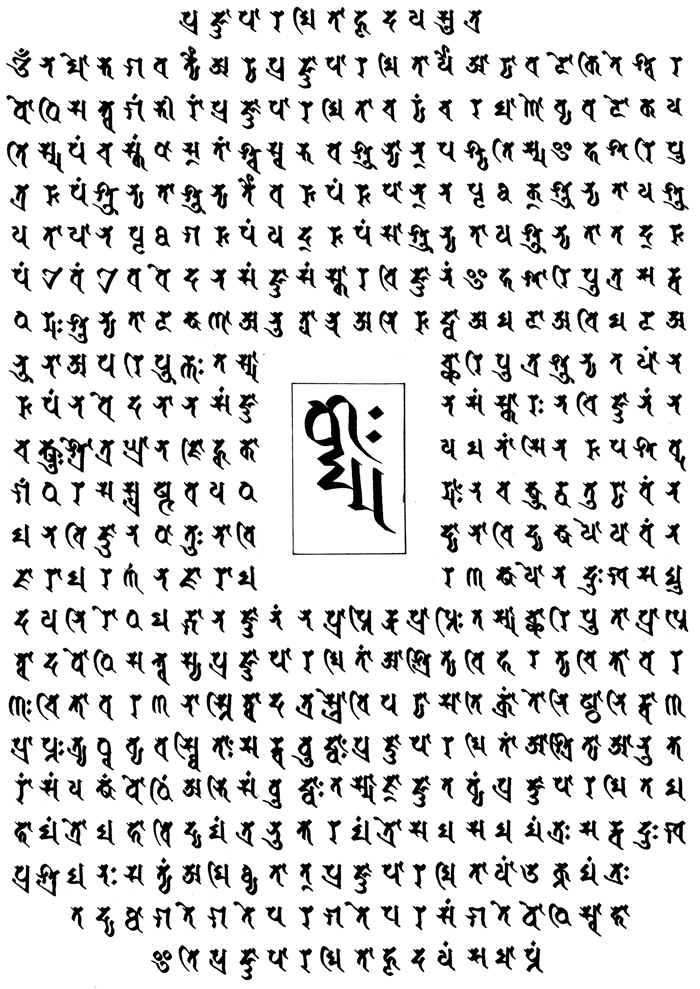
At the time the Heart was composed in China we might expect the key term to be dhāraṇī, since the mid seventh century date proposed by Nattier slightly predates the arrival of Tantra in China, while dhāraṇī texts, such as the Karaṇḍamudra Dhāraṇī depicted above, were and to some extent still are, a central aspect of Chinese Buddhism. The first Sanskrit version of the Heart Sutra was produced in India, probably in the late seventh or early eighth century at a time when Tantra was in full swing. These dates coincide for example with Stephen Hodges' proposed dates for the composition of the Sarvatathagata-tattvasaṃgraha. In such an environment mantra might have be the natural translation of 咒. Hence find a mantra where we expect not to and, according to my own definitions, where we might expect to find a dhāraṇī.

This is further evidence that the Heart Sutra is synthetic, which is to say it was constructed in China from a variety of sources, probably by a devotee of Avalokiteśvara in the 7th century. Now on the basis of a comparison with the Sanskrit sources, there is an argument for revising this portion of the Sanskrit text:
tasmāj jñātavyam prajñāpāramitā mahāmantro mahāvidyāmantro ‘nuttaramantro ‘samasama-mantraḥ,
becomes
tasmāj jñātavyam prajñāpāramitā mahāvidyā anuttaravidyā asamasamavidyā.
It should be understood that the perfection of wisdom is great knowledge, supreme knowledge, peerless knowledge.

~~oOo~~


Bibliography

  • Conze, Edward (1973). The Perfection of Wisdom in 8000 Lines and its Verse Summary. San Francisco: City Lights.
  • McBride, Richard D, II. (2004) 'Is there really "Esoteric" Buddhism?'  Journal of the International Association of Buddhist Studies. 27(2): 329-356.
    • Vaidya, P. L. (1960) Aṣṭasāhasrikā Prajñāpāramitā. The Mithila Institute of Post-Graduate Studies and Research in Sanskrit Learning. Online: http://www.dsbcproject.org/node/8242

    30 August 2013

    Heart Sutra Mantra

    My calligraphy of Heart Sutra
    Siddhaṃ script
    The Heart Sutra is a synthetic text composed in China from three main elements:
    1. Extracts from Kumārajīva's translation of the Pañcaviṃśatisāhasrikā Prajñāpāramitā Sūtra (T 8.223; ca. 5th century).
    2. Elements drawn from the devotional cult of Avalokiteśvara (觀自在 Guānzìzài). 
    3. The cult of dhāraṇī chanting, and a mantra probably drawn from existing Chinese texts. 
    The first element is quite well covered in the literature, especially as Jan Nattier (1992) focusses on this part of the text in her reconstruction of its provenance. My next essay will address a lesser known aspect of this issue which is buried in Nattier's footnotes. The second element deserves a little more attention, but is covered briefly in Nattier (174-5). This essay will largely focus on the third element. 
      In her long essay on the origins of the Heart Sutra, Jan Nattier notes (footnote 52 & 53) that two other scholars have found mantras similar to the Heart Sutra mantra in other places in the Chinese Tripiṭaka. One of these references is particularly significant as it seems to pre-date the composition of the Heart Sutra itself. This essay will present the Chinese source texts for these mantras. Before dealing with these mantras, we need to pay some attention to the dhāraṇī cult itself, and try to establish some terminological boundaries. 

      The cult of dhāraṇī chanting is sometimes placed in the context of Tantric Buddhism, but I think this is a mistake. It is true that mantras are a feature of Tantric Buddhism. However, as Ryūichi Abé. has shown, Tantric Buddhism requires certain elements to be present in order to be Tantric. In The Weaving of Mantra he emphasises the abhiṣeka or initiation in particular because the abhiṣeka is the ür-ritual which underpins all of Tantric Buddhist practice. In Japan, prior to the arrival of Kūkai and Saichō with genuine Tantric Buddhism, some Tantric elements were present: images, dhāraṇī and mantra, and even texts such as the Mahāvairocana Abhisaṃbodhi Tantra. However, in the absence of the Tantric paradigm and organising principles, these elements did not add up to Tantric Buddhism.

      Abé is trying to revise the history of Japanese Buddhism, but he has enunciated an important hermeneutic for discussing the presence or absence of a mode of Buddhist thought. For example: if a person bows before a Buddha statue, burns incense, and chants oṃ maṇipadme hūṃ, but has no knowledge of why Buddhists do such things, does this make them a Buddhist? These are simply decontextualised actions with no intentional underpinning. They are Buddhist in externals only. A similar argument is simmering away with respect to the Jon Kabat Zinn inspired mindfulness treatments. Does the teaching of mindfulness amount to teaching Buddhism, or does it lack key elements, such as "going for refuge", that render the teaching non-Buddhist? Some Buddhists who teach mindfulness argue that they are teaching Buddhism when they teaching mindfulness. Others argue that the lack of context for the practice, particularly the absence of Buddhist metaphysics, means this is a beneficial secular practice that does not conduce to liberation.

      In any case, the point is that although dhāraṇīs were incorporated into Tantric Buddhism, there is nothing in the dhāraṇī sūtras or the chapters inserted into larger texts such as the Saddharma-puṇḍarīka or Survabhāṣotama, to indicate a Tantric context. The first hints of Tantra associated with a mantra seem to be found in the Kāraṇḍavyūha Sūtra according to Alexander Studholm's study of that text, which includes an account of something like an initiation, though it still lacks the central features of the abhiṣeka ritual. The point of chanting dhāraṇīs seems largely to have been protection from malign forces or entities. And thus they have much more in common with the Theravāda practice of parittā chanting than with Tantric practice (at least with respect to the Tantric Buddhism practised by Kūkai). It's not until they are incorporated into rituals centred on the abhiṣeka, that they become Tantric. This criteria is common to other elements that were incorporated, not least the elements from Vedic ritual. No one, to my knowledge, argues that Vedic fire rituals were "proto-Tantric". 

      Nattier points to the opinion of Fukui Fumimasa (1981. Source text is in Japanese) that the name of the Heart Sutra in Chinese is 心經 Xīnjīng, literally "heart sūtra", but that 心 xīn (heart) here connotes dhāraṇī rather than 'pith' and that the text might well be a chanting text, i.e. a dhāraṇī text. We know from Xuánzàng's record of his journey to India that he used the text as a protective measure against unseen malevolent spirits. The title of the short text in Sanskrit, Prajñāpāramitāhṛdaya, does not include the word sūtra, and it seems likely that the original, short text was not considered as a sūtra. That transition probably happened in India when the traditional elements of a sūtra, such as the beginning evaṃ maya śrutaṃ... and the appreciation at the end were added. Another reading of 心 is "gist" with the idea that rather than Heart Sutra, the meaning is Gist Text, with the text representing the gist of Prajñāpāramitā.

      The dhāraṇīs of the pre-tantric Mahāyāna texts are often radically different in form from the mantras of later Tantric Buddhism. Of course there is a huge amount of variation and cast-iron definitions are difficult to construct.


      Defining Mantra and Dhāraṇī

      Tantric mantras have a number of structural features in common: a beginning (usually oṃ); a name or function; and a final seed-syllable. 

      Typically Tantric mantras begin with oṃ (not auṃ) which served to mark what follows as a mantra. However in the earliest fully-fledged Tantra, the Mahāvairocana Abhisaṃbodhi Tantra, the mantras all begin namas samanta-buddhānāṃ or namas samanta-vajrānāṃ. The ending -ānām indicated the genitive plural case (of the Buddhas). However, in Prakrits (including Pāli) the dative case (to or for the Buddhas) endings began to be replaced by the genitive case endings. Here ending is the usual genitive, but the sense is dative and the words mean "homage to all Buddhas/vajras".

      What follows oṃ can be the name of a deity (oṃ amideva hrīḥ, oṃ vajrapāṇi hūṃ, oṃ vagiśvara muṃ) or relate to a function in the ritual, especially purification with the śūnyatā mantra or the Vajrasattva mantra. Names of deities are sometimes in the dative case, or in a kind of faux dative created by the addition of -ye to the end of the word: oṃ muni muni mahāmuni śākyamuniye svāhā. The correct dative of śākyamuni is śākyamunaye (final i is replaced by aye)

      Tantric mantras typically end with a seed-syllable (bījākṣara) related to the deity or with svāhā. Sometimes the seed-syllable is specific to the deity, or to the "family" they belong to. Mantras of the vajra family typically end in hūṃ, while the padma family often end in hrīḥ. At other times it seems unconnected to other considerations. For example  oṃ maṇīpadme hūṃ is a padma family mantra. Some mantras incorporate dhāraṇī style features into them which would include the Heart Sūtra mantra and the Tārā mantra (oṃ tāre tuttāre ture svāhā). The variety of mantras is partly due to their being a number of systems existing in parallel. 

      Dhāraṇī by contrast seldom begin with oṃ and almost never end in a seed-syllable. They almost always end with svāhā. The word svāhā is the Vedic equivalent to the Hebrew amen. It is used in the Yajurveda to solemnise offerings: one makes an offering of rice mixed with ghee to the fire while chanting, for example "agnaye svāhā" or 'For Agni, amen' (Taittirīra Saṃhitā 7.1.14.1). The content of the dhāraṇī is a string of words or sounds which seldom reference names of deities, and frequently include nonsense words such as hilli, huru often with repetition and ringing the changes of the first syllable: hilli hilli milli milli. There is a tendency to use words ending in -e. Various theories have been proposed to explain this phenomenon, but my opinion is that the -e ending is a Prakrit masculine nominative singular. This probably also applies to the well known oṃ maṇipadme hūṃ mantra. A feature of dhāraṇī, then, is the use of Prakrit or Buddhist Hybrid Sanskrit. 

      Typical dhāraṇīs from the Saddharmapuṇḍarikā Sūtra:
      anye manye mane mamane citte carite same samitā viśānte mukte muktatame same aviṣame samasame jaye kṣaye akṣaye akṣiṇe śānte samite dhāraṇi ālokabhāṣe pratyavekṣaṇi nidhiru abhyantaraniviṣṭe abhyantarapāriśuddhimutkule araḍe paraḍe sukāṅkṣi asamasame buddhavilokite dharmaparīkṣite saṁghanirghoṣaṇi nirghoṇi bhayābhayaviśodhani mantre mantrākṣayate rute rutakauśalye akṣaye akṣayavanatāye vakkule valoḍra amanyanatāye svāhā.
      iti me iti me iti me iti me iti me; nime nime nime nime nime; ruhe ruhe ruhe ruhe ruhe| stuhe stuhe stuhe stuhe stuhe svāhā.
      There is a world of difference between these two dhāraṇī and most Tantric mantras.


      The Heart Sutra Mantra

      The Heart Sutra mantra is clearly referred to as a mantra by the text. But it has more features in common with dhāraṇī in form and content. It's lacks the opening oṃ for example, though some traditions have simply added one. The repetition and play of sounds in gate gate pāragate pārasaṃgate is typical of dhāraṇī. Why then does the text refer to this as a mantra? I will look more closely at this issue in the next essay.

      Meanwhile let us compare the Heart Sutra mantra with the three mantra/dhāraṇī listed in Nattier's footnotes as being similar. Of these T 12.387  大方等無想經  Dàfāngděng wúxiǎng jīng (Mahāmegha Sūtra), identified by Fukui (1981), is important because it was translated in the early fifth century, two centuries before the proposed date for the composition of the Heart Sutra.

      Mantras and dhāraṇīs are typically not translated by the Chinese, but the sounds are represented using characters for their pronunciation.  Unfortunately it can be very difficult to reconstruct the Sanskrit from a Chinese transliteration. For example the character 卑 bēi has been used to transliterate the Sanskrit syllables pra, pre, pe, pi, vi, and vai. Note that I'm using Pinyin Romanisation in these posts, which often does not reflect pronunciation at the time the texts were composed. The language of the day is referred to as Middle-Chinese (MC). Where relevant and possible I will indicate the MC pronunciation 

      The dhāraṇī in question is:
      竭帝 波利竭帝 僧竭帝 波羅僧竭帝波羅卑羅延坻 
      三波羅卑羅延坻 婆羅 婆羅 波沙羅 波娑羅 摩文闍 摩文闍 
      遮羅帝 遮羅坻 波遮羅坻 波遮羅坻 三波羅遮羅坻
      比提 嘻利 嘻梨 薩隷醯 薩隷醯 富嚧 富嚧 莎呵
      jiédì bōlìjiédì sēngjiédì bōluósēngjiédì bōluóbēiluóyánchí
      sānbōluóbēiluóyánchí póluó póluó bōshāluó bōsuōluó mówéndū mówéndū
      zhēluódì zhēluóchí bōzhēluóchí bōzhēluóchí sānbōluózhēluóchí
      bǐtí xīlì xīlí sàlìxī sàlìxī fùlú fùlú shā hē
      Fortunately for us some markers are clear at the beginning.  The Mantra in the Heart Sutra in Chinese is:
      揭帝 揭帝 般羅揭帝 般羅僧揭帝 菩提 僧 莎訶
      jiēdì jiēdì bānluójiēdì bānluósēngjiēdì pútí sēng shāhē
      One does not need to understand the characters to see that many of them graphically match up between the two mantras above, especially at the beginning. The opening characters of both are very similar. Both 竭帝 jiédì and  帝  jiēdì are transliterations of Sanskrit gate (the difference in pronunciation is a matter of tone). MC pronunciation in both cases was gal (with a hard g sound).

      The first words in the Mahāmegha Sutra mantra are: jiédì bōlìjiédì sēngjiédì bōluósēngjiédì which most likely represent Sanskrit: gate parigate saṃgate paragate. The Mahāmegha mantra ends 莎呵 shāhē; the Heart Sutra has 莎訶 shāhē; both represent svāhā. Note the graphic similarity of 呵 and 訶 which have the same pronunciation, he, in MC.

      A little note here that the mantra in Xuánzàng's version of the Heart Sutra (T 8.251) has an extra out-of-place character, 僧 sēng, between bodhi (菩提 pútíand svāhā (莎訶 shāhē). Even though this is probably the oldest version of the text, it is not without problems! 

      A similar dhāraṇi is also found in T. 21.1353 東方最勝燈王陀羅尼經 Dōngfāng zuìshèng dēngwáng tuóluóní jīng (First-radiance Knowledge King Sūtra = Sanskrit Agrapradīpadhārāṇīvidyarāja-sūtra). As in T 12.387 the dhāraṇī shares opening elements with the Heart Sutra mantra using the same transliterating characters.
      阿  竭帝 波羅竭帝 波羅僧竭帝     
      a    jiédì    bōluójiédì  bōluósēngjiédì   
      a gate paragate parasaṃgate
      Here the character 阿 is often used for the Sanskrit short 'a' vowel and thus may reference the idea of the perfection of wisdom  in one letter, or more precisely the fact that all dharmas are empty of self existence (sarvadharmāḥ svabhāvaśūnyatāḥ) because they are unarisen (anutpanna). See also The Essence of All Mantras; and Sound, Word, Reality.

      The gate gate mantra itself, with the same transliteration, is found in T 18.901 陀羅尼集經 Tuóluóní jí jīng (Dhāraṇī Collection Sūtra). This was translated ca. 653 CE which is around the same time that Nattier proposes for the composition of the Heart Sutra. Note also that it is a collection of dhāraṇī (陀羅尼 Tuóluóní) rather than mantra. The presence of a dhāraṇī in a collection is not conclusive evidence that it existed detached from the Heart Sutra before its composition, but it at least shows that dhāraṇīs can be detachable. It's quite possible that similar examples may turn up with further examination. 

      It seems that, not only is the core of the Heart Sutra an extract, but the "mantra" might also be an extract from a dhāraṇī. It might be thought that the fact that the Heart Sutra is a mash-up of bits from other texts invalidates the text. However the composition method closely resembles many Pāli texts which are clearly constructed from pre-existing elements that can be found scattered around the Canon. Far from being unusual, the Heart Sutra is following standard Buddhist procedure. Even the subsequent addition of a proper sūtra introduction is in keeping with general Buddhist practice. 

      In my discussion of cladistic methods applied to studying manuscripts, I argued that it would help to iron out biases. Another bias that Buddhist Studies faces is the prejudice in favour of texts with Indian "originals". In my essay Which Mahāyāna Texts? I outlined an observation made in another publication by Jan Nattier about which Mahāyāna texts are prominent in the West. The existence of a Sanskrit manuscript is one of the influential factors likely to bring a Mahāyāna text to prominence. The fact is that the Heart Sutra is broadly accepted as a genuine masterpiece of Buddhist thought. Commentaries from across the spectrum of Buddhist schools adopt the Heart Sutra as an epitome of their thought. Is a text any less authentic because it was not composed in India? It is true that Buddhists believed that the text was of Indian origin and that was an element in popularising it. Now that we know differently will Buddhists have to abandon this text? I think there is no question of abandoning the text, but the necessary adjustments might be quite difficult. One sign of this is the rejection of the Chinese origin thesis by Red Pine in the introduction to his translation and commentary on the Heart Sutra. Though his reasoning is spurious, it is none-the-less interesting to see how difficult Buddhists find it to absorb information like this.

      One of the reasons for writing about Nattier's work is that it has yet to penetrate to the heart of popular imagination and the discussion about textual origins is in its infancy. Such writing raises questions for Buddhists. If we take scholarship seriously, then we are forced to examine our own beliefs and sometimes to admit that our beliefs are based on false assumptions such as authenticity being related to India. 

      ~~oOo~~


      A further note 26 sept 2013.
      The Tibetan canonical versions of the Heart Sutra both include tadyathā in the mantra itself. I've looked at this generally in Tadyathā in the Heart Sūtra - the inclusion of tadyathā 'like this' in the mantra is like actors speaking stage directions out loud. One of the versions also interpolates oṃ into the mantra as do some of the Nepalese manuscripts. 
       

      Bibliography

      I've already written about the mantra of this text a couple of times:

      All Chinese texts from CBETA.

      • Abé, Ryūichi (1999). The Weaving of Mantra: Kūkai and the Construction of Esoteric Buddhist Discourse. New York: Columbia University Press.
      • Fukui Fumimasa (1981) Hannya shingyô no rekishiteki kenkyû. [= Historical studies of the Buddhist scripture Prajñaparamita-hrdaya or Heart Sutra.] Tōkyō: Shunjūsha. 
      • Studholme, Alexander (2002). The origins of oṃ manipadme hūṃ : a study of the Kāraṇḍavyūha Sūtra. Albany: State university of New York Press.
      Related Posts with Thumbnails