04 October 2013

What is Moral?

Time
There's a supposedly "moral" question doing the rounds of moral philosophy at the moment which makes me wonder whether the whole concept of abstract morality isn't completely bogus. If you go looking you will be treated to a number of earnest discussions on this matter. The question is "Would you kill one person to save five?" There has been some rather dubious research published on this question which has sparked the interest.

It's presented as a "moral dilemma" and a "moral question" but I can't help thinking that its just a "dilemma" or a "question". Why do we bother to affix the word "moral" to this kind of question? But more than this, I think the question is meaningless for most people and that any answers are meaningless as well. 


Ethics and Morality

Firstly let me try to sort out some terminology which has confused me for some time, the distinction between ethics and morality. I confess that I tend to use the two words interchangeably, but when I have made a distinction I have been rather inconsistent. 

The word moral and it's cousin morality enter the English language in about the 14th century from the Latin via French. Latin moralis means "proper behavior of a person in society" and was (confusingly) coined by Cicero to translate the Greek ethikos (whence ethics). The Latin mos means 'disposition' and in the plural mores refers to the customs, manners and morals of a society. OEtD.

Ethics, as we have seen, comes from the Greek. It comes into English in ca. 1600. The Greek ethos means 'custom' or 'moral character'. OEtD defines ethics as the "science of morality". An ethic is a set of moral principles, and ethics (used as a singular) is moral principles more abstractly. However moral principles seen in the abstract are also referred to as morality.

So non-violence or ahiṃsa is a moral principle, and the Buddhist precepts taken together are an ethic, the Buddhist ethic. The study of various kinds of ethic is ethics or morality Confusingly non-violence could be considered an ethos 'a characteristic attitude'. Also confusingly ethics is the subject studied by moral philosophers (i.e. philosophers of morality).

When we say that the Buddha ethicized the universe we mean that the Buddhist worldview asserts that the principles that govern the universal are moral principles so that some people can talk about a "moral universe". Or we say that the principle of dependent arising, the principle on which the world/universe operates, is fundamentally a moral principle that gives rise to the Buddhist ethos and ensures actions have the appropriate consequences for the appropriate people.

A morality play is a drama in which characters represent the various moral principles and which tries to convey a moral i.e. a lesson on a moral principle or on morality more generally. Buddhists texts are morality plays with idealised characters, particularly the Buddha, representing Buddhist moral principles, who act in such a way as to lionise, eulogise, and apologise for, the Buddhist ethos and ethic.

For Christians, moral principles are not natural principles, they are rules given to the faithful by an all powerful god who rewards and punishes, primarily in the afterlife, depending on whether or not his rules are followed. It is only faith in God's omniscience that justifies the rules. Buddhists by contrast argue that in a moral universe, moral principles emerge from the operation of natural laws (particularly the natural law par excellence: dependent arising) and that reward and punishment happens, primarily in the afterlife, spontaneously as a natural result of the action without any agent. Some of the apparent complexity in the comparison is ironed out when science points out that Buddhism, though claiming to be a form of naturalism, still relies on the super-natural to close the loop on actions and consequences. There is, for example, no appreciable way for the consequences actions to follow us through death into the next life that is not filled with metaphysical problems and contradictions (particularly forms of strong mind/body dualism and persistent entities). In fact apart from the personification aspect of Christianity which is largely, though not completely absent from Buddhist ethics (viz. Yama as post-mortem torturer), the outlines of the two systems, as well as much of the content, are pretty similar. The idea being promoted by one of my colleagues at present, that Buddhist morality is "not about being good", is a thoroughly modern reinterpretation of Buddhism that seems to me to be more to do with rejecting Christianity than with embracing traditional Buddhist ethics. 

On the whole Western society is much less squeamish about killing animals, and leaves plenty of loop-holes to justify killing human beings. The thrust of Western rules about killing seem to be to limit the context in which killing is acceptable (self-defence, war, certain policing situations) rather than an outright ban on it. Even societies built on Buddhist principles compartmentalise killing in various circumstances (see e.g. the essay Buddhists: Beneficiaries of Violence by Shakya Indrajala and my comment on it). And note that the same ethical problem seems to crop up in Buddhist discourse, e.g. the case of the murderer on the ferry who is tossed overboard to stop him slaughtering all the other passengers [I've never come across the source of this story, but it comes up with such regularity that I'm inclined to accept it as genuine].

In any case most people reading this, including secular humanists, will have been inculcated with the principle that killing human beings is wrong. Now because this principle is about how we behave and places limits on how we should behave - it is a moral principle (or rule). But the word 'moral' is really redundant, we don't need to be told that murder involves behaviour or social conventions. And in this case 'morality' has become humbug. Somehow a word that connotes behaviour has become extremely emotive and polarising. As though just labelling something a 'moral' issue is enough to start an argument. A moral issue is one we feel strongly about. A moral dilemma is one which divides us and causes emotionally charged debates. A moral imperative is something someone else is failing to do that we're angry about that. And so on. 

Part of the reason for the emotion is that 'moral' philosophy was for a long time the province of religion. If we say something is a moral dilemma, we invoke organised religion and the strong feelings for and against religion that characterise modern society. We invoke the entrenched arguments for and against God and all that. In the post-Christian West we're largely confused about our ethic, our system of moral principles. Where there is no agreed framework for morality then we tend to default to what we feel strongly about as a guide. Our guts tell us what is right and wrong. We're individuals who make our own decisions about what is important. And thus we don't agree about what is right and what is wrong except in a few extreme cases like murder (without extenuating circumstances). 

Thus, despite the fact that the words have technical definitions, I would argue that the word 'moral' really doesn't mean anything anymore. The semantics go out the window in daily use. It's just a signal that the issues are emotive or emotionally charged. And a lot of what passes for moral debate is in fact nonsense, confused, or unhelpful because it simply involves people contending on the basis of gut feelings without being able to articulate why. 


Would You Kill and How Would You Know?

And so back to our question. Is it moral to kill one person to save five? We use "moral" because killing is a highly emotive issue. We're really asking if it is acceptable to kill one to save five. It's a strange question because it apparently ignores the compartmentalisation of killing in all societies. Soldiers are regularly awarded medals for killing one to save five. Generally speaking our society praises the effective soldier who kills many of our enemies at minimal cost to us, though we are more sensitive to the justifications for war and its expedients these days. Similarly for the policeman who shoots a terrorist planning to explode a bomb. And even if these agents of the state make mistakes and kill innocent people, the range of extenuating circumstances is so broad that they are seldom held  to be culpable. It's acceptable for sanctioned agents of the state to kill in error as long as it was not a gross error or a deliberate breach of applicable laws. Additionally there is clear law and legal precedent for killing in self-defence dating back to antiquity. 

Where we accept the principle of self-defence extends to state agents protecting the neighbourhood or the state, we are much less clear about capital punishment. Of course some countries still practice killing of those guilty of heinous crimes, though seldom without protest these days. In the USA and often in the UK one could expect to be summarily executed if one pulled a gun on a police officer, but if one survived to be convicted in court of the same offence there is some doubt over the state's response. In the UK an armed police officer could legitimately shoot and kill someone suspected of pulling a gun (e.g. in the high profile case of Mark Duggan which is once again in the news). Keeping in mind that UK police are not armed as a matter of course. That same person could expect, at worst, to be in prison for life if apprehended and tried. Obviously there is a glaring inconsistency in this compartmentalisation, but it is an ethos that has developed over a considerably period of history. It's not trivial or irrelevant to cite Magna Carta (1215 CE) in such a discussion in the UK.

The issues become considerably more complex when we consider the question "Acceptable to whom?" For instance many people believe, contra the law and the majority, that it is never acceptable for the police to kill. In the case of Mark Duggan riots ensued after he was shot dead. His family and friends, and the people of his neighbourhood generally, certainly did not accept the killing. An inquiry is currently underway to examine the circumstances surrounding his death. Had Duggan been taken alive, he would never have faced the death penalty, whatever his crime.

So the question about killing one to save five seems only to apply outside the compartments that routinely and conventionally allow killing. Perhaps the question is really about the compartmentalisation? Perhaps we are being asked to think about the routinisation of these compartments? In addition the implicit question is about to whom it would be acceptable to kill someone in these circumstances, to which there is seldom a simple answer.

In order to give us some traction let us assume that we are asking ourselves the question. Would I even be able to kill one to save five outside the usually sanctioned context of allowable killing.

In my twenties I trained in a form of martial art called Kempo. As part of our training we engaged in a kind of sparring. In this particular form of sparring one strikes at the opponent, but aims just short of contact - a light touch is acceptable. The implication is that any strike which makes it through a person's defences to the point of contact might have gone home to some vital point and significantly injured the opponent. The first to land such a strike wins the round. Hard contact does not happen except by accident, though it happens often enough to make one wary.

Part of the point of this kind of sparring is that one learns to maintain discipline and awareness while under physical attack. It's quite a difficult thing to keep your head when fighting. And this is my point. The reality of conflict is so very different from how we see it on film and TV or how we imagine it. If you have not starred down the barrel of a gun wondering if the trigger would be pulled then you probably cannot accurately gauge how you will respond. It's too far from your experience. Faced with mass murderers most people do one of two things: freeze or run. Even if they are armed.

So we have an abstract question that assumes that any possible action is open to you. But all possible actions are not open to you. A lot will depend on how you react to being terrified of immanent death and/or immanent killing. You might be unimaginative enough that the potential consequences don't flash into your awareness. They say that test-pilots are like this. When there is a crisis they just stay calm and work through the sequence of procedures collecting information until it is time to eject. But most of us find our bodies flooding with adrenaline and taking up the classic posture of readiness for fight or flight, and most of us have a strong preference for flight. Reactions at this level have nothing to do with customs or abstract notions of goodness, it's all biology and experience.

Of course there are others who glory in the thrill of a fight. Who seek out the rush that comes from confrontation. Not just the professional boxer or the amateur Karate-ka, but the street fighters and rednecks who just love a good punch-up (I grew up around people like this). When I started martial arts sparring I had a tendency to duck - in this form of sparring strikes to the really vulnerable parts of the body like the knees or groin were not allowed precisely because of the risk of serious injury and the head is the next best target. I vividly recall my instructor shouting at me "Mr Attwood, keep your head up!" Allowing someone to punch you in the head is not clever. I'm sure I don't have to make the evolutionary argument here that ducking your head away from harm is a natural response. But I did learn to control my ducking reflex and to engage in simulated combat. I started to really enjoy it and I got reasonably good at it (I competed fairly well for my age and grade). And in a way it's ironic because I know all too well the difference between the kind of simulated combat we were doing, and the real combat where someone is actively trying to hurt you. As a boy I was attacked and hurt in anger on many occasions. As a teen I even had a gun pointed at me from a passing car. Play fighting and fighting for real are just not the same. Imagination does not prepare you for reality. Only experience prepares you for reality.

We might like to think of ourselves as this sort or that sort of person, but the fact is that most people are not going to be faced with a choice like killing one to save five, and we simply cannot begin to imagine what it would be like. We might try to give the question serious thought and try to answer it, but in most cases the answer has no basis in reality. On a practical level asking this question is pointless and tells us nothing. Most of us don't know and will never know if we are capable of fighting let alone killing. Apropos this point, anecdote tells us that even in war most soldiers don't shoot to kill. There's quite a good summary of this phenomenon in Psychology of Killing (from a website on adding reality to writing military science fiction). My favourite statistic being that, in Vietnam the US infantry fired 52,000 bullets for every enemy killed!


Conclusion

Although the word 'moral' is attached to a variety other concepts, in most cases the word could be dropped with no loss of clarity. We face issues, dilemmas, and imperatives where we have to decide how to behave. Prefixing 'moral' to these concepts only muddies the water. I suspect that the presence of the word 'moral' causes so much confusion that it stymies any useful discussion. Also using extremes to gauge our values skews things. Most of the time the question is about whether or not a course of behaviour is acceptable and to whom. 

As a general principle we value life. Why we value life is actually less important than the fact that we do. There are obvious situations where taking life is broadly acceptable. Self-defence is pretty universal - it's acceptable (though not with consequence) to kill someone if they are trying to kill us. Most of us accept that the principle of self-defence extends to the defence of our community and our nation. So police and soldiers are allowed to kill under certain conditions. There are other areas where the value of life creates conflict, for example abortion. Is killing an embryo the same as killing a person? Some argue it is and some not, but in frameworks that are often unrelated. Similarly for killing animals. For some this presents no dilemma at all. For others it is never acceptable. The unenviable task of weighing these arguments is currently vested in executive and the judicial branches of government, though this authority is contested and challenged in many ways. Changes in values are a constant hazard for decision makers. 

In this day and age there is no guarantee that we will share values with neighbours. One of the problems of individualism is that it leaves us with a certain amount of freedom to judge what is acceptable. As individuals we're often at odds with society or other groups we're members of. Joining or leaving groups is generally speaking easy and has few consequences - most of us are no longer dependent on our neighbours for survival, they mostly strangers to us and we're free to ignore them (which most urban dwellers seem to do). We move jobs, towns, associations, start and leave families, all with relative ease because we don't form the strong ties that characterise communities. 

Without some agreed set of values leading to an external standard of behaviour we're just left with our own emotionally driven opinions. We may rationalise our opinions through intellectual discussion but the process results in a drift into relativism and social tensions as everyone has their own rationalisations. Pissing contests such as that between militant Atheists and militant Christians and Muslims are unhelpful because they tend to cloud the issues and exacerbate the polarisation.

One of the problems many people have with organised religion is that it requires that you align your values (if not your thoughts) with that of the group. If you don't then membership of the religious group is meaningless. And most groups have unspoken and unwritten values that take time to appreciate and come to terms with. Group membership is a natural thing for humans. We are both social and tribal by nature. There are pros and cons to group membership of course, but on the whole we do better in groups. Over twenty years I've seen quite a lot of strife caused by naive individuals (new and old) expecting the group to align to their values instead of the other way around. The disappointment that occurs when the group denies the will of the individual in these cases can even lead to a kind of madness. The eccentric has to beware of simply defining themselves negatively, in opposition to a group, because this seems to be destructive to their psyche. 

There's no simple answer to a question like: "Is it moral to kill one person to save five?" In many ways it is a dumb and unhelpful question because it partakes in so many unspoken assumptions and biases. Untangling the knot so that the question is understood is the largest part of answering the question. And in the end the answer is that it depends. There are any number of circumstances in which it is clearly acceptable to kill one to save five. Society won't blame us if we're a soldier defending our county, or a police officer defending our neighbourhood, or a parent defending our children. Other situations are more or less ambiguous. Life is not simple. 

It's possible that by defining what the acceptable and unacceptable situations are for ourselves we might get a better idea of what our values are. And by comparing answers we might see how our values relate to the values of others. However, I suspect that while most of us could say what we feel to be acceptable, very few of us could articulate why with feel that way. It's just gut feeling and that is the product of biology and a lifetime of social conditioning, and largely unconscious.

We really don't know how we will react in extremis. We can't imagine the reality of kill or be killed. We're like virgins talking about sex. By using more everyday challenges of which we have actual experience to draw on, we'll probably get a better idea of our values and how we might deal with potential future dilemmas. We can get a great deal of information from our every day relationships and especially where the tensions are in those relationships.

These kinds of abstract, hypothetical questions from moral philosophers are really a bizarre form of entertainment. Ticking away the moments of a dull day. It's worth challenging the premises they are based on in the hope that other people don't get sucked unwittingly into the interminable discussions they initiate, but reflecting about morality is more profitably done closer to home.

~~oOo~~


27 September 2013

A New Sanskrit Heart Sutra

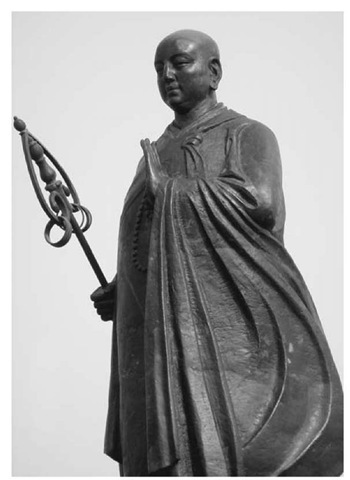
Xuánzàng
Knowing what we now know about the Heart Sutra we can begin to imagine how it came about. The text was almost certainly produced by a monk because it implies knowledge of the Large Perfection of Wisdom Sutra and this implies written texts that would have been accessible, both physically and linguistically, only to monks. The monk may well have been engaged in copying the text.

The monk was, amongst other things, a devotee of Avalokiteśvara. The cult of Avalokiteśvara was widespread in China; however, the various schools of Buddhism were not so distinct as in India. Within a more generalised, less sectarian, Buddhism, any given monastery might have had an area of specialisation without a commitment to a particular Buddhists ideology. There is no implied contradiction in a devotee of Avalokiteśvara studying the Perfection of Wisdom tradition in the context of early medieval Chinese Buddhism (just as this would not pose a huge conundrum in the UK today). That said, the choice of Avalokiteśvara as the representative bodhisattva has produced a long tradition of puzzled commentators. 

As he copied Kumārajīva's translation of the Large Wisdom Sutra (T 233), the monk probably noted down some extracts. His notebook might have been paper if his monastery was wealthy. Perhaps he used the back of discarded practice sheets. Or it might have been strips of bamboo bound together. These extracts must have struck the monk as containing the pith or heart of the perfection of wisdom. He learned the lines by heart and began to recite them to himself. Later, using phrases also mainly drawn from the same text, he composed the praises to prajñāpāramitā which follow the main extract, and the introduction featuring Avalokiteśvara, who, for him, was the ideal bodhisattva. The chant began to circulate. As time went on, various positive events and occurrences became associated with chanting the text. It took on the role of charm. Or perhaps it was intended as a charm from the beginning, because we know that magic was and is a major part of traditional Buddhism.

From here we have some traditional narratives about the text and how it became associated with Xuánzàng. The story goes that while travelling in Sìchuān, Xuánzàng helped a sick monk and was given the Heart Sutra out of gratitude. It went on to be a favourite text and charm. It protected Xuánzàng from demons in the Gobi Desert on his trip to India, for example. Xuánzàng, or another Chinese monk who learned Sanskrit and went to India at around the same time, translated the text into Sanskrit. And, of course, in India the text was extended to create the long text that begins with the convention evaṃ mayā śrutaṃ...

In any case, the person who created the Sanskrit Heart Sutra was almost certainly a Chinese speaker who allowed fragments of Chinese grammar to remain in his translation - producing centuries of head scratching until 1992 when Jan Nattier pointed this out. The Sanskrit text was transmitted by being chanted and copied. Finally, in 1948, Edward Conze produced a critical edition of the text in Sanskrit based on a number of manuscript and epigraphical sources. This he revised in 1967, adding new manuscript sources, and again in 1975 for his commentary. However, Conze made some mistakes, and as Nattier identified in the original composition in Chinese, made some infelicitous choices so that the Sanskrit Heart Sutra that most people know is, in fact, in need of revision.

Below is a new Sanskrit text which includes all of the improvements to Conze's editions (1948, 1967, 1975) suggested to date by myself and Nattier (1992). I divide the text into 6 paragraphs. This structure is also somewhat different from Conze's as a result of reinterpreting the epithets of the 'mantra'. I've used full stops for the end of sentences and upper-case letters for the first words in sentences, but otherwise tried to keep punctuation and hyphenation to a minimum. This makes no accommodation to the non-Sanskrit reader, but the idea is to produce a text which conforms to the conventions of Romanised Sanskrit. It can be modified for readability later.

I hope to publish this result more formally at some point (the first step will be my article on the first para which is currently being reviewed by a journal). My Sanskrit is by no means good enough to claim that what follows is definitive. I know a few Sanskritists read my blog and I'm more than happy to get feedback on my linguistic choices. Ideally, such an edition would be accompanied not only by footnotes with all of the alternative readings from the mss., but with detailed arguments about why one reading is better than another. Some of those arguments have been made in the preceding essays, but a proper critical edition will have to wait until I can undertake the project on the proper footing. In addition, using the catalogue of the Nepalese-German Manuscript Cataloguing Project (NGMCP) I recently discovered that the University of Hamburg has a large cache of late Nepalese mss. of the long text Heart Sutra not used by Conze in his editions. It seems only right that these be examined and considered.

The Sanskrit is followed by my own translation, which uses conventions I've established over several years on this blog. In particular, I try to make it clear that the doctrine applies specifically to experience, in contradiction of the long Buddhist tradition which sees the doctrine as describing reality. Although it is possible to extend the domain of interest beyond experience, my belief is that the insights which characterise bodhi arise from investigation of experience. Apart from my idiosyncrasies as a translator, the differences will be much less obvious in translation, since most of the changes to the Sanskrit are, in effect, paraphrases.


Sanskrit Text

Prajñāpāramitāhṛdaya


namas sarvajñāya
1. Āryāvalokiteśvaro bodhisattvo gambhīrāṃ prajñāpāramitācaryāṃ caramāṇo vyavalokayati sma pancaskandhāṃs tāṃś ca svabhāvaśūnyān paśyati sma. 
2. Iha śāriputra rūpaṁ śūnyatā śūnyataiva rūpam. Rūpān na pṛthak śūnyatā śūnyatāyā na pṛthag rūpam. Evam eva vedanā saṃjñā saṃskāro vijñānaṃ. 
3. Iha śāriputra sarvadharmāḥ śūnyatālakṣaṇā anutpannā aniruddhā amalā avimalā anūnā aparipūrṇāḥ. 
4. Tasmāc chāriputra śūnyatāyāṃ na rūpaṃ na vedanā na saṃjñā na saṃskārāḥ na vijñānam. Na cakṣur na śrotraṃ na ghrānaṃ na jihvā na kāyo na manaḥ. Na rūpaṃ na śabdo na gando na raso na spraṣṭavya na dharmaḥ. Na cakṣūrdhātur yāvan na manovijñānadhātuḥ. Nāvidyā nāvidyākṣayo yāvan na jarāmaraṇam na jarāmaraṇakṣayo. Na duhkho na samudayo na nirodho na mārgaḥ. Na jñānam. Na prāptiḥ. 
5. Tasmāc chāriputra aprāptitvād bodhisattvasya prajñāpāramitām āśritya viharaty acittāvaraṇaḥ. Cittāvaraṇanāstitvād atrastro viparyāsātikrānto nirvāṇaparyavasānam. Tryadhvavyavasthitāḥ sarvabuddhāḥ prajñāpāramitām āśritya anuttarāṃ samyaksambodhim abhisambuddhāḥ. Tasmāj jñātavyam prajñāpāramitā mahāvidyā anuttaravidyā 'samasamavidyā sarvaduḥkhapraśamanaḥ samyaktvāmithyātvāt. 
6. Prajñāpāramitāyām ukto dhāraṇī tadyathā gate gate pāragate pārasaṃgate bodhi svāhā 
prajñāpāramitāhṛdayam samāptam

Notes

Title: word sūtra is not included because it is not found in most of the mss. or canonical versions of the short text. The short text is arguably not a sūtra, though that title could be claimed by the long text. Instead, the genre of the text is hṛdaya, 'gist or essence', or as some of the Nepalese long text manuscripts would have it, dhāraṇī. Titles of Sanskrit texts are, in fact, usually given in the colophon. The title of the long text various considerably and the word sūtra is rarely used:
  • Nb ārya prajñāpāramitā-hṛdayaṃ
  • Ne ārya-pañcaviṃśatikā-prajñāpāramitā-hṛdaya nāma dhāraṇī
  • Nh ārya-śrī-pañcavinsatikā-prajñāpāramitā-hṛdaya nāma dhāraṇī
  • Nk pañcaviṃśatikā-prajñāparamitā-hṛdayaṃ
  • Ce aryrā-pañcaviśatikā prajñāpāramitā-hṛdayaṃ
  • Jb prajñāpāramitā-hṛdaya-sūtraṃ
Note that the tradition itself has already clocked the relationship to Pañcaviṃśati. It seems that individual lineages of transmission, or perhaps individual scribes, had considerable influence over title and maṅgala.

Maṅgala: the maṅgala favoured by Conze, oṃ namo bhagavatyai āryaprajñāpāramitāyai, is found in the long texts and in Nepalese mss. Strictly speaking sandhi demands that bhagavatyai become bhagavatyā (ai + ā > ā + ā). Conze's maṅgala is not found in any short text or the Japanese mss. which have this shorter, more common maṅgala. There is no oṃ in the maṅgala because this was an anachronism for the time. Probably oṃ was originally a mis-reading of the symbol known in Tibetan as yimgo 'head letter' (See Beginning and End Markers in Buddhist Texts). None of the Chinese canonical versions include a maṅgala. Sarvajñā 'omniscience' is a frequent topic in the Prajñāpāramitā texts.

1. Corrected according to my observation of an error in Conze's text. Specifically, vyavalokyati sma is a transitive verb and has pañcasakandhān (accusative plural) as its object. In other words, Avalokiteśvara was examining the five branches of experience when he saw no svabhāva in any of them. This is consistent with Chinese versions. The correction obviates the need for any punctuation in the Sanskrit because phrase boundaries are clearly marked in other ways such as the placement of caramaṇo and ca. On the translation "five branches of experience" see Pañca-skandha: Etymology and Dynamics. My formal write up of this material, including a detailed comparison of Sanskrit mss. and Chinese and Tibetan canonical versions has been submitted to a journal for review. 

2. This passage remains intact, though it is significantly different from the Pañcaviṃśati as pointed out by Nattier (1992). The phrases yad rūpaṃ sā śūnyatā yā śūnyatā tad rūpam are missing from most mss. and have no counterpart in the Chinese canonical versions, thus are not included. Nattier makes the same amendment in her translation (155; 201, n.5; and 204, n.19).  In the Pañcaviṃśati, Śāriputra is, in fact, being addressed by the Buddha, though in the Gilgit ms. he is called Śāradvatīputra; this section begins evam ukte bhagavān āyuṣmantaṃ śāradvatīputram etad avocat 'That said, the Bhagavan said to Elder Śāradvatīputra.' The list of skandhas following evam eva is usually a long compound, and the mss. are divided over whether it is itaretara, and thus deserves a plural ending, -vijñānāni (Ja, Cce, Neh), or is a samāhara (an established set) and should take the neuter singular, -vijñānaṃ (Cg). Other alternative readings are -vijñāni śūnyāni (Nelkm); -vijñānāni śūnyatā (Nde); -vijñānaṃ ca śūnyatā (Jb). It seems the majority opt for itaretara and plural, but Conze opted for samāhara. As often as not, Pañcavimśati has vedanāsaṃjñāsaṃskārā vijñānaṃ, but when combining all together has examples of both, viz: rūpavedanāsaṃjñāsaṃskāravijñānāny (Dutt 1.252) and -esu (Dutt 1.148) vs vedanāsaṃjñāsaṃskārāvijñānam (Dutt 1.132). Un-compounding the terms is another possibility. 

3. Though sarvadharmāḥ śūnyatālakṣaṇā is not included in Pañcaviṃśati, it is in all versions of the Heart Sutra, including the Chinese. The jury is out on how to split this compound: śūnyatā-lakṣaṇā, 'marked with emptiness' or śūnyatā-alakṣaṇā, 'emptiness and unmarked'. My preference is for the former because it is consistent with the Chinese 空相 kōng xiāng 'marked with emptiness' (T 251) and more consistent with Prajñāpāramitā, generally. However, the Tibetan versions seem to have the latter interpretation (Silk 1994: 122-3, 176-7) The lack of this phrase means that in the Pañcavīṃśati the string of qualities beginning with anutpannā apply to emptiness (yā śūnyatā) rather than to all experiences (sarvadharmāḥ) which in some ways makes more sense: Gilgit: yā śūnyatā na sā utpadyate...; Dutt/Kimura śūnyatā notpayate... 

4. Amended by including na before all negated list items as per mss.: Ne, Nh, Nk, Jb, Ce, Cg. This is more idiomatic Sanskrit. Thus also in the Pañcaviṃśati (Gilgit ms. Folio 21v).

5. Niṣṭhānirvāṇa is replaced with nirvāṇaparyavasānam on the basis of studying Kumārajīva's translation of the Saddharmapuṇḍarīkasūtra via the glossary produced by Seishi Karashima in comparison with the Sanskrit edition by Vaidya. The new version incorporates praises to prajñāpāramitā as vidyā, replacing word mantra with vidyā as per Sanskrit Aṣṭa and Pañcaviṃśati, thereby correcting a paraphrase that was confusing. Satyam amithyatvāt replaced by samyaktvāmithyātvāt as discussed in previous essay.

6. The word "mantra" replaced with dhāraṇī to reflect the nature of the item. Now a standalone chant with a bare introduction as the epithets clearly apply to the previous paragraph, not this one. On the dhāraṇī and my use of 'amen' to translate svāhā see The Heart Sutra Mantra.

Colophon. Traditionally, this is where a Sanskrit manuscript names the text. None of the short text mss. have 'iti' the end quotation marker, and thus it is left out here. In the long text this is at the end of the last paragraph and separated from the colophon by elaborate punctuation, e.g.
...bhagavato bhāṣitam abhyanandan iti || ༓ || ... 
[In the Triratna Order we erroneously incorporate iti into the colophon].


Translation

The Heart of the Perfection of Wisdom

Homage to the Omniscient
1. Noble Avalokiteśvara bodhisattva, practising the deep practice of the perfection of wisdom, examined the five branches of experience and saw they lacked intrinsic existence.
2. Śāriputra, form is not one thing and emptiness another. Emptiness is not one thing and form another. Form is just emptiness. Emptiness is just form. So also for sensations, names, intentions, and discriminations.
3. Here Śāriputra, all experiences are marked with emptiness, they do not arise, do not cease, are not soiled, are not purified, do not decrease, and do not increase.
4. Therefore, Śāriputra, with respect to emptiness there is no form, no sensations, no names, no intentions, and no discrimination. No eye, no ear, no nose, no tongue, no body, no mind. No form, no sound, no smell, no taste, no touchable, no mental objects. No eye element, and so on, to no mind-discrimination element. No ignorance, no cutting off of ignorance, up to, no old-age & death and no cutting off of old-age & death. There is no disappointment, no cause, no cessation, and no path. No knowledge. No attaining.  
5. Therefore, Śāriputra, because of their state of non-attaining, the bodhisattva, relying on perfection of wisdom, dwells with an unobstructed mind. And because they have an unobstructed mind, they are unafraid and overcome perverse views, culminating in nirvāṇa. Having relied on the perfection of wisdom, all the Buddhas of the three times are fully and perfectly awakened. Therefore, the perfection of wisdom should be known as a great spell, an unsurpassed spell, a peerless spell that allays all suffering because it is true and not false.  
6. A Perfection of Wisdom chant goes: gone gone gone over gone over to the other side awake amen.
The Heart of the Perfection of Wisdom concludes.

~~oOo~~

Fonts

The yimgo character in the maṅgala (and discussion) requires the Tibetan Machine Uni font (PC, download here) or the Xenotype TB Tibetan New (Mac, download here). Unfortunately it's not part of the main Tibetan Unicode block and is not implemented in some of the standard Tibetan fonts, notably Microsoft's default Himalaya. These are useful fonts to have in any case, but there is an image of the basic yimgo in my essay about text markers if readers don't wish to install them. Other Tibetan fonts may include this symbol. 


Bibliography
  • Conze, Edward (1948) ‘Text, Sources, and Bibliography of the Prajñāpāramitā-hṛdaya.’ Journal of the Royal Asiatic Society, April 80(1-2): 33-51.
  • Conze, Edward. (1967) ‘The Prajñāpāramitā-Hṛdaya Sūtra’ in Thirty Years of Buddhist Studies: Selected Essays. Bruno Cassirer, pp. 147-167.
  • Conze, Edward. (1975) Buddhist Wisdom Books: The Diamond Sutra and the Heart Sutra. George Allen & Unwin.
  • Dutt, N. Pañcaviṃśatisāhasrikā Prajñāpāramitā Sūtra: edited with critical notes and introduction. London, Luzac & Co, 1934.
  • Silk, Jonathan A. (1994) The Heart Sūtra in Tibetan: a Critical Edition of the Two Recensions Contained in the Kanjur. Arbeitskreis für Tibetische und Buddhistische Studien, Universität Wien.

20 September 2013

Fixing Problems in the Sanskrit Heart Sūtra

There's an old IT saying: "the good thing about standards is that there are so many to choose from." Standardisation does help to facilitate interactivity. These words are encoded in the English language, written in a script deriving from Roman writing. On my computer, they become encoded at one level as HTML rendered on your screen according to agreed protocols; at a lower level in terms of TCP/IP packets sent to your computer from a server; and at a lower level still as short bursts of voltage changes on a wire. If the parameters of these voltages, packets or markup languages were not agreed upon then the internet would cease to work.

In India, from about the beginning of the common-era, Sanskrit became a kind of standard for religious discourse. Even Buddhists began producing texts in Sanskrit, or Buddhist Hybrid Sanskrit, from around this time, despite the apparent prohibition on using Sanskrit contained in the early texts (Vin v.33.1). Some of the first Sanskrit texts were the early Prajñāpāramitā sūtras, especially the Aṣṭasāhasikā Prajñāpāramitā Sūtra and the Ratnaguṇasamcayagāthā. However, Buddhist Hybrid Sanskrit is distinct from Classical Sanskrit because it includes many Prakrit forms (to the point where some dialects are more like Prakrit than Sanskrit). In some out-of-the-way places other languages were important: Pāli became the "church language" in Sri Lanka; Gāndhārī was used in the Northwest Frontier and many Gāndhārī texts were translated into Chinese (especially the Āgamas or counterparts to the Pāli Nikāyas). Several Central Asian languages of the Iranian family (e.g., Tocharian and Khotanese) were also important scriptural languages. But most Mahāyāna texts were preserved in a variety of Sanskrit.

Another form of standardisation is the construction of critical editions from manuscript sources. The assumption is that a text that now exists in a variety of versions originated from a single written version, which is obviously not always true in a place like India that favours oral composition. An editor will gather all the existing editions of a text and try to determine a text, an ur-text, that is a plausible ancestor to them all. To do this they note scribal errors, any lines or phrases out of place, broken metre, etc., and try to fix them. Then, when obvious errors are fixed, they look for other ways in which texts evolve: for example, interpolations or other changes by previous editors. The resulting text may be different from any of the surviving manuscripts, as is the case for the Heart Sutra.

In the case of the Heart Sutra, we have known for some time that the core of the text derives from the Pañcaviṃśati Prajñāpāramitā Sūtra and Jan Nattier has shown that it specifically comes from the Chinese version by Kumārajīva (T 223). Further investigation tells us that the stemma codicum most closely resembles the Chinese version ascribed to Xuánzàng (T 251), though it is not a perfect match. T 251 is largely in the idiom of Kumārajīva with a few of Xuánzàng's terms over-laid. Though a version is attributed to Kumārajīva (T 250) who lived two centuries earlier, both attribution and date are plausibly disputed. Nattier argues that T 250 draws on T 25.1509 大智度論 Dàzhìdù lùn (Mahāprajñāpāramitāśastra), a commentary on Pañcaviṃśati attributed to Nāgārjuna and also translated by Kumārajīva, rather than directly from T 223, suggesting it has been edited by someone familiar with the work of Kumārajīva. T 250 also contains two passages, one of 37 characters, which do not occur in T 251. 

In the previous three essays we rehearsed Nattier's arguments that the Sanskrit Heart Sutra is a translation from the Chinese, focussing in the process on a number of infelicitous passages, the conclusion being that the Sanskrit text is, indeed, a translation from Chinese, produced by someone with Chinese as a mother tongue. If we were concerned to produce a better reading on our way to proposing a stemma codicum, some of these infelicities were easily fixed. In the case of the phrase, na cakṣuḥśrotraghrānajihvākāyamanāṃsi, we simply add the negative particle and a case ending to each word to arrive at idiomatic Sanskrit: na cakṣuḥ na śrotraṃ na ghrānaṃ jihvā na kāyo na manaḥ. Thus, the Gilgit ms. of Pañcaviṃśati and, as it happens, also quite a few of Conze's sources, e.g., Ne, Nh, Nk, Jb, Ce, and Cg (once again, Conze misses the opportunity). But some of the other problems run deeper. They would require us to first better understand the Chinese idiom and then make an informed decision about how to render that idea into Sanskrit.

This essay will look, in particular, at two phrases identified by Nattier as working well in Chinese, but becoming clumsy in Sanskrit and in English translations from Sanskrit.


Satyam amithyatvāt

The Chinese characters are 真實不虛 zhēn shí bù xū. Now, the characters 真 and 實 are used in the translation of yathābhūta-jñānadarśana (knowing and seeing things as they are), viz, 見如實、知如真, literally ‘seeing as real, knowing as true’. Where 真, zhēn, means 'real' and 實, shí, means 'true'. Hence, the sense is 'really true' which can be rendered as 'genuine' or 'authentic'. However, according the Digital Dictionary of Buddhism: 真實 has been used to translate a bewildering variety of Sanskrit terms:
akṛtrima, avitatha, avitathatā, aviparīta, ātmaka, ārjava, kalyāṇa, tattvârtha, tatva, tathātra, dravya, dharma-tattva, naya, niyata, nūnam, parama, paramârthatā, paramârtha-sat, paramârthena, pariniṣpatti, pariniṣpanna, pāramārthika, bhūtatā, thūti, maula, yathābhūta, yathāvat, *vāstavikatā, śuddhā, śubha, saṃsevana, sat, satya-kāra, satyatā, sad-bhāva, samyaktva, sāra, sāratā, sva-tantra, sva-naya, svanaya-pratyavasthāna
Choosing which of these was intended is difficult without more context. However, the second part of the phrase is more straight-forward and gives us a point of reference (note the contrast with the difficulty of this part, amithyatvād, in Sanskrit). 虛, xū, 'false', is also used for a variety of terms including śūnya; ākāśa; mṛṣā, mithyā abhūta, but these are all part of one broad semantic field concerned with lack of substance, either literally (śūnya 'empty') or metaphorically (mṛṣā 'false').

Though we find the Sanskrit satyam amithyatvāt unsatisfactory, there are a number of other possibilities that take in the contrast between truth and falsity. One of the main problems with  satyam amithyatvāt is that satyam is not usually contrasted with mithyā. Satyam is contrasted with asatya or, sometimes, with anṛta or mṛṣā. The Vajracchedikā Nāma Triśatikā Prajñāpāramitā or Diamond Sutra (section 14) contrasts satya/mṛṣāna tatra satyaṁ na mṛṣā 'there is no truth and no lie'. However, this pair is not found in the Pañcaviṃśati and mṛṣā is only used once there, in the compound mṛṣāvādaḥ, 'false speech' (cf. Pāli musāvāda). Mithyā, on the other hand, is usually contrasted with samyañc. Of the various possibilities, samyañc/mithyā seems the more likely pair.

Let us begin with 虛, xū, and take it to convey the Sanskrit word mithyā, 'false'. Thus, 不虛 bù xū ought to be: na mithyā or amithyā, literally, 'not false, non-false', or 'true'. These negative forms are common and important in Buddhist Sanskrit vocabulary (and perhaps also in wider Indian literature). There is a special emphasis in saying that something is "not false" as compared to saying that it is "true". Right down to the present, Buddhists have an anxiety about taking the wrong path, or being given false teachings that do not lead to nirvāṇa. In this phrase, the non-falsity of prajñāpāramitā is almost as relevant as its truth.

The opposite of mithyā is usually samyañc (which becomes samyak/samyag in use, since ñc is not a permitted final). For example, we usually contrast samyagdṛṣti, 'right view', 正見, or 'perfect view' with mithyādṛṣṭi, 'false view', 邪見, xiéjiàn. And so on for all of the Eightfold Path. Though note that the character used here is 邪, xié, rather than 虛, xū.

In Pāli, we sometimes find other juxtapositions of samyañc and mithyā. At SN v.17-8 and DN iii.254 the abstract nouns micchatta/sammatta (Sanskrit mithyātva/samyaktva) are contrasted in terms of the items of the Eightfold Path. At DN i.8 we find that Gotama refrains from arguments of the type 'you are proceeding falsely and I am proceeding correctly' (micchā paṭipanno tvamasi, ahamasmi sammā paṭipanno). And at DN iii.128 a contrast is made between understanding the meaning and the words of any given doctrine, either of which can be micchā or sammā: e.g., ‘ayaṃ kho āyasmā atthañhi kho micchā gaṇhāti byañjanāni sammā ropetīti. (grasping a wrong meaning while having a right sense of the words).

From amongst the many possible translations of 真實 given by the DDB we see an abstract noun formed from samyañc, i.e., samyaktva 'completeness, wholeness; truthful', though this word is seldom used in Buddhist Sanskrit (searching across the whole of the Digital Sanskrit Buddhist canon). It's entirely possible for the same Chinese character to be used to translate both samyañc and samyaktva.

So we might have expected the contrast in the Sanskrit Heart Sutra to be along the lines: samyag na mithyā; or samyak ca amithyā ca; or samyagamithyā. Or, if the abstract was preferred, samyaktva na mithyātva etc. In the critical edition of the Aṣṭa by Vaidya we find this contrast between samyak and mithyā used as adjectives:
Saced evaṃ pariṇāmayati, samyak pariṇāmayati, na mithyā pariṇāmayati. Evaṃ ca bodhisattvena mahāsattvena pariṇāmayitavyam. (72) 
If he transforms this way, he transforms truthfully, he does not transform. And thus the bodhisattva mahāsattva should transform.
In a fragment of the Aṣṭa found in central Asia we find reference to a particular samādhi named 'devouring all truthhood and falsehood': samyaktva-mithyātva-sarva-saṃgrasanaḥ nāma samādhiḥ (AṣṭaK line 13). In another fragment (AṣṭaB) we find this explained as:
tatra katama samyaktvamithyātva-sarvasaṃgrasanaḥ nāma samādhir yatra samādhau sthitvā sarvasamādhīnāṃ saṃyuktvamithyātvaṃ na samanupaśyaty ayam ucyate samyaktvamithyātva-sarvasaṃgrasanaḥ samādhiḥ
There is the best of integrated states called "devouring all truthhood and falsehood", remaining in that state he does not perceive the truthhood and falsehood of all integrated states - this is called the integrated state of devouring all truthhood and falsehood.
The same idea occurs in the Pañcaviṃśati (Dutt 1.203)
tatra katamaḥ sarvasamyaktvamithyātvasaṃgraho nāma samādhiḥ yatra samādhau sthitvā samādhīnāṃ samyaktvamithyātvāni na samanupaśyati tenocyate sarvasamyaktvamithyātvasaṃgraho nāma samādhiḥ
Here the wording is almost identical, except that, in the name of the samādhi or integrated state, samyaktva-mithyātva-sarva-saṃgrasanaḥ 'all devouring' has been substituted with sarva-samyaktva-mithyātva-saṃgraho 'compendium of all truthhood and falsehood'. Kimura (1-1.184) has 'there is an integrated state called compendium of truthhood and falsehood' (asti samyaktva-mithyātva-saṃgraho nāma samādhiḥ) and then later (1-2. 65) sarva-samyaktva-mithyātva-saṃgraho as per Dutt, with the same explanation (1-2: 74). Dutt also has (1.143) 'there is an integrated state named compendium of truthhood and non-falsehood' (asti samyak-amithyātva-saṃgraho nāma samādhiḥ).

Elsewhere in the Pañcaviṃśati samyaktva tends to only be used in a compound with -niyato 'connected with, established in, or disciplined by'
bhagavān āha: na mayā subhūte 'nuttarāṃ samyaksaṃbodhim abhisaṃbudhya kathaṃcid api sattva upalabdhaḥ, samyaktvaniyato vā mithyātvaniyato vāniyato vā (Kimura 5:120)
The Bhagavan said, Subhuti, I don't perceive a being anywhere having attained supreme perfect awakening, connected with truthhood, or connected with falsehood, or unconnected. 
Thus we have a precedent in the Perfection of Wisdom literature for the contrast samyak na mithya and for samyaktva-mithyātva. The Heart Sutra is trying to convey that the efficacy of prajñāpāramitā is down to the features of both truthfulness and non-falseness. The ablative case ending indicates from what a verb proceeds, either spatially or more abstractly for what reason the action happens. Prajñāpāramitā is a great spell, etc., is the allayer of all disappointment because 真實不虛, i.e., because it is true/truthhood and because it is not-false/not-falsehood (it is difficult to find matching abstract nouns in English). We might combine the two factors into a dvandvā compound: samyaktvāmithyātvāt

Having done all this comparative/deductive work, if we now look again at Conze's critical edition we note that there were a few variant readings of this expression:
Cae: samyaktvaṃ na mithyatvaṃ
Ne: samyaktva amithyātvā
Nb: samyaktvamithyatvat (not noted in Conze's edition)
Thus, the very readings (with some minor scribal errors) which would make sense in the context were, in fact, available to Conze in his mss., but he rejected them in favour of something which was not good Sanskrit and did not really make sense. Also, the lacuna in Conze's list of the alternate readings here is not the first I have found after examining the manuscripts.

Unfortunately, this undermines Nattiers argument that this passage is a back-translation. Other passages withstand scrutiny better, but here the simpler explanation is that we are mislead by Conze's critical edition. There was and is a better translation of this phrase.


Niṣṭhānirvaṇa

This term is more consistent in the mss. and our job here is not identifying a better reading from the extant mss. because there isn't one. The job here is to look more broadly at how Kumārajīva, in particular, might have used this phrase to translate Sanskrit. Since the passage this term appears in has not yet been identified with a counterpart in other Buddhist texts, we must cast a broader net. However, I think we can assume that the general style of Kumārajīva is likely to be a reference point, because where we have found exact correspondences to date they are to Kumārajīva's translations. We are fortunate to have Seishi KARASHIMA's detailed glossary of Kumārajīva's translation of the Saddharmapuṇḍarīka Sutra (T. 9.262), which shows us where and how each phrase was used and links it to a Sanskrit edition.

The Chinese is 究竟涅槃, jiùjìng nièpán. The last two characters render nirvāṇa while the first two mean 'finally attain' or 'ultimately'. The phrase is usually supplemented in both Sanskrit and Tibetan with the verb pra√āp, 'attains', as a past participle, prāpta. This choice is ironic because the text earlier says na prāptiḥ. Conze tolerates this:
"[Niṣṭhānirvāṇaprāthaḥ) obviously contradicts [na prāpti]. It is just because he seeks no attainment, it is just because attainment is quite impossible, that the Bodhisattva attains or wins Nirvana." (1975: 97-98), 
Conze seems to relish the contradictions sometimes found in Perfection of Wisdom texts, but I've already identified at least two example of how this predilection for nonsense has led Conze astray in editing the Sanskrit text. Generally speaking, when our text is nonsense, we have to ask if we have made a mistake. So we have to ask, is the contradiction part and parcel of the text or simply a mistake? What we want here is something that means 'culminating in nirvāṇa'. The bodhisattva, in a state of non-attaining, relies on perfect wisdom and has no mental obstructions (cittāvaraṇa), and thus they overcome wrong views and attain/reach nirvāṇa. So we can see the temptation to supply a verb like prāpnoti 'to attain' even though the text rules it out. We saw the verb ā√rādh 'to succeed' used in Pāli in the last essay.

Now the characters 究竟 are used to translate niṣṭhā, 'state, condition; conclusion, termination'; but they are also used to translate atyanta, 'ultimate, culmination; arrive, reach', and sometimes atyantaniṣṭhā (pointed out by Dan Luthaus on Buddha-L). It would seem that atyanta is a better choice, here. The terms atyantaśūnyatā, 'ultimate emptiness', and atyantaviśuddhitām, 'ultimate purity', are found quite frequently in Pañcaviṃśati. The compound atyantaniṣṭhā, however, still begs the addition of a verb or verbal form, so in this sense it does not solve our problem. 

Consulting Karashima's glossary we find some extra possibilities. Karashima has identified a number of uses for this Chinese phrase in translating the Sanskrit Saddharmapuṇḍarīka or Lotus Sūtra. But one in particular stands out.
為求聲聞者說應四諦法,度生老病死,究竟涅槃 (3c17)
Wèi qiú shēng wén zhě shuō yīng sìdì fǎ, dù shēnglǎobìngsǐ, jiùjìng nièpán
The parallel in Vaidya's Sanskrit Ed. is
yad uta śrāvakāṇāṃ caturāryasatya-saṃprayuktaṃ pratītyasamutpāda-pravṛttaṃ dharmaṃ deśayati sma jāti-jarāvyādhimaraṇaśoka-paridevaduḥkha-daurmanasyopāyāsānāṃ samatikramāya nirvāṇaparyavasānam | (12)
Here 究竟涅槃 corresponds to samatikramāya nirvāṇaparyavasānam, 'going beyond [suffering] to the conclusion of nirvāṇa'. Samatikrama (sam+ati+ √kram) means ‘going entirely over or beyond’; while paryavasāna (pari+ava+√so) means ‘end, conclusion’ or 'ending, concluding'. Kumārajīva also translates nirvāṇaparyavasāna (without samatikramāya) with 究竟涅槃 at 19c4, 50c4, 50c7. Additionally, he used these characters to translate: parinirvāṇa (7c2) and samavasaraṇa (12b5) which overlap semantically. 

Given the context in the Heart Sutra we're looking for a word or phrase that indicates that the bodhisattva's path culminates in nirvāṇa (which is not an attainment, but rather the extinction of the fires of greed, hatred and delusion). Contra Conze (1975), I see no reason to construct this as a paradox. That the goal is a liberation from something, rather than an attaining to something, is not so difficult to grasp. As a compound, nirvāṇaparyavasānam can mean exactly 'culminating in nirvāṇa', because paryavasāna is a verbal noun. As such, it is probably the best candidate for what was written as 究竟涅槃 from amongst the choices identified. The paraphrasing effect of going from Sanskrit to Chinese to Sanskrit might have produced the sequence:

nirvāṇa-paryavasānam → 究竟涅槃 → niṣṭhā-nirvāṇa

I suggest, then, that nirvāṇaparyavasānam is a better reading for 究竟涅槃 in the Heart Sutra than niṣṭhānirvāṇa, and were I editing the text would propose this substitution to create a readable text.

The assumption here is that the Chinese text was inspired by Sanskrit texts throughout. This is an assumption that requires further investigation, though I see preliminary evidence that even the parts not clearly associated with the Large Perfection of Wisdom Text drew on Chinese idioms of Kumārajīva's translations of Buddhist texts. In other words, the text has been composed to conform to Buddhist idioms, probably by somebody familiar with Kumārajīva's translations.


Conclusion

In this essay and the previous one, I have proposed two additional changes to the wording of the Sanskrit Prajñāpāramitāhṛdaya, to go with the revision of the first paragraph proposed last year, and the stylistic observations made by Jan Nattier also discussed in my last essay. The two latest suggestions are:
  1. satyaṃ amithyatvāt  → samyaktvāmithyātvāt.
  2. niṣṭhā-nirvāṇa(-praptaḥ) → nirvāṇaparyavasānam
The first is supported by extant mss. readings, though the second is not. In the second case some mss. attempt to solve the problem of the unreadability of niṣṭhānirvāṇa by adding the past participle prāpta, though this creates readable nonsense. The case for the second change, then, is based on readability and an attempt to establish alternatives by tracing how 究竟涅槃 was used to translate Sanskrit terms by Kumārajīva.

Jan Nattier argued that in both cases we have evidence for a back translation from Chinese. I have shown that in the first case this is incorrect, as it seems to be a problem with Conze's critical edition. However, the second does seem likely to an artefact of a phrase moving from Sanskrit to Chinese and back to Sanskrit.

On investigation, we find an accumulation of errors and infelicities in the critical edition of the Sanskrit Heart Sutra, along with a series of suggestions for how to improve the text. A new critical edition, and one which pays much close attention to alternate readings, is now more than desirable, it is urgent. In my next essay I'll propose a new edition of the Sanskrit Heart Sutra which incorporates the changes suggested so far.


~~oOo~~


Bibliography

  • Conze, Edward. (1975) Buddhist Wisdom Books: The Diamond Sutra and the Heart Sutra. George Allen & Unwin. 


Related Posts with Thumbnails