16 May 2014

Water, water everywhere...

I've been thinking a lot about how a failure to understand science affects the arguments against materialism. In Buddhism we often make the argument that you cannot understand Buddhism unless you have practised it. By the same token we might argue that unless one has practised science one can hardly be expected to fully understand it. And as a result many people have naive and unsophisticated views about what science is.

If more people had a positive experience of discovering empirical laws for themselves in school that we might be having a very different discussion about religion and science right now. Unfortunately most of us learn science in large classes aimed at middling students, from average teachers who may or may not have become jaded by the grind of the job. In the end most of don't actually learn any science. But for me learning science was always a joy. I want to see if I can communicate something of this.

Take the humble substance, water. Water is remarkable stuff. We all know this. We might know that ⅔ of the earth is covered in it, and that our bodies are 80% water. We know that it's essential to life of earth, that in many ways it is the medium for life. Most scientists believe that life on earth must have started in water. The properties of water are:
  • Water is a liquid at standard temperature (20°C) and pressure (1 atmosphere). 
  • Under STP it freezes, i.e. becomes a solid, at 0°C STP; and it boils, i.e. becomes a gas, at 100°C. 
  • Water is an excellent solvent and able to dissolve most minerals.
  • Water is an electrical conductor and with even small impurities can be an excellent conductor.
  • Liquid water has a high-surface tension so that it forms relatively large drops. 
  • Water is moderately chemically stable - it doesn't easily react with other chemicals. 
  • Water ice can take as many as 15 different forms depending on the conditions.
  • Water vapour is a major contributor to the greenhouse effect. 
The water molecule is represented by the chemical formula H2O. This means that each water molecule contains one oxygen atom and two hydrogen atoms. The two hydrogen atoms attach to the oxygen on one side about 105° apart from each other. I look at the reasons for this shortly.


But how do we know all of this? Isn't it all just some theory? Well, no. It's not all "just theory". It certainly involves interpretive theory, but most of it is either from direct observation, or deductions from indirect observations. I'll try to explain how we know about the water molecule.


electrolysis
If we pass an electric current through water (a process called electrolysis), gas bubbles form at each of the electrodes and the amount of water is reduced. If we collect the gasses we can discover that they are oxygen and hydrogen. Hydrogen was isolated and characterised by Robert Boyle in 1671. Oxygen a century later by Carl Wilhelm Scheele in 1772 (published in 1777). If we mix hydrogen and oxygen and provide a spark to kick things off, then in an explosive reaction they recombine to form water and nothing else. (I've done this and it is quite spectacular!) Boyle showed that any gas at a given temperature and pressure will occupy the same volume - this is an empirical law that holds true for all gases. When we electrolyse water we get twice as much hydrogen gas as oxygen gas. Hence we deduce that in water there is twice as much hydrogen as these is water. Hence the chemical formula: H2O.

2 H2 + O2 ⇌ 2 H2O

If we use pure water this is always true. Impurities do change the result slightly. But anyone can take a battery and two wires and pass electricity through water and see bubbles forming. And bubbles at one electrode will always behave like oxygen (for example will make a flame glow brighter) and bubbles at the other will always behave like hydrogen (react explosively with air), and there will always be twice as much hydrogen as oxygen. Always.

One of the important things to note is that water has properties as a compound that neither of it's component parts, oxygen and hydrogen, have or even hint at. That two gases would combine to form a liquid with entirely different physical and chemical properties is an important observation. With 20th centuries theories we not only understand this but have successfully predicted the properties of new elements and compounds. 


emission spectra
If we heat these gases till they are incandescent and start giving off light (in the same way that a heated filament does) or pass an electric discharge through them (as in a fluorescent light bulb) then we examine the spectrum of the light given off we will find characteristic frequencies of light (called an emission spectrum). We all know what sodium vapour lamps look like - the characteristic bright yellow light comes from hot sodium atoms. In fact hot sodium atoms give off two precise wavelengths of visible light, both in the part of the electromagnetic spectrum we perceive as yellow. The colours of fireworks are produced in a similar way: certain metallic elements give off specific colours when hot: strontium, a deep red; cobalt, blue; copper, green and so on. Mixing a little strontium in the gunpowder makes the explosion glow red. So we can also test for hydrogen and oxygen by measuring the light that they give off. This is also how we know the composition of distance stars - characteristic frequencies tell us the kind of elements present, and relative brightness tells us the proportions.

The structure of the water molecule is deduced by combining information from many sources. For example we might look at the six-fold (hexagonal) symmetry of snow flakes. There's only a limited number of configurations of molecules that could produce this shape. Or we can take a crystal and shine X-rays through it and measure how the X-ray beam is scattered. Different kinds of crystal give characteristic scattering patterns. This was how Rosalind Franklin deduced that DNA must be a helix. (here is her original 1953 paper). In fact water-ice can form with 15 different crystal structures depending on the temperature and pressure when it forms. (See Ice: phases)

We can also deduce something important from what kinds of substances water will mix with and what it will dissolve. For example we know that water and alcohol mix completely and can only be separated out by distillation - which involves boiling the mixture. Ethyl alcohol boils at 78°C so it boils first and turns into a gas that drifts away from the liquid. However water will not mix with oily substances. Water will dissolve rock given time, but not wax. 

NASA
There's a neat trick you can do that helps to explain this. We all know about static electricity. If you rub plastic with a natural fabric the difference in electrical properties causes a transfer of electrons and the build up of a static electrical charge. If you wear nylon clothing your whole body can build up a charge that discharges when you touch another person or a door handle (for example). If you charge up a balloon with a good amount of static by rubbing it on someone's clean dry hair (which is entertaining in it's own right) and bring it close to a stream of water, the stream will bend towards the balloon. It turns out that water is able to be attracted by an electric charge. But oils and fats are not.

CO2 
If the water molecule were symmetrical it would not be able to be attracted by an electric charge. Carbon dioxide is symmetrical and not subject to static, which is why one ought to use a CO2 extinguisher on an electrical fire and not water (which conducts electricity). The conclusion we get from all of this is that water molecule must be asymmetrical, giving it a slightly negative charge at one end and a slightly positive charge at the other. Thus we can deduce that the two hydrogen atoms must both be on one side of the molecule. By looking at snowflakes and other ice-crystals and by measuring just how susceptible pure water is to electrical attraction we can get a pretty good idea of how asymmetrical the molecule is.  The best estimate for the angle between the two hydrogen atoms is 104.5°.

We can get a better understanding of water by comparing similar compounds, especially those involving atoms nearby in the periodic table. For example might look at hydrogen compounds of carbon, nitrogen and fluorine on the same row, and sulphur in the row below. If we look at how each of these elements combine with hydrogen we find that carbon forms a compound CH4, (methane); nitrogen forms NH3 (ammonia) and fluorine forms FH (hydrogen fluoride). So there is a pattern here: 4, 3, 2, 1. Sulphur forms a compound H2S (hydrogen sulphide; aka rotten-egg gas), just as oxygen combined with hydrogen in a 2:1 ratio. In fact one of the reasons sulphur is in the same column of the periodic table is precisely because it forms H2S and not H3S  or HS.


Clearly the naming conventions are a bit mixed - common names, legacy chemical names, and modern notations compete. If FH is called "hydrogen fluoride" despite the formula being FH "fluorine hydride". If they fit the pattern above H2O and H2S really ought to be OH2 (oxygen dihydride) and SH2 (sulphur dihydride) but they never are.

By comparing the physical properties of all these we get further insights. CHis a gas at room temperature, highly combustible in oxygen but otherwise quite chemically stable, and insoluble in water. NHis also a gas at room temperature, strongly reactive with other chemicals, and is highly soluble in water. FH boils at 19°C; it is highly water soluble forming hydrofluoric acid and extremely reactive (hydrofluoric acid is used for etching glass which is not touched by concentrated sulphuric or nitric acids).

Thus we can deduce that carbon with its fourfold symmetry forms a more stable molecule. And we known that carbon forms more kinds of compounds than any other element - it is the basis of organic chemistry.

If 4 objects surround a fifth symmetrically they occupy the points of a tetrahedron - the internal angle between each would be 120°. So as a first approximation we might expect NHto be a tetrahedron minus one point (or a three sided pyramid with N at one apex). Again, if the H atoms in NH3 were evenly distributed around the Nitrogen we'd expect different properties (e.g. less soluble in water). For the two H atoms in a water molecule to be about 120° apart. In fact as I said they turn out to be 104.5°.

The mathematical models for atoms predict that each electron will have a distinctive energy. But also they will allow for pairs of electrons with different "spin" (an abstract physical property the consequences of which are observable in subtle experiments, but which would take a long time to describe). Hydrogen has only one electron and is highly reactive with almost anything that can accept an electron. Helium atoms with two electrons are very reluctant to form any chemical bonds. They occupy opposite ends of the first row of the periodic table. It turns out that if we add a third electron, as in lithium (Li) then we once again get a highly reactive atom. But atomic carbon with six (2 + 4) electrons is relatively stable and fluorine with nine (2 + 7) electrons is once again highly reactive and neon with 10 (2 + 8) electrons is almost completely inert.

The pattern is consistent with different types of orbitals for electrons. The first (s) orbital takes 2 electrons and is more or less spherical. The second (p) orbital takes 8 electrons, in 4 pairs. We can guess from the kinds of molecules they form (and the crystal structures of those molecules) that these orbitals form a tetrahedron. (In fact there is a difference between atomic and molecular electron orbitals, but we'll focus on the molecular orbitals). The shape of these orbits are relatively inflexible which is partly why water and ammonia are asymmetrical.  
Wikimedia
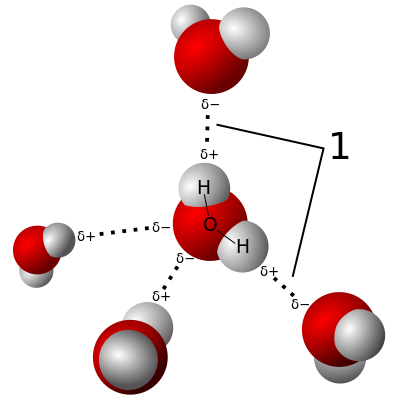
In any case we now roughly know the shape of the water molecule and its electrical characteristics. And we can begin to relate these to some of its physical properties. For example the fact that water molecules are not symmetrical means that one end of the molecule as a slight negative charge and one end (the side with the two hydrogen atoms) has a small positive charge. This accounts for water's electrical conductivity. It also means that water molecules exert a weak attraction on each other - known as a "hydrogen bond" (indicated by a Greek delta δ in the picture). The positive ends of water molecules are attracted to the negative ends of others. This accounts for the surface tension of water. Water is very cohesive. In fact compared to similar liquids (methane, ammonia, or hydrogen sulphide as liquids) then water has a very high boiling point - indeed the other substances mentioned are all gases at room temperate. Ammonia NH3 boils at -33°C and hydrogen sulphide H2S boils (becomes a gas) at -60°C! So H2S is very different indeed from H2O. In order to break the attraction between water molecules one has to use a great deal more energy than to break the attraction between hydrogen sulphide molecules which are more or less the same shape. This also means that weight for weight water can absorb a lot of heat, which makes it useful as a cooling fluid in a variety of settings. 

With the dawn of the 20th century mathematical models of atoms began to become more sophisticated and were able not only to explain the behaviour of atoms and molecules, but to make predictions. One of which was that a molecule like water would have many different ways it could vibrate: rolling, tumbling, spinning on its one symmetrical axis, stretching bonds symmetrically and asymmetrically, flexing the two bonds. And many others. And each of these modes of vibration was calculated to have a specific energy. It turns out that the energies of these modes of vibration fall in the infra-red/microwave part of the electro-magnetic spectrum. By shining infra-red light through water, and sweeping the frequency we can see what frequencies get absorbed, corresponding to making the water molecule wiggle, and refine the theory with observations. (See also Water Absorption Spectrum).


vibrational modes of the water molecule.
click image to see animation.
Spinning water molecules is also the explanation for how microwave ovens work. The microwave was patented in 1945 by Raytheon, though in fact it was discovered by mistake when a scientist working on radar melted his chocolate with his equipment. Apparently the first food to be deliberately cooked in a microwave oven was pop-corn. Water molecules spin around at ~ 2.4GHz (in the microwave part of the spectrum). Light at that frequency is absorbed by water molecules and translated into spinning, which manifests as heat (at the molecular level heat is equivalent to the speed of motion). Thus by shining microwave frequency "light" at 2.4 GHz on anything which contains water (like food) we can make it heat up.  

Bucky ball
The theory also explained in detail why certain molecules took certain shapes and why for example the fourfold symmetry of methane was a particular stable configuration. By comparing theory to observation for all of the elements we have developed a very sophisticated description of the chemical compounds we know about. But it also enables us to predict new chemical compounds and to understand how we might make them. Buckminster-fullerene, so-called "bucky-balls", a form of carbon molecule with 60 carbon atoms arranged in hollow sphere with a structure like the domes designed by Buckminster-Fuller (or like a football), were synthesised using this knowledge. This knowledge has also helped to explain the structure and function of complex molecules like cortisone, oestrogen and testosterone.

Quantum mechanics makes for an even more detailed description of molecule although with detail comes complexity. Some of the insights of quantum theory have helped in understanding the electrical behaviour of semiconductors and super-conductors. But to return to water.

The unusual ability of water to remain in the liquid state that make it the idea medium for life. Similarly the ability of water to dissolve a range of gases, minerals and many organic compounds (sugars, alcohols, amino-acids, etc) without changing them chemically, make it the ideal medium for mixing a huge range of different chemicals such as we see in living cells (compounds which number well into the tens of thousands).

This is only the briefest of surveys of what I remember from a few years of studying chemistry applied to a single, though important and interesting molecule. We now have detailed descriptions of all of the 96 naturally occurring elements, many of the artificially created elements, and millions of chemical compounds and reactions. These descriptions underpin most of the industrial processes that have made the developed world wealthy. If you're inside and you look around, the products of this knowledge will surround you: from the structural materials of your house, to the paints and other decorative elements. 

Vanillin.
Wikimedia
In my 3rd year organic chemistry class we had two major practical tasks. In the first term we were handed a vial of white powder and asked to find out what it was using any means available to us. Using chemical and spectroscopic (scanning the stuff with infra-red light) and nuclear-magnetic resonance methods I determined that my unidentified white powder was vanillin, one the the two main compounds responsible for the smell and taste of vanilla. It could not be another compound. The evidence was completely specific. The conclusion was not the product of a narrative or a worldview. If anyone else had accurately tested it, at any time and place, they would have also have found vanillin.

Coumarin
Wikimedia
The second task was to synthesise a compound called coumarin from basic laboratory reagents. Coumarin and its many related organic compounds are partly responsible for the smell of freshly grass (there are others). So the first sign of success in the synthesis - which requires a number of separate stages of chemical reaction - was the pervading smell of freshly cut grass. As it happens coumarin is also a white powder and I took my product home to make my room smell nice. The smell of freshly cut grass pales after a while. And I was able to specify in great detail, exactly how and why the recipe worked.

So when people scoff at science I find it very peculiar. When people say it's just one narrative amongst many or than there is no objectivity in science, or (worse) that everything we know from science is subject to change, I can't help thinking that only a really ignorant person could say something like this. I've personally used all of the techniques mentioned above, done the practical experiments and derived the empirical laws. But I'm not the only one. Many people have done just the same and got exactly the same results. It really does work, and it really doesn't matter what you believe about the nature of the universe. If you look, this is what you'll find, but even if you don't look this is still how thing are!
(See also Seriously, The Laws Underlying The Physics of Everyday Life Really Are Completely Understood). 
I don't think anyone who has not done chemistry, had the practical insights into chemistry, at this level or beyond, can really understand what it's like.

~~oOo~~


Here is another account of water with prettier pictures: water.

09 May 2014

Where and Why Did the Sarvāstivādins Go Wrong?

image: wisegeek
It's widely thought that both the Perfection of Wisdom texts and the writings of the Madhyamaka School attack the Realist position taken by the Sarvāstivāda School. The difficulty we have at 2000 years remove is understanding how any Buddhist could adopt a Realist position in the first place. Surely the Middle Way would have ruled this out?

However, as I showed in my essay about Action at a Temporal Distance, early Buddhists inherited a major problem: pratītyasamutpāda and karma as outlined in the early Buddhist texts are inconsistent with each other. I showed that Buddhist schools modified the doctrine of pratītyasamutpāda to preserve the doctrine of karma more or less as it was.  In the case of Sarvāstivāda, this solution required that dharmas be able to function as conditions -- tantamount to being real -- in all three times: present, future and past. But this was not the only influence pushing Sarvāstivādins towards Realism.

As with other early Buddhist schools, the Sarvāstivāda focus moved onto the Abhidharma project, with Abhidharma texts quickly attaining canonical status. Each of the surviving Abhidharma texts is distinct in it's content, if not in its overall project and methods. Thus Abhidharma is a product of sectarian Buddhist schools which often see each other as rivals. 

The key task of the Abhidharma is to identify dharmas, to catalogue and describe them and to explore the dynamic relationships between them. Colette Cox, one of the leading writers on the Sarvāstivāda, calls these two functions: evaluative and descriptive (2004). Ābhidharmikas evaluated dharmas for their contribution to liberation and used the descriptive analysis of dharmas to deconstruct perceived structures and realities (particularly the self). Cox notes that this analysis became increasing fine grained and abstract. This in turn created the conditions for treating dharmas as real entities (dravya). This essay will explore this second Realist influence on early Buddhism, again focussing on the Sarvastivāda as representative of Indian Buddhism.


Taxonomies

Collette Cox (2004) sets out the process by which Sarvāstivādins grew into the idea of dharmas as real entities (especially 558-565). Since one of the main functions of the Abhidharma was to create a taxonomy it had to take the approach that all taxonomy projects must: it had to create categories, and criteria by which any dharma might fit into any category. The Sarvāstivādins concentrated on a method called "inclusion" (saṃgraha) in which for each dharma, they outlined what categories it fit into. Each dharma might fit into multiple categories, but it either fit or did not. 

All taxonomic projects have to proceed in a particular way in order to create meaningful and useful categories. And one of the main features of such projects is well defined categories, "...invariable criteria are demanded as the basis of unambiguous classification" (Cox 59). Human beings think about the world using categories. Contemporary understanding of these categories shows them to be based on resemblance to a prototype that sits somewhere in the middle of the taxonomic hierarchy (Lakoff 1990). The edges of such categories are fuzzy and membership is by degrees.

Categories are an efficient way of dealing with large amounts of information and also to assessing the potential of a new entity or event by seeing it's similarity to familiar entities or events. And Lakoff argues that the categories we use are in part defined by how we interact with the members of the category - either physically or metaphorically (where the source domain for the metaphor is itself a physical interaction).

The categories used by Ābhidharmikas, by contrast, seem to have been hard edged and made up of simple, artificial binaries and trinaries. For example a dharma was either samskṛta or asamskṛta; either kuśala or akuśala; etc. A Buddhist needed to know kuśala from akuśala dharmas for the purposes of pursuing liberation (cf Cox's two functions above). Kuśala dharmas are to be cultivated and akuśala dharmas to be abandoned. Matrices (mātṛka) of binary and trinary categories are thought to have made up the earliest Abhidharma "texts". Lists were memorised by the mātṛkadhāra (the counter part of the sūtradhāra and vinayadhāra) and the whole structure of Abhidharma categories could be (re)constructed from such lists. The descriptive enterprise of deconstructing apparent entities, particularly the self, into constituent dharmas gave rise to an encyclopaedic attempt to list all possible dharmas and the possible relations between them. Categories multiplied until we get the lists of 85 dharmas in the Theravāda and 75 in the Sarvāstivāda Abhidharmas respectively.

Each school of early sectarian Buddhism took a slightly different approach to constructing categories, placing dharmas in them, and elaborating their relations. This suggests that the impetus itself is pre-sectarian and indeed we can see examples of Abhidharma style thinking in the early sūtras, as well as as a common core in early Abhidharma texts. However, the manifestations which survive as canonical texts and commentaries are a product of sectarian Buddhism.

A dharma fits into a particular category because it has a particular function or nature which is referred to as svabhāva. This term originally had no ontological implications. Initially svabhāva is simply what enables us to distinguish one dharma from another (Cox 561-2).


Dharmas

The early Buddhist worldview centred around the idea that experience is a flux of conditional processes, arising and passing away as our minds and sensory apparatus are impacted by objects, mental and physical. In this view a dharma was primarily the object of the mind sense (manas), though of course the word dharma is confusingly used in at least six main senses (see Dharma: Buddhist Terminology). But in relation to Buddhist thinking about experience, a dharma is a mental object. In this sense, perhaps, dharma comes closest to it etymological meaning of "support, foundation" - a dharma is the "objective" support process for a mental event to arise (i.e. for an experience to be conscious) when it interacts with the "subjective" perceiving processes. 


The first step on the road to seeing dharmas as real seems to have been the fixed categories into which they were put.
As such we know that dharmas were all impermanent, unsatisfactory and insubstantial. I've already outlined the Sarvāstivādin argument for the "existence" of dharmas in the part and future as well as the present. Arguably one could maintain this kind of view without insisting that dharmas are absolutely real. The first step on the road to seeing dharmas as real seems to have been the fixed categories into which they were put. Whereas in the early Buddhist worldview everything was process, the introduction of fixed categories introduced an artificial reference point into the picture. A dharma was a member of a category in an absolute sense (pāramārthika) and thus a dharma had an identity (ātmabhāva) which was not contingent (Cox 560). It was not inevitable that Buddhists would come to think of their categories as territory rather than map, but it was a slippery slope.

We suffer a similar problem today. For example physicists who study the regularity and similarity of experience can produce highly sophisticated mathematical models which describe the motion of bodies at difference scales and they may or may not be naive realists who believe they are describing reality (in fact most distinguish the map from the territory). But a few tiers down, those doing undergraduate physics are more likely to be unsophisticated about the distinction and to be naive realists. I know this from experience, for as one reproduces the results of, say, Isaac Newton and derives the laws of motion from first principles, the compelling conclusion is that one is describing reality (no one who has not done this can really understand how compelling it is). Once the information goes through the hands of science journalists and into the general public, most of the potential sophistication is lost. Most of us are naive realists with respect to experience, even when we intellectually espouse various philosophies about ontology, in practice we feel ourselves to be in contact with reality.


It is all too easy for human categories to start to seem natural.
Sectarian Buddhist intellectuals were still pre-scientific and produced a variety of speculative views about the world of experience with varying degrees of realism and idealism. In such a milieu the critique of views was simply a clash of opinions. It is all too easy for human categories to start to seem natural, that is to be an aspect of the world rather than something we impose on the world to help us make sense of it.

Think of categories like large and small. These are defined on the basis of prototypes of various kinds of item. When we mention, say, 'dog' each of us has a prototype image of what a representative dog looks like. From this we know that great-danes are large dogs, and chihuahuas are small dogs. We don't usually stop to wonder why, or even pause to apply the label for extreme cases like these. To us it just seems natural. And so, mostly like, the Ābhidharmikas began to think of their artificial categories as natural and therefore real. They begin to blur the distinction between map and territory because the map is an internal, almost a priori construct, that transparently structures the way we interpret experience. Thus began the reification of dharmas by Ābhidharmikas.


Putting Dharmas Into Categories

Colette Cox, with respect to the Sarvāstivāda, and Noa Ronkin, with respect to the Theravāda, both argue that ontological thinking is not obvious well into the Abhidharma project - into what Cox calls the mid-period texts. However dharmas were thought to fit into categories by virtue of their svabhāva - which early on means their 'particular nature'. It is the svabhāva of the dharma that gives it a particular quality and/or function and allows us to categorise it. At first it is simply that we are able to perceive certain regularities in our experience and thus to conceive of different kinds of dharmas. There is something particular about the the experiences that we learn to recognise and give a name to.


By fixing the definition of categories one almost cannot avoid fixing the members of the category.
The problem is that when the category is fixed and hard-edged, then the quality which qualifies any item for membership in that category can also come to seem fixed. Just as categories that move around and are not fixed don't make for very useful taxonomies, it is also practically unhelpful if the members of the categories are able to move around at random. By fixing the definition of categories one almost cannot avoid fixing the members of the category. And thus the meaning of the word svabhāva drifts from 'particular nature' towards 'intrinsic existence' and dharmas start to become real entities (dravya). 


Conclusion

It is the inherent dynamics of encyclopedic projects that, almost inevitably it seems, causes those who pursue such a project to first see their categories as real, and then to see the distinctions they make to fit objects into their categories as real, and in the Buddhist case to see the members of categories, i.e. dharmas, as real. despite the fact that the real/unreal distinction is specifically said to be unhelpful by early Buddhist texts. Be that as it may, the Abhidharma project has had a massive influence on Buddhism and leaves us with a legacy of ontological thought that frequently obscures the true intent of pratītyasamutpāda, i.e. explaining the arising and passing away of mental processes.

It may be that this is why the anti-Realist and anti-Idealist ideas epitomised in the Kaccānagotta Sutta feature in the first chapter of the Aṣṭasāhasrika Prajñāpāramitā Sūtra as well as in Nāgārjuna's Mūlamadhyamaka Kārikā. The early Prajñāpāramitā sūtras tackle Realism head on with an uncompromising anti-Realism. Where Sarvāstivādins proposed real dharmas, authors of the Prajñāpāramitā sūtras said "no dharmas". The seem to have meant "no real dharmas", but the polemic is phrased in apparently nihilistic terms, presumably for rhetorical purposes. No dharmas. No arising. No ceasing. No pure dharmas. No defiled dharmas. And so on. This approach is sampled and remixed in the Heart Sutra.

However we should not look down on the Sarvāstivādins. No other Buddhist school did much better. Theravāda ontology is scarcely more tenable. The predominant Mahāyāna solution to the problem of action at a temporal distance (the Yogacāra ālayavijñāna) involved the invention of metaphysical entities that only disguised the problem. While the Abhidharma was very intellectually productive, it was ultimately a dead end in terms of practice and soteriology.

This essay started by arguing that understanding the Sarvāstivāda was important for seeing Prajñāpāramitā in context. However it also highlights that we are not yet able to say how Prajñāpāramitā deals with the problem of Action at a Temporal Distance. The solution widely adopted by Mahāyāna schools is from the Yogacāra, but there were several centuries between the composition of the Prajñāpāramitā and Yogacāra texts. Nāgārjuna's proposed solution is to treat the everything as an illusion (!) which seems an even less successful answer than the pudgala. I hope in the near future to explore if and how the early Prajñāpāramitā dealt with Action at a Temporal Distance.

We've always known that Buddhism splintered into sects and that the sects had different doctrines. I hope that this trilogy of essays on the Sarvāstivāda has shed some light on how and why sectarian Buddhist developed in the way it did. The early Buddhists were struggling to make sense of the legacy of confusion in the early texts.

~~oOo~~


Bibliography

Cox, Collett. (2004) 'From Category to Ontology: The Changing Role of Dharma in Sarvāstivāda Abhidharma.' Journal of Indian Philosophy 32: 543-597.
Lakoff, George (1990). Women, Fire and Dangerous Things:  What Categories Reveal About the Mind. University of Chicago Press.
Ronkin, Noa. (2005) Early Buddhist Metaphysics. Routledge.

02 May 2014

Sarvāstivāda Approach to the Problem of Action at a Temporal Distance.

In recent weeks I've become a bit more involved in a distributed discussion about  the twin Buddhist doctrines of karma & rebirth. This has been in response to apologetics defending traditional articles of faith with respect to karma & rebirth.

Of course I have blogged about karma & rebirth (together and separately) quite often, mainly exploring the challenges that 400 years of empiricism raise for traditional belief. But one of the other topics I write about is the nature of religious belief and I have become increasingly aware that the discussion about karma & rebirth was in danger of becoming bogged down. It's all too easy to see the discussion as a contest between pejorative and polemical accounts of fideism and scientism. The two sides are already talking past each other. 

So I began to explore a new tack. I was aware that the Buddhist tradition itself had a history of modifying these doctrines and some explorations of this have appeared as essays on this blog (see e.g. How the Doctrine of Karma Changes). I'd also been exploring some of the metaphysical problems in early Buddhism. I realised that it might be fruitful to dive into the history of Buddhism and develop this a bit more. I wrote an essay for our Order journal which can be found on my static website: Some Problems With Believing in Rebirth. In that essay I briefly outlined eight problems that people who believe in karma & rebirth ought to have thought about and tried to resolve. These problems are not reasons to disbelieve in karma & rebirth, but they are quite serious problems most of which have historically troubled Buddhists and resulted in doctrinal innovations. 

In discussing karma & rebirth our frame of reference is usually quite narrow: for most of us circumscribed by what is available in our bookshops. As a result our discussion of the history of Buddhist karma & rebirth seems to me to be rather constrained. This essay will attempt to broaden it out a little. In addressing the problem of karma & rebirth I've tried to show that it is (at least) three sided:
1. Inconsistent Early Buddhist accounts.
2. Later Buddhist adaptations and innovations.
3. Knowledge from 400 years of empiricism.
Buddhists themselves found the earliest received versions of karma & rebirth unsatisfactory and changed them. Ignoring this aspect of Buddhism results in a lopsided discussion. The equivalent would be like discussing British history in terms of the Celts and the Industrial Revolution, but missing out the Romans, Saxons, Vikings and Normans. Importantly, the Pali suttas cannot solve the problems we encounter, because they (along with their counterparts in other scriptural languages) are the source of the problem as I will try to show.

cetanāhaṃ, bhikkhave, kammaṃ vadāmi


One of the key issues related to karma & rebirth that unsettled Buddhists is what I call the problem of Action at a Temporal Distance: the ability for short lived mental processes to have consequences spanning multiple lifetimes. This problem has two main aspects:
  1. Karma, according to the Buddha, is cetanā (AN 6.63) and cetanā is a short-lived mental event. 
  2. Pratītya-samutpāda requires that when the condition ceases the effect must also cease (imassa nirodhā idaṃ nirujjhati).
Thus, on face value karma cannot coexist with pratītya-samutpāda because it requires the possibility of an effect long after the cessation of the condition, usually with no effect in the intervening time - in other words the effect only arises long after the condition has ceased. Ancient Buddhists noticed this and the result was a raft of doctrinal innovations attempting to reconcile the two, usually by artificially prolonging the action of conditions long after they cease i.e. Buddhists adjusted pratītya-samutpāda to accommodate karma. Of the many responses, this essay will focus on the Sarvāstivāda. 

The Sarvāstivāda School has a far better claim to be representative of early Indian Buddhism than does the Theravāda School. It dominated the North Indian Buddhist scene for several centuries while the Theravada School was relatively isolated in Sri Lanka: having little influence and being little influenced. The Theravādin Kathāvatthu, which is an account of the Vibhajyavādin's dispute with the mainstream of Buddhism, does not engage with the arguments found below (Bronkhorst 1989).  There were of course other schools, but they all seem to have defined themselves at least to some extent in opposition to the Sarvāstivāda, or have subsequently been found to be part of the same movement (like the Sautrāntikas). We tend to ignore the Sarvāstivāda because of Mahāyāna polemics, and because their texts have yet to be translated into English. However, the Sarvāstivādins were very much alive to this problem and canny in their response to it.

With respect to the problem of Action at a Temporal Distance, Dundee philosopher David Bastow (1995) believes that he has discovered the earliest argument for the existence of dharmas in the past, future and present - the characteristic idea that gave the Sarvāstivāda School its name. The argument is found the Vijñānakāya, a Sarvāstivāda Abhidharma text dated to perhaps 200 BCE and available only in Chinese translation.

One Citta at a time


Consider a mental moment of greed, a "greed citta". It is axiomatic (for all Buddhist schools) that there can be only one citta at a time, though it may be accompanied by mental factors (cetāsika) such as attention, volition and so on (each citta and cetāsika being a "dharma"). This imposes a temporal sequence on experience. Cittas arise one after another in sequence, each lasting a fraction of a second.

imasmiṃ sati idaṃ hoti
imass' uppādā idaṃ uppajjati
imasmiṃ asati idaṃ na hoti
imassa nirodhā idaṃ nirujjhati


Knowing that what we are experiencing is "greed", is itself a citta. So the knowledge that a citta was greed can only follow after the fact of the greed. Knowledge follows from experience. If we know we have experienced a greed citta then that greed citta cannot be non-existent, since, imasmin sati, idam hoti. Sati is a present participle from √as 'to be' while hoti is a dialectical variant of bhavati from √bhū 'to be, to become'. The phrase says "while this exists; this exists" (the pronoun in both cases is the deictic idam which is conventionally translated as 'this' and indicates something present to the speaker).

sense object + sense organ + sense discrimination = contact


It is also axiomatic in Buddhist psychology that for vijñāna to arise there must be a sense object (ālambana) and sense faculty (indriya). Thus the greed citta must "exist" in some form (imasmin sati). We don't need to get bogged down in defining in what way it exists, only to acknowledge that like any sense object it functions as a condition for vijñāna to arise, so it cannot be non-existent. And since the greed citta must sequentially precede the knowledge citta, the greed citta must exist (in some way) in the past. The same is true of all cittas.

Furthermore, it is essential to both Buddhist ethics and karma that a greed citta has future consequences. The classic pratītya-samutpāda formula informs us that if the condition has ceased then the effect ceases. The corollary is that if there is a future effect, then a future condition must exist. Thus, in our example, the greed citta must exist (in some form) in the future or it could not have future consequences. In order for karma to work as advertised the citta must potentially continue to exist over several lifetimes. The same is true of all cittas.

Thus, dharmas exist in all three times: present, past, and future.


To summarise: a citta "exists" (in some form) in the present, but in order for us to have knowledge of it, the citta must also "exist" (in some form) in the past; and in order for it to have consequences at a later time it must "exist" (in some form) in the future. Minimally "exist" means that it must at least be able to function as a condition for the arising of mano-vijñāna (i.e. as a dharma); it must be consistent with the imasmin sati formula. Thus, cittas (i.e. dharmas) exist in all three times: present, past, and future. And this, according to the Vijñānakāya, is what sarva-asti means. 

This view, and developments of it, dominated the first phases of sectarian Buddhism in Indian from around the 2nd century BCE until it was replaced by the metaphysical speculations of the Yogacārins in about the 5th century CE. The sarva-asti view emerges from the application of standard Buddhist axioms to karma and, unlike the Yogacāra view, it does not introduce further speculation or further axioms. It is a plausible solution to the problem of Action at a Temporal Distance, certainly no less plausible than suggesting the existence of seeds in a storehouse. Thus, we should not dismiss the Sarvāstivāda view lightly. If we are going to dismiss it, then it ought not to be on the basis of further metaphysical speculation. More importantly, we ought to offer a better solution to the problem of Action at a Temporal Distance.

~~oOo~~


Bibliography
Bastow, David. (1995) 'The First Argument for Sarvāstivāda.' Asian Philosophy 5(2):109-125. Text online
Bronkhorst, Johannes. (1993) 'Kathāvatthu and Vijñānakāya'. Premier Colloque Étienne Lamotte. Bruxelles et Liège 24-27 septembre 1989). Université Catholique de Louvain: Institut Orientaliste Louvain-la-Neuve. 1993. Pp. 57-61)

Related Posts with Thumbnails