13 November 2015

Reflections on living things.

Caenorhabditis elegans
What would be involved in a complete understanding of a single animal? It would require a full study of its behaviour at all stages of its life cycle. We'd need a complete map of its genome and an understanding of all the proteins that the genes code for, as well as an understanding of the interrelationships of these genes (epigenetics) and which genes were active across the lifespan of the organism. Also a complete wiring diagram of its nervous system and a way of correlating all behaviour to brain activity. Amongst the most closely studied of all animals the tiny nematode worm, Caenorhabditis elegans is probably closest to this ideal.

C. elegans is an unsegmented, round-worm, transparent, about 1mm in length, which normally lives in soil. It is a relatively simple organism that has digestive and reproductive systems, but no circulatory or respiration system. Most individuals are described as "female hermaphrodites" (a female that also has male gonads and can self-inseminate) while a minority are males. We know the precise number of cells that make up the body: 959 cells in the adult hermaphrodite; 1031 in the adult male. There are also about 2000 germ cells in the former and 1000 in the latter (Alberts 2002). Reproduction is clearly important!
Body plan of C elegans. 

We have a complete genome for the worm (The C. elegans Sequencing Consortium 1998) and this information is open access. The worm has a total of 100,291,840 base pairs in its genome including some 19,735 protein-coding genes. That's about 100 million bits of information, a mere 12 megabytes, but these code for roughly 20,000 different proteins. The 2000-3000 cells are of a relatively limited number of types: nerve, muscle, gonad, skin, gut lining.

The development of all the cells in the animal's body over its lifespan has been traced in detail:
"C. elegans begins life as a single cell, the fertilized egg, which gives rise, through repeated cell divisions, to 558 cells that form a small worm inside the egg shell. After hatching, further divisions result in the growth and sexual maturation of the worm as it passes through four successive larval stages separated by molts. After the final molt to the adult stage, the hermaphrodite worm begins to produce its own eggs. The entire developmental sequence, from egg to egg, takes only about three days." (Alberts 2002)
A complete wiring diagram, or connectome, for the brain of C elegans, has been mapped out (White et al. 1986). The nervous system contains 302 neurons and 7000 synapses (including sensory and motor nerves).
C elegans connectome diagram (head to the right).
Scientific America
In 2008, Stephens et al. published an article that began to characterize the behaviour of the worm in response to a temperate gradient. And this showed that more complex behaviours are the result of combinations of simpler behaviours that can be described mathematically. The results of this paper were partial, partly because they only concerned two dimensions, and the authors flagged the need for more study and especially fully three-dimensional descriptions of movement. But this seems to be an important step in understanding how the simple mechanism can produce relative complex behaviour. In turn, this will eventually make it easier to link behaviour (i.e. movement) to brain activity.
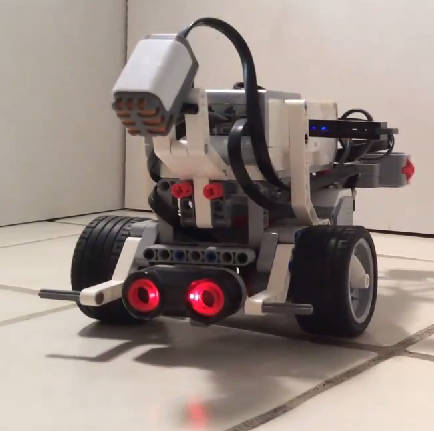
Another interesting experiment was an attempt to use the neural wiring diagram to control a lego robot (right) roughly modelled on the worm's body.
"It is claimed that the robot behaved in ways that are similar to observed C. elegans. Stimulation of the nose stopped forward motion. Touching the anterior and posterior touch sensors made the robot move forward and back accordingly. Stimulating the food sensor made the robot move forward." Black (2014)
There are some fairly obvious gaps. We need to know how to get from the genome to the adult animal. A genome is certainly interesting, but we need to know which genes are active, when in the life-cycle, and where in the body. This involves identifying all the proteins that protein-coding genes code for, and the interactions of controlling genes that switch other genes on and off (the epigenetics). We particular need to know how the expression of genes over time as proteins leads to the construction of the cells, organs, and body of the worm.

We know a good deal about the internal workings of animal cells but are nowhere near a full understanding or having the ability to make a living cell from scratch. Most of the research I've cited about is five or more years old. Progress is occurring all the time. Small gains, lead to bigger breakthroughs, that perhaps in time will accumulate and amount to a paradigm shift. If we do gain a full understanding of a complex living organism then C. elegans is a very likely candidate to be it. 


Comments

What's clear about this project is that we gain a huge amount of information through analysis, i.e. from breaking the worm down into its component parts. This many cells, of these types, arranged in this way. This many neurons connected by this many synapses. This many genes, encoding this many proteins. These kinds of internal cells structures and mechanisms. It's quite essential that we have all this information in our quest to understand the organism C. elegans. But once we have it, we need to understand how it is organised into and operates as systems. All of the parts have to fit together and operate together over time. There's no question that the genome and connectome were huge advances in our understanding of organisms. But we already see that this kind of static information represents first steps on the way to a much greater goal of understanding the dynamics of the parts functioning together as a system, and as systems within systems; or systems of systems; or networks of systems.

Understanding how the parts at the organism, cellular, and genetic levels, change over time emerges as a key goal. Life happens in time. It is particular patterns of change amongst the constituents and the whole over time that are key to our understanding that something is alive. We can use an analogy for this.

Imagine we stand at the top of the Tower of Pisa with a cannonball and a bird. We drop them at the same time. For perhaps half a second they both simply fall towards the ground (in reality, as they convert potential energy into kinetic energy, they follow a curved path through space that appears to us as acceleration towards the centre of the earth). The cannon ball continues to fall, it's path describing a parabolic curve until it hits the ground. We can describe the path it follows to ten decimal places. In Newtonian terms, it appears to accelerate at about 10 meters per second per second. Air resistance is minimal, but in a longer fall or a less aerodynamic object it becomes significant after a few seconds and the acceleration of gravity is equalled by the drag of the air so that a falling object reaches a maximum or terminal velocity. Since all non-agentive objects behave this way we usually gain an intuitive understanding of them quite early on. And at least by physical maturity, but often much earlier, we can accurately predict the path of a falling object by seeing a fragment of its path and use this to perform feats like catching balls that are thrown to us or dodging objects that might otherwise hit us. Next time you see a juggler, note that they do not look at their hands, i.e. where the ball lands, they look at the top of the arc of the ball which gives them all the information they need to catch it. This is possible because all simple objects behave similarly. All humans have always known this. We now have incredibly accurate models for the patterns and an understanding of why these patterns exist, which we call "physics". 

On the other hand, the bird behaves very differently from the canon ball. It may well fall for a very short time, but it soon stabilises its orientation to the ground, extends its wings to generate a counteracting force of lift, and begins to fly in a non-parabolic course, perhaps in a level, straight line away from the tower. It is this failure to fall that alerts us that a bird is not an object, it alerts us that the bird is not an object. The ability to move in ways that are not simply determined by the laws of motion is a defining characteristic of living things. We humans usually assume that anything which can do this has some kind of (human-like) agency for making decisions. For a creature with only 302 neurons, this projection is stretched to breaking point. For a single-celled organism, it is broken completely. Still deliberate movement in response to stimulus is characteristic of all living things.

Of course, as I previously described, there are non-living systems that defy prediction, such as a double pendulum (as I mentioned in my essay on freewill). Still, the movements of a double pendulum seem random, like raindrops falling or leaves shivering in the wind. There is nothing purposeful about them and they do not make us think that an agent might be present. 

The words organic and organism come from an Indo-European root *werg-  'to do'. Cognate words include work, erg, and orgy. In Latin, an organum is a tool or implement. In ancient Greece, orgia were religious perform-ances; just as in India karma ("work" from √kṛ 'to do') originally meant a ritual action.
The distinction between an object and an organism in terms of how they operate under the influence of gravity, one bound inexorably to it and the other free to work against it, is very similar to our intuitive understanding of the distinction between non-living and living things in general. Movement that is obviously bound by rules external to the object, or which appears random, is indicative of non-living systems. Of course, the physicist will say that all movement is bound by the laws of physics and that even the apparently random double-pendulum follows a lawful path. But by "rules" here we refer to the rules that can be intuited by an uneducated human being unconsciously observing their environment. In terms of Justin Barrett's psychology of belief, these are non-reflective beliefs in that they typically emerge unconsciously as a result of interacting with our environment (see also Why Are Karma and Rebirth [Still] Plausible [for Many People]?).

In George Lakoff's terms, the cannonball (a lump of iron) is probably close to most people's prototype of the category of non-living objects. The bird is certainly not in this category and is more like a prototypical living being. The bird is not bound by gravity, but can (by creating a counteracting lift force) defy gravity. Culture plays a part here. Pāḷi texts talk about the gods of rain (deve vassantecausing rain to fall, suggesting that the authors might have believed weather to be the result of agentive behaviour. English people also commonly treat the weather as the result of a mildly malevolent agent. Folk beliefs almost always allow for disembodied agents. Justin Barrett places such imagined agents in the category of "minimally counter-intuitive concepts": those that conflict with our intuitive beliefs, but only minimally, and in such a way as to be interesting and memorable.

These observations give us some insight into what we think of as a living organism versus a non-living object. The individual parts of the organism appear to conform to our non-reflective beliefs about non-living things. We take the parts not to be alive because we don't observe any violation of the non-reflective beliefs about how non-living things behave. Take any one of the 20,000 proteins from C. elegans and, for all intents and purposes, it is non-living. Organic but not of itself an organism. The parts together are capable of complex interactions that routinely violate our non-reflective beliefs about how objects behave; the parts alone are not capable of this. The basic difference between the cannon ball and the bird is in the complexity of their behaviour and the extent to which they conform to category prototypes of non-living objects and living beings.

Categories are imposed on nature by human beings (Lakoff 1990). This imposition is not arbitrary since our experience of interacting with the world is fundamental to the construction of categories. But the basic categories with which we think are based on non-reflective beliefs generated by experience and conditioning. All human beings have more or less the same sensory and motor equipment to interact with the world, but some cultures emphasise difference aspects and interpretations. In other words, the distinction living beings and non-living objects is a perceptual one that exists in our minds on the basis of non-reflective beliefs about previous experience. Indeed, many cultures have a distinction between living and non-living categories that is permeable: some non-living objects (e.g. mountains for example) are attributed with living qualities, and thus can be placed in the living category. Or take an animated cartoon, for example, which can elicit emotional responses appropriate to interacting with another person! Other cultures take living things, people, for example, and allow them to be in the non-living category (e.g. zombies, or strangers). People who live in cities very often treat the strangers around them as people-shaped objects. They are just obstructions to be navigated around, not beings to be interacted with. Unintentional interactions are often met with hostility ("watch where you're going, idiot!"). The distinctions still apply and what allows these exceptions to arise is that the features attributed to them are counter-intuitive in just the right way to make them interesting and memorable (cf. Barrett 2004).

Systems are capable of such complex behaviour that they confound our ability to distinguish living from non-living. They easily overwhelm our criteria for categorising in the same way that an animation does, by presenting us with motion that is too complex for our non-reflective, experientially derived rules for describing the behaviour of objects. Computers, for example, are not intelligent, but they are complex enough that sometimes they don't seem to fit the non-living category or to partially fit the living category. We begin to suspect an agent at work, especially as our desires are thwarted.


Life is complex. A problem with understanding life is that we don't see the underlying complexity because it is microscopic. That vast complexity could exist, at several scales deeper than what we see (cells, molecules, atoms, particles, quarks...) is counter-intuitive. That a gram of carbon might contain a number like 1023 atoms is inconceivable. For example, it is vastly more than the number of hairs on our heads (ca 100,000); or people in the world (ca 7 billion); or the seconds in the average lifespan of a human being (only about 2.5 x 10⁶); or the stars in our galaxy (ca 100 billion, though we can only see about 10,000 with the naked eye under ideal conditions) or even all these numbers added together. 1023  is more than all the stars in all the galaxies in the universe. For most of us cells, molecules, atoms etc are just something we have to take on faith. It is true, that their existence can be demonstrated, but we'll never know it from experience.

This animation (by David Bolinsky and team) gives a brilliant, but simplified, glimpse into cells from a particular point of view (response to inflammation). It is simplified mainly by making water molecules transparent - all that space you see is filled with water, salts, sugars, etc.


So life is complex but complex in ways that are non-experiential and more or less beyond imagination (the video shows a reality unlike anything ever imagined by a pre-modern society). The ordinary person bases their understanding of living things on their own non-reflective beliefs, derived from interactive experience and (cultural) imagination. Generalising from interactive experience is extremely unlikely to succeed in producing an accurate description of life except by unlikely accident. Nor does so-called "insight into reality" help us here. No account of insight, Buddhist or otherwise, ever gave us a hint that the body might be made of cells or anything like a Newtonian, let alone post-Newtonian, explanation of the world.

For example no one who insists that there is not a self or that the subject-object duality is an illusion is telling us anything at all about reality, the world, or living things. They are telling us (more) things about how generalising from our perceptions of these things results in erroneous conclusions. They explicitly want us to believe that they perceive the world not just differently, but more accurately, in a more satisfying matter. I would generously estimate that about 1% of 1% of religious practitioners gain access to this perspective (about 1 in 10,000). Not all of them are people I'd want to emulate. Some of them have some very peculiar ideas that can be traced to culturally specific theologies. A Vedantin and a Buddhist might well experience the same phenomena, say the cessation of specific aspects of selfhood, and yet each might tell us that it means different things. For one it is ātman, for the other it is anātman. So it is entirely apparent that even insight doesn't grant access to an absolute truth. If it did everyone that had that experience would express the same ideas about it, and we's have stopped arguing about it more than 2000 years ago. As yet scientists do not fully understand life either. We understand perhaps about 1%, but we currently understand life (as a process) better than any pre-modern culture ever did. No supernatural forces are required in this description. 

The arguments about features of living things, such as so-called "consciousness", suffer from exactly the same problems. Buddhists are working almost entirely from pre-modern models and generalising from individual experiential. They haven't a hope of understanding life, or consciousness, or any complex feature of life. Half the time Buddhists are just regurgitating some ancient ideology (something I trust less and less the more I find the ancients to have been confused or plain wrong in their thinking). But they may well come to some understanding of something, so what is that they do understand? It's this question that fascinates me, more than arguments over models and semantics. I only wish more Buddhists would deprecate the legacy jargon and ideology and just describe what they have experienced or at least the effect is has had on them in plain English. It would help us all to understand what is going on. 

~~oOo~~


Bibliography

Alberts B, Johnson A, Lewis J, et al. (2002) Molecular Biology of the Cell. 4th edition. New York: Garland Science; 2002. http://www.ncbi.nlm.nih.gov/books/NBK26861/

Barrett, Justin L. (2004) Why Would Anyone Believe in God? Altamira Press.

Black, Lucy (2014) A Worm's Mind In A Lego Body. I Programmer. Sunday, 16 November 2014. http://www.i-programmer.info/news/105-artificial-intelligence/7985-a-worms-mind-in-a-lego-body.html

The C. elegans Sequencing Consortium (1998) Genome sequence of the nematode C. elegans: a platform for investigating biology. Science 282: 2012–2018. http://dx.doi.org/10.1126/science.282.5396.2012

Hillier LW, Coulson A, Murray JI, Bao Z, Sulston JE, and Waterston RH. (2005) Genomics in C. elegans: So many genes, such a little worm. Genomes Research. 2005. 15: 1651-1660 doi: 10.1101/gr.3729105

Lakoff, George. (1990). Women, Fire and Dangerous Things:  What Categories Reveal About the Mind. University of Chicago Press.

Stephens GJ,  Johnson-Kerner B, Bialek W, Ryu WS. (2008) Dimensionality and Dynamics in the Behavior of C. elegans. Computational Biology. April 25, 2008DOI: 10.1371/journal.pcbi.1000028

White JG, Southgate E, Thomson JN, Brenner S (1986) The structure of the nervous system of the nematode Caenorhabditis elegans. Phil Trans R Soc B 314: 1–340 (1986). http://dx.doi.org/10.1098/rstb.1986.0056

06 November 2015

In Conversation about Karma and Rebirth

This post is to accompany an interview with me by Matthew O'Connell of the Imperfect Buddha Podcast. Most of what I said was first written in the web pages of this blog, so it shouldn't surprise anyone familiar with my writing, but it might interest readers, especially those who don't know me, to hear me in conversation. We covered a good deal of ground as one might imagine with such a large topic. My book on the subject currently stands at about 170,000 words over 500 pages. I'm editing it now, but can't say when it will be finished.

We talked a lot about my discovery that karma and rebirth can't work based on any of the traditional models. Matthew focussed particularly on my essay, There is No Life After Death, Sorry, which recapitulates Sean Carroll's arguments against any afterlife based on the equation he is now calling The Core Theory:

"It’s a good equation, representing the Feynman path-integral formulation of an amplitude for going from one field configuration to another one, in the effective field theory consisting of Einstein’s general theory of relativity plus the Standard Model of particle physics." (Now available as a tee-shirt in the USA).
What we need to understand about this equation is that at the mass, energy, and length scales relevant human experience, we can describe the behaviour of matter and energy very, very accurately. No extra force needs to be added to explain any observed behaviour of matter and energy on these scales. If there were other forces, of any kind, that could affect matter on this scale (and thus be part of our experience of the world), then we'd have seen some evidence of them in the millions of experiments carried out to date. If they cannot affect matter then they are of no interest as they cannot make a difference to us.

I also talked a little bit about how karma contradicts dependent arising, i.e. what I have called the problem of Action at a Temporal Distance, and how the several solutions to this problem do not stand up to scrutiny. These have been the subject of a number of recent essays that can be found under the heading Karma and Rebirth. In fact I've put a lot more more effort into this kind of argument than I have the science-based argument.


Karma and Rebirth Have Never Worked

Matthew, in an attempt to move the discussion along, begins to ask me, "So, if we get rid of karma and rebirth...". As you can hear, I interrupt at this point because something occurred to me that I had not thought of before. It's not that we "get rid" of anything. I don't advocate getting rid of karma and rebirth. At no stage in Buddhist history have we ever had a workable theory of either karma or rebirth. We cannot get rid of what we never had it to begin with. 

We never had a workable theory of karma. Our theories of karma always contradicted dependent arising. Even when Buddhist intellectuals tweaked dependent arising to come up with the Theravāda doctrine of momentariness or the bīja/ālayavijñāna theory of the Yogacārins (which currently dominate the Buddhist intellectual landscape), what I've shown is that even these more sophisticated versions of the karma doctrine do not work as explanations (See The Logic of Karma). Other explanations such as the sarva-asti-vāda or the pudgala-vāda, which were popular in North India for a time, did not work either though they were ingenious alternatives to the explanations that by accident of history are familiar to us today. The ingenuity doesn't become apparent until one realises what they were grappling with, i.e. action at a temporal distance. It is such a huge problem, and yet the Buddhist world suffered a collective case of amnesia about it. Once it was the driving force in the development of the most influential schools of Buddhist thought, with at least two schools taking their name from their solution to the problem. Without understanding the problem many of the major developments in Buddhist thought don't make any sense.

We never had a workable theory of rebirth either. Rebirth either destroyed the connection between action and consequence, thereby destroying the possibility of morality; or it proposed a definite and substantial continuity which allows for morality, but is eternalistic. If the person who experiences the consequences is not me, then I won't care (as much) about the consequences. If it is me, then I seem to be altogether too substantial in an impermanent universe. Early commentators and systematisers tried to get around this by arguing that it is neither me or not me (e.g. Milindapañha), but this simply fails to meet any reasonable criteria for a workable morality (See Unresolvable Plurality in Buddhist Metaphysics?). As far as morality is concerned, it has to be me. But according to Buddhist metaphysics, it certainly cannot be me. The result is an intellectual stalemate. Not that Buddhists ever admit this. No, they seamlessly segue between non-continuity when talking about metaphysics, and continuity when talking about ethics without anyone ever noticing what they are doing. I listened to and read Buddhists doing this for about 20 years before I realised that they were doing it. We can charitably chalk this up to pragmatism, but it does mean that dependent arising cannot explain rebirth or morality.

Dependent arising, the explanation for how mental states arise, cannot explain karma, rebirth, or ethics. This is already clear from Buddhist śāstras composed in the period ca 200-400 CE. Nāgārjuna says as much in his second-century work the Mūlamadhyamakakārikā (Chapter 17.1-6). Unfortunately for Nāgārjuna, his radical alternative of treating the whole shebang as like an illusion never caught on in the mainstream. I think his solution, while metaphysically more tenable, pragmatically could not be used as the basis of a system of morality. It required that awful Buddhist fudge: the Two Truths. The Two truths formalises the me/not-me hedge and makes it a feature rather than a bug. But any Buddhist theory couched in terms of existence or non-existence, let alone any absolutes, is faulty.

Modern science also shows us that dependent arising is not a good explanation of how matter and energy work either. I play down the role of science in critiquing karma and rebirth because in my experience Buddhists simply dismiss any inconvenient science as "Materialism" and stop paying attention. Such critiques are often seen as attacks on Buddhism itself, which Buddhists take rather personally. But the critique is there, it's quite comprehensive and compelling. The main problem for Buddhists who wish to deny it, is that they end up having to re-write the laws of physics. And I have yet to see any Buddhist even try to do this.

Sometimes, even within the same anti-science context, science can be seen as the saviour of Buddhism. Buddhists do this in two main ways. The first is through drawing false analogies, usually between Buddhism and quantum mechanics. I've dealt with this problem at some length before in two essays that try to debunk the kinds of claims that Buddhists make (see under Quantum Mechanics).

The second way is looking for confirmation of our beliefs in the empirical results of studies of the brain and behaviour under the influence of Buddhist practices. As far as I can tell this research is certainly worth pursuing. But the field is rife with confirmation bias and needs to find some rigour. We need to pay attention to study design (especially sample size), start doing pre-registration of studies, and publication of negative results before we can get too excited. The buzz word in this kind of work is reproducibility. We are not there yet. And even if we were the evidence is for a fairly mundane form of efficacy. Meditation causes measurable changes in the brain that probably affect how we perceive ourselves, other people, and the world in general. It has nothing to say about karma, or rebirth. 


Modernists Responses to the Crisis in Buddhist Doctrine

One of the ways that Buddhist Modernists negate some of the criticism of traditional Buddhism is to read inconvenient aspects of Buddhism as allegorical. They argue that we have to understand rebirth as an allegory, a symbol of some psychological process that plays out in our lives. A fine example of this is an essay by Alan Peto I stumbled on recently. In Is Buddhism Bewitched With Superstition? Peto puts forward exactly this kind of argument about superstition. However, in reading his argument I realised that while his central values were modernist, he none-the-less was endeavouring to justify his Modernist readings in traditional Buddhist terms.

There was the inevitable reference to the Pāḷi Canon, for example, in which the character of the Buddha is portrayed as reprimanding his followers for being superstitious (the word used is actually maṅgalika, but superstitious is not too bad a translation). This is read literally, rather than allegorically, as The Buddha telling his followers to abandon superstition. "Basically, the Buddha is saying that we should not fall into the trap of superstition, but instead pursue and gain wisdom." So if it fits our preconceptions, read it literally; if it does not, then take it as allegory.

Because there is a canonical injunction against it, the argument goes, there is no superstition in Buddhism, or at least in true Buddhism. In fact an injunction against something is evidence for the opposite, i.e. that it was widely practised. This leads us to the realisation that, in practice, Buddhists are really a very superstitious bunch. But how did pristine, rational Buddhism become infected with irrational elements? According to Peto, it is the creeping influence of "beliefs and traditions of society". Unfortunately there is simply no evidence for an originally rational Buddhism. That entity is a fiction of the modern imagination. As far as we know, Buddhism was never rational, did not decline over time. Indeed the opposite is evidence, major efforts went into making Buddhism more rational over time. Repeated attempts were made to solve the problems apparent in early formulations of Buddhism.

In another essay on rebirth, Peto tells us:
"While karma is referred to in popular culture as some sort of supernatural force (almost godlike) that determines your “fate”, but it is nothing like that at all."
Which is simply not true. Karma is the supernatural force that links willed actions and their consequences over time. It is supernatural because it cannot be accounted for by natural forces. In this case however, pre-modern Buddhists did see karma as a natural force. But mind you so were the miracles associated with the birth of the Buddha. So were the various spirits (benign and demonic) which abound in the pages of the Canon. Peto actually doesn't tell us what karma is, if it is not a supernatural force, but he hints that it is like "cause and effect" (which is not the traditional Buddhist view, but one clearly influenced by modernism). This particular allegory works because cause and effect is something that everyone intuitively understands and non-reflectively believes. Our understanding of cause and effect grows out of our experience of gaining control of our limbs as infants and learning how to use them to manipulate objects in the world. But karma is in fact nothing like this. Karma not only defies our modern understanding of cause and effect by separating the two ends of the relationship in time and space, but defies the traditional understanding for the same reasons! The consequence of the action is stored up until the end of your life, and then it manifests as the arising of vijñāna in another, embryonic, being either in the moment after death or after some time in a kind of limbo.

How this is achieved is unclear. For example, according to most schools of thought, the skandhas are definitely not transferred. So it is not personality, intelligence or experience, that are transferred, nor strictly speaking could it include memories (which are covered by the skandhas). And yet somehow the results of our actions are visited upon that embryo as it lives and dies. 

The approach falls well short of coherence. Modernism is applied unconsciously and inconsistently to patch the inconsistent tradition with inconsistent results. This is perhaps the biggest problem of Modernist Buddhism, i.e. the failure to fully embrace Modernism and apply it consistently.


Comments

Does the fact that so far no model of Karma and Rebirth works mean that there is no model that can possibly work? Probably. We've had 2000 years to think about it. The brightest minds of Buddhist history thought about it. And got nowhere. Now we are in a worse situation, because we must also consider science. Physics shows that there are strict limits on how matter and energy can behave and that these limits appear to be universal. At the mass, energy, and length scales relevant to human experience, this means that no afterlife is possible. So rebirth is ruled out, except as allegory and I side with those who find allegory distasteful. Of course it is always possible that someone will turn up with reliable evidence that the Core Theory is wrong. But anecdote is certainly not going to cut it as evidence in that argument. And any new evidence that would allow for an afterlife would require a whole new understanding of physics and chemistry. Again, this is possible, but nothing like this is on offer at present. What's on offer is philosophical (i.e. ontological) dualism, which states as an axiom that the mind is not to be understood through studying matter and energy. But dualism is also ruled out by the Core Theory. If the other stuff could affect our body and, in particular, our brain then it would be obvious to detectors other than the brain - there are only so many ways to influence matter;. Matter itself shows no signs of being nudged by forces other than the four so far identified (of which we can observe two unaided by machinery: gravity and electromagnetism). 

Many people get to this point in the discussion and the same question arises as Matthew asked me: "Now what?". I didn't answer that question very well in the interview I thought, so this is my attempt to do better.

So, "Now what?"

Now we need to take stock. It is only fair that we allow time to consolidate our arguments and for people to catch up if they wish. When you undermine someone's worldview to the point of collapse, a good deal of what they value suddenly must be reassessed. This is not easy and must take time. Many people will be so strongly committed to the traditionalist view are not interested in a major reassessment of their life and work, especially not on my say so. I expect virtually all people who've made life-long vows of celibacy, or those who make their living from traditionalist Buddhism, will be in this camp.

I think we have to take the psychology of belief seriously and not expect everyone to drop everything just because we have better facts. My case study for this has been the problem of communicating evolution, which in many respects has been disastrous. According to some surveys, only about half of Britons believe in evolution. Less Americans. Buddhists who agree with me about karma and rebirth ought to take evolution as a cautionary tale. We can easily screw this up, by failing to express enough kindness towards the people whose views we disagree with. My role in this is to establish new facts. I'm not a diplomat or a politician.

The problems we face are not yet well enough understood. My work, for example, only scratches the surface and my ability to persuade people is quite limited. People who are smarter and/or better connected need to be exposed to my conclusions and to test the logic of my argument. My book on this material might help with that, but I ought also to write something more pithy for an academic journal and see if I can get it through the editorial and review processes. At the very least I'd like to write something about the Problem of Action at a Temporal Distance for a journal. Other's need to take my ideas and see if they stand up to scrutiny. Not just in the sense of accusing me of Materialism (believe me this happens all too often), but by looking again at my primary sources, at the Kathavatthu, the Abhidharmakośabhāṣya, and the Mūlamadhyamakakārikā (which ideally involves being able to read Pāḷi, Chinese and Sanskrit; though all three are translated into English); and at my secondary sources (particularly David Bastow and Collett Cox). Someone needs to assess how well or how badly I've understood the sources, and either way to develop the ideas I'm proposing here. But the reality is that this is extremely unlikely to happen. That dynamic is almost entirely lacking in Buddhist scholarship even when the idea is put forward by a well know scholar with qualifications and a teaching post in a university. Most scholars are too busy pursuing their own avenues of research to spend time criticising the work of others. 80% of social science journal articles are never cited at all, so the problem goes beyond Buddhist Studies. Though I may say that David Drewes is a positive example of someone who does engage in this way. 

Interviews like the one for Imperfect Buddha Podcast are valuable in the sense that a friendly discussion of challenging material is possible, and the discussion reaches a new audience. Most of the time I don't go around trying to upset people, so I tend to pull my punches when talking to them if I think they are unlikely to agree with me. I have only one or two friends with whom I can be completely unguarded about what I say on these subjects. Some people I know have quite strong views themselves, often developed over decades. I tend not to insist on my own conclusions at the expense of another's. Something about the dynamic of the interview allowed me to state my conclusions without hedging. To put it out there in a more public way. And that felt good. Maybe there will be some response from IBP's audience that I could never get from my blog. Matthew says his own beliefs might have shifted as a result of talking to me. That's more than I could have hoped for.

Once the ideas have been more rigorously tested and refined, and once a lot more people with a stake in the game are on board, then would be the time to start exploring what to do next. I'd prefer to see us coming up with something cooperatively, than for Buddhists to continue atomising. If we get dozens or hundreds of competing models then it will take a very long time to sort out which is best. In my mind what Buddhism lacks is something like Sean Carroll's Core Theory. With a modern Buddhist Core Theory we could explain how our practices work to bring about positive change. The way that mental states arise and pass away will most likely be at the heart of our Core Theory. This is also extremely unlikely. 

The likelihood is that in 50 years time I'll be long dead and all this will be forgotten. And I will have changed nothing. Life is absurd, eh?  

~~oOo~~

My thanks to Matthew and Stuart of the Imperfect Buddha Podcast for their interest and the opportunity to talk to them and their audience about my ideas. 

30 October 2015

What is Buddhism? Who is a Buddhist?

A Triratna Buddhist Order
ordination ceremony,
Nagpur, India, 2008. 
A few months after getting involved with the Auckland Buddhist Centre in 1994, I happen to mention to an American work colleague that I was planning to go on a retreat. The chap conformed to many American stereotypes. He was the sort of guy who would repeatedly say, "I might be stupid, but I am ugly", and no one would laugh. On learning that I was planning to go on a Buddhist retreat, he enthused: "Oh I used to be a Boodist, I had my own scroll and everything". And at the time I had no idea what he was talking about. Later on, I learned that there are sects of Buddhism in which the chanting of sections of the Lotus Sutra (from a specially made scroll) is the main religious exercise they practice.

In the mean time I went on the retreat and found it very challenging, but also enjoyed aspects of it, particular the friendliness of the Buddhists. I began to read all of Sangharakshita's books. In his A Survey of Buddhism, written in 1954 while he was still living in India, he wrote that he thought that the Bodhisatva Ideal was the unifying factor of Buddhism. He subsequently changed his mind about this. In The History of My Going for Refuge (1988), Sangharakshita outlines why he thinks that going for refuge to the Three Jewels is the unifying factor of Buddhism:
"As the years went by I increasingly found that the more I related Buddhism to the spiritual life of the individual Buddhist the more I saw it in its deeper interconnections within itself, and the more I saw it in its deeper interconnections within itself the more I saw it not as a collection of miscellaneous parts but as an organic whole. This was nowhere more apparent than in the case of Going for Refuge, which I eventually came to see as the central and definitive Act of the Buddhist life and as the unifying principle, therefore, of Buddhism itself."
All Buddhists go for refuge to the Buddha, Dharma and Saṅgha, if not explicitly then usually implicitly. If going for refuge is the unifying factor then what makes someone a Buddhists is not a belief or set of beliefs, but an action. And in this view, the Bodhisatva Idea is the altruistic dimension of going for refuge. It was this idea that underlay moving away from more traditional styles of ordination or initiation, and the adoption of the Dharmacārin ordination for members of the Triratna Buddhist Order ca. 1980.

This problem of who is a Buddhist and what is Buddhism is one that is something of a hot topic in these days of scepticism about religion. Traditionalists have opinions on this based on classical accounts of ordained and lay members of the Sangha. They tend to focus on beliefs as the basis for creating a dividing line. They see rejecting traditional superstition and supernatural beliefs as placing one outside the Sangha. For example, if one does not believe in karma and rebirth, then one is not a Buddhist. I have seen this kind of opinion from Theravādins, Tibetan Buddhists and from some of my own colleagues.

Other critiques emerge. For some years now blogger, David Chapman has been critiquing what he calls "Consensus Buddhism". Most recently he has pointed out that Buddhist ethics and liberal Secular Humanist values have converged. For his purposes, he characterises this as a simple, though tacit (and perhaps unconscious) adoption of liberal values by Buddhists. This allows him to argue that the ethics of Consensus Buddhism are not Buddhist. The polemic prepares the ground for his own alternative approach to ethics based on the writings of American developmental psychologist, Robert Kegan (Chapman's into here, see also Kegan's Awesome Theory Of Social Maturity). If we are going to coopt a set of values, he argues, then let it be a more rational and well thought out set. 

Scholar/practitioner Justin Whitaker also recently blogged on this subject and an interesting discussion ensued in the comments section between myself and philosopher Amod Lele. In discussing this problem of who is a Buddhist I realised something. If you were to introduce me to a person and they said "I am a Buddhist" what would that tell me about them? I realised that I would know nothing at all about them for certain. I would not know what they believed, or what religious exercises they performed.

Our mystery guest might be a Theravādin lay person from rural Sri Lanka. Their beliefs will be a mix of classical Theravāda and local folk traditions. They believe in the existence and power of local spirits and the necessity of cultivating merit for a good rebirth. In term of religious exercises, these are probably related mainly to propitiating local spirits and supporting monks.

Or they might be a Japan Zen priest who inherited control of the temple from their father and whose beliefs are also a somewhat eclectic mix. Like the Sri Lankan, they probably believe in and propitiate local deities drawn from the Shinto side of Japanese culture. The notion that we live in a degenerate age during which bodhi is not possible might be part of their belief system. They believe in karma and rebirth, and possible have a dash of Pureland Buddhism in the mix. Their religious exercises might range from chanting sutras in mangled Sanskrit, or more likely in Chinese or Japanese translation, and long periods of seated zazen. Or they might contemplate a koan and then have to answer the questions of their master. They also perform rituals.

Or they might be a sophisticated WEIRD urbanite, who doubts karma and rebirth, does not believe in spirits or any of that superstitious nonsense. Or a Pureland Buddhist who believes, on the basis of a promise made in a text, that after death Amitābha will appear to them and guide them to another universe in which the religious exercises of Buddhism are really easy and nothing will get in the way of bodhi. Or a Tibetan monk who believes that everything that happens is a result of karma and practices "secret" tantric techniques to transform themselves into a Buddha (or to transform their minds so that they see themselves as the Buddha they already are). They might believe in an ultimate reality. Or in the ultimate un-reality of all things. They might pursue austerity or believe austerity to be pointless. They might believe that we all have to make an effort, or they might believe that no individual effort will make any difference. They might emphasise the "historical Buddha" or de-emphasise the Buddha in favour of a deity of some sort.

If you search on google for images related to "buddhist" the results are dominated by monks in robes. But most Buddhists are not monks. Most of not ordained at all. Monks are probably only about 1% of the Buddhist demographic. Why, then, do monks dominate the popular imagination of Buddhism?

Very often I find I don't even share a basic vocabulary with another Buddhist. They may discuss the Dharma in the convoluted jargon of a Tibetan scholastic, or be blissfully unaware of any technical terms and subscribe to a just chant and be happy kind of approach. Sometimes it doesn't matter what I say because the other is a fan of non-dualist bullshit and simply negates everything I say and a conversation with them on the basis of our individual commitments to Buddhism turns out to be impossible.

The simple declaration "I am a Buddhist" gives me a probability of guessing what someone believes and how that manifests in their life of no better than chance. A statement that conveys no information is meaningless. In the case of the profession of "Buddhism", it might once have been meaningful, and within particular contexts may still be meaningful, but in general, the information is swamped by the noise of the huge variety of possible meanings of the words. I'm not even sure I remain convinced that Sangharakshita is correct to say that going for refuge is a unifying factor in Buddhism. The problem is that while going for refuge is an action, the reasoning and motivation for doing the action are so varied that the shared label may well be just as meaningless.

There is no gold standard for what makes a Buddhist. 

Who is a Buddhist when the statement "I am a Buddhist" appears to have no natural limits or boundaries; when they are dozens of mutually incompatible definitions of what "I am a Buddhist" connotes?

On the other hand, someone may argue that when they meet Buddhists they always find something in common. I would put this down as confirmation bias. As described by Mercier & Sperber's classic article (see my summary) confirmation bias applies when we hold a belief and go looking for reasons to support it. The purpose of this is to make a strong argument for our belief. Reasoning (i.e. thinking without confirmation bias) only works when we are arguing against someone else's proposition, and even then only when we are not too polarised (which leads to implacable opposition) and not too motivated to agree (which leads to groupthink). In this view, confirmation bias is a feature of group centred reasoning where each participant tries to put forward the best argument they can and the others look for and point out weaknesses.

If we go looking for confirmation of our view, we tend to find it. We tend to be uncritical of such confirming evidence, and having found any confirmation we stop looking. Without the argumentative dimension to trigger critical thinking about the ideas of others, humans tend not to use reasoning at all. Other processes, like confirmation bias, dominate cognition and lead us to weak conclusions. The success rate in solo reasoning tasks that lack an argumentative context can be as low as 10% (i.e. considerable worse that random guessing).

So the act of looking for and finding confirmation of our belief is a very poor basis for decision making. It's a very poor way to decide who is a Buddhist and who isn't. One of the problems we have in Buddhism is that scholars of Buddhism often seem to have an emic (or insider's) view of the subject. Confirmation bias afflicts a good deal of scholarship of Buddhism as well, especially with the advent of scholar-monks, so a tradition of critical scholarship of Buddhist ideas has yet to develop. When scholars study Buddhism they seem to go looking for certain features, such as a tendency to convergence and unity in the past (see also Evolution: Trees and Braids and Extending the River Metaphor for Evolution). Or they focus on describing Buddhism as it was, without applying modern critiques.

As I was writing this essay, an email about a new book from Wisdom Publications arrived. One of the blurbs begins:
"The [Dalai Lama] examines the meaning of key texts from the gospels, and finds similarities in Christian and Buddhist teachings, as well as correspondences between the lives of Jesus and Buddha."
If you go looking for similarities, you find them. This is not profound, it is simply a result of a failure to reason, probably caused by lack of effective opposition. One fawning and sycophantic review is included: "The whole book is a joy, an inspiration and truly deeply devout, while at all times light and pleasant, a perfect channel to convey profound realities and insights." Frankly this makes me want to puke. Unless you are very lucky, you find what you are looking for. I count myself moderately lucky to have discovered some problems in Buddhist doctrine, enough to rouse me from the stupid paralysis of the mind that seems so prevalent amongst Buddhists.

In order to address this problem using reason, we need to argue about what we believe with people who disagree with our view while having a shared commitment to discovering the truth. We need to test opposing views and see which stands up the best. But in religious contexts views are held strongly, i.e. associated with strong emotions, and polarisation or groupthink are almost the defaults. In these circumstances, we cannot expect people to reason effectively. They will either be anxious to disagree or to agree and this defeats reasoning.

With this in mind, my answer to the problem is that it seems that anyone who calls themselves a Buddhist, is a Buddhist. But most people find this an unappealing prospect. Certainly Amod Lele didn't seem to like this prospect (we seem to agree on very little). On the other hand, Justin Whitaker seems to be annoyed by those who disagree with him on where to draw the line between Buddhist and non-Buddhist when it involves excluding some people.

I think this is because when each of us says "I am a Buddhist" we have a frame of reference in our minds. In terms of George Lakoff's theory of categorization (see his book Women, Fire, and Dangerous Things) we all have a prototype in mind when we hear the word "Buddhist" and when we come across examples of "Buddhist", we unconsciously compare it to our personal prototype and weigh up how similar it is. If the qualities of the example overlap sufficiently with our prototype then we can accept that the person is a Buddhist. I say, "personal prototype" as a rhetorical device because prototypes will vary from individual to individual, but in fact what constitutes the prototype of a category for any individual is largely determined by culture and experience.

The problem of who controls and arbitrates the categories of "Buddhism" and "Buddhist" is complicated by the imperialist tendencies of the WEIRD world. All to often we first impose our values on the discussion as a starting condition and then insist that the conclusions must conform to those values. It's quite clear that WEIRD values are modernist values that have very little to do with traditional Buddhist values except by accident. We tend to see our own values as universal values against which anything can be weighed. The fact is that this is another logical fallacy that leads to poor reasoning and weak decisions.

We want our heartfelt declaration to mean something to other people. We want "I am a Buddhism" to mean something to others. We want them to see us as special. We want the religious affiliation to say something about us. But we have no way of knowing what it communicates to anyone else. As often as not "Buddha" seems to bring to mind the Chinese folk hero Hotei who is erroneously called the "Laughing Buddha" - fat,  jolly, and trivial. 

There are some people who say that I (Jayarava) am not a Buddhist because I do not believe what they believe. They are entitled to that opinion and even to exclude me from their Buddhist activities on that basis. It usually doesn't bother me too much when someone says this because the belief system they profess usually seems pretty stupid to me and I think I've got the better end of the deal if they won't talk to me.

The fact is that we like to sit in judgement. "Stephen Batchelor is a Buddhist" or "Stephen Batchelor is not a Buddhist". My response is to wonder first why I should care about some random stranger's opinion on Stephen Batchelor. I can't see how either statement affects me. But then it matters for some Buddhists because they only have regard for the opinions of other Buddhists. A non-Buddhist cannot be expected to have anything interesting to say, especially on the subject of Buddhism! So delineating the category is important for people who think that way.

If I'm being thoughtful, I might wonder how they came to that decision because religious beliefs and decision making are subjects that interest me in the abstract. The actual decision is entirely irrelevant to my life and work, but there is an interesting process going on of someone defining their world through the decisions that they come to, that does interest me. It interests me because that's what we all do, but it's very difficult to study oneself doing it because so much of one's cognition happens unconsciously.

So these kinds of questions are really only interesting to me for the light they shed on the psychology of belief. I define "Buddhism" and "Buddhist" pragmatically. I suppose to some extent, I say that I am a Buddhist to reassure my colleagues and friends in the Triratna Buddhist Order, the religious community that I am a member of. As much as anything I am expressing my continued desire the belong to this community (See also Why I am (still) a Buddhist from 2012). In saying that I myself am a Buddhist, I no longer expect that to be meaningful to others, except to the extent that they will identify me with their existing prototype. I still largely share a prototype with other members of the Triratna Buddhist Order, but I expect that my prototype is very different to other Buddhists. Quite often as I express my views on traditional Buddhism, the result is so far from another person's prototype of a Buddhist that I seem outside the category to them. They experience cognitive dissonance. Which is fine. Buddhism is so varied that we'll probably always have this problem. About the best I can hope for is that my being a Buddhist might be the beginning of a conversation.

My understanding of what it means to be a Buddhist has been shaped in recent years by studying Buddhist doctrines and discovering the widespread systematic faults in them. And that study is a work in progress. I can see how doctrines fail to do what they were intended to do, but I cannot yet see the end result of spelling out just how bad Buddhist philosophy generally is. Right now I think we are all in the flames of transformation, and we cannot imagine how we will emerge from the conflagration.

~~oOo~~
Related Posts with Thumbnails