15 January 2016

Translating Pāḷi "Asuññataṃ"

Sāvatthī
(looking east)
My Pāḷi reading group is starting off this year by looking at the Cūḷasuññatasutta (MN 121). There's quite a lot of commentary on this text, a number of translations and commentaries, but even before we began to read the text we discovered a quandary in the word asuññataṃ, which only occurs in this sutta. Ñāṇamoli and Bodhi (2001) translate the word as "non-voidness" but I don't think this makes sense.

As analogues of the Sanskrit adjective śūnya (empty) and the abstract noun from it śūnyatā (emptiness), we find the Pāḷi suñña and suññatā. However in addition, and in the title of the text no less, we find another Pāḷi form suññato or suññataṃ, which is not found in Sanskrit dictionaries, though some counterparts are found in Sanskrit Buddhist texts. This form is often glossed over in translations as "emptiness", presumably because it is so similar to the abstract noun that the translators don't notice the difference.

I begin writing this, it is not at all clear to me how asuññataṃ derives and how to translate it. In this essay I will survey the uses of the term suññato and try to establish how it ought to be translated in order to shed light on the word asuññataṃ. My sources are the Pāḷi Nikāyas and Aṭṭhakathās (or commentaries), the counterparts of the Cūḷasuññata preserved in Chinese《小空經》(MĀ 190) and Tibetan མདོ་ཆེན་པོ་སྟོང་པ་ཉིད་ཅེས་བྱ་བ། (D.291), plus a few Sanskrit fragments.  


The Cūḷasuññatasutta

The passage that alerted us to this problem comes early on in the text. In Pāli it goes:
Seyyathāpi, ānanda, ayaṃ migāramāt-upāsādo suñño hatthigavassa-vaḷavena, suñño jātarūpa-rajatena, suñño itthipurisa-sannipātena atthi c'ev'idaṃ asuññataṃ yadidaṃ – bhikkhusaṅghaṃ paṭicca ekattaṃ
Before attempting to translate this, let me break procedure by giving the gist of what it says. This is the first part of an analogy designed to illustrate a procedure for gradually emptying the mind of sense impressions and thoughts with the goal of attaining the suññatāsamādhi "integration of emptiness" or suññatāvihāra "abode of emptiness". These seem to be equivalent to saññāvedayitanirodhasamāpatti or "the attainment of the cessation of perceptions and sensations" and thus also with nibbāna. This very important and interesting state I describe as "consciousness without content". One is alive and aware, but there is no content to one's experience. The ancients had no concept of a resting state network in the brain, so they struggled to make sense of this state. I imagine, for example, that something similar gave rise to the Vedic idea that Brahman could described as saccidānanda or being (sat), consciousness (cit) and bliss (ānanda). Dwelling in the state of emptiness one experiences only being, consciousness and bliss. Those who write about this state tend to assert that it does get any better than this. 

In this illustration of the process, the Buddha and Ānanda are sitting having a discussion in a palace or perhaps on a terrace (upāsāda), in the eastern part of Sāvathī (which places it near the river that formed the eastern boundary of the old city). This palace formerly belonged to someone who is almost always known as Migāra's Mother (migāramātā). Her name was Visākhā and she was actually Migāra's wife (that story is outlined in the DOPN). In any case it appears that the palace is given over to the bhikkhusaṅgha for their use.

The Buddha points out that the things one would normally find in such a place, i.e. livestock, wealth, and people etc., are absent, but instead only the the bhikkhusaṅgha is present. Buddhaghosa points out in his commentary that this refers to the bhikkhus as a corporate entity, not to the individual bhikkhus. This example of the palace and the bhikkhus is an analogy for the ascetic meditating in the wilderness (arañña). The ascetic notices that their mind is empty of the sights and sounds of the village and its inhabitants, and all that is present is perceptions of the wilderness which have a sort of uniformity. The perturbations of the mind caused by village life are absent, and only the perturbations due to the wilderness are present.

The question is, how do we translate asuññataṃ and ekattaṃ? Some comments on how to translate ekattaṃ can be found in Schmithausen (1981: 233-4, n. 122). I concur with Schmithausen's argument for treating ekattaṃ not as Sanskrit ekatvā "oneness, unity", but as ekātman "having a single nature" or "uniform". Buddhaghosa seems also to agree with Schmithausen at MNA 4.151 in his gloss on bhikkhusaṅghaṃ paṭiccāti. In fact I take it to be an adverbial neuter. This essay will focus on asuññataṃ beginning by looking at the apparent source, suññato


Suññato

PED offers the following definition:
Suññata (adj.) [i. e. the abl. suññato used as adj. nom.] void, empty, devoid of lusts, evil dispositions, and karma, but especially of soul, ego.
Here "adj. nom." means "an adjective in the nominative". The -to suffix is one way to indicate the ablative case. PED argues that suññato is an ablative of suñña (empty) that has been treated as a masculine noun and declined accordingly. This would make asuññataṃ an adjective in the accusative, going presumably with bhikkhusaṅghaṃ, and/or ekattaṃ.

Also PED sv. suñña defines the word in its neuter form suññaṃ "abl. ˚to from the point of view of the 'Empty'". Suggesting that suññato can still have an ablative sense mean "from the point of view of someone dwelling in emptiness". As we will see below this is apparent in some contexts as the word usually occurs with a verb of seeing. 

The primary sense of the ablative is from where or when an action proceeds, sabbato āgacchanti "they came from all sides"; pāsādā oloketi "he looks out from the palace". Very often this relationship is conveyed in English with the preposition from. In the precepts we abstain from certain types of action, and the actions are in the ablative case, i.e. pisunāya vācāya veramanī "abstaining from speech which is slanderous". The concept of separation (as in "apart from") is also conveyed by the ablative case. It is also used to indicate cause or reason for an action, e.g. sīlato naṃ pasaṃsanti "they praise him for his virtue". And just to complicate matters the cases are somewhat flexible in Middle-Indic languages, so the ablative sometimes merges with and can be used to convey an instrumental sense (with, by, through).

But why is an ablative treated as a nominative? In order to try to understand how this might have come about let us begin with a survey the use of suññato in the Nikāyas. It doesn't occur that often, so we can be comprehensive.


Occurrences in the Nikāyas

DN iii.219 Aparepi tayo samādhī – suññato samādhi, animitto samādhi, appaṇihito samādhi.
Furthermore there are three samādhis: empty samādhi, signless samādhi and desireless samādhi.
This is from the Sangīti Sutta (DN 33) which is a long list of numerical lists. Walsh (486) translates suññato samādhi as "concentration on emptiness" (i.e. he appears to ignore the case endings). Now the three words here—suññato, animitto, appaṇihito—all appear to be the same form so we can usefully look at the other two to see if they shed light on the derivation. The etymology of nimitta is given by PED as uncertain, though possibly related to √ 'measure'; but PED also tells us that the gender is neuter. Sv. nimitta in BHSD it is also neuter. But if nimitta is neuter then it should not form a nominative singular in -o, but in -aṃ. Is nimitto therefore another ablative in -to, possible from nimita (past participle) from ni√mā? I'm not sure.

If suññato and nimitto are ablatives then suññato samādhi might be "the samādhi [that comes] from [being] empty". Which is admittedly awkward.

By contrast paṇihita is very clearly a past participle from paṇidahati (pa+ni√dhā) "to put forth, put down to, apply, direct, intend; aspire to, long for, pray for." We can understand apaṇihita as a bahuvrīhi, "without longing", as opposed to a karmadhāraya "undesired". Unfortunately this breaks up the pattern. So it looks like each word, though superficially similar, might derive the -to ending via a different route.

A variation on this occurs at SN iv.360 in the Suññatasamādhi Sutta (SN 43:4):
Katamo ca, bhikkhave, asaṅkhatagāmimaggo? Suññato samādhi, animitto samādhi, appaṇihito samādhi.

And what, bhikkhus, is the path leading to the unconditioned? The empty samādhi, signless samādhi and desireless samādhi.
Here Bodhi (2000: 1373) translated suññato as "emptiness", i.e. as though he is translating the abstract noun suññatā. However, the feminine noun suññatā cannot take an -o ending, so something is wrong with this.


MN i.302 "Saññāvedayitanirodhasamāpattiyā vuṭṭhitaṃ panāyye, bhikkhuṃ kati phassā phusantī" ti? "Saññāvedayitanirodhasamāpattiyā vuṭṭhitaṃ kho, āvuso visākha, bhikkhuṃ tayo phassā phusanti – suññato phasso, animitto phasso, appaṇihito phasso"ti.
However, lady, rousing from the attainment of cessation of perceptions and sensations what feelings do those bhikkhus come into contact with? Friend Visākha, those bhikkhus come into contact with three sensations on rousing from the attainment of cessation of perception and experience, namely contact from/with that which is empty, contact from/with that which is signless, and contact from/with that which is desireless.
This is from a discussion between Dhammadinā and her former husband, Visākha, in the Cūḷavedalla Sutta (MN 44). This is a very interesting passage about going into and emerging from cessation and the way that experience fades out and in. The question is literally "What contacts do they contact?" Phasso is in the masculine nominative singular. Here suññato as ablative case, perhaps overlapping with the instrumental may make sense and I've hedge my translation to indicate this. Ñāṇamoli and Bodhi again translate suññato as the abstract "voidness" (2001: 400). This passage recurs at SN iv.294 where suññato is translated by Bodhi as "emptiness" 

MN i.435. So yadeva tattha hoti rūpagataṃ vedanāgataṃ saññāgataṃ saṅkhāragataṃ viññāṇagataṃ te dhamme aniccato dukkhato rogato gaṇḍato sallato aghato ābādhato parato palokato suññato anattato samanupassati.
One regards as impermanent, disappointing, a disease, a tumour, an arrow, a calamity, an affliction, as other, as disintegrating, as empty (suññato), and as unsubstantial anything that is connected with form (rūpagata), sensations, perceptions, volitions, and cognitions.
The ways that one should regard dhammas are all ablatives in -to. And the context suggests we read them as meaning "as". So that te dhamme suññato samanupassati should mean "he regards those dhammas as empty". Here suññato cannot be construed as the abstract "emptiness". An important point here is that the cognitive action is taking place in a state of jhāna.

Perhaps here we can take te dhamme aniccato samanupassati to mean "he regards these dhammas from the point of view of impermanence"? We might argue, for example, that if anicca was an adjective here, then it would take the plural, annice, to go with the noun dhamme in the plural. Therefore aniccato which is singular is not an adjective and is not describing the dhammas, but is indicating from whence the verb of seeing proceeds. Thus this could be see as an example of suññato having an ablative sense.

This passage is reflected in the Saṃyutta Nikāya. At SN iii.167 the question is asked to what dhammas a virtuous monk should pay attention. The answer is:
Sīlavatā... bhikkhunā pañcupādānakkhandhā aniccato... suññato yoniso manasi kātabbā.

A virtuous monk should pay attention to the five underlying apparatus of experience as impermanent... as empty... etc.
Again Bodhi reads the text as saying that the khandhas should be seen as impermanent... as "empty" (2000: 970). Here the word pañcupādānakkhandhā is a nominative plural and Bodhi is tacitly reading aniccato as a nominative singular and the sentence as a simple apposition. Note that here also the verb is one in which one regards or pays attention to the khandhas. Buddhaghosa glosses sattasuññataṭṭhena suññato (SNA 2.333) i.e. "with the meaning of 'empty of a being'".

There is a Sanskrit fragment that parallels this (Thanks to Dhīvan for pointing this out to me):
(ani)tyataḥ duḥkhataḥ śunyataḥ anāt[m]ato manasikarttavyāḥ. (Anālayo 2013: 11)
[Something]... should be attended to as empty etc.
This passage recurs at AN ii.128 and AN iv.423, where is is again associated with the cultivation of jhāna and AN ii.129 associated with the brahmavihāras. Here the one who does these practices has a pleasant rebirth that is not shared with worldings (Ayaṃ, bhikkhave, upapatti asādhāraṇā puthujjanehi.).

Finally the word occurs in the Suttanipata Sn 1119 (mentioned in the PED definition of suñña):
"Suññato lokaṃ avekkhassu, mogharāja sadā sato;
Attānudiṭṭhiṃ ūhacca, evaṃ maccutaro siyā;
Evaṃ lokaṃ avekkhantaṃ, maccurājā na passatī" ti.
View the world as empty, Mogharāja, always mindful;
Having destroyed self-vew, one may cross over death;
The King of Death does not see the one who views the world this way.
(My translation more or less follows K.R Norman here).
Norman was the leading authority on Middle-Indic languages and particularly in his translation of the Suttanipata paid close attention to the meaning of every word. So the fact that he reads suññato lokaṃ as "the world as empty" is significant. However, he does not discuss this choice in detail in his notes, but instead refers readers to E.J. Thomas (1951: 218) who simply says that suññata is an adjective meaning "void". Note that here lokaṃ is an accusative singular and the verb once again involves seeing. Here, as above, I'm inclined to take the ablative as representing a point of view. To me this suggests seeing the world from the point of view of the suññatavihāra (as in the PED definition cited above).

So the modern translators seem undecided on how to translate suññato. Depending on unknown factors, since it is never discussed, suññato can represent the abstract (though the morphology is all wrong for this) and be translated as "voidness, emptiness"; or it can represent the adjective and be translated as "void, empty", sometimes with the sense of "as empty". In combination with verbs of seeing it can be thought of as "from the empty point of view". In order to understand how ancient Theravāda commentators might have understood the word we can look at the glosses in the Aṭṭhakathās.


Commentarial glosses

DNA 3.1003. Maggasamādhi pana rāgādīhi suññatattā suññato, rāganimittādīnaṃ abhāvā animitto, rāgapaṇidhiādīnaṃ abhāvā appaṇihito ti
However the samādhi of the path is empty (suññato) because of the emptiness (suññatattā) of passion etc, is signless from the nonexistence of signs of passion etc, is desireless from the nonexistence of desire for passion etc.
Here the abstract noun suññatatta (suññatattā is the ablative of cause) is telling. It points quite strongly to Buddhaghosa constructing this sentence with suññato meaning "empty". The samādhi under discussion lacks rāga, dosa, and moha or attraction, aversion, and confusion and lacking these is said to be empty (suññato) giving it the quality of emptiness (suññatatta).

MNA 2.366/ SNA 3.97 suññato phassotiādayo saguṇenāpi ārammaṇenāpi kathetabbā. saguṇena tāva suññatā nāma phalasamāpatti, tāya sahajātaṃ phassaṃ sandhāya suññato phassoti vuttaṃ. animittāpaṇihitesupieseva nayo. Ārammaṇena pana nibbānaṃ rāgādīhi suññattā suññaṃ nāma, rāganimittādīnaṃ abhāvā animittaṃ, rāgadosamohappaṇidhīnaṃ abhāvā appaṇihitaṃ. Suññataṃ nibbānaṃ ārammaṇaṃ katvā uppannaphalasamāpattiyaṃ phasso suññato nāma. animittāpaṇihitesupi eseva nayo.
Taking up the phrase "empty contact" (suññato phasso), it should be explained according its own qualities (saguṇena) and according to its basis (ārammaṇa). According to its own qualities, it is the attainment of the fruit called “emptiness” (suññatā). Coinciding with that [emptiness], contact with reference to it, is called “contact that is empty”. Animitta and apaṇihita are inferred in the same way. 
However, according to its basis, nibbāna is named “empty” (suññaṃ), because of emptiness of attraction (rāga) etc; [named] signless because of the absence of signs of attraction etc, and desireless because of the absence of desire for attraction, aversion, and ignorance. Having made a case that nibbāna is emptiness, the attainment of the arisen fruit is called "contact that is empty". Animitta and apaṇihita are inferred in the same way.
This section of commentary is looking at MN i.302 mentioned above. The subject is what someone who has attained the cessation of perceptions and sensations comes into contact with when they rouse themselves (vuṭṭhitaṃfrom the attainment. For them contact is empty or absent. In Buddhaghosa's view their attainment is nibbāna and they don't experience the world the way ordinary people do any more. Contact for them is empty, signless and desireless. Here Buddhaghosa uses suñña and suññato synonymously and suññatā as a synonym for nibbāna. Again we see words like suññato and suññatā being used to indicate absence. 

A short gloss is found at MNA 3.146: nissattaṭṭhena suññato "with the meaning without a being (nissatta)." Another as ANA 2.334 sattasuññataṭṭhena suññato, "with the meaning of emptiness of a being", confirming that nissatta should be read as "without a being" rather than with PED "powerless". The sense here is that empty means the absence of a being (satta).

Buddhaghosa, then, is more consistent in treating suññato as synonymous with suñño, and both as meaning "empty of [something]" or that the object is absent.


Sanskrit Udānavarga

We've seen one fragment that uses the Sanskrit equivalent of suññato, i.e. śunyataḥ. Skilling (1981: 226) gives a more substantial example. He notices that in the Udānavarga (a Dharmapada text) there is a series of verses that are counterparts to the Pāli Dhammapada vs 277-279, whence the well known triplet sabbe saṅkhārā aniccā, sabbe saṅkhārā dukkhā, and sabbe dhammā anattā. Compare the Udānavarga (Uv 12. 5-8; first lines only) 
anityāṃ sarvasaṃskārāṃ prajñayā paśyate yadā... [5]
duḥkhāṃ sarvasaṃskārāṃ prajñayā paśyate yadā... [6]
śunyataḥ sarvasaṃskārāṃ prajñayā paśyate yadā... [7]
sarvadharmā anātmānaḥ prajñayā paśyate yadā... [8]|
When he sees with insight all constructs as impermanent...
When he sees with insight all constructs as disappointing...
When he sees with insight all constructs as empty...
When he sees with insight all experiences as insubstantial...
Compare the Dhp 277 where the first line is sabbe saṅkhārā aniccā ti yadā paññāya passati. Here "that which is seen" is given as a nominal sentence followed by the quotative particle. In Pāḷi sabba is a separate word, declined as a pronoun (nominative plural), whereas in Sanskrit sarva is undeclined and compounded with the noun it qualifies, though there is no change in meaning in this difference. In the Uv 12.5 and Uv 12.6, what is seen with insight, e.g. anityāṃ sarvasaṃskārāṃ, is in the accusative plural, making it the patient of the verb of seeing. Note that word order is not important here, so the fact that the two parts of the apposition, e.g. anityām and sarvasaṃskārāṃ are not the same order as in Pāḷi, i.e. saṅkhārā and aniccā is not significant. As Dhīvan pointed out in an email, in Bernard's edition of the Udānavarga on Sutta Central, Uv 12.6 begins duḥkhaṃ hi sarvasaṃskārāṃ with duḥkha in the singular. Dhīvan suggests that we treat this as nominal, as in the Pāḷi, "When one sees with wisdom all constructions indeed are disappointing...". However saṃskāra is masculine and the -āṃ ending is unequivocally accusative plural. So perhaps "When one sees with insight all the constructions that are indeed disappointing..."? 

Now in Uv 12.7 the Sanskrit word is śunyataḥ (with śūnyataḥ given as an alternate reading) = Pāḷi suññato. One way to explain the short u might be that this is a loan word from Middle Indic which has not been fully assimilated to Sanskrit morphology rules that demand a long ū i.e. śūnyataḥ. Despite grammatical problems with Uv 12.8 (see below) the general outline here seems to be that all constructs are identified with a series of qualities, particularly: impermanence, disappointment, and insubstantiality. So we expect 12.7 to fit this pattern. We expect śunyataḥ to be just like the other adjectives: anitya, duḥkha, anātman. But it isn't. Whichever case we take śunyataḥ to be, (ablative and nominative are possible) it simply does not fit the pattern because it is singular and the noun it is describing is plural (though cf. the Bernard Ed. of Uv 12.6 which is singular). Adjectives take the case, number and gender of the noun they describe; predicates have to at least be in the same case. To qualify sarvasaṃskārāṃ we expect śunyataṃ. It appears that something has gone wrong in adding this line to the text. 

Lastly in 12.8 the grammar is mangled. Perhaps echoing the Middle-Indic syntax, here sarvadharmā anātmānaḥ are in the nominative plural (matching the Pāḷi equivalent sabbe dhammā anattā ti). In Sanskrit grammar this would make them the agents of the verb, which would be nonsense. Pāḷi avoids this by adding the quotative particle. The correct grammar, matching 12.5,6 would be sarvadharmāṃ anātmanaḥ. This error might be scribal - a missing anusvāra and an incorrectly lengthened vowel are certainly common scribal errors, but that they would make the exact mistakes in two consecutive words that would accurately change them to be the same (wrong) case seems unlikely.

Unfortunately this Sanskrit example does nothing to clarify the situation. Nor does Skilling add any comment on this point, indeed he talks as if the text has śūnyatā instead. The grammatical mistake in 12.8 makes us doubt the text. But clearly the person who added the verse at Uv 12.7 understood the sentence to be the same form as 12.5,6 and likely 12.8 as well (error notwithstanding). The only way I can see to make sense of this is to treat śūnyataḥ as indeclinable. It does not change case to match the noun because it cannot. But this is far from satisfactory because it conflicts with what we already know.

Having more or less exhausted the relevant Indic language sources, we can now turn to the versions of the Cūḷasuññata Sutta preserved in Chinese and Tibetan.


The Chinese Text

The Cūlasuññata Sutta has a counterpart in the Chinese Madhyamāgama, i.e. MĀ 190 《小空經》 The Lesser Emptiness Sūtra. The parallel passage in Chinese is:
阿難!如此鹿子母堂,空無象、馬、牛、羊、財物、穀米、奴婢,然有不空,唯比丘眾。(T1 737a9-10)
Ānanda, 阿難 it is like 如此 this palace 堂 of Migara’s 鹿子 mother 母,is empty 空無 of elephants 象、horses 馬、cattle 牛、sheep 羊、money 財物、rice grain 穀米、male and female slaves 奴婢,however 然 it is 有 non-empty 不空,of only 唯 the bhikṣu-saṃgha 比丘眾
The character for both empty and emptiness is 空, however we also see here the use of 空無 which can also just mean "empty, emptiness", but which might also mean "empty and without". Where our Pāli text has asuññataṃ the Chinese has 不空 which we would expect to mean "non-emptiness" and reflect Sanskrit aśūnyatā. But the lack of clear information on inflexions in Chinese leaves considerable room for doubt. Skilling notes that the Chinese and Tibetan versions are closer to each other than either is to the Pāḷi, so next (with a little help from my friends) we can now look at the last source on the list, the Tibetan version of the Cūḷasuññata Sutta.


The Tibetan Text

Amongst the very few Tibetan translations of Nikāya/Āgama texts are the two Śūnyatā texts (Skilling 1994, 1997; also Degé vol. 71: 250a.1-253b.2).  My thanks to Joy Vriens and Maitiu O'Ceileachair for help with understanding the Tibetan. The parallel passage in the Tibetan is (though see Skilling 1994 critical edition for variant readings):
kun dga' bo 'di lta ste | dper na ri-dags 'dzin gyi ma'i khaṅ bzaṅ 'di glaṅ-po-che daṅ | rta daṅ | ba laṅ daṅ | lug daṅ | bya gag daṅ | phag gis stoṅ ziṅ nor daṅ | 'bru daṅ | 'gron bu daṅ | gser gyis stoṅ la | bran daṅ | bran mo daṅ | las byed pa daṅ | zo śas 'tsho ba dag daṅ | skyes pa daṅ | bud-med-daṅ | khye'u daṅ | bu mo dag gis stoṅ yaṅ 'di na 'di lta ste | dge sloṅ gi dge 'dun kho na 'am | de las kha cig la brten nas mi  stoṅ pa yaṅ yod do || (Skilling 1994: 150)
Mṛgāra Mother's Mansion is empty of elephants, horses, cows, sheep, roosters, and pigs. It is empty of wealth, grain, money and gold. It is empty of man-servants and maid-servants, of workers and dependants, of men and women, of boys and girls. But with regard to one thing there is non-emptiness, that is, the community of monks alone. (Skilling 2007: 234)
Compare the translation of the last sentence found in Skilling (1997: 349) "there is still the assembly of monks, or whatever depends upon it, that is not absent".

Skilling explains, "here the Pāḷi has paṭicca ekattam, the Tibetan has kha cig la breten nas, suggesting *pratītya ekatyam, with the Buddhist Sanskrit ekatya [Pāḷi ekacca; "someone, anyone" BHSD] where one would rather expect ekatva—perhaps a wrong Sanskritisation" (1997: 349-350). This leave Skilling at a loss for a translation, but as I have already pointed out above, Schmithausen argues convincingly that Pāḷi ekattaṃ reflects Sanskrit ekātman which would I think would solve Skilling's problem. In a note (1997: 349, n.49) offers a tentative reconstruction of the Sanskrit 
dge sloṅ gi dge 'dum = bhikṣusaṃgha; kho na 'am = eva vā; de las kha cig = tato ekatyaṃ; la brten nas = pratītya; mi stoṅ pa = aśūnya; yaṅ = api (ca, tu); yod do = asti
i.e. asti ca eva [idaṃ] aśunyaṃ tato bhikṣusaṃgha pratītya ekatyaṃ
C.f. Pāḷi atthi c'ev'idaṃ asuññataṃ yadidaṃ – bhikkhusaṅghaṃ paṭicca ekattaṃ
Despite this, the Tibetan translator has evidently read an adjective here which he translates as mi stoṅ pa suggesting that his Sanskrit text had aśūnya at this point. Seemingly the unknown Sanskrit translator understood his text to be using an adjective. Unfortunately no Sanskrit ms. of this text survives to enable cross-checking. Sanskrit aśūnya would be consistent with the Chinese 不空.

The only thing we can take from this is a stronger sense that, contra Ñāṇamoli and Bodhi (2001) the abstract of "non-voidness" sense is not intended here. 


Discussion

Now I have to attempt to summarise a great deal of information that is often contradictory. Before looking at asuññataṃ we need to state again that suñña means "empty", and in this context something that is referred to as suñña is absent. So when the Buddha says to Ānanda, ayaṃ migāramātupāsādo suñño hatthigavassavaḷavena "this mansion of Migāra's Mother's is empty of elephants etc.", he means that there are no livestock present, no livestock to be seen. Contrarily if something is asuññata then we can take this to mean that something is not-absent or present. 

There seem two most likely ways to arrive at the morphological form asuññataṃ. Firstly we can take suññataṃ it as an accusative singular of the abstract noun suññatā. Various translators do treat suññato as "emptiness". But as some texts point out, the word suññatā in this context really applies only to the attainment of the goal, i.e. to nibbāna. In this view asuññatā would mean something like "presence" (an abstraction from "present"). However the abstract "presence" does not quite fit the context. 

Secondly we can derive suññataṃ from the ablative suññato. It seems that this word was originally combined with verbs meaning to see, i.e. √paś or consider i.e. manasi√kṛ with the sense of "as" - dhammā suññato passati "to see dhammas as empty" or "to see dhammas from the empty point of view" or a point of view that is empty of defilements or perhaps, according to Buddhaghosa, empty of a being. The word suññato was then lexicalised, that is to say it was treated as a word in its own right rather than a declined form, with the meaning "empty; absent" and treated as a nominative singular with an accusative singular in suññataṃ. (Which I admit is more or less what PED says, but now we know why it says that and that it is correct which is a bonus where the PED is concerned). The two derivations produce the same accusative singular, suññataṃ.

The etymological meaning of asuññataṃ would be "non-emptiness" or "not-empty" and as far as I know every translator has opted for something along these lines. However I suggest we can be a bit lazy about this kind of morphology in Pāli. We don't always think about what the word really means. A negated term often has a positive value and need not be slavishly translated as not-X or without-X. In this case asuññataṃ clearly refers to something present (in contrast to absent) or visible or something along these lines. To insist on using a word that preserves the Pāḷi morphology is no more sensible than preserving the Pāḷi syntax (a practice dubbed "Buddhist Hybrid English" by Theologian Paul Griffiths). I think we have to translate the word as "present" or "presence".

Coming back to the passage under consideration, the Buddha points out to Ānanda first what is absent and then what is present. What is present at the mansion are only bhikkhus, and because there are only bhikkhus they have a sort of uniformity (ekattaṃ = ekātman) when considered with respect to what one would expect to find in a mansion, including livestock, people, and wealth. As above I think we have to take ekattaṃ as an adverbial accusative.

However, as my friend Sarah has pointed out, idaṃ is a neuter pronoun. Later when asuññataṃ is replaced in the same sentence structure by the feminine noun in the nominative case darathamattā the associated pronoun changes to ayaṃ which is also feminine nominative. This suggests that the word asuññataṃ is a neuter nominative in this sentence and the only way we can think of this happening is if it is an adjective or adjectival compound that is forced to change gender to fit a noun or pronoun, i.e. a bahuvrīhi compound a-suññatā meaning "without emptiness". So, despite everything, idaṃ asuññataṃ must mean "this presence". 

Thus I would argue that our sentence ought to be translated this way:
Seyyathāpi, ānanda, ayaṃ migāramāt-upāsādo suñño hatthi-gavassa-vaḷavena, suñño jātarūpa-rajatena, suñño itthipurisa-sannipātena atthi c'ev'idaṃ asuññataṃ yadidaṃ – bhikkhusaṅghaṃ paṭicca ekattaṃ; evameva kho, ānanda, bhikkhu amanasikaritvā gāma-saññaṃ, amanasikaritvā manussa-saññaṃ, arañña-saññaṃ paṭicca manasi karoti ekattaṃ. 
Ānanda, just as livestock, wealth, and people are absent from this palace of Migāra's Mother and there is only this presence, uniformly dependent on the community of monks; just so, Ānanda, a monk doesn't pay attention to perception of the village, or people, but uniformly pays attention to the perception of the forest. 
Note that in the last phrase manasi karoti ekattaṃ the ekattaṃ naturally functions as an adverb of the main verb manasikaroti to mean "uniformly paying attention".

A few lines on, the bhikkhu who applies this practice comes to understand
Iti yañhi kho tattha na hoti tena taṃ suññaṃ samanupassati, yaṃ pana tattha avasiṭṭhaṃ hoti taṃ "santamidaṃ atthī"ti 
Thus, that which is not there (tattha na hoti) he perceives that as absent (suñña); however that which remains (avasiṭṭhaṃ) is there (tattha) and he knows "there is this present" (santamidaṃ attthi).
We can see the practice as like progressively applying a set of filters on experience, so that what we are aware of is gradually diminished until we are aware of nothing, or there is just absence. It's not that the world ceases to exist, but that we narrow our world of perception down until nothing is presenting itself to our conscious mind. Nothing disturbs the mind, nothing disturbs the deep equanimity of being in this state. And this, the texts tell us, is what Nibbāna is like.

~~oOo~~


Bibliography

Anālayo. (2011). A Comparative Study of the Majjhima-nikāya. Vol. 2 (Studies of Discourses 91 to 152, Conclusion,  Abbreviations, References, Appendix) https://www.buddhismuskunde.uni-hamburg.de/pdf/5-personen/analayo/compstudyvol2.pdf  [II.683-8.]

Anālayo. (2013). On the Five Aggregates (2) ─ A Translation of Saṃyukta-āgama Discourses 256 to 272. Dharma Drum Journal of Buddhist Studies, 12, 1-69.

Bodhi (2000) The Connected Discourses of the Buddha. Wisdom.

Anālayo. (2015). Compassion and Emptiness in Early Buddhist Meditation. Windhorse Publications.

Choong, Mun-keat. (1999). The Notion of Emptiness in Early Buddhism. 2nd rev. ed. Delhi: Motilal Banarsidass.

Ñāṇamoli & Bodhi. (2001) The Middle Length Discourses. Wisdom.

Piya Tan. (2005)Cūḷa Suññata Sutta. The Lesser Discourse on Emptiness. http://dharmafarer.org/wordpress/wp-content/uploads/2009/12/11.3-Cula-Sunnata-S-m121-piya.pdf

Satyadhana. The Shorter Discourse on Emptiness (Cūḷasuññatasutta, Majjhima-nikāya 121): translation and commentary. Western Buddhist Review. https://thebuddhistcentre.com/system/files/groups/files/satyadhana-formless_spheres.pdf

Schmithausen, Lambert. (1981) “On Some Aspects of Descriptions or Theories of ‘Liberating Insight’ and ‘Enlightenment’ in Early Buddhism”, in Studien zum Jainismus und Buddhismus,
Gedenkschrift für Ludwig Alsdorf, (Alt- und Neu-Indische Studien, 23), K. Bruhn et al. (ed.), Wiesbaden: Franz Steiner, pp. 199-250.

Skilling, Peter. (2007) Mṛgara’s Mother’s Mansion, Emptiness and the Sunyata Sutras. Journal of Indian and Tibetan Studies, 11: 225-247. http://www.jits-ryukoku.net/data/11/ick11_skilling.pdf

Skilling, Peter. (1994). Mahāsūtras: Great Discourses of the Buddha. Vol 1. Pali Text Society.

Skilling, Peter. (1997). Mahāsūtras: Great Discourses of the Buddha. Vol 2. Pali Text Society.

Thomas, E. J. The History of Buddhist Thought. Routledge And Kegan Paul Limited. Online: https://archive.org/stream/historyofbuddhis031559mbp#page/n245/mode/2up

Walshe, Maurice. (1987) The Long Discourses of the Buddha. Wisdom, 1995.

08 January 2016

Image Schemas, Metaphor, and Thought.

Along The Yellow Brick Road
My understanding of myself and the world is quite strongly influenced by the writings of George Lakoff and Mark Johnson. These two scholars are at the forefront of the idea of embodied cognition and between them have developed some of the basic terminology. In particular Mark Johnson explored some of the theoretical nuts and bolts of how we understand our world. The idea is that we structure our experience via what he calls the image schema. These can be represented by diagrams or content rich images or even propositional statements, but in practice they are more primitive than any of these. Schemas drawn from experience that can apply to other domains, particularly abstract domains, form the basis of metaphor.

In this essay I will outline three image schemas: path, link, and cycle, drawing primarily on a section in Mark Johnson (1987: 112-121). While there are many schemas and each of them might require a book in their own right to fully explore them, I found Johnson's outlines evocative and thought provoking. Using the path schema I will try to give a brief overview of the idea of image schemas and then add notes on link and cycle schemas, trying to show why this way of thinking is relevant to understanding thought itself. 


SCHEMAS

Some of the key early experiences we have as infants involve gaining control of our body. Moving our hands to where our eyes are looking, and moving our body from place to place for example. The path schema emerges from these kinds of experiences. Our body is in one place and we want to move it to another place. As we go from our starting point to our end point we traverse all the points in between, which form a path. Before we move we can project the path in imagination. If I plan to go down to the kitchen from my writing desk, there is a virtual path in my mind, based on my internal map of the house. Incidentally we now know these internal maps are stored in hexagonal arrays of neurons in the brain, called "grid cells". We literally locate ourselves on this internal map when we think about our location. The discovery earned the 2014 Nobel Prize in Physiology or Medicine. Even more interesting is that in 2015 we discovered that the timing of when the grid cells are active also locates us in time (Kraus et al 2015).

Since we often travel with a purpose in mind, we experience paths as directional, though of course a path usually goes both ways (except in Ikea). This gives us the bare bones structure of the path schema. It consists of
  • A starting point or source and,
  • An end point of goal,
  • connected by contiguous intermediate points.
This kind of structure, which is well defined and yet simple, is a feature of image schemas. Each is well demarcated in this way. They must also be pervasive in experience and for that reason widely understood. The ubiquity of schemas is what underpins our effortless use of metaphors, and also our ability to understand the metaphors of a long dead language like Pāḷi. 

The path schema is important for how we understand time in the English speaking world. We experience time as a path with the past as source and the future as goal. We are traversing the intermediate points. We don't know the future yet because we haven't arrived there. We look back to the past. However, in some cultures time is experienced as though we are standing in a river looking downstream - i.e. we are standing still and it is the path that moves. The past is downstream, in front of us and moving away; we can see it because it has happened. The future is upstream, behind us moving towards us, we cannot see it because it has not happened yet. These are both valid ways of describing the experience of being in time. 

Central to the experience of time is entropy. The universe because less ordered over time and we intuitively understand this because experience of non-living objects tends to confirm it. If a cup falls and smashes we go from more ordered to less ordered. Living beings use energy to hold themselves in an highly ordered state while alive and then rapidly become more disordered at death. We have internalised this law of physics before we can speak. If we see the film of this event backwards it is immediately apparent that it is backwards. Time is a path from more order to less order. Theoretical time travel notwithstanding, this is how we experience it. 

A key observation from the above examples of experiences of paths is that the desire to be in a particular location is the purpose for following a path. And on arriving we feel our purpose for following the path has been achieved. Thus there is an identity between our starting point and the state of desire; and also between our final location and satisfied purpose. This relationship is not itself metaphorical. It is simply that the path schema fits both situations. And this gives rise to the possibility of metaphorical mappings. For example we can state the metaphor: PURPOSES ARE PHYSICAL GOALS. So we say of a successful actor that "they have arrived". We can also arrive at a conclusion, or follow a path to enlightenment. Because the path schema applies in both domains, we can use the language of one to describe the experience of the other. 

This metaphor is very important in Buddhism. For example, we talk about the "path to purity" (visuddhimagga) or the "Noble Eightfold Path" (āryāṣṭāṅgamārga). We use these kinds of metaphors from Iron Age India without any need to stop and decode the idea of a path to an abstract quality like "purity" or "awakening". We can do so because image schemas underpin how we structure experience independent of culture and language. This is why these metaphors transfer effortlessly from the dead languages of Iron Age to living languages. This is a good demonstration of just how important images schemas are. There are, of course, some Pāḷi or Sanskrit metaphors that we do not get or some that we use that ancient Indians might not have understood. For example, in July 2012, I discussed the MIND IS A CONTAINER metaphor that is so vital to how we understand psychology in the present and tried to show that it is absent from Pāḷi literature. This difference affects our ability to translate between the two times.

These metaphorical mappings are not arbitrary, but are constrained by the structure of the schemas we use and by the applicability of the schema to the domain. Another common use of the path schema in Buddhist thought is paying homage to the three jewels. We bow, or make the añjali gesture, towards a shrine, stūpa, or buddharūpa and metaphorically something traverses the path from us to the image. Our transmission of homage, or worship, or however we conceive of what we are offering, goes from us (starting point) to the shrine (end point) traversing all the contiguous points in-between. This helps us feel connected to the three jewels, though here we are also invoking the link schema which I will come to shortly.

Another important application of the path schema is for arguments. As Michael Palin said "An argument is a connected series of statements intended to establish a definitite proposition." (Argument Sketch) Again the path schema fits. We have a start point (proposition not established, ignorance); an end point (proposition established, knowledge); and a contiguous series of connecting points (statements that are logically connected). And this enables us to use the important metaphor for discourse: AN ARGUMENT IS A JOURNEY. When making an argument we lay out our reasoning, one step at a time, trying to avoid being side-tracked, and arrive at a conclusion. The latter in Pāḷi is niṭṭhaṃ gacchati "arrive at a conclusion". Because an argument can be understood in terms of the path schema we can use the language of a journey following a path to talk about it. And because the path schema is ubiquitous and widely understood we don't have to explain our metaphor - it is immediately apparent to any English speaker, or Pāḷi speaker for that matter.

This overview of the path schema gives an idea of the basic features of any schema and how they underpin metaphors and other kinds of cognitive processes.


Link Schema

Like the path schema the link schema emerges from experience. The link schema is formed by our own relationships and the integrity of our body. When we grip an object in our hand we form a link between us and the object. A common action is that of binding two objects together. The schema here is precisely this: two or more objects, concrete or abstract, that are in contact within our experiential field. The most basic form of contact is physical adjacency, but we can also apply the schema to notional or abstract adjacency such as contiguous moments in time, or objects with shared characteristics. The caveat of "within our experiential field" is important in deciding what is intuitive and what is not. If the connection is not visible, or we should say sensible, to us then the possibility of linkage intuitively seems remote.

As social animals physically connecting with our social group is typically quite important even if it is formalised almost to the point of abstraction, as in a handshake. At the very least proximity to our social groups alone produces a sense of well-being. As infants we feel a sense of both physical and emotional connection to parents and other family members or carers. Separate an infant of any social animal (though perhaps not insects) from its mother and it feels a powerful anxiety. We come to see ourselves as bonded to members of our family and our circle of friends. We physically express our connection through hugs, kisses, touching, hold hands, and having sex, all of which also shape our experience of connection. As we grow older shared experiences form connections between unrelated individuals. A shared ordeal, such as a disaster, or a initiation ceremony, can create a life-long bond. The human experience is one in which we perceive ourselves as being at the centre of a web of an interwoven complex of concrete and abstract linkage: physical, spatial, abstract, notional, temporal. Everywhere we look we see and experience connections.

All of these metaphors for human connection—e.g. being BONDED by genetics or shared experience—are possible because the link schema applies in many domains and allows us to use the language of physical bonds metaphorically.

Ariel Glucklich has argued that a pervasive sense of interconnectedness is important for human beings. He sees it as the heart of the magical healing art of tantric wizards in Benares. In a passage I have cited many times, for example in Mantra, Magic, and Interconnectedness (27 June 2008), in which he says:
Magic is based on a unique type of consciousness: the awareness of the interrelatedness of all things in the world by means of simple but refined sense perception... magical actions... constitute a direct, ritual way of restoring the experience of relatedness in cases where that experience has been broken by disease, drought, war, or any number of other events. (1997: 12)
We may also experience events as linked or contiguous in time. And this allows us to perceive temporally linked events as having a causal relationship. We experience memories as providing links between temporal events. Thus the link schema is very important in the concept of causality. As David Hume discovered, we never see an even which could be called "causality". We see a sequence of events and project the idea of causality onto those events. Although we don't see causality, we do experience it. The idea of causality emerges from our experience of gaining control of our eyes and beginning to direct our gaze; from gaining control of our limbs and directing., e.g. where they reach and what they grasp; and from experience our will as setting us in motion towards all kinds of goals. In other words we begin to experience ourselves as agents of cause and generalise from this experience that all events have causes.

The coherence of connections between sequences of events underlies the idea of the arrow of time. If we show a movie backwards it is immediately apparent that events are proceeding in the wrong temporal direction. A backwards sequence is not coherent with our expectations of how the world works based on experience. Non-living objects do not fly up into the air, for example, without the application of some force. The force itself ought to leave some sense impression that accompanies the action. So a broken cup does not fly back to the table and reassemble itself. Experientially this never happens. Our sense of what is coherent derives from everyday experience from the moment our minds start processing sense data (probably in the womb).

The link schema also places limits on what seems intuitive. For example in the phenomenon of quantum entanglement there appears to be actions that are related in time (i.e. that happen simultaneously) and causally (observing the quantum state of one of a pair of entangled particles causes the second to adopt a quantum state determined by the first), but which can be separated by arbitrarily large distances in space. The counter-intuitive nature of this proposition was summed up by Einstein's quip that it amounted to "spooky action at a distance". Unfortunately we seem to be stuck with spooky action at a distance at the nano-scale, despite the fact it is powerfully counter-intuitive.

More apposite to Buddhist readers I have pointed out that the Doctrine of Karma requires action at a temporal distance, i.e. events that are causally linked but separated in time, often by many years or even lifetimes. This situation is disallowed by the Doctrine of Pratītyasamutpāda or Dependent Arising and it counter-intuitive compared to experiences of causality and time. Around the time that the Abhidharma was being codified, a number of solutions to this problem were proposed including the Sarva-asti doctrine which argues that dharmas must always be existent and only sometimes active, and the Doctrine of Momentariness which argued the opposite, that dharmas are only briefly existent, but always active. Of course "existent" (astitā) as it was used by the ancient Indians doesn't apply since it always implies permanence, but neither does non-existence (nāstitā) since this would preclude us actually having experiences. It was Momentariness that won the argument in Buddhism, but I've also showed that it fails to account for the phenomenon that it purports to explain (see The Logic of Karma).

Pre-Classical Buddhist texts largely eschew the language of causation, even though this is emphasised in the received tradition. In fact the Buddhist texts propose another kind of link, one which is based on presence rather than sequence. The key word is paṭicca  (Skt pratītya), the etymology of which is "going (√i) back to (prati)" and we can read as "based on" or "dependent on". The doctrine of pratītyasamutpāda is not a doctrine of causality at all but one in which arising is dependent on coexistence (sam-utpāda). The most apposite analogy for this is the requirement for foundations to support a wall, or walls to support the roof of a house. The foundations must exist before the walls can be erected, so we can can say that the foundations are a necessary condition for walls of the house, but the foundations do not cause the walls to go up. And this is the nature of conditionality also. 

Two kinds of abstract links are also very common. The first is shared characteristics, i.e. perceived links between objects of perception that have characteristics in common. Such links between perceived objects are what enable us to categorise perceptions and structure them into a comprehensible world. The subject of categorisation is covered in great depth in Lakoff (1987). Lakoff describes a philosophy of categorisation that draws on Wittgenstein's "family resemblances" amongst other sources. A category has a prototype, an image of the ideal member of the category defined by our experience of interacting with the world, and membership of the category is greater or less depending on the number of shared characteristics the object of perception shares.

The second is functional links. A functional link exists between objects or processes that are otherwise (potentially) unrelated if they work together to achieve a common goal. Level and fulcrum or wheel and axle do not fit into similar categories, but work together to form a useful mechanism.

Combinations of the link and path schemas are the basis of formal logic. A logical syllogism is a path in which propositions are linked by particular kinds of relations. Schemas emerge from experience thus even logic, usually thought of as a purely abstract process, is fundamentally embodied. Without the the experience of embodiment the structuring concepts used in logic would not make sense to us. Indeed, as Lakoff and Johnson (2003) repeatedly emphasise, virtually all abstract thought involves metaphors for which the source domain is our physical experience of the world, and the rationale for mapping one domain onto another rests in the applicability of image schemas that emerge from and structure experience. If we add the observations of Mercier & Sperber about the nature of reasoning then we see that Classical accounts of it were fundamentally and profoundly wrong. Making sense of experience is possible only when we consider the mind as embodied and how that embodiment contributes to the schemas that we use to make sense of the world.

The link schema really is pervasive and at the heart of how we orient ourselves in space and time, and how we perceive ourselves more generally. As social animals, connections define us. The link schema structures our perceptions of connections, shared features, and functional unities. It also enables us to make sense of notional connections such as causality or logical connectedness; making possible the notion of actions having consequences for example. The link schema also underlies our use of metaphor itself since in order to use metaphors we must understand the source domain and the target domain as having shared features which are isomorphic with the schema.


Cycles

The final schema I want to explore in this essay is the cycle. The cycle schema is another pervasive aspect of experience. We experience many natural cycles such as the annual cycle with its seasons; the phases of the moon and with them the tides and also the menstrual cycle which seems to be related to the lunar cycle; the diurnal cycle; our heartbeat, breathing, and digestion. Cycles of emotional arousal (mediated by the sympathetic nervous system) and recovery. We also experience conventional cycles such as weeks and weekends, months, terms, semesters, meal times, the working or school day, and holidays. Conventional cycles can overlay natural cycles.

Cycles as schema can be represented as a circle, though this can be misleading. A circle is an image, with more content than a schema. In fact again we see that the cycle is related to both the link and path schemas. The cycle schema is a path, or a series of contiguous links, in which the beginning and end-points are contiguous. The simplest form of this is a closed loop, of which the circle is an ideal. The journey around the loop is typically in one direction, one must go forward to return to the point of origin.

However, we also experience cycles as having a climatic quality. We think of the annual cycle for example as having a nadir in winter to which we descend through autumn (or fall), and a zenith in summer to which we ascend through spring. In this case the simple circle doesn't suffice and we can instead imagine a sin wave. 

Relation between circle and sin wave
The animated image on the right shows the relationship between these two. In this climatic version of the schema we often think of the cycle as having distinct phases. Researchers William H. Masters and Virginia E. Johnson described a cycle of human sexual response in terms of arousal, plateau, climax, and resolution. To some extent we can link this to the cycle of anticipation, seeking, reward, and satiation typically thought to underlie our responses to pleasurable sensations of all kinds. In this case we do have evidence from physiology that this experience is embodied in the form of the  different hormones and neurotransmitters that characterise the different phases of the reward system.

Mark Johnson insists that this climatic structure is not inherent to natural cycles like the annual cycle, that we project zenith and nadir onto the year (usually coinciding with mid-summer and mid-winter). I'm not so sure about this. Other cycles are built into this annual cycle which seem to me to undermine this claim. For example the length of the day and the average temperature also fluctuate cyclically because of the physics of the solar system. We're naturally more active in summer than we are in winter. These natural variations seem to me to contribute to the the experience of a climatic structure. 

Another image to which the cycle schema can be applied is the helix. Although the earth orbits the sun once per year and seems to return to the same spot each time, in fact the sun is in orbit around the galactic centre (the plane of the ecliptic is inclined by about 60º with respect to the plane of the sun's orbit ) and so the orbit of the earth describes a helix. In this sense a cycle is not simply a closed loop which always returns to its origin, but any cyclic phenomenon that recurs regularly or quasi-regularly.

Cycles constitute temporal boundaries for activities and tend to be rigid. Hence the persistence of the 60 seconds, 60 minutes, 24 hours, of the clock. Also the persistence of the seven day week. Apparently the Soviets tried to change this to five days and it was, according to Johnson, "disastrous". This system of time keeping goes all the way back to ancient Babylonia. 

The experience of cycles and the cycle schema may well explain why astrology continues to seem plausible to some people. The cyclic schema makes the idea of a relationship between those cycles we experience, between emotional states, or good and bad fortune, and the cycles of the observable planets. The planets were imagined to have agency and personality, especially they were seen as manifestation of gods (our names for the planets are the Latin names of Greco-Roman gods). The discovery of the true nature of the planets, of more and more remote planets not visible to the naked eye, of the precession of orbits, and the ambiguity in the definition of a planet have complicated the practice of astrology, though despite what some critics say, serious astrologers have tried to adapt to all this new information. However, there is no question that extremely remote lumps of rock or balls of gas orbiting the sun can affect our lives in the way that astrologers claim. They cannot.


Even with conventional cycles, such as the week we can experience a qualitative difference between the phases of the cycle. This is why despite 24/7 shopping many of us still feel differently about the different days of the week and the weekend. Again this difference is not inherent in the cycle - there is no inherent difference between Monday, Friday, or Sunday, but we experience them as being different. Such cycles can become so pervasive that they define the character of our experience.

The cycles that we live in are multiple, overlapping, and sequential. Many metaphors emerge from the applicability of cycles to experience, for example THE LIFE CYCLE IS A YEAR means we can talk about someone being a spring chicken, or being in their autumn years. The metaphor SITUATIONS ARE MARRIAGES is quite peculiar, but if I say that I'm in a new town, country or relationships and the "honeymoon period is over" you know what I mean (the underlying schema is related to the climatic cycle of novelty, familiarity, and indifference). A common metaphor in scholarship based on the climactic cycle schema is A SOCIETY IS A PERSON. Historians of the past we particularly fond of this one, seeing the phases of conception, birth, infancy, maturity and dotage as mirrored in civilisations: e.g. in the decline and fall of the Roman Empire. Some early WEIRD scholars of Buddhism mapped this scheme onto the emic categories hīnayāna, mahāyāna and vajrayāna, seeing in this a climatic cycle, with vajrayāna representing the inevitable decline of Buddhism as it aged and became senile, helped by the Victorian contempt for magical thinking, and the embrace of teleological thinking, the idea that everything has a purpose and moves inexorably towards a predetermined end. The latter underlies the apocalyptic and millennial ideas that Christians share with some Buddhists who are convinced that we must be in the end times. That Buddhism had died out in India only reinforced this notion. In fact Buddhism has gone through many climatic cycles phases of decline and renewal, often many overlapping phases at once, and the idea of an overall arc has long been shown to be nonsense. 


The Classical Theravāda commentator Buddhaghosa used the idea of niyāma or restriction to describe the cyclic nature of unseen processes like kamma and citta. Both kamma and citta are like the life-cycle of a plant, in that if one sows rice one reaps rice. He called this restriction bījaniyāma "the seed limit" and used it to analogically explain that kusala actions gave rise to kusala vipaka or phala (literally fruit). Similarly with akusala actions and akusala fruits. He expanded the metaphor by adding that just as the trees flowered and fruited in the right season (utu) so kamma and citta produced their results at the appropriate time, a principle he called utuniyāma "the seasonal limit". The restrictions on kamma and citta were called kammaniyāma and cittaniyāma respectively. Buddhaghosa's fifth example of the cyclic niyāma was the miracles which inevitably manifest at key points in the life cycle of a Buddha (conception, birth, enlightenment, teaching, dying), which he called dhammaniyāma "the nature limit" (as in, it is the nature of a Buddha that their life is accompanied by miracles). This system was distorted by early translators so that it seemed to described causality in the universe seen at different scales. This distortion was popularised by the founder of the Triratna Buddhist Order, Sangharakshita, and recently refined by Subhuti into a grand meta-narrative. Buddhaghosa had something quite different in mind.

India and Buddhism are famous for their cyclic eschatology, the course of the life of an individual and the universe itself are governed by climatic cycles. Although in truth our Buddhist eschatology is a hybrid of cyclic and lineage eschatologies (see my Taxonomy of Afterlife Beliefs). Without making an effort to abandon seeking sense pleasure as a means to happiness one is reborn time and again in circumstances that are dependent on how one has lived. And if one is able to abandon pleasure-seeking then one is not reborn, though in pre-classical Buddhism which rejected absolutes, nothing more could be said by way of clarification of what happened to a tathāgata after death. The question was unanswerable (avyākṛta). The Upaniṣads have a similar eschatology, the major difference being the means of achieving liberation (ātman vs anātman) and the destination (Brahman vs avyākṛta).


Conclusions

To summarise, an image schema emerges from our physical experience of the world, it is pervasive in experience and thus widely understood. It has a simple, well-defined structure. It can be represented by diagrams, but our use of it is not necessarily visual or diagrammatic. Isomorphism, a similarity of form, in different domains allows the image schema to apply to many domains. This wide applicability of a schema is what enables us to effortlessly use metaphors in which we describe one domain in terms of another. The source domain is usually experiential, but the target domain may be experiential, entirely abstract, or somewhere in-between. For example if we talk about the flow of money around an economy, then we are applying the metaphor MONEY IS A FLUID and this is possible because a fluid schema exists and there is some isomorphism between our experience of fluids and our experience of money that allows the schema to apply in both domains and allowing us to use the language of one to describe the language of the other.


There are many image schemas, Johnson mentions about 50 in his book and seems to place no limits on the possible number. Because all human beings have the same kinds of bodies and sensory processes we can say that schemas are not cultural, but part of our shared heritage. As we've seen, metaphors used in the ancient dead language Pāḷi are often immediately clear. If a Pāli text refers to "grasping an concept" or "following the path to enlightenment", we understand without having to do anything more than translate the words. The metaphor is effortlessly, immediately apparent to us because we also have an object schema and a path schema that allows the mapping. Indeed we have these very same metaphors in English. 

The necessity of isomorphism between source and target domains of a metaphor does places limits on how and where metaphors apply. For example, a wall is not a path. The experience of a wall typically lacks the structural features which would allow us to map the path schema onto it. An exception to this might be that some walls are think and have a path along their top, as in a castle wall. But more typically the wall is characterised by the barrier schema, related to force schemas, which are also discussed in Johnson (1987).

One of the important assumptions of this work is that what gets stored in the brain is not individual metaphors, but the image schemas themselves. What is missing, so far as I know, is evidence from neuroscience supporting the philosophy. The description of image schemas is compelling and has good deal of explanatory power but we have yet to see the neural correlates. In the case of spatial and temporal location we now know that this information is stored in the brain in a hexagonal array of neurons which literally map out the space around us. And since the neurons involves fire in a sequence we also use them to orient ourselves in time, a discovery that was announce in 2015. We also know a good deal about how the cycles of our body are mediated by the sympathetic nervous and endocrine systems.

In a forthcoming essay I will again dip into Johnson (1987). I'll look at metaphors related to the body and how the entailments of metaphors guide how we make inferences from experience. This is an important process in understanding the history of religious ideas. 

~~oOo~~


Bibliography

Glucklich, Ariel. (1997) The End of Magic. New York, Oxford University Press.

Johnson, Mark. (1987). The Body in the Mind: The Bodily Basis of Meaning, Imagination and Reason. University of Chicago Press.

Kraus, Benjamin J. et al. During Running in Place, Grid Cells Integrate Elapsed Time and Distance Run. Neuron, 88(3), 578-589. DOI: http://dx.doi.org/10.1016/j.neuron.2015.09.031

Lakoff, G., (1987) Women, Fire, and Dangerous Things: What Categories Reveal About the Mind. University of Chicago Press.

Lakoff, George. (1995) Metaphor, Morality, and Politics, Or, Why Conservatives Have Left Liberals In the Dust. http://www.wwcd.org/issues/Lakoff.html

Lakoff, George & Johnson, Mark. (2003) Metaphors We Live By. New Ed. [Originally published 1981]

Mercier, Hugo & Sperber, Dan. (2011) Why Do Humans Reason. Arguments for an Argumentative Theory. Behavioral and Brain Sciences. 34: 57 – 111. doi:10.1017/S0140525X10000968. Available from Dan Sperber's website.

01 January 2016

The Oldest Dated Heart Sutra

22 June 2018: Please note that I have had to revise my facts on the oldest dated Heart Sutra. Please see my more recent essay: The Earliest Dated Heart Sutra Revisited, which describes the Fangshan Stele. I think the facts around the Beilin Stele are still of some interest. It is a unique piece of history. 

Now published as:

Attwood, Jayarava. (2019). "Xuanzang’s Relationship to the Heart Sūtra in Light of the Fangshan Stele." Journal of Chinese Buddhist Studies, 32, 1–30. https://chinesebuddhiststudies.org/article/xuanzangs-relationship-to-the-heart-sutra-in-light-of-the-fangshan-stele/


[Updated 5.6.2018]

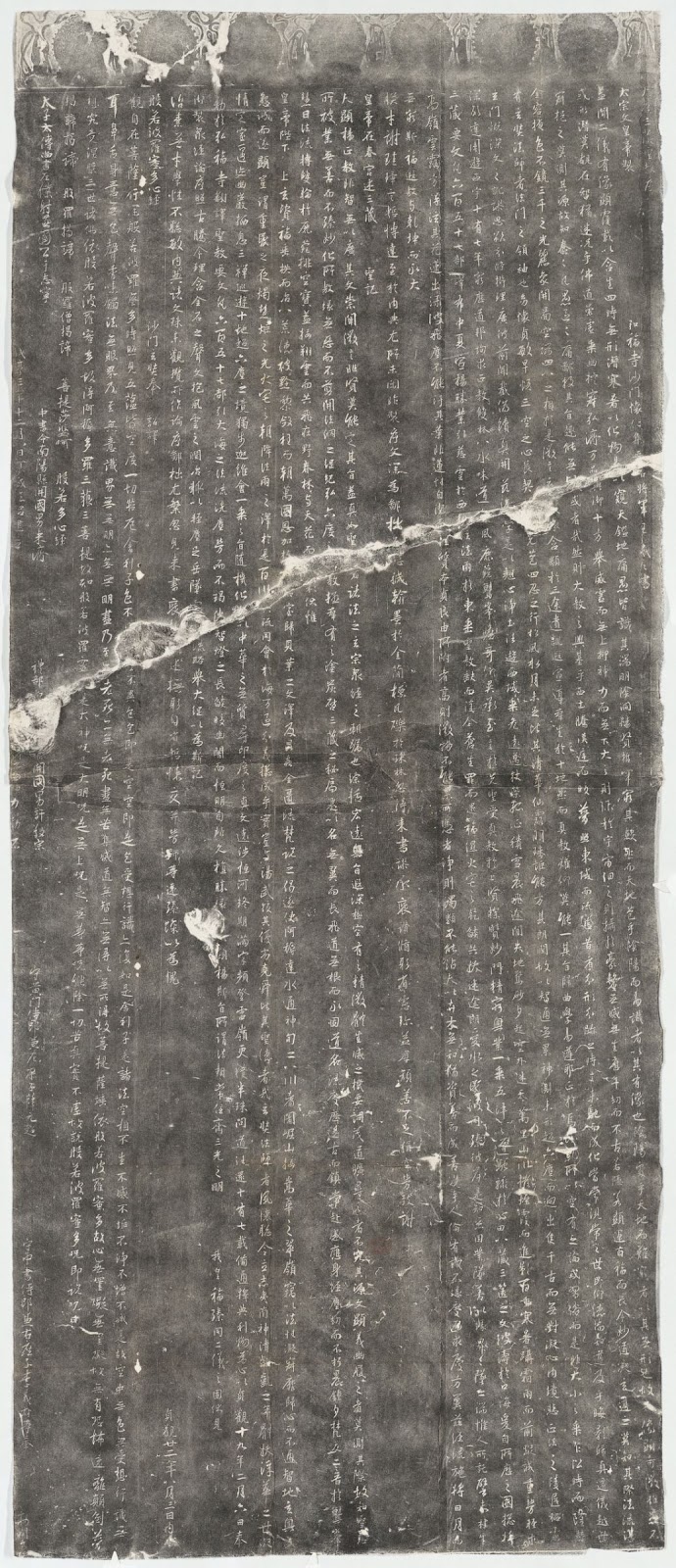
This essay is in the form of a minor mystery. I started off trying find some basic information about an image in a recent book on the Heart Sutra (below) and ended up investigating all kinds of things and finally discovering that the image is not quite what it appears to be. I hope that presenting the information in roughly the order I discovered it will make for better reading than just presenting the end point. The final picture came together slowly over a period of a couple of weeks of intensive exploration of the Chinese Heart Sutra. So to begin at the beginning...


In Tanahashi (2014: 96) the image above is captioned, "The earliest known rendering of the Heart Sutra. Carved in 672. Stone Rubbing". The List of illustrations adds "Public Domain" (xi). The discussion of this inscription says "Xuanzang's Heart Sutra was carved on the monument erected by Emperor Gao in 672 at the Gaofu Monastery, Chang'an." (81; sic). This statement is credited in the notes to "Ibid., 562", i.e., Fukui (2000: 562). I don't have access to Fukui (2000) yet, so I set about trying to track down this "public domain" image mainly in order to compare the text with other Chinese Heart Sutra texts, but also because I was intrigued that it might be the earliest dated Heart Sutra.


You might think that a public domain image of the "The earliest known rendering of the Heart Sutra" would be of considerable interest and therefore be easy to find. Not so. Initially, I could find no images of this text on the internet, except for a badly cropped version showing only the upper half.

Note 3 Jan 2016. I was mistaken about this image being cropped. The text is all there but is a little more compressed that the image above. I will add more about this other image below.

So I wrote to Shambala Publications who kindly sent me a high resolution image. The author himself has not replied to my questions about the provenance of the image, however. So I had to find out for myself.


The first step to finding out more, was to try to clarify the information supplied in the reference. There were two Emperors of the early Tang called "Gao". To coincide with the year 672 CE, Tanahashi must be referring to 唐高宗 Táng Gāozōng, i.e., Gāozōng of the Tang Dynasty (628 – 683). Gāozōng was the third Emperor of the Tang Dynasty. He is usually considered a rather lacklustre emperor. After a series of strokes, his wife, Empress Wu 妾皇后, more or less took over running the state, then after he died she became the first Empress. Where Gāo, like previous Tang emperors, was not very supportive of Buddhism, Wu found in it her justification for being a female emperor in deeply patriarchal China.

Seal One
At first I could find no reference linking Gāozōng to this inscription. At the end of the inscription however, are two seals. The practice of adding seals to documents for authenticity may have begun with Gāozōng's father, 唐太宗, i.e., Emperor Tàizōng of Táng (r. 627-649). It seems to have been related to his interest in the calligraphy of Wang Xizhi (see below). Chinese seals are carved, usually into soft stone, with characters in the Seal Script, an archaic form of Chinese writing still used for decorative purposes. Unlike the inscription itself, the forms of these seal characters are often quite different from the modern ones. Reading seal script is an art in itself. Identifying the characters in these seals seemed like it might be illuminating.

seal generator
I asked for help identifying the characters in these seals via my Visible Mantra Facebook Page. Seal One reads: 高堅之印 or "The Seal of Gāo jiān". Where 印 means "seal" and 之 is possessive. 高, Gāo, is the same character as occurs in the name of Emperor Gāozōng, which made me think that perhaps it was related to the emperor. Different fonts render seal script in different ways, but on the right is one version, created by an online app, which shows some similarities with this seal (the bottom left character is inverted). However, one of the comments gave me some useful information about this seal:
"Yes this is 高堅之印, the seal made by a very famous seal artist Mitsui Takakata 三井高堅". (@Shugendo Canada).
So here the character 高 is, in fact, Japanese taka(i) "high, elevated". And Seal one, in fac,t reads "Seal of Takakata". Mitsui Takakata (1867-1945), aka 宗堅, Sōken, was a Japanese industrialist and art collector (note that in Japanese the Kanji 堅 can be pronounced kata or ken). He was a senior member of the Mitsui Zaibatsu, one of the largest corporations in the world at the time. He also had strong artistic leanings: "Takakata was a talented calligrapher versed in classical literature and an amateur epigrapher with a particularly good knowledge of seals." (Sherman 1982). Below are some examples of seals he created, supplied by my informant. The one of the left bears a striking resemblance to Seal One.

三井高堅之印 高堅之印

Takakata was responsible for collecting perhaps 500 rubbings of stone inscriptions now held in the East Asiatic Library, University Of California, Berkeley (Mitsui was broken up by the post-WWII government and forced to divest itself of many assets, which meant selling a large chunk of their extensive library). I could not locate the rubbing from Tanahashi in EAL collection, though it contains several examples of the Heart Sutra or 心經.

It seems that Mitsui Takakata was the person who did the rubbing that appears in Tanahashi (2014). He must have stamped it with his own seal afterwards. We still don't know when he created this image or where the original rubbing is.

Seal Two
In the second seal we may have 安唐. 唐 means Tang, the name of the Tang Dynasty which is the Dynasty under which Xuanzang lived. Or it may be 安適. Opinion was divided amongst commentators and neither option produced much insight into whose seal this is. The two seals are very different in style, so perhaps this seal was part of the original inscription? In any case I could not learn anything further about Seal Two.

Update 3 Jan 2016. The plot thickens a little as I discovered, by paying attention, that the other image of a rubbing found on Wikimedia shows what may well be the original rubbing that the image in Tanahashi is based on.
Wikimedia
The image here is rather indistinct, but a very hi resolution image is available via Wikimedia. Here there are 40 short columns, while in Tanahashi there are 27 longer columns. I'm not sure if this is a separate rubbing or if this is the model used for creating the image in Tanahashi. If so, it has been cleaned up substantially. There's a lot more noise in the Wikimedia image - white pixels surrounding the characters. I've tried looking specifically at the stray pixels around the characters - since the characters themselves are more or less identical - but the Tanahashi image has either been cleaned up in some way (perhaps using photoshop) or they are different. Note that the Wikimedia image has no seals. 

Returning to the description in Tanahashi (2014), "Gaofu Monastery" was a brief mystery in its own right. In fact, it is a mistake. The author, or perhaps the typesetter, has taken the name Gao from the emperor and mixed it up with the name of the monastery. The monastery is called 弘福寺 Hóngfú sì (Great Good-fortune Monastery), a place closely associated with Xuanzang. It was where he started his translation work on returning from China. Later, he moved to 西明寺 Xīmíng sì (Western Bright Monastery).

Tanahashi relates the story behind the creation of the inscription of which the rubbing is a copy (2014: 95-97). In Wong (2002) we find another version of the story:
"In 652, at Xuanzang's request, Gaozong authorized the erection on the temple grounds of a five-story Indian-style stūpa, which was built as a brick-covered earth core. After the stūpa was completed, the two steles incised with the imperial texts were installed in a stone chamber on its top floor."
"In 672 the same imperial texts were inscribed anew, this time in the style of Wang Xizhi's 王羲之 (307-65) xingshu, or running script (fig. 3). Huairen 懷仁 a monk from the Hongfu Monastery, initiated the project and was responsible for its design. Assembling characters from Wang Xizhi's extant works, he shrank or enlarged them as necessary, so that the texts incised on the stele would replicate Wang's fluent, semi-cursive style. 12 This work is currently in Xi'an's Beilin 碑林, or Forest of Steles." (Wong 2002: 49; emphasis added)
Each version of this story that I have uncovered seems to have slightly different details. Emperor Taizong who was originally fascinated by the calligraphy of 王羲之 Wáng Xīzhī (303–361), a Chinese calligrapher traditionally referred to as the Sage of Calligraphy (書聖), and became a collector of his work (Powers & Tsiang 2015: 299). In 2010 an example of this calligraphy sold for $46 million (BBC News). In 648 Taizong issued an edict as the preface to the Chinese Tripiṭaka titled, Preface to the Sacred Teaching 聖教序 (781 characters). It was this text that was initially inscribed in stone on a stele. According to Powers & Tsiang (2015), two versions were created, one based on the calligraphy of Chu Suiliang 褚遂良 (597-658) in 653 and a more elaborate one, by Huairen, based on the calligraphy of Wang Xizhi. Perhaps the Heart Sutra was added by the pious Huairen? All sources agree that it took 25 years to assemble all the characters needed for Huairen to compose the full text in this way (so collecting the characters must have begun in 647 at the latest, which is during the reign of Taizong and six years before the first stele was completed). When a precise character could not be found its radical and parts were extracted from other characters so it could be constructed. The finished project (1903 characters) included the Heart Sutra that interests us here.

Sheng (2011: 65) by contrast mentions:
"A pair of steles inscribed with the Da Tang Sanzang shengjiao xu 大唐三藏聖教序 (Preface to the Holy Teachings of the Tripiṭaka of the Great Tang Dynasty) and Da Tang Sanzang shengjiao xu ji 大唐三藏聖教序記 (Notes to the Preface to the Holy Teachings of the Tripiṭaka of the Great Tang Dynasty) erected in 653, represent the most refined phase of [Chu Suiliang's] calligraphy
The former preface was composed by Li Shimin 李世民, i.e., Emperor Tàizōng, and the latter by Li Zhi 李治, i.e., Emperor Gāozōng. The first steles stood at the southern entrance of the famous 大雁塔 or Great Goose Pagoda at 大慈恩寺 (Great Grace and Goodwill Monastery) (Sheng 2001: 87-88), which we mentioned in last week's essay as a monastery associated with Xuanzang's disciple Kuījī. A good deal more detail on the influence of the Imperial obsession with the calligraphy of Wang Xizhi on the development of writing in China can be found in Sheng (2011: 48ff).

So Huáirén created a kind of Frankenstein text of these two prefaces, plus some other bits and pieces and a Heart Sutra text. Sheng (2011: 100) notes that Chinese art historians have tried to trace the individual characters to individual works by Wang Xizhi with limited success. Knowing this is quite helpful because when we look at the image from Tanahashi we can see that the characters are indeed a mishmash of styles. We probably would not guess they were all by the same calligrapher. For example, compare these characters (below) which were selected to highlight the differences. They were all copied from the Tanahashi image without any resizing:


The characters are different styles and different sizes, a fairly random collection of mismatched characters. It becomes even more apparent when we look at variations of individual characters, for example of 不, 亦, and 無 respectively.


This observation supports the idea that the rubbing in Tanahashi was created from the stele created by Huairen in 672. At this point it might we worth saying something about the Chinese practice of making inscriptions of sutras.


Dhāraṇī Pillars


Dhāraṇī texts (including the Heart Sutra) are the subject of Paul Copp's (2014) book, The Body Incantatory. Carved pillars with short texts including the Prajñāpāramitāhṛdaya and Uṣṇīṣavijayadhāraṇī Sūtra were very common in medieval China. Around the 7th century the writing down of texts for use as amulets worn as arm-bands or necklaces had become a specific practice and it appears that short texts, such as the Uṣṇīṣavijayadhāraṇī Sūtra and possibly the Prajñāpāramitāhṛdaya were composed especially for this purpose.

The image on the right (taken from Sotheby's online catalogue) shows a typical stone pillar, octagonal and carved with the Uṣṇīṣavijayadhāraṇī Sūtra. One of Conze's Heart Sutra texts was a similar octagonal pillar discovered in Mongolia and published by Miranov in 1932. The Heart Sutra and Uṣṇīṣavijayadhāraṇī appear together on the famous Horiuzi Palm-leaf manuscript and in several other manuscript sources.

See also Liying Kuo (2014), who notes that the second oldest Heart Sutra text is found engraved on a pillar erected in 702, during Wu’s reign. And recall that Wu could not justify her taking power through either Daoism or Confucianism and so sought legitimation through Buddhism. By this time the kings of Japan were also using Buddhism as a legitimating narrative for their kingship.

So the inscription and, indeed, the Heart Sutra, more generally, needs to be seen in this light. It was distinctive in its way, but also fits into the context of a widespread popular practice. And it was in the context of clarifying this information that I came across the real prize in this research.


The Stele

Amongst the many searches for the image itself I turned up many references to the original stele now residing in the Forest of Steles Beilin, in Xian, no other images of the stele itself. Then, serendipitously, whilst looking for images of Dhāraṇī pillars, I chanced upon an image of another rubbing of the same stele held in a collection of rubbings at Harvard University Fine Arts Library. In the image below the Heart Sutra takes up columns 23-27 (counting from the right).


The Stele is 226 x 94 cm. There are 30 columns of text, each of which contains up to 84 characters. Each character is about 3.5 cm in width and 4 cm in height. Although most sources mention only three texts, Sheng (2011: 96) describes several:
"The stele begins with the title Da Tang Sanzang shengjiao xu. Next to the title, two important statements—―太宗文皇帝製 (Composed by Taizong, the Literary Emperor) and ―弘福寺沙門懷仁集晉右將軍王羲之書 (Monk Huairen in Hongfu Monastery collected the characters from the calligraphies of Wang Xizhi, General of the Right Army of the Jin dynasty [to engrave on this slab] are presented in one line. This statement of calligraphic authorship is followed by five individual bodies of text: the complete text of Taizong’s Preface (ten lines), Taizong’s reply to Xuanzang’s gratitude letter (one line), Gaozong’s Notes to the Preface (ten lines), Gaizong’s reply to Xuanzang’s gratitude letter (one line), and a paragraph [sic] from the Heart Sutra (five lines).
"The last line of the inscription reads, ―On the eighth day of the twelfth month in the third year of [Gaozong] Xianheng era [672], erected by the Buddhist priests in the capital; calligraphies engraved on the stone by civil official Gentleman-litterateur, Zhuge Shenli, and Commandant of Militant Cavalry, Zhu Jingzang (咸亨三年十二月八日京城法 侶建立; 文林郎 諸葛神力 勒石 武騎尉 朱靜藏 鐫字). (Sheng 2011: 95)

Because of the distinctive nature of the text a comparison is relatively easy. The text of the rubbing in Tanahashi is the same as the text in this rubbing. See image right comparing the title of the text - with Harvard on the left, Tanahashi in the middle, and the Wikimedia image on the right. I have tweaked the contrast in the Harvard image to improve the contrast (by adjusting the black, mid and white points using the "levels" tool in Photoshop Elements) Looking at this my impression is that the characters in the Tanahashi image have also had the contrast adjusted. The white of the characters is too white. Contrarily, the Wikimedia image shows texture in the white of the letters, which is what we might expect with an engraving.

The third image complicated matters somewhat because we don't have enough information on the provenance of any of them to know how or even if they are related. We can say that the Harvard rubbing shows no sign of seals and that these must have been added to the rubbing at a later date, possibly by Mitsui Takakata himself, or perhaps by someone else. 

The original stele was more like a dhāraṇī pillar than a page of manuscript. This stele now stands at Beilin Museum in Xian and it is commonly referred to as the 集王聖教序并記 "Preface and the Notes to the Preface to the Holy Teaching with the Collected Wang's [calligraphies]" (Sheng 2011: 89). Sheng goes on to discuss the Preface in great detail (90ff). Sheng suggest that Taizong's preface was composed specifically for Xuanzang's translation of the 100 fascicle Yogācārabhūmi.

Of the utmost importance for the history of the Heart Sutra is the note by Sheng (2011: 96) that "At the end of the main text, five high officials are credited with giving the translation of the sutra a proper elegance and finish... and ... the process of the afore named officials' finalizing and polishing the sutra's translation took place in 656". Thus the Xuanzangisms in the text (the spelling of 觀自在 and 舍利子, for example) may well have been added in tribute to Xuanzang rather than by him, but before his death in 664. We also know that although Emperor Gāo appreciated Xuanzang, more generally he was no fan of Buddhism and is, contra Tanahashi (95), unlikely to have thought of promoting the Heart Sutra. Gāo cancelled the translation program in the same year as Xuanzang died and thence turned increasingly to Daoism (Wriggins 2004: 203). This also means we can date T251, which is more or less identical to this text, to 656 CE at the latest. This is still long after Xuanzang returned from India and also after the date traditionally ascribed to T251 i.e. 649 CE.


The Text of the Stele Inscription

I have transcribed the inscription as it appears in Tanahashi, checking against the Harvard rubbing where possible. My version is shown below in a semi-cursive font (and repeated below in whatever your browser uses for a standard Chinese font). The text mainly follows Xuanzang's version and the traditional Chinese reading order - one starts at top right and reads down, then goes to the top of the next column to the left and finishes in the bottom left. It's like English writing with the page rotated 90° clockwise.


The first two lines read:
  1. 般若波羅蜜多心經 i.e. Prajñāpāramitāhṛdaya Sūtra.
  2. 沙门玄奘奉 "Homage to Shāmen Xuánzàng." 沙门 shāmen here means “monk”. There are two separate characters below this that are indistinct in Takakata's rubbing and even less clear in the Harvard rubbing. The characters are difficult to read, but comparison with a number of other texts suggests that they are 詺 "named," and 譯 "interpret, translate". I'm not sure how to read them in this context. The Wikimedia image does not separate these characters out. 
Note 5.6.2018: 詔譯 means "a translation requested or sanctioned by the emperor". While 奉詔譯 "translated by imperial decree". So the Line 沙门玄奘奉奉詔譯 should not have a gap, and another inspection shows no gap in the Beilin Stele. The line thus reads "The Monk Xuánzàng translated by imperial decree".
The rest of the text is the same as T251 the version attributed to Xuanzang, except that in columns 25 and 26 the character 帝 is written as 諦. However, these two have the same pronunciation, . The text written left to right reads:
般若波羅蜜多心經
沙门玄奘奉    
觀自在菩薩行深般若波羅
蜜多時照見五蘊皆空度一
切苦厄舍利子色不異空空
不異色色即是空空即是色
受想行識亦復如是舍利子
是諸法空相不生不滅不垢
不淨不增不減是故空中無
色無受想行識無眼耳 鼻
舌身意無色聲香味觸法
無眼界乃至無意識界無無
明亦無無明盡乃至無老死
亦無老死盡無苦集滅道無
智亦無得以無所得故菩提薩
埵依般若波羅蜜多故心無
罣礙無罣礙故無有恐怖遠
離顛倒夢想究竟涅槃三世
諸佛依般若波羅蜜多故得
阿耨多羅三藐三菩提故知
般若波羅蜜多是大神咒是
大明咒是無上咒是無等等
咒能除一切苦真實不虛故說
般若波羅蜜多咒即說咒曰
    揭諦揭諦    般羅揭諦
    般羅僧揭諦    菩提僧莎訶
般若多心經

Conclusions

I think this story shows how important good referencing is. Without accurate information it can be very difficult to track down the original, be it an image or a textual source. Tanahashi has not made it easy to locate this important version of the Heart, so seldom written about or studied in English. However, I believe I have now correctly identified the image, filled in many of the gaps in the information about its provenance, transcribed it and shown how it fits in with existing versions. Scholarship is partly about ensuring that those who come after you don't have to reinvent the wheel.

If this is indeed the earliest dated Heart Sutra text, then it is extremely important in the history of the Heart Sutra. The Japanese Horiuzi palm-leaf manuscript is said to date from 609 CE, but this is unlikely to be true. The first European scholars to examine the ms. dated it to the 8th century on palaeographic grounds. Of course absence of evidence is not evidence of absence, but an earliest text dated 672 CE is consistent with Nattier's Chinese Origins hypothesis. If, for example, it really had been "translated" in the 5th Century by Kumārajīva we might expect an earlier inscription or some other corroborating archaeology. Not only do we have the first physical evidence of the Heart Sutra in the late 7th century, but we can also date the first commentaries to around the same time, i.e., shortly after the death of Xuanzang. Again, if the text were earlier we might expect a narrative source, such as the diaries of previous Chinese pilgrims to India to mention the text, but again the earliest source for this kind of evidence is associated with Xuanzang. As it is, the earliest Indian evidence, the Indian commentaries preserved in Tibetan, date from the 8th century.

All of this is consistent with the text being composed or at least popularised in the 7th century, probably originally as an amulet for protection from misfortune. The status as an epitome of Prajñāpāramitā most likely came later and, in fact, the first commentators (i.e., 원측 Woncheuk and 窺基 Kuījī),  understood the text to be an epitome of Yogācāra thought, unlike the Indian commentators who saw in the text either a Madhyamaka or Tantric epitome.

~~oOo~~

Note 5.6.2018. It was announced in China in 2016, but not reported in the West, that two more stone steles have been discovered and dated to 661 and  669 CE. Both contain the line “三藏法師玄奘奉詔譯” bolstering support for Xuanzang's involvement in the text, since he died in 664 CE. However, a note of caution -- I have not yet seen anything to say how these steles were dated. 
22 June 2018: Please note that I have had to revise my facts on the oldest dated Heart Sutra. Please see my more recent essay: The Earliest Dated Heart Sutra Revisited, which describes the Fangshan Stele (I hope to have something published on this in 2019). I think the facts around the Beilin Stele are still of some interest. It is a unique piece of history. 

Bibliography

Copp, Paul. (2014). The Body Incantatory: Spells and the Ritual Imagination in Medieval Chinese Buddhism. Columbia University Press.

Liying Kuo. (2014). Dhāraṇī Pillars in China: Functions and Symbols in Wong, Dorothy C. & Heldt, Gustav. (Eds) China and Beyond in the Mediaeval Period: Cultural Crossings and Inter-Regional Connections. https://www.academia.edu/10400197/Dha_ra_ni_Pillars_in_China_Functions_and_Symbols

Powers, Martin J. & Tsiang, Katherine R. (2015). A Companion to Chinese Art. [229] Google Books: http://is.gd/CNjFij

Roger Sherman. (1982). Acquisition of the Mitsui Collection by the East Asiatic Library, University Of California, Berkeley. Journal of East Asian Libraries, 67. [This article is a summary of the author's MLS specialization paper, Graduate School of Library and Information Science, UCLA, 1980].

Sheng, Ruth. (2011). The Development of Chinese Calligraphy in Relation to Buddhism and Politics During the Early Tang Era. A dissertation presented to the Graduate School of the University of Florida in partial fulfillment of the requirements for the degree of Doctor of Philosophy, University of Florida.

Tanahashi, Kazuki. (2014). The Heart Sutra: A Comprehensive Guide to the Classic of Mahayana Buddhism. Shambala.

Wong, Dorothy C. (2002). The Making of a Saint: Images of Xuanzang In East Asia. Early Medieval China 8, 43-81.

Wriggins, Salley Hovey. (2004). The Silk Road Journey with Xuanzang. (Rev Ed.) Icon Editions, Westview Press.
Related Posts with Thumbnails