19 September 2014

Cemetery Practice

The city of Cambridge is old. The University of Cambridge was founded in 1208, but the town dates from centuries earlier. We have the remains of a motte & bailey castle overlooking the town. It was built in 1068 just two years after the Norman conquest. But in fact there are Iron Age settlements in the neighbourhood that are around 3500 years old. This is around the time the earliest Indian texts were composed. Romans and Saxons also lived here at different times. Cambridge was under the Danelaw in the 9th century. 

I grew up in New Zealand where human occupation is thought to have begun ca 1000 CE with the arrival of the first Pacific Islanders, probably from what are now known as the Cook Islands. European's began arriving some centuries later beginning with Abel Tasman from Zeeland, Holland (hence the name), and followed by James Cook from Britain. Most of the evidence of human occupation of New Zealand is only a century or two old. Down the road from me in Cambridge is a church built when the Māori were washing up on the shores of New Zealand. 

In New Zealand we think 100 years is a long time. In Britain we live with much longer roots into the past. But we also have reminders of transiency. Some of the most evocative of these are the various cemeteries dotted around. In Britain each church parish had their own cemetery, though some, like the one I'm going to discuss, were shared between parishes. Many of these are now closed, full of the dead, and are slowly being turned into parks. Even headstones moulder given centuries. I particularly enjoy Mill Rd Cemetery. It's quite large and in a quiet part of town so that one can sit there and have a sense of being isolated from the busyness and business of the city. There are many mature trees and smaller trees, shrubs, brambles (if you will eat berries that grow in a cemetery they are juicy and ripe at this time of year). 

grave markers of that time
are rather ostentatious
Mill Rd Cemetery was consecrated in 1848 and closed in 1949 and thus neatly spans the last century of the British Empire. By 1848 Britain was starting to become seriously wealthy on the back of the Empire, so many of the grave markers from that time are rather ostentatious by today's standards. And yet some stones are now so weathered that the names are unreadable. Acid-rain due to fumes from industry and motorised transport has ablated the sandstone headstones, though marble fairs better. A couple of events of savage vandalism damaged many gravestones. The cemetery is slowly giving way to nature. In fact the management of the cemetery are helping nature out by planting trees.

There are a number of paths through the cemetery. However, after some thought I realised that not all of them are official. Some of them are simply shortcuts that have been worn down by use. In fact in some cases the shortcuts go right over graves. When it rains all the paths flood. If there's a lot of rain people go around the puddles and walk new paths into the grass. Again these frequently go over and across graves with apparently no hesitation. These old graves are not as sacred as new graves, if they are sacred at all. I find this aspect of the cemetery troubling. But then after a few hundred years we treat graves as curiosities to dig up and examine. Where is that line in time?

Another aspect for contemplation is that the cemetery regularly attracts groups of homeless people and/or alcoholics. In dry weather it's a pleasant place to spend time. And often-times people sleep out under the bushes in out of the way places. At one point a regular colony became established. But this is Cambridge and such things are not tolerated here, so they were moved on. Watching these people, whose lives and health are wrecked by drugs, alcohol, or fate, is salutary. I dare not stare for fear of inviting confrontation, but I do think that I could so easily have ended up amongst them. I gave up alcohol more than 20 years ago, before it wrecked my life, but had I waited a little longer it might have done a great deal more damage than it did. Both my grandfathers and at least one of my great-grandfathers were alcoholics. One of my uncles died of an accidental morphine overdose, another was a junky who died from a stab wound to his cirrhotic liver that a healthy man would have survived. There are other addicts in the family. I'm not so different from the dishevelled and unwashed street-people drinking their cheap, ultra-strong beer for breakfast. Having shouted conversations, not comprehending or caring. 

Descendants have
forgotten their ancestors.
 
But what really strikes me about the graves in Mill Rd Cemetery is that except for one or two, none are tended, kept clear of weeds or offered flowers. Descendants have forgotten their ancestors. And this in a town with more than averagely memorable people. Even holding relatively high office in the town is no guarantee of being remembered. Two or three generations after we die we'll, most of us, be forgotten. We think all the stuff we're doing today is so important. But most of it leaves no lasting impact on the universe. Even if we do manage to pass on our genes, our families forget us. We cease to exist even in memory. History has a very bad memory. Most of what we think of as important today is entirely inconsequential in the long view. All those decisions we agonise over for hours, days and months, they won't be given a moments thought in fifty years. Even if we have kids, our graves will go untended. Our cemetery will eventually be closed and turned into a park. Vandals or acid rain will destroy our modest headstones. People will casually walk over our graves to save a few minutes or avoid a rain-filled puddle.

So the question I find myself asking is this. "What will be my legacy?" OK I've written some books and they are in libraries. But they're printed on acid paper and won't last more than a century. And there were only ever a few dozen copies of each. Perhaps Google will leave this blog to stand for years after I die and stop updating it? Who knows? Maybe they'll start deleting cob-websites after a period of inactivity to save a little bit of money? In fifty years it's not going to matter much. Maybe my academic publications will have a longer life (if I ever get my Heart Sutra material published it might last a century). 

Does it make sense to even think in terms of legacy in this light? And if not legacy, then on what standard do we assess the value of our lives. One can see how life after death holds it's appeal for the majority of people. Or should we adopt the YOLO "live in the moment" maxim? In its hedonistic or contemplative aspects. My experience suggests that moments are only bearable if we know they're going to end. One has to have a longer perspective than just one moment in order for any given moment to be tolerable. In the moment, one is utterly alone. In perspective one is intimately connected. If in the long term we don't make a difference or matter, then perhaps in the short term we matter to the extent we experience our connectivity? Being in a dynamic web of relations is fundamental to being human, perhaps it is the ultimate source of meaning also? 

I don't have answers to these questions and I've become distrustful of people who have easy answers. It seems to me that perhaps contemplating such things is a value in itself without ever coming to an end point. If I ask myself these questions then at least I'm not stumbling blindly through my life with no sense what why I do anything. And one gets the sense that so many people are blind. 

So I continue to visit the cemetery. I sit and enjoy the environment, read, drink ginger beer, watch the people, think about the dead, and wonder about my place in the universe. It's hardly the ancient cremation ground practice, but it seems much better than a church or temple as a place for contemplation (weather permitting).

~~oOo~~


Pics from Mill Rd, Cemetery.
I enjoy Fentimans and Fever Tree ginger beer. Ginger beer, especially these fairly dry varieties, is a great alternative to alcoholic drinks for those who still like the feel of a bottle in their hand. If more of us drink it, the shops & pubs will stock it. Give it a go.

12 September 2014

Living in a Non-Utopian Universe

Garden of Eden
Hieronymus Bosch
Recently I copped some abuse on Twitter because I disagreed with a tweet that, basically, argued that everyone is entitled to security no matter how risky their behaviour. Possibly what I'm about to write will earn me more disapprobation. This does worry me. Like most writers I crave approval. However it's an interesting area of ethics. Do we have a right to safety which is distinct from our duty to care for ourselves?

We live in a non-utopian universe. There are risks. I live in the beautiful and largely tranquil, City of Cambridge. On the whole the streets are safe, even at night. But I make a point of not going to certain places at night because there is a risk attached. There are some places I know where people have been attacked, where drug addicts congregate, or where I feel fear. I've never been physically attacked in Cambridge. I'm careful not to put myself in a situation where I might be, because when I was growing up I was repeatedly assaulted by other kids in my neighbourhood and I'd like to avoid a repeat. 

I'm not arguing that this is ideal or even OK. I don't like to feel afraid. I'd prefer to live in a world where people were all friendly (much more friendly than the average Cantabridgian!) but I don't. You don't. We don't. Most people reading this won't be living in a war zone, but there are people nearby who would rob us or hurt us for a variety of reasons. Even if we are actively trying to change this, it's a fact.

We live in a non-utopian universe. I envisage "utopian" here as a kind of analogue of Euclidean. Euclidean geometry is a special case of geometry that assumes a flat world. On a small enough scale the world approximates flatness so that Euclid's geometry is useful in the way that Newton's mechanics are useful. If you want to build a house, Euclid will do. If you want to circumnavigate the world in a yacht it won't do, you need spherical geometry (at least, though the earth is slightly oblate). There's a logic to Euclidean geometry and it works within artificially constrained frameworks, but it breaks down in any kind of bent universe. The real universe is non-utopian, in the way that real-world geometry is non-Euclidean. We can imagine a perfect world, even do geometry in it, but that does not make it real.

All actions have consequences. This is hardly rocket science. But it is something to keep in mind. In a non-utopian world actions also have risks attached. Some consequences are desirable and some not. For any given action there'll known consequences and unknown consequences; and each consequence will have a probability of occurring with respect to the action. In life we gamble on both good and bad consequences. Sometimes we play safe, sometimes we take risks. Sometimes risks pay off, sometimes not. Research suggests we're poor at gauging probabilities of outcomes, but even so it's still up to us to make the call. We decide.

There are two main issues: the risk and the risky behaviour. If I argue against the latter, it does not mean I endorse or enforce the former. It is terrible that everyone is at risk of being robbed or assaulted. But we live in a non-utopian universe. There's never been a time or place where anyone has lived without unfair risks. No one is, or has ever been, completely safe. If one can take reasonable precautions against the risk of assault that is realistic. It's not necessarily a capitulation to the criminal element. 

I've been assaulted many times, to the point where I have permanent psychological scars (and a badly healed broken arm). Not all the people who assaulted me years ago were male. A number of females joined in or initiated violence against me. But yes, on the whole men are more physically violent than women. The risk of being assaulted by a man are much higher. But the risk of being assaulted by any given man? I don't have statistics, but I've known very few men in my life who assaulted anyone, even counting a childhood full of violence. It was always a select few who were physically violent and everyone, men included, feared them. So I think we need to be cautious about assigning blame for the situation. Just blaming "men" for example, as many people do, doesn't help. All people are products of their upbringing to some extent. The fact of violence in society is complex. 

I had a number of insights on my ordination retreat in 2005. Often on sleepless nights I would walk up the valley to look at and talk to the stars. It was up there, late one night, that I let go all remaining hostility to the people who assaulted me in my childhood. My tormentors were the products of poverty, alcoholism, colonialism and racism and so on. I realised that I knew the fear and anger they experienced. I also knew that they were like that because they too were surrounded by frightened angry people. Being a target for their violence I never had any sense that I was privileged with respect to them, the main difference was that I was loved and cared for (though assaulted by members of my family at times also). We too were poor and working class; living in a rough neighbourhood of a small town with low educational standards; and we had low expectations of life. It was my mother who pulled us out of that milieu, inspired us to be educated and pursue our dreams. She came from a hellish background of abandonment and violent alcoholic adults, so where she got her aspirations I don't know. I think perhaps from the Church. In which case I'm grateful to the Church. I published the story of her early life if anyone is interested.

Today it makes me reflect on the risk of being assaulted. People are usually violent for a reason. They're usually the victims of violence, often from an early age. The fact that some people in my current city are violent is not because of sexism or testosterone or any of the glib arguments put forward by the kind of entitled modern feminists that I met on Twitter. A non-utopian society creates these people, fosters them, and fails to offer them alternatives. Whether it's too much effort, or too expensive, or we're ideologically opposed to helping people that won't help themselves, or whatever it is. Society has an underbelly because of the way that society operates. And we all participate in society. We all make it what it is.


The Utopian Universe. 

The utopian universe is supposed to be moral, it ought to take care of injustice and imbalances of various kinds and  automatically set things to right. In some ways Karma is the ultimate expression of this utopian ideal: it describes a cosmic balance unmediated by any agent human or supernatural. In the utopian universe, morality is or ought to be a zero-sum game. When Anubis weighs the heart of the dead against the feather of the law, that heart is either heavy or light and what happens subsequently is determined by which way the balance swings. 

In the olden days the olden people had agreements with the olden Gods. There was a quid pro quo. They offered sacrifice (we gave up something valuable) or got out-of-their-skulls on magic mushrooms or whatever and all agreed to follow God's rules (whatever they were imagined to be) and in return God would keep the seasons regular, send enough rain but not too much, keep us and our cattle free of disease, protect us from enemies (more on enemies in a minute), and generally give us our Daily Bread. Except God was a lousy provider. We got climate change; floods and droughts; we and our animals got sick; our enemies persistently attacked us; and everyone died sooner rather than later, often horrifically. God doesn't keep Her side of the bargain. When there were no scientists the failure of a bargain with God was not cause to reconsider the bargain. "It's not you, it's me," they'd say. "I did agree to follow the rules all of the time in the full knowledge that no-one follows all of the rules all of the time. Clearly if there is fault it is mine, and punishment is only just. Ebola virus? Well OK, it seems kinda harsh, but God must know what She's doing. 50% infant mortality? God must really love babies!"

In a utopian universe the harsh and unfair must balanced by the beautiful and fair. Rather than give up the belief we became schizoid. We split the World into two. Now & later. Here & there. Here, things are manifestly unfair. Most of the universe is inhospitable to life, and even the good parts are full of parasites and pathogens (the better the weather the worse the flies). Bad people prosper and good people flounder. But all moral debts are paid in the afterlife. It's there we find beauty and justice. 

The generalised archaic utopian religion lives on, but instead of buying it for a price, we demand it as a right. This sense of entitlement is a new game for humans. We have Rights, God damn it. We demand that we have Rights. And we also demand that we have these rights independently of whatever else we might do or not do. The Tweet I disagreed with was a demand for the right to security regardless of risky behaviour. It was a demand for the "authorities" to institute the Kingdom of Heaven here on earth, but with no obedience or hegemony, no allegiance or quid pro quo.

"Rights" is also a capricious bulwark against the non-utopian universe. Like God, Rights tends to get distracted and allow terrible things to happen. The Rights of the rich and powerful tend to get more notice than the rights of the poor and oppressed. I may have a Right to live without fear of being robbed or have my arm broken, but that doesn't stop me being robbed and it certainly didn't stop me having my arm broken as a kid. 

Oh, Rights is a good thing in many ways. The UN declaration of Human Rights is enlightened in many ways. The values it expresses are admirable, they are my values. The actions taken on many fronts towards treating everyone with respect and ensuring they have food and shelter put God to shame, as She never did so much in all the Millennia of being worshipped. When we take pride in ourselves and take care of ourselves we do much better than God ever did.  

But the facts are these: we do not control the weather; we are still prone to disease; human enemies of various kinds still exist. Demanding our rights does not change this. Human enemies might include angry people; hungry people; people with compromised empathy; greedy people; powerful people (or some combination of all and more). Of course we can imagine a world in which no one wants to rob or assault us. The more so if we have been robbed and assaulted. But as the olden saying goes: "If wishes were horses, beggars would ride". Whereas in fact "beggars can't be choosers". 

We live in a non-utopian universe. Some people find ways to shut out this fact. And they tell you that shutting it out in their particular way is a panacea. All the ills of the world don't even seem like ills if we adopt the position that ills are just a matter of perception. Or the ills of this world are cancelled out by infinite bliss on the other side. But there is no panacea. The things we think will cure all ills are thousands of years old and they have not yet cured all ills. 

After 100,000 years of religion most people are still unhappy most of the time (even the one's with digital watches). Indeed if people weren't unhappy, Buddhism would have almost no customers. Ergo? Ergo, religion (Buddhism) is not the way to institute Utopia. No way of thinking that accepts the definite possibility of a utopian universe ought to be taken seriously. The universe is not broken. It is what it is. It is non-utopian and independent of our values. Fixing the universe is not an option. In a non-utopian universe, morality is a non-zero sum game. There are winners and losers. Some of the winners are good by our values system and some are not. There are values, just no universal values. If we understand what the game of life is all about, maybe we can play it better? Except it's not really a game, now is it? Hunger is not abstract. Pain isn't just a concept.

The best I can do is take responsibility for my own actions. I'm not responsible for all men or the British Empire. I don't blame my family or my neighbourhood for my difficulties in life. There's no mileage in blaming anyone. I joined a Buddhist movement in part because as an individual I am weak and vulnerable. As a member of this collective I hope to make a difference in the world. I could have joined a political or ecological group, but, I joined a religious group. I've dedicated my life to participating as much as I can in the activities of this group and to helping them as best I can to making the world a better, safer, more harmonious place. But the universe is non-utopian. It's never going to be perfectly good, perfectly safe, or perfectly harmonious. Indeed, even a religious community is not always good, safe or harmonious. 

~~oOo~~


05 September 2014

The Politics of Evolution and Modernist Buddhism.

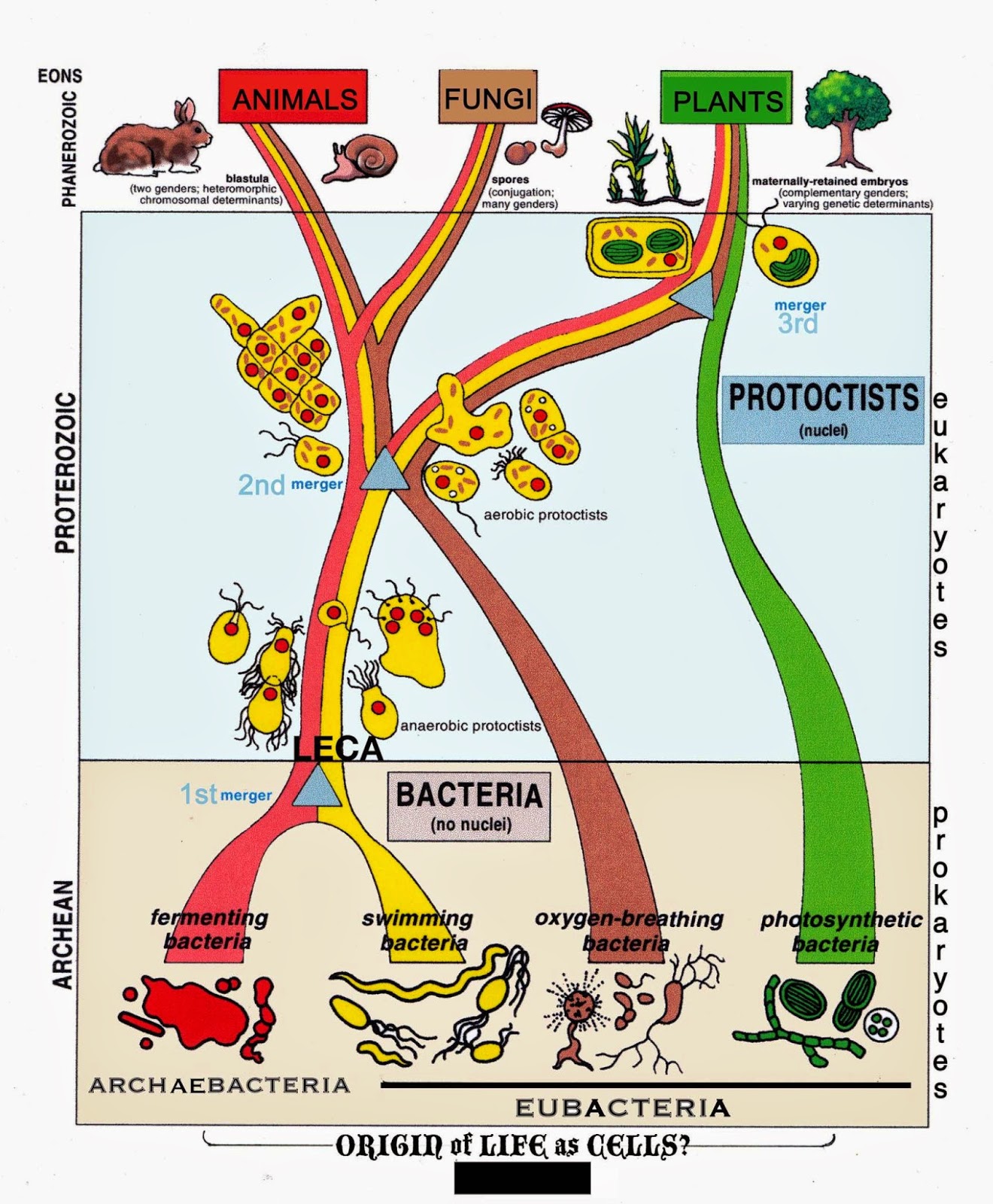
Endosymbiosis according
to Lynn Margulis.
There have been some watershed events in the history of evolution theory. The discovery of fossils. Darwin and Wallace's insights into natural selection. The discovery of the structure and function of DNA by Crick, Watson, Franklin and Wilkins. To this list I would add the discovery of endosymbiosis. Unfortunately there hasn't yet been a defining moment in the study of epigenetics, but it ought to be represented too. We're still waiting for a decisive breakthrough in biogenesis - how life got started in the first place, but it will also be a watershed when it comes.

It's Endosymbiosis I want focus on in this essay. Endo means 'internal' and symbiosis means 'living together' and the compound refers to the fact that each of our cells is in fact a community of bacterial cells living together. This idea was first floated in the early 20th Century by a Russian scientist, Konstantin Mereschkowski. His observation concerned the green parts of plants. Seen under a microscope the plant resolves into uncoloured structures which support small green pills called Chloroplasts. These are very similar to cyanobacteria or blue-green algae and he conjectured that their might be a relationship. In the 1920s another scientist named Ivan Wallin made a similar identification between mitochondria (the oxygen processing parts of our cells) and other kinds of free living bacteria.

However the watershed event for endosymbiosis was the publication, after considerable difficulty with the establishment journals, of this paper:
Sagan, Lynn. (1967) 'On the origin of mitosing cells.' Journal of Theoretical Biology. 14(3) March: 225–274, IN1–IN6. DOI: 10.1016/0022-5193(67)90079-3
This rightly famous paper is now copied online in many places. Lynn Margulis had married Carl Sagan young and subsequently reverted to her maiden name for most of her career. So we'll call her Margulis, even though she was Sagan at the time. Incidentally Margulis was a collaborator with James Lovelock and a major contributor to the Gaia Hypothesis. 

Margulis's mature theory goes like this. The first cells were bacterial. They had no nucleus, DNA in loops that could be shared with any other bacteria, reproduced by simple division, and no internal organelles with membranes. Bacteria are able to live in colonies with loosely symbiotic relationships, some are multicellular through their life cycle, but at some point one bacteria engulfed another, or one invaded the cell of another, and the result was not digestion or infection but symbiosis: a mutually beneficial relationship with one bacteria living inside another. Margulis argues that the complex cells of all plants and animals (called eukaryote) are the result of at least three symbiosis events in the past, with the photosynthesising chloroplasts of plants being a fourth. The resulting eukaryote cells are large, have a nucleus and other internally bounded organelles (particularly mitochondria) and reproduce sexually (they divide their DNA and allow it to recombine with half the DNA of another individual to produce variety). Eukaryote cells don't just form colonies, but collectively form multicellular organisms with a high degree of morphological specialisation.

The paper by Margulis led to the theory of endosymbiosis finding a firm footing and eventually to the idea being included in biology textbooks. However the establishment was and to some extent still are reluctant to follow up the implications of this discovery. NeoDarwinians treat Endosymbiosis as a one-off event 3 or 4 billion years ago with little relevant to evolution in the present.

But consider this. Every sperm is very like two kinds of organism. On one hand they are like certain type of motile bacteria with a single flagellum (a rotating 'tail') that propels them through the liquid environment. On the other hand a sperm is rather like a virus, which Margulis conceived of as a bacteria from which almost all the biological functionality had been stripped out: a virus is nuclear material with a basic mechanism to inject it into the host cell. A sperm travels to its target like a motile bacteria. When it meets an ovum it bonds with the outer surface and injects its DNA into the egg, like a virus. That DNA is transported to the nucleus to form a complete set of chromosomes and the cell is "fertilised". It begins to grow and divide almost immediately. Sperm are also unusual in that production of them requires lower temperatures than any other cell type - we males have to maintain a separate cooler environment for sperm production. So part of the complex human life-cycle is lived as a cross between a motile bacteria and a virus which prefers cooler temperatures. Each fertilisation event is an example of Endosymbiosis. If we don't have endosymbiosis at the forefront of our minds, we cannot understand the basics of reproduction.

Endosymbiosis is the most significant event in the history of evolution since life began. It ought to inform one of the fundamental metaphors for how we understand our universe, but instead we have competition, selfishness and treat the predator as totem. I hate to say this, but it all sounds a bit masculine, don't you think? We we might just have easily focussed on the combinative, symbiotic, collective aspects of life. So why don't we? 


Evolution and Empire.

Margulis speculated in interviews that the reason her idea was so difficult to get published and the establishment was so reluctant to take it seriously, was to do with Victorian attitudes amongst the mainstream (mainly male) proponents of evolutionary theory. The maxim of evolution is "survival of the fittest", coined by Herbert Spencer and adopted by Darwin in later editions of On the Origin of Species. By this Darwin apparently meant "the preservation of favoured races in the struggle for life" (Darwin Correspondence Project). In this section I want to look at the historical context for this maxim.

Britain and various European powers had fought repeated wars over many centuries, but with the opening up of Asia and the Americas, trade was making Europe seriously wealthy at the expense of their colonies. The British, perhaps more so even than their European neighbours, developed a sense of superiority. The decisive battles involved in defeating Napoleon at the beginning of the 19th century left Britain in almost total control of the world's sea lanes and trade routes. This cemented a victory in the long running trade wars between expanding European Empires and accelerated the growth of wealth in the UK. Investment money poured into technological innovations that turned the industrial tinkering into the the Industrial Revolution. The great symbol of the British Empire is found in Trafalgar Square in London. There Admiral Nelson is celebrated by a very ostentatious, and very costly monument: a statue set on a towering column supported by four enormous bronze lions. Less obvious are the aisles of St Paul's Cathedral which are lined with statues of military heroes rather than saints, something that shocked me when I first arrived in this country but now makes perfect sense: church, mercantile sector, state and military are all aligned here.

Darwin, Spenser and a previous generation of thinkers such as Jeremy Bentham (father of utilitarianism) and Adam Smith (humans primary motivation is self-interest) were writing at a time when Britain was the world's only super-power and it was busily using that advantage to exploit the entire world for individual profit. Even the peasants of England were exploited. The newly rich forced the enclosure of common lands for example, in order to both become more wealthy, but also to keep pressure on peasants to stop them revolting. Britain was, and to a great extent still is, a deeply hierarchical society dominated by a few wealthy and powerful families. Everyone is expected to play the social role they were born into, though anyone can aspire to be middle class these days because that threatens no one (except some of the middle class).

Back in the 19th Century Charles Dickens chronicled this way of life and the baleful influence it had on the less fortunate. Another contemporary, Karl Marx, saw the system for what it was and wanted to completely replace it. What has changed since Dickens and Marx is the rise of the middle class: a class of people whose main function is to manage and facilitate the wealth making activities of the wealthy. They do so in exchange for lives of relative comfort and security (compared to the poor) but seldom make enough money to escape the need to work for a salary for the best part of their adult lives. Averages salaries are about 1% of the earnings of their company's CEO and a tiny fraction of the actual profits of the company. Religion is still the opium of the people, but the middle classes oversee the production of the empty calories and mindless entertainment that are the crack cocaine of the people. 

Thus for members of the landed gentry, such as Spenser and Darwin, it was only natural that they subscribed to the theory that nature favoured some members of a species above others. Some were destined to succeed and dominate the herd. It was at heart a notion that justified their position both in British society and the dominance of the British internationally. They and their whole class saw themselves as the fittest to rule. This attitude persists in Britain and is on open display in today's government. The members of government have hereditary privilege and wealth and often title as well. They see themselves as the natural leaders and arbiters of morality. In other words there is a political dimension to Darwin's ideas. We cannot understand the development of mainstream science of evolution without understanding this political dimension. 

A key NeoDarwinian figure like Richard Dawkins is very much a product of the British class system: born to a Civil Servant father who administered a colony (Kenya); educated in a private school, followed by Balliol College, Oxford University; eventually becoming a "Don" at Oxford. There's no doubt that the boy was bright, but he was a member of a privileged class and as such had opportunities no ordinary British person would have, even now. And the vision of his class is basically the Victorian one. The Selfish Gene is essentially the Victorian gentleman's values expressed as an ideological view of genetics. Dawkins repeated says that the Selfish Gene is only a metaphor, but it is a metaphor for, even an apology for, the values of the British upper-classes as much as it is a metaphor for evolution. We can see that being enacted even today in the policies of conservative governments. Dawkins basically recapitulates Adam Smith's idea that each individual striving for their own benefit is the best way to benefit society. He even argues that this is the best way to understand altruism!

Compare Adam Smith
"Every individual necessarily labours to render the annual revenue of the society as great as he can. He generally neither intends to promote the public interest, nor knows how much he is promoting it ... He intends only his own gain, and he is in this, as in many other cases, led by an invisible hand to promote an end which was no part of his intention. Nor is it always the worse for society that it was no part of his intention. By pursuing his own interest he frequently promotes that of the society more effectually than when he really intends to promote it. I have never known much good done by those who affected to trade for the public good." An Inquiry into the Nature and Causes of the Wealth of Nations. 1776
With Richard Dawkins:
"The argument of this book is that we, and all other animals, are machines created by our genes. Like successful Chicago gangsters, our genes have survived, in some cases for millions of years, in a highly competitive world. This entitles us to expect certain qualities in our genes. I shall argue that a predominant quality to be expected in a successful gene is ruthless selfishness. This gene selfishness will usually give rise to selfishness in individual behavior. However, as we shall see, there are special circumstances in which a gene can achieve its own selfish goals best by fostering a limited form of altruism at the level of individual animals. 'Special' and 'limited' are important words in the last sentence. Much as we might wish to believe otherwise, universal love and the welfare of the species as a whole are concepts that simply do not make evolutionary sense. " The Selfish Gene. 1976.
Coming in the late 1970s the conception of The Selfish Gene coincides with the rise of the new political and economic ideologies of the Right: the new libertarianism, that deprecates government's role in society and says it's every man for himself. Neolibertarians distrust government and believe an abstraction called "the market" can mediate and arbitrate the price of everything (including political and white-collar corruption). This is erroneously called Neoliberalism, but there is nothing liberal about it. Three years later Margaret Thatcher was elected as Prime Minister of the UK and began transforming society with this same metaphor in mind. Stripping away anything which put the breaks on the profit making activities of business people or the need for them to contribute to society beyond paying the lowest possible wages to their staff. Her successors, including the New Labour Party, have gone much further: NLP removed credit controls allowing the largest amount of private debt in recorded history to build up (topping 500% of GDP in the UK ca. 2008) so that when bust inevitably followed boom, it was arguably the worst in recorded history. The present government are slowly dismantling the welfare state by selling off provision of services to the private sector where they themselves are major investors (in any sane society this would count as corruption). Meanwhile vast amounts of taxes go unpaid, and the wealthy are helped with the process of insulating themselves from social responsibility by shoddy laws enacted by their peers in government and corrupt administrators.

Dawkins and Darwin must be seen in their political landscape. Must be seen as active participants in both shaping and justifying the ideology of the ruling classes, at least in Britain. Seeing things clearly is part of waking up.

Each year we discover more and more about the role of symbiosis in speciation, in the effective working of our gut, in evolution generally. And not just symbiosis, but cooperation more generally, and related events like hybridisation.  All of these make a mockery of the Selfish Gene metaphor because everywhere we look things only work at all when they work together. Where Dawkins saw altruism as rare, it is in fact ubiquitous. Where Dawkins saw genes only working for the benefit of similar genes, in symbiogensis and symbiosis completely unrelated genes benefit each other. Genes are in fact very generous. 

In fact there's no level of organisation in which the part can function independently from the whole. A gene requires a genome; a genome requires a population; a population requires an ecosystem. The dependency is not mere abstraction, it's an absolute. For example, the cell is a product of its genome as a whole (including epigenetic factors) and without the cell the gene can neither survive nor function. This is not to say that there is no competition or no examples of self-interested behaviour. But it is to question the pivotal role given to metaphors involving selfish individuals pursuing self-interested goals benefiting the whole, especially when generally speaking. It is to question what is a self in the first place. When what we think of as a "self" is in fact a community, what does selfish even mean?


The Values of Modernist Buddhism

The self-justificatory Victorian metaphor runs very deep in British society. And is generally quite popular at the moment, because the USA is inventing stories to justify its position in the world: the self-declared champion of freedom. The idea that the vision of nature put forward by ideological zealots, steeped in the politics of Libertarianism, is the only possible view is beyond a joke. It's a tragedy. At present it is being used to justify exploiting working people throughout the first world to pay off debts incurred by corrupt bankers and their political facilitators. The effect in the developing world is often akin to slavery. The every-man-for-himself and no-holds-barred approach was supposed to allow wealth to accumulate across the society, through "trickle down economics", but in fact it just meant that the rich got richer and the poor got poorer. Wealth is being funnelled up to the wealthy. This happens because given free reign, greed forces wage-earners to work longer for less money. Neolibertarians only see staff as an expense that sucks money out of the pockets of shareholders: a line item to be minimised. People don't matter to them.

More than any other area of science I know of, the science of evolution reflects politics and in particular the political values of the Right. As George Lakoff has wryly observed, the Right have not only been setting the political agenda for the last 4 or 5 decades, they have been cunningly using language to frame and control the political discourse for everyone. I fear we may be seeing an end to the liberal experiment, to the spirit of liberté, égalité, and fraternité.

This critique, if you believe it, has much wider implications. The idea of creating a world that might be consistent with Buddhist values is at present losing ground. Survival of the fittest, as envisaged by the wealthy elite, is driving us backwards. A survey of Buddhist countries offers no great insights and no models for emulation (unless we fancy the brainwashed peasantry of Bhutan). While I do not agree that Modern Buddhists are necessarily complicit in and facilitating this situation (Slavoj Žižek strikes me as a fatuous pseudo-intellectual), I am not seeing the clarity of economic and political thinking from Buddhist leaders that might make a difference. Because of this deficit I see Buddhists engaged in activities, which, while in themselves are admirable enough, are entirely ineffectual and insufficient to make a significant difference to the status quo. We continue to reach 100s of people each year in countries with populations of 10s or 100s of millions. Of those 100s the vast majority are middle-aged and middle class and none at all are of the ruling classes. Indeed as Westerners have begun to take Buddhism more seriously, the Western world has taken substantial steps away from our values because legislators and businessmen are now one and the same. That was the revolution. It was not televised. The rule of the business people, for the business people, by the business people. The only Buddhists challenging this at present are those taking mindfulness into the corporate and political arenas and they seem to get nothing but flack from other Buddhists.

At present our Buddhist leaders tend to be introspective and politically naive meditation teachers. Our organisations are headed by introverts who fail to be outward looking enough to properly engage in politics let alone effective organisational communication. We have great difficulty managing the politics of our own organisations, let alone getting engaged with the world in a united way.

Modern Buddhists generally have a tendency to disengage from worldly events and distance themselves from politics. We still draw heavily on the baby-boomer counter-culture ethos that sat back and let the Neolibertarians take over. In this we are quite unlike our monastic antecedents. Buddhist monks were sometimes so wealthy and so heavily involved in politics that they virtually ran empires. Sometimes the conflict between monks and bureaucrats spilled over into open war, in which the monks usually lost out. Obviously some kind of middle-way would be preferable.

We Buddhists need to get up to speed with economic and political critiques and to get involved in public discourse. We need to understand the metaphors that underpin modern life, where they originate, how pervasive they are, and develop strategies to effectively counter them where necessary. At present all the major political parties have bought into Neolibertarian ideology to some extent and it is inimical to our values. Dropping out of the system does not change the system. It merely allows the system to change in ways beyond our influence. This is the lesson of the baby-boomer counter-culture approach.

It won't be easy. Most of us are middle-class and middle-aged already (80% of the Triratna Order are over 40 and I gather this is not unusual in Buddhist Groups). We're used to being able to do pretty much what we want in exchange for our functionary roles in the economy. We don't expect to lose our freedom of religion or our comfortable way of life. Or we're comfortable with dropped-out obscurity. We do worry about being able to sustain that comfort after we stop working. And since we live longer, our retirement lasts longer and decrepitude progresses much further before we die, meaning we have to put more effort into ensuring that comfort. We're hardly revolutionaries, though many of us like to think we are. With all due respect to my teachers, the counter-culture thing was never revolutionary because it hardly changed anything and in contrast to the rise of Neolibertarianism that happened at the same time, it was negligible. Contrast this with the aggressive engagement and success of the suffrage movement and its successors (though I sometimes blanch under the scorn of feminists, I support equal rights). There are models for changing the social landscape, and to-date we are too proud to follow any of them.

I'm not a Buddhist leader, nor do I have the ear of any Buddhist leaders. I know one or two influential people read this blog, but I'm not getting open endorsements or anything. The best I can hope for is to be an irritant. One of my intellectual mentors once asked "Of what use to me is a friend who is not a constant source of irritation?" (Richard P Hayes. Land of No Buddha, p.179). I've tended to paraphrase his conclusion as "a friend ought to be a constant source of irritation; but not a source of constant irritation." I hope to be a friend to Buddhists everywhere.

~~oOo~~

It so happens that George Lakoff  recently updated his book on political metaphors and framing political debates: Don’t Think of an Elephant! Know Your Values and Frame the Debate. Due in shops mid September 2014. Worth a read if this kind of thing floats your boat. 

29 August 2014

Placing the Heart in Indo-European

In Sanskrit the main word for 'heart' is hṛd or the suffixed form hṛdaya. However most of us are also familiar with the word for faith, śraddhā, which we think means 'placing the heart'. Here the word for heart is śrad. Most sources suggest that the two words hṛd and śrad are in fact two forms of a single word that has undergone a series of phonetic transformations. However some sources suggest that there are two distinct roots. This word makes for an interesting case study in comparative linguistics and shows the kind of evidence that is used to reconstruct Proto-Indo-European. In this case the reconstructed root is written different ways: k̑ered- : k̑erd-, k̑ērd-, k̑r̥d-, k̑red-.

We need to note some conventions. Where a form is reconstructed and/or not actually attested it is frequently suffixed with an asterix: *kred. In order to distinguish phonemes or sounds from letters they are written between two forward slashes. Thus come has initial c but is pronounced /k/. Similarly c can be pronounced also as /s/. Linguists make a distinction between /ḱ/ or /k̑/ the palato-velar and /k/ the plain velar. The difference is the k sound in "scum" and "come". If you pay close attention to where your tongue is in your mouth as you pronounce these words you'll notice the tongue makes contact with the roof of the mouth further forward in the word "scum" and is the /ḱ/ sound. In English the two are allophones, meaning we don't hear the difference and don't notate it differently. This seems to be true of other Indo-European languages also, though the distinction is important in Proto-Indo-European (PIE) the putative mother language of all the present day and dead IE languages.

I'll begin with a survey of the various cognates in other Indo-European languages by family grouping. In Indo-Iranian we have several related forms:

Avestan:zərədzraz-dā
Vedic: śradśraddhā
Vedic:hṛd(aya)
Gāndhārī:*ṣa(d)ṣadha
Pāli:saddhā
Pāli:hadaya

It's quite regular for Avesta to have /z/ where Sanskrit has /ś/. In Sanskrit dhā is plain root meaning 'place/put'. Perhaps because of the conservative nature of religion we can see this form throughout the Indo-European language family. We need to ask about the two distinct forms in Vedic. There are two possible explanations for this situation.
  1. There was a progressive change /ḱ/ > /ś/ > /h/
  2. The word came into Vedic twice: PIE /ḱ/ > /ś/ and /ḱ/ > /h/.
There is a regular change from PIE /k/ to Vedic /ś/ so we can quite easily explain kred > śrad. What we need to explain then is either  /ś/ > /h/  or /ḱ/ > /h/.

sirt
srĭdĭce
serdtse
serce
srdce
seyr
šerdìs
ser̃de

As we move from west we find three other language family has the change from palatal stop to sibilant. The Armenian form is sirt. It's very easy for a voiced consonant /d/ to change to an unvoiced consonant /t/ with the same articulation (compare Latin pater - German fader - English father). Slavic languages follow a similar pattern: heart = Church Slavonic srĭdĭce; Russian serdtse; Polish serce; Slovak srdce. And finally the Baltic languages: Old Prussian seyr; Lithuanian šerdìs; Latvian ser̃de. We can see that in most of these words a vowel is interposed between the initial /s/ and /r/. Here, then, the initial consonant change is /ḱ/ > /s/ 

kartiyaaš
kardia
cordis
cord
cuore
cœur
corazón
coração
The Anatolian, Helenic and Italic families preserved the /k/ though this is often spelled 'c'. Thus we see Hittite kar-ti-ya-aš 'heart'; Greek kardia (καρδία); Latin cordis (and credo 'trust, believe'). The Latin gives rise to Romance Language forms: French cœur; Italian cuore; Spanish corazón; Portuguese coração; Romanian cord. Note the dropping of the final stop in French and Italian. In Spain /d/ becomes /z/ and in Portuguese /d/ > /sh/. One can see how this might have come about in the sequence: /d/ > /dz/ > /z/ > /sh/. Initial /ḱ/ is preserved, though it may become the plain velar /k/. The notation is ambiguous.

Celtic similarly preserved initial /k/: Old Irish cretim; Cornish créz; Welsh craidd. Though the more common word for 'heart' in Welsh seems to be the unrelated calon.

Germanic languages change initial /k/ to /h/ which is interesting because this is just the change that we are looking for. There's no question of any communication between Germanic and Sanskrit, it's just a case of parallel evolution, but it's helpful to know that one of the transformations that an initial /ḱ/ can undergo is change to /h/. The Proto-Germanic form is *herton- (OEtD) The Germanic family is divided geographically. West Germany covers what's now Germany and Holland. East is represented by a single dead language, i.e. Gothic. North is all of the Scandinavian languages. Usually English has been considered to be part of the West Germanic sub-family, related to Old Saxon. However more recently a case has been made to consider it part of the Northern sub-family along with Scandinavia. The Germanic speakers—Saxons, Angles and Jutes—who settled in Britain did come from what is now the state of Schleswig-Holstein in the North of Germany, which abuts Denmark. And of course there was a significant overlay of Danish onto Old English as well.

West North
Old Frisian herte/hirteOld Icelandichjarta
Dutch hart Swedish hjärta
Old Saxon herta Danish hjerte
Old High German  herza Old English heorte
German herz Mid. English hert
English heart

With the Norman Invasion English picked up the Latin derived words for heart as well, as can be seen in words such as accord, cordial, courage, credible, credit, creed, grant, miscreant, and quarry (i.e. prey). 

What comparative linguistics does is to look at all the forms and look for logical transformations that might account for all the forms. Such changes much be checked against a range of words with the same sounds. It's only when patterns emerge across a wide range of words that one can describe regular changes (what we might once have called formulating laws). The more obvious examples help to explain the less obvious.


*kred vs *kerd

I recently read that treating kred and kerd as the same root might be incorrect.
Outside of the verbal system we find another word that curiously seems to display such a gradation and that is *ḱerd- 'heart', while in Sanskrit we find hṛd- and in Avestan we find zərəd- which both seem to go back to *ǵʰrd-, and then there's the Sanskrit śrad- (notice the schwebe ablaut!) which in combination with dhā- 'to give' give a lovely indo-european expression also found in Latin Credere 'to believe'. This form seems to go back to *ḱred-.
A schwebe ablaut is a full-grade vowel that is not always in the same position within the root. We don't really talk about vowel grades in English though we use them, e.g. in the verb sing sung sang and the related noun song the changed vowel gives us grammatical information. Ablaut is a very important part of Sanskrit morphology, for example those derived from √dṛś exhibit the various vowel strengths: dṛṣti, darśana, draṣṭṛ, adrākṣit. But note that darśana and draṣṭṛ invert the order of the vowels in the stronger grades (what the Sanskrit grammarians called guṇa and vṛddhi). Modern grammarians make guṇa the normal grade and talk about a weaker () and a stronger (ār/rā) grade. So in √dṛś the vowel grades from weakest to strongest are: , ar/ra, and ār/rā. With one sees that strengthening in Sanskrit is like adding ă (short a) before the root vowel and applying the rules of sandhi. With other vowels the changes are a bit less obvious.

Another example is √bhū 'to be'. The vowel grades for ū are: ū, o, & au, where o ≈ ă+u; and au ≈ ā+u. [note au is a diphthong]. √bhū forms a present stem by strengthening the root and adding a.
  • root:  bhū
  • guṇa: bh[ăū] (= bho)
  • + a:    bhă-ūa (which sandhi resolves to) bhava-
  • conjugations: bhavāmi, bhavasi, bhavati etc.
In the past particle, the root stays in the weaker grade so: bhūta. And in the strongest grade we find the noun bhauta 'related to living beings'. These processes were first described by Pāṇini in perhaps the 4th century BCE. Through study of Sanskrit grammar the principles were rediscovered by the first European comparative linguists. The term ablaut (German 'off sound') for this phenomenon was coined by Jacob Grimm of "the Brothers Grimm" in the late 19th century.

Edward Sapir notes a difference in the Tocharian word for heart:
The Tocharian word [käryā] does not represent IE *ḱṛd-yā́ (i.e. *erd-yā́) but *ḱred-yā́ (reduced from the basic *ḱred- seen in Sanskrit śrad and Latin crēdō < * krede-dō).
Selected Writings of Edward Sapir. University of California Press, 1968 p.227

So Sapir is also distinguishing *kred and *kṛd (> kerd). Jonathan Slocum's PIE Etyma List records two roots: kered- and kred-, but they both mean heart and the list of cognates or reflexes does not distinguish between them.

Sanskrit roots with initial /h/ are very often degraded from /dh/ or /gh/. Sometimes this becomes obvious. For example in the root √han 'to strike' The present tense 3rd person singular is hanti, but the 3rd person plural is ghnanti. Similarly we find the perfect jaghāna, a past participle ghāta (also hata). (cf my comments on the word saṅgha). So we can deduce from this that √han must originally be from *√ghan. In other roots the archaic forms don't survive. So on face value the idea that hṛd might represent an archaic *ǵʰrd- is not outrageous. However I can't find a root *ǵʰrd- in any PIE etyma list I have access to. Nor does any root that I can find seem to fit the bill.

Words related to either hṛd or śrad are few and far between in Sanskrit. If hṛd were a separate root we might expect a word hrada, and we do find such a word, but it means "a deep pool" and it seems to be connected to the root √hlād or √hlad 'refresh', which has only sporadic use. In India there is a regular confusion of l and r. In fact on the Asoka pillars the word for king is lāja not rāja. Both words have a specific domain beyond which they have little use: hṛd, hṛdaya 'heart'; hṛdya 'in or of the heart; charming etc'. Versus śraddhā 'faith', śrāddha 'faithful, funeral rite'. We do see some variants on √dhā used with śradśrad-dadhānaśrad-dhayitaśrad-dhitaśrad-dheya but the sense stays the same. 


Conclusions

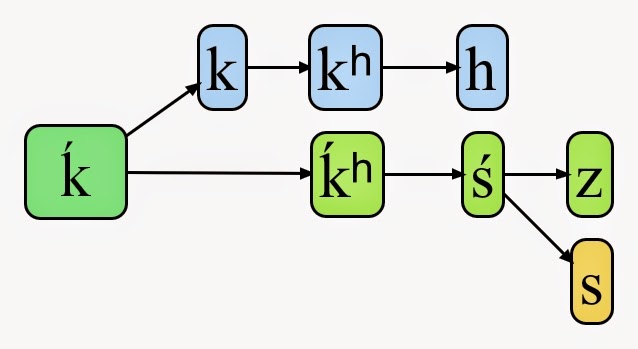
Sound changes cannot happen at random. And yet the change from /k/ to /s/ is counter intuitive. It is logical however. The steps to get the other sounds look like this (as best I can tell):


/k̑/ > /k/ involves a moving the tongue back slightly in the mouth. Allowing some air past the tongue gives /kh/ and dropping the stop altogether leaves us with /h/. The same change starting from /k̑/ > /h/ > /ś/. Voicing /ś/ gives /z/ and moving the tongue a little forward and dropping the aspiration gives /s/. 


We've already seen how ar can alternate with ra with no change in sense. And lastly we have to allow for a vowel to interpose between two consonants. Describing all the vowel changes would extend this essay too much, but one can work through the logic of that as well. We've now described how one root with a weakest grade *kṛd and strong grades kred or kerd, could produce all the many variants by the application of simple rules that are anchored in how the tongue moves in the mouth to produce vocal sounds. With this particular word the sense of it has remained remarkably stable - all the different languages understand this word to mean "heart".

So can we now say any more about Sanskrit hṛd/śrad? Looking at the IE cognates it seems that only Sanskrit exhibits this alternation of ar and ra. So my suspicion is that Sanskrit has retained this feature of PIE rather more prominently than other languages. Since getting from /h/ to /ś/ is a complex process I conclude that it is less likely than the other option: that either hṛd or śrad is a loan word from another branch of the Indo-European family. Since the expected change is /k̑/ > /ś/ and the Avestan has /z/ it looks like hṛd is a loan word from a closely related language that favoured the change /k̑/ > /h/. This doesn't eliminate the possibility that hṛd comes from a root *ǵʰrd-, just that with the resources at my disposal I cannot find such a root. Since the sense of the word changes so little across time and space, however, it seems less likely that there were two roots.

The point here is not to draw strong conclusions, but to think about how language sounds change over time, and how that change tends to be systematic: e.g. all initial /k̑/ change to /ś/. It is interesting that some of the main distinctions between say Vedic and Avestan, or between Vedic and Pāḷi are just these systemic changes in pronunciation.


~~oOo~~

Note 7 Sept 2014

According to a chart on wikipedia (I know) Avestan /z/ is a reflex of PIE /ǵ/ and the corresponding Sanskrit reflex is /h/. Thus Skt. hṛd and Av zrad might well come from *ǵʰrd-. And śrad < *ḱred is another root. What is the relationship between *ǵʰrd- and *ḱred? How to square this with cognates in other languages that clearly point to heart < *ḱred?

Compare
*ḱm̥tóm, 'hundred' > Vedic Sanskrit: śatám & Later Avestan: satəm 
*ǵʰasto- 'hand' > Skt. hástas & Av. zasta, 

Note 13 Sept 2014
Still looking into this in a desultory way. As well as ablaut (the change in vowel strength) we also see changes in the strength of consonants. The change from unvoiced stop // to voiced stop /ǵ/, as well as the change from stop to fricative /ś/ is an example of lenition or "weakening". *gʰan > han is another example of this phenomenon. The opposite process is fortition. Another type of lenition, called debuccalization is the weakening of final /s/ to /ḥ/ (as in manas > manaḥ).

9 Apr 2017

In a recent discussion on this issue on academia.edu, German Dziebel wrote:

We know that Lat cre:do, OIr cretid go back to *k'red- attested in Skrt śraddha- and, with an original root shape and a syllabic r, in Lith sirdis, etc. So, we don't need extra proof that there was a palatovelar there. We know it already. We  also have a voiced variant of it attested in hrd/zered, so we only need to understand how this voiced palatovelar got devoiced. We know that *s+D can give *sT in any IE dialect [Siebs's Law], and in Skrt ś can go back to sk- (śardha next to Lith (s)kerdzius). This is what Lubotsky shows. If Skrt ś can go back to sk-, then it can go back to sk'-, too, if comparanda warrants a PIE palatovelar after s-. This is simple logic. For us, to link hrd and śraddha- we just need to postulate 1) *g'herd- > InIr *j'hrd; and 2) *(s)g'herd-/*(s)g'hred- > *sk'red- > *śrad-, and both hrd and śraddha- receive a systematic explanation. I think where I got you confused is in bringing up Lubotsky who described how sk- > ś- in Skrt before a front vowel. He didn't tackle a situation such as śraddha where k' is inherited from PIE and what we need to prove is not the emergence of palatovelar from *sk- but the presence of s- before a palatovelar because it is that s-mobile that we're attributing the devoicing of the palatovelar to.

22 August 2014

Action at a Temporal Distance in the Theravāda

Image: All Things Thai
One of my bigger projects at the moment is an article on the problem of Action at a Temporal Distance. This is the contradiction between pratītyasamutpāda requiring the presence of a condition for the effect and karma which requires the manifestation of the effect long after the condition has ceased (with no intervening manifestation of the effect). 

Having dealt with the Sarvāstivāda approach to this problem it will be interesting to see how other schools managed. In this essay I'll look into the Theravāda Abhidhamma to see how they dealt with Action at a Temporal Distance. Where the Sarvāstivādins dealt with the problem explicitly, the Theravādins do so only implicitly, and spread the answer out so that it's not so obvious. Indeed it's so obscure that some respected modern scholars have missed it entirely!

It's fairly common to see Theravāda Dhamma books referring to the accumulation (āyūhana) of kamma over time. Other terms like latent tendencies (anusaya) and karmic formations (saṅkhārā) seem to hint at something similar. In particular saṅkhārā appears to be made up from an accumulation of cetanā. The problem here is that these kinds of answers simply shift attention without solving the problem. The question shifts from "where is kamma in the interim between cetanā and vipāka?"; to "where is anusaya or āyūhana?" If there is an accumulation of something, where and/or how does it accumulate; and why does it not affect the person until the karma ripens? Something happens to hold over the effect (vipāka) long after the cetanā that conditions it has ceased, in contradiction of the fundamental principle of conditionality. The standard answers are simply linguistic substitutions. Other commentators have noticed that there is a problem here.
"Questions about the persistence of latent dispositions and accumulation of karmic potential thus remain: once the cognitive processes are activated, are they transmitted through the six modes of cognitive awareness? If so, why do they not influence these forms of mind? If not, how do they persist from one moment of bhavaṅga-citta to the next without some contiguous conditioning medium? The bhavaṅga-citta does not directly address these persisting questions, adumbrated in the Kathavātthu so many centuries before. Nor, to my knowledge, do subsequent Theravādin Abhidhamma traditions discuss these questions in dhammic terms."
Waldron, William S. Buddhist Unconscious: The Ālaya-vijñāna in the Context of Indian Buddhist Thought. London: RoutledgeCurzon, 2003. p.83.
The bhavaṅgacitta is like a resting state of the mind when there is no sense experience. Like sense cittas, the bhavaṅga-cittas are short-lived and one follows another in succession. Unlike sense cittas, the bhavaṅgacittas all have the same object as the paṭisandhicitta or relinking-mental event that was the first conscious event to arise in our freshly minted being after the final or death-moment conscious event (cuticitta) of our last being. Unlike sensory cittas, bhavaṅgacitta doesn't register as vedanā. Thus even when we are not consciously having experiences—such as in deep sleep or arūpa-jhāna—there is a steady stream of mental events that we are not aware of that provide continuity between moments of sense awareness. 

Waldron invokes the stream of bhavaṅgacitta (or bhavaṅgasota) but it's hard to see how it can  be responsibile for accumulation if each bhavaṅgacitta is identical. This difficulty had already been noticed by Professor Rupert Gethin (before Waldron):
"...it does not seem possible on the basis of what is said explicitly in the texts to justify the claim that the bhavaṅga carries with it all character traits, memories, habitual tendencies, etc." (30).
Gethin, Rupert. (1994) 'Bhavaṅga and Rebirth According to the Abhidhamma.' in The Buddhist Forum. Vol III. T. Skorupski and U. Pagel (eds.), London: School of Oriental and African Studies, University of London, pp. 11–35.
However Gethin is alive to the need for something to do this job or perhaps we should say, for this function to be carried out somehow. Since bhavaṅgacittas all have the same object they aren't much use for the kind of connectivity with accumulation we are looking for. But they are not a million miles away. Gethin finds it inconceivable that the great Theravādin commentators, Buddhaghosa, Buddhadatta, and Dhammapala, had not considered the problem, and he ventures to speculate a little on how they might have solved it. Like Gethin, I'm interested that the great three seem not to have openly dealt with the problem in the way that Sarvāstivādins did. Buddhaghosa is nothing if not thorough.

For Gethin there are many similarities between bhavaṅga and ālayavijñāna (the solution to the problem of Action at a Temporal Distance adopted by Yogacārins, based on the Sautrāntika idea of 'karmic seeds'). Thus he is willing to entertain the thought that the two at least "belong to the same complex of ideas within the history of Buddhist thought." (35). I agree on this last point. However I think we can go further.

Firstly a reminder that in Dhammavāda there are four kinds of dhamma: citta, cetasika, rūpa and nibbāna. Importantly for us, each citta though itself singular and occurring strictly in series, has a variable number of associated cetasikas. What the Buddha calls kamma is cetanā, which is classified as a cetasika. So each citta has associated with it a cetanā that makes it morally significant. Just to be clear a citta is a mental event and a cetanā is the intentional function of that mental event. With this in mind we can look at what some of the traditional sources tell us about the accumulation of kamma.

Buddhaghosa provides a quote from the Paṭisambhidāmagga that looks promising. At Visuddhimagga (Vsm) XVII.292:
Tenāha ‘‘purimakammabhavasmiṃ moho avijjā, āyūhanā saṅkhārā, nikanti taṇhā, upagamanaṃ upādānaṃ, cetanā bhavoti ime pañca dhammā purimakammabhavasmiṃ idha paṭisandhiyā paccayā’’ti (Ps 1.47).
Hence it is said: 'In the previous kamma-process becoming, there is delusion, which is ignorance; there is accumulation (āyūhanā) which is formations (saṅkhārā); there is attachment, which is craving; there is embracing, which is clinging (upādāna); there is volition (cetanā) which is becoming (bhava); thus these five things in the previous kamma-process becoming are conditions for the rebirth-linking here [in the present becoming]. (PTS Ps i.52). trans. Ñāṇamoli
Elsewhere the commentary on the Saṅkhārasuttaṃ, AN 3.23 (Mp 2.192), Buddhaghosa glosses the phrase kāyasaṅkhāraṃ abhisaṅkharoti with:
Kāyasaṅkhāranti kāyadvāre cetanārāsiṃ:
The body-formation [is] "a heap of intentions in the body-door”. 
Abhisaṅkharotīti āyūhati rāsiṃ karoti piṇḍaṃ karoti.
The verb abhisaṅkharoti [means] he accumulates, he makes a heap, he makes a lump.”
This points towards saṅkhārakkhandha as the process by which cetanā accumulates. But I still don't see where this fits into the cittavīthi (or the track of mental events). A problem here is that kamma accumulations are not supposed to take effect until the kamma ripens, creating a vipāka. The idea that kamma accumulates as saṅkhārā is attractive, but there is a contradiction since the saṅkhārā is actively involved in the perceptual process. The experience of the vipāka is supposed to be a one-time thing: it ripens and we either experience it as vedanā or we experience it as gati (rebirth destination) and then it is expended. If it were not expended then there would never be a way to escape from previous negative karma. This is complicated because clearly habitual tendencies (positive and negative) are a phenomenon that everyone experiences. They're also centrally important in cultivating a Buddhist lifestyle and the pursuit of liberation from greed, aversion and confusion.

There's nothing intrinsically wrong with the idea that a kamma stays active for a period and has an effect while active; and then once it is exhausted ceases to be active. But that's not what the texts describe. And the same limitations apply: the kamma qua event is short-lived and if it is to accumulate we have to find a way to pass on the effect without the continued existence of the condition. Effects are said to accumulate despite the absence of their conditions which, being mental events, exist only in the moment.

In Early Buddhist Metaphysics, in the chapter "Causation as the Handmaid of Metaphysics" Noa Ronkin summarises the 24 types of conditions as found in the seventh book of the Abhidhamma, the Paṭṭhāna. This seems to be the key to understanding the Theravāda response to Action at a Temporal Distance. The functions of accumulating and passing forward kamma are distributed amongst several different types of conditionality. The approach relies on the idea that dhammas can operate as a condition in many different modes. Twenty-four such modes are discussed in the Paṭṭhāna.

Under her discussion of the pair proximity condition (antara-paccaya) and contiguity condition (samantara-paccaya), Ronkin says, "Every preceding thought moment is thus regarded as capable of arousing succeeding states of consciousness similar to it in the immediately following instant." (216). She further speculates that these two, almost identical, modes of conditionality were "probably necessary in order to account for the continuity of phenomena without relying on any metaphysical substance". (216) Buddhaghosa covers this subject in Visuddhimagga XVII.73-6 (Vol 2, para 598 in the VRI ed.) Buddhaghosa spends some time refuting an internal dispute regarding the need for temporal proximity. The fact that Theravādins were not united on this issue of temporal proximity is telling. It shows that they were actively considering the problem of Action at a Temporal Distance and divided over how to solve it. If we follow through the rest of the paccaya modes we find more specific links of this kind.

The decisive support condition (upanissaya-paccaya) allows a dhamma to self-sufficiently arouse a resultant dhamma, like the related nissaya-paccaya but not necessarily foremost and "it lasts longer, has long-term effect and implies action at a distance... The importance of the decisive support condition seems to lie in its accounting for more and spiritual progress: virtues like trust or confidence (saddhā), generosity (dāna), undertaking the precepts and others, all assist the occurrence of their long term results (the jhānas, insight, taking the path etc) as their decisive support, and these results, in their turn, condition the repeated arising of trust, generosity etc. (219, emphasis added). As the Paṭṭhāna says:
purimā purimā kusalā dhammā pacchimānaṃ pacchimānaṃ kusalānaṃ dhammānaṃ upanissayapaccayena paccayo.
"All preceding wholesome dhammas are a condition by way of decisive support condition of all subsequent wholesome dhammas" (i.5)
Similarly for unwholesome (akusala) and undetermined (avyākata) dhammas. This section is covered in Visuddhimagga XVII 80-84. This criteria of self-sufficiency is interesting since it seems to flirt with something like svabhāva. Here though a dhamma is not a condition for itself, but a condition for another which we would expect to be parabhāva, a term we do find in Nāgārjuna's discussion of conditionality. This aspect requires some more research, but it looks like an all or nothing problem such as Nāgārjuna describes for svabhāva.

We also have:
Habitual cultivation (āsevana-paccaya)... "for example, developing a certain skilful thought once facilitates the cultivation of the same thought with a greater degree of efficiency and intensity... It therefore underlies the cultivation of right view, right speech and right action." (Ronkin 219)
Habitual cultivation is thus also responsible for memory without an agent that remembers. Ronkin places this observation in a note (242 n.118), with a reference to an article in two parts by David Kalupahana (1962) 'The Philosophy of Relations in Buddhism' University of Ceylon Review: 19-54; 188-208. Kalupahana re-visited this material in his 1975 book: Causality: The Central Philosophy of Buddhism (Uni of Hawai'i Press), especially chapter VII "Causal Correlations". However compare:
"It is because of proximity-condition and contiguity-condition that we can remember past experiences, events which occurred many years ago." (38)
Gorkom, Nina van. (2010) The Conditionality of Life: An Outline of the Twenty-four Conditions as Taught in the Abhidhamma. Zolag.
This is troubling because the two commentators contradict each other. Buddhaghosa seems not to participate in this dispute. He mentions memory under neither heading. More research is required to untangle this knot, which only further emphasises the difficulty of dealing with the problems raised by Action at a Temporal Distance.

The kamma-paccaya occurs in two modes simultaneous (sahajāta) and asynchronous (nānākhaṇika)... and according to Ronkin:
"An asynchronous condition obtains when a past kamma comes into fruition in a manifest corresponding action. Although the volition itself ceases, it leaves in the mind latent traces that take effect and assist the arising of an appropriate action when the necessary conditions are satisfied" (220)
This is less satisfying because it does not explain the "latent trace" but I think the implication is clear enough in the light of the other passages. 


Conclusions

The picture is that each citta is not a simple event, but a complex one with many facets (cetasikā). And each citta conditions the next in a variety of ways (twenty four different ways according to the Paṭṭhāna). Theravādins envisaged that an aspect of conditionality would be the passing on of information from citta to citta, particularly the information relevant to karma: information about cetanā. And this process is perfectly conservative in order that karma can be 100% effective. There is no loss of information until the conditions amassed in a life-time manifest as a single vipāka. This takes place at the moment of death when death-moment conscious-event (cuticitta) occurs and conditions the paṭisandhicitta or 're-linking mental event'. By focussing on the information content the Theravādins avoided positing an entity for storing information. And by denying any interval between death and rebirth they avoided the complicated and unsatisfactory metaphysics of the antarabhāva or interim state. Thus information is conserved even though no entity is.

The idea of continuity with no entities, nascent in the suttas, is fleshed out in the Paṭṭhāna. It's not so clear what Buddhaghosa intended in Vism., though he bases his exposition on the same sources. Also some modern commentators seem to interpret functions like memory as being related to different kinds of condition.

I'm still slightly puzzled that this problem is so prominent elsewhere, and yet here quite submerged and difficult to get at. However, when one considers how initially disturbing is the notion that the two fundamental doctrines of Buddhism contradict each other it may be that at the same time as solving the problem they swept it under the carpet.

However, on first acquaintance this solution to Action at a Temporal Distance is far from satisfactory. If citta is a kind of dhamma then it ought to be unitary and simple. How does such a simple, momentary event operate as a condition in twenty-four distinct ways simultaneously? But then a citta is not a simple event after all, because it is always accompanied by cetasikas which are also dhammas. So is a citta a dhamma or not?

We still have no knowledge of how the final conscious event in one mind conditions a first conscious event in another mind. Handing on information within one mind is somewhat intuitive, but transmitting it to a spatially separate mind is quite counter-intuitive. Every single person has first-hand experience of the first, while experience of the latter is reported by a very few witnesses that we have every reason to doubt.

Traditionalists seem not to have an answer to this. The best they can do is to state that they simply cannot imagine conscious processes ceasing with physical death, and so it seems "natural" that conscious events continue to happen so their must be a transfer somehow. This is what all believers in an afterlife think: the afterlife is all about acknowledging physical death but denying mental death (a trait observed already in quite young children). So this refusal to allow for one's inner life to cease, certainly has a long pedigree and is widely accepted, but it doesn't ever answer the question of "how". Indeed the question of how can often produce hostile anti-intellectual responses which attack the idea that questions like this can be answered. The afterlife must be taken on faith and the answers to probing questions about the afterlife are never satisfactorily answered, which undermines faith.

Another question for this model is, how does the mind know that any particular citta is to be the last in this life and thus take on the function of cuticitta? That last citta has to perform a special function so it must "know" that it is the last citta. It implies a peculiar kind of determinism. But it also implies a very simplistic view of death. For the ancients death is consistent with the cessation of observable bodily processes, particularly the breath, which I have explained in my essays on vitalism is the quintessence of a living thing. However we now know that one can stop breathing for many minutes and be resuscitated (which is from the Latin and means "to summon up again"). In the West we have long associated death with the cessation of the heartbeat. But the discovery of brainwaves led to more precise definitions related to brain activity. However even this is far from precise. Identifying the last moment of consciousness is impossible. In the last couple of years fMRI scanners have enabled us to perceive mental activity in people who are in persistent vegetative states. 

A puzzling aspect of this model is the huge build up of information that would occur over a life time of responding to sensory cittas. If we have several cittas per second then the information being passed on from citta to citta grows exponentially (as we must "process" information about the information); especially if we consider that memory is a function of this process as well. Each citta passes on information about itself and information accumulated from all previous cittas. It seems implausible at best that such a process had sufficient bandwidth to transfer a lifetime's information in a fraction of a second, every fraction of a second without ever glitching. Let alone the information from uncounted lifetimes from the past.

We also need to acknowledge the obscurantism of the source texts. The Paṭṭhāna and the Visuddhimagga are both very difficult texts to read and comprehend. Which means that for the most part we are reliant on commentators to explain the intention of the authors. And the commentators apparently disagree.

Perhaps it is expecting too much of these very early theories to stand the test of time and the rigours of a modern philosophical inquiry? It's one thing to understand the Theravāda view on it's own terms, it's another altogether to accept it on those terms.

This inquiry raises important questions. We cannot both embrace modernity and these ancient ideas about mental functioning. Something has to give. I know many Buddhists are content to let it be modernity that gives way. Buddhist apologetics are proliferating at present in the face of the conflict. But there is always something two-faced about the rejection of modernity. We embrace modern medicine to stay alive while rejecting the idea that the mind is an emergent property of brain and body function, even though both are products of the same body of knowledge. How ironic that the internet is a prime tool for dismissing modern progress away from superstition towards reason. Perhaps this is because the internet is a sufficiently advanced technology that is seems like magic?

For the present we can just about have our cake and eat it too, but how long can this continue? Must we choose between anachronistic, superstitious, rejection of modernity; and a non-religious, humanist, scientific utopia? Or is their some middle ground?  

~~oOo~~


This essay began life as a discussion on the Dhammawheel forum.
Thanks to those who contributed to the discussion.

Related Posts with Thumbnails