24 July 2009

Indo-European Writing


brhami scipt from British Museum

Aśoka (6th) Pillar fragment
Brāhmī inscription
formerly at Meerut. Mid-3rd century BCE.
(?u)pagamane sememokhyamate
(bhi)sitename iyaṃdhaṃmali(pi) li*


© British Museum (my photo)
When I recently blogged about Indo-European languages one of my friends asked what is quite an obvious question: what about writing? So I'm going to outline the development of writing as it is relevant to Buddhist India. India is very linguistically diverse - there are three distinct language families, including Indo-European, plus a number of languages not related to any known language - known as 'isolates'.

Most modern scripts can trace their origins to Mesopotamia. A surprising number trace their roots to the writing developed in India - in fact almost every country that saw Buddhist missionary activity, excepting China, has seen some influence from the India scripts on their writing systems. That said writing came relatively late to India, and even then was not used for religious texts for many centuries.

The earliest evidence of writing anywhere in the world is from around 3500 BCE in present day Iraq. The Sumerians left caches of clay tablets at sites along the Tigris and Euphrates Rivers. This earliest writing, similar in some ways to the earliest Chinese writing (ca 1400 BCE), involves pictures which represent concepts. However it was with the invention of cuneiform that something like writing as we know began. The earliest examples of cuneiform combine signs for concepts with signs for sounds (as do Egyptian hieroglyphs). A variety of cuneiform continued to be used in the middle-east until the last century before the common era. However in the same region speakers of Semitic languages began to represent their language using only signs for sounds - i.e. to use a true alphabet - around 2000 BCE.

The Achaemenid empire (ca 550 - 350 BCE) founded in Persia adopted a form of Semitic writing, often called Aramaic after the language it encoded, for administrative purposes. It represented a significant improvement on cuneiform - it could be written (and read) more quickly and easily, and on a much greater variety of materials. Now it so happens that the Achaemenids invaded India and controlled, or at least had a powerful influence, up to the western bank of the Indus River - about half of what is now Pakistan. In fact the Buddha lived during this period and there is some evidence of Persian influence in the Pāli Canon - which I have discussed previously in this blog. The Achaemenids were toppled by Alexander of Macedonia, and in India at least the power vacuum was filled by the Mauryan Dynasty of which Asoka is the stand out figure.

Certainly by the time that King Asoka ruled India (mid 3rd century BCE) there was a well developed form of writing: the Brāhmī Lipi or Writing of God which he used on his rock pillars and edicts. Brāhmī is said to show signs of influence from Aramaic. Another script, Kharoṣṭhī, was less widely used in India proper, but was the main script in Gandhāra and parts of central Asia for some centuries. We can say with some confidence that Kharoṣṭhī was based on Aramaic as it retained many features of the Semitic script. It is possible that Kharoṣṭhī influenced the development of Brāhmī , but it is difficult to say because the earliest known examples of Brāhmī are already a fully fledged script and the direction of development subsequently is determined by the nature of Indian languages.

We can say that all forms of written language in India, as well as Tibet, Burma, Sri Lanka, Thailand, Laos and Cambodia are descendants of Asoka's Brāhmī. In India there was a very distinct north/south divide which I think was caused by writing materials, but may have been influence by the geographical spread of Indo-European languages (north) and Dravidian languages (south). The North favoured birch bark and wood to write on, while in the South the material of choice was the leaf of the talipot palm. The palm leaf is ribbed which lead to the development of the more rounded shapes of Southern writing (which then influenced Sinhala, Burmese etc). Note that technically Sinhala is a North Indian language, part of the Indo-European family, and not related to Tamil or other Dravidian languages, but it is written in a southern style script and palm leaves were the medium of choice until relatively recently. Similarly Burmese, though written with a Brāhmī derived script is part of the Tibeto-Burman family which has a relationship with the plethora of Chinese languages.

Brāhmī underwent continuous development in the North and diversified into local geographical variants. But because dynasties based in the North-east - particularly the Mauryans and then the Guptas (3rd - 6th centuries) - were dominant they tended to influence the development of writing more. The Brāhmī variant commonly used by the Guptas was by that time a distinct script. The Nalanda University was in the Gupta heartland and the Gupta script was important in the spread Buddhist texts. Later it would give rise to the Siddhamatṛkā or just Siddhaṃ script which was commonly used to write the Tantras. It is still in use today for writing mantras in China and Japan. The Gupta script, or something very like it was used as the basis for Tibetan writing, which also continued to develop independently and diversify. Siddhaṃ evolved into Devanāgarī, which is the most common script for Sanskrit in the present - though it is written using the Tamil script in South India for instance.

There are several ways of represent sounds using signs. The English alphabet attempts to convey individual sounds that combine into syllables or phonemes. This is a very efficient way of representing spoken sounds - with just 26 letters we manage to convey the 25 single consonant sounds, and 23 vowel sounds that are used in 'standard' English (as represented by the Oxford English Dictionary) and an extensive repertoire of combination of them in words and sentences. Another method is to represent speech as a series of syllables. One can either represent all possible syllables by individual signs which is only practicable if there are a small number of syllables - the Japanese Kana alphabets are good examples of this approach. An intermediate option is available where consonants and initial vowels have distinct signs and these are modified to show medial and final vowels. The latter is typical of Indian writing.

There are several distinct features shared by all Indic scripts which I will demonstrate using Devanāgarī. Initial vowels have distinct signs - 14 in Sanskrit - but medial and final vowels, and the absence of a vowel (which happens at the end of words and in conjuncts) are indicated with diacritic marks. Consonants are assumed to be followed by the short 'a' vowel unless otherwise specified. क is ka not k. Examples of vowel diacritics are: kā ke kai ki kī ko kau kṛ = का के कै कि की को कौ कृ. Vowels may also be absent, nasalised or aspirated (the technical terms being virāma, anusvāra, visarga), so g, gaṃ, and gaḥ = ग् गं गः . Indic, like English, allows for a variety of combinations of consonants without intervening vowels. These are either written as a vertical stack as in ṣ + ṭha > ṣṭha = ष् + ठ > ष्ठ; or as a horizontal combination with the initial consonant as a "ligature": t + pa > tpa = त् + प > त्प. As many as four consonants can be combined in this way e.g. strya स्त्र्य. Special variations occur with 'r' viz pra = प् + र > प्र, and rta = र् + त > र्त; ś can also undergo a special change e.g. śva = श् + व > श्व; cf śya = श्य; and some conjuncts have distinct signs jña ज्ञ and kṣa क्ष. Writing Sanskrit this way is considerably more complex than writing English.

Buddhist texts in Indic languages are preserved in a plethora of scripts: Brāhmī in many varieties, the Gupta script again in many varieties, Siddhaṃ with some variation over time (and major variants in China and Japan), Kharoṣṭḥī, Devanāgarī, several Tibetan scripts, Sinhala, Burmese, Thai etc. Each of these scripts records texts in an equally wide variety of Indian languages and dialects; and of course many texts are now known only in translation in Chinese, Tibetan or any of a dozen other languages - making the history of Buddhist texts quite complex. All this is remarkable given centuries of resistance to the use of writing for the purpose of writing sacred texts in the early days of Buddhism.

A scholar of Buddhism must often know several languages and associated scripts in order to read the relevant manuscripts. The standard of handwriting in ancient times was often quite poor, and the attention to copying of texts wavered causing scribal errors, which means that no two manuscripts are ever the same. Deciphering such manuscripts requires imagination and powers of deduction as well language skills. As such we owe a great deal to those people down the ages with the aptitude and motivation to take on the difficult task of learning these, often dead, languages and scripts, in order to study and translate the texts for us. Having dipped into their world I am in awe of them.

Note

* The bottom line of the Brāhmī inscription pictured is a fragment of a longer stock phrase:
saḍuvīsativābhisitena me iyaṃ dhaṃma lipi likhāpita
when I [Asoka] had been consecrated twenty-six years I ordered this inscription of the dhamma to be engraved
- c.f. the 1st pillar in A. L. Basham The Wonder that was India, 1967, 2001, p.395. There is now some doubt as to whether Asoka meant the Buddhadhamma or his own dhamma [see Aśoka, Pāli and some red herrings].

17 July 2009

Do we have a choice?

Recently Matt Quinn commented on my post "Who Craves?" He asked a very good question and in answering it I found myself edging over into rave mode and realised that it would be a good topic for a stand-alone blog post. I had said "An interesting conclusion here is that we aren't personally responsible for the arising of craving (or hatred) in the present. There can be no doubt that we are responsible for our present actions, ..." and Matt's question draws out an interesting point:
"It seems that you are saying we don't choose whether or not we crave, but we do choose how we act. Have I understood you correctly? If so, then I would like to ask whether you consider choices (or actions) to arise dependent upon conditions just as craving does? If this is the case, then why am I responsible for the former and not the latter? If this isn’t the case, then why isn’t it the case?"
The question is basically the question of free will. Are our choices in response to craving and hatred really choices or are they a matter of karma playing itself out?

There are many ways to approach this. So let's start with cause and effect. Craving is an effect of previous choices. Choices cause craving (or not). The fact that we do crave influences our choices - but it does not determine them. When craving is present we are strongly drawn to the object we desire, but we are not inexorably or invariably drawn to it. Experientially you will know this to be true - sometimes you can say no to desire. This choice, according to Buddhism, is always present, and it is what distinguishes the human state from other possible states of being.

My understanding of free will is that it is silly to insist on absolutes - the debate in the West is often in terms of do we have it or not, and this is framed by a dispute within Christianity, as well as a dispute between Christians and Humanists. This is not a debate I'm inclined to join on it's own terms as it is framed in terms of a world view I don't share. I suggest that it is more useful to ask this: "to what extent are we free to choose?" Our choices are conditioned by our previous choices - the technical term for this is saṃskārā. If we make the same kind of choice many times it becomes habitual, and habits are hard to break, saṃskārās are these habits compounded over lifetimes. Even addictions, where there is very little choice, however, are able to be overcome given good conditions. People can and do change. I know I've seen it for myself, and so the question becomes how much can we change, and under what conditions, and in what directions?

Sometimes rather than exercising free will we might talk about setting up positive conditions for change. By this I mean conditions which encourage mindfulness and emotional positivity. The traditional way of talking about the wheel of life is that most of it is just inevitable, almost like an automatic process: so if you are born, then you die, and are reborn; if you have the sensory equipment then you have sensory experiences. And the rest is just details. But there is a possible gap in the process. It is between sensation (vedanā) and craving (taṇha). It is just possible to experience the pleasurable sensation and not experience the desire to possess it. If this were not possible then we could never say no to desire.

In breaking free of craving we do not break the cycle all at once. At first we weaken the reaction. So when there is no mindfulness we experience the pleasurable sensation, and reach for it without thinking. When we have some mindfulness however there is a possibility of not reaching for the object. We may feel the desire to reach out for the pleasure (to try to obtain, maintain, or retain it: the -tain part comes from Latin tenere "to hold"), but we stifle the desire and in doing so we experience a little bit of freedom - a taste of freedom. We can build on this until we have more and more freedom to not try to obtain the object of desire. We find that this makes us more content. Often you get a taste of this on retreat where the conditions are good for mindfulness and desire naturally reduces. Then the task becomes the breaking of desire itself which means we go beyond being mindful of our sensations and reactions, and trying to hold in mind the process itself, and try to see into that process to see through it - this is the literal meaning of vipassanā, to see through.

Early Buddhist texts identify two trends in conditionality. In one we simply act on craving, hatred and confusion and this sustains those very qualities. Acting on craving leads to more craving. In the second we act on some positive impulse - the two main one's in the texts are faith (saddha) and non-remorse (avippaṭisāra) - then this leads to positive consequences that in turn set up the conditions for more positive consequences. At some point we are making so many positive choices that there is no scope for craving. So we have two ways to deal with craving - to reduce and eliminate it through mindfulness; or we can overwhelm it with positivity. Sangharakshita has called the first path cyclic, and reactive; and the second spiral, and creative.

Note that one strain of Buddhism - descending from the Japanese thinker Shinran - came to the conclusion that there is so little choice that individual will is insufficient and that all we can hope for is rescue by a Buddha as set out in the Sukhāvati-vyūha Sūtras where Amitābha makes a series of vows to save all beings. This kind of faith based approach to Buddhism is very popular in East Asia, and indeed it is important in the West in the form of Nichiren and Soka Gakkai - the latter being an offshoot of the former. However, even within that kind of framework it is up to the individual to develop their faith, so even there we are not free of actually having to make choices.

In fact we are always making choices and decisions even if only unconsciously. It can't be avoided. Scientists have begun to show that animals do make limited choices, but we may still generalise and say that the characteristic of animals is that they simply respond to stimulus and act without reflective thought or self-reflection. Human beings are many orders of magnitude ahead of our animal cousins in that we have the ability to reflect on our actions and to examine our motives for acting. We are moral beings, whether we like it or not, and our actions have moral consequences. In order to fully take up our humanity we must engage with this fact and at least begin to take responsibility for our actions. Though addicted to pleasurable sensations (and we may say the avoidance of unpleasant sensations) we have a choice.

Our instincts are honed for a much less sophisticated and technologically simple world and often do not serve us in the present. The natural desires for example for sex, for sweet and fatty foods, and for social status are hyper-stimulated in our societies. So every relationship is sexualised, we are fat, and we constantly struggle for status through grooming and/or combat. Nietzsche famously said that man is a tightrope stretched between the animal and the 'over-man'. We retain some of our animal characteristics, but we are capable of being so much more. As followers of the Buddha we conceptualise this 'more' as 'Buddhahood', as being liberated from greed, hatred and confusion. And the key is that we do have a choice, and each positive choice we make gives us more choice in the future.

image: cartoon from www.marriedtothesea.com.

10 July 2009

Kūkai's journey to China : Kentōshi Ships and Weather

To see my Google Map click here


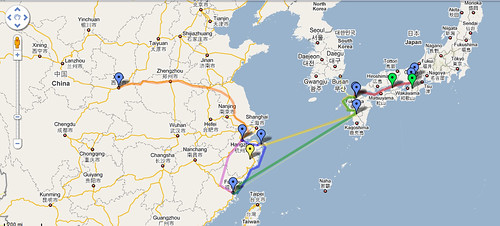
One of the marvels of modern technology is that we have easy access to all kinds of information. I've been trying to visualise Kūkai's journey to China and to understand the scale of it. Using the internet I was able to locate a journal article which discusses the detail of the journey, then using Google Maps I have been able to visualise it and get a sense of the scale of it. The route outlined here relies on an article by Robert Borgen in Monumenta Nipponica.*

Kentōshi (遣唐使), which means 'Envoy to the Tang' i.e. mission to Chinese court of the Tang (T'ang 唐) dynasty,** was used to describe both the people and the ships they went on. We don't have much definite information about the vessels, but it is assumed that they were built on the model of the Chinese junk which were developed in China during the Han Dynasty (220 BCE - 200 AD) which were being used for ocean voyages by the 3rd century. Such Chinese ships visited Japan for trade. We know that the Japanese and the Koreans definitely used Chinese junks as models for later ships. It's often stated that because the ships had a flat bottom and no keel that they could only use the sails when the wind was directly behind them. However the boats used a very large rudder which projected well below the bottom of the ship, and did much the same job as a keel, i.e. it stopped the wind pushing the boat sideways when sailing to windward. They could probably have managed to sail close hauled at between 45-60° to the wind. Which in fact means that they could sail in much the same way as an early square rigged European ship such as Magellan had sailed around the world in.

The idea that the Japanese were poor sailors seems to be an assumption related to their decision to sail in the typhoon season, but as I pointed out in an earlier post (Why did Kūkai sail in summer?), the Japanese envoys were concerned to get to the Tang court on New Years day in order to offer their tribute at the appropriate time, and this must have over-ridden the concerns of the sailors. In fact the Japanese were highly attuned from ancient times to the annual changes to their climate wrought by the monsoon, and I find it very unlikely indeed that they did not understand the wind patterns. Note also that by Kūkai's time, in the early 9th century, envoys from the nation of Po-hai (north of Korea) to Japan regularly timed their journeys to take advantage of seasonal winds.

It's very often stated that the winds were against the ships sailing across the sea to China, but the prevailing wind during the summer monsoon in that region is from the south-east. This means that the Kentōshi ships, sailing south and west, were most likely cutting across the wind - a favourable geometry for sailing. With a wind from the south-east (135°) they could probably have sailed in any direction from say 0° - 75° and 195° to 360°. In fact a line joining Tanoura to Ming-chou is at about 252-3° which in sailing terms is a 'close reach' and probably well within the capabilities of the ships.

It is quite unlikely that they could have made the journey at all if they had to row ships that probably weighed over 100 tons all the way, and it does not seem so unreasonable to me that they relied on sails most of the time - even sailing north from Fu-chou to Ming-chou. Note that all four ships of the mission survived a typhoon, some of them two typhoons, and a 500 mile ocean crossing so they must have been reasonably well built. European ships of a similar size and square rigged could make about 5-7 knots, and, allowing for variable wind conditions and given that they would have paused during the night when they could, I initially guessed that they might average about 20 or 30 miles per day.

Previous missions would have made a quick jump across the straights of Korea probably via Tsushima Island, a journey of about 150 miles with a longest stretch of open water of about 35 miles. On a good day the Kentōshi ships could have sailed that distance in a single long day. From there the boats would have hugged the coast all the way to China. However in the 7th century Japan's long term enemy Silla had, with the help of Tang China, unified the whole Korean peninsular under their rule, leaving the Japanese with no bases on the mainland and a more powerful antagonist as neighbour.

The four Kentōshi ships left from Naniwa (modern day Ōsaka) and headed for Hakata (Fukuoka) on Kyūshū Island, a distance of 330 miles most of which is in the usually pacific Inland Sea. Note however that in 803 when the mission first sailed the boats were almost wrecked by a (rare) storm in the Inland Sea. From Fukuoka the ships hugged the coast of Kyūshū down to Tanoura (since merged into Ashikita), the last stop before heading west across the East China Sea. We don't know how good the navigation techniques were at this time, though simply sailing west would mean hitting China at some point, but the ships ideally would make land near the modern city of Shanghai or north of there. They left from Tanoura on the 6th day of the 7th month of Enryaku 23 (ca 14 August 804).

Of the two ships that completed the journey in 804 Ship Two is said to have taken about two months to get to Ming-chou (near modern Ningpo). Now here is a puzzle: Abe, Hakeda, and others give this time frame, but Abe says that the Vice Ambassador who lead Ship Two died in Ming-chou on the 25th day of the 7th month of Enryaku 23. This is a mere 19 days after leaving Tanoura. So, assuming this is not a misprint, either the Vice Ambassador died at sea less than half-way across, or Ship Two made very good time crossing the 540 miles, averaging about 30 miles a day. The latter figure is not unreasonable if they met no more storms, and my other assumptions are correct.

Ship One, the ship that Kūkai was on, took much longer to make the crossing, coming to land on the 10th day of the 8th month (ca 17 September 804) after 34 days at sea. They landed near the city of Fu-chou, in Fukien province (modern day Fuzhou, Fujian). It is sometimes said that this was 1000 miles south of where they intended to be, however the map above makes it clear that the distance from Fu-chou to Ming-chou by sea is about 390 miles, and by land about 360 miles to Hang-chou (using a route something like that suggested by Borgen). In a straight line Ship One covered about 750 miles in the crossing, which means they averaged at least 22 miles per day. In fact we know that they didn't go in a straight line because they were blown off course by the typhoon.

On the return journey (late June early July of 805) which was apparently without major incidents Ship One took nineteen days to make landfall at Tsushima (the island in the Strait of Korea); while Ship Two took twenty eight days to arrive at Hizen on Kyūshū Island. This is about 29 and 19 miles per day respectively - quite comparable to the outward journey suggesting that 20-30 miles per day is a good measure of the average speed of the ships.

typhoon over the East China Sea
Typhoon Tokage near Japan
Image Courtesy NASA Earth Observatory
Typhoons make a rather wavy line as they progress towards Japan from the Pacific Ocean, typically they follow the prevailing winds which spiral out from a massive region of high pressure over the Pacific and into a low over continental Asia. In August the typical typhoon would swing around Kyūshū and head up the Sea of Japan - though a lot of variation has been observed. As the typhoon approached the wind would have swung around initially from the south-west, to the west - the winds swirl in anti-clockwise to the centre, and have become a tight knot by the time they reach Japan. On the western side of the storms the winds are blowing more or less to the south and this explains how Ship One might have been sent far southwards. Ship Two somehow escaped this. The trailing edge of the typhoon seems to have blown Ships Three and Four eastwards back to Japan, though this suggests that there was already a significant distance between them and Ships One and Two by this stage.

Borgen's article is an important source of information about ships 3 and 4 from the Kentōshi flotilla - but that is another story. Hopefully you can see that using Google maps in this way really does makes the scale of the journey clearer, and you find my route plausible where I have supplied details not vouchsafed by history. The historical sources are vague on the construction and design of the ships, but I hope my reinterpretation of the Japanese as intelligent and able boat builders and sailors is both welcome and sound - I hate it when historians assume that people are stupid because they (the historians) don't understand what was going on!


Notes
* Borgen, R. The Japanese Mission to China 801-806. Monumenta Nipponica, Vol 37(1), 1982, p.1-28. In this article I also indirectly cite or use information from: Abé, Ryūichi. The Weaving of Mantra: Kūkai and the Construction of Esoteric Buddhist Discourse. (Columbia University Press, 2000); and Hakeda, Y.S. Kūkai : major works : translated and with an account of his life and a study of his thought. (New York : Columbia University Press, 1972).
** I tend to use the Pinyin version of Chinese transliteration with Wade-Giles equivalents in parentheses at the first occurrence. If there is only one transliteration it is Wade-Giles and I don't have a Pinyin version. Some names have changed substantially since Kūkai's time.

For other materials related to Kūkai and his voyage see my Kūkai bibliography.

Aug 2010 Update.

Since writing this essay I have studied the Diary of Ennin (Ennin, E.O. Reischauer (Translator] Diary: Record of a Pilgrimage to China in Search of the Law) paying particular attention to his records of wind and sailing directions. Although he records about a dozen combinations, the ships he sails on never seem to sail into the wind, and only run before it. It now seems more likely to me that the ships couldn't manage anything more than a broad reach - about 45° either side of the wind direction, i.e. that they could not use a head wind. I've noted that the prevailing wind at the time of year is from the South-East (or perhaps the East) and this may tally with their leaving from quite far south on Kyūshū - they expected to make leeway to the North while travelling West. Although my lines on the map are straight it seems likely the storm blew them far to the south, and that they then sailed North/N' West to make landfall. I have no idea if the could accurately determine latitude.


03 July 2009

The Role of Monasteries

Tiger's Nest Monastery BhutanIn March 2008 Melvin Bragg's 'In Our Time' show focussed on the dissolution of the monasteries of Britain in the 16th century by King Henry VIII. Although the monasteries were wealthy and this was something that lead to their downfall, I was struck by how the role of the monasteries was defined: they were there to pray for the nation and the king. There is a parallel here with Japan in the Nara and Heian periods - the two eras which Kūkai's life straddled.

Before the dissolution there was probably no place in the UK more than thirty minutes from a monastery. European monasteries had a routine of daily prayers which were always the same, and chanted or sung at the same time every day. They also celebrated saints days and festivals. In the case of Japanese monasteries the chants were Buddhist sūtras, but otherwise the form and function were very similar.

Monastery and monk are related to the word mono and all convey the idea of 'singular', an individual or one alone. Clearly the term must have applied originally to hermits or anchorites. Anochorite comes from Greek anakhoretes, lit. "one who has retired." However these days we understand a monk to be someone who lives communally. The term for this is 'cenobite' from the Greek koinobion "life in community, monastery." The traditional terms bhikṣu/bhikkhu are often translated as 'monk', and this works because although bhikkhus were likely to have been anchorites in the very early days, they have mostly been cenobites for many centuries. The word 'nun' by the way comes from an entirely different source - it is a name for a female elder and is related to 'nana' (which is what we called my grand-mothers as kids).

I like this image of numerous widespread groups of people whose sole responsibility was praying for the benefit of the nation and the king or queen. Of course this was before the present scientific era, and prayer was a far more prominent approach to dealing with suffering. These days we think that science and technology have suffering beat. There is no doubt that scientific medicine has made a huge difference in our lives - we live longer, survive diseases that might have killed us, and have a more comfortable life generally. However we still grow old, still get sick (in ways that cannot be simply cured by drugs), and we still die. These facts are very much at the heart of the Buddhist definition of suffering, and they haven't changed. Often we feel a greater sense of unease about old-age, sickness and death and I think this is why a rigidly rational approach to life fails to satisfy. Keep in mind here that recent research on the placebo effect has shown that if we believe that prayer helps us recover from illness, then it will help!

I think it's fair to say that the image of the Buddhist monk these days is quite different, and to be fair the monks themselves seem ambivalent about what they are doing. I have heard it said that becoming a monk is a selfish act. I disagree with this, but I can see where the idea might have come from. Monks don't work, and rely on others for their living. This is inimical to the Protestant work ethic, and so is frowned on in the west. Monks appear to reject worldly things, although it is clear that many monks maintain an active engagement with worldly things. Rejecting materialism is not always viewed positively in western culture, but it is hard to see how a monk with a computer, ipod and pension plan can really be said to be a renunciant. The clearest mark of a monk is celibacy something which is clearly fraught with problems. Celibacy as a lifestyle choice is a mystery to most of us. We don't see how it could benefit anyone - though I note that a recent New Scientist article suggests that irrational acts of sacrifice help to reinforce belief in others.*

The idea that a Buddhist monk might have become a monk for the benefit of all beings has not really taken root because it's not obvious how beings benefit from such behaviour. In the current world view it is not clear "what is in it for me" to support monks. Sadly many of us do not take the effects of acts of devotion seriously, despite the evidence.

Japanese monks focussed on a small number of Mahāyāna texts which state that anyone who chants the sūtra will gain protection from misfortune for themselves, the nation and the king - for instance the Golden Light Sutra. They took this on face value and set up a network of regional temples for the purpose of chanting there sutras. Another aspect of supporting monks is the accumulation of merit (puñña/puṇya). By acting meritoriously one tried to attain a more fortunate rebirth from which the pursuit of liberation is easier. The role of lay people in Buddhist society often devolves to simply supporting monks. At worst the role of the monks is simply to teach lay people how to follow the rituals about supporting the monks. An example of this is the Sri Lankan bhikkhus who go to India to meet with the Dalits and rather than teaching them the Four Noble Truths, or how to meditate, focus on the correct procedure for bowing to a bhikkhu.

There are now a number of well established Buddhist monasteries in the West. I've not had any direct experience of them - though friends of mine have.** I think one of the reasons that the FWBO has not yet developed monasteries is that we are not entirely clear what they are for. Long solitary retreats are quite popular, and some longer retreats (particularly the annual three month order retreat at Guhyaloka) are now available. But what role would a monastery play? I know that a number of my colleagues are interested in this question and it will be intriguing to see if we develop a cenobitical lifestyle at part of the FWBO mix.

Notes
* Holmes, B. "Suffering for your beliefs makes others believe too," New Scientist volume 202 no 2710, 30 May 2006, p.9. On the New Scientists website as "Religions owe their success to suffering matyrs".
** See for instance Jayasiddhi. June at Gampo Abbey.


image: Tiger's Nest Monastery, Bhutan. unusuallife.com

26 June 2009

Eternalism

'Eternalism' is the English translation of the Pāli terms sassatavāda or sassatadiṭṭhi. The former indicates the profession of a doctrine of eternalism, indicated by the word vāda meaning 'speech' or 'words'; while the second is the eternalist view or belief, using the word diṭṭhi 'see', or 'view' and by metaphor an 'idea'. In practice they are more or less synonymous. Sassata, therefore, should mean something like 'eternal'.

The Pāli English Dictionary (PED) suggests that sassata comes from the Vedic śaśvat, and means 'eternal, perpetual'. So far I have not found a convincing etymology of the word śaśvat. It is used in some form in the older books of the Ṛgveda, but not often. Of the words that begin with śaś- the vast majority are to do with hares or rabbits, or with the moon. Ancient Indians saw a rabbit in the moon and so named it, amongst other things, Śaśin - literally 'with a rabbit'. The root śaś is said to mean 'leap' and a rabbit is a leaper. These other words however all suggest something recurring: śaśaya, śaśīyas, śaśvadhā, śaśvāya, śaśvata, śaśvatika. Now one of these in particular gives us some information. Śaśīyas is a comparative in which the suffix -īyas is added to an adjective. The dictionary tells us that śaśīyas means 'more numerous, mightier, richer'. This suggests that there is an adjective śaśi or śaśī meaning 'numerous, mighty, rich', and a verbal root śaś. However neither is in the dictionary, or in the Whitney's list of verbal roots. As one friend said - not every word can be traced to a verbal root, and śaśvat may be irreducible. If there were a root śaś then the suffix -vat might be a possessive, and śaśvat may be conceived of as something like possessing numerousness. Etymology not withstanding the basic idea conveyed by śaśvat seems to be recurrent rebirth and redeath (punarbhava and punarmṛtyu).

Skeat's etymological dictionary relates "eternal" to the Indo-European root √i 'to go' which occurs in Sanskrit as the verb 'eti'. The same verb occurs in Pāli, and in the imperative may be familiar from the phrase ehi bhikkhu - "come monk" - with which the Buddha indicated that he had accepted someone as a disciple. The word comes into English via the Latin word ævum meaning 'age' or 'life period'. Eternal, age and aeon are related words.

This illustrates that when we translate we need to sensitive to nuance, because eternal suggests to an English speaker something which is 'always on'. And unending process or state. Whereas the India word suggests something which happens again and again, an recurrent process and a repeating state. Thought these two concepts are related, they are not identical. However eternalism is so established as the translation of sassata that I doubt it will change because I say so!

Let us turn to what eternalism is according to the Pāli Canon. We do not have to go far because sassatavāda is defined near the beginning of the first Sutta in the Canon - the Brahmajala Sutta. The eternalist doctrine is said to be applied in two ways: to the ātman and to the loko. I think that this is one of those occasions where the word 'loka' means the material world. We might translate it here as 'universe'. There are four ways that one can come to hold the sassata doctrine. The first three of these are of most interest to us. Firstly a person may, through meditation, experience recall of very many previous lives. And they may conclude that this process simply goes on for ever. Or they may, again in meditation, see either a few, or many world ages (these are two of the four cases). A world age is the almost infinitely long period in which the universe is created, persists, and is destroyed in a conflagration. Having seen these repeat themselves in visionary meditative experiences a person may come to believe that they just keep happening without end. The fourth involves reasoning - one simply comes up with a metaphysical theory. These kinds of theories are not all bad - the theories of physics and chemistry for instance are useful even though we know them to be only models - but in this case the theory is not helpful.

The idea that the ātman comes back again and again is a view from the early phase of Upaniṣads. Already in the later parts of the Ṛgveda there are hints that the Brahmins believed that having died here one went to the fathers (pitṛ) there, but after a time returned to live here again. This process seems to have been endless. In the Bṛhadāranyka Upaniṣad (BU) the idea undergoes a refinement which Johannes Bronkhorst associates with the śramaṇa group known as Ājivakas. We mainly know about the Ājivakas from the polemics against them in Buddhist texts. In the first chapter of BU there is a form of rebirth which is a cycling between this world and 'the other' and it is the ātman which journeys between the two. Note that here there is no sign of a way out of the cycle - no liberation or mokṣa. Later on again the Brahmins adopted the idea of mokṣa. Note that the reference to this world and the next is commonplace in the Pāli texts - which suggests that this version of rebirth remained current alongside other theories, for sometime.

Why is a view that the ātman or the universe is eternal a bad thing? It is because there is no possibility of escape from the cycle. Escape from the cycle, liberation, mokṣa was a crucial aspect of the what the Buddha offered to his followers. It is likely that the Buddha was not the first to talk about escaping the round of rebirth, that the Jains and Ājivakas also believed that escape was possible which is what motivated them to do severe austerities. But clearly some people in the Buddha's day still believed in this relatively unsophisticated view of rebirth and did not accept that liberation was possible. If we do not believe in liberation we won't be motivated to practice with the intensity required for liberation. So the eternalist belief is counter-productive.

You may be wondering why these ancient metaphysics are still relevant. If we believe in rebirth at all, we certainly don't literally believe in an endless cycle of rebirths. Western Buddhists tend to take on views of rebirth consistent with whatever Buddhist tradition they follow, and they are forewarned against eternalism. It turns out the any kind of eternalistic belief denies the possibility of liberation, any kind of unchanging entity fouls up the logic of it. And we do tend to have eternalistic beliefs. The whole world view of Christianity is based around ideas of an eternal God, and an eternal soul; eternal heaven, eternal damnation. Salvation is not based on being liberated from suffering, but from an acceptance of Christ leading to eternity in heaven. Many Western Buddhists, even those not overtly bought up as Christians, will have a view like this lurking somewhere in their psyche. More over the idea of an eternal soul plays along with the human tendency to see ourselves as continuous over time, and going on with out end - we think we're going to live forever and so we don't face the world as though our time here is limited and precious.

19 June 2009

Who craves?

One time when the Buddha was dwelling at Sāvatthi*, a bhikkhu called Moḷiyaphagguno asked a series of related questions: Who consumes the nutriment of consciousness (ie receives the input from the senses)? Who makes contact? Who feels? Who craves? Who grasps? Sense impressions, sensations, craving, grasping are part of the list of nidānas or links - that is part of the sequence which is traditionally used to explain the workings of paṭiccasamuppāda or dependent arising. Each of the answers is similar and we can get a feel for the discourse by focussing on just one: craving.
‘‘Ko nu kho, bhante, tasatī’’ti? ‘‘No kallo pañho’’ti bhagavā avoca – ‘‘‘tasatī’ti ahaṃ na vadāmi. ‘Tasatī’ti cāhaṃ vadeyyaṃ, tatrassa kallo pañho – ‘ko nu kho, bhante, tasatī’ti? Evaṃ cāhaṃ na vadāmi. Evaṃ maṃ avadantaṃ yo evaṃ puccheyya – ‘kiṃpaccayā nu kho, bhante, taṇhā’ti, esa kallo pañho. Tatra kallaṃ veyyākaraṇaṃ – ‘vedanāpaccayā taṇhā, taṇhāpaccayā upādāna’’’nti. (SN 12:12; PTS S ii.13)
Who craves, Sir? The Blessed One said "that is not a proper question". I don't say "he craves". If I did say "he craves", then it might be a proper question, but I don't talk like that. A proper question would be: "with what condition is there craving?" And the proper answer is that because of sensations, there is craving; and because of craving, there is grasping.
Note here that 'he craves' is tasati, while 'craving' (the verbal-noun) is taṇhā, this literally means 'thirst' and is a poetic metaphor for craving more generally. The relationship is more obvious in Sanskrit where the verb is tṛṣyati and the noun tṛṣṇā. Each of the verses is structured identically and identifies the condition and what is conditioned by it - that is the cause and the effect - of the element being asked about. Here the sequence is
  • vedanā > taṇha > upādāna
  • sensation > craving > grasping
Note that the Buddha does not associate pronouns with the links. He does not speak in terms of "I crave", "you crave", "he/she/it craves". He talks in terms of "there is craving", and there is craving because the condition of sensation (vedanā) is present.** It is an application of the general principle "because of that being, this is (imasmiṃ sati, idam hoti)" to the existence of craving.

So the agent of craving is not a person, it is the process of paticcasamuppāda. Craving is in fact impersonal. Craving arises because there is sensation.*** By the way I have taken to translating vedanā as 'sensations' rather than the more usual 'feelings', because in English we talk about our emotions as 'feelings' and this is not what is intended in the Buddhist term. Emotions are a down stream product of experiencing vedanā that emerge as a result of papañca.

An interesting conclusion here is that we aren't personally responsible for the arising of craving (or hatred) in the present. There can be no doubt that we are responsible for our present actions, but because of the situation we are in, if there is sensation then there will automatically be craving - until we are awakened this is involuntary. But we don't need to feel guilty about experiences which have arisen in dependence on causes. The text is not trying to pin the blame on anyone. There can be no blame for a natural process. We don't blame rain for being wet. This exposes an aspect of the ancient Buddhist world view which is that some things are dhammatā - the natural thing, a natural law. Dhammatā literally means lawfulness - it is an abstract noun from dhamma in the sense of law or principle.

The Buddha is saying then that the arising of craving in dependence on sensations is a natural process, a natural law even. Such things as craving are unavoidable, they just happen. However we cannot rest here, because the rest of the story is that where there is craving there is grasping (upādāna), and grasping is the fuel (a more literal meaning of upādāna) for becoming (bhava) which leads to birth, old age, and death - in other words it all leads to dukkha, to sokaparidevadukkhadomanassupāyāsā - grief, lamenting, misery, dejection, and trouble. So if we simply acquiesce to this process then we are stuck with the misery of it.

Fortunately for us there are other dhammatā or natural laws (or other aspects of the law) which means we can address the problem of suffering in two basic ways. Firstly by removing the causes: where there is no craving there is no grasping, where there is no contact there is no craving, etc which is the solution recommended by this sutta. When this ceases, that ceases also. Secondly we can try to cultivate positive states. For instance through practising ethics, we generate non-remorse, which gives rise to joy, to rapture, etc, which we know after Sangharakshita as 'the spiral path'. There are a few variants on the spiral path in the canon (for a list see my essay A Footnote to Sangharakshita's A Survey of Buddhism). The spiral path also represents a dhammatā in that the texts say that if we only begin and persist, the effects will follow quite naturally. Both of these approaches lead to freedom from suffering - the ultimate goal of the Buddha's path in the Pāli texts.

A note here for Mahāyanists: it's often said that the so-called 'Arahant Ideal', the ideal of awakening propagated in the Pāli texts is selfish. It's clear from this text that the ideas of a self or the idea of my suffering or my awakening, are not properly phrased. The Buddha does not talk in terms of I, me, mine; thou, thy, thine; or he, him, his etc. There can be no question therefore of only practising to remove "my suffering", because "my suffering" is an improper use of language. It is simply that there is suffering, and it arises in dependence on a cause. One can either remove the cause, or one can cultivate the opposite, but "I" doesn't come into it. While compassion for all beings, or awakening for the sake of all beings is more explicit in Mahāyana discourse, it is only a restatement of something implicit in the Pāli texts, something which perhaps did not need to be stated so boldly at the time.

Once again this texts focuses on the nature of experience - sensory input and how we process it. It seems especially important to understand the nature of this relationship between sensations, craving, and grasping. It is equally important not to get caught up in trying to figure out what Reality is, or dwelling on metaphysics. You have access to all the information you need - it is your own experience. What is required is a systematic investigation of your experience of things, which does not require much in the way of definitions and discussion, or even education for that matter. If you can sit quietly and pay attention to the effects of sensations on mind/body, then you are well on your way.


Notes
* The Moḷiyaphagguna Sutta is in the Saṃyutta Nikāya (SN 12:12; PTS S ii.13). My translation based on the Pāli text from tipitika.org. Translated by Bhikkhu Bodhi on pg 541-2 in his Connected Discourses of the Buddha; and by Bhikkhu Thanissaro on Access to Insight as the Phagguna Sutta.
** It is a quirk of Pāli and Sanskrit that one doesn't need to use a verb "to be" in order to assert the existence of something. Just stating 'taṇhā' is sufficient. Although one can say 'taṇhā hoti' - there is suffering - in these Pāli sentences 'to be' is not used, but is understood. Note that this way of talking without pronouns is similar to some of the ways that Benjamin Lee Whorf records being used amongst indigenous Americans.
*** I think this view of dependent arising as impersonal and the eschewing of pronouns is an argument against a literal reading of rebirth, but that is a more complex story than I can address here.

12 June 2009

The Group and the Individual

One of the distinctive teachings of Sangharakshita has been his exploration of the dynamics of groups and individuals in relationship to them. I've always found it helpful to keep in mind. My thinking in this area is also influenced by Colin Wilson's seminal book The Outsider, and by the first spiritual influence in my life: the Richard Bach story Jonathan Livingstone Seagull. I'm also a fan of Jane Goodall's book In the Shadow of Man about her time studying chimpanzees at Gombe Stream which I think provides many insights into our social nature. From these disparate sources and personal experience I have strung together a kind of personal narrative about groups.

We humans are social animals. This is the first thing to understand, and remember. We are social by biology and psychology. We do not have any choice in this matter - as humans we are defined by our relationship to social groups. The average person will participate in a number of groups over their lifetime. Family is the most important in early life, but as soon as we start to socialise outside the family our peers have a massive influence as well. We have school groups - classes, years, school - sports groups, interest groups, political groups, etc. Generally speaking, and genuine loners not withstanding, we operate best in groups - it is natural, and beneficial.

The key quality of a group is that it provides support and stability - of various kinds. As social animals we are psychologically attuned to groups and feel lonely without one. Loneliness can become a pathology. Groups fulfil, or help to fulfil, our biological needs - the lower end of Maslow's hierarchy of needs. Groups conserve - they preserve culture, and custom and keep it alive. Again, we don't fair well without these. So groups are necessary and beneficial, but there is a dark side to the group. Groups can become riots or mobs, or can perpetrate larger more heinous corporate acts like slavery and genocide. Groups seem to have the capacity to act in ways that are not simply the sum of their parts, that is not individual behaviour writ large.

Now spiritual growth or progress is, at least as far as Buddhism is concerned, an individual matter. Each individual is responsible for their own conscious acts and the consequences of them. Each one can choose to be moral or immoral, to pursue higher states of consciousness or not. Groups are what Sangharakshita has called the lower evolution - progress is collective, very very slow and limited to the cultural or material sphere. The individual undertakes the higher evolution which is an evolution of consciousness. This focus on the individual consciousness is a relatively new thing in human evolution - dating from only about 2500 years ago. It was the Buddha and his contemporaries in India, Asia, and Europe who began to promote the individual, to examine the individual and to conceive of the individual as the unit of progress rather than the tribe or family or nation. The period when this began to happen is sometimes called the Axial Age - and is broadly speaking the eight centuries centred on the fourth century before the common era.

Now the group generally speaking has two responses to an individual who - for what ever reason - stands apart: assimilation, or anihilation. In the former case the group seeks to coop the member back in, to lull them back to sleep, to coerce them to conform. If this doesn't work, or the group is oriented to the other strategy then the individual is cast out - whether figuratively or literally - or in extreme cases killed. Shunning is a practice common to the Christian and Buddhist traditions for instance! There is a very rare exception to these in the case of the powerful leader. Sometimes someone has such charisma that they single-handedly change the group to their way. But even then things can still turn nasty as many martyrs have discovered.

So any person who sets out on a spiritual journey is likely to experience turbulence in their relationships with groups. This is a given because they are trying to be different. Sometimes old relationships simply break down under the strain. This is something that has to be born by each individual, they don't necessarily set our to break bonds or upset the status quo, but it is almost inevitable at some point. The group values the group per se, over any one individual, and this is why groups persist and are supportive. It is natural for a group to react this way!

A lot of this will be familiar to most people in the FWBO - it's a core Sangharakshita teaching. One of his aphorisms is "the group is always wrong!" However, as is the way with these things the teaching is taken too literally. A manifestation of this is knee-jerk anti-establishment attitudes and behaviour. Sometimes people are simply critical of any group activity or any form of collectivity. This can be seen as a reaction against groups. The person still defines themselves in terms of the group, rather than membership they focus on opposition. Some of this is down to disappointing experiences of organised religions, some to unresolved psychological conflicts, and any number of other reasons. But it ignores our fundamental needs, and is impractical.

One of the first things the Buddha did on becoming enlightened was to set out to tell people what he had discovered. He sought out the most receptive people he knew and they soon saw for themselves the breakthrough. Thus a collective was created that continues to exist in many forms around the globe that we call sangha. As Jamie Lee Curtis's character says in A Fish Called Wanda - "the central philosophy of Buddhism is not 'everyman for himself'". Jump to the future and we find that the sangha needs structures to facilitate communication, it is helpful to have people organising events, and to create venues for practising and teaching. We need these institutions, else we do not create the best conditions for our own practice, and for helping other people to find the Dharma and take up the practice as well.

Like most religious people Buddhists believe that everyone could benefit from doing what we do - I am a fervent believer of this in relation to Buddhist practice, though doubtful about taking on religious beliefs. Although we need to be a true individual, evolving our own consciousness, in practice this is difficult. Supportive conditions, including a positive social network of like minded people, are essential. This means that there is always likely to be a tension between the group and the individual.

05 June 2009

Keeping up Appearances

One time the Buddha was staying near the town of Āpaṇa in the country of the Angas. Anga was to the west of Magadha in what we would now most likely call Western Bengal. After taking alms in Āpaṇa, the Buddha retired to a forest grove for the day where he met an interesting character named Potaliya after whom the sutta is named* The text says that he was sampanna-nivāsana-pāvuraṇo chatta-upāhanāhi - possessed of clothing and cloak, a parasol** and sandals. That is to say he was well dressed by the standards of the day, and massively over dressed by the standards of the samaṇas. Despite his appearance Potaliya considered himself to have gone forth from the home life, and so he was miffed when the Buddha addressed him as "gahapati". This word is usually translated as 'householder' - we'll come back to this. After Potaliya complains about being called gahapati, he and the Buddha have a discussion about what going forth is really like, and the Buddha offers an intriguing definition of it. Potaliya says that he has sabbe kammantā paṭikkhittā sabbe vohārā samucchinna - stopped all work and given up all of his business interests.

So let us begin by looking more closely at this word gahapati (Sanskrit gṛhapati). I have mentioned it before in my collection of philological odds and ends. There I noted that Jan Nattier says that the term seems to have meant something rather more than householder. Gaha does mean house, but pati means "lord, master" - so it is more literally house-master. The thing is that, as in much of Western history, very few people in the Buddha's day would have owned property. Witness the fact that the word for house in Latin, domus, also gives us the words domain, dominion, and dominant. The owner of a house (dominus) was someone of considerable means, not to say power. Similarly the word pati (lord) has a Latin cognate potis meaning 'powerful, able, capable' from which we get our English word potent. So a gahapati (Latin domus-potens?) is more literally someone who has the power of, or over, a dominion. In terms of social standing the gahapati is often mentioned alongside brahmins and kṣatriyas - ie alongside, but not included in the two higher varṇas or classes. It seems as though gahapati was a kind of title for someone not from the higher varṇas, but who was none-the-less a significant person in terms of wealth and influence, most likely a successful merchant. We can note here that the Buddha thought of Potaliya as a gahapati because of his clothing and appearance - he dressed like a rich man. In these days where home ownership is the norm in the West it is a bit hard to grasp the meaning of gahapati when translated as householder. I was thinking that 'squire' (a non-aristocratic landowner) would have done nicely in T.W. Rhys Davids' day, but is a bit archaic now - I quite like the idea of the Buddha greeting Potaliya as squire. I suggest that 'landlord' might come closer than householder to capturing the meaning.

So this is the first point of the sutta - you can't walk around dressed like a rich person and claim to have gone forth (take note monks in silk robes!). Potaliya says that he's given up his work and left his money to his children. He takes a back seat in business affairs and relies on his children for food and clothing. We might say 'early retirement on a fat pension'. In contemporary times we find many of our Buddhist brethren concerned with fashion and appearance (especially the craze for having tattoos!). Many of us own property, have careers and families. The point is not so much that the lifestyle is wrong, but that we should not kid ourselves about having gone forth when we have not! If we still have a cell-phone and a computer, and CDs and DVDs; if we own a house or any other substantial property, then we are quite simply householders - we are not monks. In the FWBO we used to talk about semi-monastic lifestyles - somewhere in between. My observation is that most people are more semi than monastic - we like our little luxuries.

That said the teaching which comes next is not concerned with appearances at all. The Buddha does not ask Potaliya to give up his clothes and parasol, doesn't even talk in material terms and he latches onto this phrase "vohārā samucchinna" - giving up business. Note here that Potaliya was using vohāra in the sense of his work, but the Buddha has retained the word but is using it in a more general sense - a rhetorical technique he uses quite often. Potaliya's phrase vohārā smucchinna, then, is used as a synonym of the more familiar word pabbajana - going forth.

The Buddha begins by outlining a system of ethics, and then says that the culmination of his path is, in effect, the going forth from addiction to sensual pleasure. His disciples undertake eight practises in order to give "give up business". These are abandoning killing living beings (pāṇātipāto), taking the not given (adinnādāna), false speech (musāvāda), slander (pisuṇā vācā), greedy desires (giddhilobha), angry blame (nindārosa), consuming-rage (kodhūpāyāso), arrogance (atimāna). The noble disciple goes forth by abandoning the negative quality, and by developing the positive opposite. This set of eight precepts is similar in content and spirit to the ten kusala-kammā, the ten skilful actions which members of the Western Buddhist Order (and incidentally Shingon followers) undertake. There is nothing here about haircuts, or clothing, or meal times and the suggestion is that going forth is synonymous with practising ethics - that is going forth from unwholesome behaviour, speech and mental states.

Why begin with ethics? The text answers this on several levels. Firstly someone killing living beings etc, would blame themselves - ie experience guilt; they would be censured by the wise; and they would be destined for an unhappy rebirth after death. Furthermore killing a living being etc is itself a fetter (saṃyojana) and a hindrance (nīvaraṇa). Lastly killing living beings etc creates taints (āsāva) trouble (vighāta) and distress (pariḷāha), while abstaining does not create them. I see this list as appealing to the reader in different ways. We may not, for instance, be so motivated by rebirth, but we might care about the opinions of our kalyana mitras. Or we might be thinking in terms of trying to not create extra hurdles for ourself in life. However we relate to ethics we need to reflect on how our behaviour impacts on other beings, and how that affects us in return. This is conditionality in the gross sense.

But the Buddha cautions Potaliya by saying that going forth is not complete with ethics. Cutting off of all business affairs - really retiring from the world - is not simply a matter of ethics. Now the discussion becomes more reflective, the Buddha invites Potaliya to consider a number of metaphors for his relationship to pleasurable sensation (kāmā).

I have been making this point over and over for some time now. In order to really be free we must begin to understand the effect of sensations on our minds - especially pleasant sensations. The Buddha, for instance, compares sensual pleasure to a bone cleaned of all meat, but smeared in blood and thrown to a dog. Clearly the bone would be very attractive - would smell and taste nice, but it would not provide any sustenance. A number of similar metaphors follow reflecting the unsatisfactory nature of experiences. They are intended as subjects for reflection, intended as meditation subjects in other words. First ethics to prepare the way, and then meditation from which wisdom can arise. Wisdom is seeing that the conditioned nature of experience (yathābhūta) and results in the cutting off from 'business' entirely and in all ways (sabbena sabbaṃ sabbathā sabbaṃ vohārasamuchhedo).

Potaliya understands the Buddha's message, he sees that although he has retired from his worldly affairs, he has not renounced his addiction to sensual pleasures. Up to this point he has been quite confused in fact. He is now inspired by the example of the samaṇas and respects them, and he becomes a Buddhist by stating that he goes for refuge to the three jewels.

So the emphasis here is not on a monastic lifestyle even though the starting point is the incongruency of a wealthy man believing he has retired from the world when he still has fine clothes. The Buddha never criticises Potaliya directly about what he is wearing. He just offers him a more complete vision of vohārasamuchhedo or giving up business. It's not that Potaliya or other rich merchants like Anāthapiṇḍika could not practise the Dharma. They could, and Anāthapiṇḍika for one attains stream entry. The problem is fooling ourselves about what constitutes the path and where we are on it.

I think this is a sutta which speaks to the contemporary Western Buddhist - we are often very well off materially compared to, for example, our Indian Buddhist brethren. An amusing manifestation of this is when people justify little luxuries by invoking the middle way - meaning that though it is in fact an indulgent luxury, that in view of the massive luxury we live surrounded by it is not so much. This is not the middle way as I understand it, this is the kind of rationalisation that Potaliya was involved in. Be that as it may our first task as Buddhists is not to become homeless and give away our possessions - the real meaning of going forth is a rigorous engagement with ethics, going forth from unwholesome acts of body, speech and mind; followed by serious, prolonged and determined reflection on the nature of experience and our responses to experience. If we are honestly doing this, then we will naturally be more inclined to renunciation, and not concerned with appearances.


Notes
* Potaliya Sutta MN 54, PTS M i.359. My own translations. Translated by Ñāṇamoli and Bodhi in the Middle Length Discources p.466f, and in part by Thanissaro on Access to Insight. Pāli text from www.tipitaka.org.
** PED suggests that parasol for chatta would be misleading since the pole of a chatta was fixed to the circumphrance rather than centre of the circle. However the two have the same purpose.
My thanks to Joe Shier for drawing my attention to the Potaliya Sutta.

29 May 2009

Indo-European Languages

It occurs to me that I often go on about etymology and the links between Sanskrit and English words and yet I've never said much about that link. How can a Sanskrit and an English word possibly be linked, or even cognate? It's because Sanskrit and English are both members of a large family of languages known as Indo-European (IE). This includes most of the languages of Europe (the major exceptions are Basque, Finnish, Estonian, and Hungarian), and the languages of North India. These share many grammatical and morphological features.

We have to begin this story in the middle. During the period when Britain ruled over most of India many men were sent out to India as administrators. These men often had a classical education - that is they read Latin and Greek, and were familiar with the works of the classical authors. Sir William Jones (1746-1794) had gone much further and was a gifted linguist, having published translations from Persian and Arabic, and learned a number of other languages besides. However his livelihood was in law and he was appointed to be a Judge in Calcutta in 1783. Here he came into contact with Sanskrit and within a few years was publishing translations from Sanskrit. Jones reported to the Asiatic Society of Calcutta, which he had founded, in February 1786 that there was an apparent relationship between Latin, Greek and Sanskrit: "... no philologer could examine them all three, without believing them to have sprung from some common source, which, perhaps, no longer exists."

Subsequently much work has been done in comparative linguistics to demonstrate that the same kind of links exist between very many other languages. The 'Euro' of Indo-European includes the groups: Celtic languages, Germanic (including English), Italic (aka Romantic), Slavic, Greek, Albanian; Armenian. The 'Indo' stands in fact for Indo-Iranian - this branch includes Persian/Iranian, Panjabi, Hindi, Gujurati, Marathi, Bihari, Bengali. Of the European exceptions Basque may well be a remnant of the languages spoken in Europe before the Indo-European ancestors moved into that area. Finnish, Estonian, and Magyar (i.e. Hungarian) are members of the Finno-Ugric branch of the Uralic family which seems to have had an ancestral homeland in and around the Ural mountains. Basque is not related to any other known language - as such it is known as a language isolate.

One of areas where Indo-European languages show similarities is in kinship nouns. Consider for example the word for father.

Sanskrit pitṛ (nominative pitā)
Greek pater
Latin pater
German vater
Hindi pitā

One can see that there are changes from /p/ to /v/; and from /t/ to /d/ and to /th/ in English. These changes are typical of the type of changes that happen from language to language. So the sounds used for the word father are either the same, or related to each other via a known process.

Another area where the links are clear is in numbers.


Sanskrit


Greek


Latin


German


English


Hindi

1
eka


eis


unus


eins


one


ek

2
dvi


duo


duo


zwei


two


do

3
tri


treis


tres


drei


three


tīn

4
catur


tettares


quattuor


vier


four


cār

5
pañca


pente


quinque


fünf


five


pañc

6
ṣaṣ


hex


sex


sechs


six


chah

7
sapta


hepta


septem


sieben


seven


sāt

8
aṣṭa


octo


octo


acht


eight


āṭh

9
nava


ennea


novem


neun


nine


no

10
daśa


deca


decem


zehn


ten


das


Again the similarity in some cases is striking (two, eight) and in some cases less obvious but subject to understandable variation (four, five). Of course linguists have marshalled a lot more evidence over the two centuries since "India" Jones wrote his paper. So much so that it has been possible to tentatively reconstruct what the precursor language might have sounded like and worked. This language is called Proto-Indo-European. PIE is a best guest as nothing in fact survives from that time which might indicate what language was spoken or how it was spoken. It seems likely that there were a range of related dialects some of which had more input than others - which is what we see in later India and Europe. For instance some linguists think that Pāli is not a direct descendent of the Vedic language of the Ṛgveda, but of a closely related dialect.

The word āryan is often used in this context though Indo-Aryan is being replaced by Indo-Iranian in linguistic circles. There are two reasons for this. Firstly there are the unfortunate associations with the Nazi racial purity ideas. These are alive and well if the internet is anything to go by. Racist Europeans still try to show that they are a pure race descended from the āryans. They don't seem to realise that almost every one else in Europe is as well, including that often hated group the Gypsies whose Roma language is included amongst the IE family and whose origins are likely to have been in North West Rajasthan.

The second reason is more important for linguists. If anything āryan describes a linguistic group, not a racial group. This is very important. Sometimes the IE family has nothing to do with race. When peoples migrate they often end up speaking the tongue of their neighbours. In any case race is a rather vaguely defined concept these days. Genetics are showing that where we perceive racial difference there is often little evidence of this in DNA. In fact, for instance, for some genes all people in India are similar - including speakers of IE, Dravidian, and Munda languages. Race is not a natural category, it is one we impose on people.

Using the phrase Indo-Iranian refers to a geographic area. And what we see is that languages in proximity may share features that distant, but related, languages do not. A very important case is the use of retroflex consonants. These are pronounced with the tip of the tongue curled back to touch the top of the palette, and are Romanised as ṭ ṭh ḍ ḍh ṇ and ṣ. Of the IE languages only the languages of India use them. This is well established by the time of the Ṛgveda (ca. 1500 BCE). The Dravidian languages, centred by not entirely confined to South India, also use retroflex consonants. It is a feature of Indian languages that transcends race or language family. Mind you, our English dentals (t th d dh n) sound retroflex to Indian speakers because we typically don't have our tongue on the teeth, but immediately behind them on the gum - the sound is less crisp than a true dental and so words like doctor, for instance, are transliterated with retroflexes: e.g. ḍaokṭor (ढॉक्टर्) in Hindi.

The earlier IE languages are heavily inflected. This means that endings are added to a word to tell us what its function in the sentence is (grammar). So in a simple sentence in Sanskrit like:
rāmo bhaginyā saha tāṃ nagarīmagacchat
Rāma went to town with his sister.
There would be no ambiguity if we change the words around (although the euphonic sandhi changes are slightly different - they don't affect the meaning)
aggacchat tāṃ nagarīṃ bhaginyā saha rāmaḥ
We always know that it is Rāma who is the agent, that his sister is with him, and that they went to town no matter the order. The trend in IE languages is away from use of inflections towards prepositions such as: to, with, his. If we mix up the word order in English then we confuse the meaning of the sentence. This trend is not inevitable, but is a characteristic of IE languages. Tamil went the other way for instance, becoming more inflected.

One thing which seems clear, although the scholarly debate rumbles on, is that the homeland of IE, or PIE, is not in India. The debate is largely kept up by Indian scholars who are keen to prove that Sanskrit was the indigenous language of North India. As sometimes happens where there are vested interests, the scholarly debate can be quite emotional with India scholars accused of Hindu Nationalism, while at the same time using terms like 'Orientalist' and 'Cultural Imperialist' for their European detractors. However one must look to the evidence which supports the view that the Indo-European languages originated from the Caspian Sea area in what is now Turkmenistan.

Another area of dispute is the Indus Valley civilisation. This is a rather large topic, so I'm only going to skim it. Basically from possibly as early as 7000 BCE up to about 1700 BCE there was a civilisation along the Indus River, and the now dried up Saraswati River. Their material remains were only discovered in the 20th century, but it seems clear that they were for a long time a successful culture - with possible trading links to the Middle East. The cities were abandoned gradually, rather than being over-run by invaders (scotching the Āryan invasion theory) probably due to a major shift in the patterns of the monsoons which caused the Saraswati to dry up. They left behind hundreds of little clay tablets with symbols on them. Too few to be a ideographic writing like Chinese, and too many to be an alphabet. They most likely do represent some form of written language - similar to Egyptian hieroglyphs which mixed words, ideas, and sounds to create about 400 symbols in all. But what that language is remains a mystery - despite many attempts to decipher it. None of the many claims to have deciphered it stand up to scrutiny, and most exploit the ambiguity of having not texts but only very short sequences of characters to work with - a maximum of 20, but an average of about 8. It would have been nice if the Indus language turned out to be Sanskrit, but this seems not to be the case. Neither is it Dravidian - there is little evidence for Dravidian people having been driven out of the North by Āryan invaders either. One possibility is that it is related to Munda - the family of languages spoken by remnant tribal populations in part of India and related to Malay.

So some mysteries remain. The exact relationship of the speakers of Indo-European languages is still not entirely clear, though the answer most likely lies in the areas of geography and sociology rather than race. But the relationships between IE languages themselves is clear, and the evidence very strong. They are all related, and probably all grew out of one language, or a very small number of closely related dialects. Some languages seem to be less changed than others. Slavic languages for instance are closer to PIE than the Germanic languages. Romantic languages, whose roots in Latin are still obvious, often show considerable similarity. But even in English one can see the relationship if one is observant.

22 May 2009

In the seen...

eye by Guhyaraja There is a very famous story regarding the ascetic Bāhiya Dārucīriya (Bāhiya of the bark garment) who travels far to find the Buddha. He repeatedly asks the Buddha for a teaching and eventually the Buddha turns and utters the now famous words: "in the seen, only the seen; in the heard only the heard" - etc for all the senses. However it is quite difficult to know exactly what the Buddha meant, and although we get a general picture the details are sometimes left obscure. Indeed scholars allow that the passages which follow are not really understood any more.

I recently stumbled upon precisely the same teaching being given to another person in the Saṃyutta Nikāya. Māluṅkyaputta is an elderly bhikkhu and asks the Buddha for a nice brief teaching that he can reflect on. The Buddha repeats the same words as he says to Bāhiya. Fortunately for us Māluṅkyaputta is not sure he understands either, and he asks the Buddha for clarification. He does this by spelling out his understanding and asking if that is what the Buddha meant. And since it he gets it right we can learn from this sutta.

Here is an edited version of what he said:
Rūpaṃ disvā sati muṭṭhā, piyaṃ nimittaṃ manasi karoto;
Sārattacitto vedeti, tañca ajjhosa tiṭṭhati.

Tassa vaḍḍhanti vedanā, anekā rūpasambhavā;
Abhijjhā ca vihesā ca cittamassūpahaññati;
Evaṃ ācinato dukkhaṃ, ārā nibbānamuccati.

..sutvā ... ghatvā... bhotvā... phussa... dhammaṃ ñatvā
Having seen a form with mindfulness forgotten,
attending to the delightful appearance
Experiencing an impassioned mind,
and remaining attached to that

In him numberless sensations multiply from that form.
Covetousness and worry impair thinking.
Thus suffering is heaped up and nibbāna is said to be remote.

Similarly for sounds, smells, tastes, contact, and the knowledge of mental objects.
So let's pause here to consider what's been said so far. This is our existential situation. We see forms, hear sounds, etc and we are entranced by them. Consider that we do not have one sensory experience at the time, but live in a flood of sense impressions all giving rise to sensations and thoughts. So the problem is multiplied many times. And, because we are caught up in the delightful sensations that our senses deliver up to us, we are covetous. As I say - we seek happiness by pursuing pleasure. We worry when we don't get pleasure - either new pleasures or the same old pleasures. We are appalled when we get unpleasant sensations because we think this means we are unhappy. And all this impairs our mental functioning. We get caught up in the pursuit of pleasure and defending ourselves from worry and vexation. We accumulate material goods, we indulge in hedonism, we fight and quarrel over things. And none of this actually makes us happy! In fact the more we go on like this the less happiness we are likely to have. The more we have the less content we will be. The more pleasure we find, the less we will enjoy it. Pleasant sensations are like addictive drugs - after a while we need more to get the same effect.

So in this state nibbāna - the blowing out of the fires that torment us - is remote. It is remote because our craving is fuel for the fire. We keep the fire burning by pursuing pleasure and reacting against pain.

The sutta continues:

Na so rajjati rūpesu, rūpaṃ disvā paṭissato;
Virattacitto vedeti, tañca nājjhosa tiṭṭhati.
Yathāssa passato rūpaṃ, sevato cāpi vedanaṃ;
Khīyati nopacīyati, evaṃ so caratī sato;
Evaṃ apacinato dukkhaṃ, santike nibbānamuccati.
Having mindfully seen a form, he does not delight in forms,
He experiences dispassion and remains unattached
He sees a form and has the associated sensation,
It falls away, does not accumulate - thus he exercises mindfulness.
Thus suffering is not heaped up, and nibbāna is said to be near.
So what is the alternative to heaping fuel on the fire? Should we just give up everything and join a monastery? Well it's not quite as simple as that. Renunciation in a worldly sense can sometimes be counter productive if we remain mentally attached to the thing. Renouncing pleasure qua pleasure is not really possible. Those who try to do so end up cultivating pain, and that is quite as unhealthy as pursuing pleasure. The problem is our relationship to sensations. The key is mindfulness - which enables one to stay calm in the face of pleasure or pain, and to just experience what is happening in each moment as it happens.

This requires training. At first we don't even see that we have this kind of relationship to sensations. We have to become aware of what we are aware of, and not trundle along letting our unconscious reactions to things dictate our behaviour. This is what it means to become truly human - to rise above instinctual or habitual reactions and be conscious. By cultivating mindfulness of things, and our body and other people we generally refine our awareness. And most people find that this makes them slow down and appreciate things a little more, and it allows a measure of contentment to develop. This is preliminary to the greater work which is to begin to see more clearly that pleasure is not equal to happiness, and vice versa, and equally that pain - as in the physical sensation of pain - doesn't necessarily equate to unhappiness.

We may also pay attention to the grosser forms of impermanence and cause and effect - this helps us to tune into the spirit of the teachings. At some point our focus needs to shift to the impermanence of experience itself: to the way that experiences occur when the conditions are there (that is to say sense organ, sense object and sense consciousness) and that nothing substantial is found in the experience itself. Pleasurable experiences in particular do not last, they create no lasting happiness, and if we are very subtly attuned we begin to sense that our addiction means that as soon as we feel pleasure we begin to fear it's end - we cling to it.

So in order to be closer to extinguishing the flames that torment us we need to stop feeding the fire. When we have a sense experience we try to stay aware of it's temporary and contingent nature - we have that experience, but do not try to hold onto it, and stay open to possibility. We become 'fed up' with chasing pleasure and we turn away from the chase. This detachment brings it's own rewards - we are calmer, we are content. Life becomes simpler. Equanimity means we have more energy since we no longer waste it, and it is smoother. We are no longer rocked by the winds of change and fortune - because we stop looking for happiness in pleasant experiences.

Notes
  • The Māluṅkyaputta Sutta is in the Saṃyutta Nikāya (SN 35.95 PTS: S iv.72). Pāli text from tipitka.org. Translated by Bhikkhu Bodhi The Collected Discourses p. 1175-8. It is also translated by Bhikkhu Thanissaro on Access to Insight.
  • On Nibbāna and the fire metaphor see also my essay: Everything is on fire!
  • Another take on the Māluṅkyaputta Sutta can be found in this interesting essay: theravadin.wordpress.com.

image: eye by Guhyaraja.

15 May 2009

The Simile of the Chariot

One time in Sāvatthi the bhikkhunī Vajirā went on her alms round, and then having eaten her meal she went to meditate in the Blind Man's Grove. Māra appeared to her and tried to frighten her and disrupt her meditation. He planted questions in her mind: who created this being? Where is the creator? Where does this being arise, where cease? Vajirā however knew these thoughts to be the product of Māra. She replied:

Kiṃ nu sattoti paccesi, māra diṭṭhigataṃ nu te;
Suddhasaṅkhārapuñjoyaṃ, nayidha sattupalabbhati.

Yathā hi aṅgasambhārā, hoti saddo ratho iti;
Evaṃ khandhesu santesu, hoti sattoti sammuti.

Dukkhameva hi sambhoti, dukkhaṃ tiṭṭhati veti ca;
Nāññatra dukkhā sambhoti, nāññaṃ dukkhā nirujjhatī’’ti

What makes you resort to belief in 'a being' Māra?
A heap of mere fabrication, a being is not found here.

Just as the combination of parts is called 'a chariot';
Thus while there are the apparatus of experience, conventionally there is 'a being'

For only suffering is produced; suffering persists, and ceases.
None other than suffering is produced, none other than suffering ceases.  
Māra was disappointed at not frightening Vajirā, and he disappeared. This is the famous simile of the chariot from the Vajirā Sutta, in the Saṃyutta Nikāya (5:10; PTS S i.136). It is used to illustrate the idea that we are only an assemblage of parts, that nothing really exists in the absolute sense - as the sutta says when the parts come together we conventionally say 'a being'. This collection of parts is also called a mere heap of fabrication (suddha-saṅkhāra-puñjoyaṃ). But what are these parts? They are the khandhas. Traditionally these are defined as that which conventionally makes up a being. The definition is circular: a being is made up of the things that make up a being. There's not much information in that interpretation. However Sue Hamilton has given us a better way of thinking about the khandhas: they are the apparatus of experience. That is, instead of thinking of the khandhas as what makes up a being, we can think of the khandhas as the minimal requirements for having an experience. Briefly we have the locus of experience (form/rūpa), then "having met with sensory data (vedanā) [via the physical sense organs] we process it: we become aware of and identify the sensation (saññā), we categorise it and name it (viññāṇā), and we respond affectively to it (saṅhkāra)." [The Apparatus of Experience]

To my mind the focus on experience explains why no being is found. What might be found is the experience of a being, but there is no being apart from experience. However note the third verse spoken by Vajirā. It says that it is only suffering that arises, persists and ceases. Only suffering. Without this part of the verse the received explanation works alright. But the third verse tells us something extra. Here is a confirmation that what arises in dependence on causes are experiences. In my essay on the first verse of the Dhammapada I said: "... if we fail to see and understand the nature of experience (yathābhūta-ñāṇadassana), then suffering follows, just as the wheel follows the ox which draws the cart". Dukkha in this view is all unenlightened experience. This sounds a bit miserable, but as I recently pointed out [proliferation] it's not that pleasure is bad, but that we mistake the pursuit of pleasant sensations as leading to happiness, which they do not.

This kind of sutta where Māra visits someone and tries to put doubts in their mind is quite common. Māra here seems to be a psychological metaphor, i.e. Māra represents our own doubts coming to the surface. The tactic of getting into dialogue with that doubting voice is something that is used by some psychologists. It also resembles the approach of Cognitive-Behavioural Therapy - identifying thoughts and deciding whether to take them seriously or ignore them.

So where the apparatus of experience come together we conventionally say there is a being. But this is to mistake the experience of being, for something more substantial. We need to focus on experience and on the processes by which we have experiences, because it is experience - especially suffering - that arises in dependence on conditions. It is our failure to recognise experiences in general and suffering in particular as dependent, that causes us to suffer.

While the idea of a 'being' as made up of parts and therefore insubstantial and impermanent is far from wrong, I think the use to which the verse is put shows the weakness of taking verses out of context. Because the real import, the central point of the simile, occurs in the third verse - only suffering arises - and this is routinely left out of presentations of the Dharma. Here the context reveals once again that whatever the truth of ontology and the reality of beings, the Buddha was focussed on the problem of suffering.


The chariot simile is from the Vajirā Sutta (S 5:10; S i.136) Pāli text from CSCD Pāli Tipiṭaka; pg 230 in Bhikkhu Bodhi's translation which is also available on Access to Insight; translated by Bikkhu Thanissaro on Access to Insight.

image: from Achaemenid Persia by Mark Drury. The picture is of a chariot from Afghanistan but would have been very similar to Indian war chariots.
Related Posts with Thumbnails