08 January 2010

Mystical Grammar - oṃ & auṃ

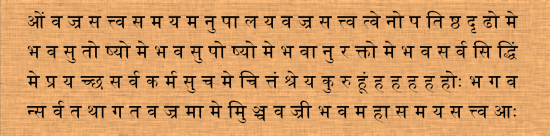
oṃ in the Siddhaṃ script
oṃ in the
Siddhaṃ script
For the ancient Indians grammar was one of the major paradigms for understanding how the universe functioned. One product of this is in the understanding of the seed syllable (bījākṣara) oṃ in the Vedic and then the Hindu traditions.[1] The earliest references to oṃ are in the Yajur Veda. This Veda was composed sometime after 1000 BC but before the Buddha. In some rituals the hotṛ Brahmin shouts oṃ at the end of the invocation to the god being sacrificed to (anuvākya) as an invitation to partake of the sacrifice.

The analysis of oṃ as being made up of three parts (a + u + ṃ) originates in the Sanskrit grammarian tradition but is given ritual or religious significance in the post-Buddhist early Upaniṣads, especially the Māṇḍūkya and Praśna Upaniṣads. Let's look at how this works.

Vowels may be monophthong or diphthong - made up on a single sound (short or long), or made up of two sounds (short or long). Linguists might describe a diphthong as beginning on one vowel sound and ending on another. The vowels of Sanskrit can divided up like this:

shortlong
monophthongsa i u ṛ ḷ
अ इ उ ऋ ऌ
ā ī ū ṝ
आ ई ऊ ॠ
diphthongse o
ए ओ
ai au
ऐ औ

Note that the anusvāra (ṃ) and visarga (ḥ) are often counted as vowels, but practically they are modifications of existing vowels: nasalisation and aspiration respectively. They can be applied to any of the vowels. The long vowel ḹ (ॡ) is a theoretical possibility but in practice is never used.

The vowel o is a diphthong which is made up of two sounds: a + u. However note that the vowel au is a long diphthong which is analysed as ā + u. The two vowels o and au sound quite different: o sounds like o in hope; au sounds like ou in sound. Similarly e can be thought of as a + i: and ai as ā + i. Technically (and metrically) e and o are long vowels. In Sanskrit the Proto-Indo-European short vowels e and o converged with a (which helps to explain why a is far more common than other vowels). Since there is no short e or short o in Sanskrit there is no need to write the long vowels as ē and ō, though this would be more consistent.

It is necessary to understand these distinctions in order to understand some sandhi phenomena, because in some cases o actually behaves as a+u. The conjugations of the verbal root √bhū 'to be' offer a good example. This is a class 1 verb and forms a stem in -a with guṇā (strengthening) of the root vowel: so bhū (with guṇā) > bho; and when we add the stem vowel -a we get the stem form bhava; and the 3rd person singular is bhavati. What happens here is that the o in bho is treated as a + u, and the addition of -a invokes sandhi rules governing when two vowels meet - in this case u + a > va: ie bha+u+a > bhava. (This kind of thing is what makes learning Sanskrit difficult).


auṃ written in the Siddhaṃ script

auṃ
in the
Siddhaṃ script
From a purely technical point of view we can see that the analysis of o as a + u does not justify writing oṃ as auṃ using the long diphthong. Note that the syllable auṃ written in Siddhaṃ (left) looks like the modern Hindu ॐ which is frequently transliterated as auṃ, and suggests that some confusion about this crept into Hindu discourse. Buddhist texts did not adopt the practice of writing oṃ as auṃ as far as I have been able to discover.

Another purely technical point is that the notation oṃ indicates a nasalised o vowel. This should rhyme with the French 'bon', not with the English 'bomb'. In fact this distinction seems to have been lost for some time, and oṃ (ओं) is regularly pronounced as om (ओम् ) even in India (i.e. with the bilabial rather than the pure nasal). Note also that au is the vowel sound in the English word 'sound'. So auṃ should not sound like oṃ and vice verse.

These jejune distinctions were important to the Indian grammarians because it was thought that the Vedas were divinely inspired, eternally unchanging and true, texts. They were transmitted orally, and after some centuries the vernacular Sanskrit language was significantly different from Vedic [2] which lead to scholars making a thorough investigation of the language - both canonical and vernacular at around the time of the Buddha. It was important to get the pronunciation right if the meaning was to be preserved. Changing the pronunciation was unthinkable.

By the time the early Upaniṣads were being composed (beginning ca 800 BCE) there was quite a lot of interest in the relationship between words and reality. The existence of eternal, true words gave this a particular flavour. Also note that the word for 'true' and 'real' was the same: sat. It was the authors of the Upaniṣads, especially the Chāndogya (CU), who began to make the connections between syllables and aspects of the cosmos, though this seems to have been a natural development of the idea of correspondences (bandhu) between the macrocosm and the microcosm which was also a preoccupation in the Vedas. Oṃ in CU text is seen as a single syllable and equated with the udgītha, that is with the chanting of the sāman or hymns of the Sāma Veda. In other texts oṃ is associated with brahman. Then later, in the last century BCE, the technical breakdown of o into a+u was given esoteric significance. A key passage from the Māṇḍūkya reads:
so 'yamātmādhyakṣaramoṅkāraḥ | adhimātra pādā mātrā mātrāś ca pādā akāra ukāro makāra iti || ManU 1.8

On the subject of syllables, this syllable 'oṃ' is the ātman; on the subject of metre, the feet are the metre, and the feet are the syllables a, u, and ma. (my translation)
Here oṃ, the ātman, is likened to 'śloka' the poetic metre (mātra [3]) consisting of four lines or 'feet' (pādā) of eight syllables, with each of the lines likened to a constituent phoneme. The Māṇḍūkya then spells out the esoteric correspondences of the constituent phonemes. The fourth foot (pādā) is said to be without a phoneme (amātra) and ineffable (avyavahāraya).

I'm not aware of any canonical Buddhist text which restates the Vedic breakdown of oṃ into a+u+ṃ, though Kūkai does break hūṃ into ha+a+ū+m suggesting that the technique was not unknown to him. [4] For Buddhists the esoteric significance is typically based on the Arapacana acrostic which was originally a mnemonic for remembering aspects of an extended reflection on śūnyatā, for example: akāra (the syllable a) is the first syllable; which reminds us of the key word anutpanna (non-arising); and the full reflection subject is akāro mukhaḥ sarvadharmāṇāṃ ādyanutpannavāt (the syllable 'a' is an opening because of the primal quality of non-arising of all mental phenomena). Various versions of the Arapacana exist, the earliest date from around the 1st or 2nd century CE.

This method of analysing mantras is far more significant in understanding the function of a mantra than the words in the mantra. For instance Kūkai always seems to have broken down words (even sūtra titles) into syllables in order to understand their esoteric significant. In Tibetan Buddhism the fact that the Avalokiteśvara mantra has six syllables which enables it to match up with the six realms of conditioned existence is probably more important than the understanding of the word maṇipadme (which has been central to Western exegesis of the mantra).

~~oOo~~

Notes

  1. This distinction is a bit vague. I call the religion Vedic which is primarily based directly on the three Vedas (Ṛg, Sāma, Yajur) excluding the Atharva (which is a distinct tradition I think) and which is focussed on the sacrifice: it's main gods were Indra, Agni, and Soma - though several dozen deities were propitiated. Hinduism is a complex of various religious ideas and practices where the Vedas have faded into the background and practice is focussed on devotion (bhakti) or with Tantric rites (śakti): prominent Gods are Śiva, Viṣṇu, Brahmā and the mother goddess in many forms especially Lakṣmi and Kāli. This is of course a massive over-simplification. What seems important is to mark that there have been tectonic shifts in India religions over the millennia.
  2. Vedic is the most common name for the language of the Vedas. It has a number of differences from Classical Sanskrit which was codified by Pānini in the 5th or 4th century BCE.
  3. Note the phonetic similarity with the English word - both come from the same Indo-European root meaning 'to measure'.
  4. see Ungi gi in Hakeda Major Works p.246ff

Further Reading

01 January 2010

All Dhammas

My text today is the Mūlaka or Roots Discourse, a short sutta from the Aṅguttara Nikāya. [1] In it the Buddha advises his bhikkhus what to say if asked by other wanderers (paribbājakā): what is the root (mūla) of all things? How do they arise (sambhava)? What is their origin (samudaya)? Where do they meet (samosaraṇo)? What is the foremost (pamukha)? Who should rule them (pateyya)? Who is higher (uttara)? [2] What is their essence (sāra) ? Where do they merge (ogadha)? And where do they conclude (pariyosāna)?

These kind of questions are quite common in the Buddhist texts. Once you see the answers you can see that they are cliché questions which elicit stock answers in formulaic terms. This kind of question actually has quite a long history in Indian religion. During the development of the Ṛgveda (which was composed ca 1500-1200 BCE probably on the basis of an existing oral tradition) the visionary poets (ṛṣi) would ask each other enigmatic questions. A good ṛṣi would be able to come back with an clever answer and might be selected to carry out the all important sacrifice. [3] These kinds of questions were called 'brahman' (grammatically neuter) . The same word came to mean the absolute enigma of existence: the Brahman which manifested as ātman in the microcosm of the human being. The personification of brahman was the creator God Brahmā (masculine). The name of the ritualist inheritors of the Vedic texts came to be 'brāhmaṇa', often Anglicised as Brahmin(s). Brahma also took on the mean of 'sacred' and was used in Buddhist terms like brahmavihāra, brahmacarya, and brahmaloka. The controversial bhikkhu who ordained four women recently is called Brahmavaṃso with no apparent irony - vaṃsa is 'race, clan, family, tradition, lineage' so the name means something like 'the race of the sacred' or having a 'sacred lineage'.

Such questioning became a feature of Indian religious life - holy men would challenge each other to answer enigmatic questions about the mysterious nature of existence, and sometimes wagered that they, and their followers, would all convert to the the religion of the one with the best answer. Obviously in the Mūlaka Sutta the procedure has become completely formulaic, but it echoes the ancient tradition. The questions asked here are quite reminiscent of similar questions in in the Bṛhadāranyaka Upaniṣad, for instance, and it is thought by many scholars that the Buddha knew this strand of Brahminical teaching, if not the actual text that has come down to us.

So, onto the Buddha's answers:
chandamūlakā, āvuso, sabbe dhammā, manasikārasambhavā sabbe dhammā, phassasamudayā sabbe dhammā, vedanāsamosaraṇā sabbe dhammā, samādhippamukhā sabbe dhammā, satādhipateyyā sabbe dhammā, paññuttarā sabbe dhammā, vimuttisārā sabbe dhammā, amatogadhā sabbe dhammā, nibbānapariyosānā sabbe dhammā’ti

Desire is the root of all experiences, they arise from attention, their origin is contact, they meet in sensation; concentration is the foremost of experiences, all experiences are mastered by being mindful, wisdom is higher than all experiences, their essence is liberation, all experiences merge in the deathless, and conclude with nibbāna.
We need to pause here to consider what is meant by dhammā - the plural of dhamma. As I recently discussed there are many possible meanings. [4] However finding the word in the plural and in this context narrows it down considerably. It has to mean 'things' or 'mental objects'. Bhikkhu Bodhi opts for 'things'. This is natural since it follows tradition, but I wonder if it really makes sense? Is every 'thing' rooted in our desire - is a mountain, is that ball point pen? Well, no. So 'things' is more likely to refer to the subjective end of existence - hence I've translated it as 'experiences', though dhammas are the units of experience (I'm still searching for a good term for this - qualia?). Regular readers will be familiar with this quirk of mine, but I think it is worth insisting on because the Buddhadhamma makes more sense generally speaking if we adopt this point of view.

I want to look at this text in terms of the 'truths of the nobles' (ariyasacca) [5]: dukkha, samudaya, nirodha, magga.

The Buddha repeatedly stated what his teaching was about: it was not about God, or Heaven, or about any kind of absolute; it was not about how the universe began or will end. In fact he dismissed all of these subjects out of hand. The Buddha said that his teaching was about dukkha, it's cause, it's end, and how to end it. By dukkha the Buddha means all unenlightened experiences - ranging from physical pain, to the various disappointments of life, to existential dissatisfaction with the world of the senses. As I said in my commentary on Dhammapada verses 1 & 2: "Dukkha, then, is the opposite of nibbāna". In today's text the Buddha suggests that desire is at the root of all of this. Desire directs our attention which leads to contact with objects of the senses, which in turn give rise to sensations (vedanā). The text leaves unspoken the fact that it is sensations we crave, that we think of as able to last, able to satisfy desire. This is demonstrably not the case, but the idea is rooted very deeply. (I've speculated that in fact it gave an evolutionary advantage earlier in the history of the species - see Why Do We Suffer?). So these are the first two truths of the nobles: dukkha, samudaya - pain/disappointment/disatisfaction, and it's cause.

The Mūlaka Sutta deals with the third and fourth truths in the opposite order, ie with the way to end dukkha first, and then the cessation of it. Sticking to the usual order, how does this text deal with the cessation of dukkha? Firstly it says that wisdom (paññā) is higher (uttara) than other dhammas; that the essence of dhammas is liberation, they merge in the deathless and conclude with nibbāna. Paññā (Sanskrit prajñā) here is a dhamma - an object of the manas or mind. Contra to more mystical approaches to describing the enlightenment experience this is saying that there is an important cognitive aspect. Paññā is knowledge about the nature of dhammas, it is the meta-knowledge of the nature of all dhammas as anicca, dukkha and anatta - impermanent, unsatisfactory and insubstantial. Indeed the statement that the essence (sāra) of dhammas is liberation may well prefigure the Mahāyāna idea that all dharmas are marked by śūnyatā (sarvadharmāḥ śūnyatā lakṣanā - The Heart Sūtra). The conclusion of dhammas comes with the extinction (nibbāna) of desire. At first sight this could be considered nihilistic - it seems to be saying that all dhammas, all experiences simply cease - and we need to say something about this. However I think what is meant here is that dhammas all have this characteristic of anicca and that if we noticed this in any dhamma, we can see it in all dhammas and this leads us inexorably towards nibbāna - paraphrasing somewhat I might phrase it that the conclusion we come to is the extinction of greed, hatred and delusion. This extinction is the end-point of suffering and disappointment because we know the true nature of experience and cannot be disappointed by it.

The way to liberation is condensed into two statements in this text: concentration (samādhi) is the foremost of experiences, all experiences are mastered by being mindful (sati). We could go further and sum this up as meditation is the way to liberation. I'm aware that some people dispute this, but as a scholar it seems clear enough to me that the Buddha's completely consistent message is that meditation is indispensable. My experience suggests that concentration is invaluable as a prelude to insight reflections - else the requisite focus, clarity, continuity of purpose and positivity are simply not enough to go deeper. Here, all dhammas are mastered by sati 'recollection'. Sati can be taken as mindfulness (awareness) generally or as one of the ten recollection (sati or anusati) meditations. I think what's intended here is the twofold distinction between samatha and vipassana. Samādhi being synonymous with the former, and sati with the latter - I'm thinking especially of the Satipaṭṭhāna style meditations.

No doubt other ways of interpreting this text are possible. I'm always intrigued, however, by the way that one formulation can be used to understand another. I think the possibility is open because all of the various formulations represent various approaches to Buddhist practice which stem from a common principle. The underlying similarity has been much clearer since taking on board Sue Hamilton's observation that the Buddha was always talking about experience. Scholars call a way of interpreting texts a hermeneutic - from the Greek hermeneuein 'to interpret'. The God Hermes was a messenger and god of speech and writing. Our hermeneutic can condition what we understand a text to be saying. The experiential hermeneutic is a key that unlocks many doors.


Notes.
  1. Mūlaka Sutta AN x.58; PTS A v.106. My translations. Also translated by Bikkhu Bodhi Numerical Discourses of the Buddha (anthology) p.250-1. Pāli text from http://www.tipitaka.org/romn/
  2. uttara is the comparative degree of ud- (English 'up', or 'upwards') i.e. 'higher'; while uttama is the superlative 'highest'. Bodhi translates this as a superlative.
  3. There are some superficial similarities here with the monastic debates held in Geluk monasteries.
  4. See my trilogy on the word dharma/dhamma:
  5. Following K.R. Norman I take ariyasacca to be a tatpuruṣa compound meaning 'truth of the noble(s).'


image: Buddha head in banyan tree roots, Thailand. [original]

25 December 2009

Meditation & Scholarship

Saint Jerome in his studyOver the last couple of years I've sometimes come in for some shtick from colleagues and acquaintances who think that because my writing focuses on doctrine more than meditation I've got nothing useful to say about the Dharma. I've tried pointing out that the subject I write about is what seems best suited to the medium and my own temperament, and that my words are not entirely unrelated to my experience as a practising Buddhist. But the suggestion that my contribution is of less value hangs in the air. For my part I find that my critics who focus on meditation at the expense of study are often self-absorbed, intellectually vague, and inarticulate. So you might imagine that I was quite interested to see that this kind of, shall we say, 'incompatibility' between Buddhists with different proclivities has a long enough history to be recorded in a Pāli sutta. [1] The sutta is one delivered by Mahācunda to a gathering of bhikkhus and the Buddha does not feature in it at all.

The Mahācunda Sutta (AN 6.46) describes two kinds of monks: those 'keen on dhamma' (dhammayogā bhikkhū) and those keen on meditation (jhāyī bhikkhū). Dhammayoga is glossed in the commentary as dhammakathikānaṃ 'a dhamma-preacher' (AA 3.376), but Bhikkhu Bodhi thinks it means someone (like me) who is more focused on study, i.e. a scholar.

In the sutta it says the scholar bhikkhus disparage the meditating bhikkhus:
ime pana jhāyinomhā, jhāyinomhāti - jhāyanti pajjhāyanti nijjhāyanti avajjhāyanti. Kimime jhāyanti, kintime jhāyanti, kathaṃ ime jhāyantī’ti?

"We are meditating, we are meditating" [they say]. They meditate here, they meditate there, they meditate up, they meditate down. Do they meditate? How do they mediate? Why do they meditate?
Similarly the meditating bhikkhus disparage the scholar bhikkhus:
ime pana dhammayogamhā, dhammayogamhāti uddhatā unnaḷā capalā mukharā vikiṇṇavācā muṭṭhassatī asampajānā asamāhitā vibbhantacittā pākatindriyā. Kimime dhammayogā, kintime dhammayogā, kathaṃ ime dhammayogā’ti?

"we are dhamma scholars, we are dhamma scholars" [they say]. They are inflated, showing off, arrogant; they talk too much and loosely, they're unmindful, unfocussed, scattered and their thoughts stray with senses uncontrolled. Do they study? How do they study? Why do they study?
One can almost hear the mocking tone of these taunts. However the text says that there is no profit for anyone in this kind of talk. Thus all bhikkhus should train themselves this way:
dhammayogā samānā jhāyīnaṃ bhikkhūnaṃ vaṇṇaṃ bhāsissāmāti... jhāyī samānā dhammayogānaṃ bhikkhūnaṃ vaṇṇaṃ bhāsissāmāti

We will say that scholars are of equal value to meditators. We will say that meditators are of equal value to scholars.
The meditator is of value because:
...ye amataṃ dhātuṃ kāyena phusitvā viharanti
...they dwell having touched the deathless state with the body.
The scholar is of value because:
gambhīraṃ atthapadaṃ paññāya ativijjha passantī
they see, they penetrate with wisdom into the depths of texts.
The text is noted by Reginald Ray in his book Buddhist Saints in India. He takes the term dhammayogā bhikkhu or dhammayogin [2] to be synonymous with what he calls the settled monastic whose role in Buddhist society was remembering the Buddha's words, preserving them in texts, and studying the meaning of them. In addition they were responsible for basic literacy - monks like this probably were the ones who spread writing across India, Central Asia, Tibet and South-East Asia. Their counterparts, the meditators or jhāyins, are called forest renunciants by Ray. They devoted themselves to meditation practice in out of the way places, aiming for realisation of the truth. This, by the way, marks the sutta was probably a late addition to the canon because this kind of division must have taken some time to emerge. Ray also notes that such divisions are evident in later strata of Buddhist texts and even in contemporary Buddhist discourse. I might also note in passing that Jan Nattier's book A Few Good Men makes it seem likely that early in the Mahāyāna 'bodhisatta bhikkhu' was also synonymous with the jhāyī bhikkhu. [3]

The Mahācunda Sutta is a plea for tolerance of different temperaments leading people towards the Dhamma in different ways. We can all make a contribution to the wider Sangha according to our abilities. This is not to say that scholars need not meditate, or that meditators should not study. We must not only play to our strengths. It is of course entirely necessary to test our theories in practice - to give expression to our faith. On the other hand concepts are required to communicate insights and it benefits everybody if the concepts are clear and put across in ways that can be understood. As well as some frustrating experiences, I have also found that it is possible to get some depth of conversation with meditators and to use their experience as confirmation of the way I think, and on the other hand to help meditators to clarify the way they communicate the experience of meditation, and even to refine their approach especially to vipassana meditation. We can learn from each other.

In both study and meditation we confront our views. This is one thing about study and scholarship which often seems to be misunderstood. The scholar is not seeking certainty, not trying to fix things in words. Indeed the scholar is often intensely aware of the limitations of words, and especially in professional scholarship one's thoughts are subject to constant criticism by one's peers. The scholar is trying to expand knowledge, to make clear what is opaque, to observe new things. If there were nothing new to see and hear, then scholarship would have died centuries ago, but there are always fresh insights that need to be communicated, always unnoticed subtleties to explore. My own exploration of the texts, especially the Pāli texts, has lead me to a much stronger faith in the Buddhadharma. As critical as I can be, as unwilling to accept received traditions and dogmas, I find something beautiful and timeless in the Dharma that I have great confidence in.


Notes
  1. Mahācunda Sutta. Aṅguttara Nikāya 6.46 (PTS: A iii.355). My translations. Also translated by Bhikkhus Nyanaponika and Bodhi. Numerical Discourses of the Buddha. p.163-4; and by Bhikkhu Thanissaro on Access to Insight.
  2. Ray discusses the term dhammayogin on p.201-2. Ray seems too quick to accept La Vallee Poussin's characterisation of dhammayogins which smacks of polemic. There is no a priori reason to think that a scholar is only interested in the 'intellectual' or that they are interested in metaphysics at all - though I will admit that it seems to have been the pattern through history. I wonder whether things could have got that far before the composition of the Mahācunda Sutta?
  3. Nattier, Jan. 2003. A Few Good Men: The Bodhisativa Path According to the Inquiry of Ugra (Ugraparipṛcchā). University of Hawai'i Press. See especially chapter 5.
image: St Jerome in his study

18 December 2009

Ethics: it's not rocket science.

texting while drivingRecently a friend of mine tweeted this:
Question. Are the moral consequences of texting while driving the same if (a) you accidentally kill someone or (b) you do not kill anyone?
After initially engaging with the idea I realised that there was an underlying problem. Whenever I get into discussions on ethics I end up making the point that Buddhist ethics don't really work in the abstract or hypothetically.

In this example my friend was assuming that he could know and understand the intent of the person, as though the behaviour can be isolated from the life of the person and that intentions are a fixed entity rather than a process. Acts are not isolated - we 'will' and act in a massively cross-linked matrix. The idea that a single intention gives rise to a single act is simply erroneous. Behaviour is more complex than this, and if we don't take this into account then we can draw erroneous conclusions. Indeed driving and texting are both complex acts in themselves that extend over time with intention varying from moment to moment. There is no single intention, though like a story with many episodes there may be a kind of story-arc, an over-arching goal such as sending a text, but this can never be disentangled from the matrix of conscious and unconscious willing going on all of our waking hours.

We also need to be very cautious about thinking that we understand the intentions of other people. Social psychologists have determined that humans are actually quite bad at guessing motivations: we can empathise, that is experience the emotions of another, but when we assign reasons for behaviour we tend to grossly under-estimate the importance of environmental interactions (including the social). This is called the Fundamental Attribution Fallacy. We assume that the individual is an entirely free agent, as we imagine ourselves to be, and in order to understand how another person could act in a particular way we try to imagine what kind of internal state (ignoring the external) might motivate us to act that way. An example very commonly encountered in online communication is where there is a perceived slight, and our first assumption is not that we have misunderstood, or that the person has communicated poorly, or that they are having a difficult time; our first assumption is that they acted maliciously because we can only imagine slighting someone if we were doing it maliciously. Online communication is often characterised by what is known as flaming - hot headed remarks and insults.

So it is important not to over simplify human behaviour because this does not give meaningful insights into the way people act. But even more importantly we need to think about what question is Buddhist ethics is trying to answer. Typically we try to answer the question 'why is this happening to me?' The point of Buddhist ethics is to answer the question: 'given the circumstances, what should I do?'

Very often we approach ethics from the point of view of the Abrahamic (ie Jewish, Christian, and Islamic) morality which is concerned to determine guilt, apportion blame, and direct punishment. We need to know who is responsible for what so that we can inflict some harm on them to atone for their sin. The harm we inflict cancels out the sin; and not only deters the sinner from doing it again, but will deter others from doing the same thing since they see the painful consequences. This we call "justice". It's important to spell it out like this, because even though we have left behind "an eye for an eye" our thinking about ethics is often underpinned by this kind of model. It highlights amongst other things why societies rooted in Abrahamic values have never made any progress on anti-social or illegal behaviour. In fact it is irrational to confess to a crime in our society, because to acknowledge guilt is to invite harm upon oneself. Unless one is convinced that suffering will atone for the sin, and we do not now believe this either individually or collectively (if we ever did); then it is not rational to invite society to harm oneself by acknowledging guilt. Note that guilt and blame can be distinguished - sometimes the guilty are not blamed, and therefore not punished, due to extenuating circumstances or diminished responsibility for instance.

Another aspect of Judeo-Christian morality is that it is rule based. As moral agents, in this view, we can only be moral if we can understand the rules and obey them - this is the fundamental teaching of Christianity especially. Over and above the basic rules which God has etched in stone, we know that society imposes a large number of subtle, often unspoken rules on us, and in order to avoid guilt, blame and punishment we have to conform to them - though there is always leeway. Additionally if one is suffering one wants to know "what did I do to deserve this" (i.e. what rule did I break?) because from the Judeo-Christian point of view there is no punishment without guilt and blame. We want to know how to avoid punishment - we do so by avoiding guilt and/or avoiding blame. But we also consider ordinary suffering to be a (divine) punishment, and therefore look for the rule that we have broken to deserve it.

Many people when they hear about the Buddhist doctrine of karma/vipāka assume that it reflects a cosmic retribution for evil acts. This is not helped by Tibetan versions of the doctrine which insist, contra the explicit early Buddhist position, that everything that happens to you is a result of something you have intentionally done - i.e. you do deserve to suffer! (NB: I do not believe this) The original intent of the doctrine was to focus our minds on the way the actions have consequences, particularly for how able we are to still our minds to meditate and seek wisdom. It is about deciding how to act. It is not about explaining how we got into this mess, but how we go about getting out of it. If we impose rules then we start to focus on avoiding guilt and blame all over again.

For these reasons it is important to bring ethics down to the experiential, to the personal. Buddhist ethics is not about laying down rules and judging other people. It is far more valuable to reflect on our own actions in practice and see what consequences came from what kinds of actions, to see for ourselves in actual experience, what is helpful and what is not. In this situation what should I do? What helps us to live harmoniously what helps us to achieve the calm state that we need in order to meditate and seek wisdom successfully? We do not need to concoct tricky intellectual exercises because these only lead to more theories and theorising. We need to observe ourselves in action. We need to be able to make broad brush stroke equations like: when I'm angry it's very difficult to communicate or get my point across to others. When I'm generous I receive more appreciation and kindness in return. When I serve others in some way I feel more content with my life. When I avoid gross stimulation it's easier to calm my mind for meditation. It's not rocket science.


image: Pasen Law Group blog.

11 December 2009

Aspects of the Hundred Syllable Vajrasattva Mantra II

nectar gathering bumblebeeHaving dealt with some of the issues of the linguistics of the mantra [1], I want now to look at the mantra as a text. While in the Tibetanised version the main theme is taken to be purification of karma, in the corrected Sanskrit one of the other themes emerges into the foreground: samaya. Samaya is our relationship (or agreement or meeting place) with Vajrasattva, the embodiment or personification of the Dharmakāya.[2] I want to explore the nature of this relationship in various terms which will demonstrate some continuities.

Firstly let me say a quick word about the purification of karma. I showed in my published paper on confession [3] that from the point of view of early Buddhism willed actions (karma) inevitably produce results (vipaka). The fruits of actions cannot be eliminated or 'purified'. However they can be mitigated and I cited several texts which explore how this happens. In a footnote to that article I also noted that in later versions of the Samaññaphala Sutta this doctrine began to change. Whereas in the Pāli the story of King Ajātasattu confessing to the Buddha that he has killed his father is only the frame for a larger doctrinal exposition, in the surviving Sanskrit fragment and three Chinese translations Ajātasattu's confession is the main focus. In the Pāli version there is no way to prevent the devastating effects of his actions (patricide is one of the five unforgivable acts), and the commentary on the story tells us that at death he goes straight to the Hell of Copper Kettles. The later versions all make his meeting with the Buddha transformative and state that, to varying degrees, Ajātasattu is released from the effects of his 'unforgivable' actions. Indeed it seems that this became an important theme in Mahāyāna Buddhism and is epitomised by the Tantric Vajrasattva as purifying through the recitation of his mantra.

The theme of samaya is distinctively Tantric, though it has resonances with earlier traditions. Samaya, as I have explained, means 'agreement, meeting, meeting place' and could also be translated as relationship. The idea is brought out quite poetically in Kūkai's expositions on kaji (Sanskrit adhiṣṭhāna) which I wrote about some time ago as grace. The idea is that it is not just the practitioner reaching out towards a remote and disinterested goal, but that the Dharmakāya is doing it's bit to reveal itself. Lest we become too theistic about it I want to unpack this idea.

In the Heart Sūtra is says that all dharmas are marked by emptiness (sarvadharmāḥ śūnyatā-lakṣanā). This is entirely in keeping with the earliest (pre-abhidharma) notions on the nature of dharmas. Dharmas are the units of experience, both the information from the senses, and the mental aspects consciousness such as memory, associative and inductive thinking. Experiences, the focus of discussions of dependent arising, have no ontological status - they are not solid existence 'things', nor are they non-existent. As Nāgārjuna observed the terms existent and non-existent do not apply to dharmas (and therefore to experience). All that we know and are conscious of results from contact between objects and sense organs giving rise to dharmas - in this sense the word means 'foundation'.

However we do not treat experience this way: we take it far more seriously than this, as existent and important. We spin stories about it which we believe and invest with value, a process known as prapañca. Hence we make our fundamental errors which lead to suffering.

Now the samaya with the Dharmakāya says something like: if you seek, you will find. In other words the true nature of experience is always able to be discerned, it can't be permanently hidden from us. If we go about it the right way, we will see through (vipaśyanā) our delusions. This is an important aspect of Buddhist faith. The guarantees that Awakening is possible come in many forms amongst which Tathāgata-garbha, so-called Buddha nature, stands out as a good example. Buddha nature, like this samaya, is designed to set your mind at ease about the possibility of your liberation. Likewise the samaya uses the model of an agreement between two parties to assure us that we can realise the Dharmakāya.

I see the mantra as a dialogue, or even perhaps as a dramatisation of this relationship. On the one hand the chanter is reminding Vajrasattva, as an embodiment of the nature of experience, of his side of the relationship: we need the possibility of gaining insight into the true nature of experience to remain open to us, so that we can be liberated.

On the other hand the seed-syllables are Vajrasattva's response to us. Vajrasattva reminds us that it is we who project onto experience. That he, i.e. the nature of experience, is always available to us, and that in fact nothing can ever change that. Śūnyatā, pratītyasamutpāda, Buddha Nature, etc: these are all ways of pointing to the nature of experience - saying the same thing in different ways. Vajrasattva replies in non-linear, non-rational fashion because typically it is very difficult to think straight about this subject. Typically we are completely caught up in, or intoxicated with (pramāda), our stories and we cannot really think outside that narrow context. In Tanric terms oṃ āḥ and hūṃ represent not just our mundane body, speech and mind, but also the Three Mysteries (trighuya) the 'body', 'speech', and 'mind' of the Dharmakāya which are communicated through his use of mudrā, mantra, and maṇḍala. These three also become the technology by which we align our body, speech and mind with the Dharmakāya and become enlightened. The nectar of the deathless (both words translate as amṛta) is always available for beings in saṃsāra!

Notes
  1. I've dealt with the mantra from a linguistic point of view in two previous posts:
  2. Samaya is a complex term. It also covers our relationship with our guru, and with all sentient beings. Samaya can additionally mean 'vow', that is the vows that taken in conjunction with abhiṣeka. There are many different explanations.
  3. Did King Ajātasattu Confess to the Buddha, and did the Buddha Forgive Him?' Journal of Buddhist Ethics. Vol 15, 2008.

04 December 2009

Aspects of the Hundred Syllable Vajrasattva Mantra I


Siddhaṃ writing on palm leaf from 11th century Nepal. A section of the Aṣṭasāhasrika Prajñāpārimtā Sūtra
In my annotated translation of the Hundred Syllable mantra I tried to convey what the Sanskrit text of the mantra was and how it might be translated [1] - I did this in such a way as to open up the meaning and allow anyone to produce their own wording. There is a lot more to say about this mantra. Here I want to look at why the mantra might have been misread to produce a garbled version.

Tantric Buddhism is generally agreed to have begun in the 7th century in India. It continued to develop until Buddhism died out in India, and long afterwards in the surrounding nations of Bhutan, Ladhakh, Nepal and especially in Tibet. Having been conveyed to China and the far east, this stream of transmission (and back transmission) was cut off with the demise of the Silk Rd, and the collapse of the Tang dynasty in the late 9th century. Some scholars see the much earlier dhāraṇī tradition as being "proto-tantric", but this is like saying that flour is proto-cake.

Tantras were on the whole composed in Buddhist Hybrid Sanskrit, with the exception of the Kālacakra Tantra which was composed in Classical Sanskrit. BHS is an inflected vernacular language which has been modified to be more like Sanskrit. This was a general trend and even Pāli has been Sanskritised to some extent. My view is that mantras are also in BHS rather than Classical Sanskrit - the -e ending on so many words being not, as many scholars assume, a feminine vocative, but a masculine nominative singular. [See words in mantras that end in -e].

Writing during this time was somewhat different to present day. The script in widespread use in Northern India at the time is known by several different names but is now generally called Siddhaṃ (perfected) or Siddhamātṛka (matrix of perfection). A version of this script, adapted for writing with a Chinese calligraphy brush, is preserved in the Chinese Tripiṭaka for writing mantras - even when they are also transliterated into Hanzi. The Tibetan script dbu-can (pronounced Uchen) was designed on an early model of the Siddhaṃ script. In the latter part of the Tantric period the script which is now often no referred to simply as Sanskrit, but which is more correctly called Devanāgarī (City of Gods) began to supplant Siddhaṃ.

A feature of texts of this period is that syllables were not grouped into words, but written individually with little or no punctuation. In order to read a text like this one had to have a very good knowledge of Sanskrit word endings. Here is the Vajrasattva mantra written as it might have been in the 10th century in Devanāgarī:


Some of the mistakes that crept into the Vajrasattva mantra over time, or perhaps even all at one time, seem to me to be the result of misreading rather than mishearing. Note that Tibetan writing is open to the same kinds of difficulties in reading. Take this segment for instance:
व ज्र स त्त्व स म य म नु पा ल य = va jra sa ttva sa ma ya ma nu pā la ya
As I noted in my translation there are several ways to clump the syllables into words. The first four naturally form the name of vajrasattva. But this leaves sa ma ya ma nu pā la ya. If we are versed in Tantra but not so much in Sanskrit we might be attracted to the word samaya. Because this is a mantra we may not be expecting formal grammar, so we might take that as a unit. This leaves us with manupālaya. This is not well formed Sanskrit, but it has familiar parts (exlpained in my translation). I can't say how often as a neophyte Sanskritist I have fallen into a similar trap. The problem is that when a word ends in -m and the next word begins with a- the two are combined into a single syllable ma for the purposes of writing. So sa ma ya ma nu pā la ya is actually samayam anupālaya 'uphold the agreement'. In spoken Sanskrit this error would be less likely to occur.

A more crucial error in reading occurred further along.
स र्व क र्म सु च मे चि त्तं श्रे य कु रु = sa rva ka rma su ca me ci ttaṃ śre ya ku ru
This phrase is at the heart of the use to which the mantra is put - the purification of karma. Let me review what I think may have been the procedure for understanding this based on my own experience of reading an unfamiliar Sanskrit text. Keep in mine that we know this is a mantra and mantras seldom follow grammatical rules so we're not expecting to see grammar. Several familiar words stand out: sarva (all), karma (action), cittaṃ (mind) kuru (make). This leaves some bits and pieces. Some thought shows that śreya is related to the word śrī, and that me is 'me' or 'mine'. We're left trying to explain su ca. Suca (often spelt sucha to avoid the confusion on how to pronounce c in English) isn't a word, but it is similar to words related to √śuc 'to gleam' figuratively 'to clean or purify'. The basic form is śocati, past-particple śukta, infinitve śuktum, 2nd person singular imperative śoca. Close enough for a mantra. So sarva karma suca me by this process means 'purify all my karma'. And cittaṃ śreya kuru means 'make the mind more śrī'.

In fact su goes with sarva-karma to give the locative plural sarvaskarmasu and the ca is the copulative particle 'and'. Sarvakarmasu ca means 'and in all my actions', and the rest me cittaṃ sreya kuru means 'make my mind more śrī'. Śrī has a very broad range of meaning and I chose 'lucid' because that conveys the sense of light which underlies śrī as well as being an auspicious state of mind.

Well formed Classical Sanskrit sentences do not just form at random. The chances of taking any series of syllables, gathering them into clumps, and finding sentences is vanishing small. Garble is far more likely, and more commonly encountered in mantras. This means that the best explanation is that the formal Sanskrit we find in the mantra when we fiddle with word breaks is very likely the original text. Given that the mantra was composed in Classical Sanskrit it suggests that it may well be from the same milieu that created the Kālacakra Tantra.

A corollary of this is that the mantra only gained its association with the purification of karma after it had been garbled and that this was not the original use of the mantra. [2] Not only that, but the way the message is garbled suggests to me that the mantra was passed on without an explanation at some point, and then later on an exegesis was composed based on the mis-read rather than a mis-heard Sanskrit text. Indeed I wonder whether the text was passed on in written form because an oral tradition would have preserved the Sanskrit rhythms of speech that would have made this kind of mistake quite unlikely. I would imagine that this did not happen on Indian soil.

This finding of the original text, and my conjecture about it, creates a significant tension with the received tradition which revolves around purification of karma. In my next post on this subject I will explore some implications of this tension, and look at the theme that emerges into the foreground when the spurious reference to purity is removed: samaya.

Notes
  1. In my translation I relied heavily on notes by Dharmacārī Sthīramati aka Dr Andrew Skilton published privately as: Sthiramati (aka Andrew skilton). 'The Vajrasattva Mantra : notes on a corrected Sanskrit text'. Order Journal. vol.3 Nov. 1990.
  2. In this article Sthiramati makes it clear that a great deal of work remains to be done on the history of this mantra. Several fragments appear in other contexts for instance. I don't have the resources to carry out this research but perhaps someone else will one day (it might make a good dissertation).

27 November 2009

New Articles on Dhāraṇī

Kharoṣṭhi Alpabet

Gāndhārī Alphabet in
the Kharoṣṭhī script
It was with some anticipation that I began to read Ronald Davidson's new review article in the Journal of Indian Philosophy on the meaning of dhāraṇī in Mahāyāna Buddhism - a subject in desperate need of an overhaul. However Davidson seems to have misunderstood crucial aspects of the system of practice in which early dhāraṇī was located. My comments will mainly concern his understanding of the Arapacana alphabet, especially as it occurs in the Large Perfection of Wisdom Sutra, [1] however I flag up wider concerns as well.

Davidson proposes the idea that the main point of the words associated with the Arapacana is to draw attention to how the letters can support (carry √dhṛ) meaning - thus linking dhāraṇī with the type of esoteric speculation in the early Upaniṣads and Tantric Buddhism. He explicitly denies the other and more natural possibility that the letters are mnemonics for words and concepts. His contention seems to be that the relationship must be this way around because in some texts different words are associated with the letters. The existence of variations on the theme in different texts surely suggests a technique widely used in different contexts, rather than incoherence or simple polysemy.

There are two main objections to Davidson's thesis. He argues that the words indicated by the syllables are intended to help the student remember the alphabet. Even if we put aside the fact that the Gāndhārī alphabet continues to be used even when the rest of the work is composed in Sanskrit, and can therefore be of little practical use for learning there are deeper problems with the idea that the Arapacana developed in this way. Davidson uses same example already put forward by B.N. Mukherjee, though he seems unaware of this: a is for apple, b is for bear etc. But stop and think about this. A in the Arapacana, even in the very early versions, is for anutpannatva. This is an abstract noun from anutpanna (not-arising) meaning 'not-arising-ness'. In fact this is one of the most complex abstract ideas of Indian philosophy which cannot be easily understood outside the context of many years of instruction in Buddhist thinking. The other 4o odd letters stand for equally complex abstract concepts. Can Davidson really believe that such an abstruse abstract notion would be of use to a learner trying to memorise the alphabet? Surely this would be an impediment rather than a helpful mnemonic device! When we teach the alphabet we use concrete examples. I note that the children's Devanāgarī chart I picked up last time I was in India uses concrete examples as well: e.g. a is for anāra (pomegranate) and bha is for bhālū (bear).

It makes much more sense to think of the letters as a mnemonic for the concepts, not the other way around. Davidson suggests that literacy in the India world at this time was low, but even if literacy was low in the rest of the world generally, Buddhist monks in Gandhāra probably all learned basic reading and writing, since the reading of texts had by then become a fundamental monastic skill. Indeed Buddhist monks were the primary vector for literacy in most of Central, Southern and South-East Asia as the persistence of Brahmī derived scripts testifies!

More broadly the very presence of such lists and this level of abstraction speak of a written rather than oral culture. I've written about the probable Persian influence the alphabetical list, and that was a literate culture without any doubt, and their writing formed a model for the Kharoṣṭhī script [see: Persian Influences on Indian Buddhism]. However here I'm particularly thinking of the characteristics of oral cultures enumerated by Walter Ong - "an oral culture has no vehicle so neutral as a list... [oral cultures are] situational rather than abstract, unavoidably using concepts but again within situational frames of reference that are 'minimally abstract'." [2]

The other objection is broader. If we look at the words indicated by the Large Perfection of Wisdom Sutra, and most other versions of the Arapacana [3] then we see that they are all related to śūnyatā - the notion that experiences are neither existent nor non-existent, that they have no independent existence (svabhāva). This is the heart of the Perfection of Wisdom approach to practice. Indeed taking the Arapacana in context with other statements in the sūtra [4] we can see that they form the basis of a insight meditation practice - by reflecting on various aspects of śūnyatā one comes to see the true nature of experience, and is liberated. The texts emphasise the sameness (samatā) of each of the syllables, not because of the inherent polysemy of letters making them interchangeable which they plainly are not, but because the concepts which they stand for show the practitioner the truth about experience being śūnyatā - śūnyatā is the common characteristic (i.e. the basis for the sameness) of all experience. Davidson seems to have lost sight of Nāgārjuna's polemics against ontology, not to mention the Buddha's.

What I think Davidson is doing is reading the texts with a particular result in mind, specifically that the word dhāraṇī can best be understood as meaning code/coding. I wholeheartedly agree that other contemporary writers have erred in emphasising the mnemonic function of dhāraṇī generally or in maintaining the fiction that dhāraṇī are somehow 'summaries' of the text they appear in. The mnemonic function is restricted solely to the Arapacana context, though it clearly is a mnemonic in this context contra what Davidson says. I do not believe that I have seen any dhāraṇī that comprehensibly summarises a text - though of course this has not stopped people producing ad hoc/post hoc exegesis on the basis that dhāraṇī are somehow summaries. Witness the many and varied readings of the Heart Sūtra mantra for instance - most of which are mutually contradictory!

A far better attempt, though more limited in scope, was published by Paul Copp in 2008. [5] Copp explores the way the word is used in Chinese translations of the Bodhisattvabhūmi and the Treatise on the Great Perfection of Wisdom Dazhidu Lun (大智度論). Copp shows that the basic meaning of the word dhāraṇī in these contexts can best be understood as 'grasp' - used in the sense of grasping the meaning, holding in memory, keeping in mind, etc. I concur. Just as the various meanings dharma (which I explored in Dharma - Buddhist Terminology) can be understood in terms of 'foundation' used literally, abstractly and metaphorically. It remains for Copp to show how his ideas fit into a much broader context, but his views seem more promising. I certainly prefer Copp's method of working from the texts to see what the word must mean in context, than Davidson's reading the meaning into the text.

From the point of view of a practitioner Davidson's error is perhaps an understandable one. For him the ideas do not seem to be tied into the practical use that is made of them: Buddhism is an intellectual system to be studied and understood in contemporary Western terms. No doubt he understands that Buddhists practice Buddhism, but the deeper implications of this pragmatism are not apparent. The impracticability of teaching an alphabet with recondite abstractions is only the most obvious sign of this.

One useful thing in Davidson's article is his survey of the history of the Western commentary on dhāraṇī - this threw up a few references I had not come across before. But that history is a bit depressing - it is a history of misunderstandings and the clash of Western preconceptions with Buddhist preoccupations. We're still trying to disentangle ourselves from that train wreck and in my opinion Davidson is pulling in the wrong direction.


Notes
  1. The Large PoW Sutra was translated by Conze but for variety of reasons the translation is less than satisfactory: for instance Conze was not working from an edited text and freely used passages from other versions in 18,000 and 100,000 lines where his manuscript (which itself has many faults) let him down. He also rearranged the text to suit subject headings from the Abhisamayālaṅkāra. Dutt's edition of the Sanskrit is flawed in the Arapacana sections with some doubling of syllables (which may be why Conze did not use it). Dutt was editing the text in the years before Salomon demonstrated that it was a real Alphabet. KIMURA is bringing out an edited Sanskrit text (see below) but the crucial part with the Arapacana is in the volume which has not yet been published. However some other related passages are available and I am working on translated them with my rather haphazard Sanskrit. - return to article
  2. [my italics] Walter J. Ong. Orality and Literacy, cited in Lopez, Donald S. Elaborations on Emptiness, p.33. - return to article
  3. The Arapacana in the Gandhavyūha Sūtra is the major exception. In this version the keywords do not relate to the alphabet at all indicating that the point of the exercise has been missed in this case. In this case the exception proves the rule. - return to article
  4. See for instance passages at p.162, 488-9, and especially p.587 in Conze's translation. I wonder if these scatter references were once more closely associated? - return to article
  5. Davidson may have been writing before Copp published, but does not seem to be aware of the article. - return to article

Bibliography
  • Conze, Edward (trans.) The Large Sutra on Perfect Wisdom. University of California Press, 1975.
  • Copp, Paul. Notes on the term Dhāraṇī in Medieval Chinese Buddhist Thought. Bulletin of SOAS. 71 (3) 2008: 493-508.
  • Davidson, Ronald. 'Studies in Dhāraṇī Literature I: Revisiting the Meaning of the Term Dhāraṇī'. Journal of Indian Philosophy. 37 (2) April 2009: 97-147.
  • Dutt, N. Pañcaviṃśatisāhasrikā Prajñāpāramitā Sūtra: edited with critical notes and introduction. London, Luzac & Co, 1934.
  • KIMURA Takayasu : Pañcaviṃśatisāhasrikā Prajñāpāramitā. Tokyo: Sankibo Busshorin 1986. Vols II-V (vol I forthcoming) Online: http://www.sub.uni-goettingen.de/ebene_1/fiindolo/gret_utf.htm#PvsPrp
  • Lopez, Donald J. 1996. Elaborations on Emptiness: Uses of the Heart Sūtra. Princeton University Press.
  • Mukherjee, B. N. 1999. Arapacana: a mystic Buddhist script in Bhattacharya, N. N. (ed) Tantric Buddhism. New Delhi: Manohar Publishers & Distributors. p.303-317.
See also my Arapacana bibliography.

20 November 2009

What was the Buddha's name?

In the Pāli texts his followers called him Bhagavan. Other people tended to call him Gotama or 'sāmaṇa' depending on whether they were being polite or impolite. Later is was established that his name was Siddhartha Gautama. In this essay I want to take a brief look at the evidence we have for what the Buddha's name was, or as we shall see, what it probably wasn't.

The name Siddhartha occurs in the Pāli texts, in the form Siddhattha, only in the Jātakas and later commentarial works. It is not used in the Nikāyas or Vinaya as the name of the Buddha, though it is used for other people. The Jātakas are legendary material which we can't take seriously as historical accounts. Siddhartha is used in the Sanskrit Mahāvastu - technically a vinaya text of the Mahāsaṅghika sect but actually an extended and much elaborated biography, really a hagiography of the Buddha. The fact is that the more strictly biographical accounts of the Buddha, such as the Ariyapariyesanā Sutta, make no mention of his given name at all! The best we can say is that apart from the name Siddhartha there is no other name mentioned as a contender.

Gautama (P. Gotama) is something of a puzzle because it is a distinctively Brahmin name. There are several well known Brahmin philosophers called Gautama, and even a Brahminical Gautama Sūtra. Gautama is a traditional Brahmin gotra (P. gotta) name. The gotra is like a clan name, and indicates people descended from a particular ancestor. While the Vedic Brahmins did not worship their ancestors, whom they referred to as the pitaraḥ 'the fathers', they did revere them and in earlier versions of rebirth theories the good Brahmin would leave this world and go to the world of his fathers (women were not included in this scheme) for a time before coming back to this world. A hint into the original use of this term is that it also means a cow (go) shed (tra, 'protection') - the image is of the herd of cows enclosed and protected, similar to the relationship of the individual to the clan group. Only a few dozen traditional gotra names are recorded (there are lists in the pre-Buddhist Bṛhadāranyaka Upaniṣad for instance). Monier-Williams' Dictionary suggests there are 49, and gives Gautama as one of his examples in his Sanskrit dictionary.

It is mentioned many times through the Buddhist canon that the Buddha was a kṣatriya - that is of the class (varṇa) [1] which is associated with rulers and secular leadership - sometimes kṣatriya and rāja 'king, ruler' are treated as synonyms. The other three classes were priests (brāhmaṇa) merchants (vaiṣya) and peasants (śudra). Although the Buddha's father was referred to as a 'rāja' at that time the Śākya nation was more like an oligarchy or republic. Rāja cannot really mean king or royalty in this context, and probably just means 'leader' and even then one leader amongst many. In the commentarial traditions we find that the Śākyas did not follow Vedic, but Dravidian marriage customs, suggesting that perhaps they were not Āryans [2] at all (though this is a late tradition it must have had the ring of truth to survive since it contradicts his being a kṣatriya, which is a more convenient appellation in caste conscious India). There are pockets of Dravidian speaking peoples in North India still and it is usually assumed that they were the aboriginal inhabitants of the Ganges plain and were displaced by the encroaching Vedic/Sanskrit speaking peoples. There is some doubt about this theory now, and of course it tends to ignore the other major language group in India - Muṇḍa - traces of which can be found in the Ṛgveda (see my discussion of the Dhp 1 and 2 for an example of a Muṇḍa loan word in Sanskrit and Pāli). In any case politically and it seems socially the Śākyas were distinct from the Brahmins - making the fact of the Buddha's Brahmin surname even more odd.

There is evidence that Brahmins were not above adopting clans into the Āryan class/caste system - sometimes making their priests honorary Brahmins. It has been suggested that perhaps the Śākyans employed a Brahmin purohita (a priest) and adopted his gotra name. If this is true it shows how very powerful the influence of the Brahmins was on the culture of Greater Magadha even at this early stage when it was dominated by the various śramaṇa groups. The Vedic languages were a powerful means of cultural imperialism.

To summarise then: while there is no other contender the name Siddhartha is not associated with the Buddha in the earliest texts, though Gautama is. Gautama however is a distinctive traditional Brahmin name which does not fit the general picture of the Buddha's non-Brahmin, probably non-Āryan background.

Such uncertainty does not sit well with religious sentiments, and so the legends which filled the gaps in our knowledge gained the status of facts: the Buddha's name simply is Siddhartha Gautama and we 'know' many details of his parentage and life. Of course it is possible that the legend is based on a fact not recorded in the suttas, however unlikely this seems. Perhaps the Buddha deliberately obscured aspects of his pre-enlightenment existence. I've noticed that occasionally when people wish to belittle me they will insist on using my birth name instead of my Buddhist name - particularly when denying the validity of my ordination. Perhaps the Buddha wished to create a bit of distance between that old identity and 'the Tathāgata'. Other details of his life are equally vague, and even more elaborately filled in by Buddhists. Indeed the further we get from the actual life the more elaborate the stories become until they leave behind any sense of historicity.

Does it matter? I think not. The Buddha is a symbol of our potential - every human being if they pursue the dhamma can become 'like that' (tathāgata), i.e. we can all have that experience which the Buddha had. The fact is that people have been having that experience ever since the Buddha's first disciples and right down to the present. Buddhists do not rely on the divinity of the Buddha. We have the dhamma - the ways and means of following the Buddha. We have the Saṅgha - each other, but more especially those with experience, with the experience, to support and guide us. The main reason for pointing out the problems with the hagiographic narratives is to prevent us from deifying that version of the Buddha who is more a product of human imagination than of history. Such a figure must remain a symbol and not become an idol if we are to retain the spirit of the Buddha's teaching.

30.7.10 Update:
See also Some Additional Notes which looks again at the issue of the name Gautama.
18.5.2011 Update:
The word śākyamuni is used in the Lalitavisatara and the Mahāvastu, two of the earliest Mahāyāna texts. It also occurs in the Aṣṭasāhasrikā Prajñāpāramitā [Sūtra] where several times we find the phrase:
śākyamunirnāma tathāgato 'rhan samyaksaṃbuddho vidyācaraṇasaṃpannaḥ sugato lokavid anuttaraḥ puruṣadamyasārathiḥ śāstā devānāṃ ca manuṣyānāṃ ca buddho bhagavāniti 

The tathāgata named Śākyamuni: the worthy, the fully and perfectly awoken, endowed with knowledge and conduct, in a good state, excelled in understanding the world, a trainer of people, a charioteer for gods and humans, awakened, fortunate.
More or less this same phrase is found in the Ajitasenavyākaraṇa which Williams discusses as a Mahāyāna sūtra that originally belonged to a pre-mahāyāna tradition (Mahāyāna Buddhism, p.26). The phrase śākyamuniṃ tathāgataṃ appears to occur only once in both the long and short Sukhāvatīvyūha Sūtras.

However the name Śākyamuni appears not to occur at all in the Śālistambasūtram, nor in the Ratnaguṇasaṃcayagāthā (though 'śakya' does).

This is a brief and far from comprehensive survey of the Mahāyāna sūtras generally acknowledged to be early, and which can be found online and searched electronically. While not universal, nor always prominent, the name does seem to be established by the time these texts were composed - by perhaps the first century before the common era or a little before, but probably post Aśoka (to take him as a reference point).


Notes
  1. Class' better captures the higher level fourfold division of Indian society. 'Caste' is a translation of jāti 'birth' which is also used this way in Pāli - see e.g. the Pūraḷāsa Sutta in the Suttanipāta. Jāti often referred to one's specific occupation.
  2. 'Āryan' as a cultural description is falling out of favour because it is seen as politically incorrect. The people in question probably spoke a range of dialects all related very closely to Vedic or Sanskrit and to Iranian languages of the same period - I've seen it said for instance that Pāli is not descended directly from the Vedic of the Vedas, but from a near relative. Anyway I'm now uncertain how to refer to the people (if they were a people) or this family of languages. Vedic is not quite right, and Sanskrit has only limited applicability.

13 November 2009

Tadyathā in the Heart Sūtra


tadyathā
I've been asked several times recently about the meaning and function of this word tadyathā - especially in the Heart Sūtra. I thought some brief comments on my Visiblemantra blog would suffice, but I found that the explanation got a bit too involved and so I moved it here. My main source is Edward Conze's Sanskrit version of the Heart Sūtra in his 1975 book Buddhist Wisdom Books, though I have consulted other Sanskrit versions especially those edited by Vaidya. There is considerable variation in the Sanskrit manuscript versions of the text. I'll use the abbreviation PP for prajñāpāramitā.

The word tadyathā is often found at the beginning of mantras and is often included in the actual chanting. There is clearly some confusion amongst Buddhists on the role of the word tadyathā as evidenced in online debates. Tadyathā is an adverbial compound consisting of tad 'that' and yathā 'as like, according to, in that way'. So tadyathā means 'like this' or 'this way'. When the mantra in the Heart Sūtra is being introduced the text says:
prajñāpāramitāyām ukto mantraḥ tadyathā: gate gate pāragate pārasaṃgate bodhi svāhā.
In the 'wisdom gone beyond' the mantra is spoken this way: gate gate pāragate pārasaṃgate bodhi svāhā. [1]
If we follow Conze's punctuation in Buddhist Wisdom Books (p.101) the passage is pretty confusing, because the breaks seem to come at the wrong place - and interestingly his English is in fact punctuated quite differently from his Sanskrit (cf for instance the colon after "tasmaj jñātavyam" but not after "Therefore one should know"). In Vaidya's Sanskrit editions the punctuation is minimal. A daṇḍa (i.e. the punctuation mark | )before tasmaj jñātavyam which begins the series of epithets of the mantra, and another between mantraḥ and tadyathā in both. I'm not convinced by this, and as I will show below it is more natural to take prajñāpāramitāyām ukto mantraḥ tadyathā as a single (well formed) sentence. So let us examine the grammar of this phrase:


The verb is ukta from √vac 'to speak'. [2] Grammatically it is a passive past-participle so means 'spoken' or 'said', and functions something like an adjective describing something. It is in the nominative singular form, uktaḥ, and sandhi dictates that the -aḥ ending changes to -o when followed by ma: hence we spell it uktoMantraḥ is also in the nominative case so we can deduce that ukto goes with mantraḥ, and the phrase ukto mantraḥ means 'the mantra is spoken'. Note that word order is not important in Sanskrit so it could equally be mantra uktaḥ. (in this case -aḥ followed by u > a)


Now, despite the fact that both Conze and Vaidya take tadyathā as a standalone word (separating it out with punctuation), it seems to me that tadyathā can quite naturally be seen to be an adverb modifying the verb ukto: 'spoken this way'. Separating tadyathā out seems to make for both poor Sanskrit and poor English: '...ukto mantraḥ. Tadyathā' = '...the mantra is spoken. Like this.' Sometimes a preconceived idea can blind us to the obvious, and perhaps this is what has happened in this case. So the phrase ukto mantraḥ tadyathā means 'the mantra is spoken this way'.

Prajñāpāramitāyām is actually a locative singular so I don't follow Conze's translation of it as an instrumental 'by the PP'. In Perfect Wisdom (1973: p.140) Conze aims for a more literal reading and has "In the Prajñāpāramitā has this spell been uttered". [3] Later in Perfect Wisdom (p.143), however, he repeats the version from Buddhist Wisdom Books 'by the PP'. The locative is used to indicate where the action of a verb takes place - in space or time. I think there are three ways to interpret this:
  1. In (the state of) perfect wisdom
  2. In the system of practice known as perfect wisdom
  3. In this perfection of wisdom text
Option one suggests that the mantra is spoken like this in the state of perfect wisdom, or by someone in that state. It may also refer to the point of view of perfect wisdom. Option two acknowledges that perfection of wisdom is also the name of a system of practice - we might say something like: 'in the perfection of wisdom school...' Option three allows for the possibility that the mantra is the one found in this text. Conze insists the mantra is not found in the any of the Large PP texts (Buddhist Wisdom Books: p.106). However compare Jan Nattier's note (The Heart Sūtra: p.177) of McRae and Fukui's discovery that "some or all of the mantra found in the Heart Sūtra also occurs in at least three other texts contained in the Chinese Buddhist canon". [4] I think Conze is opting for option one by translating Prajñāpāramitāyām as "by the perfection of wisdom" - ie he is taking Prajñāpāramitā to be the personification of perfect wisdom.

Whichever translation we choose it seems to me that tadyathā was not intended to be included in the mantra, though of course in many traditions it is included. This essay was sparked by someone asking about the mantra of the Medicine Buddha, as given to him by the Dalai Lama, which also has tadyathā included in the recitation. In the locus classicus for that mantra: Sūtra of the Medicine Buddha [pdf file] (Taisho XIV, 450) tadyathā is preceded namo followed by a number of epithets for the Buddha all in the dative form, then followed by the mantra: "homage to [the Medicine Buddha] like this: oṃ bhaiṣajye bhaiṣajye mahābhaiṣajya-samudgate svāhā". The grammar is quite different and suggests that this mantra is being presented as a way of paying homage to the Medicine Buddha. Here again however tadyathā forms a natural part of the introduction, but not the mantra.

Compare Frits Staal's comments on the incorporation of 'stage directions' during the recitation of Vedic mantras in Discovering the Vedas (p.115):
Stage directions should not slip into the recitation. Once I recorded a mantra recited by a priest when he gave a stick (daṇḍa) to a boy. The recitation included the final words of a rule: iti daṇḍaṃ dadhyāt, 'thus he should give the stick'.
The inclusion of tadyathā is a similar case which probably occurred amongst people who recited texts in Sanskrit without knowing the language. Interestingly from what I can tell the practice occurs in both Tibetan and in the Far Eastern lineages. The inclusion of the tadyathā, though technically an error, is actively being passed on by living, authoritative teachers such as the Dalai Lama. Sometimes convention trumps philology. Sanskrit is a difficult language to learn and we Buddhists seldom know it these days, so convention becomes our only guide. I always prefer good philology if it is available, but sometimes it is too late to correct a centuries old custom.


Notes
  1. I leave the manta untranslated. I think there are some problems with Conze's translation of gate as 'gone'. He gives it a (grammatically) perfect sense which is not quite right for a participle. I deal with this a bit more on the visiblemantra.org Heart Sutra Mantra page.
  2. Via some tortuous internal sandhi: vac + -ta > vakta [with samprasāraṇa va > u] > ukta.
  3. Several prominent scholars of the early to mid 20th century including Conze and Snellgrove insisted on translating mantra as 'spell'. I think this is unhelpful and Snellgrove's justification of it in Indo-Tibetan Buddhism seems disingenuous. It is one of those words with no exact equivalent in English, and though there is some cross-over under some circumstances, 'spell' gives entirely the wrong impression in most cases.
  4. The references are given in footnote no.52: McRae "Ch'an Commentaries" identifies T no.901, 18.785a-897b, esp p.807b20-21. See also T 18.8071b19-c9; and T 18.804c-807b.

Bibliography
Sanskrit texts for both versions of the Heart Sūtra can be found online at the Digital Sanskrit Buddhist Canon Website. These are copied from the texts edited by Vaidya, P.L.
  • Conze, Edward. 1975. Buddhist Wisdom Books : Containing the Diamon Sūtra and the Heart Sūtra. 2nd Ed. London : George Allen & Unwin. First Ed. 1957.
  • Conze, Edward. 1973. Perfect Wisdom : The Short Prajñāpāramitā Texts. Buddhist Publishing Group.
  • McRae, John R. 1988. "Ch'an Commentaries on the Heart Sûtra: Preliminary Inferences on the Permutation of Chinese Buddhism". Journal of the International Association of Buddhist Studies 11, no. 2: 87-115.
  • Nattier, Jan. 1992. The Heart Sūtra : a Chinese apocryphal text? Journal of the International Association of Buddhist Studies. Vol. 15 (2), p.153-223.
  • Staal, Frits. 2008. Discovering the Vedas : Origins, Mantras, Rituals, Insights. Penguin.
  • Vaidya, P.L. 1961. Buddhist Sanskrit Texts No. 17 Mahāyāna-sūtra-saṁgrahaḥ (part 1). Darbhanga, The Mithila Institute of Post-Graduate Studies and Research in Sanskrit Learning. [contains both versions of the Heart Sūtra]
See also my Calligraphy of the Heart Sūtra.


Note 23.2.2013 I'll leave this essay to stand, but now I would translate this passage as:
prajñāpāramitāyām ukto mantraḥ tadyathā:
The mantra uttered with respect to Perfect Wisdom is like this:
Taking the locative to indicate the object towards which the mantra is spoken, and taking the sentence to have an implied copula 'is'. It's slightly odd in the sense that a mantra is not usually 'said' (ukta), we expect it to be 'muttered' (japita) or 'recited' (paṭhita) etc.
Related Posts with Thumbnails