04 February 2011

Action and Intention III

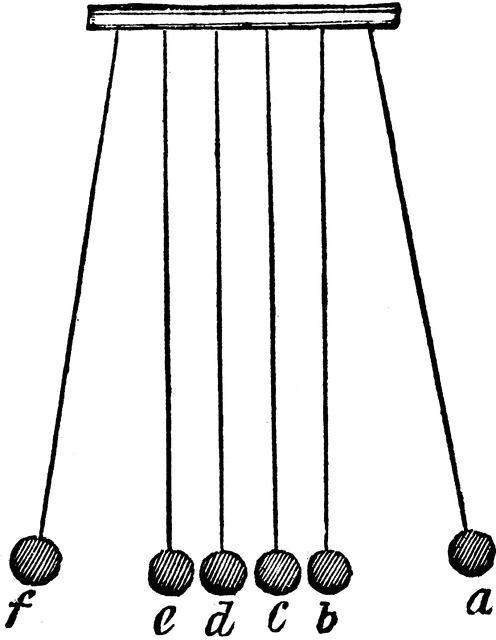
Newton's cradle REGULAR READERS WILL KNOW that I harp on about the Buddha's equation of intention and action - cetanā and kamma. More than one person has noted that this equation only occurs once in the Canon. This uniqueness makes us uneasy about putting so much weight on the phrase - surely if an idea was centrally important then it would be mentioned more frequently? I agree with this, and I have been on the look out for more references which discuss kamma and cetanā. I found an interesting passage in the Cetanā Sutta (SN 12.38, S ii.65-66). The first paragraph of the sutta translates as:
At Sāvatthī. What you think about (ceteti), monks, what you plan for (pakappeti), and what obsesses (anuseti) is the condition (ārammaṇa) of the persistence (ṭhiti) of cognition (viññāṇa). When there is a basis, there will be cognition. With persistence and growth of conscious there will future rebirth in a new existence. With future rebirth there will be future birth, old-age and death, grief, lamenting, misery, dejection, and trouble. Thus is the origin of the whole mass of disappointment.
The other paragraphs deal with a partial and complete cessation of disappointment, as simple negatives, so I'll just focus on this paragraph. Here the verb ceteti is the origin of the action noun cetanā. I said in my first post on ethics and intention:
Cetanā derives from the root √cit which also gives us the words citta 'mind' and cetas 'thought'... The root √cit is defined in the dictionary as "knowing; thought , intellect , spirit , soul", but also "to perceive , fix the mind upon , attend to , be attentive , observe , take notice of"; and "to aim at , intend , design; to be anxious about , care for; to resolve". So √cit concerns what catches our attention on the one hand, and what we move towards on the other; or, what is on our minds, and what motivates us (emotions are what 'set us in motion').
In Sanskrit the two roots √cit 'to perceive' and √cint 'to think' are different enough to be thought of as distinct, though Whitney does acknowledge that √cint appears to derive from √cit. PED draws out the difference by seeing √cint as an active voice (parasmaipāda) form with a nasal infix (like for example √muc 'to free' > muñcati 'he releases'); and √cit as a medial or reflexive form (ātmanepāda). Originally the reflexive form was for verbs affecting oneself, while the active form was for verbs affecting others - like, for instance the difference between 'I go' and 'he goes' (the word is the same but the form is different) - though this semantic distinction is largely lost in both Classical Sanskrit and Pāli even when the form persists.

Pāli citta is further confused with Sanskrit citra 'to shine'. So when the Buddha says Pabhassaramidaṃ, bhikkhave, cittaṃ (AN 1.51) what most people miss is the pun. Citta means both 'thought' and 'shine' and the phrase could equally be read - 'this thought is radiant', or 'this shiny-thing is radiant'. The context does incline towards reading 'mind', but the ambiguity and pun are obvious to a Pāli speaker.

cetanā is an abstract noun from active form (cinteti 'to think') and PED defines: 'the state of ceto [mind] in action, thinking as active thought'.

Now in the passage quoted above Bhikkhu Bodhi, very much the Buddhaghosa of our time, draws attention to the relationship of ceteti with cetanā by translating it as 'what one intends'. (Connected Discourses p.576). Bhikkhu Thanissaro (on Access to Insight) follows suit, and and Maurice Walsh opts for 'what one wills'. Why? First there is the title of the sutta - cetanāsuttaṃ - though, as I understand it, most of the titles in SN were added later. Secondly ceteti is paired with two other verbs pakappeti 'to plan' and anuseti 'to obsess over' and in Pāli these kinds of appositions are usually synonyms reinforcing each other. PED specifically mentions this group of three 'to intend, to start to perform, to carry out' (s.v. cinteti meaning b.)

Buddhaghosa's commentary glosses
Ettha ca 'cetetī'ti tebhūmakakusalākusalacetanā gahitā

And here ceteti refers to having grasped the good and evil intentions of the three levels of being (i.e. kāmaloka, rūpaloka, arūpaloka). [1]
I'm slightly wary here. My argument would be supported by simply agreeing with Buddhaghosa and the modern translators who have clearly followed him. But my understanding of the philology and the context makes me want to translate ceteti as 'thinks about', with the understanding that we are drawn to or away from objects as we find them pleasant or unpleasant only as an implication. I don't like 'intends' as a translation here, even though it would suit my rhetorical purposes better. There is a third possibility in PED which is that under some circumstances ceteti can mean 'to desire' though this requires the object of desire to be in the dative case. Our situation the object is abstract 'what' (yaṃ) but not in the dative.

In any case ceteti is one of three activities, three mental activities, which provide a basis (ārammaṇa) of the persistence (ṭhiti) of cognition (viññāṇa) and therefore for rebirth in the future (āyatiṃ punabbhavābhinibbatti). This is interesting because we're not talking about a condition for the arising of cognition here, but for its persistence. Once cognition is arisen it is sustained by what we think about, plan for, and obsess over - which is to say that once a cognition arises in our minds (through contact between our sense faculties and sense objects) it is we who sustain them through actively keeping them in mind. Seeing things this way I struggle to see how cognition generally can be said to arise from ignorance (avijjā) in a single step, and it makes those versions of the nidāna chain which leave out this connection (especially the Mahānidāna Sutta) even more attractive.

The connection with kamma is that the persistence of viññāṇa, through ceteti is what makes rebirth possible. For early Buddhism viññāṇa provides the continuity from life to life. Through our ceteti we ensure rebirth; so here ceteti is kamma, is the kind of action that results in rebirth. The confirmation is rather indirect, and not unambiguous, but it is there.

~~oOo~~


Notes
  1. For those interested in such things the analysis of this compound - tebhūmakakusalākusalacetanā - is interesting. Firstly I take kusalākusala as a dvandva compound - kusala-akusala 'good and bad'. Then I take kusalākusala to form a karmadhāraya compound with cetanā (i.e good and bad intentions). Bhūmaka is a tadhitha compound or secondary derivation from bhūma (=bhūmi) + -ka (an adjectival suffix); and tebhūmaka is a dvigu form of karmadhāraya compound - 'having three grounds or levels'. Then finally kusalākusalacetanā forms a tatpuruṣa compound with tebbhūmaka 'the good and evil intentions of the three levels'. One can see that compounds like this are a very succinct way of writing as they convey a lot of grammar implicitly, but you wouldn't expect them in an oral literature because it's more difficult to parse such long compounds orally. It also assumes that we know what 'the three levels' refers to.
image: Clipart ETC

28 January 2011

Love and the Ordered Universe

The idea that the universe is non-random, above all that the universe follows rules analogous to human social rules that we can understand and follow in order to get along, is one of the most pervasive human myths and an important idea in most religions. Indeed we could define myth in this sense as a story or narrative which conveys the sense of an ordered universe, and in what way the universe is ordered (i.e. myth is descriptive); and religion as attempts to ensure we follow the laws implied by an ordered universe (i.e. religion is prescriptive). In ancient India this order was called first ṛta and then dharma.. In some tellings of Greek myth first there was khaos - an unordered, unstructured void - and then the ordered universe, the kosmos, was brought into being.

Since the European Enlightenment it has been discovered that mathematical models can describe aspects of the world very accurately. Simple equations such as F=ma or E=mc2 tell us a great deal about how matter behaves, and what to expect from it in the future - matter appears to 'obey' these 'Laws'. In the course of my education I studied these physical laws in great detail, and personally demonstrated many of them. But along the way I began to see that my education in science consisted in being presented with a series of increasingly sophisticated models, none of which was true in any absolute sense, and none of which did much for my angst. The Laws of physics are useful and accurate descriptions of matter under most circumstances, but they do not meet every need.

Just because we perceive order, does not mean that there is order. Hopefully readers will recall the movie A Beautiful Mind. It no doubt romanticised the experience of madness, and yet it highlighted something about the human mind. Our mind sees patterns - we are pattern recognition sensors of the highest sensitivity. In fact we tend to see order where there is none. Give a human being a random array of points of light (like, say, the stars) and we fill it with a bestiary and a pantheon that reflects everything that we care about. Given random events we will see connections. In the movie John Nash becomes obsesses with and delusional about patterns, but this was a natural faculty gone haywire, not simply a product of madness.

One could also say that religion is simply our collective hopes and fears writ large and projected out onto the universe: our worst fear is that the universe is devoid of rules, or else utterly determined by rules; the hope is that there are enough rules to make life predictable, not too many as to make it stultifying. We want to be free to act, to choose, to experience novelty; but not too much. We want to know that the sun will rise each day, that the seasons will appear in due course, that the crops will grow and ripen; that we will have enough food and water, that predators will not carry us or our loved ones away etc. Most of these are not very sophisticated and reflect our evolved biological needs rather than our intellectual longings. Our societies overlay this with a veneer of sophistication, but our actual needs haven't changed in millennia, just the strategies for meeting those needs. As social primates it's important for us to establish social rules and hierarchies and for everyone to keep to them in order to fulfil our social needs. Hence we see the personified forces of nature as a celestial society, or as in ancient China as a celestial empire. The gods of course are not observed to obey the same social rules as humans, but never the less we discern order amongst them and do what we can to facilitate that order through sacrifice and prayer (all gods are similar in needing to be propitiated in order to behave - rather like over-sized toddlers). Many gods are effectively alpha-male primates in the sky - demanding submission and the best food. It seems irrational until you look at, say, chimp behaviour (I highly recommend reading Jane Goodall's In the Shadow of Man for instance). Part of the reason that apparently irrational religion is so very popular is that it speaks directly to deep human needs.

I wonder if this mismatch between our basic biology and intellect may be behind the mismatch between ordinary people and intellectuals? Recently I watched TED video of Richard Dawkins exhorting his audience to militant atheism. One of the points he makes is that amongst members of the American Academy of Science less that 10% believe in a god. When you compare that to members of the public it's more like 75% of people believe in a god. Dawkins quotes (ex)president Bush as saying an atheist could not be a patriot. Atheism is, however, the largest category of religious belief in the USA after Christianity - outnumbering Judaism, Hinduism and all other religions put together. But atheists have no political voice in the USA. I thought that was a very interesting point.

Intellectuals can generally see that the idea of a creator god is not credible, and it is interesting that Christian intellectuals back off from anthropomorphic versions of god even when they cannot give up the idea altogether. Ordinary people are harder to convince because they still project their hopes and fears onto the universe. And they want the universe to care. A caring universe is often personified as a loving mother or father (I don't recall any culture describing the universe/nature as a favourite aunt or uncle for instance).

The universe described by scientists seems not to care about us. I had an important realisation about this some years back when I used to surf on the rugged West Coast beaches near Auckland, New Zealand (especially Piha). These beaches are potentially dangerous and every year several people drown there, though with care they provide excellent surfing and swimming. The waves just roll in to their own rhythm, and they do not hesitate to drown the incautious. The sea does not glory in killing people, or regret one getting away. The sea is completely and utterly indifferent to us. When you float around on it for hours at a time, several days a week for a couple of years this becomes apparent. The ocean is magnificent, beautiful, fascinating, and thrilling, but it is not alive, not sentient. The ocean does not care, because it cannot. Caring is something that humans do.

I believe the universe is like this also. The universe does not care about us. It is not an ethical universe (i.e. it has no bias towards 'good') but one which is not aware at all, let alone aware of us and our needs: the universe is largely inanimate and driven by physics and chemistry. This might sound bleak or hard, scientists are often accused of being cold, but I'm not finished. Because the wonder is that self-aware beings can and do care. Sure, other animals experience consciousness and emotions so some extent. I don't deny that. But humans have this ability to rise above circumstances that no other animal possesses. We have an ability to be altruistic not possessed by other beings - for instance we help strangers, and can turn enemies into friends. In effect it is humans that provide the love, the caring, and the emotional warmth in the universe because they are products of consciousness, especially self-consciousness.

In response to one group of Brahmins who were concerned about the afterlife (Tevijja Sutta DN 13), the Buddha described a series of meditations in which one radiates positive emotions for all beings. One first of all radiates general goodwill, friendliness, love. One makes no distinctions between any beings, but imagines all beings everywhere being happy and well. Then we imagine that all people in need getting what they need, all the ill and unhappy beings becoming well and happy. Then we imagine ourselves celebrating along with everyone who has good fortune. And finally we radiate equanimity - a pure positivity not dependent on circumstances, but which arises out of our identification with all beings everywhere. What finer use of the imagination is there? It is no coincidence that the Buddha named this group of practices brahmavihāra (dwelling with god) and said of them that dwelling on the meditations was like dwelling with, or perhaps as, Brahmā (the creator god - usually depicted with four faces looking in the cardinal directions). The name was probably aimed at Brahmanical theists whose religious goal was brahmasahavyata 'companionship with Brahmā'. In response to concerns about the afterlife the Buddha simply teaches us to love without bounds in the here and now (as the Karaṇīya Mettā Sutta says).

The Buddha's point is much the same as I have been saying. The universe, god if you will, is not the source of friendliness, love, caring, compassion. We are. Love is a human quality that emerges from our consciousness. It is up to us to provide this quality. It's a big job, and so we must set about it systematically, and collectively. Else we may fail, and we all know what that failure looks like. Fortunately we have ways of developing these qualities, and we have exemplars to inspire us. All we need do really is allow ourselves to be inspired, and have a go at the practices.

21 January 2011

Philogical Odds & Ends VI - Meditation Words

philologyMANY WORDS HAVE INTERESTING STORIES associated with them. This is a sixth set of terms which have caught my eye as having some interest, but which did not rate a whole post on their own. There is a list of other terms I've written about at the bottom of this post.

In this post I cover words related to meditation: dhyāna, anusmṛti, bhāvanā, yoga, samādhi, sādhana, and meditation.


Dhyāna
Most of us will be familiar, I think, with the notion that the Japanese word Zen is in fact the Japanese pronunciation of a Chinese pronunciation of the Sanskrit word dhyāna, most often translated as 'meditation'. Here I will go over that ground but in some detail, then go one step further and look at the Proto-Indo-European origins, before considering the translation as 'meditation'. Beginning with East Asia we find the following:
or chán - traditional Chinese.
chán - simplified Chinese.
zen, ぜん - Japanese.
sŏn, - Korean
thiền - Vietnamese.
I'm using the Pinyin transliteration system for Chinese where diacritics indicate tone. In the other most common system - Wade-Giles - 禪 is spelled ch'an. These forms all stem from an original Chinese 禪那 (chán ), which is a transliteration, not a translation - i.e. it is an attempt to capture the sound, not the meaning - of the Sanskrit word dhyāna. It was probably pronounced something like /ʥanːa/ (using the International Phonetic Alphabet). My friend Maitiu tells me:
"this character 禪 has the phonetic element dān 單 which has two small boxes at the top and wherever this character is used with simplified characters in Chinese these two boxes are are replaced with two strokes 单. In the Japanese version of this character the boxes are replaced with three strokes . The radical can also be written two ways - 礻and 示 - hence the two different characters and . Of these 示 is the older form, and also an independent character meaning 'to show or instruct'. Originally 示 was a pictograph of a sacrificial altar and it's used as the radical in lots of characters with meanings associated with sacrifice, ritual and religion. Originally 禪 meant a sacrifice to the earth made by the the King or the ritual of abdication, though in these meanings it has the alternate reading shàn."
Note: Some fonts seem to default older forms to newer ones and even traditional to simplified. Getting the various characters to display correctly is quite difficult - but at time of publishing I see them in the text.  
The Pāli spelling resolves the conjunct dhyā as jhā, i.e. jhāna, while Gāndārī is jaṇa. This made me wonder if the Chinese had decided on the sound chán because they were hearing a central Asian pronunciation with /j/ or /jh/ sound instead of Sanskrit /dhy/. Most of the early Buddhist contact with China was by Central Asians (from cities like Khotan on the Silk Road), or from Gandhāra and other western regions of India. I asked about this and Maitiu replied:
"禪那 is also used in the transcription of the place names Ujjayini and Nairañjanā which supports a reading of jana. Having a quick search the earliest uses of the transcription 禪那 seem to be by Kumārajīva [344 CE – 413 CE] and Dharmarakṣa [4th century] who were both central Asian."
From China, most likely through Central Asia, we come back to India and Sanskrit. Authorities differ on the root of dhyāna. MW lists it under √dhyai. PED points to √dhī as the root. Whitney has √dhyā and distinguishes this from √dhī; he simplifies the meaning as 'think'. The word forms listed under each root are different: √dhī: 'dhīmahi, dīdhayas' vs √dhyā 'dhyāyati, dhyāti' (3rd person singular present indicative forms). However √dhyā and dhī are evidently related.
The noun dhyāna is formed by adding the primary suffix (kṛt-pratyaya) -ana (known as lyuṬ in the Pāṇinian code) to the root. 
The PIE root is *dheiǝ 'to see, to look, to show', and according to AHD this has a variant *dhyā which is where our words come from. A suffixed form *dhyā-mṇ (where is called a 'sonant' form, a sort of nasal vowel) gives us the Greek sēmeion and sēma 'a sign' from which we get our words semantic, semiotic, semaphore, etc. The Indo-European Lexicon lists dhī as a variant form of dheiǝ. The word dhyāna then from it's etymology means something like 'to observe mentally'.

Rather than transliterate, the Tibetans translate dhyāna as bsam gtan (བསམ་གཏན), pronounced 'samten', meaning 'mental focus'. It is made up from bsam 'thought, intention'; and gtan, an intensifier, also meaning 'order, system'. Clearly there is only a semantic, and no etymological or phonological connection. Tibetan translations were standardised quite early one, meaning that one can almost always reconstruct the original Sanskrit terminology.

Anusmṛti
There are a series of meditation practices referred to as anusmṛti (Pāli anussati). The root is √smṛ 'to remember', and with the prefix anu- we get 'to recollect, or bring to mind' and anusmṛti is an action noun meaning "recollecting". These are practices therefore of recollection, remembrance and reflection. In Pāli there are six anussati meditations: recollections of the Three Jewels (buddhānussati, dhammānussati, and sanghānussati), reflection on ethics (sīlānusati), generosity (cāgānussati), and on [the merit of] the devas (devānussati); or ten with the addition of four (three with only sati instead of anussati) reflection on death (maraṇasati), on being embodied (kāyagatāsati), on the breath (ānāpānasati), and on peace (upasamānussati).

Bhāvanā

Bhāvanā is from the Sanskrit root √bhū 'to be' in the causative form (bhū and be are cognate). It therefore means 'development, cultivation'. This is the word most commonly translated as 'meditation' (see below). There are two types of bhāvanā: śamatha and vipaśyanā. The cultivation of śamatha 'calming, tranquillity' is more or less synonymous with dhyānabhāvanā in early Buddhism. Also mettābhāvanā - the development of loving kindness. The word vipaśyanā means 'seeing' (paśyanā) through (vi-). The anusmṛti meditations are vipaśyanā-bhāvanā. If we were to create a Latinate neologism to translate vipaśyanā it might be 'diavision'.

Yoga
Yoga means 'connection, joining; application, meditation, spiritual practice' from the root √yuj ‘to yoke’ originally the act of yoking animals esp horses together, or to a chariot or plough. PIE *√yeug ‘join’ > Greek. zygon > Eng. –zygous, syzygy; Latin jugum ‘yoke’ > Eng. jugular, conjugate, & Latin jungere > E. join, junction, junta, etc; cf Welsh iou ‘yoke’; Old English geoc ‘yoke’; also S. yuga ‘eon, era’. [definition from my book Nāmapada]. Buddhaghosa's usual term for a meditator is yogāvacara 'devoted to yoga', but this and the related term yogin 'one who practices yoga' do not occur in the Nikāyas.

Samādhi
This word means 'concentration, focus'. The Pāli commentators consider it to be synonymous with 'one-pointedness of mind' (cittass'ekagatā). The root is √dhā 'to place' with a double suffix sam- + ā; c.f. śraddhā 'to place the heart'. Samādhi is a morally neutral state - one can be focussed on good or evil. In the Abdhidhamma it is one of seven mental states which are always present - i.e. for their to be consciousness at all we must be focussed on something. Samyak-samādhi (Pāli sammāsamādhi) is the 8th limb of the eight-fold path. With respect to meditation samādhi has three degrees (in Pāli) parikamma-samādhi 'preparation focus'; upacāra-samādhi 'access concentration'; and appanā-samādhi 'attainment concentration;, i.e. the dhyānas.

Sādhana
Sādhana is an action noun from the root √sādh ‘to succeed’, meaning 'leading to the goal, effective, efficient'. This word is not used in this sense in Pāli, and is more particularly associated with tantric practice. Someone who does spiritual practice is a sādhaka. √sādh is most likely related to the root √sidh which also means 'to succeed' and gives us the words siddha 'an adept, accomplished, one who has succeeded', and siddhi 'accomplishment, success'.

Meditation
By contrast the English word meditation comes from a PIE root meaning 'to measure': *med. Through Greek metron, we get the English cognates meter, measure, symmetry ('with measure'), and via Latin medērī 'to look after, to heal' (i.e. to take appropriate measures) words such as medical, medicine, remedy. Other words from Latin variants include modest, moderate; mode, model, modern. A Germanic compound *ē-mōt-ja is the source of the word empty. The word meditate, comes from L. meditārī 'to think about, consider, reflect'. I see a definite semantic cross-over with vipaśyanā-bhāvanā style meditations which generally do involve reflection, but not with śamatha-bhāvanā style meditations. Some people have opted to translate dhyāna as 'trance' but this seems to miss the point completely; 'absorption' will just about do; though I think now that 'concentration' is more common, though again I wonder whether concentration really capture the expansiveness and openness of the experience of dhyāna.

~~oOo~~

See other Philological Odds & Ends posts:
  • I: tathāgata, sūtra, śramaṇa, loka, gahapati/gṛhapati.
  • II: cakravartin, cintāmaṇi, yoniso manasikara, pāramitā, etymology.
  • III: bodhisattva, anagārikā, samyak/mithyā.
  • IV: vrata, mitra, kavi.
  • V: megha, mañju, saṅgha.

14 January 2011

Buddhist Atheism and Darwin

Since being contacted by Ted Meissner of The Secular Buddhist podcast for an interview (an enjoyable experience), I've been taking more interest in the theme of non-religious Buddhism as an adaptation of Buddhism to Western Culture. I've watched a Stephen Batchelor video on YouTube, and read various articles. Batchelor is a voice of reason and I appreciate his contribution. At the same time I've discovered that I very much enjoy Richard Dawkins' polemical approach to religion.

Not long ago I changed my strap-line for this blog to "Western Buddhism... the Buddhist Enlightenment colliding with the European Enlightenment" which reflects my growing interest in how we adapt Buddhism to Western culture in a way that honours both. Though now a Buddhist and writer, I grew up secular and focussed by education on science. I have a B.Sc in chemistry from Waikato University, NZ. However, during my studies I realised that a detailed knowledge of the theory and practice of science was not enough. I was still largely unhappy, even depressed, most of the time, despite getting good grades in my chemistry classes. I did some shopping around before becoming a Buddhist and joining in with the Triratna Community. Buddhism seemed to offer what I was missing, and a large part of that was a community of people with coherent, well articulated, but also lived values. I found at the Auckland Buddhist Centre back in 1994.

In this post I want to look at one kind of rhetoric used by religions adapting to new cultural surroundings, and contrast that with how Charles Darwin changed the Christian Church forever. In the Hindu tradition there is a popular narrative about Gautama the Wake. He was in fact the ninth avatara of Viṣṇu, and he manifested in order to stop Hindu's from carrying out animal sacrifices, to reform the Hindu class system so as to allow the śudra class to be liberated. Hindu's therefore see Gautama the Wake as a reformer from within. I have met people, both in the West and in India, who hold this view in all seriousness and who tried to convince me of it. Of course no Buddhist takes this seriously. The lie is so great and so bold that we hardly know where to begin to refute it. However the avatara story is not rhetoric intended to convince Buddhists that really they are Hindus. No, the rhetoric has a primarily internal audience. This is a story that is mainly told by Hindus for Hindus.

Buddhists have used precisely this tactic. I've already pointed out that despite the efforts of many scholars (with K. R. Norman and Richard Gombrich at the forefront) to find parallels and echoes of the Upaniṣads in early Buddhist texts, that the early Buddhist portrayal of Brahmins suggests a slim and superficial knowledge - a second-hand caricature - rather than a true critique (See especially Early Buddhism and Ātman/Brahman). It might make sense to see the Buddhist critique of Brahmins as similarly intended for an internal audience, especially in light of the historical failure to convince many Brahmins. Later on we see other aspects of Indian religion being absorbed by Buddhists: Sarasvatī and Śrī in the Golden Light Sūtra; Śiva in the Karaṇḍavyūha Sūtra, and again in the Sarvatathāgata-tattvasaṃgraha where Śiva is converted to Buddhism and becomes a dharmapāla (often the form of Mahākāla). Indeed if you look at the periphery of the early Tantric Buddhist maṇḍalas you will find all manner of deities from the Vedas and Pūraṇas, some of whom like the ḍākiṇī who go on to become quintessentially Buddhist! So Buddhists have long employed this same kind of rhetoric, critiquing other religions for an internal audience. I think it helps to strengthen group coherence, and faith in one's chosen path, especially perhaps under adverse circumstances.

I've noticed this same tactic on the Secular Buddhist Facebook page where there is a running critique of traditional Buddhism in terms of what it gets wrong: basically traditional Buddhism contains some superstition and some untestable metaphysical beliefs, such as, and perhaps especially, a belief in karma & rebirth. In my Secular Buddhist interview, Ted and I talked about rebirth & karma and the difficulties they pose for contemporary Buddhists. I am personally very sceptical about rebirth (see Rebirth and the Scientific Method), but I have argued that a belief in karma linked with rebirth might have pragmatic value when seen in the right light as a motivation to be ethical (see Hierarchies of Values). Mind you, I see beliefs per se as rather secondary to practical matters - what motivates someone to be ethical is less important than the fact that they are ethical. Motivations get refined by practice.

Buddhist Atheists, or secular Buddhists, or whatever we call them, have a problem not unlike the problem of 'Christian Atheists' (people whose belief system is defined by not believing in the Christian God). I suppose most Christian Atheists would claim that they don't believe in any god, but the fact is that the most of the public dialogue revolves around the existence or non-existence of the Christian God. Christians still set the agenda. One of the things I see as vitally important for modern discourse (over which I have almost no influence; but, hey, everyone has an opinion) is that we who are atheists need to find some positive content and start talking about incessantly. We need to stop defining ourselves in terms of what we do not believe, in terms of opposition to the mainstream. God is irrelevant.

One of the reasons that Charles Darwin has been so successful is that he did not set out to criticise the Church or its members. He set out to observe nature, and presented positive evidence of what he found. He did not invent the evolution meme, but he decisively showed that it was the über-meme of biology. Of course it had massive theological implications, but he more or less left it to the Church to work them out. Ironically the Darwin Correspondence Project draws out the fact that Darwin had not intended to attack church doctrine:
"But Darwin was very reticent about his personal beliefs, and reluctant to pronounce on matters of belief for others. His published writings are particularly reserved or altogether silent on religion." - What Did Darwin Believe?
Darwin is a model for anyone who thinks a paradigm needs overturning. He didn't, as far as I know, complain about the lack of a level playing field, or the lack of political influence amongst the intelligentsia (as Richard Dawkins does in his 2007 TED presentation); and he did not directly attack church doctrine - he didn't need to. Though we still argue about implications of his finding, we cannot ignore them. Darwin destroyed the church doctrine of creation by merely presenting his evidence to the Royal Society and the world.

In a sense I'm not interested in reading that traditional Buddhism is getting it all wrong. I agree that an Iron Age tradition, whose most recent innovations are medieval, is unlikely to sit well in our Information Age. It's a given that ancient traditions are failing to live up to the present situation, because we who live in these times, who invented these times, can barely understand and cope with them. On the other hand traditional Buddhism clearly helps many people to lead more meaningful and fulfilling and ethical lives - just as Christianity still appeals to many good people.

On the other hand the idea that Buddhism is inherently in tune with a scientific worldview is not true either - it is rooted in old-world ideas that no longer make sense. Many of those responsible for presenting Buddhism to the Western audience since the 19th century have been passionate about the European Enlightenment rationalist legacy, and they have edited Buddhism to suit Western tastes. Aspects of Buddhism distasteful to the Western mind are often simply left out, glossed over, or explained away; and it's not until a closer association that we find that they are indubitably and perhaps indelibly present. It's not necessarily an intention to deceive, more like a strategy to attract people with what we already know attracts them, but to some extent it is a deception. One consequence is that some Buddhists still claim that the historical Buddha did not believe in any gods, but our own scriptures show him, on almost every page, conversing with gods from various religions. If he did not believe in gods, then who was he talking to?

What I want to see is evidence that leads to conclusions that change the way we think about life in general, from which we can work out the implications for Buddhism. I don't see this coming from Cosmology or Quantum Mechanics or any branch of physics. I think the parallels drawn to these disciplines are either prosaic or spurious. Probably we will find interesting results from ecologists, and evolutionary biologists - especially the followers of James Lovelock and Lynn Margulis, and if I had more time I would go back to Lovelock, and read Margulis (who argues that symbiosis and cooperation are more important drivers of evolution than specialisation and competition). For my money I think we will find compelling evidence to change the way we Buddhists think in the work of neuroscientists such as Oliver Sacks, Antonio Demasio, V. S. Ramachandran, Joseph LeDoux; and their colleagues such as Thomas Metzinger (philosopher), and Martin Seligman (psychologist). I had not read anything in this area for some years, but have been working through Metzingers's recent book The Ego Tunnel: The Science of the Mind and the Myth of the Self. It's not always a joy to read, but the book has some very interesting things to say (more to come on Metzinger!). Clearly those who study consciousness and the mind are much closer to our interests than those who study matter.

Rather than railing against rebirth, karma, or any traditional beliefs (which I think will convert very few people) we would be better off to focus on talking about the implications neuroscience research. One fascinating instance of this is the unfolding discovery of just how intimately connected are consciousness and the brain - this area of study is surging ahead at the moment. The conclusion that mind and brain are inseparable seems increasingly obvious; and the idea of disembodied consciousness increasingly unlikely. I predict that actual rebirth won't survive as a viable meme for much longer except in marginal, fundamentalist sects. However symbolic rebirth as a myth (in the Joseph Campbell sense) may well continue to inform our lives. And we will understand the difference more clearly. The challenge will be presenting what is in fact a highly technical body of knowledge to a readership already overwhelmed by information, with a decreasing attention span, and not trained in the kinds of thinking required to truly grasp the implication of science.

The Darwinian approach of presenting a mass of positive evidence and allowing people to come to their own conclusions can change the world. Although an oppositional rhetoric (as described above) for an internal audience must have some value (or it would not survive), it won't reach beyond the borders of the converted - it is not useful for proselytising. In order to make changes in society, even in Buddhist society, one has to be clear that there is a better alternative, and I'm not sure that Buddhist atheists (or perhaps anyone who identifies with the label atheist) have found what that is yet - they know what they're against, but not what they are for. Or at least what they are for is actually part of the background of modern life (secularism, rationalism, materialism etc).

07 January 2011

Nāmapada: a guide to names in the Triratna Buddhist Order


Support independent publishing: Buy this book on Lulu.
This is my second book published under my own imprint Visible Mantra Press. I've been writing about words, and Buddhist technical terms for some time on this blog and have accumulated lots of notes about various words, as well as a number of useful reference works for tracking etymologies. I saw a need for an accessible guide to the Sanskrit and Pāli names we use in the Order. Most people don't have much Sanskrit or Pāli beyond a few technical terms, and struggle with the standard dictionaries. With my interest in words I was well placed to write such a guide.

So I got hold of a list of all the names in current use and began to work on creating a list of all the words used in constructing them, including suffixes and prefixes. For each of these I offered some of the most common definitions, and then as much etymological information as I could find, and in some cases did some original research (for instance on mitra). It turned out to be fascinating as a large proportion of the words have English cognates, but there are also a few which are not Indo-European in origin but come from the Dravidian or Munda language families. Also one or two words are influenced by the Tibetan translation (ḍākinī and mañju) for instance.

Then I wrote an introduction which covers the basic elements of how words are constructed (morphology) in Sanskrit. Hopefully this will be accessible enough for lay people to use in decoding names. Below is an example of how the book looks using the example of our founder Urgyen Sangharakshita.


urgyen
(ö-rgyan ཨོ་རྒྱན). Tibetan rendering of S. udiyāna (or oḍḍiyāna and other variants). Xuán zàng (玄奘) translated the word as 'garden' suggesting he read S. udyāna 'going out; walking out; park or garden'. The legendary birthplace of Padmasambhava. Though still not positively identified many consider it to be in the Swat Valley, others in South India or Orissa. P. uddiya means 'northern, northwestern' i.e. Nepal. PED suggests a connection with S. udīcya 'territory north and west of the Sarasvatī River' which could include the Swat Valley. The name Urgyen was given to Sangharakshita by Kachu Rinpoche in 1962.

The name Sangharakshita (more correctly transliterated as saṅgharakṣita) is made up of two parts saṅgha and rakṣita.

saṅgha
(also spelt saṃgha which is less correct, though not entirely wrong). Derivation is uncertain but most likely √hṛ as per PED. MW √han is unlikely; but C.f. MW entry for saṃ-hṛ 'to bring together, unite, collect, etc'. PIE *gher 'grab, grip, seize' > Gk. khortos 'enclosed space'; L. hortos (cf. W. garth 'fold, enclosure'; Irish gort 'crop, field'); Gk khoros > E. choir, chorus. Gmc *gurdjan > E. girdle, yard, orchard. Interestingly there is a L. parallel from PIE *ko(m)-ghṛ (= S. sam-hṛ/saṅ-gha) > L. cohors > E. cohort, court. The suffix –gha is a verbal (kvi) suffix which retains the PIE g.[1] In S. spelling rules any nasal followed by gh > , hence correct spelling is saṅgha. However it is further possible, though avoided in Classical S., to use anusvāra – ṃ – to represent any nasal followed by a consonant allowing for saṃgha. Buddhist scribes often favoured anusvāra because it is invariably easier to write.


[1] This happens in other roots in gha, e.g. S. han 'to kill' *ghan. See Jayarava 'Philological Odd & Ends V' for a more in-depth discussion of the etymology and spelling of saṅgha.


rakṣita.
(P. rakkhita) "guarded, protector, watched over" < rakṣ 'to protect, observe, guard'. (note 'observe' means 'watch over' ). PIE *ark > Gk. áléxo hence Alexander 'the protector'; L. arceo > E. ark, arcane 'enclosed' (and therefore 'hidden'), and exercise. The name Gurkha comes from go 'cow' + √rakṣ.
As the introduction says, there are a number of ways of adding two words together to form a compound. In Nāmapada I describe the various approaches and the applicable form is:
1. Here the relationship is 'Y of X' for example: Prajñāpriya 'the lover (priya) of Wisdom (prajñā)'; or Dharmadhara: 'the bearer or memoriser (dhara) of the teachings (dharma). Note that the first element can be plural. The relationship can also be 'Y for X'; 'Y through X'; or, particularly when the last part is a past–participle like rakṣita 'protected', 'X by Y' e.g. SAṄGHARAKṢITA 'protected by the saṅgha'.

Note that I've included some of the technical jargon (this is tatpuruṣa compound) but it is not emphasised. So we see that Saṅgharakṣita means 'protected by the spiritual community'. Finally in the introduction I have sections on pronunciation and stress - so saṅ rhymes with 'sung', not 'sang' for instance; and kṣi has a short i sound as in 'bit', not a long ee sound as in 'beet'. Stress falls on the ra (which is 'heavy' because it is followed by a conjunct consonant), so: Saṅgharakṣita.

With almost 500 entries the book covers the meanings of all names in use in the Order up to June 2010. I've tried to make it as easy as possible, so the entries are in the order of the English alphabet ignoring diacritics - all diacritics are provided, along with some guidance on how to break down names which might be tricky. For instance Dharmolka 'a firebrand for the Dharma' is make up from dharma + ulka 'firebrand'. The change of spelling is caused by sandhi meaning 'junction'. The rules for sandhi are complex, but only a few are relevant to names in use, and these are listed and explained in the introduction. In this case when a word ending in a is combined with a word beginning with u, the two vowels coalesce to o.

I'm very pleased to be able to make this offering to the Triratna Order, and I hope that it helps everyone involved with the Order to feel more comfortable and familiar with our names.

31 December 2010

A General Theory of Conditionality?

IT IS VERY OFTEN POINTED OUT that the nidāna sequence is only the application of a general principle of conditionality to the specific case of rebirth or becoming (depending on how one interprets the nidānas). What if this idea, that the Buddha proposed a general theory of conditionality, is not true? I want to revisit an article by Eviatar Shulman in the Journal of Indian Philosophy [1] I've previously mentioned, and discuss one of his conclusions. He points out that what is traditionally thought of as the general principle of conditionality is:
imasmiṃ sati idaṃ hoti,
imass'uppādā idaṃ uppajjati;
imasmiṃ asati idaṃ na hoti,
imassa nirodha nirujjhati.
That being, this becomes;
with the arising of that, this arises.
That not being, this does not become
with the ceasing of that, this ceases.
This formula occurs just 14 times throughout the Nikāyas, and not at all in the Vinaya. [2] What we don't often see is that this formula is, in all but one case, followed immediately by the nidānas. So at SN 12.21 (Dasabala Sutta):
Iti imasmiṃ sati idaṃ hoti, imassuppādā idaṃ uppajjati; imasmiṃ asati idaṃ na hoti, imassa nirodhā idaṃ nirujjhati - yadidaṃ avijjāpaccayā saṅkhārā; saṅkhārapaccayā viññāṇaṃ…pe… evametassa kevalassa dukkhakkhandhassa samudayo hoti.
Note that the punctuation varies from place to place in the various Romanised versions of the Canon: sometimes the phrases are connected by hyphens or semi-colons, though of course Pāli traditionally employed no such punctuation; sometimes they are separated into separate sentences. The abbreviation "pe" occurs in the Pāli, especially in the Saṃyutta Nikāya, for well known lists such as the 12 nidānas. The phrase avijjāpaccayā saṅkhārā means 'with the condition of ignorance, there are volitions'.

A great deal of exposition on the Dharma relies on paṭicca-samuppāda being a general theory of conditionality. Nyanatiloka's Buddhist Dictionary entry on paṭicca-samuppāda is broadly representative and begins:
'dependent origination', is the doctrine of the conditionality of all physical and psychical phenomena... (p.154)
For Buddhists all phenomena are explained by paṭicca-samuppāda. In the traditional account the twelve-fold nidāna sequence is a special case of paṭicca-samuppāda applied to becoming, or to rebirth, just as the 'Four Noble Truths' are that principle applied to suffering. Shulman's point is that this is not what the suttas say. His argument revolves around the connecting pronoun yadidaṃ (or yad idaṃ). He says:
"If yad idaṃ meant ‘for example’ or ‘such as,’ we could accept the view that the 12 links are a private case of a general principle of conditionality. But it clearly does not. What it does express is more akin to ‘that is,’ or more precisely ‘that which is’." (p.307)
This proposition is quite startling. Shulman is not just proposing that we reinterpret an obscure piece of doctrine, but that we completely re-read the Buddhist tradition. I decided to take him seriously, and explore his hypothesis more fully.

The PED has a fairly full description of the use of yadidaṃ (s.v. ya˚, p.544b)
nt. yadidaŋ lit. "as that," which is this (i. e. the following), may be translated by "viz.," that is, "i.e." in other words, so to speak, just this, "I mean"; e.g. kāmānaŋ etaŋ nissaraṇaŋ yad idaŋ nekkhammaŋ "there is an escape from the lusts, viz. lustlessness"; or: "this is the abandoning of lusts, in other words lustlessness" It 61; dve dānāni āmisa˚ dhamm˚, etad aggaŋ imesaŋ yad idaŋ dhamma˚ "this is the best of them, I mean dh -- d." It 98=100; supaṭipanno sāvaka -- sangho, y. i. cattāri purisa -- yugāni etc. M i.37.
There seems no necessity to restrict yadidaṃ to a narrow range of meaning based on etymology as in practice it is quite broad. Additionally Warder (Introduction to Pāli, p.292) suggests precisely the kinds of translations that Shulman says are not applicable: "such as, to wit, i.e., namely". So the case on this ground is not as strong as Shulman suggests.

The single exception to the imasmiṃ formula being followed by the nidānas (M ii.32 Cūḷasakuludāyi Sutta) seems to be inconclusive and Shulman dismisses it summarily. My opinion is that the 13 examples where imasmiṃ... is linked via yadidaṃ to the nidānas weigh against the singular exception. The context of the sutta - where the Buddha introduces the imasmiṃ formula but appears to be interrupted by Udāyin, who baulks at hearing the full teaching - supports the contention that this exception need not be construed as a standalone, but could equally be seen as a fragment, as an incomplete statement. In other words though I disagree with Shulman about yadidaṃ, I tend to agree that the exception does not definitely point to a different conclusion.

In search of some more conclusive evidence I looked for sentences which used the same locative absolute syntax as the 'general formula - Xlocative sati Y hoti. If we were to find the same syntax applied in different situations this would strengthen the 'general principle' case. It turns out that we do find other types of examples: for instance at D ii.276 we find a series of connected elements in the form:
kismiṃ sati issāmacchariyaṃ hoti? piyāppiye sati issāmacchariyaṃ hoti.

When what exists is there envy? When there is pleasant and unpleasant, there is envy.
The sequence runs:
papañcasaññāsaṅkhaya → vitakka → chanda → piyāppiya → issāmacchariya
There is no intersection with the nidāna sequence, but the same syntax is being used, suggesting that this syntax is not as specific as Shulman's claim would suggest. Having found a counter example we can say that Shulman's specific conjecture is refuted. The formula does have a more general, a more abstract sense.

However Shulman's wider point is this: "There is no reason to believe that dependent-origination originally discussed anything but mental conditioning" (p.307), and here I find we are in better agreement. In looking at this kind of syntax I did mostly find applications to mental process. However just one example of the Xlocative sati Y hoti construction is used as a simile which is suggestive. At S iv.172 the Buddha uses the example that "where there are hands, you get picking up and putting down" and similarly with the functions of the feet, limbs, and belly. These are cited to illustrate the application to mental processes, but they do show that the Buddha was aware of a more general application, even if it was not emphasised. As elsewhere the Buddha draws on nature for similes to illustrate his meaning, and this suggests that he saw similar processes in nature, though the similes all point one way - the mind is never a simile for what happens in nature.

The other aspect of the formula - X uppādā Y uppajjati - is much more restricted. I can find only one occurrence outside the context of the nidānas. At D ii.215 (Janavasabha Sutta) we find:
Tassa evaṃ jānato evaṃ passato avijjā pahīyati, vijjā uppajjati. Tassa avijjāvirāgā vijjuppādā uppajjati sukhaṃ, sukhā bhiyyo somanassaṃ.

For one who knows and sees, ignorance wanes and knowledge arises. For that one, from the purification of ignorance and arising of knowledge, bliss and happiness arise.
The relevant part is vijjuppādā uppajjati sukhaṃ - word order is not important here, and this is equivalent to vijjā uppādā sukhaṃ uppajjati. This confirms my earlier finding that though the formula is not tied specifically to the nidānas, it applies mainly to mental processes. It seems that Shulman has over-stated the case a little, but was not completely off the mark. Indeed his idea is confirmed by Sue Hamilton's findings in Early Buddhism: a New Approach, and some of the references he himself cites, particularly Collette Cox's investigation of the development of the theory of dhammas in the Sarvastivādin tradition. It is good to see scholars continuing to challenge the status quo and traditional orthodoxy. I found Shulman's paper very stimulating and thought provoking. I've focussed here on only one aspect of it and may return to some of his other points in other blog posts.

This has clarified my thinking on paṭicca-samuppāda in a very useful way. The fact that there is even a single example of the kind - "when there are hands, there is picking up and putting down" - suggests that the Buddha did indeed see the idea of conditionality applying outside of mental processes - a hypothesis I have been arguing against for some time on this blog. That conditionality can be illustrated by similes drawn from nature tells us that the principle is more general. I don't think this changes the observation that the Buddha was concerned exclusively with mental processes as the source of disappointment; it changes the context a little, but not the focus.


~~oOo~~

Notes
  1. Shulman, Eviatar. 2008. 'Early Meanings of Dependent-Origination,' Journal of Indian Philosophy, 36(2): 297-317.
  2. The imasmiṃ formula occurs at: M i.263, ii.32, iii.63; S ii.28, 65, 70, 78, 79, 95, 96, v.388; A v.184; Ud 1, 2. All of the references in S ii are in the nidāna saṃyutta.

A much longer and more involved exploration of this subject can be found in this essay: Is Paṭicca-samuppāda a Theory of Everything?.

24 December 2010

Paṭicca-samuppāda - a theory of causation?

Wheel of Life: Dependent Arising
"The doctrine of Dependent Origination is a
fundamental Buddhist teaching on causation
and the ontological status of phenomena."
-
Encyclopedia of Buddhism [1]

~~~

THIS IS THE FIRST SENTENCE from the definition of dependent-origination from the Encyclopedia of Buddhism, and it made me think "no, it isn't!" The fact is that this kind of source - a general encyclopedia - is not going to make much difference in Buddhist circles since Buddhists aren't likely to be consulting an encyclopedia on Buddhism, but it will get taken up by students, especially students of comparative religion, who will propagate the view.

I'm very doubtful about this word 'doctrine'. It leads to the phrase 'dependent-arising' being capitalised, when dependent-arising is purportedly a description of a process of 'things' arising, i.e. adjectival; it is not a thing itself, so I don't think it should be a proper noun. In any case "doctrine" sounds too fixed, too certain, and too dogmatic for my ear. So I won't use it, and will instead talk about the theory of dependent-arising.

First paṭicca-samuppāda is not a teaching on, or a theory of, causation at all. While the Buddha did use the term hetu 'cause, reason' sometimes, it was always synonymous with words like paccaya 'condition', samudaya 'origin', etc. The English translations are all synonyms as well, according to my Oxford Thesaurus. Paṭicca-samuppāda is about dependency and contingency, but it is not about causation. As far as I can tell the Buddha doesn't use hetu in its verbal form (hinati, pahiṇati), in this context. I've done a detailed analysis of the word paṭicca-samuppāda and you can consult that if need be, but the gist is that things arise on the basis of conditions. We do not say that the condition causes the thing to arise (and thereby we avoid assigning agency to them), only that something arises having depended on (paṭicca) something else. This form - 'having depended on' or 'depending on' - (a gerund) sounds awkward in English, but is a very common way of creating subordinate clauses in Pāli. The gerund refers to an action immediately preceding the main verb (here indicated by the verbal noun samuppāda arising). The arising is preceded by the condition, and arising is dependent on the condition - this is all that is being said.

When the Buddha said imasmiṃ sati idaṃ hoti (that being, this becomes) he used a particular grammatical form known as a locative absolute: both imasmiṃ and sati are in the locative case. Here sati is an action noun from √as 'to be', and not related to sati 'remember' (Sanskrit smṛṭi). The sense is of the locative absolute sub-clause is one of duration: 'while this exists' or 'when this exists'. Then idaṃ hoti just means 'this is'. So the sentence says: "while there is that, there is this" (imasmiṃ and idam are the same deictic pronoun and should both be 'this', but that gets confusing). There is no sense, nor any implication of causation here. We might say, following the metaphor used by Bhikkhu Ñāṇavīra, that while there are walls, the roof stays up; and when the walls are absent there can't be a roof, if the walls crumble the roof falls down. The walls do not cause the roof, nor are they in themselves sufficient to bring the roof into existence (it requires some other factors as well). To take the walls as causing the roof would be to give them agency as builders.

The most common way of explaining paṭicca-samuppāda is with reference to the nidānas:
"from the condition of ignorance [there are] volitions (avijjā-paccayā saṅkhārā)" etc.
The verb 'to be' (i.e. 'there are', 'there is') is missing because it is permissible, and idiomatically correct in Pāli. Just as above avijjā is a condition without which there can be no saṅkhārā, but it does not cause it - ignorance doesn't have agency of itself, but causes the agency I do have to go awry. Another frequent expression goes like this: with the eye and forms as conditions, eye-consciousness arises. (cakkhuṃ ca paṭicca rūpe ca uppajjati cakkhu-viññāṇaṃ). Again think of the house analogy - when the foundations and the walls are in place, you can put up a roof. As Bhikkhu Bodhi, articulating a more orthodox Theravāda view, says of the nidānas:
"The sequence of factors should not be regarded as a linear causal process in which each preceding factor gives rise to its successor through a simple exercise of efficient causality. The relationship among the factors is always one of complex conditionality rather than linear causation. The conditioning function can include such diverse relationships as mutuality (when two factors mutually support each other), necessary antecedent (when one factor must be present for another to arise), distal efficiency (as when a remotely past volitional formation generates consciousness in a new life), etc." [2]
The second point is about ontology. Ontology is one of these big words I've gotten into the habit of using without ever saying much about it. The Online Etymology Dictionary tells us that word comes from the Greek verb einai 'to be' (present-participle: on 'being', genitive ontos.) and refers to the study of, and theories about 'being'. The primary question ontology asks is "what is there?" Similarly epistemology is the study of knowledge and asks "what can we know about what's there?" These are the basic questions of Western philosophy down the ages. And, as I have previously argued, there is a fundamental mismatch between Buddhism and Western philosophy because the Buddha had no interest in either of these questions. The domain (visaya) for Buddhist inquiry is the 'world' which arises out of the interaction between between sense faculty and sense object. The Buddha has little or nothing to say about sense faculties except to list them; and little or nothing to say about sense objects except that desire for them is unhelpful. Because he is not interested in the question "what is there?" we must conclude that the Buddha was not interested in ontology. As I pointed out in my commentary on the simile of the chariot, from the point of view of the Buddha only disappointment (dukkha) arises, and only disappointment ceases. Paṭicca-samuppāda is an insight into how dukkha arises - dukkha being a synonym for 'the world of experience' [see also What Did the Buddha Mean by World?].

I had a go at explaining the various meanings of dhamma in Oct 2009. Dhamma is often translated as 'phenomena' - with the sense that it applies to any phenomena. It can simply mean 'thing' and this may give the impression of an ontological position. The nidānas are sometimes referred to as dhammas (items in a list). However over some years now I've been arguing for the adoption of one of Sue Hamilton's key insights: that the Buddha was always talking about experience, and not about ontology. [3] Even Bhikkhu Bodhi who apparently remains convinced that the Buddha did talk about ontology from time to time, concludes:
“The world with which the Buddha’s teaching is principally concerned is ‘the world of experience,’ and even the objective world is of interest only to the extent that it serves as that necessary external condition for experience.” [4]
To be fair there are some ontological implications of paṭicca-samuppāda: e.g. consciousness (viññāna) apparently precedes body (nāma-rūpa); but the teaching is not about that, it's an incidental aspect of the teaching. [5] I've confessed that these ontological implications cause me some confusion, and I have been so far unable to reconcile them. But in terms of getting on with practice it doesn't matter in the least - my focus, like the Buddha's is not on ontology, but on experience. I'm happy to practice ethics, calm down, observe my 'world' and allow insight to resolve lingering doubts and confusion when it comes - it's a work in progress.

So if I were to reframe that first sentence in the Encyclopedia I would say it this way:

The theory of dependent-arising is a
fundamental Buddhist teaching on conditionality
and the nature of experience.


~~oOo~~

Notes
  1. Keown, D. and Prebish, C. Encyclopedia of Buddhism. Routledge, 2007. (p.268.)
  2. Bodhi Connected Discourses. p. 523 (introduction to the nidāna-saṃyutta.)
  3. Bodhi Connected Discourses. p. 394, n.182.
  4. I note that there is a contemporary philosophical discourse about the "ontology of experience" but I don't understand it. My view is that experience has an indeterminate ontological status - the language of ontology, i.e. existence and non-existence, simply doesn't apply. This is in line with what we find the Buddha saying in the Kaccānagotta Sutta (SN 12.15); and later in Nāgārjuna's Mūlamadhyamaka Kārikā (which quotes a Sanskrit version of the Kaccānagotta at 15.7).
  5. See especially: Shulman, Eviatar. 2008. 'Early Meanings of Dependent-Origination,' Journal of Indian Philosophy, 36(2): 297-317. I have some reservations regarding Shulman's assumptions about what is referred to in the nidāna chain, but over-all this is one of the most interesting articles I've read in years.

17 December 2010

Action and Intention II

diamondIn translating and commenting on the Nibbedhika Sutta a few weeks back I neglected to tie my comments in with another idea I have been working on for some time. It's not an obvious proposition that intention is the ethically significant aspect of morality, and some people struggle with this. I think it is because we are mistaken about the range or domain (visaya) in which the teachings apply, and the equation of cetanā and kamma is actually a clue in the puzzle.

I've been researching the way the Buddha talks about paṭicca-samuppāda to try to discern where he thought it applied. We Buddhists are all familiar with the idea that "everything is impermanent"; we often say "all things arise in dependence on causes" but I keep asking the question "what is meant by 'everything' or 'all things'?" I'm working through this territory in a long essay, that has been evolving over a couple of years, and questions some of the basic assumptions in these slogans.

I've already written about the question what arises in dependence on causes? The short answer is 'dhammā'. Dhamma can be translated as 'thing', and it is sometimes that general in Pāli. But in terms of 'arising' it is not talking about things generally, but about mental processes. On the whole it is mental processes that arise in dependence on causes. This raises the question of why we talk of paṭicca-samuppāda as a general theory of conditionality?

I've also talked about 'the world', and how the world for the Buddha was the world of experience. The very word 'loka' implies the visible world, the sensual world, but a series of other texts make it clear that 'the world' in this context means "one's world". Our own world is neither objective nor subjective, but it arises out of the interaction of the two poles. See for instance M i.259: ‘The consciousness that arises with forms and the eye as condition is called eye-consciousness’ (cakkhuñca paṭicca rūpe ca uppajjati viññāṇaṃ cakkhuviññāṇant’eva sankhaṃ gacchati); or M i.111: ‘dependent on the eye and forms, eye-consciousness arises: these three together constitute contact’ (cakkhuñcāvuso, paṭicca rūpe ca uppajjati cakkhuviññāṇaṃ, tiṇṇaṃ saṅgati phasso).

This world, this experiential world, is the stage upon which we play out our lives.
And, friend, it is right here in this arm-span measure of body endowed with perception and cognition that I declare the world, the origin of the world, the cessation of the world, and the way leading to the cessation of the world. (S i.62)
Not only this, but the texts make it clear that loka is synonymous with dukkha. Both are described in precisely the same terms as the product of paṭicca-samuppāda. I have not found any reference to a text saying that an external object arises in dependence on causes, and I would be very interested if any reader could turn one up.

I'm summarising 9,000 words of argument and textual citation here, but what starts to emerge is that the Buddha doesn't seem to think of paṭicca-samuppāda as applying to the world in general, only to the experiential world arising out of contact. To make the point I offer a thought experiment.
Imagine a diamond in ancient India at the dawn of the second urbanisation, say around 1500 BCE. It is polished and sparkling. We can see it, and touch it, but don't have microscopes or lens; and our theory of elements doesn't give us the kinds of insights that modern chemistry and physics do. It is handed down from generation to generation and apart from gathering a little dust, it does not change for a thousand years. This is part of the value of a gemstone: time does not diminish or tarnish it. After a thousand years no one can remember any details of its provenance. It is as it is, and always has been - unchanging. The Buddha is born 1000 years later, and meets the present owner of the diamond. He sees it, and holds it. He questions the owner about it. For all intents and purposes he establishes that the diamond has never changed (in living memory) and there is no real prospect of it ever changing.
It is not quite true to say that everything changes, or at least we can say it is not possible to know that this is true. If the Buddha was intellectually honest (and I'm assuming that he was) then there were many objects in his world that did not appear to change in the span of living memory, and to say that they did change would not be relying on experience.

What I conclude is that paṭicca-samuppāda was applied only to the experiential world; and was not intended to apply, and in fact does not apply, to the world of sense objects in the Buddha's teaching (there is no world of ideal objects inaccessible to the senses in Buddhist epistemology since we could have no knowledge of them). However it is very easy to show, and to understand, that even with reference to a hypothetical unchanging object, that the world of experience arising from contact between that object and our subject is one which is which constantly changing. Experience fully conforms to paṭicca-samuppāda under all circumstances, and this way I, incidentally, side-step the potential charge of eternalism.

No doubt there is cause and effect in the objective world, but physics is a much better description of this than Iron Age Buddhist theories. On the other hand though physics has produced many marvellous discoveries, it has liberated very few minds. In fact the European intellectual tradition has been aware of the changing nature of things as long as the Indian tradition - going back to Heraclitus at least. We all understand that things change, that everything changes.

The Buddha often says "I teach dukkha and the way to make dukkha cease". I think he was speaking quite literally; I think he was not offering an insight into The World, but only into our own world, into our relationship with experience, and how a dysfunction in that relationship causes us suffering. I believe that this is no less profound, but brings the Buddha's insight out of the realm of mystical experiences, inaccessible to the great majority of us, and into the realms of possibility. I believe that any one of us can, with some effort, have this life-changing, world changing insight. I don't discount that it might have a mystical dimension, but I don't see bodhi primarily in terms of mysticism these days.

Of course it was Buddhists themselves who developed the Buddha's initial observations and exposition in the direction of a generalised theory of conditionality. Why Buddhism developed in this metaphysical direction is an interesting question, but one that I haven't the space to pursue. If we understand conditionality in the way I've outlined, then the equation of kamma and cetanā becomes clearer. Cetanā is so vital to Buddhist ethics because Buddhist ethics applies in the realm of the dependently arisen mental processes, and it is in this realm that we have most influence. We might not be able to change the world, but we can certainly change our own minds.


~~oOo~~


image: Phillip Stoner The Jeweller. For, who could resist a diamond seller called 'Stoner'?
Related Posts with Thumbnails