15 April 2011

Another Version of the Spiral Path

jacobs ladder as illustration of the Spiral PathI have now identified more than two dozen texts which describe the Spiral Path. [1] Two more recently came to my attention. AN 10.61 and 10.62 are the same except that AN 10.62 adds 'craving for becoming' at the bottom of the spiral. These two texts are significantly different from all other Spiral Path texts. For one thing there is a downward spiral and an upward one, which both seem to operate on the same principle. The nodes on the path are distinctive, though reminiscent of the path outlined in the Samaññaphala Sutta (DN 2). The central sequence from pamojja to samādhi, a feature of virtually all the other Spiral variations is entirely missing. From the morality related nodes we go into a meditation phase of a different sort. The wisdom phase is collapsed into one node and does not highlight the distinction between the experience of liberation and the knowledge of liberation. What makes this a Spiral Path is the syntax, and the presence of the rain simile. Below is a condensation of the two texts combined. [2]


Spiral path at 10.61 & 10.62
The beginning of craving-for-becoming isn’t clear. And yet craving-for-becoming has a specific condition (idappaccaya).

Craving-for-becoming is fed, and fulfilled by ignorance,
Ignorance is fed, and fulfilled by the five hindrances,
The five hindrances are fed, and fulfilled by the three bad courses,
The three bad courses fed, and fulfilled by the non-restraint of the senses,
Non-restraint of senses is fed, and fulfilled by the unmindfulness and inattentiveness,
Unmindfulness and inattentiveness are fed, and fulfilled by unwise attention,
Unwise attention is fed, and fulfilled by lack of faith,
Lack of faith is fed, and fulfilled by not hearing the good teaching,
Not hearing the good teaching is fed and fulfilled by not associating with good people.

Association with good people feeds and fulfils hearing the true teaching,
Hearing the true teaching feeds and fulfils faith,
Faith feeds and fulfils wise attention,
Wise attention feeds and fulfils mindfulness and attentiveness,
Mindfulness and attentiveness feeds and fulfils sense restraint,
Sense restraint feeds and fulfils the three good courses,
The three good courses feed and fulfil the fours foundations of mindfulness,
The four foundations of mindfulness feed and fulfil the seven bodhi factors,
The seven bodhi factors feed and fulfil liberation through knowledge.

Just as, when the gods pour down rain over the mountains, water flows down the mountainside filling up the branches of the crevices and gullies; having filled the crevices and gullies, small lakes, and the great lakes are filled; the great lakes being filled the small rivers fill up; the small rivers fill up the large rivers, and the large rivers fill up the great ocean.
In Pāli the terms for the second, upward path are:
  • sappurisa-saṃseva - association with good people.
  • saddhammassavana - hearing the true dhamma
  • saddhā -faith
  • yoniso-manasikāra - wise attention
  • sati-sampajañña - mindfulness and attentiveness
  • indriya-saṃvara - restraint of the sense faculties
  • tīṇi sucaritāni - three good courses (i.e. good actions of body, speech and mind)
  • cattāro satipaṭṭhānā - four foundations of mindfulness
  • satta bojjhaṅgā - seven factors of bodhi.
  • vijjāvimutti - liberation through wisdom
What we have here is a collation of other lists into a coherent spiritual path according to the Spiral Path paradigm. There are some interesting features of these lists. Both suttas begin by invoking idappaccaya 'specific condition'. This is an important aspect of paṭiccasamuppāda. The literally meaning is 'grounded on this' where ida is short for idaṃ 'this' the deictic (or pointing) pronoun. Idaṃ refers to something immediately present to, perhaps even within the grasp of, the speaker in Pāli. The term conveys the idea that what's being talked about has a specific condition (paccaya). Both paccaya and paṭicca come from the verb pati+√i which means 'resting on, foundation'. Although some commentators describe the relation of paṭicca/paccaya as causal, it is incorrect to think in terms of 'this causes that'. The words indicate a conditional relationship: 'with this condition in place, that arises'.

Note that the specific condition for faith is hearing the dhamma. Faith here does not arise on the basis of practice or personal experience, but either through the intellectual understanding, the intuitive grasp of what is heard; or the charisma of the speaker. This seems to contradict the usual modern narratives about faith being based on personal experience (hence the cliché that Buddhism doesn't require blind faith). From experience, as we see in complimentary texts like AN 6.10 or AN 11.12, arises 'confirmed confidence' or 'definite clarity' (aveccapasāda) not faith. I've not seen this distinction made before, and plan to return to this theme in a future post.

In the upward spiral to the restraint of senses the nodes are very similar to other Spiral Path texts (e.g. DN2, SN 55.40, MN 7 etc). Then we have three sub-lists. The three good courses, the four foundations, and the seven bodhi-factors. This is similar to the list found in the Ānāpānasati Sutta (MN 118) where ānāpānasati fulfils (paripūri) the four foundations and seven bodhi-factors as well, and leads to vijjāvimutti. Note the use of the same verb.

The prefix in sappurisa and saddhamma is a contraction of sant (or Sanskrit sat). This is a present participle of the verb √as 'to be' (related to English is) and means 'being; true, real, actual; good'. The related word sacca (Skt. satya) is 'truth, reality'. So a sap-purisa is a true or good man, in the moral sense (a 'good' Buddhist). Similarly the sad-dhamma is the 'true or correct teaching'.

Vijjāvimutti seems like an unusual term to me. As PED notes vijjā is usually only secondary when it comes to bodhi. The opposite of avijjā is more often ñāṇa 'knowledge'. Vijjā is often associated with mundane, worldly knowledge on the one hand; and with esoteric or occult knowledge on the other. Later in tantric Buddhism vidyā is used as a synonym for mantra. Of course there are the tevijjā, the three types of knowledge which constitute the intellectual content of the Buddha's awakening, though this formulation seems to be a conscious parody of the Brahmanical triveda, the three books of sacred revelations. In his Saṃyutta translation Bodhi translates vijjāvimutti as a dvandva compound "true knowledge & liberation". The latter is justified in a note (p.1904, n68) which points to the phrase vijjā ca vimutti ca at SN 45.159 (PTS S v.52) and (PTS v.329) which says the bodhi-factors fulfil two things, i.e. vijjāvimutti. So vijjā here may well signify seeing through (vipassana) or knowledge & vision of things as they are (yathābhūta-ñāṇadassana) which results in liberation (vimutti).

Another interesting feature of these two texts is way the nodes are linked. Each sutta gives two sequences, both linked in two ways. Firstly the nodes are the food (āhāra) for next node. Secondly each node fulfils (paripūri) the next. The former, āhara, is possibly interesting because it is a typically Vedic expression - the sacrifice becomes food for the devas for instance, or it can refer to Soma which both feeds the devas, and inspires the ṛṣi. However we must temper this suspicion by reading it along with SN 46.2 which compares the way the five hindrances are sustained by the 'food' of e.g. careless attention (ayoniso manisikāra) to 'signs' (nimitta), with the way that the body is sustained by food: i.e. the metaphor is simply a reference to eating, and probably not a reference to Vedic metaphysics in this case. The latter is the verb used in the rain simile which is found in many other places, but notably in the Upanisā Sutta (SN 12.23) taken by all commentators to date as the locus classicus of the Spiral Path (though I would say it should be AN 11.2!). The root is √pṛ 'to fill' used in the causative form pūreti 'to cause to be filled' and with the prefix pari- here most likely indicating 'completeness' so that paripūreti means 'to fulfil, to complete, to perfect'. We also have the action noun paripūri 'filled up, fulfilled'. So these two metaphors - feeding and fulfilling - give an insight into the nature of idappaccaya, and into paṭiccasamuppāda.

The kind of progression here, though linked to the more typical Spiral Path imagery, is also typical of some texts which talk about the bojjhaṅgas - the bodhi-factors - particularly the suttas of the Bojjhaṅgasaṃyutta (SN 46). Indeed we can see the bojjhaṅgas in this context as another distinct formulation of progressive conditionality.

So these two suttas are drawing together material from a number of different formulations of the path: Spiral Path, ānāpānasati, and the bodhi-factors. And presenting them as a sequence to be followed. This kind of progressive path seems to be typical of Buddhism even beyond the early Buddhist texts - Buddhism is a path. Later in the development of Buddhist thought the path metaphor is replaced by other metaphors which emphasise being rather than doing. These constellate around the notion of the tathāgata-garbha which itself draws on Brahmanical ātman 'contained within the cave of the heart'. My (untested) opinion is that doctrines like tathāgata-garbha (and aspects of Yogacāra) had to be innovated partly because the Spiral Path teaching was lost. The loss of the Spiral Path left Buddhists wondering how liberation could be possible for the deluded, grasping and hating individual.


Notes
  1. My current list of Spiral path texts includes:
    • Samaññāphala Sutta (DN 2; repeated at DN 9, 10, 11, 12, 13 )
    • Dasuttara Sutta (DN 34)
    • Vatthūpama Sutta (MN 7; repeated at MN 40)
    • Kandaraka Sutta (MN 51)
    • Upanisā Sutta (SN 12.23)
    • Pamādavihārī Sutta (SN 35.97)
    • Pāṭaliya Sutta (SN 42.13)
    • Nandiya Sutta (SN 55.40)
    • Parisā Sutta (AN 3.96) – partial to samādhi only.
    • Vimuttāyatana Sutta (AN 5.26)
    • Mahānāma Sutta (AN 6.10)
    • Satisampajañña Sutta (AN 8.81; truncated at AN 7.65, AN 6.50, AN 5.24 & 5.168)
    • Kimatthiya Sutta (AN 10.1 = AN 11.1)
    • Cetanākaraṇīya Sutta (AN 10.2 = AN 11.2)
    • Paṭhama-upanisā Sutta (AN 10.3 = AN 11.3)
    • Dutiya- & Tatiya-upanisā Suttas (AN 10.4 & 10.5; = AN 11.4 & 11.5)
    • Avijjā Sutta (AN 10.61)
    • Bhavataṇha (AN 10.62)
    • Dutiyamahānāma Sutta (AN 11.12)
    • Visuddhimagga (Vism i.32)
  2. craving for becoming in AN 10.62 only.

08 April 2011

Positive Criteria for Moral Decision Making in The Kālāma Sutta

LAST WEEK I DWELT in some detail on the negative criteria in the Kālāma Sutta - trying to tease out the intended meaning of the terms individually and collectively. My conclusion was that the intention of the text was not to provide general decision making criteria, or to encourage 'free thinking' - as the popular account would have it - but to link thinking about morality to experience. This week I'll be continuing my exploration of the Kālāma Sutta taking up where I left off by looking at the positive criteria that follow and showing that the 'experiences' in which decisions about what we should do, or how we should live are rooted in our relationships to other people.

The positive section of the text begins like this:
Yadā tumhe, kālāmā, attanāva jāneyyātha – ‘ime dhammā akusalā, ime dhammā sāvajjā, ime dhammā viññugarahitā, ime dhammā samattā samādinnā ahitāya dukkhāya saṃvattantī’ti, atha tumhe, kālāmā, pajaheyyātha.

When you know for yourselves -- 'these things are unskilful, these things are offensive, these things are criticised by the intelligent, these things undertaken and accomplished result in harm and misery' -- then you should abandon them.
The word kusala (Sanskrit kuśala) means 'clever, skilful, expert'; and therefore in the moral sphere 'good, meritorious', where it is synonymous with puñña 'merit'. None of my dictionaries offers an etymology for kusala, and I cannot propose one. This leads me to suspect that, like other words beginning with 'ku' (e.g., kumāra), it might be a loan word from the Munda family of languages.[1]

It's not unusual to read this injunction to abandon the unskilful separately from what comes after, but this can lead to doubtful conclusions. Immediately following this paragraph is a series of questions and answers which we can easily condense. The Buddha asks the Kālāmas about the effects when craving, aversion, or confusion arise inwardly in a person. The Kālāmas agree that when these arise it is harmful because the result is that, overwhelmed and overcome by these mental/emotional states, the person causes physical harm, takes what is not given, goes with others' sexual partners, and speaks falsely. They encourage others to behave like this as well. The message here is that behaviour rooted in unskilful states is harmful. The whole passage is about how we should live; i.e., morality, not what we should think or believe. It is not about assessing spiritual teachings or philosophical positions generally. This is further emphasised when the Kālāmas agree that such behaviour is offensive (sāvajja) [2], criticised by intelligent people, and results in harm and misery. The whole passage is repeated accentuating the positive, i.e., that acting from non-craving, non-aversion, non-confusion is beneficial. We note that the Kālāmas are apparently in full agreement with the Buddha about morality and virtue.

The next section of the sutta describes the ideal Buddhist (ariya-savaka) dwelling in the four brahmavihāras: mettā, karuṇā, muditā and upekkhā. This description is not linked to what comes before in the Kālāma Sutta. However, if we compare the version at SN 42.13, then we see that what is intended is that the person who cultivates virtue ends up dwelling in these four sublime states. This is a point I have not seen made before. Here the cultivation of these qualities (mettā, etc.) is achieved through practising virtue, not through seated meditation! The brahmavihāra states are seen as active, and characterise the quality of our relationships and interactions with other people. The precepts can be seen to epitomise the kind of behaviour that conduces to brahmavihāra. So it becomes clear that "these things" (ime dhammā) are not 'things' in general, but our willed acts of body, speech and mind in relation to other people.

Many readers and commentators seem to have taken this sutta as suggesting that it's up to each of us to decide for ourselves how to think or behave. They take it as a confirmation that the Buddha preached something like the Romantic view of natural virtue spontaneously emerging in the individual free of social constraints. [3] In fact the Buddha's view was not like this at all. For the Buddha, the way of virtue was one of restraint (saṃvara) and vigilance (appamāda); where remorse (hiri) and shame (ottappa) were uppermost in the mind; and one restricted sensory input by guarding the senses (indriyesu guttadvāra) and carefully avoiding contact with disturbing influences (yoniso manasikāra). Buddhist morality, as we find it in these early sources, is in fact about carefully and strictly conforming to a set of norms which provides the mental clarity and calm that enable effective meditation. The Buddha apparently had more in common with Puritans than with Romantics!

The reader influenced by this Romantic view finds a contradiction between the negative criteria "don't use 'we respect the toiler'" ( samaṇo no garu) and the positive criteria "these things criticised by intelligent people... should be abandoned" (ime dhammā viññugarahitā... pajaheyyātha). The conflict here arises because of reading the former as saying we shouldn't listen to anyone else's opinion, and the latter as the opposite - and such readers usually have clear preference for the former! A little historical info might be useful at this point. The samaṇas were a mixed bunch. At the extreme end were people who believed that any action caused harm, and that the future effects of karma could be mitigated through suffering in the present. As a result they tortured themselves, and the apotheosis of their practice was to sit down rigidly unmoving, and starve to death. The story goes that the Buddha himself once followed this path, but abandoned it at the last minute, before finding his own path. At the other end were samaṇas who were utter nihilists, believing that no action could possibly have consequences. If I am correct about how to read this text then the Kālāmas were asking who they should follow; i.e., whose morals should they should emulate. And emulating a person torturing themselves or starving themselves to death, or emulating someone who did not believe in moral consequences, would not be sensible (at least from the Buddhist point of view). One might feed a samaṇa out of generosity, or to gain merit. One might politely listen to their dhamma. But to emulate their morality would be folly.

On the other hand, consider who is meant by viññū (Sanskrit vijña). The word is often translated as 'the wise' but really just means 'knowledgeable'. The viññū are simply intelligent people, wiser in the sense of 'older and wiser' perhaps, not necessarily in the sense of awakened. The Cūḷaniddesa provides a representative list of synonyms for viññū: learned (paṇḍito), sensible (paññavā), intelligent (buddhimā), knowledgeable (ñāṇī), clear-headed (vibhāvī), and clever (medhāvī) [Nd ii 125]. I suggest that in fact they were probably the older members of the community - elders who were skilled at inter-personal relationships and had learned how to get on with everyone. We still rely on these people in groups to help navigate personal differences between members. So in fact there is no contradiction in these two criteria when they are seen in the proper context. Together they tell us not to pay attention to extremists, but emulate those who have the practical skill of getting along with people.

Against the Romantic view we must also balance another fact. If you read through the Vinaya you will find an enormous number of rules are made because the monks upset the villagers and towns-people with their impiety. I've noted passages, for instance, where people complained about monks singing like villagers (Vin ii.108), I've written about the episode of the sneeze. Similarly the Buddha tells the monks not to insist on a particular language, but to use the local dialect (Vin ii.139 & M iii 234-5). The rules of etiquette in the Vinaya were very much concerned with social harmony, and to some extent were a negotiation between the lay people and the bhikkhus. Most of the rules can be seen as curbing the natural impulses - especially the sexual impulses - of the bhikkhus and bhikkhunis.

To quote Jamie Lee Curtis's character in A Fish Called Wanda: "The central message of Buddhism is not 'every man for himself!'" [4] Indeed, the morality outlined in the Kālāma Sutta is quite the opposite of this. Nor is it about 'cause and effect' in a mechanical sense. The feedback that we need for understanding morality comes from interacting with other people. I would go so far as to suggest that the idea of the individual in the sense that we mean it in the modern West - the individual with rights and autonomy - is completely absent from the Buddhist canon. It is true that the Buddha recommended solitary meditation for the purposes of attaining liberation. But this was a solitary retreat in many cases lasting only days or weeks. In fact, everyone in the canon can be seen as embedded in the fabric of society. Even the renouncers who gave up the home life remained in relationship with householders - depending on them for food, clothing and (at times) shelter.

Reading this sutta in Pāli, studying it in detail, pondering the meaning of it, and looking into the parallel texts has changed my thinking about Buddhist morality. I had not seen how morality is rooted in social interactions. It has made me see that Western Buddhist discussions on morality are, on the whole, far too abstract and too often divorced from the context of human relationships. Ironically, I imagine my main Buddhist teacher would be surprised to see that I had not understood this earlier. It is one of the central points that he makes in his 1984 book on morality: The Ten Pillars of Buddhism (which examines the ten precepts collectively and individually). He says for instance:
The Love which is the positive form of the First Precept is no mere flabby sentiment but vigorous expression of an imaginative identification with other living beings. (p.57)
What's more, thinking about this text has helped to make clear the value of Sangha, of living amongst a community that shares our values, and appreciates the virtues we cultivate; and which can reflect back both our successes and our failings in a helpful way. We need to participate in a particular kind of moral ecology; to interact with people on this shared basis. Without this positive social environ-ment we are seriously hampered in trying to lead a good life as understood by the Buddha in the Kālāma Sutta.


~~oOo~~

Notes
  1. The only related form I can identify is kusalatā 'skilfulness' which tells us nothing. Kusa is the name of a grass (Poa cynosuroides aka Desmostachya bipinnata) but I can see no connection. Loan words from Munda are discussed in: Witzel, Michael. (1999) 'Substrate Languages in Old Indo-Aryan (Ṛgvedic, Middle and Late Vedic).' Electronic Journal of Vedic Studies 5 (1). http://www.ejvs.laurasianacademy.com/index.html
  2. Sāvajja is often translated as 'blameable', but this strikes me as an awkward expression. Sāvajja parses as sa- 'with' + avajja. There is some dispute over the etymology of avajja, though the obvious a-vajja (= Sanskrit a-vadya) is thought unlikely by PED. Childers considered this to be related to hypothetical Sanskrit *ava-varjya < *ava-vraj 'not forbidden' though this doesn't fit the usage since we are discussing bad behaviour. PED notes that the Pāli commentarial tradition prefers ava-vad (Skt *ava-vadya) 'to blame'; however cf BHSD which lists avavāda = Pāli ovāda. PED defines avajja as 'low, inferior, bad'. C.f. BHSD avadya-bhīru 'dreading reproach'. MW also lists avadya as 'low, blameable'; c.f. MW ava-dyat 'breaking off'. I think PED is probably wrong here and the simplest explanation is that avajja = Sanskrit avadya. Avajja then literally means 'not spoken of, unmentionable'. In plain language doing something conventionally unmentionable is 'offensive'.
  3. David L McMahan traces this line of thought to Buddhist modernisers, e.g. Dwight Goddard and especially D. T. Suzuki. (The Making of Buddhist Modernism. Oxford University Press, 2008.) See especially chapter 5 - where my main Buddhist teacher, Sangharakshita, is also mentioned. Another view on Romanticism and Buddhism is articulated by Bhikkhu Thanissaro in a recorded lecture: Buddhist Romanticism [the main part of the lecture is about 25 mins.]
  4. The full quote is "Now let me correct you on a couple of things, OK? Aristotle was not Belgian. The central message of Buddhism is not 'Every man for himself.' And the London Underground is not a political movement. Those are all mistakes, Otto. I looked them up." IMDB.


image: The Three Graces. Antonio Canova (1757 – 1822)

01 April 2011

Negative Criteria for Moral Decision Making in The Kālāma Sutta

moralityIN THE KĀLĀMA SUTTA the Buddha provides a list of negative criteria for making moral decisions. These are quite interesting, but I don't think any of the mainstream translations really captures what's going on. We all seem to agree that the criteria form sets, but the translations offered don't seem to hang together as sets. What's more, some of the translated criteria seem counter-intuitive or confusing. This may be because the terms are vague, or in some way unusual. What follows is my attempt to combine etymology with historical and textual context to tease out more connected meanings and translations of the terms used so they makes sense on their own, and also form natural sets in English.

The general formula is mā X-ena - i.e., the prohibitive particle 'don't' with a word in the instrumental case, and no verb. The sentence then means 'don't use X to do something', and we are left to discover what the something is from the context. Clearly, the context shows that the something is making a decision about morality, about how to behave. I'll just mention that Buddhaghosa's commentary supplies the verb gaṇhittha which I take to be the second person aorist of gaṇhati ' to grasp, seize, take hold' - the combination of + a verb in the 2nd person aorist forms a strong prohibition. Though this raises the further question of 'don't seize what with X?'

The same set of criteria are used in the commentaries (DA iii.879 & SA ii.308) as part of the explanation of the phrase ekaṃso gahito (SN 47.12, and elsewhere). In SN 47.12 the Buddha is describing Sāriputta's declaration of trust (pasanna) that the Buddha is more knowledgeable (bhiyyobhiññataro) than anyone -- past, present or future -- on the subject of sambodhi. He says that Sāriputta's statement has ekaṃsa gahito 'grasped certainty ' (gahito is the past-participle of gaṇhati). Bhikkhu Bodhi translates this phrase as an adjective -- 'definitive' -- of the next phrase: "a definitive, categorical lions roar". (Connected Discourses, p.1641) Here the Buddha accepts Sāriputta's inferred knowledge of the Buddha's attainment as trustworthy which I'll come back when discussing nayahetu below.

Coming back to the Kālāma Sutta. The list of criteria in Pāli, with my translation, is:
mā anussavena, mā paramparāya, mā itikirāya, mā piṭakasampadānena, mā takkahetu, mā nayahetu, mā ākāraparivitakkena, mā diṭṭhinijjhānakkhantiyā, mā bhabbarūpatāya, mā samaṇo no garūti. (A i.189)

Don’t use revelation, don’t use lineage, don’t use  quotation and story, don’t use tradition; don’t use pure reason, or inference, or the study of signs, or speculation, don't just accept what seems likely; don’t use respect for a toiler.
We begin with anussava which comes from √śru 'to hear'. In this kind of context what is heard is religious teachings. The Vedas, for instance, are known as śruti 'the result of hearing' or more aptly 'revealed'. The suffix anu- means 'after, along, along with'. This and the next three terms can all be translated as 'tradition', PED has "hearsay, report, tradition", but each of our terms brings out a different aspect of tradition. Buddhaghosa merely supplies the gloss anussavakatha 'talk of tradition'. My sense of this word is that it reflects the origins of tradition in revealed truths, and that it not only forms a set with the next three items, but that they form a sequence.

Next, we have parampara: literally this means 'another and another', i.e., 'one after another', or 'a succession'. We might translate it as 'lineage.' This refers to the passing on of revealed truths from teacher to student generation after generation. In the parallel list in his commentary on SN 47.12 Buddhaghosa substitutes ācariya-paramparāya, i.e., a lineage of teachers. This kind of succession of teaching receives a sharp criticism in the Tevijjā Sutta (DN 13), where the Buddha suggests that what is passed on is only empty words (appāṭihīra-kathaṃ). He doesn't accept the original revelation because it is not based on personal experience (sakkhidiṭṭhi). Buddhaghosa, again, merely glosses paramparakatha 'talk of succession'.

Then comes itikirā, which is a (dvandva) compound of two words used to indicate quoted speech: iti & kirā. The two words together as a compound occur only infrequently (here, A ii.190, and in the commentaries on these texts). PED says that kirā is used in continuous story, whereas iti is used in direct or indirect speech. PED suggests 'hearsay', but I think the context makes this more specific and suggests to me the practice of quoting from spiritual teachers and telling spiritual stories. The contrast is, again, with personal experience. A more speculative translation might be 'aphorisms & parables'. This kind of thing is a step further removed from a revealed truth than the lineage of teachings - it is the teachings becoming popular culture.

The last term in this set is piṭaka-sampadāna: 'handing on of collections'. We call the three main sections of the Buddhist Canon -- sutta, vinaya, abhidhamma -- the tipiṭaka 'three collections'. The etymology is not clear, but it apparently means 'basket' with an agricultural application - e.g. vīhipiṭaka, 'a basket for rice'; kuddāla-piṭaka, 'hoe & basket'. It's not clear when this term came to mean 'a collection of writings' - the usage seems to me to be Buddhist, so for example, the Vedas use different terminology for collections of texts. Would the metaphor predate writing; i.e., predate the need for a physical container to place physical texts in? Or might it refer to the mind of the expert who memorised the texts before they were written? Buddhaghosa is no great help: ...piṭaka-tantiyā saddhim sametīti 'collections of sacred teachings (tanta = Sanskrit tantra) together with associations (PED sameti 'to come together, assemble' with a connotation of 'what is learnt'). I suggest that what is collected are the quotations and stories (itikirā) just mentioned. By the way, the word anthology has a similarly rustic origin: it comes from the Latin for 'a collection (logia) of flowers (anthos)'. The anthology is the museum of religious teachings: frozen in time, and devoid of the living context of revelation or personal communication of that revelation.

So the sequence is: 'revelation, lineage, aphorisms & parables, and anthologies'. Each step is further from the source of wisdom, but even revelation is not necessarily connected with personal experience and is therefore not a reliable guide to how to behave.

Having dismissed tradition in its various forms, the Buddha then moves on to deal with intellectual criteria. Firstly, takkahetu. PED gives 'ground for doubt, or reasoning'. Hetu, of course, is 'cause, reason, condition'; and takka is literally 'twist, turn' and metaphorically 'to turn something over in your mind, to think about'. For the Sanskrit tarka MW suggests 'reasoning, speculation, inquiry' or 'logic'. Buddhaghosa glosses: takkaggāhenapi mā gaṇhittha 'also don't grasp by seizing of reasoning'. The question then is: what kind of compound is this? So we may see this as a karmadhāraya: 'logically-caused'; or a bahuvrīhi: 'whose cause is logic'. The sentence seems to be saying 'don't reason'; but in light of what comes after we have to take this as referring to hypothetical reasoning, to what Kant called "pure reason", i.e., reasoning disconnected from experience, and especially from emotions and values.

The next term is similar in form: nayahetu. Naya is from √'to lead' and means 'method, plan, inference; sense; behaviour, conduct'. 'Inference' fits the context nicely as a counterpart of logic. However, in SN 47.12 Sāriputta understands according to the Dhamma (api ca me dhammanvayo vidito) where dhammanvaya = dhamma 'nature, truth, the teaching?' + anvaya (anu- + √i) 'conformity, accordance; according to'. One of Buddhaghosa's glosses of this passage suggests that such understanding is anumānañāṇaṃ 'knowledge from inference' (where anumāna is a synonym of naya). So inference per se is not a bad thing, as long as it is based on dhamma.

Next we have ākāraparivittaka which is a bit more complex. Ākāra is from ā + √kṛ and means 'a way of making; a state or condition; a property, sign; a mode'; while parivitakka derives from takka with prefixes pari- and vi- and means 'thought, reflection' or 'meditation' (in the English sense). PED suggests 'study of conditions, careful consideration, examination of reasons' but these seem to be perfectly good ways of approaching moral decisions, and in keeping with the general trend of Buddhist approaches. Nyanaponika & Bodhi translate it "reflection on reasons" (Numerical Discourses, p.65). I'm not satisfied with this, especially in light of the Vīmaṃsaka Sutta (MN 47) where one places faith in the Buddha as teacher (sarathi pasīdaṃ) for the reason (ākāra) of having heard the dhamma. Turning to Buddhaghosa we get:
'sundaramidaṃ kāraṇan'ti evaṃ kāraṇaparivitakkenapi mā gaṇhittha

One should also not grasp thinking about obligation as 'this obligation is beautiful'.
So Buddhaghosa appears to relate ākāra with kāraṇa - both from the same root. I'm not convinced that this fits the context either. My feeling is that it might be a reference to seeking knowledge through interpreting (parivitakka) signs (ākāra), i.e., divination and reading omens. The extensive list of divination practices banned in the Dīgha Nikāya make it seem likely that many such practices were in use and popular. This is placed amongst intellectual approaches to making moral decisions because it provides a rationale for behaviour which is not related to experience, but not tied up with larger religious revelations, and therefore continues the theme.

After this comes diṭṭhinijjhānakhantiya; PED 'delighting in speculation'. It's a triple compound with diṭṭhi 'views' nijjhāna 'understanding, insight; favour, indulgence' and khanti 'patience, forebearance'. Nyanaponika & Bodhi suggest "accepting a view after pondering". Clearly khanti here suggests passivity so 'accepting' fits quite well. I can just about see how the compound could mean a view accepted after pondering, presuming that nijjhāna can mean 'pondering'. I wonder if it would be more straightforward to read it as saying 'accepting & indulging a view'; i.e., uncritically accepting an ideologically based understanding (reading nijjhāna-khanti as a dvandva; and then as a tatpuruṣa with diṭṭhi). The compound allows for this, I think, and it makes more sense to me. It also fits the context of decision making based on something other than personal experience.

Next comes bhabbarūpatā. PED has no suggestion for this compound though bhabba (a gerund from √bhū) means 'able, capable; fit for'. Rūpatā is from rūpa 'form' and means 'appearance'. Nyanaponika & Bodhi, apparently following Buddhaghosa, attribute the fitness (bhabba) to the 'speaker' (or bhikkhu in AA). I understand the quality of 'fitness' to relate to the idea, however. I think it means something that 'seems likely'. That is to say, intellectual laziness. Something seems likely so we just accept it uncritically. It would, therefore, relate to how I understood the previous four terms, and I place it with that set. Nyanaponika & Bodhi, however, takethe plausibility to be a quality of the speaker rather than the idea and so place this criteria with the next one. There is a symmetry to this - four criteria relating to tradition; four to intellect; and two relating to teachers.

The last criteria is samaṇo no garu 'the toiler is respected by us'. Here it seems that the samaṇa (literally 'one who toils' from √śram 'to toil') is the one mentioned at the beginning of the sutta who outlined a doctrine, but lashed out at other doctrines. The most common translation seems to be 'teacher'. Samana is one of the words that are difficult to translate. We find: ascetic, contemplative, recluse, etc., but none of these are accurate and all of them carry a heavy burden of connotation. My coining, 'toiler', is more literal and in this context has less baggage. Garu means 'weight', and by association 'respect'. A guru (from the same root) is someone with gravitas.

It may be that in aiming to fit these terms into sets I have done some violence to the original text. I hope not. I prefer to be creative in finding a translation that makes sense, rather than sticking rigidly to the dictionary definitions and producing something which is not coherent. All of my translations can be justified on etymological grounds, however. I did not pluck them out of the air. I used the dictionary as a starting point, and read each one in the context of its neighbours, as well as other texts which use the terms. In each case the aim was to produce a decision-making criterion divorced from experience, but one which makes sense on every level. For instance, it doesn't make sense to admonish people not to use their reason to think about their behaviour, but it might make sense to tell people to reason in the light of experience.

25 March 2011

Philogical Odds & Ends VII - Mind Words

philology
Many words have interesting stories associated with them. This is a seventh set of terms which have caught my eye as having some interest, but which did not rate a whole post on their own. There is a list of other terms I've written about at the bottom of this post.

I've resisted this one for while because it's a tangle. Buddhist terminology for the mind is complex, and changes over time, so delineating what a particular word means is fraught. In fact understanding context is vital in the early Buddhist texts where words like citta, manas, and vijñāna start out as simple synonyms, but diverge and settle down into distinct terms. And all before the canon was closed! So I'll outline my understanding of these settled meanings, with two caveats: 1. one must always look closely at the context, and 2. I may have misunderstood them! These words stem from three main roots so I'll deal with them in groups.

CIT

The root √cit is defined in the dictionary as "knowing; thought , intellect , spirit , soul", but also "to perceive , fix the mind upon , attend to , be attentive , observe , take notice of"; and "to aim at , intend , design; to be anxious about , care for; to resolve". So √cit concerns what catches and holds our attention on the one hand, and what we move towards on the other; or, what is on our minds, and what motivates us (emotions are what 'set us in motion'; emotion comes from an old French word emouvoir meaning to 'stir up'; ultimately from Latin from ex- 'out' + movere 'to move'). And it can just be 'the mind'.

BTW I've noticed a tendency for famous translators to give verbs from √cit an 'intending' sense even when a 'thinking about' sense would seem more natural. I think they are trying to reinforce or conform to the idea that Buddhist morality depends on intention (cetanā).

One of the most common words from this root is citta. Generally speaking citta often just means 'the mind', but more specifically citta is 'thoughts'. We do have a problem finding English terms to correspond with this because in the Indian conception emotions are simply another kind of mental activity. Interestingly scientists are beginning to see emotions in this way also. Generally speaking emotion is a combination of generic physiological arousal (involving for example increased heart rate, alertness, and 'readiness'), along with thoughts which give the feelings their emotional 'colour', by telling us why we are aroused.

Citta is often translated as 'heart'. I would say that this translation reflects the Romantic trend in Western Buddhism which places a high value on inner experience, subjectivity, and especially the emotions. (Romanticism is a reaction against the rationalism of the early European Enlightenment which tended to see the world in rather mechanical terms). I don't think this is helpful as the Romantic ideology doesn't reflect the Indian idea any better than, say, scientific rationalism. Note that 'heart' is hṛdaya in Sanskrit, and hadaya in Pāli, and it has the same dual reference as in English: the cardiac organ, and the seat of the emotions. If a Sanskrit or Pali speaker meant 'heart', they had a perfectly good word for it; and, if we translate citta as 'heart', then how do we translate hṛdaya? [My friend Maitiu has written to me to suggest: " the translation of citta by heart might also be influenced by 心 xīn 'heart' being its most common translation in Chinese". Good point!] Update. Tibetan's translate citta with སེམས (sem). This can be traced back to a proto-Sino-Tibetan root *siǝm. And this is cognate with Chinese 心 xīn.

Cetas is the faculty which carries out thinking, i.e. 'the mind'. As such it is like manas (see below). Comments about 'the heart' apply to this word as well.

Cetanā means 'intention, will, volition'. It is the (e)motive aspect of thinking, the thing that sets us in motion. Hence, perhaps, the Buddha equates kamma and cetanā. In some texts (e.g. S iii.60) the confusing term saṅkhāra is explained as six types of cetanā associated with the six sense faculties.


MAN

The root √man ‘to think, believe’ evolved from the PIE root *√men also gave rise to Greek meno 'mood, anger'; Latin mēns 'mind, understanding, reason' in turn evolves into the English words mind, mental, and remind. Greek manthánein 'learn' gives us mathematics (originally ‘something to be learned’ ). PIE includes the sense 'memory', but this is lost in Sanskrit where words for memory are typically from √smṛ (e.g. smṛti) and √dhṛ (e.g. dhara).

The dictionary defines manas as "mind in the widest sense: thinking, thought, intellect, understanding, sense, conscience". Manas in Buddhism is primarily the function which processes the mental sense objects (dhammā) and the mental representations of the five physical senses.


Mati an abstract noun meaning 'mind', i.e. the manas faculty.


JÑĀ

Root √jñā 'to know' can be used as a standalone noun as well i.e. jñā 'knowledge'. It evolved from PIE *√gnō (with many variant spellings) which gives us the Greek gnosis and Latin cognitus > English cognition and recognise. French variations on Latin cognōscent (present participle) give us connoisseur, cognisance, and reconnaissance. From the Latin nōbilis we get the English noble which originally meant ‘(well) known’. Other cognates are note, notorious and (interestingly) quaint.

Jñāna (Pāli ñāṇa) "knowledge, knowing, wisdom."

Vijñāna (Pāli viññāna) vi- prefix to indicate 'dispersal' or 'division' (it can also indicate an opposite and function as an intensifier). Generally translated as 'consciousness', but not quite synonymous with the English word. The Buddhist term refers to what arises when there is a sense faculty interacting with a sense object. What we call consciousness would include the receptive aspect of consciousness waiting for input, or functioning independent of input. The Buddhist idea is that consciousness is always consciousness of something, and makes the internal mental world a 'sense' like the five physical senses.

Saṃjñā (Pāli saññā) saṃ- + jñā. The prefix saṃ- usually has the sense of completeness or togetherness. Saṃjñā is used in the particular sense 'apperception', perception combined with recognition; but also used as a synonym for viññāna in some texts (e.g. SN 45.11 and 45.12: Communicating the Dhamma).

Prajñā (Pali paññā) The prefix pra- has several sense but probably here means 'much' rather than 'before' (c.f. Latin prognosis). In Buddhism it is virtually synonymous with vipaśyanā (Pali vipassanā) or 'seeing through'.

Recently I've been studying the Kālāma Sutta and this word viññu (Sanskrit vijña) comes up. One of the moral criteria is to avoid doing things offensive to the viññu. This is often translated as 'the wise' but this is deceptive. There is an apparent conflict because the Buddha has already told the Kālāmas 'don't [decide, thinking] we respect the religious teacher' (mā samaṇo no garūti). However the viññu and the samaṇa aren't necessarily the same, and it doesn't refer to the arahants either. The word viññu just means 'intelligent, knowledgeable, or well informed' and 'wise' is probably a poor choice.

So amongst the main terms for 'consciousness', broadly speaking: manas is the mental sense faculty; citta is the content it deals with; saññā is the function of perceiving and recognising those contents; paññā is the resulting knowledge; and viññāna is broadest term encompassing these functions.

It doesn't pay to insist on these distinctions and one must pay close attention to how the word is being used in Pāli - translators can often obscure the subtleties here - even a very reliable translator like Bhikkhu Bodhi for instance admits to translating both citta and mano as 'mind' under most circumstances. An exception is SN 12.61 which has citta, mano, and viññāna all in one sentence, where he translates as 'mind', 'mentality', and 'consciousness' - though there, ironically, they may just be simple synonyms. (Connected Discourses p.595, and p.769, n.154).

~~oOo~~


See other Philological Odds & Ends posts:
  • I: tathāgata, sūtra, śramaṇa, loka, gahapati/gṛhapati.
  • II: cakravartin, cintāmaṇi, yoniso manasikara, pāramitā, etymology.
  • III: bodhisattva, anagārikā, samyak/mithyā.
  • IV: vrata, mitra, kavi.
  • V: megha, mañju, saṅgha.
  • VI: Meditation words

18 March 2011

Complexity & Simplicity in Doctrine


THIS IS A DIAGRAM showing the Canonical variants of paṭicca-samuppāda in both its lokiya (left) and lokuttara (middle) forms along with the bojjhaṅgas or factors of awakening (right) which have some cross-over. The lokiya being more usually know as the 'nidānas', or in the Triratna movement the 'cyclic nidānas'. The lokuttara known as the 'Spiral Path', the 'positive nidānas', or 'progressive conditionality'. I have started calling them the upanisās and hope to popularise this. I constructed this diagram because I like to think visually - certain relationships are easier to see graphically - and because I had some new (free) software to play with in the form of the Visual Understanding Environment. If you click on the image you can see the full sized version which is 7578 x 3591 px.

When paṭicca-samuppāda is taught in traditional circumstances it is typically not this very complex view that is taught. What is taught is a synthesis which irons out all of the complexity and condenses all of the variation into the standard 12 nidānas, and usually leaves out the upanisās all together. Even in the Triratna Order, which emphasises the upanisās as being of central importance, we only teach the version found in the Upanisā Sutta (SN 12.23).

This raises two questions I think. Firstly why is the canonical account of paṭicca-samuppāda so complex, and even contradictory? Secondly, why is the presentation of paṭicca-samuppāda so simplified and coherent?

I can think of several reasons why paṭicca-samuppāda might be complex. Both scholars and buddhists believe that paṭicca-samuppāda is a general principle which can be expressed in a variety of ways. The general principle is that 'things' arise in dependence on conditions. I've critiqued this view (see A General Theory of Conditionality? and Paṭicca-samuppāda: a Theory of Causation?), but in the end I think it is inevitable that we see the general nature of the principle of conditionality. And any general principle can be illustrated using a variety of concepts, images and metaphors. So we might expect to find complexity. There is also the generally acknowledged idea that the Buddha responded to individuals, explaining things in a language, and at a level, which they could understand. This might explain some of the variation, and a certain amount of contradiction. The Buddha had the goal of liberation in mind, but allowed for any number of paths to get there. Anything which conduces to liberation is Dharma! (see What is Buddhism?) Some of the contradictions are in the order of development in the morality part of the upanisās section of the diagram. These don't amount to show stoppers, but are just different ways of presenting the dynamics of morality. I've confessed to other confusions concerning the lokiya side of things which I think are more serious problems with the model.

Another reason for complexity is that the composition and transmission
of these texts, and their collation into a Canon, took place over several centuries. It also seems likely that variations emerged in different communities - what we might these days call transmission lineages. Evidence for these lineages can be found where the same story occurs in different versions. Look for instance at the story of Vaseṭṭha and Bharadvaja in DN 27, MN 98, and Sn 3.9 (and compare with DN 13 as well) - these suggest to me one story remembered different ways. Some scholars (especially Tillman Vetter, following Eric Frauwallner) have speculated that the 12 nidānas were originally two sequences that that have been joined together. One of the supporting observations they make is that there are several Canonical sequences that begin with taṇha (e.g. SN 12.52), though to suggest that this is somehow 'original', rather than merely fragmentary is actually quite doubtful - especially in light of all of the other fragments of doctrine floating around the Canon! Joanna Jurewicz and Richard Gombrich have suggested that especially the first four of the 12 nidānas were added to a shorter sequence in order to satirise Vedic cosmogony because these terms have a particular resonance for Brahmins [1]. This idea of historical process may be the only way to make sense of the various fragments, or sequences that skip steps.

The complexity of the Canonical accounts of
paṭicca-samuppāda are comprehensible, and even predictable under the circumstances. But why has the tradition condensed all this to a single set of 12 nidānas, ignored variation and dropped the upanisās all together?

Obviously it makes teaching about paṭicca-samuppāda a lot easier to present it in a simplified version. The discussion of all of the variations is time consuming and is potentially confusing. So there are didactic or pedagogical reasons for beginning with a simple version. I don't understand, however, why the simple version became the only version. If the tradition goes to all the trouble to preserve this vast corpus of literature, why did it lose interest in the detailed content of that literature? After the synthesis produced by Buddhaghosa there seems little interest in critical scholarship in the Theravāda until the modern era, and that was stimulated by the Western critical traditions. And in the Mahāyāna they seem to be immersed in sorting out the significance of their own doctrinal innovations to pay much attention to these basic issues. We seem to have mistaken the map for the territory at some point.

One of the interesting quirks of history is the complete loss of the upanisā sequence in received traditions. Though the sequence occurs once in the Visuddhimagga (Vism i.32) it is given no prominence. As far as I know it does not feature in Mahāyāna texts at all, nor in contemporary Theravāda presentations of the Dhamma. [2] Sangharakshita speculates that it was a preference for via negativa arguments - what he polemically calls "one-sided negativism" [3] - that the upanisā sequence was lost sight of, but in fact we do not know the answer to this conundrum. The full recovery of the teaching has not yet been completed either, because all present published accounts of the upanisā sequence rely on the Upanisā Sutta (SN 12.23) and as I argue in my essay
on the upanisā sequences (Onramps to the Spiral Path - pdf) this sutta is not representative of the other Canonical accounts.

It also seems that one of the functions of religion is to provide some certainty, or at least the illusion of certainty. A nice, simple model of reality suggests that life or the universe is actually simple and that certainty is possible. Presenting a simplified model as a beginning is fine, however in many quarters the knowledge that it is only a simplified model seems to have been forgotten. I suggest that this is a symptom of not studying our own texts - we tend to take our knowledge of Buddhism from contemporary accounts of commentarial traditions, precisely because they are simplified and easier to understand. Most people do not seek complexity, they seek simplicity; and most of us are uncomfortable with uncertainty.

Complexity is difficult to communicate or understand. One of the best ways for dealing with complexity is to look for patterns. So in the diagram above we see that many factors repeat in the various schemes, and that they clump together in related categories: many of the elements are to do with morality for instance, while others are related to meditation. So we describe the complex situation in simpler terms - the threefold path of morality, meditation and wisdom is one useful scheme for organising the complexity we find in the Pāli Canon. This is technically called a reductive explanation - and most Buddhist doctrine is highly reductive. It is important to remember that a reductive explanation only simplifies the explanation for the purposes of communication, it does not reduce the phenomena in any way. Ironically, there seems to be a prejudice against reductionism amongst many Buddhists, perhaps because of a tendency to forget about the distinction I've just made. Every conceptualisation involves some reduction of complexity, and Buddhism as communicated in texts is always reductive, always trying to communicate meaningfully about the complexity of human experience, through simplifications, generalisations, and broad categories. This is not a problem unless we take the reductive explanations literally. As
Alfred Korzybski said: the map is not the territory.

Books and articles are still being written about the Dharma to supplement a commentarial tradition stretching back in all likelihood to the time of the Buddha himself. Contemporary scholars have yet to reach a full consensus regarding the complexity of the nidāna sequences, but the complexity of the upanisā sequences has received almost no scholarly attention. My own essay on the upanisā sequence is not intended for an academic audience, but aims to provide a scholarly account for the Triratna Order (I reference in-house documents and discussions that would no doubt be disqualified in an academic journal). The idea of lokuttara paṭicca-samuppāda is still mostly a lost idea.


~~oOo~~


Notes
  1. Joanna Jurewicz's idea is summarised in chapter 9 of Richard Gombrich's book What the Buddha Thought. I think Gombrich overstates the importance of Jurewizc's discovery. It is interesting, but it's not obvious that the sequence was formulated primarily as a parody. There is unexplored complexity here!
  2. There are two exceptions that I know of. Bhikkhu Bodhi wrote Transcendental Dependent Arising (1980) in response to Sangharakshita's The Three Jewels. Ayya Khema wrote about the Spiral Path in When the Iron Eagle Flies (1991) and, as she was a personal friend of Sangharakshita, I suspect she also got the idea from him.
  3. Sangharakshita (1993) A Survey of Buddhism. 7th ed., Windhorse, p.136.

The latest version of the diagram is on my dependent arising webpage, where you can also find partial versions of the diagram, and some other essays. I've printed it on A1 paper, and it is just readable. A0 would be better.

11 March 2011

A Theory of Language Evolution (with a footnote about mantra)

I HAVE BEEN READING The Ego Tunnel: The Science of the Mind and the Myth of the Self by Thomas Metzinger. It is a book with some flaws, which I'm not going to dwell on, but on the whole Metzinger presents a fascinating theory of consciousness, selfhood, and self-consciousness. Metzinger is a philosopher, so is concerned to give an overview and to create a coherent narrative of consciousness, but his source materials are the findings of neuroscience, along with his own out-of-body experiences and lucid dreams. The combination is intriguing because though he fits in with a scientific, even materialistic, world-view, he seeks a theory of consciousness which takes his unusual experiences seriously and explains them. This may make him unique in the field.

His opening sentence declares that he is setting out to convince us that there is no such thing as a self. In this he follows in the footsteps of Antonio Damasio whose book The Feeling Of What Happens I highly recommend. I want to come back to Metzinger's theory of consciousness in subsequent blog posts, but here to talk about a point he makes in passing in his chapter the 'Empathetic Ego'.

Recently neuroscientists discovered two related facts about the link between behaviour and the brain. When we see an object, groups of neurons associated with motor activity are active. These are called canonical neurons. When we perceive objects part of us is relating to them by imagining potential physical interactions, by how we might manipulate them. I'm reminded here of George Lakoff & Mark Johnson's theory of metaphor. They say that the metaphors which underlie our abstract language and thought are related to our physical interactions with the world. Hence we can say that we grasp an idea meaning that we understand the concept. (See Metaphors We Live By).

On the other hand we know that some neurons associated with motor activity -- called mirror neurons -- light up whether we are doing the action ourselves, or whether we are observing someone else doing it. In particular these mirror neurons seem to be active when we witness emotional states in other people and feel empathy with them. It seems that mirror neurons are involved in modelling the posture, gesture and facial expression we see in others, in order to understand the kinds of feelings we associate with that physical arrangement. This ability to sense emotions in others is quite accurate, and important for us social primates.

Metzinger speculates that these two types of neurons might have been associated with the development of communication and I want to run with this idea, and sketch out an idea about how language might have evolved.

Once we move beyond the very simple forms of animal life - the single celled organisms - and look at the way animals communicate there are clearly hierarchies. We all release chemical messengers, e.g. hormones, and these are sensed with the mouth and nose, or have a physical effect on us. The other form of communication shared by all animals is posture - and posture is one of the basic activators for the canonical and mirror neurons. Posture can communicate attitude - aggression, receptivity (for mating), submission or dominance. But not much beyond this. Think of reptiles.

Subtlety begins to emerge when we employ three other forms of communication. Over posture we note that reptiles will sometimes reinforce posture with sound, although reptilian sounds don't add much to the message. Birds developed elaborate postural displays, and added more complex sounds to the mix. These sounds mainly seem to transmit the the message conveyed by posture -- e.g. territorial displays, or receptivity to mating -- but over a broader area. In other words, birds can broadcast their posture. Mammals, however, are capable of producing more sophisticated sounds, though these are still related to fairly basic 'emotions' like fear, contentment, receptivity, and aggression.

Some mammals added gesture, a more subtle form of posture, to the mix. Gesture allows for more nuanced communication. Then primates in particular added facial expression to this mix. With these one can communicate a wider range of emotions. Scholars have come up with many lists of basic emotions which overlap but do not converge. However, any list would contain some common items, for instance: anger, joy, sadness, fear, disgust, surprise, desire. All of these, and many variations can be accurately communicated without any words through posture, gesture, tone of voice, and facial expression.

With posture, non-language verbal sounds, gesture, and facial expression we can communicate the full range of human emotions. However there is not much scope for abstraction, no possibility of communicating outside the immediate present. And in fact we share this level of communication with other primates. We do know that chimps are capable passing on knowledge of tool use, of planning, and getting others to cooperate in group actions that require forward thinking - war and hunting. So this level of communication is quite sophisticated, but language is orders of magnitude more sophisticated again.

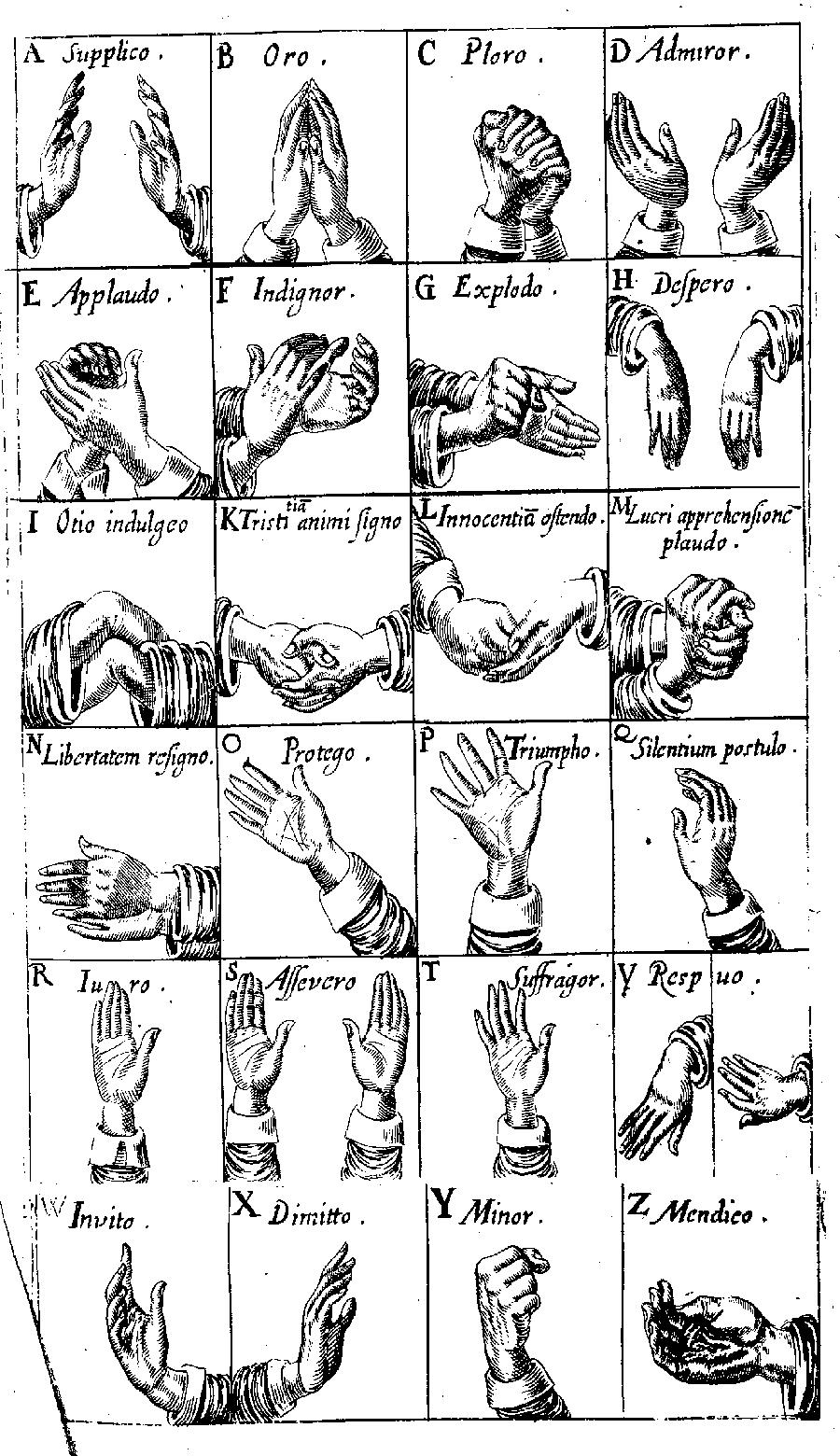
Language sits on top of all of this. You would be forgiven for thinking that language existed apart from all of this because linguists seldom make reference to non-linguistic communication, and are often focussed on just the words involved in language, or even just written language. As I mentioned, Lakoff & Johnson have argued that the metaphors which underlie the our abstract though are based in our physical interactions with the world. So native English speakers know the metaphor that up is good (on the whole) and down is bad: e.g. a good mood is up; optimists feel things are looking up etc. (Similar metaphors are found in Sanskrit btw.). Similarly, in discussions we employ the argument is war metaphor: we take sides and defend positions against opponents; a vigorous exchange involves cut and thrust; we line points up and shoot them down; and we win if our points are on target or we exploit a weakness, or lose when our argument is undermined or demolished; we love to drop bombshells, and overturn paradigms, but hate to capitulate and back down. This suggests that language doesn't jut sit on top of the under-layers of physical, emotional communication, but is deeply rooted in them, and perhaps emerges out of them. We can't really consider language separately from gesture for instance, or from posture, or tone of voice.

Further support for this idea comes from research on the Brocas area of the brain. This region is intimately connected with language, but is also part of the system that controls motor function in the mouth and hands. V. S. Ramacandran (in his 2003 Reith Lectures) speculated that cross-activation in this area is responsible for the tongue poking out during intense concentration on manual tasks for instance, and that this is related to the evolution of language. Gestures, mouth movements and language are obviously connected. People can communicate complex abstract language with only their hands.

Vocal sounds are, at least some of the time, used symbolically and the study of this phenomenon is called Sound Symbolism or Phonosemantics. The roots of sound symbolism may be in pre-language sounds which communicate emotions, and in mouth movements which either directly interact with an object, or imitate an interaction. In which case we would expect that both canonical and mirror neurons would be involved in the language as well - I'm not sure if anyone has looked at this.

One of the central dictates of modern linguistics is that "the sign is arbitrary". This is usually qualified by saying that it is arbitrary but not random, since clearly conventions of sounds are seen. Sound symbolism takes this further by saying that the conventions are so pervasive and they represent such a high a level of organisation that they cannot be arbitrary. Indeed it would be surprising if verbal sounds were arbitrary in relation to the concept being conveyed because they would exist outside the structure of language itself. Lakoff & Johnson say that abstractions are not arbitrary, but rooted in how we physically interact with the world. Sound symbolism tells us that there is a relationship between a word and it's meaning which is not arbitrary, but related to how verbal sounds function as symbols.

So Metzinger's theory is interesting because we can construct a plausible narrative about the evolution of communication around it, and it links up with other interesting ideas about the brain, the mind, and the evolution of language. It can incorporate many different observations, and it dovetails with other theories of embodied awareness and communication. It certainly seems to tie together many of my own interests. Though I note that one reviewer of The Ego Tunnel complained that "Grandiose philosophy is so 19th-century". [1] So perhaps Metzinger and I, with our interest in such "grandiose philosophy", are out of step with contemporary philosophy - but there have been few ages when being out of step with contemporary philosophers has been a bad thing. Personally I think Metzinger is ahead of his time.

This is not idle speculation on my part, nor only a side line. This idea has been bubbling away in my Buddhist brain because I am fascinated by Buddhist mantra. Mantras are said to be sound symbols, and I'm interested in how verbal sounds function as symbols. I believe that this sketch of a theory, or something very like it, might begin to explain the effectiveness of Buddhist mantras both as a collective, devotional practice, and in individual meditative practice -- without resort to the supernatural.

~~oOo~~

Note
  1. Flanagan, O. (2009). Review: The Ego Tunnel by Thomas Metzinger. New Scientist, 201(2700), 44.

image: Rhetorical gestures. Wikimedia.

04 March 2011

Is Buddhism Just Navel Gazing?

IT IS SOMETIMES ASSUMED THAT BUDDHISM is an introspective path, best suited to dreamy, inward looking, introverts. After all we spend a lot of time on omphaloskepsis, or navel gazing, don't we? And the ideal Buddhist is often portrayed as a solitary, reclusive meditator. Buddhism can easily be seen in terms of personal psychology or self development. I would like to challenge this notion by looking at Buddhist meditation.

Buddhism broadly speaking offers two kinds of meditation: samatha and vipassanā (Sanskrit śamatha, vipaśyanā). Samatha comes from the root √śam 'to be calm, quiet, to rest'. In samatha meditation we are trying most of all to calm down, and to steady our mind. This in no way involves rumination or dwelling on one's inner world. The archetypal practice is one which involves 'watching' the sensations of breathing, allowing the sensations to fill one's awareness (hence to be mind-full). Note that I do not say "the breath". It is helpful to get away from "the breath" as an entity (what is that in any case?) and to orientate oneself towards the experience of breathing as a dynamic procession of sensations presenting themselves to our conscious awareness. The sensations of breathing offer a good meditation subject because they give feedback on one's state of calm, they change at a pace which does not excite, and they are primarily proprioceptive - i.e. felt as changes in muscle tension in the body - which helps to draw attention away from the primary modes of interacting with the world - sight and hearing. When we allow our minds to be full of these sensations, follow them closely but in a relaxed way, we begin to experience changes in our awareness.

On a good day we find that we are no longer pulled towards other experiences, or towards our own mental chatter. We find that we naturally settle into a relaxed, but focussed state. By attending to experience wisely we can deepen this state until other sensations cease to resister in our mind, and there is only the increasingly subtle experience of breathing. This state can go very deep, and is often described as beautiful, expansive, open, and blissful. One can experience physical rapture, but also other internally generated experiences with a sensory character such as visual imagery. Although we have withdrawn our attention from the world, we find a world within which is at once gloriously alive and yet very refined and subtle. The technical term for this kind of experience is jhāna (Sanskrit dhyāna).

Sometimes Buddhists will frown on talking about meditation experience - straight-forwardly saying that one has experienced jhāna for instance can be seen as "boasting" or "making a claim". This is unfortunate because experiencing a concentrated mind is relatively ordinary, and certainly within reach of anyone who seriously practices meditation in a supportive context. I'm no great meditator and I have had these kinds of experiences. The Buddha's prohibition for the monks is against falsely claiming to be an arahant, and as far as I know there is no traditional prohibition on discussing the experience of various jhānas, nor on claiming to be an arahant if one actually is an arahant. At times a useful discussion is stifled by literalism or over-reacting. I should also say that some Buddhist traditions are distrustful of jhāna. Because it is pleasurable it can become a distraction. I know several people who can easily get into these states, and some of them do say that it can become an end in itself. However my own teachers have always emphasised that jhāna is a means to an end, not the end in itself. Concentrated meditation leaves one feeling calm, happy, and peaceful. Regular meditation encourages psychological integration. The fact of getting concentrated is not in itself very significant or spiritual advanced, but concentration and absorption are useful in preparing the mind for meditation in the second sense.

The essential counterpart to concentrated meditation is vipassanā often translated as 'insight'. The term derives from √paś 'to see' and with the prefix vi- means 'seeing through' - i.e. not insight but through-sight. Using 'insight' as a translation has the unfortunate connotation that we are seeing inside ourselves, suggesting introspection. But what we are doing is seeing through our self not seeing into it. Again this kind of meditation doesn't really involve introspection.

In this style of meditation one reflects on some aspect of experience - the tradition provides a number of templates for this. We might for instance reflect on impermanence, or on suffering. We might reflect on the way things arises in dependence on causes. Other styles of vipassanā practice include visualisations of a Buddha, koan practice, or simply sitting and watching the play of experience. Reflecting this way we aim to see the way experience unfolds, to understand why we feel and think the way we do, not by by dwelling on the content of our own thoughts, but by trying to get underneath this and see how the thoughts that we have depend not so much on the sensations we have, but on the stories we tell ourselves about them. The medium is the message.

This is not like rumination. We don't get hooked on the content of our thoughts, in fact we aim for the precise opposite - to get unhooked from the content of our thoughts. This is why jhāna practice is so useful. With a mind prepared by jhāna meditation we are in a very advantageous position to observe the workings of our mind without being caught up in the content of our thoughts and feelings. Being calm and content we can just be with what we find in our minds. We can also sustain our focus on the subject far more easily.

I don't know much about Zen meditation, or other 'just sitting' or formless practice styles, but as I understand it the formless practices combine samatha and vipassanā aspects. I won't say more, but I do think that formless practice can just about fit into the paradigm I've outlined. And of course meditation is not the only practice. There are also intellectual, ethical, and devotional aspects to Buddhism which are important.

Where a Buddhist can usefully do a little introspection is in the area of ethics. By this I do not mean thinking about morality in the abstract. We cannot really see how Buddhist ethics works by considering hypothetical cases. Buddhist ethics simply asks us to reflect on our own behaviour, and especially our relationships with other people. How do we observe that our behaviour affects those around us? How do we observe it affecting our own minds? We will particularly notice the effects on ourselves in the form of the hindrances to meditation. So if we want to spend time thinking about ethics we can reflect a little on what hindrances to concentration we are currently meeting. Unethical behaviour sets up conflicts and tensions, or scatters our energies which we experience as restlessness, torpor, craving, or aversion. There is often something we can do or cease doing that will be helpful in moving us towards a less conflicted, more alive state of mind. We need not be at the mercy of hindrances.

I hope it's clear that introspection has a role in Buddhism, but that it's role is not predominant, and that in meditation we are not being introspective per se. Of course one will need some self-knowledge, to understand one's own temperament in order to sustain an effective practice. We need to understand our own habitual tendencies in order to effectively counteract them or reinforce them as appropriate. But this knowledge comes as a by-product of attempts to engage with Buddhist practices, and as we interact with other people. The fact that being generous and regulating our behaviour towards others are firmly at the base of Buddhist practice, shows that a lot of self-centred navel gazing is out of place.


~~oOo~~
Related Posts with Thumbnails