01 June 2012

Irrelevant Details

Please note that a revised and extended version of this essay has been published as:
Attwood, Jayarava. (2013) Translation Strategies for the Cūḷa-Māluṅkya Sutta and its Chinese Counterparts. Journal of the Oxford Centre for Buddhist Studies, 5, 42-63. Online: http://jocbs.org/index.php/jocbs/article/view/54/86

~o~ 

Revised 7.6.2012 with suggestions from Bryan Levman (BL). Many thanks.

I'VE BEEN READING the Cūḷa-Māluṅkya Sutta (M 63) which is a well known text, if only because of the allegory of the man shot by an arrow who refuses treatment before finding out all the details of the person who shot him, and what he was shot with, and dies because of the delay.

Perhaps we should not be surprised that translators and commentators have focussed on the main point, and glossed over the details that consumed the proverbial victim. Unfortunately some of the details are no longer understood because scholars, from Buddhaghosa onwards, were not paying attention. This makes for unconvincing translations. Having the kind of mind I do, I've been trying to reconstruct what the terms might have meant in order to accurately translate them. Some aspects are probably lost forever now. And before anyone gives me a hard time about becoming engrossed in the details; yes, I do see the irony; and no, I don't care. Since the Chinese version of the text (Taisho T.01 n.94 p.0917c21) provided an insight or two I have included my notes on it below as well. Thanks to Bryan Levman of the Yahoo Pāli Group for the suggestion of checking the Chinese, and supplying a reference to it. [Note: there are in fact two versions of this text in Chinese T 1.26 and T 1.94. Also it is paraphrased at T 1509.15]

Text

Here's my translation of the Pāli passage (M i.429)
"Suppose a man was struck by an arrow thickly smeared with poison. His friends, colleagues and relations would engage an arrow-removing physician to treat him. And suppose the man would say: 'as long as I do not know that man who shot the arrow, whether he was warrior, priest, merchant, or peasant; his name & clan; whether he is tall, short, or middling; dark, brown or fair [of complexion]; and whether he came from a village, town or city I will not allow the arrow to be removed. And as long as I do not know whether I was shot with a cāpa bow or a kodaṇḍa bow; whether the bowstring was akka, or bamboo, or sinew, or bow-string hemp; whether the arrow shaft was gathered or planted; whether the arrow was fletched with the feathers of a vulture, heron, falcon, peacock, or sithilahanu; and bound with cow, buffalo, deer or monkey sinew; and whether the tip was a point, knife-edged, barbed, iron, calf-tooth, or leaf shaped, I will not allow the arrow to be removed.' That man would die before all this was known, Māluṅkyaputta."

The first thing that I was struck by is that the man's friends and relations ...bhisakkaṃ sallakattaṃ upaṭṭhapeyyuṃ.  Ñāṇamoli & Bodhi (hence forth Ñ&B) render this as "brought a surgeon to treat him" (p.534) which as far as I can see leaves out the word sallakattaṃ altogether; c.f. Gethin (2008) "summon a doctor to see the arrow" which acknowledges the salla part of sallakattaṃ, but there is no verb 'to see' here! A doctor is bhisakka.  The verb is upaṭṭhapeti a causative form of upaṭṭhahti 'to stand near, to attend, nurse'; from upa- 'near' + √sthā 'stand'; and it's in the optative mood so means 'would cause to attend'. So his relations 'would cause a doctor to attend' but again this misses out sallakattaṃ.

What does sallakattaṃ mean? The salla part means 'arrow' (which is what the whole thing is about) and this leaves us with -katta. According to BL "the only phonological explanation for the -tt- is if the geminate replaced an original conjunct consonant. The only one that would be contextually relevant is the noun karta [from √kṛt 'to cut'] which means "hole, cavity." Hence sallakatta must refer to the 'arrow wound'. This reading requires the verb to take two patients, and it's not clear whether this is allowed. DOP lists no examples of this.

BL notes that Buddhadatta concise Pāli-Eglish Dictionary defines sallakata as 'surgeon' (and sallakattiya as 'surgery', on the basis, apparently that salla can mean a surgical instrument. PED derives katta from *kartṛ 'worker' (the word exists in Skt. so I'm not sure why they use the asterisk). However the obvious meaning of sallakartṛ would be 'arrow maker' or 'fletcher', rather than surgeon. Compare MW śalyakartṛ 'arrow maker'; but śalyakarttṛ 'a remover of splinters, i.e. a surgeon'. Apte's English Sanskrit Dictionary suggests śalyataṃtravid and śasravaidyaḥ for surgeon. I think the answer is that Pāli sallakatta is Skt. śalyakarttṛ 'arrow remover' rather than śalyakartṛ 'arrow maker' or śalyakarta 'arrow wound' (all three devolve into Pāli with the same spelling); and that we should avoid translating this as 'surgeon', because here, anyway, it seems to be an adjective rather than a noun. It's not inconceivable that an arrow maker might also have found employment as a remover of arrows, being conversant with arrows. Just as a medieval European barber found other employment for their razor (though again calling this 'surgery' is over the top). 


All this means that we do not have to impose two patients on the verb, and that bhisakkaṃ sallakattaṃ is a straightforward apposition 'an arrow removing doctor'.

Bow
Moving on we come to the bow. Most translators cope well with this sentence. There are in fact three words: dhanu, cāpa and kodaṇḍa. The first two are synonyms, though dhanu (Skt. dhanus) is also a word for 'rainbow'; and may be related to words for trees, c.f. dāru 'wood'. PED suggests that the word cāpa, by contrast, comes from a root meaning 'to quiver' from PIE *qēp. However, my new Sanskrit etymological dictionary, Kurzgefaβtes etymologisches Wörterbuch des Altindischen (CSED), suggests *kēp or *kamp. The root *kēp does not occur in my standard PIE sources, but *kamp does and it means 'to bend' (AHD/OIEL).

A kodaṇḍa is according to PED a 'cross bow' though it is doubtful whether the technology existed in the Buddha's time; c.f. DOP 'a kind of bow'; MW & Böhtlingk who both define it as 'bow' with no mention of 'crossbow'. CSED makes the obvious point that daṇḍa is a stick, or staff, but adds that ko- here is a pejorative prefix (a form of Skt. ku) so that it must mean something 'bad stick'. Note that the Chinese version of the text does not mention the cross-bow although they clearly had them by the time the translation was made. BL's suggestion is that kodaṇḍa is a loan word from Munda and refers to the bows that the Munda speaking peoples used. Certainly daṇḍa appears to be a loan word (C.f Witzel 1999, p.16) [I have one more ref to check on this JR]

Bow String
Calotropis gigatea
Now we come to the bow string. In translating this passage we need to keep in mind that a bow string must be able to withstand considerable tension, and can't be made of ordinary rope. The choices of material here are in Pāli: akka, saṇṭha (or saṇha), nhāru, maruvā and khīrapaṇṇiṇ. PED is quite good at identifying plant names, though some of them have been revised in the mean time.

Pāli akka is Calotropis gigantea (Skt. arka). Variously called in English “calotrope, crown flower, giant milkweed, swallow-wort, and apple of Sodom.” Chiefly notable in the present for its milky sap, which has medicinal properties, and for its attractive flowers; in the past the leaves were used in Vedic ceremonies, and apparently the plant produced fibers strong enough to be woven into bowstrings. The last item in the list is Pāli khīrapaṇṇin, but this is simply a synonym for akka; literally meaning ‘having leaves with milky sap’. Ñ&B translate it as ‘bark’; MA informs us that bowstrings were made from the bark (vāka) of the akka – though as a flowering shrub it doesn’t have bark per se, so here it must mean the outer layers of the stems. Compare the notion of ascetics wearing the vākacīra or ‘bark garment’, which presumably is from cloth woven of rough fibre produced from this or a similar source. According to the Udāna-Aṭṭakathā, Bāhiya used akka stalks (akkanāḷāni) to make a robe and shawl (nivāsana-pāvuraṇāni) to clothe himself. akkanāḷāni chinditvā vākehi paliveṭhetvā nivāsanapāvuraṇāni katvā acchādesi (UdA 77).


Pāli saṇṭha (Sri Lankan and PTS eds.) PED ‘a reed (used for bow strings)’; or saṇha (CST) PED ‘smooth, soft’. I can’t find any more information on saṇṭha or a Sanskrit equivalent. MA glosses veṇuvilīva: meaning ‘slivers of bamboo’. Bamboo is certainly a source of strong fibres that can be woven. Another possibility is that these are variations of saṇa, sāṇa: PED ‘hemp’; Skt. śaṇa, MW: hemp (Cannabis sativa), or sunn hemp (Crotolaria juncea) aka ‘Bengal flax’.

Pāli nhāru is a variant spelling of nahāru meaning 'sinew'. Sinew is, of course, the connective tissues from animals, particularly tendons. It's possible that 'gut' might be included under this heading, since as we know stringed instruments used to (and sometimes still do) use gut strings and these are able to bare considerable tension.

Sanseveria roxburghiana
Pāli maruvā is a plant of the genus Sanseveria (also spelt Sansevieria) specifically S. roxburghiana. One of the characteristic plants of this genus is the ornamental ‘mother-in-law’s tongue’ (S. trifasciata). Sometimes called ‘bowstring hemp’, though not related to the cannabis plant. Other names for the genus include: dragon’s tongue, jinn’s tongue, snake tongue, etc. Some species are excellent sources of fibre, and used for making rope (and bow strings) in India and Africa. For an illustration of how fibres were obtained from such plants see: primitiveways.com.

The Chinese substituted various kinds of sinew (筋) at this point in their text.


Shaft
Saccharum sa
The shaft of the arrow is the next thing that concerns us. Here we have two options: gaccha or ropima.

Pāli gaccha ‘a shrub or bush’. MA ‘from a mountain bush or river bush etc.’ (pabbatagaccha-nadīgacchādīsu jātaṃ). PED gaccha ‘shrub, bush’ often in comparison with trees (rukkha) and vines (latā); PED denies the confusion with Skt. kaccha; (PED Sv. kaccha pabbatakaccha & nadīkaccha mountain & river marshes’).

Pāli ropima ‘what has been planted’. MA ‘having sown, raised, desiring sara; having got sara, [the arrow] was made’ (ropimanti ropetvā vaḍḍhitaṃ saravanato saraṃ gahetvā kataṃ.). Pāli sara is Saccharum sara (aka muñja grass) which sends up long (2m) tufted spears that can be made into arrows. Alternatively ‘desiring sara’, saravanato, could be ‘from a grove (vana) of sara’ - though does grass grow in 'groves'? Ñ&B, following MA, understand this and previous term to mean “wild” and “cultivated”.

The Chinese have three options: muñja grass, bamboo and luó é lí wood (羅蛾梨木) though I could not produce a plausible translation for the last.


Feathers

For an arrow to fly true it needs some stabilising fins or vanes at its base. Traditionally these were made from feathers. In our allegory the feathers might have come from the vulture, heron, falcon, peacock, or sithilahanu. The latter is a mystery.

Ñ&B translate sithilahanu as ‘stork’, but on what authority? The name is a hapax legomenon (a one off) in the Canon. Buddhaghosa's commentary (MA) merely says ‘a bird of that name’ (evaṃ nāmakassa pakkhino)! The sub-commentary (MṬ) ‘Sithilahanu is the name given for an bird with ears(?)’ (sithilahanu nāma dattā kaṇṇo pataṅgo) where kaṇṇa means ‘angle, corner; ear; rudder’; pataṅga is not in PED, but the CST dictionary lists ‘a bird’ (c.f. Skt. pataṃga ‘flying; any flying insect’). PED sv. sithila ‘loose, lax’; and sithilahanu ‘a kind of bird’. Sithilahnu is not in DOPN; nor is the Sanskrit (śithirahanu/śithilahanu) in MW. Searching PED electronically reveals no occurrence of the word ‘stork’. Buddhadatta’s English-Pāli Dictionary sv. stork gives ‘bakavisesa’; while Apte’s English-Sanskrit dictionary gives nothing like sithilahanu for 'stork'. Thomas (1913) and Gethin (2008) leave the word untranslated; c.f. Horner (1954-9) “some other bird” (vol.2, p.99). Note that also in our text we have the name kaṅkha 'heron' (from √kaṅk which may have an onomatopoeic origin).

Grus monacha
The Chinese version of this text (Taisho T.01 n.94 p.0917c21) records the name as 鶬鶴 (cāng hè) which is Grus monacha, the Black or Grey Crane. However the text only includes three names: peacock (是孔雀), black crane (鶬鶴), and eagle (鷲). So cāng hè could just as easily be a substitute for heron as for stork, and indeed G. monacha could be said to more closely resemble a heron.

There is a suggestion that sithilahanu refers to the open billed stork (Anastomus oscitans). This is mentioned in a blog post by Shravasti Dhammika for instance. The Envis Centre on Avian Ecology in collaboration with the Bombay Natural History Society lists "shithil hanu bak" as the Sanskrit name of the A. oscitans. This has obviously been Hindi-fied and ought to be śithilahanubaka. But where has this come from?

If we translate sithalahanu it means something like 'slack jawed' (hanu is cognate with the English chin) which might plausibly be a reference to the open billed stork since it's lower beak does not quite fit the upper leaving a gap. Sanskrit-English and Pāli-Eng. dictionaries only include the more gracile herons and cranes under the name baka; but Eng-Skt. and Eng-Pāli dictionaries include baka as a name for the stork.

Anastomus oscitans
Ali & Ripley in their authoritative guide to India birds (2001), give the Hindi name of A. oscitans as Gūnglā, Ghonghila, or Ghūngil. Hindi etymology is difficult to establish but Skt. ghoṇa 'beak, nose', Skt gila 'swallowing' might allow for a hypothetical Skt. *ghoṇagila(?). Though there is nothing like this in either my Pāli or Sanskrit dictionaries. The Bengali names are given as Thonte Bhānga, Shāmukh Bhānga, Shāmukh Khol. Here I've had more luck (with help from a young naturalist): ṭhōnṭa 'beak'; śāmukh 'mollusc'; bhaṅga 'breaking'; khol 'cover; shell; hollow, crevice, open' (e.g. চোখের খোল (cokhera khola) 'eye socket'; and পেটের বা বুকের খোল (peṭera bā bukera khola) 'chest cavity'.) Which gives us Thonte Bhānga 'broken beak'; Shāmukh Bhānga 'mollusc breaker'; or Shāmukh Khol 'mollusc hollow(?)' as possible names. The Tamil name is Naththai kuththi narai 'Snail Pecking Stork'. The Bihari name is given as Dokar, but I cannot find any more information on this word. So none of the modern Indian names of the bird resemble sithilahanu, either in form or content.

In tracing this further I think I found the source of the equation of sithalahanu and the open-billed stork. In his 1949 book on bird names, celebrated Indian scholar Raghu Vīra lists (entry 2215, p. 426) Anastomus oscitans as घोंघाशा शिथिल-हनु (ghoṃghāśā śithila-hanu) and then slightly below as शिथिल बक (śithila baka). At first sight this would seem to be definitive, but we note that Vīra does not list any Sanskrit sources. In his notes he only refers to a yet-to-be-published book by K. N. Dave seen in manuscript which referred to the stork by this name. This book was subsequently published (apparently posthumously in 1985) and it reveals something interesting about the Sanskrit name of A. oscitans (p.395-6). In trying to identify the open billed stork in Sanskrit literature Dave tentatively identifies a number of other candidate names, but these are by no means certain. Significantly he does not list śithilahanu as a Sanskrit name, suggesting that he did not find it in any Sanskrit text. However he has noticed the Pāli bird name sitihlahanu which translates as 'having a lower mandible loose or relaxed' and says
"I need hardly add that शिथिलहनु [śithilahanu] is a most fitting name and a correct rendering of the English name Open-bill for the bird."  (p.396)
Dave has performed a remarkable slight of hand here. Although there is no traditional equation of the open billed stork with sithilahanu that I can find, or that he cites, he has made the leap and connected them. Then in another great leap he equates the Pāli with the Sanskrit, spelling the Pāli word in the Sanskrit manner, and somehow śithilahanu becomes the perfect name for the bird, even though this Sanskrit name does not exist, and there is no a priori reason to believe that the Pāli name refers to this bird! Indeed his enthusiasm rests partly on the way that his invented Sanskrit spelling fits the English.

In fact there is nothing 'loose or relaxed' about the very robust bill of the stork (have another look at the picture above) it just doesn't fit together. 'Loose' is hardly a "fitting or correct rendering" of 'open' when you stop to think about it. These unjustified leaps are given a seal of approval by the great Raghu Vīra and it becomes a "fact" that the Sanskrit name is śithilahanu, or reading the Devanāgarī Hindi fashion: Shithil Hanu

Unfortunately connection is entirely spurious, and this means that, after a thorough search, I can find no authority for translating sithilahanu as 'stork' or 'open-billed stork'. The word sithilahanu appears to be lost to us unless some new evidence should emerge.


Binding

Ruru Jataka bas-relief


Next our man wants to know about the binding used for the feathers, and again we are left with some mysteries. The choices are the sinews of the cow (gava), buffalo (mahiṃsa), something called roruva (or in CST bherava), and something called semhāra.

CST has bherava ‘fearful, terrible’, which MA glosses as kāḷasīha ‘black lion’ (the Asiatic lion can apparently be a mottled black in colour); other editions have roruva ‘deer’ (the two words are in fact related from the root √ru ‘roar’ [as is the -rava part of my Sanskrit Name]. Male deer do roar in the rutting season, to attract mates and warn off rivals.) Roruva is the name of a hell realm (DOPN). Skt. ruru is a kind of antelope, but can refer to savage animals in general.

Under semhāra PED "some sort of animal (monkey?)", noting that it is explained as makkaṭa  (monkey) by Buddhaghosa's commentary. The Sanskrit markaṭa is also ‘the Indian crane, a spider, and a sexual position’). This word is also a hapax legomenon in the Canon and my research has not turned up anything interesting. There is no Sanskrit equivalent that I can find, unless semhāra is related to, or a dialectical form of the Sanskrit siṃha 'lion' (Pāli 'e' is the guṇa and vṛddhi grade of 'i'); though note that Gāndhārī spells it siṃha. Like sithilahanu this word seems to be lost to us.


Arrowhead

The arrow heads have produced the least informative translations, but it's possible to reconstruct what the terms might have meant by casting our net a bit wider than PED, and by looking at the shapes that arrow heads traditionally take. In Pāli we have: salla, khurappa, vekaṇḍa, nārāca, vaccha-danta, and karavīra-patta.

Of these terms nārāca ‘iron’ seems to be the odd one out, though the Sanskrit Epics mention arrows of iron which were used to kill elephants (Singh p.105). The other names seem to concern shape of the arrow head:
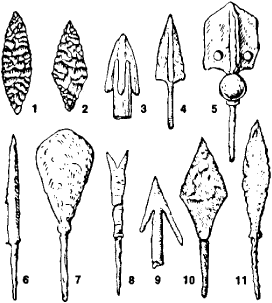
various arrow heads
  • the salla is a simple point [c.f. no. 6, right].
  • khurappa (PED ‘hoof’) is the Epic Skt. kṣurapra ‘knife edged’ arrow [c.f. 4] (Singh 1989, p.105) and hence Ñ&B have read this too literally, or been mislead by PED. Note that Cone's new DOP gets this right and lists it under khura1 'a razor or sharp blade'.
  • vekaṇṇa (barbed); [9]
  • vaccha-danta calf’s tooth (Skt vatsa-danta) is mentioned in the Epics and said to be in the shape of a calf’s tooth [similar to 7] and extremely sharp (Singh 1989, p.105); 
  • karavīra-patta or oleander leaf, the shape of which is technically described as ‘narrow lanceolate’, i.e. a narrow, elongated oval coming to a sharp point. [11]
Note the similarity of some of the names in the Chinese version below.


Conclusion

Why should we care about such details in a text which is primarily making a metaphysical point about what kinds of questions are answerable and/or important to ask? For most people, and most translators judging by their approach to this text, the answer seems to be that the details are irrelevant, which is to take the message of the text rather literally. After all I am not pierced by an arrow, or trying to emotionally blackmail anyone, I'm trying to translate a text so as people who don't know Pāli can read it. I'm not Māluṅkyaputta. I'm not refusing to practice unless I find the answers, but I am interested, and enjoy the investigative process.

I think what made me spend time looking into these questions is that the poor quality of the other translations jarred, and disrupted my sense that the text was a living document. The lack of concern for preserving knowledge of small details has meant that we have lost any hope of definitively understanding them - I can speculate, but in the long run neither I nor anyone can reconstruct terms that were lost unless some new evidence should emerge - perhaps a Gāndhārī version of the text for instance. 

It might be argued that losing Pāli terms for archery is no great loss, but if we get these details wrong through indifference then what other details are we getting wrong? How many of us, for example, picture Bahiya going around draped with great lumps of tree bark instead of roughly spun jute cloth? Keeping the past alive, or bringing it to life, means making use of such details to give our picture resolution. Why settle for vague blur when we can do considerably better than that?

I think word extinction is a problem. Perhaps not a huge problem, if one tree dies, we still have the forest, but it's a sign of carelessness, or neglect. If we value these texts for what ever reason, then there is an imperative not just to preserve them, but to keep alive what they mean. If we allow a words to cease being meaningful, then the whole is marginally less complete and less beautiful. Most likely we'll never recover what has been lost.


~~oOo~~

    Chinese Text
    What follows is a very rough rendering of the same passage from the Chinese text (Taisho T.01 n.94 p.0917c21) from CBETA, using online translation (often ludicrous), dictionaries, pattern recognition,  and some guess work on the basis that it can't be that different from the Pāli. Notes on each paragraph are included below it in bullet points. While the grammar is less than crystal clear, one can pick out key words, the nouns and adjectives, which is all we need for a general comparison. The caveat is that I only know a handful of Chinese characters (and that from my interest in Japanese). MO = notes by Maitiu O'Ceileachair.
    I cannot remove the arrow (我不除箭) until I know of the one who shot me (誰以箭中我): what was his surname (姓), his name/mark(?) (字); was he long (長) or short (短); if he was dark (黑) or pale (白); kṣtriya (剎利), Brahmin (婆羅門), layman (居士), or worker (工師姓); from the East (東方), South (南方), West (西方) or north (北方)?
    • The 字 is what is usually known as the style name, that used to be taken by a man at 20. Here it just means name. (MO).
    • 剎利 shālì = kṣatriya
    • 婆羅門 póluómén a phonetic rendering of brāhmaṇa.
    •  居士 Jūshì = lay, scholar, Buddhist.
    In addition I cannot remove the arrow (我不除毒箭) until I know: was the bow sala wood (薩羅木), tala wood (多羅木), or chì luó yāng jué lí wood (翅羅鴦掘梨木)?
    • sà luó i.e. Skt. sala.
    • duō luó: Skt. tala i.e. palmyra
    • chì = ke, ki, ḍa; luó = la, ra; yāng = aṇg; jué = ku, gu; lí = ri. Karungali? (Acasia catechu) Keralan name; c.f. kirankuri (Emilia sonchifolia) a herb in Hindi.
    In addition I cannot remove the arrow until I know: were the sinews (筋) which wrapped the bow (而用纏彼弓) beef sinew (若牛), sheep sinew (羊筋), or yak sinew (氂牛筋)?

    In addition I cannot remove the arrow until I know: was the bow grip (弓弝) white bone (白骨), black lacquer (黑漆), or red paint (赤漆)?

    In addition I cannot remove the arrow until I know: was the bowstring (弓弦) beef sinew (牛筋), sheep sinew (羊筋), or yak sinew (氂牛筋)?

    In addition I cannot remove the arrow until I know: is the arrow [shaft] Shě luó wood (舍羅木), bamboo (竹), or Luó é lí wood (羅蛾梨木)?
    • 舍羅 Shě luó = Skt. śara (Pāli sara) = Saccharum sara used for making arrows. 
    • Luó é lí = The first and last characters are used to transliterate ra and ri, but I haven't found an example of 蛾 used this way. Literally the characters read 'gather moth pear'.
    In addition I cannot remove the arrow until I know: is the arrow binding (纏箭) beef sinew (牛筋), sheep sinew (羊筋), or yak sinew (氂牛筋)?

    In addition I cannot remove the arrow until I know: are feathers (毛羽 used to make the vanes (取彼翅用作羽), peacock (孔雀), black crane (鶬鶴), or eagle (鷲)?

    In addition I cannot remove the arrow until I know: was it iron (鐵), or calf [tooth] (婆蹉), póluó (婆羅), or nàluó 那羅,  or jiāluó bǐng (伽羅鞞)?
    • 婆蹉 pó cuō is a translation of vātsīputriya; c.f. Pāli vatsa 'calf'. Burnouf & Buffetrille (2010), p.518.
    • 婆羅 = póluó = Skt. pāla, bāla, bala, sāra.
    • 那羅 = nàluó; = Skt. na ra; c.f. 緊那羅 kinnara; cf. Pāli nārāca 'iron'.
    • 伽羅鞞 jiāluó bǐng = Skt karavī[ra]?; cf. Pāli karavīra-patta 'oleander shaped leaf'.
    In addition I cannot remove the arrow until I know: what was the blacksmith's (鐵師) last name (姓); long or short; dark or pale; in the East, South, West or north?
    • I think 鐵師 means 'blacksmith'. It occurs quite frequently in the canon and from context it usually seems to refer to a craftsman of some sort. (MO)
    Despite considerable obscurity remaining, most of the content of the text can be identified. Even without fully understanding the Chinese we can see that the form is much the same as the Pāli text, but that content is mostly quite different. The Chinese translators have used two different methods to deal with unfamiliar words or entities. Firstly they transliterate using a Chinese character (汉字 hànzì) to represent the sound, e.g. 婆羅門 póluómén for brāhmaṇa; secondly they substitute with something more familiar, as with black crane (鶬鶴) for heron (kaṅka).

    It's useful to know that Chinese translators sometimes transliterated and I'm grateful to my friend Maitiu O'Ceileachair for many long discussions about the ins and outs of this and other translation issues (and thanks for giving me a few pointers post publication, noted above). I'm also grateful to the anonymous person who extracted many examples of the Chinese translation approach from the Digital Dictionary of Buddhism (which has an incomprehensibly restrictive access policy).

    A final note is that we can tell from the way of the words are transliterated that the original the Chinese translators were working from was not in Pāli, but in Sanskrit, or a more Sanskrit-like Prakrit. For instance when transliterating sara the 's' is aspirated (sh)--舍羅 shě luó--which is not a feature of Pāli, but compare the Sanskrit equivalent, śara, which is aspirated, and note that the Gāndhārī Dhammapada (G-Dhp 329) has śara for the Pāli saraṃ 'arrow' (Dhp 320). At least some of the texts reaching Chinese were written in Gāndhāri (c.f. Boucher 1998)

    Bibliography

    • Anonymous (1998). 'Vernacular Names of the Birds of the Indian Subcontinent' (PDF). Buceros 3 (1): 53-109. Environmental Information System (ENVIS) Online: http://www26.us.archive.org/details/IndianBirdNames.
    • Ali, Sálim and Ripley, Dillon S. (2001) Handbook of the birds of India and Pakistan: together with those of Bangladesh, Nepal, Bhutan and Sri Lanka. Bombay Natural History Society. 
    • Ānandajoti. (2007) A Comparative Edition of the Dhammapada: with parallels from Sanskritised Prakrit edited together with A Study of the Dhammapada Collection. (2nd rev. ed.) Online: http://www.ancient-buddhist-texts.net/Buddhist-Texts/C3-Comparative-Dhammapada/index.htm.
    • Biswas, Sailendra. (2000) Samsad Bengali-English dictionary. 3rd ed. Calcutta, Sahitya Samsad. Online http://dsal.uchicago.edu/dictionaries/biswas-bengali/
    • Boucher, Daniel. (1998). 'Gāndhārī and the Early Chinese Buddhist Translations Reconsidered: The Case of the Saddharmapuṇḍarīkasūtra.' Journal of the American Oriental Society, 118 (4): 471-506. Article Stable URL: http://www.jstor.org/stable/604783
    • Buddhadatta. (1955) English-Pali Dictionary. Motilal Banarsidass, 1989.
    • Burnouf, Eugène &  Katia Buffetrille [trans]. (2010) Introduction to the History of Indian Buddhism, University of Chicago Press. Originally published as Introduction à l'histoire du buddhisme indien, Paris: Imprimerie Royale, 1844.
    • Dave. K. N. (1985) Birds in Sanskrit Literature. Motilal Banarsidass.
    • Dictionary of Pali Names [DOPN]
    • Childers, R. C. (1875) A Dictionary of Pāli language. London: Trubner & Co.
    • Gethin, Rupert. (2008). Sayings of the Buddha. Oxford University Press.
    • Horner, I. B. (1954-9) The Book of Middle Length Sayings. (3 vols.) Pali Text Society.
    • Ñānamoli and Bodhi. (2001). The Middle Length Discourses of the Buddha. 2nd ed. Wisdom.
    • Singh, Sarva Daman. (1989) Ancient Indian Warfare: With Special Reference to the Vedic Period. Motilal Banarsidass.
    • Vīra, Raghu. (1949) Indian Scientific Nomenclature of the Birds of India, Burma and Ceylon. International Academy of Indian Culture.
    • Witzel, Michael. (1999) 'Substrate Languages in Old Indo-Aryan (Ṛgvedic, Middle and Late Vedic).' Electronic Journal of Vedic Studies (EJVS) 5(1): 1–67

    25 May 2012

    Facts and Feelings

    WESTERN PHILOSOPHERS have pondered the questions of 'what is knowledge?', and 'what is truth?' for centuries. Without, it must be said, coming to any kind of consensus. And without, it seems to me, acknowledging that the inability to come to a consensus after many centuries says there is something terribly wrong with the whole enterprise of philosophy! The question of why two philosophers can never agree is part of a larger question that interests me. On the surface there seem to be very different modes of knowing and processing knowledge. We distinguish intellect from feelings for instance, and reasoning from intuition. We have always insisted that the differences are important and have often valued one over the others. The classic contest is between reason and emotion. But some research (now decades old in fact) raises the question of whether these are even valid categories when it comes to knowledge.

    I've already mentioned, several times, a case study cited by Antonio Damasio in which he meets a patient with damage to his ventro-medial pre-frontal cortex (red in the image). This part of the brain is involved in the regulation of emotions. Emotional impulses typically come from deeper brain structures in the so-called Limbic System; a series of related structures in the lower and mid-brain. However emotions are also processed and regulated by our neo-cortex. In the patient mentioned by Damasio his awareness of emotions is extremely attenuated. Asked to describe his journey to the appointment his emotional tone was flat, even when describing the traffic accident he witnessed along the way. The emotions do not register. But his narrative shows that his powers of observation and understanding are not impeded; for example his recall of the trip is detailed and the facts are accurately related. He understands cause and effect. What is missing is the emotional response. And this shows when the patient is asked whether an appointment on Tuesday or Thursday next week would suit him better. He has a complete grasp of the facts relating to the choice - his and other's schedules, traffic conditions at different times etc, and he understands the task: but after 30 minutes of reviewing the facts he cannot come to a decision. The facts appear to be evenly weighted in his mind. Each fact is as important as every other fact. So that he has no basis on which to make a decision. (Descartes' Error. p.192ff.) (see also Grabenhorst & Rolls, van den Bos & Güroğlu).

    This points to a very important conclusion: that facts alone are not the basis of how we make decisions. We need to know the relative value of each fact, and this information comes from the emotional response we have in relation to the fact. When we consider the facts we don't just decide what we believe to be true. In any given situation there are likely to be hundreds of true facts. We need to decide, given the context, which facts are relevant and important, i.e. salient. Facts make for sense, and emotions make for salience. We simply cannot make decisions without both.

    Salience is terribly important. I recently learned for instance that schizophrenia is going to be renamed salience syndrome in the DSM-V (The DSM Diagnostic and Statistical Manual of Mental Disorders, 5th ed. due out next year) The current thinking is that a person with the disorder assigns the wrong level of salience to their experience which leads to delusions. Cause and effect can become confused or disconnected, and coincidences start to take on far too much salience. Inner experience can seem as though it is connected to external events in ways that only the sufferer can detect. An urge to act may not be felt as coming from 'me' so must be coming from outside. And so on. Schizophrenia means 'split mind' (though the etymology of Greek phren 'mind' is unknown), which is not at all descriptive of the disorder and has often lead to confusion amongst lay people. Correctly assessing the salience of our experience is virtually a definition of sanity, though the definition has a broad and ill-defined boundary.

    So part of the reason that philosophers (or people generally) cannot agree on things is that we have different notions of value and salience, and since these are primarily emotional they are difficult to articulate. In fact we tend to unconsciously absorb the values and notions of salience from the people around us. Values are strongly conditioned by relatives, friends, race, region, and religion (i.e. by all the various groups we are members of). Attempts to articulate universal values have so far failed to convince everyone. The problem of inarticulate values is exacerbated by those aiming at what they call 'rationality' or 'objectivity' since this usually involves consciously suppressing emotional responses.

    Incidentally, this shows that unless the Vulcans of Star Trek were wired very differently from humans, that Mr Spock & co. would have been unable to make decisions. Without a way to assign value to facts they would all be just like Damasio's brain damaged patient.

    Intuition and Reason


    People I know have been using the term 'intuition' a lot lately and have consistently failed to respond to my request to know what they mean by it. I think I'm in a position to offer a definition which demystifies the word. Let's start with reasoning. In reasoning, as I have indicated, we don't just manipulate facts to make sense. In reasoning we tap into emotions to give value to facts, and then compare the relative values to decide which is salient, or which is most salient. Saliency is a much more fuzzy concept than truth. We know that two intelligent people can reasonably come to opposing conclusions given a set of facts. This is the basis of of arguments in politics and well as philosophy for example. It's so much a part of our daily lives that it hardly needs an example, but the classic illustration is between conservative and liberal politics. Given identical facts, right and left leaning people will come to completely different conclusions about appropriate courses of action, because each assesses the salience of competing facts differently. (The different values of left and right are summarised very well in a diagram produced by David McCandless and Stefanie Posavec for the Information is Beautiful website. See also McCandless on TED) The irreconcilability of left and right rests not on the facts per se, but on what each side considers to be the most salient facts. This is true of the irreconcilability of philosophies, ideologies, and religions also.

    The champions of reason initially saw it as a way of freeing us from superstition. The great discovery of the Enlightenment was facts that were apparently independent of belief systems (though geometry was known to have this property since antiquity). Gravity affects the Atheist and the Christian in precisely the same way. If we measure the acceleration due to gravity anywhere on the earth then it is about 10 ms-2 with a variation proportional to our distance from the centre of the earth, and the density of the material directly under us, and a margin of error. In a world where most conflicts are based on mutually antagonistic belief systems this revelation from science seemed to be incredibly valuable. The hope was that we had discovered a reliable way to make decisions, and there were things we could all agree on! Some people still see science in this light, but most of us now acknowledge that values play a role in science as well. Though of course some religieux still fail to acknowledge facts that conflict with their (highly valued) belief systems.

    Reason came to be associated with the conscious manipulation of these facts divorced from emotional involvement. And the Romantics (over) reacted to this by revalorising emotions at the expense of reason (leading Romantics tended to break with the values of the society around them). Unfortunately there is a great deal of difference between a value independent fact (like gravity), and value independent thinking (which amounts to suppressing one's awareness of emotions and therefore empathy). We still have to decide what facts are relevant to any situation, and all too often empathy is left out of rational equations. Cold reason has caused atrocities every bit as wicked as unchecked emotions have.

    So reason, it seemed, could free us from superstition. Obviously it has failed to do so. Why? It could only have succeeded if the supernatural had low salience for us. In fact supernatural thinking tends to have a high value, and therefore high salience for many people I know (C.f. On Credulity), and though they are a bit credulous they are by no means cretinous. The survival of the supernatural is partly due to the pernicious influence of the Romantics who celebrated the irrational, but of course they only tapped into something that already existed in the hearts and minds of people. There is a very great reluctance to abandon the supernatural, many of us value it, and continue to find it salient in understanding our experience. People who rail against religion (often to a highly irrational extreme, marked by very strong emotions) on the whole seem to be ignorant of this dynamic, making their criticisms unhelpful (and I'm specifically thinking of Richard Dawkins here).

    Which brings us to intuition. Unlike reasoning where we try to consciously compare the values we have assigned to facts, intuition is the same process undertaken unconsciously. Experientially it seems as if we leap to a conclusion, or the answer to a problem appears as if from nowhere. We tend to be quite naive about this and since we don't see a process, we assume that one doesn't exist or that it is a bit magical. Intuition then becomes mystified. All that is happening is that we are weighing the value of facts subconsciously and coming to an unconscious decision. It may also be that our phenomenal ability to detect patterns operates better at an unconscious level, since it it something we developed early in evolutionary terms (other animals also use pattern recognition to help them survive).

    It may even feel as though trying to think consciously about a problem is counter-productive. Perhaps this is because we cast the net too widely and overload our judgement of salience with too many facts; or perhaps our intellectual (or ideological) values actually conflict with our unconscious values; or perhaps we are just alienated from our body and emotions which makes are values difficult to access. In any case often we solve a problem by allowing ourselves to work on it unconsciously. Many of the great advances in science have come through allowing the problem to mull over unconsciously. Breakthroughs often come after a night's sleep and have even come in dreams (like the structure of the benzene molecule). There's nothing very mysterious about this process, and in many ways it is simply the same as "reasoning" - connecting facts and/or experience, to emotions and values, to decide what makes the most sense of the given facts under the circumstances.

    It seems to me that a number of fallacies about how we think persist in spite of new evidence which is constantly emerging. Folk ideas about the mind are still in the process of assimilating the ideas of the 19th century psycho-analytic movement and it's more popular spawn, let alone the insights of neuroscience. As I understand it there is no fundamental difference between reason and intuition, they are the same process operating at different levels of awareness. There is nothing magical about intuition (I frequently rely on it), though the unconscious nature of it does lend itself to magical explanations.

    In a sense the magical explanations of intuition are rather egocentric: 'I' am the owner of all that I'm aware of in my mind and body, and since intuition is unconscious it must be 'not I'. And being both 'I', in that the inputs and outputs happen in my mind, and not 'I', in that I am unaware of the process of producing the output from the input: then something super-natural must be happening.

    Embodied Cognition

    Another fallacy about reasoning is that it is wholly abstract and divorced from experience. George Lakoff and Mark Johnson have showed that this is not so. Lakoff and Johnson have showed for instance that when we think abstractly we employ metaphors which draw on our physical experience of being embodied. We employ metaphors like UP IS GOOD/DOWN IS BAD. So if the stock market 'rises', then that is a good thing. But the stock market is only a notional entity and is not able to move about in space. Our reasoning here depends on the experience we have of moving about in space with our bodies. UP IS GOOD is likely related to an upright position being consistent with life, and lying down with death. And note that UP is not always GOOD. When we have a "high" fever this is a negative. Temperature being "high" or "low" is also a spatial metaphor (perhaps related to the position of the sun in the sky).

    If I say "a thought just came into my head" I am performing quite a complex metaphorical translation. I am employing a range of metaphors: thoughts are objects, thoughts are agents, my head is my awareness, my head is a container--therefore awareness is a container). I'm relying on my experience of placing objects into containers, without which the sentence would not make sense. I'm also placing my first-person perspective inside that same container. The thought has to enter the same container, because containers can also hide objects. The unconscious is a container I cannot see into for instance. And note that the thought is an autonomous agent - it comes into my head, without me willing it (c.f. my previous statements on intuition). Although we all have an experience like this, the expression is metaphorical. Even apparently simple statements of fact are often couched in terms which rely on a complex interlocking system of metaphors that ultimately depend on how we physically interact with the world.

    This argument from linguistics is confirmed from a neuroscience angle by the existence of mirror and canonical neurons, which form part of the motor cortex. When we do an action, say clenching a fist, parts of the motor cortex are active. Mirror neurons are active when we see someone else perform an action. Canonical neurons are active when we are presented with an object, or an image of an object, and we imagine how we might manipulate it. It is an unsurprising conclusion that we relate to the world in terms of how we might interact with it or manipulate it. However these same interactions form the basis of the metaphors that we use in abstract thought, which is not generally recognised.

    Reason, then, is very much embodied and abstract thought depends on metaphors arising from our physical interactions with the world. Reason relies on assessing the salience of a fact by connecting it to our emotions, which we experience as bodily sensations. Reason also relies on metaphors and abstractions which are based in how we physically interact with the world. When we consider the nature of belief we need to keep all this in mind. A belief is a proposition that we have decided is not only true, but which has great salience. To shift a belief by offering alternative truths is ineffective. One can only shift a belief by changing the relative importance of the facts - that is by addressing salience. Indeed if we hold something to be highly salient, then the "fact" that it is untrue might not be salient - and we can comfortably and tenaciously believe untrue propositions. I would say that it is frequently the case with fundamentalist religious beliefs. In a future essay I want to look at how scientists have failed to communicate the salience of evolution, and allowed some religious people to continue to deny it despite the "facts". This is paralleled by Buddhist responses to the demonstrable fact that rebirth is factually implausible.

    ~~oOo~~

    Bibliography

    • Damasio, Antonio. Descarte's Error. London: Vintage Books, 2006.
    • Grabenhorst, Fabian & Rolls, Edmund T. 'Value, pleasure and choice in the ventral prefrontal cortex.' Trends in Cognitive Sciences. 1 February 2011 (Vol. 15, Issue 2, pp. 56-67) doi:10.1016/j.tics.2010.12.004
    • Lakoff, George & Johnson, Mark. Metaphors We Live By. University of Chicago Press.
    • van den Bos, Wouter & Güroğlu, Berna. 'The Role of the Ventral Medial Prefrontal Cortex in Social Decision Making.' The Journal of Neuroscience, June 17, 2009 • 29(24):7631–7632. DOI:10.1523/JNEUROSCI.1821-09.2009
    • van Os J. 'Salience syndrome' replaces 'schizophrenia' in DSM-V and ICD-11: psychiatry's evidence-based entry into the 21st century? Acta Psychiatr Scand. 2009 Nov;120(5):363-72.
    ~o~

    2012 article on Phineas Gage in the Guardian.


    Reference: Van Horn, J. D., et al. (2012). Mapping Connectivity Damage in the Case of Phineas Gage. PLoS ONE, 7(5): e37454. DOI: 10.1371/journal.pone.0037454

    18 May 2012

    The World

    It's become one of the staples of my writing that what the Buddha means by loka 'world' in the Pāli Canon is not simply 'the world' as we usually understand it. The word loka is undoubtedly used a number of different ways, very similar to how we use it in English, but it also has a technical meaning that is bought out in three suttas from the Saṃyutta Nikāya.

    In the Lokantagamana 'Going to the End of the World' Sutta (S 35.116), the Buddha is cited as saying: "I don’t say, bhikkhus, that the end of the world might be known, seen or attained by [physically] going. However I also say that one can’t make an end of disappointment without having attained the end of the world."

    Since this is unclear to the bhikkhus who hear it, they ask Ānanda for an explanation. After the stereotypical reluctance he says that he understands it to mean:
    "That by which one is a world perceiver, a world conceiver in the world; in this ideal discipline this is called 'the world'. By what one is a world perceiver, a world conceiver in the world? By the eye, the ear, the nose, the tongue, the body; by the mind one is a world perceiver, a world conceiver in the world."
    The Buddha endorses this statement saying that Ānanda is very wise.

    As Buddhaghosa says in his commentary loka here refers to saṅkhāraloka ‘the world of constructs’ (SA 2.388) that is to say the world of experience arising out of sense object and sense faculty in the light of sense cognition.

    Ānanda's statement is a little cryptic from our point of view. In Pāli he refers to "lokasmiṃ lokasaññī hoti lokamānī". Here lokasmiṃ ‘in the world’; saññin ‘having perception, a perceiver, perceiving; mānin ‘having a mind, having a though, thinking’; both in the nominative singular; note that this sense of mānin is not recorded in PED, but the word comes from √man 'to think' which gives us the verb maññati 'thinking', and the noun manas 'mind'. Both lokasaññin and lokamānin seem to be tatpuruṣa compounds: ‘perceiving the world, perception of the world’. The resulting English is awkward, but other translators have not been able to find a more felicitous reading. In any case taken as a whole Ānanda's explanation is understandable. He is emphasising that the Buddha is not talking about the world in the ordinary sense, not being paradoxical. The world of experience is not one that ends by physically travelling (gamanena); and here we add that in Iron Age India it was thought one could get to the end of the physical world by physically travelling.

    The Rohitassa Sutta (S 2.26) also mentions going to the end of the world, though here as place without cyclic rebirth:
    “However I say, friend, there is no making an end of disappointment, without reaching the end of the world. And, friend, it is right here in this arm-span measure of body endowed with perception and cognition that I declare the world, the origin of the world, the cessation of the world, and the way leading to the cessation of the world”.
    Again this reinforces the idea that 'the world' is one which we create. It comes into being right here in our body and mind - in our arm-span measure of body endowed with perception and cognition. Mrs Rhys Davids translated byāmamatte kaḷevara as ‘this fathom long carcass’ which is certainly a striking rendition, but byāma refers to 'an arm-span' which is typically somewhat less than a fathom, and carcass though allowed by the dictionary is usually a word for a dead animal body. No doubt Mrs Rhys Davids was trying to make a point here, I'm trying to understand the text, not Mrs Rhys Davids.

    The last text which I'd like to draw attention to in this context is the Loka Sutta (S 12.44). This text tells us that ‘the world’ arises as a consequence of the nidāna chain, making it synonymous with dukkha! This relates to a point made by Sue Hamilton about the khandhas. These three terms dukkha, loka, and khandha are part of a set of interlocking metaphors for unawakened experience. It's not that unawakened experience makes us suffer, it is that awakened experience is dukkha. This is partly why I choose to translate dukkha as disappointment. Because clearly some experiences are pleasurable. It's not the everything is painful per se, but that nothing lives up to our expectations. Even the pleasurable is ultimately disappointing because it is ephemeral. Biology has programmed us to create experience worlds, in which we seek our pleasurable experiences and avoid painful ones. This works well for us in our natural environment, but no one reading this has lived in their natural environment for about 10,000 years since the dawn of agriculture and high density living. Our internal worlds are out of sync with the world as it is.

    One last little observation about this text is that Buddhaghosa makes a comment: "Thus he should see: 'I do not, friend, declare these four truths in grass and wood, but I declare them only in this body of the four great elements.'" This is presented as a quote from the Buddha, although it does not seem to occur in the canonical texts that have come down to us. Buddhaghosa appears to be saying here that paṭicca-sammupāda applies only to one’s world of experience, rather than to external objects.

    One of the difficulties this reading of loka presents is reconciling it with the reading of the Pāli texts which say that the nidānas describe an actual rebirth process and that rebirth is essential to Buddhism. There's such strong textual support for these two approaches, one which understands that the Buddha was only talking about our experiential world, and one which understands that the Buddha was talking about the world in a more Realist sense. Citing suttas is certainly not going to resolve such a dilemma. But it does show that my views are not heterodox with respect to the Canon: my view is firmly based in sutta readings that try to make clear that the context of all the teachings was the world of experience rather than the 'real' world (in which one might be physically reborn). Equally, as Thanissaro has showed there is ample textual support for taking rebirth as physically being reborn with some kind of continuity between lives, despite all of the philosophical problems this continuity causes, and the many different ways that Buddhists have tried and failed to resolve them over twenty five centuries.

    Untangling the two contradictory views is impossible because from our point of view they have equal antiquity. There is no empirical way of giving one priority over the other. But only one of these views is compatible with a modern view informed by two or thee centuries of science, philosophy, and especially history since the European Enlightenment. So for me there is no dilemma and no difficulty in deciding which of these views I accept and which I do not. My criteria for making such a decision were in place by the time I left primary school. The other view is interesting from the point of view of the history of ideas and anthropology, but it's not something I could base my life on.

    That other people have different criteria is not necessarily problematic; but looking at the world around me I do see a problem if the mainstream of Buddhism is seen as upholding beliefs such as rebirth. The problem being that the people who are willing to have blind faith in religious dogmas in the modern world is shrinking, and the hostility toward organised religion is increasing. Our disappointment with organised Christianity generally turns to anger when we see religious fundamentalists trying to impose their views: especially in the area of evolution in schools, or the imposition of forms of law which undermine such important principles as non-discrimination on the basis of gender or sexual orientation, and which impose barbaric punishments. Our liberty, equality and fraternity were hard won, and we would be fools to give them up.

    ~~oOo~~


    23 June 2015. I sometimes get some funny looks when I talk about this view of the world. It's not familiar despite being fairly obvious in the Pāḷi texts, because it's not central to the teachings of any modern teachers. But I recently found a passage in the Aṣṭasāhasrikā Prajñāpāramitā which confirms this view (as well as confirming some of my suspicions about the Aṣṭa itself) (Vaidya 126)
    atha khalv āyuṣmān subhūtir bhagavantam etada vocat - yad bhagavān evam āha - prajñāpāramitā tathāgatānām arhatāṃ samyaksaṃbuddhānām asya lokasya saṃdarśayitrīti, kathaṃ bhagavan prajñāpāramitā tathāgatānām arhatāṃ samyaksaṃbuddhānāmasya lokasya saṃdarśayitrī? katamaś ca bhagavan lokas tathāgatair arhadbhiḥ samyaksaṃbuddhair ākhyātaḥ?
    Then indeed Elder Subhūti said to the Bhagavan, "Bhagavan has said that, 'prajñāpāramitā is the teaching of the world of the tathāgatas, arhats, perfect Buddhas. What, Bhagavan, is prajñāpāramitā, the teaching of the world by the tathāgatas, arhats, perfect Buddhas? And what, Bhagavan, is the world declared by the the tathāgatas, arhats, perfect Buddhas.
    evam ukte bhagavān āyuṣmantaṃ subhūtim etada vocat - pañca subhūte skandhāḥ tathāgatena loka ity ākhyātāḥ / katame pañca? yaduta rūpaṃ vedanā saṃjñā saṃskārā vijñānam / ime subhūte pañca skandhā stathāgatena loka ity ākhyātāḥ //
    That said, the Bhagavan said this to Elder Subhūti, "Subhūti, it has been declared that 'the five skandhas are the world according to the tathāgatas'. Which five? Form, sensation, apperception, volition, and cognitions."
    subhūtir āha - kathaṃ bhagavaṃs tathāgatānāṃ prajñāpāramitayā pañca skandhā darśitāḥ? kiṃ vā bhagavan prajñāpāramitayā darśitam?
    Subhūti said, "How does the Bhagavan teach the five skandhas with respect to the prajñāpāramitā of the tathāgatas?"
    evam ukte bhagavān āyuṣmantaṃ subhūtim etad avocat - na lujyante na pralujyante iti subhūte pañca skandhā loka iti tathāgatānāṃ prajñāpāramitayā darśitāḥ /
    When this was said, the Bhagavan said this to Elder Subhūti, "they are not destroyed, they don't break down. Subhūti, 'the five skandhas are the world' is taught with respect to prajñāpāramitā of the tathāgatas.
    *lujyante is a Prakrit form of the passive of Sanskrit √ruj. The l for r swap is also seen in many of Asoka's inscriptions e.g. lāja for rāja. Pāḷi has rujati but lujjati.
    tat kasya hetoḥ na lujyante na pralujyante iti darśitāḥ? śūnyatāsvabhāvā hi subhūte pañca skandhāḥ, asvabhāvatvāt / na ca subhūte śūnyatā lujyate vā pralujyate vā /
    What is the reason for this teaching of 'they are not destroyed, they don't break down.' Because of the state of lacking self-existence (asvabhāva-tva), Subhūti, the five skandhas have a self-existence which is emptiness. And, Subhūti, emptiness is not destroyed or broken down.
    Cf. Conze's translation p.173 which consistently mistakes the grammar of tathāgata so that the tathāgatas are bring instructed, which they are not!

    11 May 2012

    On the Nature of Experience

    I'VE BEEN READING  a lot of Pāli suttas in Pāli lately and came across an interesting pair: the Uppādā Sutta (A 3.134) and the Paccaya Sutta (S 12.20). They're a pair because they apply two abstract qualities-- dhammaṭṭḥitā and dhammaniyāmatā--to their subjects: the three lakkhaṇas in the first case; dependent arising (paṭiccasamuppāda) and dependently arisen dhammas (paṭicca-samuppannā dhammā) in the second. In cross referencing my notes on the two a reflection flashed into my mind, which I will try to flesh out here.

    As always my context is experience. Although the terminology remains a little vague I see dhammas as the objects of the mental sense - arising from mental objects directly, or through the mental objects created when we process sense consciousness arising in relations to sense objects.

    S 12.20 is in the Nidāna Saṃyutta, and in Pāli it assumes that we have read and learned S 12.1 where the nidāna chain is spelled out in full. Subsequent suttas of this saṃyutta abbreviate the chain with pe which here means 'etc.' or 'ditto'. Note that here we find the standardised twelve nidānas, so this whole section of the Nikāya represents the mature Canonical thinking with all the wrinkles and differences ironed out. This is just a contextualising comment, not a polemic. It represents a particular stage in the development of this strand of Buddhist thought.

    The sutta makes two main points. For reasons of space I will focus on the first, which is that dependent arising is the nidāna chain, and has the form of statements such as 'from the condition of birth, there is ageing and death' (jāti-paccayā jarā-maraṇaṃ). The form and the content of this statement are true if tathāgatas (plural!) arise or not. That is to say the authors believed that this observation is not a special revelation from the Buddha, but a fundamental truth about experience. I would argue that the mature twelve membered nidāna chain introduces some awkwardness into this process because it's become a little more than a model of experience. We have to wonder about the relationship between upādāna, bhava and jāti for instance. But leaving aside metaphysical problems for now, this process of experience is described as:

    ṭhitā'va sā dhātu dhammaṭṭḥitā dhammaniyāmatā idappaccayatā

    The first part 'this property (sā dhātu) is persistent (ṭhitā eva)...' is relatively straightforward (note that ṭhitā takes a feminine ending so it must be an adjective of dhātu). In the case of birth, everyone born will die. We don't need a Buddha to tell us this. Indeed even the idea that 'everything changes' is not specific to Buddhism. [see Everything Changes but So What?]. The rest of model is not going to be intuited exactly by non-Buddhists, but it's recognisable when explained. In the absence of a Buddha, Western psychologists developed models of experience which are not so different.

    The next three terms do need some explanation. But before getting into the individual terms I want to make a comment on the form of this phrase (which itself is actually the second half of a sentence). The last three words are strung together without connectors, which tells us that they are also adjectives related to dhātu. Being a feminine noun, dhātu forces the pronoun () and the adjectives to take feminine endings (-ā) also. It's quite common for the first adjective to precede the noun, and the others to follow it. The dhātu (element, property) is a property of paṭiccasamuppāda, has four characteristics: ṭhita (persistence, stability) and the other three. It will help to reinforce the fact that the context of this phrase that the first half is "whether tathāgatas arises in the world or not". So now to the other three adjectives.

    This notion of conditionality is also described as dhammaṭṭhitā. We need to read translations carefully, because other translators do not read this as an adjective of dhātu but as a standalone statement with dhamma (often The Dhamma) as the subject. Hence Bodhi "the stableness of the Dhamma" (p.551). Thanissaro "this regularity of the Dhamma" (ATI). I can't go along with this, and neither does Buddhaghosa who sees dhamma- here as plural i.e. 'mental objects'; and tells us that conditionally arisen dhammas persist with that condition (paccayena hi paccayuppannā dhammā tiṭṭhanti), i.e. as long as the condition persists. Bodhi doesn't often disagree with Buddhaghosa, but here is an example. If we follow Buddhaghosa, and this time I do, then we must read dhammaṭṭhitā as 'the persistence of dhammas [in the presence of their condition].' This makes good sense. Confusingly Buddhaghosa commenting on the parallel phrase at A 3.134 glosses dhamma-ṭṭhitatā with sabhāva-ṭṭhitatā where sabhāva means ‘nature; state of mind; truth, reality’, most likely meaning ‘nature’. I think trying to make sense of this would take us too far from the main theme.

    It's worth digressing to ask why two Theravāda bhikkhu's going against the Great Commentator here, to make persistence a quality of The Dhamma rather than of dhammas? Buddhists often want the Dhamma to be something cosmic; not (only) related to the nature of experience, but to the nature of everything. In other words Buddhists want to see Buddhism as providing a Theory of Everything. There are times when Buddhists appear to favour the idea that Buddhism is a revealed rather than an empirical religion, and that paṭicca-smuppāda is a kind of cosmic order to the universe. Perhaps this explains the situation?

    We have a similar situation with the next term. Again Buddhaghosa helps as he says that dhammaniyāma refers to the way that the condition constrains the dhammas [that arise] (paccayo dhamme niyāmeti). Again Buddhaghosa uses the plural; and again compare Bodhi: "the fixed course of the Dhamma"; and Thanissaro: "this orderliness of the Dhamma"; both using the singular. Now look at an unrelated passage at M i.259 which explores this quality from the other side:
    yaññadeva, bhikkhave, paccayaṃ paṭicca uppajjati viññāṇaṃ tena ten'eva saṅkhaṃ gacchati.
    From whatever condition cognition arises, it is known as that kind of cognition.
    Pāli Buddhism makes no allowance for synaesthesia: eye forms, and eye faculty only give rise to eye consciousness; never to ear, nose, tongue or body consciousness. This is a constraint (niyāma) of the Buddhist process of cognition. So dhammaniyāmatā refers to this kind of constraint which is a feature of dependently arisen dhammas, rather than a magical quality of The Dhamma. The tendency to translate niyāma as 'order' is one that I'm quite resistant to. Certainly paṭiccasamuppāda does seem to impose constraints (niyāma) on experience in the minds of the authors of this text; and this suggests that experience is to some extent orderly - but such order gives rise to constraints, so dhammaniyāmatā is not a reference to the order itself, though it could seen as assuming a fundamental order.

    One little note on this word niyāma: my main source of Pāli is the 1954 Burmese Sixth Council Edition of the Tipiṭaka published (for free) by the Vipassana Research Institute, and it always uses the spelling niyāma. The PTS edition will sometimes have niyama in the same place. VRI modestly report: "The version of the Tipiṭaka which [the 6th council] undertook to produce has been recognized as being true to the pristine teachings of Gotama the Buddha and the most authoritative rendering of them to date."

    The last of the four adjectives, idappaccayatā, posses less problem since it is a commonly used and understood term. In fact it is almost synonymous with the previous term. It means that each specific outcome has a specific condition: i.e. birth is the specific condition for ageing and death, while becoming (bhava) is the specific condition for birth. It is probably not significant that A 3.134 leaves this adjective out.

    So mature Pāli sutta Buddhism sees this process of dependent arising as quite deterministic: this situation persists, the way that dhammas arise from conditions is always the same, the results are determined by the conditions, and nothing else. They see this process as independent of a living Buddha.

    A 3.134 applies this same analysis to the three lakkhaṇas using the well known formulae (c.f. Dhp 277-279):
    sabbe saṅkhārā anicca - All experiences are impermanent.
    sabbe saṅkhārā dukkha - All experiences are disappointing.
    sabbe dhammā anattā - All mental events are insubstantial.
    Here saṅkhārā seems to refer to complex constructs of sense object, sense faculty, and sense cognition along with the resulting responses (vedanā, papañca etc.); that is to say [unawakened] experience in it's fullness. All experience, including the first person experience, is just the ephemeral coming together of conditioned processes; and because we fail to grasp this our expectations are distorted and all experience is disappointing; with the arising of experience nothing substantial (attā here in the sense of 'body, form') comes into being. In other words experience has no clear ontological status: 'existent' and 'non-existent' don't apply in this domain (c.f. the Kaccānagotta Sutta. S 12.15). Experience is just experience, nothing less (i.e. not just an illusion), but nothing more. Experience is neither real nor unreal, it is dependently arisen.

    If paṭiccasamuppāda describes the nature of experience, then the lakkhaṇas are the consequences of that nature, with an emphasis on the consequences for those unaware of that nature. Our fundamental problem, according to my reading of the Buddhist tradition, is that we don't see the processes clearly, and therefore we don't understand the consequences. The traditional solution to this problem is to pay dispassionate, even minded, close attention to experience to see for ourselves how it actually works; and then to base our responses to sensations on the knowledge we have gained. Flinching from the flame is perfectly reasonable, but usually this is accompanied by stories both gross and subtle which are the dukkha that we cause ourselves. The authors of the Canon saw similar limitations on the processes and the consequences because they are two sides of the same coin.

    We don't have to go along with the redactors of the Canon and see the 12 nidānas as the definitive model of experience; we don't have to accept the deterministic spin they put on it; we don't have to go along with modern exegetes deification of The Dhamma; but we can see that there are some useful principles here, and some practical outcomes.

    We don't have to throw the baby out with the bath water, but we should be prepared to throw out the bathwater. If I can stretch this metaphor, Buddhists have been very reluctant, on the whole, to pull the plug on the bath, and have opted to just keep on adding more water; so that often the bathtub over-flows, and the baby is in danger of drowning. However in the West we all have indoor plumbing, hot water on tap, and (mostly) modern sewerage - pulling the plug is not such a big deal. Of course if we do pull the plug we are left holding the baby, but the baby will grow into an adult if we nurture it.


    04 May 2012

    Rebirth & Buddhist Fundamentalism

    Nullius in verba
    Accept nothing on authority
    Motto of the Royal Society
    RECENTLY THANISSARO, the Theravāda bhikkhu of Access to Insight fame, published a forty page essay entitled The Truth of Rebirth and Why it Matters for Buddhist Practice. Thanissaro's essay is quite measured, and makes it clear that the Buddhist tradition has believed in rebirth since its earliest records of belief. To not believe in rebirth goes against a long record of believing. But as I've tried to show the evidence emerging from several branches of scientific enquiry make any afterlife belief seem implausible, but that this hardly matters to the majority of Western Buddhists. [Rebirth is Neither Plausible nor Salient].

    It seems as though belief in rebirth is going to be a watershed issue for Buddhism in the modern world. Either we take rebirth on faith and believe, or we do not. And if we do not, we stand accused by Old Buddhism of being non-Buddhist. Though Thanissaro himself does not make this accusation, several of my readers have suggested that because my views are not traditional, they are not ipso facto Buddhist. Thanissaro himself takes a 'Pascal's Wager' approach to Rebirth (better to believe than not), and rather than dismissing the non-believer, he does suggest that we will not get the best out the Buddha's teaching if we do not at least "give [the Buddha's] statements on rebirth a fair hearing".

    Faced with a forty page essay, filled with many citations from the texts, we may feel daunted. We may feel overwhelmed by the sheer mass of the citations from the Canon. One way to win an argument is just to keep talking until your counterpart gives in. We may grant to Thanissaro and other fundamentalists that the Buddhist texts are full of references to rebirth. Thanissaro himself is very familiar with the contents of the Pāli Canon, something of an expert, so he should know.

    But we do not need to deal with Thanissaro's argument on the level of detail for the simple reason that his essay rests on a couple of false assumptions, indeed the whole stack of his citations is built on very flimsy foundations.

    Citing Scripture

    I too can play the "Citing Scripture" game. Perhaps not as well as Thanissaro, but well enough. In response to Thanissaro I ask readers to consider the Tevijjā Sutta (D 13). I've done this before, but let me recapitulate. In the Tevijjā Sutta many different Brahmins claim to lead out of saṃsāra and into union with Brahmā. But when the Buddha questions the students who have approached him, it turns out that none of their teachers, or their teachers' teachers down to the seventh generation, or any of the ancient ṛṣis who composed the mantras (under divine inspiration) have ever met Brahmā, or been to his realm personally. 'So if they have no personal experience how can they teach?' the Buddha asks. Their words are religious cant (appāṭihīrakata D i.239); indeed their words are just laughable, prattle, empty and worthless (hassakaññeva, nāmakaññeva, rittakaññeva, tucchakaññeva D i.240).

    So my main question to Thanissaro is this: if he knows and sees for himself from personal experience why does he argue from scripture and lineage? If he does not know, and does not see, why does he teach? Or is he like the Brahmins in the Tevijjā Sutta: yaṃ na jānāma, yaṃ na passāma tassa desema. 'we do not know, we do not see, yet we teach'. My sense is that Thanissaro, and other Buddhists, do not argue that we should believe in rebirth because they know from personal experience that it is true, but from fear of the consequences if we cease to believe. They fear that without the supernatural elements Buddhism will cease to be meaningful. This is something I need to address separately, but for now let's just say that it's a poor foundation for a lifetime of renunciation (so it must haunt a bhikkhu). The situation is probably worse for someone who's life is predicated on being a "Buddhist Teacher" because in changing their story they'd have to admit they got it wrong all these centuries. Not easy.

    Consider this: if our scriptures are to be taken literally, then why not other scriptures? By Thanissaro's underlying logic we should also take the Bible as the literal word of God and an accurate history of the times it discusses. I don't know Thanissaro, but somehow I doubt he would accept that God created heaven and earth in six days just 6000 years ago, and that we will only come to the Father through the Son, else go to hell for eternity. The Buddha's advice to the Kālāmas was not to base their behaviour on revelation, lineage, tradition or citations from scripture, but to act as they knew from experience to be good.

    The modern evidence is very firmly against the plausibility of rebirth. Experience is telling us that rebirth is simply no longer plausible, whatever our texts say. I do not deny that this creates problems for us. But we'll just have to deal with them. Won't we?


    Textual Authority

    Thanissaro has a much, much deeper problem which is the naive assumption that the Pāli texts represent the actual thoughts and words of the Buddha, and an accurate record of the history of mid-to-late first millennium BCE India. There are some extreme positions on this issue - the most extreme seem to come from North American scholars who say that all of this is simply untrue. I try to take take a middle way and to see the value of the texts while seeing their limitations.

    What we have, what the Pāli Canon is, is a series of parallel oral histories several of which coalesced and were translated into the dialect we now call Pāli thus becoming "the Pāli texts". Other streams manifested as other lineages in other languages, but most disappeared without a trace. With the Pāli texts we often find several re-tellings of stories with differences in the details (compare for instance D 27, M 95 and Sn 3.9). Where we have records of texts over time (such as when they reappear in Mahāyāna guise) we find that Buddhists have often made major changes to the texts. The example of the Samaññaphala Sutta is one that fascinates me. In the Pāli kamma is inescapable (c.f. Dhp. 127) and Ajātasattu is doomed to hell for killing his father. But this changes in later editions where the magical power of meeting the Buddha firstly mitigates, and then removes altogether the negative consequences of his parricide. The Doctrine of Karma in fact underwent very significant change outside of the Theravādin milieu - there's a long essay in this sometime.

    We also see clear evidence of tampering with the texts by monks. For example in the Mahāparinibbāna Sutta we find, in section five, a discussion about pilgrimage places beginning at 5.8 (p. 263 in Walshe's translation). The discussion continues in 5.10-12, but 5.9 is just a diatribe against women. As that old curmudgeon Walsh mildly points out: "this small passage seems arbitrarily inserted at this point" (p. 573, n. 430). This means that monks, since it could not have been anyone else, have tampered with this 'sacred text'. The Therīgāthā verses of Bhaddā (Thig 107-111) give the lie to the bhikkhu's hatred towards women having a basis in the Buddha's own attitude (an idea found in many sutta passages, and most of the Vinaya). Reginald Ray has also shown that the story of Devadatta as an evil murderer has been clumsily superimposed on the story of Devadatta the arahant (Buddhist Saints in India p.162ff), probably by sectarian monks.

    These are just some of the most blatant examples of tampering. What about the monks who were less clumsy, but no less bigoted or sectarian? How do we tell what comes from the Buddha and what comes from the monks? The answer is that we cannot know with any certainty!

    And if you are reading a translation you are in an even worse position since the translators make a range of arbitrary decisions about what the text means when the translate - it's an arcane art. But something even worse happens in Pāli text translations. Frequently, and tacitly, a translator will simply translate the commentarial gloss rather than the text itself, usually because the text is so obscure the translator cannot make sense of it. I've caught most of the famous translators doing this. We don't know for sure that this has not happened from the first - that difficult passages have simply being changed, usually to fit the orthodoxy of the time. You'll never know unless you read the text in Pāli whether you are reading the supposed words of the Buddha or actual words of Buddhaghosa (who lived about 800 years later in Sri Lanka!).

    Nor can we be absolutely sure of the period that the texts represent. I do not accept the arguments which say that there is no evidence at all of Buddhism before Buddhaghosa, or the slightly less extravagant version which says that there is no evidence before Asoka. I think these are extreme views that take too narrow a view of what constitutes evidence (literalism is no more attractive in scholars than it is in religieux). There is a middle ground that involves a careful reading of circumstantial evidence. It places the origins of Buddhism this side of the middle of the first millennium BCE, probably in the fifth century or thereabouts. One can quibble about this, but an argument from absence seems considerably less substantial than an argument from circumstantial evidence. There is a further problem in identifying the period of the Pāli literature. At best, if we accept that the form of the Canon became fixed in the first century CE, the Pāli texts represent a period of at least several centuries. Some of the Canonical texts are clearly written a long time after the Buddha - some centuries at least.

    Some argue that the consistency in the Pāli texts points to a single founder and point of origin. However one could also argue that the inconsistencies point to an incomplete process of standardisation, as in the cases Devadatta and Bhaddā! Where a list exists in versions with 8, 10 and 12 items, we generally assume that monks added items as time went on. This phenomena of incrementing lists is a fundamental feature of the Canon - the texts remained relatively fluid for an unknown period of time. They do not represent a single written revelation like the Bible or Koran, but the collective working out, over several centuries, of what was understood of what was remembered, by a disparate group.

    There is also the embarrassing fact we discover on closer inspection that in some cases we no longer understand the texts on their own terms. Some of the words, and passages can be explained, but when we dig we often find that these explanations originate in the commentary and it's clear that the commentator was also at a loss to understand the text. Important aspects of the Canon are in fact incoherent in ways that are hidden by the received tradition. The down side of learning Pāli and actually reading the scripture is that these problems start to become apparent almost immediately. Thanissaro's translation notes make this clear less often than Bodhi or Ñāṇamoli, but he also has to grapple with mysteries.

    Thanissaro's section on "Modern Ironies" seems very dated indeed. I certainly don't think the "modern" arguments that he puts forward only to by refuted by scripture, are very convincing. They appear, ironically, to be tired old straw dogs from philosophers, rather than new arguments from scientists or historians. And I think the really devastating critiques of religion come from history rather than science! There is no answer to the charge of lack of personal experience on the part of Buddhist teachers. So called "scientists" interviewing young children notwithstanding, where are the Buddhist teachers who don't have to rely on scripture, Iron Age world-views, and Medieval dogmas; but who know from personal experience?

    Don't get me wrong, I love the Pāli language and the Canon. I spend a lot of my time reading and studying the Canon. But one has to be realistic about what it represents, and Thanissaro, in this essay at least, is not realistic. The texts are not the source of authority he claims them to be. We pejoratively call someone who takes scripture literally a fundamentalist. And Thanissaro is taking scripture literally in this essay. At best we may say that in this essay Thanissaro is expressing a fundamentalist view of Buddhism. For a contrast Thanissaro's critique of Romanticism in Buddhism is really useful. My intention here is not to criticise Thanissaro personally, but to criticise the ideas expressed in his essay. I'm grateful to Thanissaro for his translating efforts.

    According to the Tevijjā Sutta Thanissaro announcing the "Truth of Rebirth" is just like a man who has announced that he is going to marry the most beautiful girl in the land, though he doesn't any idea about her background, what she looks like, or where she lives; and in fact has never met her. "The truth about rebirth" is just an idea we read about in books.The irony is that the texts themselves give stern warnings about this approach to Buddhism.


    What Danger Does Buddhist Fundamentalism Present?

    I've already written about my attitude to Buddhist fundamentalism, but I want to take another look at it in the light of Thanissaro's essay. We might ask what danger Buddhist fundamentalism presents. Isn't it all quite harmless? What does it matter if, on the basis of a literal reading of scripture, someone forms a firm belief in rebirth? On the face of it Buddhists seldom go to war on the basis of what they read in their scriptures, and compared to fundamentalist Christians or Muslims they are relatively benign. Indeed I have argued that a blind belief in rebirth could conceivably motivate a person to be more ethical (which was, I believe, the original impetus for the idea of an afterlife.) But there is a problem, which is that Fundamentalism discourages the use of reason. Thanissaro effectively tells us we don't need to think about rebirth, we just need to read scripture and have (blind) faith.

    Actually the same texts tell us that Buddha asked his followers to understand the teachings, and to reason with, and about the concepts he used to teach. Yes, one had to have faith in the Tathāgata (e.g. D i.63; p. 99 in Walshe's trans.), but this came about because what the Buddha said made sense. In the Pāli literature there are some striking examples of the Buddha failing to make sense (or at least people failing to make sense of him) with disastrous consequences: in the Piyajātika Sutta (previously mentioned) the Buddha's failure to empathise with a man whose child has died repels the man and sends him into the arms of vicious gamblers (contrast this with Kisagotamī episode!). Elsewhere the Buddha teaches bhikkhus to reflect on death, then goes off on a retreat. When he returns he finds that there has been mass suicide (the commentator tries to fudge this by invoking a deterministic version of the Law of Karma and the Buddha's psychic powers, but it's really unconvincing!) See my long essay on Suicide in the Pāli Canon for details [written before my ordination, so under my old name]. Reasoning and making sense are important.

    Fundamentalism discourages individuality. Where a dogma exists, members of the group will incorporate that dogma into their self-image, so that anyone who disagrees becomes an outsider (a heretic!). My views, for example, have more than once brought forth the idiotic charge that I'm not really a Buddhist. Of course Buddhists don't burn heretics, but they do shun them, and they do disparage them. This contributes to divisions and partisan thinking. At times it has resulted in Buddhists instigating or condoning acts of violence. One only needs to mention, for example, the recent history of Theravāda countries such Sri Lanka, Burma, Thailand, Laos and Cambodia; Japan in WWII; or the Tibetan Shugden debacle - which has resulted in violence and murder. Yes, the violence is rare, but could it exist in the absence of dogma inspired group think? If we want to make the world a better place then one of the main things we can do is dismantle dogmas (we need to be dogmanoclasts). As Buddhists our responsibility is to constantly test our own doctrines against experience. If they are not useful we should not insist that they are necessary. Thanissaro's case is not that rebirth is useful, but that it is Canonical.

    Unfortunately fundamentalism also obscures what is good and useful about Buddhism. If we present it as just another superstitious belief system based on sacred texts, instead of a different system of practice based on centuries of experience, then we will lose the attention of the people who we desperately need to reach! Just as we can't drift towards enlightenment, we can't bullshit our way to making a difference in the world. Let's just drop the dogmatic assertions and focus on the practical. Doctrine is the least of what Buddhists have to offer the world! We pride ourselves on our techniques producing results, and they often do. But I would argue that our beliefs change nothing, whereas our actions might just change everything.

    Finally dogma makes our mind unreceptive to experience. Indeed a forty page scriptural defence of a belief, with no argument from personal experience or substantial evidence, looks like the work of an intelligent, but ultimately closed mind. It is the experience of disappointment that makes most people interested in practice, and certainly this is the experience that the texts focus on. The central point of the texts is that all unawakened experience is disappointing (or 'stressful' Thanissaro's translations). You can't pour liquid into a cup that is already full. And for most of us the cup is full of dogmas and other beliefs. What can experience teach us, if we have no receptivity to it because we already "know" what it signifies.

    I think Thanissaro fails on the idea of using the texts as an authority for belief because the texts are far from being as authoritative as he makes out; but even on the basis of those texts the kind of argument he makes is criticised as unhelpful. The bottom line is that, as far as I have know, the Buddha is never portrayed as saying to anyone: "you must believe in rebirth". In fact he never says "you must believe" in anything. So why is insisting on belief a feature of modern Buddhism? I suggest that we emphasise belief in the absence of personal experience.

    I suppose we could see Thanissaro's long essay as a small victory. I see a forty page apologetic for rebirth as a sign that the case against is starting to hit home. The fact that the apologetic rests entirely on a fallacious appeal to authority shows us how flimsy the case for rebirth is. This is helpful in the long run, because it simplifies the task of the dogmanoclastic. So, I hope that rather than finding the Truth of Rebirth daunting, that those of us struggling to throw off the oppressive superstitions and dogmas of Old Buddhism will take heart from it. Clearly our arguments are starting to bite, and dogma is not really defensible.

    ~~oOo~~

    27 April 2012

    Subjective & Objective

    These two terms subjective & objective occur very frequently in discussions of Buddhism. The terms are used in fairly standard ways according to psychological or philosophical norms. But there is also the suggestion that bodhi consists of a breakdown of the distinction between subjective and objective. In this essay I will look at some of the philosophical assumptions behind these two words, and suggest that they are not in fact very useful to us as Buddhists because they don't apply in the domain that most interests us: experience.

    The two words are part of a cluster linked by the common word 'ject' (meaning 'to throw out, to spout') which comes from a Proto-Indo-European root * 'to do, throw, project'. The cluster of English words includes: abject, adjacent, adjective, deject, eject, gist, inject, interject, jet, jetsam, jetty, jut, object, project, reject, subject, trajectory.

    Etymologically an object is something thrown (ject) against (ob-) i.e. something we come into contact with through our senses (Buddhists also saw objects as striking the senses). While a subject is something thrown under (sub-), meaning something under our control. A 'subject' of the king is subjected to their rules. Similarly we are said (psychologically) to be 'a subject' because we believe our body and thoughts to be under our control. How much this is true is debatable, but this is what the etymology tells us.

    Now the suffix -ive is used to turn a verb into an adjective. So objective simply means 'of or pertaining to objects' and subjective means 'of or pertaining to control'. But time has extended the simple meaning. In the case of objective the OED suggests "anything external to the mind, and actually real or existent; exhibiting facts without emotion or opinions; objects which are seen by other observers not just the subject." There are other definitions, but these are the relevant ones. Similarly subjective is now defined in terms of "the personal, proceeding from idiosyncrasy or individuality; not impartial; belonging to the individual consciousness or perception; imaginary, partial or distorted."

    So these two terms have come to represent a fundamental dichotomy: what exists in the world, and what I individually perceive, including my sense of being a unique independent self. Along with this dichotomy is the assumption that we can tell the difference between the two domains. A shared experience, for example, is more likely to be considered objective, than a private one. Though we do also doubt the objectivity of groups. It is thought that scientists who describe objects dispassionately are being objective; that they are describing what really exists, as it exists. There are some notable attacks on this view from the 20th century, but the pendulum is already beginning to swing back from the extreme relativity of French nihilism and distrust of authority. Scholars are once again seeking objectivity (scientists never stopped!) though with more caveats than in the past, so that post-modernism was not a complete loss.

    Now the Buddhist model of consciousness I have described on a number of occasions, but most recently on my Rave on Phenomena. Early Buddhism grants that there are objects of the senses. It is dualistic to this extent. It grants that there is a sense faculty and that this is associated with a locus of experience (body) and with mental processes such as sensing, apperception, and categorisation. When these come together in the light of sense consciousness then we have an experience. What we are aware of, and respond to is experience: it is the complex product of interactions between sense object, sense faculty and sense consciousness. This is similar to the kind of process outlined in recent years by, for example, Thomas Metzinger. In this model we know nothing of either objects, nor of ourselves as a subject. What we know is the experience of objects and the experience of ourselves as a subject. This distinction is vitally important to get clear.

    Shared and repeatable experience leaves us with only one sensible conclusion: objects exist independently of us. There's every reason to think that the early Buddhists agreed with this, and that early Buddhism was therefore a form of Transcendental Realism. That the self is simply an object of the mental faculty is more difficult to show, but I have summarised and endorsed Thomas Metzinger's ideas on the first-person perspective. I'm convinced largely because of what happens when the first-person perspective breaks down. The self is a dynamic process of self-awareness. Like Metzinger I find Antonio Damasio's accounts of how this might come about quite plausible.

    The terms objective and subjective as they are used today seem to make assumptions which, if we accept the Buddhist model of consciousness, we must conclude are false. When we say "objective" we cannot be referring to what exists, because it is implicit in our model that we can say nothing about it except how we experience, and experience contains an irreducible subjective component. Indeed I've challenged people several times now to come up with an unequivocal reference to the Buddha discussing the nature of objects and so far no one has come forward to accept the challenge. The objective world becomes a short hand for what we regularly and repeatedly experience, and what seems to be experienced by other people regularly and repeatedly. And while I do say that it makes sense that these experiences must be based on something independent of the observer, I go no further than that.

    The idea of subjectivity also needs to be critiqued. The subjective is said to be private and individual, our sense of being a self and being in control. But if we accept that all experiences are conditioned - i.e. arise in dependence on sense object, faculty and consciousness - then we get into a loop of subject and object. We can't be a subject unless we are simultaneously an object, and vice versa. We've tended to separate so-called "subjective experience" off - and to distrust it as a source of knowledge. But experience arises in the interactions of sense-object, faculty and consciousness. No experience can be subjective or objective, all experience is both at the same time.

    One of the most important points we can make is that far from being under our control, neither the mind or the body respond easily to our commands. We have limited control at best: we cannot stop our bodies from becoming ill, ageing and dying for example; there are some reflexes we cannot over-ride; we cannot consciously control our viscera. [1] Similarly with our mind. Thoughts and impulses appear unbidden from no-where. Measurement has shown that our motor cortex becomes active some time before we consciously come to a decision to move a limb, that movements are not actually under our conscious control, despite the persistent illusion that they are. Our mind is more amenable to control perhaps, but only with rigorous training spanning years. And then it is so tightly linked to our bodies that as our body ages and becomes ill our minds are involuntarily affected. So many things affect our moods - weather, diet, exercise, social status - and none of this is under our direct control.

    So if the terms subjective and objective do not even apply to the Buddhist model of consciousness, then in what sense can bodhi be said to be a breakdown of the distinction between them? We are fortunate in this respect to have the testimony of Jill Bolte Taylor, a neuroscientist who had a massive temporal lobe stroke that deprived her of language and disrupted her sense of self. She described being unable to distinguish where her body ended, and as a result feeling huge and extended. This is a common sensation for meditators, which even I have experienced. For Taylor it was accompanied by bliss and a sense of profundity. This is obviously a very desirable mode of functioning. She had the classic mystical experience of feeling at one with everything, and that everything was one. But in her case the cause was a massive stroke causing extensive brain damage. There can be no doubt that the stroke changed Taylor's life, and that she has dedicated herself to talking about human potential since her rehabilitation (which took many years). But did she experience bodhi? I don't know, in a way I can't know, but my sense was that despite being a likeable person that her experience had some real limitations. My main worry is that apart from having a massive stroke she did not seem to have insights into the processes which might bring about such as experience. I acknowledge the value she found in the experience, and that it is interesting and inspiring to hear her talk, but I am reluctant to pursue the experience of having a massive stroke.

    I've tried to show that subjective and objective cannot have the same meaning in a Buddhist context as they do in either in philosophy or everyday speech; that really, considering the way we use these words, they don't apply. I'm resigned to talking about objects of the senses, but I don't see a role for the term 'subject' at all. I find Metzinger's more descriptive terminology - e.g. sense of self, first-person perspective - less fraught and more useful. We don't have subjectivity or objectivity, we have experiences arising from being equipped with sensory apparatus in a world of objects to be sensed. However sometimes it is safe to conclude that an experience was private: if we have a vision, but no one else in the room sees it, then it is a private experience. In this case the object may very well be an internal object such as a memory.

    In the long run early Buddhism seems entirely unconcerned by the nature of objects. The nature of self-awareness gets some attention, but the main thrust of the Buddhist program is to be aware of our responses to sensory experience - of being drawn to, attached to, addicted to and obsessed by pleasure especially. The mainstream of practice seems to be paying attention to what is happening in our field of experience, and monitoring our responses to it.


    ~~oOo~~

    Notes
    1. Most of us have control over the last part of our gastrointestinal tract, and some people do seem able to gain limited control over their body temperature and heart rate. But I've yet to read of anyone with control over, say, their liver or spleen.

    20 April 2012

    The Fivefold Niyāma

    Music of the SpheresTHIS TEXT IS ALMOST CERTAINLY one that you have never read before because it comes from the traditional Pāli commentary on the Dīgha Nikāya ascribed to Buddhaghosa (ca. 5th century CE) and as far as I know there is no published translation.

    It is interesting to me, and others familiar with Sangharakshita's Dharma teaching, because it is one of the source texts for the five niyāmas, or, more correctly, the fivefold niyāma. Using this list, which is not canonical, but first appears in the commentaries (probably in this commentary), Sangharakshita has painted a picture of conditionality as multi-layered. This is particularly important because it shows how kamma is not the only form of conditionality, and that events may have causes that are nothing to do with our actions. This has become particularly important in the literalistic West, especially under the influence of Tibetan Buddhist teachers who claim, in accordance with their tradition, that everything that happens to us is a result of our actions. This is certainly not the view of the Pāli texts (as discussed in my earlier essay Is Karma Responsible for Everything?). However the lack of translations has made it difficult for people to follow up the sources, and so I offer this one as a start.

    Dīgha Nikāya Aṭṭhakathā (2.431)
    Commenting on Mahāpadāna Sutta (D 14; PTS D ii.12) [1]: "It is natural [2], bhikkhus, that when a bodhisatta falls [3] from his Tusita (Heaven) form, he enters his mother's belly… this is natural." [4]
    BUDDHAGHOSA [5]: says: 'ayamettha dhammatā'—here entering the mothers belly is natural (dhammatā) and is called 'this nature (sabhāva [6]), this certainty (niyāma [7]).' And the five-fold certainty [8] has these names: certainty of actions (kamma-niyāma); certainty of seasons (utu-niyāma); certainty of seeds (bīja-niyāma); certainty of thoughts (citta-niyāma); and the certainty of natures (dhamma-niyāma [9]).

    This, 'the giving of pleasant consequences for skilfulness, and unpleasant results for unskilfulness', this is the certainty of actions. There is an illustration. The grounds for this are in the [Dhammapada] verse:
    Not in the sky, nor the middle of the ocean,
    Nor in a mountain cave;
    Though terrified there is nowhere on earth,
    Where one might escape from an evil action. [10]
    Moreover once a woman quarrelled with her husband and strangled him. Then wanting to die herself she put a noose around her neck. A certain man was sharpening a knife and saw her about to hang herself. Wanting to cut the rope, he ran up to relieve her [calling] 'don't be afraid, don't be afraid.' The rope having become a snake he froze. Frightened he ran. Shortly after the woman died. Thus the danger should be obvious. [11] 
    The trees in all the provinces acquire fruit and flowers etc. all at the same time [12]; the wind blowing or not blowing; the quickness or slowness of the sun's heat; the devas sending rain or not; [13] day blossoming lotuses whithering at night; this and similar things are the certainty of seasons. [14] 
    From rice seed comes only the rice fruit; from a sweet fruit comes only sweet flavour, and from a bitter fruit comes only bitter taste. This is the certainty of seeds.
    From the first aspects of mind and mental events (citta-cetasikā dhammā), to the last, each is conditioned by a condition or precondition (upanissaya-paccayena). Thus that which comes forth from eye-cognition etc. [15] is immediately in agreement [with that cognition]. [16] 
    The shaking of the 10,000 world system when the bodhisatta enters his mother's belly and other such phenomena [associated with the life story of the Buddha as told in the Mahāpadāna Sutta], this is called the certainty of natures (dhammaniyāma). Certainty of natures is understood as consisting in this. This was primarily said, bhikkhus, because just this meaning explains dhammatā.


    ~~oOo~~

    Notes

    [1] dhammatā, esā, bhikkhave, yadā bodhisatto tusitā kāyā cavitvā mātukucchiṃ okkamati… Ayamettha dhammatā.
    [2] Walsh "it is a rule"; or 'it is lawful'. The word dhammatā is an abstract noun from dhamma; so a first parsing suggests it means dhamma-ness. However which meaning of dhamma is being referred to. Translators and commentators agree that it is dhamma as 'nature' (i.e. having a particular nature) as when the Buddha says at his death vayadhamma saṅkhārā 'all constructs are perishable'; i.e. they are of a nature (dhamma) to decay or die (vaya). The text is saying that it is in the nature of things, the nature of the universe that the life events of the Buddha happen as they do. I have no wish to get into the theological debate that necessarily ensues from this statement, I merely wish to establish what the text says, and, following K. R. Norman's dictum, why it says that. If something is in the state of having a nature (dhamma-tā), then that nature (dhamma), is natural (dhammatā) to it. Hence we may translate ayamettha dhammatā as 'this here is natural'.
    [3] Men die, but devas living in a devaloka (like Tusita) fall (cavati).
    [4] The term dhammatā is then used to describe all the miraculous events of the Buddha's hagiography.
    [5] Buddhaghosa is the 5th Century CE author of this commentary on the Dīgha Nikāya. He was born in Indian but worked in Sri Lanka.
    [6] The word sabhāva later becomes a technical term in Mahāyāna Buddhism in its Sanskrit guise svabhāva. Here it just means 'state (of mind), nature, condition.' (PED)
    [7] Niyama or niyāma the two are confused in Pāli, can be translated several ways. Obviously here it refers to something which just happens, something which always happens in the life of a Buddha, and which must happen. I focus on the last aspect here.
    [8] pañca-vidha niyāmaniyāma 'certainty' is singular, and pañcavidha 'five-fold'.
    [9] As we will see the term dhammaniyāma is itself defined in terms of the events described above as dhammatā.
    [10] Dhammapada v.127 cited by number only in the text. This is the so-called 'law of kamma' or as here 'the certainty of actions' (see also Attwood 2008). This certainty was eroded as time went on, and eventually the Vajrasattva mantra became a way to circumvent any evil kamma, even the atekiccha: "incurable" or "unpardonable" actions (see also example A iii.146).
    [11] As best as I can make out this is a magical allegorical story – the rope turns into a snake to prevent the man from saving the woman from being rescued and therefore rescued from the fate she deserves after having strangled her husband. That is to say that the results of actions are inescapable! See also note 10. above. Presumably the idea of a rope turning into a snake did not seem wholly improbable to the bhikkhu saṅgha.
    [12] ekappahāreneva 'with just one blow'
    [13] It is curious that modern translators often leave out the notion that it is devas who send the rain – they silently remove this supernatural cause and only allow that it rains.
    [14] Sayadaw's (1978) 'caloric order' is clearly wrong in this case. What is intended is cyclic seasonal phenomena: the flowering and fruiting of trees in the same season throughout the land, winds, the heat of the sun at different times of the year, and the day night cycles. Indeed utu (Skt. ṛtu) means 'season, time' and can also refer, for example, to the menstrual cycle. I suppose one must concede that from the modern point of view the phenomena mentioned in the text are all related to the heat gradient in the earth's atmosphere caused by its movement around the sun and the tilt of its axis (which might therefore warrant the term caloric (from the Latin calor 'heat'); however the ancient Indians (even the medieval Sri Lankans) did not think in these terms in the 5th century. As I note above they see rain as being sent by devas!
    [15] Meaning ear, nose, tongue, body and mind cognition.
    [16] The point here seems to be the one made in the Mahātaṇhasaṅkhaya Sutta (M 38), i.e. from whatever condition cognition arises it is named after that. The cognition that arises on condition of eye and form is eye-cognition: (yaññadeva, bhikkhave, paccayaṃ paṭicca uppajjati viññāṇaṃ thena teneva saṅkhaṃ gacchati. cakkuñca paṭicca rūpe uppajjati viññāṇaṃ, cakkhuviññāṇan-t-eva saṅkhaṃ gacchati - M i.259). So a contact between eye and form does not give rise to ear cognition (the formula takes no account of synaesthesia). In a sense the point here is the same as the certainty of seeds: you can't have ear cognition from eye contact.


    Bibliography
    Attwood, Jayarava. 2008. ‘Did King Ajātasattu Confess to the Buddha, and did the Buddha Forgive Him?’ Journal of Buddhist Ethics. Vol. 15.

    Ledi Sayadaw 1978. The Niyama-Dipani: The Manual of Cosmic Order.’ in The Manuals of Buddhism, trans. Barua, B. M., Rhys Davids, C. A. F., & Nyana. Bangkok: Magamakut Press. Online: http://www.dhammaweb.net/html/view.php?id=5


    Subhuti. 2011. Revering and Relying upon the Dharma: Sangharakshita's approach to Right View. [A glimpse of Sangharakshita's recent thinking on the niyāmas as discussed with and recorded by Dharmacārī Subhuti.]
    For more on the niyāmas in the context of the Triratna Buddhist Order see my friend Dhīvan's website.
    For my work-in-progress on translating all the texts which mention the niyāmas see : The Fivefold Niyāma. [pdf]

    Related Posts with Thumbnails