15 June 2012

How Buddhist Rebirth Changes Over Time

ONE OF THE FACTS about the foundation texts of Buddhism that most people don't seem to have taken in is that rebirth is an idea with a history. The idea did not spring into being fully formed. And what's more we can discern this history in the Pāli texts themselves. It has been traced in detail by Gananath Obeyesekere in his book Imagining Karma. In this post I want to review the development of rebirth from its primitive form to the full blown received version, basing myself on Obeyesekere, along with some observations and diagrams of my own. The received tradition tends to obscure the variations in the texts, but they can be (at least partially) reconstructed. So this is a kind of archaeology in the spirit of Foucault. A caveat here is that we don't know the absolute chronology of these changes, we only know that they were all preserved, somewhat unevenly, with the fixing of the Canon.

The most basic form of rebirth eschatology is binary. It involves 'this world' (ayaṃ loko) and 'the other world' (paro loko) a way of referring to rebirth that one finds scattered throughout the Canon, and which may have been retained as an idiom long after the binary model had been augmented. In this simple model of rebirth one lives on earth; then after death one rises up to the other world (always up), where one lives for a long time; then one falls back to be reborn on earth again. For example in M 49 the movement is described by this sequence of verbs: jāyati jīyati mīyati cavati upapajjati--being born, living, dying, falling, being rebirth. Rebirth is automatic, and human.

Brahmins also began with a binary cyclic eschatology. Indeed it seems as though rebirth eschatologies were indigenous, or at least endemic, in India. The Brahmin ancestors (or fathers) live in the other world. This cycle is what is referred to as saṃsāra - which means 'going through; course; passage' (from saṃ- 'with, together, complete' √sṛ 'flow, run, move'). The cycle is believed to be endless and beginningless. At this early stage rebirth is not problematised; its just a description of the how the world is. However for the Brahmins going to the next world, like all significant life moments, required the performance of certain rituals. There is no sense of morality being a factor here, but the need for the rituals to be performed correctly had a similar effect. The arrival of morality is the next thing to discuss.

What morality does to any afterlife is divide it. If one has lived well the other world is a place of reward, and if one has not lived well the other world is a place of punishment. In Buddhist texts we find the distinction in the pair of terms 'good destination' (sugati) and and 'bad destination' (duggati. Skt durgati). Another pair of terms are 'heaven' sagga (Skt svarga) and 'hell' (niraya). The word svarga 'shining place' has a long history in the Vedic tradition. It was where the gods lived, but also where the ancestors lived, so in simple terms the other world was svarga. It was situated beyond the sky. However initially there is no clear reference to hell in Indian texts, it's not really until Buddhism that hell plays any definite role in Indian cosmology or eschatology. The word niraya means 'going down'. Because the idea of a subterranean hell appears to be absent from earlier Vedic texts, some scholars have speculated that the idea of hell comes Zoroastrianism (via the Iranian Śākya tribe - see Possible History). Like heaven, the early hell is a place where you go to live out the consequences of the actions done in life, but not a place where one does actions with consequences. We see this explicitly in the Devadūta Sutta (M 130) where one is tortured in hell, but does not die, and therefore cannot be reborn elsewhere until the wicked actions have exhausted their force. Actions carried out in hell appear to have no bearing on this fate.

Note that liberation is outside of space and time and described as "dhuva, sassata, nicca, etc." by both Brahmins and Buddhists. Because the Brahmanical diagram would look just the same I say the two are topologically identical.

At the same time a third option appears, which is liberation (mokṣa, vimokṣa) from going around the cycles. The idea is first seen in literature in the Bṛhadāraṇyaka Upaniṣad (BU). By re-jigging the dates of the ancient India texts and placing BU after the Buddhist texts, Johannes Bronkhorst manages to argue that this idea must have come from the śramaṇa milieu. However it's doubtful whether his revised chronology will stand up to scrutiny, and I know of no other scholar who has adopted it yet.  Even so, my work on the Iranian origins of the Śākya tribe makes it seem possible that the idea of liberation (i.e. a single destination eschatology) might have been introduced into both milieus around the same time (ca. 850 BCE) from Iran; leaving the current consensus on chronology intact. However it arose, the option of liberation from saṃsāra becomes the major preoccupation of Indian religion from about the middle of the first millennium BCE down to the present. And given how it spread in various guises it must be seen as one of the most influential ideas in the whole history of ideas.

It seems as though these early versions of rebirth eschatology are similar to Brahmanical views, but they might have been more widespread. Rebirth eschatologies are not common amongst the Indo-European speaking peoples (with some ancient Greeks as a debatable exception) but they are ubiquitous in India. So, like linguistic features such as retroflex consonants, rebirth might have been a regional feature. In any case what happens next is the incorporation of some explicitly Brahmanical elements into the Buddhist model. These are not taken on their own terms, in fact presented in distorted, rather mocking ways.

For the Brahmins we meet in the Canon going to Brahmā's realm (brahmaloka) is synonymous with mokṣa or liberation from saṃsāra. Richard Gombrich has argued that the Buddha used brahmasahāvyatā as a synonym for nibbāṇa; which in turn explains the brahmavihāra (literally "dwelling with/on/like God") meditations. Buddhists denied Brahmanical soteriology, and did two things: they brought Brahmā's realm back into saṃsāra, but placed it over the god realm (devaloka) creating a new refined level of saṃsāra (also called ārupaloka); and they multiplied the Creator God into a whole class of very refined beings called Brahmās (plural). On one hand the Brahmās are the highest beings in saṃsāra and people in the texts are very impressed when one of them visits the Buddha, and one of them, Brahmasahampati, is responsible for convincing the Buddha to teach; and on the other hand they are depicted as being deluded about their own nature, trapped in saṃsāra and therefore subject to death. The other thing that happens at this stage is the separation of the spirits of the dead from the gods. The word peta (Skt. preta) has two possible etymologies one which derives it from the word for father (pitṛ) and the other which derives it (as an action noun) from a verb meaning 'gone before' or 'departed' (pra-√ī). In any case this common word for the spirits of the dead who are in the other world becomes a pejorative. Perhaps because the Brahmins made sacrifices to the gods and to their fathers, in Buddhism the preta came to stand for a class of ghosts who were constantly hungry, but unable to ever satisfy that hunger.

At the same time, or perhaps a little later, the idea arose that one could be reborn as an animal. This idea is first seen in the Bṛhadāranyaka Upaniṣad where the fate of those who do not carry out the rituals is to be reborn as an invertebrate. So at first it appears to be a somewhat chauvinistic Brahmanical idea, but it catches on and is incorporated into the Buddhist eschatology.

Click to enlarge
The final stage involves the emergence of the full-blown version of the Buddhist cosmology with the brahmaloka, devaloka and hell realms being divided into many different layers, and the layers of the first two being related to states of meditation. The devas and their counterparts the asuras undergo their separation and the asuras are sometimes (but not always) given their own realm. In some older parts of the Ṛgveda the two terms deva and asura are synonyms. Varuṇa for example is referred to as both deva and asura. However the contest between them required a winner and loser, and the asuras lost. (In Iran they won and the devas are seen as demons.) Some remnants of the early stories are preserved, often with little alteration, in the sakkasaṃyutta of the Saṃyutta Nikāya (the 11th chapter, beginning on p.317 in Bodhi's translation). For the purposes of diagramming the brahmaloka and devaloka are often treated as aspects of a single domain, though Brahmā is never referred to a deva. This gives us the traditional six domains of rebirth: human, deva, asura, preta, hell, animal, as seen, for example on the bhavacakra or 'Wheel of Becoming'. It is possible to go to any realm from any other realm, but liberation is only possible from the human realm.

One of the major changes from beginning to end is the likelihood of a human birth. Initially it is 100% certain. Even in a morality influenced eschatology one always returns to this world as a human being eventually. However, by the end of the process the likelihood of being born human is vanishingly small. The chance compares unfavourably with the probability that a blind turtle raising its head from the great ocean just once a century might put its head through the hole in a plough harness (yoke not yolk!) which is floating about at random on the ocean. While this is not impossible, the chances are vanishingly small. If we take this on face value we have almost 0% chance of being born human. Related to this is the possibility of multiple rebirths in hell or heaven, particularly the former. This suggests a growing concern over the waywardness of human beings and a greater desire to curb behaviour with the threat of exile from humanity in the afterlife. In other words it looks like a hint that rebirth theory changed in response to social change. This should not be surprising as a huge number of Vinaya rules, including the pāṭimokkha ceremony itself, are made in response to public pressure.

In this essay I've been looking at the development of the idea of Rebirth in the Pāli texts. Given the way that kamma changed after the Pāli Canon was closed, it is only reasonable to assume that ideas about rebirth also continued to change. I will briefly mention one other major development in rebirth theory which was the invention of the so-called Pure Land: a parallel universe with a living Buddha. The Pure Land was not simply another level in this universe, not another level of heaven, but an entirely separate and complete universe (though usually lacking the durgati). The parallel universe was not invented because the ancients had insights into the nature of the multiverse or M Theory, it was a theological necessity for those who had begun to believe that the presence a living Buddha was necessary for liberation (the same theological anxiety can be see in the Suvarṇabhāsottama Sūtra; and in Peter Masefield's Theravāda oriented book Divine Revelation in Pali Buddhism.). The Pure Land is a place where liberation is guaranteed by the constant living presence of a Buddha (I would argue that at this point the Buddha has become a god, theos; and that the term theology is entirely appropriate). The resident Buddha in fact creates this parallel universe through their practice of the perfections, emphasising the importance of hard work. Fantastically rococo in many other respects, each Pure Land is entirely flat for some reason. I mentioned Pure lands last week, and it is a fascinating area, but for another essay. Those interesting in how Pure Land theory developed should read this article by one of my favourite authors:
Nattier, Jan. (2000) 'The Realm of Aksobhya: A Missing Piece in the History of Pure Land Buddhism.' Journal of the International Association of Buddhist Studies. 23 (1): 71–102. Online: http://archiv.ub.uni-heidelberg.de/ojs/index.php/jiabs/article/view/9167
Those who oppose the idea that rebirth is implausible often fall back on simplistic arguments like: rebirth has always been accepted by Buddhists, it's been analysed and accepted as true many times. However this argument seldom takes in the subtleties of the history of the idea. Rebirth clearly changes during the period between of the inception of Buddhism and the closing of the canon. Several different versions of rebirth are, as it were, trapped in the amber of the Pāli texts. But rebirth continued to change. The received tradition, as is usual, never acknowledges the variety of the models, nor the subtle contradictions in the collection of texts. Received traditions are all about presenting an internally coherent narrative, and ironing out difficulties. So inconsistent aspects of the textual tradition are reinterpreted or simply bracketed out. This is not a new process. And confirmation bias is not a new problem.

Contrarily those who seek to deny that rebirth was part of the original teaching don't have a leg to stand on. Rebirth is prominent in the older hagiographical accounts like the Ariyapariyesanā Sutta, and in the older parts of the Sutta Nipāta. Rebirth is quite obviously an important part of Buddhism in the earliest records we have. The idea that rebirth is somehow in the background, or was added later, is insupportable based on current evidence. That rebirth no longer seems plausible is an entirely different proposition. And one that creates a dilemma that I have no wish to underplay. We have yet to really work out the implications of this news, though it is the news. Understanding that our doctrines have always been quite changeable and responsive to social change, seems to me to be an important factor in loosening our grip on traditional doctrines with a view to letting them go. Everything changes. Resisting changes causes suffering. The only way forward for Buddhism is, well, forward.

~~oOo~~

08 June 2012

How the Doctrine of Kamma Changes Over Time

Anubis weighing the soul of Ani the Scribe against the Law to decide his fate in the afterlife. Egyptian Book of the Dead.
EVER SINCE I FIRST published my article on the confession of King Ajātasattu in the Samaññaphala Sutta (Journal of Buddhist Ethics), I have wanted to write a follow-up essay which showed how the idea of karma changed after the early Buddhist period. I'm using this post as a sketch to be filled out later. More recently, I outlined a possible pre-history of the idea of karma, linking it to Egyptian ideas about how morality affected the afterlife transmitted to India via Iran, which then interacted with local Indian beliefs. In this essay I will look at some milestones along the route of a major change that happened to Buddhist moral theory as it moved out of its 'early' phase, in particular, the early ideas of the Pure Land (first centuries CE), the Mahāyāna version of the Samaññaphala Sutta (ca. 5th century CE) , and a special mantra which appears for the first time in the Sarvatathāgata-tattvasaṃgraha (ca. 7th century).

In the early Buddhist theory the results of actions are inescapable; there is nothing that stands between us and the consequences of our actions, not death, not god or the Buddha, and no form of praxis. The Buddhist commentators came to see this belief as epitomised in Dhammapada Verse 127:
Not in the sky, nor the middle of the ocean,
Nor in a mountain cave;
Though terrified, there is nowhere on earth
Where one might escape from an evil action.
Buddhaghosa, cites this verse, for example, in his commentary on the Mahāpadāna Sutta while explaining the term dhammatā, 'naturalness'. He uses it to explain the inevitability of karma (kamma-niyāma), which is one of the five niyāmas. In the Ajātasattu article I cite a couple of texts which suggest ways in which one might lessen the impact of the consequences of our previous actions, but there is no way to avoid them entirely. This is a distinctive moral teaching of the Early Buddhists, and yet precisely this aspect of Buddhist morality changes.

In the Samaññaphala Sutta, King Ajātasattu is troubled by his conscience and goes to meet the Buddha. During the meeting, he confesses that he has killed his father (and the Buddha's friend and patron), King Bimbisāra. The Buddha accepts this news, and acknowledges that the King wishes to return to lawfulness. However, when Ajātasattu leaves, the Buddha says to the bhikkhus "the king is wounded (khatāya), and done for (upahatāya)" (D i.86). Had Ajātasattu not killed his father, he would have attained the dhammacakkhu after hearing the Dhamma discourse. What’s more, patricide is one the five actions which result in immediate rebirth in hell after death. The patricide is said to be atekiccha, 'incurable' or 'unpardonable' (see A iii.146). Buddhaghosa's commentary records that on death Ajātasattu goes straight to the Hell of Copper Kettles. Note that his comeuppance comes only after death, and compare my conjecture that the notion of being judged on your actions after death was introduced to India from Iran. In M 130 we find that a trip to hell lasts for as long as it takes for the consequences to play out; i.e., one was not repeatedly reborn in hell, but more on the development of rebirth theory next week.

In my article, I showed that when Ajātasattu is told the Buddha of having killed his own father he cannot be considered to be 'making amends' (as modern translators suggest), nor does the Buddha 'forgive' him, since such a thing is not in his power. Incidentally, I showed that everyone (including both translators and lexicographers) had previously misinterpreted the word paṭikaroti and the phrase yathādhammā paṭikaroti (returning to lawfulness). Ajātasattu confesses and makes a resolution to return to moral behaviour. The Buddha simply acknowledges the confession and resolution, and does not intervene in any way, because in this system of morality he cannot.

In this worldview we are each the heirs of our own actions (c.f. the five facts to reflect on) and literally nothing can change that. Indeed, I would argue that karma can hardly be expected to work as a moral deterrent unless this is true. But it seems that Buddhists found this limitation too onerous, and introduced ways to first limit and then eliminate the damage done to themselves by evil actions.

The Samaññaphala Sutta has survived in several versions preserved in the Chinese Canon, and a fragment in Sanskrit (Sanskrit title: Śrāmaṇyaphala Sūtra), which have been studied by MacQueen (1988). In the Pāli sutta, the Ajātasattu story is relatively unimportant and merely frames the important middle section of the sutta dealing with heterodox teachings. MacQueen shows that the later versions make the meeting of the Buddha and Ajātasattu the most important feature, and finds the middle section relatively unimportant. One Chinese version (C1 in MacQueen’s notation) says of Ajātasattu “his transgression is diminished; he has removed a weighty offence” (p.48-49). C2 has by contrast “he has completely done away with imperfections and impurities and is free from the Outflows [āsravas]” (p.69) which is to say that just meeting the Buddha completely purifies Ajātasattu, releases him from the consequences of killing his father, and elevates him to awakening. On this change MacQueen comments: “In the 5th century A.D. this religious event [Ajātasattu’s conversion] was of far more interest than the issue of whether or not there were immediate fruits to the life of a monk” and that “the more depraved the person is who is saved, the more the Buddha’s divine power is demonstrated” (p.215).
A major change has taken place in Buddhist doctrine somewhere between the closing of the Pāli Canon and ca. 5th century AD (when the Chinese copies of the Śrāmaṇyaphala Sūtra were made).

A related development occurred in the Akṣobhyavyūha and Sukhāvatīvyūha Sūtras (ca 1st or 2nd centuries BCE) which heralded the possibility of a new eschatology. It seems that the original idea was that with a lot of dedication and practice one might attain the Pure Land of Akṣobhya, and from there liberation was certain. However, Akṣobhya's Pure Land was soon eclipsed by Amitābha's. The Sukhāvatīvyūha Sūtras set forth a soteriology in which if we simply call the name of Amitābha he will meet us at death and guide us to Sukhāvatī from where we are guaranteed awakening. Indeed, the idea of Akṣobhya's Pure Land was so deeply buried that it was only rediscovered in the 20th century (see Nattier 2000) We have only to reflect on the enormous and wide ranging influence of Pure Land Buddhism throughout Asia, found in every branch of Mahāyana Buddhism, to see what a very appealing idea this possibility of being saved was, especially amongst the ordinary population of Buddhist countries. 'Calling the name' of the Buddha as a practice seemed to come under the wing of the old practice of buddhānusati/buddhānusmṛti (recollecting the superior qualities of the Buddha), the two together constituting key prototypes for the Tantric visualisation of a Buddha accompanied by chanting their mantra. There are some precedents in the Mahāvastu, which probably date from a century or two earlier than the Sukhāvatīvyūha Sūtras, and the 'calling the name' practice is linked to mantra chanting in the Kāraṇḍavyūha Sūtra (ca. 4th century).

However, the change expounded in the Śrāmaṇyaphala Sūtra is still not as revolutionary as what was to come. The Śrāmaṇyaphala Sūtra allows that in the past someone who met the Buddha might be saved from the evil consequences of their actions, which reinforced the specialness of the Buddha, but was not immediately relevant to present day practitioners who lived in a time which was many centuries removed from the Buddha. However, the Sukhāvatīvyūha Sūtras show that the idea of the Buddha as an eternally living presence was beginning to take hold. Indeed, this is a key metaphysical problem in another popular Mahāyāna text: the Suvarṇabhāsottama Sūtra (or Golden Light Sūtra). Here the puzzle is that though merit making extends life, and the Buddha is said to have infinite merit, yet he appeared to live a normal human lifespan. In response to this question the Bodhisattva Ruciraketu has a vision in which it is revealed to him (by a maṇḍala of Buddhas) that, in fact, the lifespan of Śākyamuni is infinite. And, of course, this is good news to those who believe that one must be in the presence of a living Buddha to attain awakening because now the Buddha is always living, and always accessible.

The metaphysical problems introduced by an eternal Buddha (which is a form of sassatavāda; Skt śāśvatavāda) seem to have been outweighed by the soteriological possibilities.

The process of change that I have been tracking with respect to the doctrine of karma reaches its apotheosis in a Tantric text composed in the late 7th or early 8th century: the Sarvatathāgata-tattvasaṃgraha. This text survives in two Sanskrit manuscripts (though they are copies from a much later date) as well as in Chinese and Tibetan versions). It is in this text, perhaps the first to expound a mature Tantric Buddhism, that we find the Hundred Syllable Vajrasattva Mantra or hṛdaya as the text calls it. (See, also, my article in the Western Buddhist Review. 5). This hṛdaya mantra stands apart from the surrounding text, by which I mean it seems to be a distinct idea and is not integrated into a sādhana or other practice. However, it is accompanied by a few lines before and after which give it some context. This context is the one which will be familiar, I imagine, to all tantrikas, since it explicitly says that the mantra will purify a person, and make liberation possible for them when their vow keeping has become lax, no matter what evil acts they have committed.

Tantric Buddhism, then, appears to admit no impediment to liberation, no action so heinous that it will make liberation impossible in this life. Whatever evil one has committed, one simply chants the Vajrasattva Mantra and one is released from the consequences of wicked actions. It does not require grace or intercession from a god; one's sins are simply set aside through the chanting of the mantra. I find this extraordinary, but I know from first hand experience that some tantrikas take this quite literally.

This is surely one of the most dramatic and far-reaching changes in the history of Buddhist ideas. Our doctrine is completely turned on its head over the course of several centuries. And these are not the only variations. S 36.21 outlines why we cannot consider karma to be responsible for everything that happens to us. Some scholars have seen the post-Canonical development of the five-fold niyāma as a continuation of this idea, though this, in large part, seems to stem from innovations introduced by Mrs Rhys Davids, and is not really supported by the texts which discuss the niyāmas. However, in present day Tibetan Buddhism the doctrine is that everything that happens to us is because of our karma.

There is no single unified Theory of Karma in Buddhism, either synchronically (in our time) or diachronically (across time). Instead, there are multiple theories, and very many exegetes explaining the "Truth" of karma. Some of these 'truths' are mutually exclusive. Sectarians tend not to be conversant with the details of the different theories, since sectarian teachers present their version of karma as the Truth. Those who are conversant with a range of karma theories find them difficult to reconcile. 'Actions have consequences' is what it boils down to, but it's hard to see this as a great revelation from the Buddha, since everyone knows this platitude already. The how and when of actions having consequences are Buddhism's specific contribution to moral theory, but unfortunately Buddhists themselves disagree on precisely these points.

~~oOo~~


Bibliography


Chinese Versions of the Śramaṇyaphla Sūtra studied by MacQueen:

C1. 沙門果經 Shāmén guǒ jīng (Śrāmaṇyaphala sūtra) in T01n0001:長阿含經 (Dīrghāgama). Translated 413CE Buddhayaśas (佛陀耶舍) and Zhú Fúniàn (竺佛念). CBETA T01n0001_p0107a16-114b02: http://www.cbeta.org/result/normal/T01/0001_017.htm

C2. 寂志果經 Jì zhì guǒ jīng (Śrāmaṇyaphala sūtra). T01n0022. Not part of a collection. Trans. 381-395 CE by 竺曇無蘭Zhú Tánwúlán. CBETA: http://www.cbeta.org/result/normal/T01/0022_001.htm

C3. Untitled. but referred to as 無根信 Wúgēn xìn ('Faith Without Roots' = Skt. amūlakā śraddhā) T02n125p762a07 ff. (Śrāmaṇyaphala sūtra) in T02n0125: 增壹阿含經 (Ekottarikāgama) T 2.124: 762-764. 7th sūtra, 39th fascicle, 43rd section. Trans either 384 CE or 397 CE uncertainty depends on who translated the text. CBETA http://www.cbeta.org/result/normal/T02/0125_039.htm

C4. Untitled e (T24.1450.205a09) (=partial version of Śrāmaṇyaphala sūtra) in T24.1450根本說一切有部毘奈耶破僧事 (Mūlasarvāstivāda Vinaya Saṃghabheda-vastu). Translated 710 CE by 義淨Yìjìng. CBETA http://www.cbeta.org/result/normal/T24/1450_020.htm

Note that each of the four versions is in a different place in the Canon: Dīrghāgama (= Pāli Dīgha Nikāya); stand-alone; Ekottarikāgama (= Pāli Aṅguttara Nikāya); and Vinaya.

01 June 2012

Irrelevant Details

Please note that a revised and extended version of this essay has been published as:
Attwood, Jayarava. (2013) Translation Strategies for the Cūḷa-Māluṅkya Sutta and its Chinese Counterparts. Journal of the Oxford Centre for Buddhist Studies, 5, 42-63. Online: http://jocbs.org/index.php/jocbs/article/view/54/86

~o~ 

Revised 7.6.2012 with suggestions from Bryan Levman (BL). Many thanks.

I'VE BEEN READING the Cūḷa-Māluṅkya Sutta (M 63) which is a well known text, if only because of the allegory of the man shot by an arrow who refuses treatment before finding out all the details of the person who shot him, and what he was shot with, and dies because of the delay.

Perhaps we should not be surprised that translators and commentators have focussed on the main point, and glossed over the details that consumed the proverbial victim. Unfortunately some of the details are no longer understood because scholars, from Buddhaghosa onwards, were not paying attention. This makes for unconvincing translations. Having the kind of mind I do, I've been trying to reconstruct what the terms might have meant in order to accurately translate them. Some aspects are probably lost forever now. And before anyone gives me a hard time about becoming engrossed in the details; yes, I do see the irony; and no, I don't care. Since the Chinese version of the text (Taisho T.01 n.94 p.0917c21) provided an insight or two I have included my notes on it below as well. Thanks to Bryan Levman of the Yahoo Pāli Group for the suggestion of checking the Chinese, and supplying a reference to it. [Note: there are in fact two versions of this text in Chinese T 1.26 and T 1.94. Also it is paraphrased at T 1509.15]

Text

Here's my translation of the Pāli passage (M i.429)
"Suppose a man was struck by an arrow thickly smeared with poison. His friends, colleagues and relations would engage an arrow-removing physician to treat him. And suppose the man would say: 'as long as I do not know that man who shot the arrow, whether he was warrior, priest, merchant, or peasant; his name & clan; whether he is tall, short, or middling; dark, brown or fair [of complexion]; and whether he came from a village, town or city I will not allow the arrow to be removed. And as long as I do not know whether I was shot with a cāpa bow or a kodaṇḍa bow; whether the bowstring was akka, or bamboo, or sinew, or bow-string hemp; whether the arrow shaft was gathered or planted; whether the arrow was fletched with the feathers of a vulture, heron, falcon, peacock, or sithilahanu; and bound with cow, buffalo, deer or monkey sinew; and whether the tip was a point, knife-edged, barbed, iron, calf-tooth, or leaf shaped, I will not allow the arrow to be removed.' That man would die before all this was known, Māluṅkyaputta."

The first thing that I was struck by is that the man's friends and relations ...bhisakkaṃ sallakattaṃ upaṭṭhapeyyuṃ.  Ñāṇamoli & Bodhi (hence forth Ñ&B) render this as "brought a surgeon to treat him" (p.534) which as far as I can see leaves out the word sallakattaṃ altogether; c.f. Gethin (2008) "summon a doctor to see the arrow" which acknowledges the salla part of sallakattaṃ, but there is no verb 'to see' here! A doctor is bhisakka.  The verb is upaṭṭhapeti a causative form of upaṭṭhahti 'to stand near, to attend, nurse'; from upa- 'near' + √sthā 'stand'; and it's in the optative mood so means 'would cause to attend'. So his relations 'would cause a doctor to attend' but again this misses out sallakattaṃ.

What does sallakattaṃ mean? The salla part means 'arrow' (which is what the whole thing is about) and this leaves us with -katta. According to BL "the only phonological explanation for the -tt- is if the geminate replaced an original conjunct consonant. The only one that would be contextually relevant is the noun karta [from √kṛt 'to cut'] which means "hole, cavity." Hence sallakatta must refer to the 'arrow wound'. This reading requires the verb to take two patients, and it's not clear whether this is allowed. DOP lists no examples of this.

BL notes that Buddhadatta concise Pāli-Eglish Dictionary defines sallakata as 'surgeon' (and sallakattiya as 'surgery', on the basis, apparently that salla can mean a surgical instrument. PED derives katta from *kartṛ 'worker' (the word exists in Skt. so I'm not sure why they use the asterisk). However the obvious meaning of sallakartṛ would be 'arrow maker' or 'fletcher', rather than surgeon. Compare MW śalyakartṛ 'arrow maker'; but śalyakarttṛ 'a remover of splinters, i.e. a surgeon'. Apte's English Sanskrit Dictionary suggests śalyataṃtravid and śasravaidyaḥ for surgeon. I think the answer is that Pāli sallakatta is Skt. śalyakarttṛ 'arrow remover' rather than śalyakartṛ 'arrow maker' or śalyakarta 'arrow wound' (all three devolve into Pāli with the same spelling); and that we should avoid translating this as 'surgeon', because here, anyway, it seems to be an adjective rather than a noun. It's not inconceivable that an arrow maker might also have found employment as a remover of arrows, being conversant with arrows. Just as a medieval European barber found other employment for their razor (though again calling this 'surgery' is over the top). 


All this means that we do not have to impose two patients on the verb, and that bhisakkaṃ sallakattaṃ is a straightforward apposition 'an arrow removing doctor'.

Bow
Moving on we come to the bow. Most translators cope well with this sentence. There are in fact three words: dhanu, cāpa and kodaṇḍa. The first two are synonyms, though dhanu (Skt. dhanus) is also a word for 'rainbow'; and may be related to words for trees, c.f. dāru 'wood'. PED suggests that the word cāpa, by contrast, comes from a root meaning 'to quiver' from PIE *qēp. However, my new Sanskrit etymological dictionary, Kurzgefaβtes etymologisches Wörterbuch des Altindischen (CSED), suggests *kēp or *kamp. The root *kēp does not occur in my standard PIE sources, but *kamp does and it means 'to bend' (AHD/OIEL).

A kodaṇḍa is according to PED a 'cross bow' though it is doubtful whether the technology existed in the Buddha's time; c.f. DOP 'a kind of bow'; MW & Böhtlingk who both define it as 'bow' with no mention of 'crossbow'. CSED makes the obvious point that daṇḍa is a stick, or staff, but adds that ko- here is a pejorative prefix (a form of Skt. ku) so that it must mean something 'bad stick'. Note that the Chinese version of the text does not mention the cross-bow although they clearly had them by the time the translation was made. BL's suggestion is that kodaṇḍa is a loan word from Munda and refers to the bows that the Munda speaking peoples used. Certainly daṇḍa appears to be a loan word (C.f Witzel 1999, p.16) [I have one more ref to check on this JR]

Bow String
Calotropis gigatea
Now we come to the bow string. In translating this passage we need to keep in mind that a bow string must be able to withstand considerable tension, and can't be made of ordinary rope. The choices of material here are in Pāli: akka, saṇṭha (or saṇha), nhāru, maruvā and khīrapaṇṇiṇ. PED is quite good at identifying plant names, though some of them have been revised in the mean time.

Pāli akka is Calotropis gigantea (Skt. arka). Variously called in English “calotrope, crown flower, giant milkweed, swallow-wort, and apple of Sodom.” Chiefly notable in the present for its milky sap, which has medicinal properties, and for its attractive flowers; in the past the leaves were used in Vedic ceremonies, and apparently the plant produced fibers strong enough to be woven into bowstrings. The last item in the list is Pāli khīrapaṇṇin, but this is simply a synonym for akka; literally meaning ‘having leaves with milky sap’. Ñ&B translate it as ‘bark’; MA informs us that bowstrings were made from the bark (vāka) of the akka – though as a flowering shrub it doesn’t have bark per se, so here it must mean the outer layers of the stems. Compare the notion of ascetics wearing the vākacīra or ‘bark garment’, which presumably is from cloth woven of rough fibre produced from this or a similar source. According to the Udāna-Aṭṭakathā, Bāhiya used akka stalks (akkanāḷāni) to make a robe and shawl (nivāsana-pāvuraṇāni) to clothe himself. akkanāḷāni chinditvā vākehi paliveṭhetvā nivāsanapāvuraṇāni katvā acchādesi (UdA 77).


Pāli saṇṭha (Sri Lankan and PTS eds.) PED ‘a reed (used for bow strings)’; or saṇha (CST) PED ‘smooth, soft’. I can’t find any more information on saṇṭha or a Sanskrit equivalent. MA glosses veṇuvilīva: meaning ‘slivers of bamboo’. Bamboo is certainly a source of strong fibres that can be woven. Another possibility is that these are variations of saṇa, sāṇa: PED ‘hemp’; Skt. śaṇa, MW: hemp (Cannabis sativa), or sunn hemp (Crotolaria juncea) aka ‘Bengal flax’.

Pāli nhāru is a variant spelling of nahāru meaning 'sinew'. Sinew is, of course, the connective tissues from animals, particularly tendons. It's possible that 'gut' might be included under this heading, since as we know stringed instruments used to (and sometimes still do) use gut strings and these are able to bare considerable tension.

Sanseveria roxburghiana
Pāli maruvā is a plant of the genus Sanseveria (also spelt Sansevieria) specifically S. roxburghiana. One of the characteristic plants of this genus is the ornamental ‘mother-in-law’s tongue’ (S. trifasciata). Sometimes called ‘bowstring hemp’, though not related to the cannabis plant. Other names for the genus include: dragon’s tongue, jinn’s tongue, snake tongue, etc. Some species are excellent sources of fibre, and used for making rope (and bow strings) in India and Africa. For an illustration of how fibres were obtained from such plants see: primitiveways.com.

The Chinese substituted various kinds of sinew (筋) at this point in their text.


Shaft
Saccharum sa
The shaft of the arrow is the next thing that concerns us. Here we have two options: gaccha or ropima.

Pāli gaccha ‘a shrub or bush’. MA ‘from a mountain bush or river bush etc.’ (pabbatagaccha-nadīgacchādīsu jātaṃ). PED gaccha ‘shrub, bush’ often in comparison with trees (rukkha) and vines (latā); PED denies the confusion with Skt. kaccha; (PED Sv. kaccha pabbatakaccha & nadīkaccha mountain & river marshes’).

Pāli ropima ‘what has been planted’. MA ‘having sown, raised, desiring sara; having got sara, [the arrow] was made’ (ropimanti ropetvā vaḍḍhitaṃ saravanato saraṃ gahetvā kataṃ.). Pāli sara is Saccharum sara (aka muñja grass) which sends up long (2m) tufted spears that can be made into arrows. Alternatively ‘desiring sara’, saravanato, could be ‘from a grove (vana) of sara’ - though does grass grow in 'groves'? Ñ&B, following MA, understand this and previous term to mean “wild” and “cultivated”.

The Chinese have three options: muñja grass, bamboo and luó é lí wood (羅蛾梨木) though I could not produce a plausible translation for the last.


Feathers

For an arrow to fly true it needs some stabilising fins or vanes at its base. Traditionally these were made from feathers. In our allegory the feathers might have come from the vulture, heron, falcon, peacock, or sithilahanu. The latter is a mystery.

Ñ&B translate sithilahanu as ‘stork’, but on what authority? The name is a hapax legomenon (a one off) in the Canon. Buddhaghosa's commentary (MA) merely says ‘a bird of that name’ (evaṃ nāmakassa pakkhino)! The sub-commentary (MṬ) ‘Sithilahanu is the name given for an bird with ears(?)’ (sithilahanu nāma dattā kaṇṇo pataṅgo) where kaṇṇa means ‘angle, corner; ear; rudder’; pataṅga is not in PED, but the CST dictionary lists ‘a bird’ (c.f. Skt. pataṃga ‘flying; any flying insect’). PED sv. sithila ‘loose, lax’; and sithilahanu ‘a kind of bird’. Sithilahnu is not in DOPN; nor is the Sanskrit (śithirahanu/śithilahanu) in MW. Searching PED electronically reveals no occurrence of the word ‘stork’. Buddhadatta’s English-Pāli Dictionary sv. stork gives ‘bakavisesa’; while Apte’s English-Sanskrit dictionary gives nothing like sithilahanu for 'stork'. Thomas (1913) and Gethin (2008) leave the word untranslated; c.f. Horner (1954-9) “some other bird” (vol.2, p.99). Note that also in our text we have the name kaṅkha 'heron' (from √kaṅk which may have an onomatopoeic origin).

Grus monacha
The Chinese version of this text (Taisho T.01 n.94 p.0917c21) records the name as 鶬鶴 (cāng hè) which is Grus monacha, the Black or Grey Crane. However the text only includes three names: peacock (是孔雀), black crane (鶬鶴), and eagle (鷲). So cāng hè could just as easily be a substitute for heron as for stork, and indeed G. monacha could be said to more closely resemble a heron.

There is a suggestion that sithilahanu refers to the open billed stork (Anastomus oscitans). This is mentioned in a blog post by Shravasti Dhammika for instance. The Envis Centre on Avian Ecology in collaboration with the Bombay Natural History Society lists "shithil hanu bak" as the Sanskrit name of the A. oscitans. This has obviously been Hindi-fied and ought to be śithilahanubaka. But where has this come from?

If we translate sithalahanu it means something like 'slack jawed' (hanu is cognate with the English chin) which might plausibly be a reference to the open billed stork since it's lower beak does not quite fit the upper leaving a gap. Sanskrit-English and Pāli-Eng. dictionaries only include the more gracile herons and cranes under the name baka; but Eng-Skt. and Eng-Pāli dictionaries include baka as a name for the stork.

Anastomus oscitans
Ali & Ripley in their authoritative guide to India birds (2001), give the Hindi name of A. oscitans as Gūnglā, Ghonghila, or Ghūngil. Hindi etymology is difficult to establish but Skt. ghoṇa 'beak, nose', Skt gila 'swallowing' might allow for a hypothetical Skt. *ghoṇagila(?). Though there is nothing like this in either my Pāli or Sanskrit dictionaries. The Bengali names are given as Thonte Bhānga, Shāmukh Bhānga, Shāmukh Khol. Here I've had more luck (with help from a young naturalist): ṭhōnṭa 'beak'; śāmukh 'mollusc'; bhaṅga 'breaking'; khol 'cover; shell; hollow, crevice, open' (e.g. চোখের খোল (cokhera khola) 'eye socket'; and পেটের বা বুকের খোল (peṭera bā bukera khola) 'chest cavity'.) Which gives us Thonte Bhānga 'broken beak'; Shāmukh Bhānga 'mollusc breaker'; or Shāmukh Khol 'mollusc hollow(?)' as possible names. The Tamil name is Naththai kuththi narai 'Snail Pecking Stork'. The Bihari name is given as Dokar, but I cannot find any more information on this word. So none of the modern Indian names of the bird resemble sithilahanu, either in form or content.

In tracing this further I think I found the source of the equation of sithalahanu and the open-billed stork. In his 1949 book on bird names, celebrated Indian scholar Raghu Vīra lists (entry 2215, p. 426) Anastomus oscitans as घोंघाशा शिथिल-हनु (ghoṃghāśā śithila-hanu) and then slightly below as शिथिल बक (śithila baka). At first sight this would seem to be definitive, but we note that Vīra does not list any Sanskrit sources. In his notes he only refers to a yet-to-be-published book by K. N. Dave seen in manuscript which referred to the stork by this name. This book was subsequently published (apparently posthumously in 1985) and it reveals something interesting about the Sanskrit name of A. oscitans (p.395-6). In trying to identify the open billed stork in Sanskrit literature Dave tentatively identifies a number of other candidate names, but these are by no means certain. Significantly he does not list śithilahanu as a Sanskrit name, suggesting that he did not find it in any Sanskrit text. However he has noticed the Pāli bird name sitihlahanu which translates as 'having a lower mandible loose or relaxed' and says
"I need hardly add that शिथिलहनु [śithilahanu] is a most fitting name and a correct rendering of the English name Open-bill for the bird."  (p.396)
Dave has performed a remarkable slight of hand here. Although there is no traditional equation of the open billed stork with sithilahanu that I can find, or that he cites, he has made the leap and connected them. Then in another great leap he equates the Pāli with the Sanskrit, spelling the Pāli word in the Sanskrit manner, and somehow śithilahanu becomes the perfect name for the bird, even though this Sanskrit name does not exist, and there is no a priori reason to believe that the Pāli name refers to this bird! Indeed his enthusiasm rests partly on the way that his invented Sanskrit spelling fits the English.

In fact there is nothing 'loose or relaxed' about the very robust bill of the stork (have another look at the picture above) it just doesn't fit together. 'Loose' is hardly a "fitting or correct rendering" of 'open' when you stop to think about it. These unjustified leaps are given a seal of approval by the great Raghu Vīra and it becomes a "fact" that the Sanskrit name is śithilahanu, or reading the Devanāgarī Hindi fashion: Shithil Hanu

Unfortunately connection is entirely spurious, and this means that, after a thorough search, I can find no authority for translating sithilahanu as 'stork' or 'open-billed stork'. The word sithilahanu appears to be lost to us unless some new evidence should emerge.


Binding

Ruru Jataka bas-relief


Next our man wants to know about the binding used for the feathers, and again we are left with some mysteries. The choices are the sinews of the cow (gava), buffalo (mahiṃsa), something called roruva (or in CST bherava), and something called semhāra.

CST has bherava ‘fearful, terrible’, which MA glosses as kāḷasīha ‘black lion’ (the Asiatic lion can apparently be a mottled black in colour); other editions have roruva ‘deer’ (the two words are in fact related from the root √ru ‘roar’ [as is the -rava part of my Sanskrit Name]. Male deer do roar in the rutting season, to attract mates and warn off rivals.) Roruva is the name of a hell realm (DOPN). Skt. ruru is a kind of antelope, but can refer to savage animals in general.

Under semhāra PED "some sort of animal (monkey?)", noting that it is explained as makkaṭa  (monkey) by Buddhaghosa's commentary. The Sanskrit markaṭa is also ‘the Indian crane, a spider, and a sexual position’). This word is also a hapax legomenon in the Canon and my research has not turned up anything interesting. There is no Sanskrit equivalent that I can find, unless semhāra is related to, or a dialectical form of the Sanskrit siṃha 'lion' (Pāli 'e' is the guṇa and vṛddhi grade of 'i'); though note that Gāndhārī spells it siṃha. Like sithilahanu this word seems to be lost to us.


Arrowhead

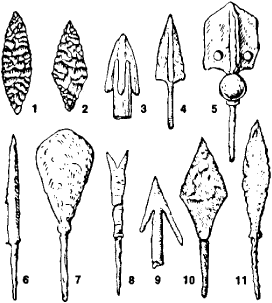
The arrow heads have produced the least informative translations, but it's possible to reconstruct what the terms might have meant by casting our net a bit wider than PED, and by looking at the shapes that arrow heads traditionally take. In Pāli we have: salla, khurappa, vekaṇḍa, nārāca, vaccha-danta, and karavīra-patta.

Of these terms nārāca ‘iron’ seems to be the odd one out, though the Sanskrit Epics mention arrows of iron which were used to kill elephants (Singh p.105). The other names seem to concern shape of the arrow head:
various arrow heads
  • the salla is a simple point [c.f. no. 6, right].
  • khurappa (PED ‘hoof’) is the Epic Skt. kṣurapra ‘knife edged’ arrow [c.f. 4] (Singh 1989, p.105) and hence Ñ&B have read this too literally, or been mislead by PED. Note that Cone's new DOP gets this right and lists it under khura1 'a razor or sharp blade'.
  • vekaṇṇa (barbed); [9]
  • vaccha-danta calf’s tooth (Skt vatsa-danta) is mentioned in the Epics and said to be in the shape of a calf’s tooth [similar to 7] and extremely sharp (Singh 1989, p.105); 
  • karavīra-patta or oleander leaf, the shape of which is technically described as ‘narrow lanceolate’, i.e. a narrow, elongated oval coming to a sharp point. [11]
Note the similarity of some of the names in the Chinese version below.


Conclusion

Why should we care about such details in a text which is primarily making a metaphysical point about what kinds of questions are answerable and/or important to ask? For most people, and most translators judging by their approach to this text, the answer seems to be that the details are irrelevant, which is to take the message of the text rather literally. After all I am not pierced by an arrow, or trying to emotionally blackmail anyone, I'm trying to translate a text so as people who don't know Pāli can read it. I'm not Māluṅkyaputta. I'm not refusing to practice unless I find the answers, but I am interested, and enjoy the investigative process.

I think what made me spend time looking into these questions is that the poor quality of the other translations jarred, and disrupted my sense that the text was a living document. The lack of concern for preserving knowledge of small details has meant that we have lost any hope of definitively understanding them - I can speculate, but in the long run neither I nor anyone can reconstruct terms that were lost unless some new evidence should emerge - perhaps a Gāndhārī version of the text for instance. 

It might be argued that losing Pāli terms for archery is no great loss, but if we get these details wrong through indifference then what other details are we getting wrong? How many of us, for example, picture Bahiya going around draped with great lumps of tree bark instead of roughly spun jute cloth? Keeping the past alive, or bringing it to life, means making use of such details to give our picture resolution. Why settle for vague blur when we can do considerably better than that?

I think word extinction is a problem. Perhaps not a huge problem, if one tree dies, we still have the forest, but it's a sign of carelessness, or neglect. If we value these texts for what ever reason, then there is an imperative not just to preserve them, but to keep alive what they mean. If we allow a words to cease being meaningful, then the whole is marginally less complete and less beautiful. Most likely we'll never recover what has been lost.


~~oOo~~

    Chinese Text
    What follows is a very rough rendering of the same passage from the Chinese text (Taisho T.01 n.94 p.0917c21) from CBETA, using online translation (often ludicrous), dictionaries, pattern recognition,  and some guess work on the basis that it can't be that different from the Pāli. Notes on each paragraph are included below it in bullet points. While the grammar is less than crystal clear, one can pick out key words, the nouns and adjectives, which is all we need for a general comparison. The caveat is that I only know a handful of Chinese characters (and that from my interest in Japanese). MO = notes by Maitiu O'Ceileachair.
    I cannot remove the arrow (我不除箭) until I know of the one who shot me (誰以箭中我): what was his surname (姓), his name/mark(?) (字); was he long (長) or short (短); if he was dark (黑) or pale (白); kṣtriya (剎利), Brahmin (婆羅門), layman (居士), or worker (工師姓); from the East (東方), South (南方), West (西方) or north (北方)?
    • The 字 is what is usually known as the style name, that used to be taken by a man at 20. Here it just means name. (MO).
    • 剎利 shālì = kṣatriya
    • 婆羅門 póluómén a phonetic rendering of brāhmaṇa.
    •  居士 Jūshì = lay, scholar, Buddhist.
    In addition I cannot remove the arrow (我不除毒箭) until I know: was the bow sala wood (薩羅木), tala wood (多羅木), or chì luó yāng jué lí wood (翅羅鴦掘梨木)?
    • sà luó i.e. Skt. sala.
    • duō luó: Skt. tala i.e. palmyra
    • chì = ke, ki, ḍa; luó = la, ra; yāng = aṇg; jué = ku, gu; lí = ri. Karungali? (Acasia catechu) Keralan name; c.f. kirankuri (Emilia sonchifolia) a herb in Hindi.
    In addition I cannot remove the arrow until I know: were the sinews (筋) which wrapped the bow (而用纏彼弓) beef sinew (若牛), sheep sinew (羊筋), or yak sinew (氂牛筋)?

    In addition I cannot remove the arrow until I know: was the bow grip (弓弝) white bone (白骨), black lacquer (黑漆), or red paint (赤漆)?

    In addition I cannot remove the arrow until I know: was the bowstring (弓弦) beef sinew (牛筋), sheep sinew (羊筋), or yak sinew (氂牛筋)?

    In addition I cannot remove the arrow until I know: is the arrow [shaft] Shě luó wood (舍羅木), bamboo (竹), or Luó é lí wood (羅蛾梨木)?
    • 舍羅 Shě luó = Skt. śara (Pāli sara) = Saccharum sara used for making arrows. 
    • Luó é lí = The first and last characters are used to transliterate ra and ri, but I haven't found an example of 蛾 used this way. Literally the characters read 'gather moth pear'.
    In addition I cannot remove the arrow until I know: is the arrow binding (纏箭) beef sinew (牛筋), sheep sinew (羊筋), or yak sinew (氂牛筋)?

    In addition I cannot remove the arrow until I know: are feathers (毛羽 used to make the vanes (取彼翅用作羽), peacock (孔雀), black crane (鶬鶴), or eagle (鷲)?

    In addition I cannot remove the arrow until I know: was it iron (鐵), or calf [tooth] (婆蹉), póluó (婆羅), or nàluó 那羅,  or jiāluó bǐng (伽羅鞞)?
    • 婆蹉 pó cuō is a translation of vātsīputriya; c.f. Pāli vatsa 'calf'. Burnouf & Buffetrille (2010), p.518.
    • 婆羅 = póluó = Skt. pāla, bāla, bala, sāra.
    • 那羅 = nàluó; = Skt. na ra; c.f. 緊那羅 kinnara; cf. Pāli nārāca 'iron'.
    • 伽羅鞞 jiāluó bǐng = Skt karavī[ra]?; cf. Pāli karavīra-patta 'oleander shaped leaf'.
    In addition I cannot remove the arrow until I know: what was the blacksmith's (鐵師) last name (姓); long or short; dark or pale; in the East, South, West or north?
    • I think 鐵師 means 'blacksmith'. It occurs quite frequently in the canon and from context it usually seems to refer to a craftsman of some sort. (MO)
    Despite considerable obscurity remaining, most of the content of the text can be identified. Even without fully understanding the Chinese we can see that the form is much the same as the Pāli text, but that content is mostly quite different. The Chinese translators have used two different methods to deal with unfamiliar words or entities. Firstly they transliterate using a Chinese character (汉字 hànzì) to represent the sound, e.g. 婆羅門 póluómén for brāhmaṇa; secondly they substitute with something more familiar, as with black crane (鶬鶴) for heron (kaṅka).

    It's useful to know that Chinese translators sometimes transliterated and I'm grateful to my friend Maitiu O'Ceileachair for many long discussions about the ins and outs of this and other translation issues (and thanks for giving me a few pointers post publication, noted above). I'm also grateful to the anonymous person who extracted many examples of the Chinese translation approach from the Digital Dictionary of Buddhism (which has an incomprehensibly restrictive access policy).

    A final note is that we can tell from the way of the words are transliterated that the original the Chinese translators were working from was not in Pāli, but in Sanskrit, or a more Sanskrit-like Prakrit. For instance when transliterating sara the 's' is aspirated (sh)--舍羅 shě luó--which is not a feature of Pāli, but compare the Sanskrit equivalent, śara, which is aspirated, and note that the Gāndhārī Dhammapada (G-Dhp 329) has śara for the Pāli saraṃ 'arrow' (Dhp 320). At least some of the texts reaching Chinese were written in Gāndhāri (c.f. Boucher 1998)

    Bibliography

    • Anonymous (1998). 'Vernacular Names of the Birds of the Indian Subcontinent' (PDF). Buceros 3 (1): 53-109. Environmental Information System (ENVIS) Online: http://www26.us.archive.org/details/IndianBirdNames.
    • Ali, Sálim and Ripley, Dillon S. (2001) Handbook of the birds of India and Pakistan: together with those of Bangladesh, Nepal, Bhutan and Sri Lanka. Bombay Natural History Society. 
    • Ānandajoti. (2007) A Comparative Edition of the Dhammapada: with parallels from Sanskritised Prakrit edited together with A Study of the Dhammapada Collection. (2nd rev. ed.) Online: http://www.ancient-buddhist-texts.net/Buddhist-Texts/C3-Comparative-Dhammapada/index.htm.
    • Biswas, Sailendra. (2000) Samsad Bengali-English dictionary. 3rd ed. Calcutta, Sahitya Samsad. Online http://dsal.uchicago.edu/dictionaries/biswas-bengali/
    • Boucher, Daniel. (1998). 'Gāndhārī and the Early Chinese Buddhist Translations Reconsidered: The Case of the Saddharmapuṇḍarīkasūtra.' Journal of the American Oriental Society, 118 (4): 471-506. Article Stable URL: http://www.jstor.org/stable/604783
    • Buddhadatta. (1955) English-Pali Dictionary. Motilal Banarsidass, 1989.
    • Burnouf, Eugène &  Katia Buffetrille [trans]. (2010) Introduction to the History of Indian Buddhism, University of Chicago Press. Originally published as Introduction à l'histoire du buddhisme indien, Paris: Imprimerie Royale, 1844.
    • Dave. K. N. (1985) Birds in Sanskrit Literature. Motilal Banarsidass.
    • Dictionary of Pali Names [DOPN]
    • Childers, R. C. (1875) A Dictionary of Pāli language. London: Trubner & Co.
    • Gethin, Rupert. (2008). Sayings of the Buddha. Oxford University Press.
    • Horner, I. B. (1954-9) The Book of Middle Length Sayings. (3 vols.) Pali Text Society.
    • Ñānamoli and Bodhi. (2001). The Middle Length Discourses of the Buddha. 2nd ed. Wisdom.
    • Singh, Sarva Daman. (1989) Ancient Indian Warfare: With Special Reference to the Vedic Period. Motilal Banarsidass.
    • Vīra, Raghu. (1949) Indian Scientific Nomenclature of the Birds of India, Burma and Ceylon. International Academy of Indian Culture.
    • Witzel, Michael. (1999) 'Substrate Languages in Old Indo-Aryan (Ṛgvedic, Middle and Late Vedic).' Electronic Journal of Vedic Studies (EJVS) 5(1): 1–67

    25 May 2012

    Facts and Feelings

    WESTERN PHILOSOPHERS have pondered the questions of 'what is knowledge?', and 'what is truth?' for centuries. Without, it must be said, coming to any kind of consensus. And without, it seems to me, acknowledging that the inability to come to a consensus after many centuries says there is something terribly wrong with the whole enterprise of philosophy! The question of why two philosophers can never agree is part of a larger question that interests me. On the surface there seem to be very different modes of knowing and processing knowledge. We distinguish intellect from feelings for instance, and reasoning from intuition. We have always insisted that the differences are important and have often valued one over the others. The classic contest is between reason and emotion. But some research (now decades old in fact) raises the question of whether these are even valid categories when it comes to knowledge.

    I've already mentioned, several times, a case study cited by Antonio Damasio in which he meets a patient with damage to his ventro-medial pre-frontal cortex (red in the image). This part of the brain is involved in the regulation of emotions. Emotional impulses typically come from deeper brain structures in the so-called Limbic System; a series of related structures in the lower and mid-brain. However emotions are also processed and regulated by our neo-cortex. In the patient mentioned by Damasio his awareness of emotions is extremely attenuated. Asked to describe his journey to the appointment his emotional tone was flat, even when describing the traffic accident he witnessed along the way. The emotions do not register. But his narrative shows that his powers of observation and understanding are not impeded; for example his recall of the trip is detailed and the facts are accurately related. He understands cause and effect. What is missing is the emotional response. And this shows when the patient is asked whether an appointment on Tuesday or Thursday next week would suit him better. He has a complete grasp of the facts relating to the choice - his and other's schedules, traffic conditions at different times etc, and he understands the task: but after 30 minutes of reviewing the facts he cannot come to a decision. The facts appear to be evenly weighted in his mind. Each fact is as important as every other fact. So that he has no basis on which to make a decision. (Descartes' Error. p.192ff.) (see also Grabenhorst & Rolls, van den Bos & Güroğlu).

    This points to a very important conclusion: that facts alone are not the basis of how we make decisions. We need to know the relative value of each fact, and this information comes from the emotional response we have in relation to the fact. When we consider the facts we don't just decide what we believe to be true. In any given situation there are likely to be hundreds of true facts. We need to decide, given the context, which facts are relevant and important, i.e. salient. Facts make for sense, and emotions make for salience. We simply cannot make decisions without both.

    Salience is terribly important. I recently learned for instance that schizophrenia is going to be renamed salience syndrome in the DSM-V (The DSM Diagnostic and Statistical Manual of Mental Disorders, 5th ed. due out next year) The current thinking is that a person with the disorder assigns the wrong level of salience to their experience which leads to delusions. Cause and effect can become confused or disconnected, and coincidences start to take on far too much salience. Inner experience can seem as though it is connected to external events in ways that only the sufferer can detect. An urge to act may not be felt as coming from 'me' so must be coming from outside. And so on. Schizophrenia means 'split mind' (though the etymology of Greek phren 'mind' is unknown), which is not at all descriptive of the disorder and has often lead to confusion amongst lay people. Correctly assessing the salience of our experience is virtually a definition of sanity, though the definition has a broad and ill-defined boundary.

    So part of the reason that philosophers (or people generally) cannot agree on things is that we have different notions of value and salience, and since these are primarily emotional they are difficult to articulate. In fact we tend to unconsciously absorb the values and notions of salience from the people around us. Values are strongly conditioned by relatives, friends, race, region, and religion (i.e. by all the various groups we are members of). Attempts to articulate universal values have so far failed to convince everyone. The problem of inarticulate values is exacerbated by those aiming at what they call 'rationality' or 'objectivity' since this usually involves consciously suppressing emotional responses.

    Incidentally, this shows that unless the Vulcans of Star Trek were wired very differently from humans, that Mr Spock & co. would have been unable to make decisions. Without a way to assign value to facts they would all be just like Damasio's brain damaged patient.

    Intuition and Reason


    People I know have been using the term 'intuition' a lot lately and have consistently failed to respond to my request to know what they mean by it. I think I'm in a position to offer a definition which demystifies the word. Let's start with reasoning. In reasoning, as I have indicated, we don't just manipulate facts to make sense. In reasoning we tap into emotions to give value to facts, and then compare the relative values to decide which is salient, or which is most salient. Saliency is a much more fuzzy concept than truth. We know that two intelligent people can reasonably come to opposing conclusions given a set of facts. This is the basis of of arguments in politics and well as philosophy for example. It's so much a part of our daily lives that it hardly needs an example, but the classic illustration is between conservative and liberal politics. Given identical facts, right and left leaning people will come to completely different conclusions about appropriate courses of action, because each assesses the salience of competing facts differently. (The different values of left and right are summarised very well in a diagram produced by David McCandless and Stefanie Posavec for the Information is Beautiful website. See also McCandless on TED) The irreconcilability of left and right rests not on the facts per se, but on what each side considers to be the most salient facts. This is true of the irreconcilability of philosophies, ideologies, and religions also.

    The champions of reason initially saw it as a way of freeing us from superstition. The great discovery of the Enlightenment was facts that were apparently independent of belief systems (though geometry was known to have this property since antiquity). Gravity affects the Atheist and the Christian in precisely the same way. If we measure the acceleration due to gravity anywhere on the earth then it is about 10 ms-2 with a variation proportional to our distance from the centre of the earth, and the density of the material directly under us, and a margin of error. In a world where most conflicts are based on mutually antagonistic belief systems this revelation from science seemed to be incredibly valuable. The hope was that we had discovered a reliable way to make decisions, and there were things we could all agree on! Some people still see science in this light, but most of us now acknowledge that values play a role in science as well. Though of course some religieux still fail to acknowledge facts that conflict with their (highly valued) belief systems.

    Reason came to be associated with the conscious manipulation of these facts divorced from emotional involvement. And the Romantics (over) reacted to this by revalorising emotions at the expense of reason (leading Romantics tended to break with the values of the society around them). Unfortunately there is a great deal of difference between a value independent fact (like gravity), and value independent thinking (which amounts to suppressing one's awareness of emotions and therefore empathy). We still have to decide what facts are relevant to any situation, and all too often empathy is left out of rational equations. Cold reason has caused atrocities every bit as wicked as unchecked emotions have.

    So reason, it seemed, could free us from superstition. Obviously it has failed to do so. Why? It could only have succeeded if the supernatural had low salience for us. In fact supernatural thinking tends to have a high value, and therefore high salience for many people I know (C.f. On Credulity), and though they are a bit credulous they are by no means cretinous. The survival of the supernatural is partly due to the pernicious influence of the Romantics who celebrated the irrational, but of course they only tapped into something that already existed in the hearts and minds of people. There is a very great reluctance to abandon the supernatural, many of us value it, and continue to find it salient in understanding our experience. People who rail against religion (often to a highly irrational extreme, marked by very strong emotions) on the whole seem to be ignorant of this dynamic, making their criticisms unhelpful (and I'm specifically thinking of Richard Dawkins here).

    Which brings us to intuition. Unlike reasoning where we try to consciously compare the values we have assigned to facts, intuition is the same process undertaken unconsciously. Experientially it seems as if we leap to a conclusion, or the answer to a problem appears as if from nowhere. We tend to be quite naive about this and since we don't see a process, we assume that one doesn't exist or that it is a bit magical. Intuition then becomes mystified. All that is happening is that we are weighing the value of facts subconsciously and coming to an unconscious decision. It may also be that our phenomenal ability to detect patterns operates better at an unconscious level, since it it something we developed early in evolutionary terms (other animals also use pattern recognition to help them survive).

    It may even feel as though trying to think consciously about a problem is counter-productive. Perhaps this is because we cast the net too widely and overload our judgement of salience with too many facts; or perhaps our intellectual (or ideological) values actually conflict with our unconscious values; or perhaps we are just alienated from our body and emotions which makes are values difficult to access. In any case often we solve a problem by allowing ourselves to work on it unconsciously. Many of the great advances in science have come through allowing the problem to mull over unconsciously. Breakthroughs often come after a night's sleep and have even come in dreams (like the structure of the benzene molecule). There's nothing very mysterious about this process, and in many ways it is simply the same as "reasoning" - connecting facts and/or experience, to emotions and values, to decide what makes the most sense of the given facts under the circumstances.

    It seems to me that a number of fallacies about how we think persist in spite of new evidence which is constantly emerging. Folk ideas about the mind are still in the process of assimilating the ideas of the 19th century psycho-analytic movement and it's more popular spawn, let alone the insights of neuroscience. As I understand it there is no fundamental difference between reason and intuition, they are the same process operating at different levels of awareness. There is nothing magical about intuition (I frequently rely on it), though the unconscious nature of it does lend itself to magical explanations.

    In a sense the magical explanations of intuition are rather egocentric: 'I' am the owner of all that I'm aware of in my mind and body, and since intuition is unconscious it must be 'not I'. And being both 'I', in that the inputs and outputs happen in my mind, and not 'I', in that I am unaware of the process of producing the output from the input: then something super-natural must be happening.

    Embodied Cognition

    Another fallacy about reasoning is that it is wholly abstract and divorced from experience. George Lakoff and Mark Johnson have showed that this is not so. Lakoff and Johnson have showed for instance that when we think abstractly we employ metaphors which draw on our physical experience of being embodied. We employ metaphors like UP IS GOOD/DOWN IS BAD. So if the stock market 'rises', then that is a good thing. But the stock market is only a notional entity and is not able to move about in space. Our reasoning here depends on the experience we have of moving about in space with our bodies. UP IS GOOD is likely related to an upright position being consistent with life, and lying down with death. And note that UP is not always GOOD. When we have a "high" fever this is a negative. Temperature being "high" or "low" is also a spatial metaphor (perhaps related to the position of the sun in the sky).

    If I say "a thought just came into my head" I am performing quite a complex metaphorical translation. I am employing a range of metaphors: thoughts are objects, thoughts are agents, my head is my awareness, my head is a container--therefore awareness is a container). I'm relying on my experience of placing objects into containers, without which the sentence would not make sense. I'm also placing my first-person perspective inside that same container. The thought has to enter the same container, because containers can also hide objects. The unconscious is a container I cannot see into for instance. And note that the thought is an autonomous agent - it comes into my head, without me willing it (c.f. my previous statements on intuition). Although we all have an experience like this, the expression is metaphorical. Even apparently simple statements of fact are often couched in terms which rely on a complex interlocking system of metaphors that ultimately depend on how we physically interact with the world.

    This argument from linguistics is confirmed from a neuroscience angle by the existence of mirror and canonical neurons, which form part of the motor cortex. When we do an action, say clenching a fist, parts of the motor cortex are active. Mirror neurons are active when we see someone else perform an action. Canonical neurons are active when we are presented with an object, or an image of an object, and we imagine how we might manipulate it. It is an unsurprising conclusion that we relate to the world in terms of how we might interact with it or manipulate it. However these same interactions form the basis of the metaphors that we use in abstract thought, which is not generally recognised.

    Reason, then, is very much embodied and abstract thought depends on metaphors arising from our physical interactions with the world. Reason relies on assessing the salience of a fact by connecting it to our emotions, which we experience as bodily sensations. Reason also relies on metaphors and abstractions which are based in how we physically interact with the world. When we consider the nature of belief we need to keep all this in mind. A belief is a proposition that we have decided is not only true, but which has great salience. To shift a belief by offering alternative truths is ineffective. One can only shift a belief by changing the relative importance of the facts - that is by addressing salience. Indeed if we hold something to be highly salient, then the "fact" that it is untrue might not be salient - and we can comfortably and tenaciously believe untrue propositions. I would say that it is frequently the case with fundamentalist religious beliefs. In a future essay I want to look at how scientists have failed to communicate the salience of evolution, and allowed some religious people to continue to deny it despite the "facts". This is paralleled by Buddhist responses to the demonstrable fact that rebirth is factually implausible.

    ~~oOo~~

    Bibliography

    • Damasio, Antonio. Descarte's Error. London: Vintage Books, 2006.
    • Grabenhorst, Fabian & Rolls, Edmund T. 'Value, pleasure and choice in the ventral prefrontal cortex.' Trends in Cognitive Sciences. 1 February 2011 (Vol. 15, Issue 2, pp. 56-67) doi:10.1016/j.tics.2010.12.004
    • Lakoff, George & Johnson, Mark. Metaphors We Live By. University of Chicago Press.
    • van den Bos, Wouter & Güroğlu, Berna. 'The Role of the Ventral Medial Prefrontal Cortex in Social Decision Making.' The Journal of Neuroscience, June 17, 2009 • 29(24):7631–7632. DOI:10.1523/JNEUROSCI.1821-09.2009
    • van Os J. 'Salience syndrome' replaces 'schizophrenia' in DSM-V and ICD-11: psychiatry's evidence-based entry into the 21st century? Acta Psychiatr Scand. 2009 Nov;120(5):363-72.
    ~o~

    2012 article on Phineas Gage in the Guardian.


    Reference: Van Horn, J. D., et al. (2012). Mapping Connectivity Damage in the Case of Phineas Gage. PLoS ONE, 7(5): e37454. DOI: 10.1371/journal.pone.0037454
    Related Posts with Thumbnails