20 July 2012

Revisiting Greater Magadha

WHEN JOHANNES BRONKHORST'S BOOK Greater Magadha hit the scene a lot of us were over-awed by the scope and complexity of the argument. I wrote about my first encounter with it in a blog post called Rethinking Indian History (2009). A the time we thought it must be significant, and the new theory did seem to solve some of our problems. It was exhilarating to realise that history was able to be re-written.

However, such a book is difficult to assess, and even after several years there has been little critical response to it from the field of Buddhist studies. A few reviews, but nothing of real substance. This may be because in order to place Bronkhorst's claims in context one must have a good grasp of a body of literature and evidence that is unfamiliar to most Buddhologists. If we haven't read Bronkhorst's oeuvre, for example, we'll struggle to really grasp where he's coming from. We also need to be familiar with writers on Indology such as Michael Witzel and Asko Parpola (neither of whom are read by many Buddhologists). The archaeological and anthropological studies are also critical - and they are scattered and from an entirely different discipline. And this work also relies on familiarity with Vedic literature and on the philological problems of dealing with it. In other words, there is not much criticism because not many of us are qualified to read Bronkhorst critically.

At the same time Bronkhorst's book seems seems to have over shadowed Geoffrey Samuel's book, The Origins of Yoga and Tantra, which came out a year later. In fact, Samuel is by far the better author, his book is far more readable and accessible, and about 1/10th of the price! His treatment of the relevant material (mainly based on an unpublished book by Thomas Hopkins) seems more credible, though it still has its limitations.

At the time, I was very enthusiastic about Greater Magadha because it was one of those moments when I realised that everything I thought I knew might be wrong, and what could be more exciting for a scholar? However, I've been reflecting on Bronkhorst's book in the light of Geoffrey Samuel's book, and particularly Michael Witzel's equally awe inspiring writing (again far more accessible since he shares pdfs of many of his publications for free!). My conclusion is that Bronkhorst's thesis will not stand the test of time.

Bronkhorst, as my friend Dhīvan said in his recent M. Phil. thesis, is often arguing tendentiously. I like this word. It means that Bronkhorst has a conclusion that he is pursuing and this is reflected in how he treats the evidence. Everything is predicated on Bronkhorst's revised chronology and presented in such a way as to support his conclusions. In my view the evidence is read in the light of the theory, which is the opposite of the scientific method.

Poor Reasoning

There are some examples of faulty work in the Book, for example in the Appendix VI covering Brahmins in the Canon. Here he notes that the Ambaṭṭha Sutta may well refer to Sanskrit ambaṣṭha: i.e. someone born of a brāhmaṇa father and a kṣatriya or vaiṣya mother. Ambaṭṭha turns out to have a Brahmin father and a mother descended from a slave and is therefore low caste. Bronkhorst argues that here ambaṣṭha/ambaṭṭha must refer to the mixed caste of the interlocutor which is plausible. However, a slave is not a kṣatriya or vaiṣya so Bronkhorst is stretching the evidence to suit himself. Richard Gombrich is using the same kind of argument when arguing that the Buddha must have known about the Puruṣasūkta (ṚV 10.90) because he refers to Brahmins being born from Brahmā's mouth in the Tevijja Sutta. Bronkhorst points out that in the ṚV the Brahmins are born from Puruṣa's mouth, not Brahmā's and concludes that they Pāli authors "did not know" the sūkta (p.213). Bronkhorst seems to have a rather irrational aversion to Gombrich and it shows here in his inconsistent standards in treating the evidence. It also shows in his treatment of the humorous passages of the Pāli suttas which do not get a laugh from him.

Another example is the conclusion that because the Pāli texts are familiar with an idea found in the Dharmasūtras the Pāli texts must be late. The Dharmasūtras are much less securely dated than the Pāli, though the consensus seems to be that the written texts are originally post-Asoka. However, it is also widely accepted that they codify conventions that are a great deal older, so there is no a priori reason to assume that a detail in isolation is late because it is found in a Dharmasūtra. And the Pāli parallels are all details in isolation.

Bronkhorst is caught out using fallacious reasoning on two separate occasions and this must put us on our guard. These examples are from areas I understand well enough to be sure of my ground. It might be argued that these are relatively minor infractions, but if someone like me can spot these kinds of minor problems, what are the professionals seeing? (and when will they write about them?)

Magadha

Closer to the heart of the matter is that the very concept of Greater Magadha seems flawed. Yes, there are two cultures on the Ganges plain ca. 1000 BCE and one of them is the Kuru-Pañcāla state. The other one is not Magadha, but the Kosala-Videha complex, which is formed from Vedic tribes forced to move east by the rise of the Kurus. Witzel has referred to these tribes as para-Vedic, as they seem to have had customs significantly different than the Kuru Vedic tribes. Videha in particular retains connections with the Kuru Brahmins and the Videhan Kings invite them east. This is what we see in Bṛhadāraṇyaka Upaniṣad when King Janaka invites a number of orthodox/orthoprax Brahmins to a debate. A debate which local boy Yājñavalkya wins. Yājñavalkya represents, even personifies, a major shift that is going on in the Brahmanical world. A shift away from the orthopraxy of the Kurus towards a new form of Brahmanism that forms the basis of what comes after. Not only is BU composed in Videha but so is the White Yajurveda, and the single extant recension of the Ṛgveda (which once existed in a number of different recensions). At this time Magadha hardly features in texts at all. Geographically Magadha is isolated from the major players by being south of the Ganges.

By the time of the Pāli texts Kosala is clearly more welcoming to Brahmins than Magadha, which is further east and, crucially (in my opinion), south of the Ganges. The Pāli texts show more Brahmin towns and more land gifts to Brahmins in Kosala than in Magadha. In fact, Bimbisāra gave only two grants and his murderous son Ajatasattu is not recorded as giving any. Later, we know that the Mauryas were not converted to Brahmanism, but still followed śrāmaṇa religions.

Witzel considers that the evidence of the texts themselves, especially the language involved, shows that the early Upaniṣads must predate the early Pāli texts by some centuries, although he does point out that for both literatures there is a long gap between initial composition and final redaction, and this blurs the boundaries. The early Upaniṣads represent a time before the Second Urbanisation (ca 600-500 BCE), while the Pāli texts represent a time when it is in full swing. A difference not dealt with by Bronkhorst as far as I can see. Magadha as a power, with its fortified capital city Rājagaha, is only associated with the Second Urbanisation.

"Greater Magadha" as a region, then, only has meaning in Bronkhorst's idiosyncratic revised chronology which places all of the Upaniṣads post-Buddha. If anything the region is Greater Kosala in the late Vedic period (ca. 700-500 BCE)! It is true that the idea of ethicised karma does make a first appearance in BU, and I think Bronkhorst is on the right track when he says the Buddhist idea is not a development of Vedic eschatology, or at least not a direct development. What seems to mislead Bronkhorst is the idea that the source of this idea came along only in the 5th century. I believe this is short sighted, and ignores what we know about the history of ideas in India.

Brahmins

A fact which no scholar has yet come to grips with is that Brahmins, as far as they are recorded in the Pāli texts are quite diverse: we have at least ritualist, renunciate and theistic Brahmins, we also have some that are just plain villagers. Upaniṣadic ideas and practices are not found with any clarity in Pāli, they don't stand out, but they can apparently be inferred. We never see the Buddha in conversation with a Brahmin about ātman, for instance, or about brahman, or the identity of the two (leading to mokṣa), or about oṃ, or the vedas. Where Brahmins express religious ideas in the Canon they are cosmological or related to a Creator God. The cosmological ideas are likely to have been common knowledge. The central ideas of the Upaniṣads are missing from Buddhist texts. This might be seen to support Bronkhorst's thesis, but I'm not so sure. My guess is that Brahmins maintained a relatively orthoprax exterior and kept the Upaniṣads secret for a long time--the word upaniṣad can mean 'esoteric'.

The theistic Brahmins have yet to receive adequate attention from scholars. Gombrich treats references to Brahmā as a criticism of brahman, but this only works in the specific context of the Tevijja Sutta, and what we see throughout the Canon is no mention of brahman, and many mentions of Brahmā. The theistic tendency has parallels in parts of the Mahābhārata, and may represent a kind of short-lived orthodoxy that is quickly over-written by the cults of Śiva and Viṣṇu which relegate Brahmā to saṃsāra just as the Buddhists did.

Śākyas

Taking Witzel's (1997) suggestion that the Śākayas arrived in North-East India rather late, I have developed this idea in my forthcoming article (draft on academia.edu). All things considered, we can probably say that they arrived in the decade or two following 850 BCE. That year (± ~10 years) marks the beginning of a major dry period in India. Witzel notes that other North-Eastern tribes such as the Malla and the Vṛji were known to live in the West (Rajasthan and the Panjab) by early Vedic texts, but are neighbours of the Śākyas in the Pāli texts. At this time Kosala-Videha culturally dominates the Central Ganges region, and the Magadhan city of Rājagṛha is just about to be founded.

The argument is quite involved and requires the weighing of many separate items of circumstantial evidence, but a case can be made for contact between the Śākyas and the Zoroastrian culture of Iran. What is suggested by this line of argument is that the idea rebirth is found throughout Indian (perhaps it was an indigenous belief) but the introduction of ethicisation follows contact with Zoroastrianism. I try to make the case for this happening in the 9th century BCE, giving it time to infect the early Upaniṣads. However, it could have come with Achaemenid influence after Darius claims Gandhāra and Sindh as provinces of Persia ca. 520 BCE.

Revised Chronology

One of the problems with Bronkhorst's argument is that he mixes texts from different eras and is relying on conjectural reconstructions. So he contrasts the Bhagavadgītā, which is certainly written in the common era, with other bits of the Mahābhārata (post Asoka, but probably BCE), Pāli texts (ca 4th century BCE) Upaniṣads (7th-5th century BCE), and reconstructions of ideas of early Jain and Ājivika beliefs. This is not comparing apples with apples. A century of ideological development in a milieu which sees a lot of mixing and matching, assimilation and adaptation of each other's ideas and practices can see major changes. So it seems to me Bronkhorst's method is flawed.

As I said above everything is predicated on Bronkhorst's revised chronology and presented in such a way as to support his conclusions. In other words, one has to accept the his new chronology, which places the Upaniṣads after Buddhism rather than before it, and allows Brahmins to absorb ideas, particularly karma and rebirth, from the śrāmaṇa milieu. But the reasoning is circular. The thesis only works if we accept the chronology; while the chronology only fits if we accept the thesis. The same argument applies to the reconstructions of Jain and Ājīvaka religious ideas, especially the latter which are reconstructed mainly from Buddhist texts (a rather unreliable source of information!)

Conclusions

I think Bronkhorst has made a valuable contribution to the historiography of India. He has certainly made many of us rethink our understanding of and approach to the history of India before the Common Era, and this is a valuable service. A major challenge such as this forces us to be more precise in stating our differences of opinion if we have them. There are reasons to be cautious in accepting Bronkhorst's argument. I find I am persuaded by Witzel's account of the evidence as much because he seems to have no particular agenda as anything. Witzel has repeatedly, and at considerable length, played with the pieces of the evidential jigsaw in order to make a coherent picture from them. Samuel has showed that it is possible to read the archaeological evidence as supporting the consensus chronology. Following Witzel I have tried to show that the ideas might have come from a third source, Zoroastrian Iran, and been introduced into śrāmaṇa and Brahmin culture at roughly the same time. (Revising the article for publication is my next job).

Another plus is that Bronkhorst has made it abundantly clear that Buddhism can no longer be studied in isolation, but is a branch of Indology. Ignorance of archaeology and material culture (the gist of Greg Schopen's critique of Buddhist studies as a subject) is no longer acceptable. The Late Vedic literature--the Epics, Early Upaniṣads, Brāhmaṇas, Dharmasūtras, Dharmaśastras and even the Gṛhyasūtras--is starting to look more relevant in understanding early Buddhism. Early Buddhism existed in a context and we have been overlooking, or over-simplifying this context for too long. The downside of this is that an already complex subject appears to become an order of magnitude more complex. And this at a time when we are just beginning to make use of the Chinese parallels to the Pāli Nikāyas and discover the influence of Central Asia in transmitting Buddhist to the East. And this also at a time when Buddhist studies is dying out as an academic subject in the UK.

So far as I am aware, no scholar has adopted Bronkhorst's revised chronology. And the whole thesis depends on acceptance of the chronology. It may be that more time is required for scholars to assimilate Bronkhorst's work, and to provide a critique. But in the meantime there are some obvious flaws in it that should make the reader wary of just accepting what he says uncritically.

I want to conclude with a coda on critical discourse. Not so long ago I was speaking to a prominent long time Buddhologist and they remarked that criticising someone else's work in print was coming to be seen as unacceptable. Certainly in the US where tenure depends on a positive reaction to one's work, critical dialogue is dwindling. Journals have apparently refused to publish critical articles.  If the refutation aspect of conjecture and refutation is abandoned, then progress in knowledge inevitably goes awry. Just look at economics!

~~oOo~~

Bronkhorst, Johannes. 2007. Greater Magadha : Studies in the Culture of Early India. Leiden: Brill.

Reviews
If you know of other reviews drop me a line.

13 July 2012

Semmelweis Reflex

Ignatius Semmelweis
1818-1865

ONE OF THE REAL BENEFITS of living in the UK is the BBC, a non-commercial network of TV and Radio stations. I'm a fan of Radio Four which is fairly high-brow in its approach to culture and science. Some years ago I learned about Ignatius Semmelweis on Radio Four.

Semmelweis was a Hungarian physician working in Vienna in the mid-19th century. His claim to fame is that he realised that doctors were spreading Childbirth Fever to women during childbirth, a disease which was frequently fatal. He recommended that doctors wash their hands in a chlorine solution before attending to each patient. In particular he made interns in his hospital who had been dissecting cadavers wash their hands before touch living patients. He obtained a definite decline in cases of Childbirth Fever and saved many lives. However, despite the clear benefits, his idea was so radical and preposterous that until Louis Pasteur established 'germ theory' in the 1870's, after Semmelweis had died, his hygienic practices were not widely taken up. Semmelweis published his findings in medical journals of the day, and wrote about this theory in a book, but made little headway. It's thought that doctors found his theory unbelievable. Trust in empiricism was still relatively new amongst scientists, and in those days doctors were not scientists. At the same time doctors were gentlemen and found the very idea that their hands were "dirty" and caused disease unseemly and unbecoming.

Today there was a magazine program which included Joanna Kavenna who published a novel, The Birth of Love, on the themes of childbirth and motherhood. Semmelweis is a character in the novel. While being interviewed on the subject of creatively she mentioned something called the Semmelweis Reflex. The Semmelweis reflex is a knee jerk rejection of a new idea because it is unfamiliar. There's a nice definition on Wikipedia:
Semmelweis Reflex (or effect) "is a metaphor for the reflex-like tendency to reject new evidence or new knowledge because it contradicts established norms, beliefs or paradigms."
It's so easy to feel that we understand things. With understanding comes a feeling of being in control, or at least not too much at the mercy of events. It has to be said that medicine is vastly improved by understanding, though modern medicine certainly has its limits. People who wish to limit the influence of science will often point out the limitations of science, though on the whole the people that I see doing this seem woefully ignorant of science and in no position to judge it's limits.
Click image to embigg
One place we might expect to find a well developed Semmelweis Reflex is in the sphere of religion. Religious people are not known for welcoming new information, especially when it contradicts there beliefs. When Darwin published On The Origin of Species in 1859 the response from Christians was a Semmelweis Reflex. Evolution continues to be the watershed issue for Christianity, especially in the United States. In the USA there is an ongoing battle to have Christian supernatural ideas given equal or better status as evolution has in the education system.

On the right is a modified version of a diagram showing a simplified version of how Christian responses to evolution have evolved over time (based on a diagram that seems to be endemic on the internet. I found it here). My version attempts to show the relative chronology vertically. In the late 18th and 19th centuries we saw several attempts to incorporate evolution into Christianity, especially after Darwin. There were those, of course, who simply refused to look at the data, refused to read On the Origin of Species, and refused to consider changing their views. What we then see is the emergence, mainly in the last 20th century a series of increasingly sophisticated approaches involving outright rejection of evolution. If the Semmelweis Reflex can be sustained over 150 years it seems as though 'reflex' is not quite the right word any more. Indeed unlike Semmelweis's case, the establishing of facts (paralleling Pasteur) doesn't seem to have initiating the overwhelming change in behaviour that it did in the case of hand washing amongst doctors.

Another classic Semmelweis Reflex can be seen in economics. Mainstream economists completely failed to predict the disastrous global financial crisis which began in 2007, and has become a depression one the scale of the 1930s. But there are a number of heterodox economists who did predict it. My favourite is Steven Keen of the University of Western Australia. He realised in 2005 that private debt was rising exponentially in Australia, with similar trends in the entire Western World. Neo-classical economic models ignore private debt, since they see credit and debit as cancelling each other out. In fact Neo-classical macro-economic models make a number of outrageous assumptions about complex systems, such as linear behaviour (the classic supply and demand graphs) and the concept of equilibrium which finds expression in the oft voiced trust that left to itself the market will find it's level. But anyone that knows anything about complex systems is that their behaviour is never linear, and never approaches equilibrium. Economists, sincere as they may be, are completely deluded about the extent to which their models fit reality. Progress in a discipline like economics comes one funeral at a time. In other words these hoary old economists are simply not going to change their minds, come what may. Our best hope it to outlive them and hope they don't cause too much damage in the mean time.

I believe that we are already seeing something similar over the issue of rebirth. I think I've done a pretty good job of outlining why rebirth is implausible, and have added some other points since publishing my blog Rebirth is Neither Plausible nor Salient (27.1.12). The case is quite strong, and those willing to consider the evidence I've marshalled on the whole seem to agree with me. But then they almost certainly already agreed and were not convinced by my arguments. At best people appreciated my enthusiasm and thoroughness. So I'm preaching to the converted, which is not entirely satisfying because it's not a real test of my argument. And it needs testing.

On the other hand as people who commented, and as discussions elsewhere on the internet, have made clear, those who disagree with me seem unwilling to examine my argument in detail and point out flaws or inconsistencies. What they do is fall back on what they know, and a literal reading of Pāli suttas. I haven't seen objections on the basis of Mahāyāna scripture, for example, though it may exist. Most of these reactions simply restate the mature theory of kamma and rebirth as they were taught it, ignoring the inconsistencies in the presentation, and say that it must be taken as a whole or not at all. In other words they are having a Semmelweis Reflex.

The point is that neither side seem to be really thinking about the issues and weighing the evidence. They're just taking sides because it fits their ideology or doesn't. Rebirth is integral to the Buddhist tradition--it is assumed at every step. The fact that it does not seem plausible on the basis of what we now know leaves us with a difficult task. I don't think anyone has really got to grips with it yet. Most rebirth deniers just seem to be dodging the issue. On the other hand I see fundamentalism as the kiss of death for Buddhism in the modern West, because it will be seen in the light of religious fundamentalism more generally. If fundamentalism continues to gain ground it will certainly alienate the mainstream of Western Society who seem heartily sick of religious dogma.

The problem needs to be addressed on two levels. We need to be clear about the facts, both from the tradition and the new facts emerging from scientific and historical investigation. But we also need to look at the level of values and salience. For the fundamentalist the tradition has enormous gravitas that affects the way that salience is assessed. Many fundamentalists have tipped the scales so far that science carries no weight. Every scholar, author and academic finds their own theory more salient than any other, though the good ones remain open to persuasion. In other words we need to try to communicate the facts, but at the same time the value of these facts. Obviously for someone like me scientific knowledge has great salience. Not only can I not ignore it, but I actively seek it out, and make it a priority to learn new things. This is not true of many religious people, and so we must frame the debate carefully.

There is also an ethical issue involved in deliberately attacking someone's belief system. One can very easily stray into violent behaviour. If someone is not receptive to us, we cannot force them to listen without doing violence to them. Making people receptive to us usually means making an empathetic connection with them first. This involves understanding and appreciating what they value and why. In order to change someone's mind we have to be able to imagine ourselves in their shoes. And very few non-religious people seem willing or able to do this.

Of course many people will prefer to stay out of the discussion. People say they are happy with their beliefs and have no desire to convince anyone of anything. Sadly this kind of cop-out see to be a modern default setting. I would argue that both religious and secular ideas are laced with an imperative to be in dialogue with others and to help other people understand your point of view. Buddhism is one of the great proselyting religions, and it's imperative is to teach other people how not to suffer. Inherent in a secular view is the betterment of humankind through knowledge. People can't better themselves if thy remain ignorant.

But this is not a call to take sides. Far from it. This is a call to empathise with your neighbour, and to treat them as you would be treated by them. Without first establishing empathy their can be no communication. Empathy doesn't need to be learned, we're all born with the ability. But we learn to suppress it with respect to outsiders and that needs to be unlearned.

~~oOo~~


06 July 2012

Why I am (Still) A Buddhist.

Cairn and flag to celebrate my private ordination,
June 10, 2005. (Cairn ~ 1.5m). In the hills above
the Guhyaloka Retreat Centre, Spain.
(38.620356,-0.186663 looking almost due west.)
GIVEN THE TONE of my blog over the last two years especially, and some of the responses to what I've written, I've been meaning to pause for thought and write something about why I'm still a Buddhist. Glenn Wallis of Speculative Non-Buddhism expressed his enthusiasm for such a project when I mentioned it to him. So here goes, but it might not be what you expect, because the subject is by nature personal rather than impersonal. I've tended to avoid being personal here because it's bitten me in the arse before now, but I can't avoid it today.

In the last couple of years I've been quite busy becoming disenchanted (nibbindata) with traditional Buddhism. I've been analysing and critiquing some of the central doctrines of Buddhism. I did not set out to attack Buddhism, I set out to discover Buddhism in more detail. However on closer examination I found the presentations of Buddhism wanting at every turn, and have been endeavouring to articulate the various problems as I see them.

In the process I have discovered that there are Buddhist fundamentalists who seem to see me as a kind of anti-Buddhist agent provacateur bent on destroying the True Faith. There are also a number of people who feel disappointed with Buddhism for various reasons who have sought to make common cause with me, though I don't find their self-indulgent little revolutions very attractive, and such contacts frequently turn sour when it becomes apparent that I have no intention of sacrificing Buddhism on their bonfire. Then there are the people who have either reinvented Buddhism in their own image, or developed their own special philosophy which peripherally touches on Buddhism, and who want to share it with me, mistaking my critical stance for an openness to every crackpot idea that comes along. After seven years of this I'm a bit jaded, and more likely to give up blogging than I am to give up Buddhism.

I became a Buddhist in 1994, after a bit of shopping around. I've had a more or less life-long interest in psychology and human potential thanks to my mother, Durelle Dean, a true seeker, and until recently a born-again member of a pentecostal church and a missionary working in rural Africa. (She's looking at becoming a Catholic at present!) We get on famously, btw, and I'm about to publish her memoir of her childhood. By the time I went to the Auckland Triratna Centre I was quite clear about what I was looking for. I was looking for a community to belong in. I had toyed with 12-step groups for a couple of years (I'm 20 years sober now), and I'm grateful to my old school friend Gareth Masefield for introducing me to the Steps. It was also Gareth who suggested I try meditation to help with recurrent depression, which I still experience. But why community?

Taupo, looking south.
I grew up in Taupo, New Zealand. A small town in a small country. Technically I'm a hick, as one of my English friends amusingly pointed out to me. I lived in a rough neighbourhood in that hick town, it wasn't East LA, but it was often frightening and sometimes violent. A guy in Taupo, called Geoff Henshaw, had a chemistry set (probably the only one in town) and I became fascinated by science, at which I turned out to be a prodigy, and ended up doing a degree in chemistry. But there's not much scope for being an egghead in hick town, and being good at maths and science had a negative impact on my social circle. Geoff moved on and out of my life after less than a year (and he promptly forgot me as I discovered years later). When I was twelve my family also moved to NZ's largest city, Auckland. Being a pubescent hick in the large and (from my point of view) sophisticated city was no fun, and even the city kids weren't impressed by my knowledge of science. I became more dislocated. Though I met Gareth around that time (also good at science) and had other friends, I did not feel I belonged anywhere. After about four years I found a new friend in Mary Holmes, whose family welcomed all kinds of waifs and strays. Mary's friends were my friends for a while which was both a treat and an education. I even lost my virginity to one of Mary's friends, who is now a senior civil-servant in the NZ government. Going to university to study chemistry meant a new town, and new friends. I loved the classes and labs, but I didn't identify with the science crowd and was still dislocated. I made a few friends, but started to come apart, and depression set in once again. And so it goes. I never quite fit in anywhere.

Allan, Mitch, Lee, Jaimi
Then one year my brother Allan and his wife Lee, living in Australia, decided to go on a road trip, beginning from Melbourne, north through Sydney and Brisbane, up to Darwin and Cairns, down the middle via Uluru and Alice, to Adelaide, and then back to Melbourne. There to start a family (they now have two grown-up kids Jaimi and Mitch). They set off with a caravan and six months of unscheduled time. They'd drive for a bit, find a place to park the caravan, set up their temporary home. But then, since Allan played rugby, they'd head down to the local rugby club and have a few beers with the locals. Sometimes if they were around for the weekend and the local club needed an extra player, Allan would play for them. And they did this for six months the whole way around Australia. Everywhere they went had a place to go to meet like-minded people, with whom they shared a set of values (of a sort) or at least a common interest. If you play sport in the Australia or New Zealand you need never be lonely. Needless to say I didn't play sport.

Hearing about my brother's experience I realised that there was something missing in my life. This was the late eighties and in Auckland there were lots of choices. Durelle was involved in all sorts of things, but latterly Sahaja Yoga. I was reading Robert Bly, Sam Keen, James Hillman, Jung, and chanting oṃ namaḥ śivāya with the yogis occasionally (I always did like a sing-along). I 12-stepped for a while, but didn't find the community vibe I was looking for. If the Alexander Technique people had had a community in NZ at that time I might have gotten involved in that. But they didn't and the nearest training centre was in Australia and it was very expensive! But through my Alexander Technique teacher, Peter Grunwald, I heard about a big men's gathering over a long weekend on the theme of male archetypes, so I headed off to that. We did drumming in the woods, trust games, and a sweat lodge and all that stuff. It was fantastic! And afterwards I got an invite to join a regular men's group which I attended for a while. In the end I felt it was too small scale, and did not constitute a community. It was what I did on Thursdays evenings. I'm grateful to Trevor Johnston (founder of Bean Supreme) for his inspired leadership of that group, and for making meditation sound attractive, but I moved on.

Guhyaprabhā
And so to the Buddhist centre to see if meditation might help with depression. It was almost immediately obvious that the Auckland Buddhist Centre was what I had been looking for. I was greeted by Guhyaprabhā, the class leader. We don't really have publicity seeking famous teachers in our movement, so in all likelihood you've never heard of Guhyaprabhā. A really beautiful woman in many ways, with a good mind, and an adept meditator. She taught me the basics of meditation, but even more she and her team showed me that I had been looking for a spiritual community, and that I had found it. Guhyaprabhā now also lives in Cambridge and remains a dear friend. After 10 weeks I was already eager for more, and immediately signed up for the next class. The leader of that course, Guhyasiddhi, also became a lifelong friend. I felt at home at the ABC. As well as finding a bunch of people to hang with, I was discovering that a lot of the New Age 'wisdom' I'd been hearing for years had been recycled from Buddhism. I felt I was getting information from source. Given that I was unhappy a lot of the time I was interested in what Buddhism had to say about this, and it did, and does make sense to me.

Those were some of the happiest times of my life. Difficulties followed as they always do with people: more depression; a broken marriage; bad advice from amateur Buddhist psychologists; and friends who betrayed me for stupid reasons. My first retreat was a mix. In the deep end I loved the long meditations and weird rituals, but it was also a time of anxiety and it was a few years before I could let go and enjoy retreating. I usually had some kind of crisis for the first dozen or so (and thereby became notorious). But almost two decades later, looking back, some of the peak moments of my life have been lived on retreat. Various pics from retreats are here, here, here, here, here, here, and here.

Sona
Other stand out connections: Nityajyoti in Wellington, and his seat of the pants classes with me flying alongside and making tea. Sona who came from the UK to lead two week ordination training retreats, and is so very kind and helpful, Very direct at times as well, which is rare in an Englishman. I found other mentors who offered friendship and kindness. All of them are down to earth and do not require special treatment or artificial reverence. I met my dear friend Peter Willis through Gareth initially, but then he started coming to the centre and we started playing music together, and through music found a deep friendship. I miss Peter very much. I also met Victoria Chammanee who I immediately fell in love with, which might have complicated things, but we managed to sustain a friendship with that is one of the most important relationships in both of our lives.


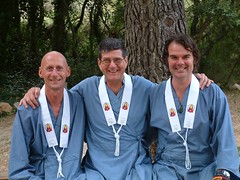
Jayagupta & me with our
private preceptor, Nāgabodhi (centre)
freshly ordained 13 June 2005.
And then there's Nāgabodhi. We made friends comparing insomnia experiences at a place called Ngati Awa, on the Kapiti Coast about 16 or 17 years ago. He's amazing. Always laughing, but capable of great seriousness as well. Always caring and concerned. Always encouraging, but testing to see if there's options I need to consider (I could have saved myself considerable misery by more carefully considering his questions in 1998!). When he and I did my private ordination ceremony together, and he gave me my initiation and my Buddhist name, I felt so loved and so loving. It was a time of intense joy, and a highlight of my life. The ordination courses was four months on retreat, a shitload of meditation, and making more friends. I understood things up in those mountains in Spain, late at night, pacing around in the dark under the brilliant stars, that made my whole life makes sense. For the first time I saw the 'logic' of my life. These are not the traditional insights of Buddhism, but they were the insights I needed to have. And I came back as Jayarava (Cry of Victory). I love my name. I associate it with the joy and happiness of my ordination, and a sense of spiritual rebirth I had on the ordination course. I use my birth name for legal purposes still, but it's not me any longer. I left that guy in the mountains.

I moved to Cambridge in 2002, and was ordained in 2005. I've been living with Buddhists, working with Buddhists; all my friends are Buddhists. I've been going on retreats, courses, weekends, gatherings, seminars (all paid for by my Buddhist employer as part of an innovative remuneration package).  I found friends in Satyapriya, Vidyavajra, Gambhiraḍāka, Śākyakumara, Emma, Sanghaketu, Dhīvan, Amanda (and many others). I live with Nāgavīra and Jayasiddhi, one of a dozen Buddhist communities in Cambridge. Dozens of people have passed through our semi-monastic home, from Holland, Venezuela, Portugal, Spain, Australia, Mexico, England and New Zealand. It's had its ups and downs but has been very rich, and I have few regrets. This is my life now, though I hope one day to go back to New Zealand as, like the Māori people, I feel that the landmarks of my birthplace--Tauhara, Waikato, Taupō-nui-a-tia, Aratiatia, Kaingaroa, Ruapehu, Ngāuruhoe, Tongariro, Kaimanawa, Uruwera--are part of my genealogy.

Not long after ordination I went on a retreat focussed on White Tārā. I didn't know anyone there, but as we sat together, sang mantras and praises together, cooked and ate meals together, all in spirit of kindness and friendship based on shared values, a connection emerged that epitomises for me why I'm a Buddhist. Being a member of this community opens up the possibility of deep communication and friendship that I have never experienced in any other context.

Vajrapriya
I've been chronically ill for the last few years and often get a bit out of touch with my local community. When times are tough I hunker down writing, or go to the Cambridge University library, or I get sucked into the internet. But I recently went to a farewell do for a colleague, who for 15 years had dedicated himself to helping at the Cambridge Triratna Centre, doing everything from designing the website, to cleaning, and leading classes. Vajrapriya is doing some shorter retreats--a week here, a month there--before setting off to Spain for a year on retreat in 2013. The thing is that there was so much warmth and love in the room. About 70 people all wishing him well, and celebrating his positive qualities, telling anecdotes. And I felt good being part of that. Was it intellectually rigorous? Not hardly. But it was all very warmly human, and I felt at home amongst these people, and I'm happy to sort out the metaphysics later. Indeed the combination of human relationships like this, and intellectually sorting our the metaphysics is just about perfect for me.

I'm grateful for our community. I feel sorry for people who don't have what I have. Though I'm so critical, I actually find a ready audience amongst my peers. Many of us have similar concerns. Our community has its share of ideologues, but because we constitute a practice community rather than a faith community we can carry quite a lot of intellectual dissent. And we do. I see saṅgha as essential to the process of growth and change. No doubt groups have their downsides, but humans are social monkeys, and we're actually worse off alone. Parasocial relationships: soap operas, celebrities, teachers, blogs, forums, all the modern ersatz communities, are no substitute for getting into relationship with people. Ethics is really only empathetic relationships, nothing more, but nothing less. You can't practice outside of human relationships.

Of course I see that I fell in love, and my critique of falling in love applies to me as much as anyone. "Naivety demands betrayal" according to Robert Bly, though he may have been quoting James Hillman. And I have been betrayed at times. But losing naivety is not a bad thing. In being betrayed I've grown. Better to be betrayed by friends than enemies I suppose, as the long term consequences are usually less severe. I suppose my friends and enemies would be quick to point out I've done my share of betraying (I claim to be a Buddhist, not a saint). I didn't fall in love with Buddhist ideas until later. I was first and foremost a saddhānusarin. I fell in love with the reality of people living and working together with a set of shared values and common goals, and very obviously benefiting from it. Today I might grumble that we are too idealistic, but better that than too cynical. For all the iconoclasm in my blog it's actually a small part of my life.

Of course now I find myself deep in a critical inquiry into Buddhist ideas, the work of a dhammānusarin. The ground work was laid by studying Saṅgharakṣita who remains something of an enigma to me. I'm really very grateful to him, and love him; I'm inspired by his life; and find him frustrating at the same time. He's very kind and friendly in person. Unfailingly so, I believe, whatever is said about him on the internet. I am a Saṅgharakṣitarite Buddhist at heart. He encouraged me to really think about Buddhism in the first place, not to have blind faith, and our correspondence (such as it is) on my recent ideas to date has been encouraging. I don't think just any kind of Buddhism would suit me, and I've no intention of leaving the Triratna Order. I doubt many movements would put up with me slaughtering their sacred cows for long. I have no real interest in Secular Buddhism, though some secular Buddhists were interested in me for a while.

More recently I'm very grateful to Richard Gombrich who has been quite generous over the years, without ever being under any obligation to be so. His Numata Lectures in 2006-7 (that subsequently became What the Buddha Thought) caused a revolution in how I thought about and approached the practice of Buddhism. You can see the change in my blog from around that time. And that lead me to his student Sue Hamilton. I think it's fair to day that Sue is not a great writer, but the ideas she wrote about now saturate my thinking. It was Sue that woke me up to Buddhism being about experience rather than reality. She's not working in the field any more, but graciously responded when I wrote to her. I feel I've developed her ideas in my own way. Many of the scholars I've bugged with my questions have responded, usually positively. I'm grateful to Satyanandi (Fellow of Trinity College) for writing a letter of introduction for me to get a Cambridge University Library reader's card, my most precious possession.

Anyone expecting an intellectual defence of Buddhism from me might be puzzled by what I've written so far. If you only know me through my writing you might be forgiven for thinking that I am someone who has a fiercely intellectual approach to Buddhism. But really I don't. The intellectual side of things is only my pastime. Here's my definition of 'Buddhism' and 'Buddhist':
  • Buddhism is the stuff that Buddhists do, and the experiences that Buddhists have doing that stuff.
  • One is a Buddhist if one does stuff that other Buddhists do, in the company of other Buddhists.
Yes, they are circular, and there is a chicken & egg problem for those who like that kind of thing. I'm someone who does stuff that Buddhists do, in the company of other Buddhists, and therefore I consider myself a Buddhist. I'm still a Buddhist because the experience of doing that stuff is something I value more than solving intellectual problems. Belief seems to have little to do with why I'm a Buddhist, so even my own intellectual critique seems to have little effect on my feeling that I am a Buddhist. Indeed attacking views makes me feel more of a Buddhist, and my intellectual understanding of the dynamics of experience have resulted in quite strong faith in our methods.

I'm bored by intellectuals who carp from the sidelines, who are not involved in a Buddhist community and have never engaged in any Buddhist practice, but feel confident to comment on Buddhism. Like armchair sports fans, or vicarious travellers it's possible to become very knowledgeable but still to have no sense of what it feels like to kick a ball into a goal, or arrive in a new country. Intellectuals, especially the armchair variety, seem to get caught up in definitions; in what we are supposed to believe or think. They mistake the map for the territory. They are convinced that thinking is the most important thing because it's what they like doing and what they are good at. However most of the important phenomena of Buddhism are felt rather than thought. Buddhism is all about experience. Thinking about Buddhism in the absence of any experience of Buddhism is just having a wank. We all enjoy a wank, but let's not pretend it's anything more than it is. Or perhaps, if that offends, we could paraphrase Frank Zappa, and say "thinking about Buddhism is like dancing about architecture".

What people say they believe is far less important to me than what they do and how they behave, which is a far better indication of what they really value. It's also how I know I have anything important in common with them. Some of the kindest, most empathetic people I know are not great intellects (no disrespect intended). Bad philosophers can still be good human beings (and good Buddhists). They often make far better friends. It's all very well being able to have a good argument with someone, but when the chips are down I want a friend who is loyal, empathetic, kind, and practical; I want a community who'll support me. I don't give a fig for the professed beliefs of the Amish, but if my barn burned down I'd surely love it if the community showed up and made an event out of building a new one together. The fact that we generally don't behave like this seems like a malaise to me. I happen to like the vibe in my Buddhist community, and I like the experience of practising Buddhism. I've watched many people be transformed by our practices and it still gives me a buzz watching friends striving to be better people, and succeeding in whatever degree. I've also watched the internet chatter about Buddhism over many years, and come to the conclusion that it has little to offer. Text is not really suited to mediating human interactions, or communicating values. Realising this I stopped doing forums and started writing longer more considered essays instead. Comments on my blog have only reinforced my perceptions about internet interactions generally. On the whole they've not worth much. Better one hour spent talking to a real person than a 1000 hours spent online.

It is no doubt fun to exercise one's intellect. I love writing the stuff I do and spend hours doing it. But I also like solving killer sudoku puzzles. The most important thing is human relationships, which have to be lived rather than solved by logic. I suspect that it's more important to be able to have a laugh at yourself than to understand the metaphysics of Kant, or the phenomenology of Heidegger (perhaps because I can only do the first). Such things are for the intellectual elite. Certainly I admire people who can cope with that level of intellectual activity, but if I had to choose I'd rather share a good joke with someone than share a philosophical insight. Not that thinking is totally unimportant, just less important. I don't think I can be fairly accused of not thinking. Sharing ideas can be stimulating and interesting, but sharing a laugh is to experience a wordless and deeply satisfying sense of connection and empathetic resonance. And explaining the joke kills it. I discovered today that this opinion is not original.
The pedant and the priest have always been the most expert of logicians — and the most diligent disseminators of nonsense and worse. The liberation of the human mind has never been furthered by such learned dunderheads; it has been furthered by gay fellows who heaved dead cats into sanctuaries and then went roistering down the highways of the world, proving to all men that doubt, after all, was safe — that the god in the sanctuary was finite in his power, and hence a fraud. One horse-laugh is worth ten thousand syllogisms. It is not only more effective; it is also vastly more intelligent. 
Henry Menken. "Critical Note" in "Clinical Notes" in The American Mercury (January 1924), also in Prejudices, Fourth Series (1924) [My emphasis] Via Wikiquotes.

So, I still do the stuff that Buddhists do, in the company of other Buddhists, and I enjoy the experience. Which is what makes me a Buddhist. Yes, their are flaws in Buddhism and in Buddhists, but perfection is a myth. There are no perfect human communities, but at least our community is striving individually and collectively to improve itself. It's all very well being a critic, but I'll finish with the words of Jean Sibelius:
"Pay no attention to what critics say. No statue has ever been put up to a critic."
 
~~oOo~~


29 June 2012

Canonical Sources for the Vajrasattva Mantra

I've mentioned that Maitiu O'Ceileachair and I have identified the earliest textual occurrence of the Hundred Syllable Vajrasattva Mantra in the Chinese Tripiṭika. Circumstances have meant that Maitiu and I have not been able to write up our notes formally. I know there is considerable interest in this mantra, and the Vajrasattva Mantra continues to be the most popular page on my mantra website. So I thought I would write up some of the basic stuff that we've found, along with transcriptions of the mantra from various Canonical sources. This blog post represents our collaborative effort, but credit for all the observations on the Chinese goes to Maitiu.

The earliest occurrence in the Chinese Canon, which is really the only candidate for the earliest literary use of the mantra, since only the Chinese dated their texts, is in T.866, a collection of mantras related to the Sarvatathāgata-tattvasaṃgraha (STTS). T.866 was translated into Chinese by Vajrabodhi (ca 671-741) in 723 CE. Stephen Hodge (2003) says that Vajrabodhi acquired his STTS manuscript circa 700 CE, so it had to have been composed before that date.

Two Sanskrit manuscripts of STTS are extant, though both are relatively recent copies. One has been published in facsimile edition (Candra & Snellgrove), and another forms the basis of a critical edition by Yamada (which means that he compares his Sanskrit manuscript with other versions).  *see comments. We also looked at two versions in printed editions of the Tibetan Canon (the Peking and Derge editions) and several other Chinese versions from the Taisho Edition of the Tripiṭaka (e.g. T.873, 875, 884, 1224, 1320, 1956), including Amoghavajra's translation into Chinese (T. 873).

The mantra occurs in the context of a brief introductory paragraph and is followed by another brief paragraph.


Sanskrit text


atha sarvamudrāṇāṁ sāmānyaḥ svakāyavākcittavajreṣu vajrīkaraṇavidhivistaro bhavati| yadā mudrādhiṣṭhānaṁ śithilībhavati, svayaṁ vā muktukāmo bhavati, tato'nena hṛdayena dṛḍhīkartavyā|
oṃ vajra-satva-samayam anupālaya
vajrasatvatvenopatiṣṭha
dṛḍho me bhava su-toṣyo me bhavānurakto me bhava
su-poṣyo me bhava sarva-siddhiñ ca me prayaccha
sarva-karmasu ca me citta-śreyaḥ kuru hūṃ
ha ha ha ha hoḥ
Bhagavan sarva-tathāgata-vajra mā me muṃca
vajrī bhava mahā-samaya-sattva āḥ ||
anenānantaryakāriṇo'pi sarvatathāgatamokṣā api saddharmapratikṣepakā api sarvaduṣkṛtakāriṇo'pi sarvatathāgatamudrāsādhakā varjasattvadṛḍhībhāvādihaiva janmanyāsu yathābhirucitāṁ sarvasiddhimuttamasiddhiṁ vajrasiddhiṁ vajrasattvasiddhiṁ vā yāvat tathāgatasiddhiṁ vā prāpsyantī-tyāha bhagavāṁ sarvatathāgatavajrasattvaḥ||

Todaro's translation of the Sanskrit.
(except for the mantra which is my translation)

"Now an explanation of the rite of the strengthened of all mudrās alike in one's own body, speech and mind thunderbolt is given. When the mudrā empowerment becomes weak or when there is a desire for liberation by oneself, then one should be made firm with this mantra:
oṃ
O Vajrasattva honour the agreement!
Reveal yourself as the vajra-being!
Be steadfast for me!
Be fully nourishing for me!
Be very pleased for me!

Be passionate for me!
Grant me all success and attainment!
And in all actions make my mind more lucid!
hūṃ
ha ha ha ha hoḥ
O Blessed One, vajra of all those in that state, don't abandon me!
O great agreement-being become real!
āḥ
"The Bhagavat Vajrasattva of all the Tathāgatas said: "Notwithstanding continuous killing, the slander of all the Tathāgatas, the repudiation of the true teaching and even all evil and injury, (by this) the perfection of all the Tathāgata's mudrās from the strengthening of Vajrasattva, in the present life as you desire, and all accomplishments, the supreme accomplishment, the thunderbolt accomplishment or the accomplishment of Vajrasattva, up to the accomplishment of the Tathāgata, will be attained quickly."

Comments

The reconstructed version of the mantra created on the basis of Sthiramati's work in Jayarava (2010) reflects the extant Sanskrit and Chinese texts of STTS quite well, with only minor differences. It may be that the Tibetans were working from a different source text.

The mantra explicitly allows that someone who has done evil, more or less any kind of evil, will not be prevented from making progress. The Chinese version includes the five atekicca or unforgivable actions. (Giebel p.99). This represents that last phase of turning a tenet of Early Buddhism on its head, i.e. that the consequences of actions are inescapable. This role of the mantra--usually referred to as 'purifying karma'--remains central in the narratives surrounding its use in Tibetan Buddhism. The mantra seems much less prominent in Sino-Japanese Tantric Buddhism, and Vajrasattva (Japanese: 金剛薩埵 Kongosatta) plays quite a different role than in Tibet.

The text refers to the mantra as hṛdaya, i.e, 'heart mantra' or 'heart essence'.

Both extant Sanskrit versions spell sattva with one t, i.e. satva; which may indicate some Middle-Indic influence, although the language of this passage appears to conform to Classical Sanskrit norms.

The main difference between this mantra text and the one reconstructed from the Tibetan in Jayarava (2010) is that Yamada has su-toṣyo me bhavānurakto me bhavasu-poṣyo me bhava; where as the Tibetan (and the Chinese texts) transpose the last two phrases:  sutoṣyo me bhava, supoṣyo me bhava, anurakto me bhava. Note that bhavānurakto is a coalescence of bhava anurakto forced by Sanskrit sandhi rules (-a a- > -ā-).


Tibetan Versions of the Mantra


The Tibetan texts below are transcribed as they appears in the printed text, including punctuation marks, see also note at the end of this section. The lines of woodblock prints are long, and the mantra goes over a couple of long lines in both cases--difficult to reproduce in this medium so I haven't tried.

Derge Ed.
ཨོཾ་བཛྲ་སཏྭ་ས་མ་ཡ། མ་ནུ་པཱ་ལ་ཡ། བཛྲ་ས་ཏྭ་ཏྭེ་ནོ་པ། ཏི་ཥྛ་དྲྀ་ཌྷོ་མེ་བྷ་བ། སུ་ཏོ་ཥྱོ་མེ་བྷ་བ། ཨ་ནུ་ར་ ཀྟོ་མེ་བྷ་བ། སུ་བོ་ཥྱོ་མེ་བྷ་བ། སརྦྦ་སི་ དྡྷི་མྨེ་པྲ་ཡཱ་ཙྪ། སརྦྦ་ཀརྨྨ་སུ་ཙ་མེ་ཙི་ཏྟཾ་ཤྲེ་ཡཿ་ཀུ་རུ་ཧཱུྂ། ཧ་ཧ་ཧ་ཧ་ཧོཿ། བྷ་ག་བཱན། སརྦྦ་ཏ་ཐཱ་ག་ཏོ། བཛྲ་མཱ་མེ་མུཉྩ་བཛྲི་བྷ་བ་མ་ཧཱ་ས་མ་ཡ་སཏྭ་ཨཿ།

oṃ badzra satva sa ma ya| ma nu pā la ya| badzra satva tve no pa| ti ṣṭha dṛ ḍho me bha ba| su to ṣya bha ba| a nu ra kto me bha ba| su po ṣyo me bha ba| sa rbba siddhi mme pra ya tsatsha| sa rbba ka rmma su tsa me tsi ttaṃ śre yaḥ kuru hūṃ| ha ha ha ha hoḥ| bha ga vān| sa rbba ta thā ga ta| badzra mā me nu ñca ba drī bha ba ma hā sa ma ya satva aḥ

Peking Ed.
།ཨོཾ་བཛྲ་སཏྭ་ས་མ་ཡ། །མ་ནུ་པཱ་ལ་ཡ།བཛྲ་ས་ཏྭ་ཏྭེ་ནོ་བ།ཏི་ཥྛ་ཌི་ཌྷོ་མེ་བྷ་བ་སུ་ཏོ་ཥྱོ་མེ་བྷ་བ།སུ་བོ་ཥྱོ་མེ་བྷ་བ།ཨ་ནུ་རག་ཏོ་མེ་བྷ་བ།སརྦྦ་སིད་དྷི་མྨེ་པྲ་ཡཱ་ཙྪ་་་་་་་་་་སརྦ་ཀརྨ་སུ་ཙ་མེ།ཙི་ཏྟཾ་ཤྲེ་ཡཾ་ཀུ་རུ་ཧཱུྂ།ཧ་ཧ་ཧ་ཧ་ཧོཿ་བྷ་ག་བཱན།སརྦྦ་ཏ་ཐཱ་ག་ཏོ། །བཛྲ་མཱ་མེ་མུཾཙ་་་་་་བཛྲི་བྷ་བ་མ་ཧཱ་ས་མ་ཡ་སཏྭ་ཨཱཿ

| oṃ badzra satva sa ma ya | | ma nu pā la ya | badzra sa tva tve no ba | ti ṣṭha ḍi ḍho me bha ba su to ṣyo me bha ba | su po ṣyo me bha ba | a nu rag to me bha ba | sa rbba sid dhi mme pra ya tsatsha ……….. sarva karma su tsa me | tsi ttaṃ śre yaṃ ku ru hūṃ | ha ha ha ha hōḥ bha ga vān | sa rbba ta thā ga to | | badzra mā me muṃtsa……badzri bha ba ma hā sa ma ya satva āḥ
Peking ed. shows signs of being slavishly copied from a woodblock of a different size. The repeated shad | | (not to be confused with a nyis shad || ), for example in the first line 'ya | | ma' indicates that the original line ends with ya | and the new line starts with | ma. The groups of multiple tsheg indicate space filling. We've included the exact number of tsheg as in the printed text (C.f. Beginning and End Markers in Buddhist Texts).

Tibetan regularly makes several substitutions: va > ba; ja > dza; ca > tsa. In addition rva > rbba; rma > rmma (Derge). Medial nasals are sometimes replaced by anusvāra, e.g. muñca > muṃtsa. Both have satva for sattva, but so do extant Sanskrit texts.

General anomalies in the Tibetan versions of the mantra are discussed in Jayarava (2010). Particularly the break between samayam anupālaya becoming samaya manupālaya from an Indic original that would have written individual syllables with no word breaks: e.g. स म य म नु पा ल य sa ma ya ma nu pā la ya (See also the Chinese Siddhaṃ script preserved in T. 875 below.) This is quite simply an error, and was probably a mistake of reading rather than listening.

Both texts incorrectly add a shad in the middle of vajrasattvatvenopatiṣṭha. The words are vajrasattvatvena upatiṣṭha with a sandhi  -a u- > -o- (See Jayarava 2010 for more on this).


Chinese Versions of the Mantra


Reconstructing Sanskrit from Chinese is an imprecise art and often relies on knowing what the Sanskrit 'should' say. Chinese transcriptions are not very good at representing visarga and anusvāra can go missing as well (though this might be the Buddhist Hybrid Sanskrit source material rather than the translators). Some translators indicate vowel length and some don't. Generally Amoghavajra is pretty good and many translators followed his conventions.

The earliest occurrance is T. 866.

T. 866
金剛頂瑜伽中略出念誦經
A Summary of Recitations Taken from the Sarvatathāgatatattvasaṃgraha(sūtra)
Translation by Vajrabodhi: 11th year of Kaiyuan (開元), Tang dynasty (CE 723) in Zisheng Monastery (資聖寺). (fasc. 2)

[each section of the mantra is transliterated and then followed, in parentheses, by a gloss in Chinese]
[0239a12] 唵 跋折囉 薩埵三摩耶 麼奴波邏耶。(金剛薩埵三摩耶願守護我)跋折囉薩埵 哆吠奴烏(二合)播底瑟吒(以為金剛薩埵)涅哩茶烏(二合)銘婆嚩(為堅牢我)素覩沙揄(二合)銘婆嚩(於我所歡喜)阿努囉(上 )訖覩(二合)婆銘縛 素補使榆(二合)銘婆嚩 薩婆悉地 含銘般囉野綽(授與我一 切悉地)薩婆羯磨素遮銘(及諸事業)質多失唎耶(令我安隱)句嚧吽呵 呵呵呵護(引)薄伽梵(世尊)薩婆怛他揭多(一切如來)跋折囉麼迷悶遮(願金剛莫捨離我)跋折哩婆嚩(令我為金剛三摩耶薩埵)摩訶三摩耶薩埵阿(去 引)
oṃ vajra sattvasamaya manupālaya (vajrasattvasamaya please protect me) vajrasattvatvenopatiṣṭha (become vajrasattva) dṛḍho me bhava (be strong [for] me) sutoṣyo me bhava (be pleased with me) anurakto me bhava supoṣyo me bhava sarvasiddhi [there is an extra syllable here gam/kam] me prayaccha (bestow on me all siddhis) sarvakarmasu ca me (and all karmas) citta śreyaḥ (make me at peace) kuru hūṃ ha ha ha ha hoḥ bhagavan sarvatathāgata vajra mā me muñca (please Vajra do not abandon me) vajrībhava (make me the vajra samayasattva) mahāsamayasattva āḥ
Vajrabodhi gives glosses for some parts of the mantra that make it clear that he understands sarvasiddhi to mean 'all the siddhis'. I suspect that the punctuation of this line is incorrect and 含 has been moved from directly behind 悉地 and that these characters should be read together as siddhiṃ or siddhaṃ. It is possible that siddhiṃ is a Middle-Indic form of siddhīn. According to Edgerton (BHSD) when the nasal of -īn is retained the vowel is shortened.

Note that the Chinese appears to read vajra sattvasamaya manupālaya rather than vajrasattva samayam anupālaya in line with the Sanskrit mss. If this is correct then the error could have occurred on Indian soil and been transmitted to Tibet and China as it was.


T.865
金剛頂一切如來真實攝大乘現證大教王經
(translated by Amoghavajra 753 CE. 1st chapter only)
唵日羅 薩 怛 三 摩 耶 麼 努 波 (引) 耶
日羅 薩 怛 怛 尾 怒 波 底 瑟 奼
捏 哩 濁 寐 婆 蘇 都 使 庾 寐 婆
阿 努 囉 羯 都 寐 婆
蘇 布 使 庾 寐 婆
薩 悉 朕 寐 缽 囉 也 車
薩 羯 摩 素 者 寐 質 多 室 哩 藥 矩嚕 吽
呵呵呵呵 斛 (引)
婆 伽 梵 薩 怛 他 櫱 多 日囉 摩 弭 悶 遮
日哩 婆 摩 訶 三 摩 耶薩怛 噁(引)

ǎn rì luó sà dá sān mā yē me nǔ bō (yǐn) yē
rì luó sà dá dá wěi nù bō de sè chà
niē li zhuó mèi pó sū dōu shǐ yǔ mèi pó
ā nǔ luo jié dōu mèi pó
sū bù shǐ yǔ mèi pó
sà xī zhèn mèi bō luo yě chē
sà jié mā sù zhě mèi zhì duō shì li yào ju lū hōng
a a a a hú (yǐn)
pó gā fàn sà dá tā niè duō rì luó mā mǐ mēn zhē
rì li pó mā hē sān mā yē sà dá ě (yǐn)

Amongst the Chinese versions are two which preserve a (corrupt) Siddhaṃ version of the mantra. We include one of these for comparison. (The Siddhaṃ is written using the CBETA Font which is not aesthetically pleasing but gives us an idea of what Chinese Siddhaṃ looks like.)

T.875
蓮華部心念誦儀軌 [平安時代寫東寺三密藏藏本]
A Ritual Manual of the Mental Recitation of the Lotus Section.
Written during the Heian Period (794-1185 CE). From the Sanmitsu Collection of the Tō-ji.
[0326a26] 金剛三昧。
[0326a27]

Transliteration
oṃ va jra sa tva sa ma ya ma nu pā la ya va jra sa tva nve no pa ti ṣṭa dṛ ho me bha va mi su tu ṣuo me bha va a nu ra kto me bh ba sup u ṣo me bha va sa rva si ddhiṃ me pra ya ccha sa rva ka rma su ca me cit ta śre ya ku ru hūṃ ha ha ha ha hoḥ bha ga vaṃ sa rva ta thā ga ta va jra mā ma muṃ ca va jrī bha va ma hā sa ma ya sa tvā āḥ
Be aware that this mantra is corrupted and contains many introduced errors. It is provided for comparison purposes only.


Conclusion


These then are principle canonical sources of the Hundred Syllable Vajrasattva Mantra in the Sanskrit, Tibetan and Chinese versions of the Sarvatathāgata-tattvasaṃgraha. Since the Chinese accurately recorded the date of their translations we can be confident that T. 866 is the earliest translated text in the Chinese Tripiṭika to contain this mantra. The differences between the various versions are relatively minor, though they suggest that even at the earliest times this text existed in several versions containing these minor differences, i.e. not all the differences are due to translations or scribal error.

All of these canonical versions tend confirm the notion that the mantra was originally written in good Sanskrit rather than the somewhat garbled version in the received Tibetan tradition. The garbling of the mantra forms part of the discussion in Jayarava (2010), as does the tension created by received tradition vs. other forms of authority. However T. 866 suggests that at least some of the errors were present in the Indian tradition already. The fact of the difference between the canonical and received versions of the mantra highlights the conflict of sources of authority in the Buddhist tradition. Though Tantric Buddhism places great emphasis on guru to disciple transmission, which tends to outweigh textual authority; the fact that we now have much greater access to the Tripiṭika and the knowledge that the mantra has been partially garbled are difficult to ignore for Western converts unconsciously inculcated with the valorisation of textual authority.

The Vajrasattva mantra was set free from this context in the Tibetan Tantric tradition where it performs an important role in purifying karma that might otherwise impede progress on the Buddhist path.  In its self this is a fascinating aspect of the history of ideas in Buddhism.


~~oOo~~

Sources


大正新脩大藏經 [Taishō Revised Tripiṭaka]

Chandra, Lokesh and Snellgrove, David L. Sarva-tathāgata-tattva-saṅgraha : facsimile reproduction of a tenth century Sanskrit manuscript from Nepal. New Delhi : Sharada Rani, 1981. Online transcription Digital Sanskrit Buddhist Canon. http://dsbc.uwest.edu/node/7269

Chinese Buddhist Electronic Text Association (CBETA) http://www.cbeta.org/

'De-bshin-gśegs-pa thams-cad-kyi de-kho-na-ñid bsdusp-pa shes-bya-ba theg-pa chen-poḥi mdo (Sarvatathāgata-tattvasaṃgraha-nāma-mahāyāna Sūtra).' The Tibetan Tripitaka Peking Edition. (Ed. D. T. Suzuki) Tokyo: Tibetan Tripitaka Research Institute, 1956. Vol.4, p.233. (Ña 37a-b)

‘De-bshin-gśegs-pa thams-cad-kyi de-kho-na-ñid bsdusp-pa shes-bya-ba theg-pa chen-poḥi mdo (Sarvatathāgata-tattvasaṃgraha-nāma-mahāyāna Sūtra).’ Derge: The Sde-dge Mtshal-par Bka’-’gyur: A Facsimile Edition of the 18th Century Redaction of Si-tu Chos-kyi-’byuṅ-gnas Prepared under the Direction of H.H the 16th Rgyal-dbaṅ Karma-pa. Delhi: Delhi Karmapae Chodhey Gyalwae Sungrab Partun Khang, 1976-1979.

Giebel, R. W. (2001) Two Esoteric Sutras. Numata.

Hodge, Stephen. The Māhvairocana-Ambhisaṃbodhi Tantra: With Buddhaguhya's Commentary. London: RoutledgeCurzon, 2003.

Jayarava. 'The Hundred Syllable Vajrasattva Mantra.' Western Buddhist Review, 5, Oct 2010. Online: http://westernbuddhistreview.com/vol5/vajrasattva-mantra.pdf

Tadaro, Dale Allen. An Annotated Translation of the Tattvasamgraha (Part 1) with an Explanation of the Role of the Tattvasamgraha Lineage in the Teachings of Kukai. Doctoral dissertation Columbia University, 1985.

Weinberger, Steven Neal. The significance of yoga tantra and the "Compendium of Principles" ("Tattvasamgraha Tantra") within tantric Buddhism in India and Tibet. Ph.D. Dissertation, University of Virginia, 2003.

Yamada, Isshi. Sarva-tathāgata-tattva-saṅgraha nāma mahāyāna-sūtra : a critical edition based on a Sanskrit manuscript and Chinese and Tibetan translations. New Delhi : Sharada Rani, 1981 p 95.


22 June 2012

Why Do Fools Fall in Love?

WHEN I BECAME A BUDDHIST I was initially attracted by the fellowship of the people and the promise of becoming a better person. I also found attractive the idea that Buddhism did not require blind faith, though it's obvious to me now that Buddhism does in fact strongly suggest, if not actually require, blind faith.

Apropos faith I recently participated in quite an interesting discussion on Glenn Wallis's blog Speculative Non-Buddhism. Responding particularly to something written by Stephen Bachelor, but also from general observations of the Secular Buddhist online groups, Glenn outlined five articles of faith he could see in so-called Secular Buddhist discourse. These articles of faith, he suggested, showed that Secular Buddhism is not secular at all, it is another variety of what he styles 'x-Buddhism'.

Secular Buddhists (including Ted Meissner who might well have invented the term; and is now Executive Director of the Secular Buddhist Association) chimed in that they did not recognise Glenn's portrayal of them, but on the whole they missed the point of his meta-analysis of their discourse. Sadly it did not attract a response from Bachelor himself. Whatever we make of secular Buddhism, Glenn's articles of faith are interesting and I would like to discuss them in light of my own ideas.

Buddhist Articles of Faith
  1. Transcendental Dharma: The dharma—that unity of unique and timeless truths uttered by the enlightened Buddha—addresses and resolves our 'ultimate concern' as human being.
  2. The Buddha: the human source of this timeless dharmic clarification of the great matter of life and death.
  3. Special Teachings: both exigent and unique. "For, all four [Noble Truths] have been articulated throughout history, and continue to be formulated and developed, in ways far more sophisticated, hence appropriate to a modern audience, than Buddhism’s ancient, ascetically-driven versions."
  4. The Principle of Sufficient Buddhism: The Dharma as Theory of Everything, with no need for input from any other domain of knowledge.
  5. Ideological Rectitude: Buddhism is "natural, empirical, pragmatic, and in accord with science". The teachings, as the ancient trope has it, are simply how things are. They are phenomenologically obvious. Thus, they posit not matters to be believed but tasks to be done.
This list is intended as a polemic of Secular Buddhism, but I think it has a broader application as a polemic of Buddhist faith generally. I've critiqued the idea of the Dharma as Theory of Everything at some length (See: Is Paṭicca-samuppāda a Theory of Everything? Short answer: no it isn't). But some new ideas occurred to me as a result of thinking about the problem in the light of my essay on the interactions between reason and emotion, and the idea of embodied cognition (Facts and Feelings) and I began to articulate them in comments on Glenn's blog. I've gathered the threads together in this essay and tried to flesh them out.

I think we translate the word saddhā (Skt. śraddhā) as 'faith' because this is the standard English translation of the Latin 'credo', which probably comes from the same PIE root and is conventionally understood to mean 'I believe'. However, in practice saddhā has little in common with credo. I've explored the notion of saddhā before, but now I want to put forward a new interpretation. Recall that saddhā is typically tathāgate saddhaṃ, which is conventionally translated as 'faith in the tathāgata'. It arises after hearing the Buddha talking about the Dharma. It's widely known that saddhā comes from sad 'heart' (Skt. śrad = hṛd < PIE *kred > Latin cred; the śrad form is more closely related to Iranian forms, and only used in this context), and the verb dhā 'to place'. Saddhā then is 'what we give our heart to'; or as I am now suggesting what we fall in love with. This is very far from being an intellectual position or a mere statement of belief. Saddhā has an erotic charge to it (using eros in the Jungian rather than the Freudian sense). The Pāli texts, I suggest, do actually talk about saddhā as if people fall in love with the Buddha. And why not? He is always portrayed as supernaturally beautiful and extraordinarily charismatic. In Indian religious terms this feeling is also called bhakti 'devotion, love, worship', and one who feels it is a bhaktin. Once a disciple gets some fruit from their practice they experience avecca-pasāda 'definite clarity', i.e. they know from personal experience what the practice does. The first fruit traditionally being described as stream-entry (sotāpanna), after which one can say "I know, I see" (janāmi passāmi) And this knowledge replaces the superficial feelings of saddhā with something more grounded. One can now continue under one's own steam. Although the word is typically used in another way, we could call this śakti 'capability, power, strength', and one possessing it a śaktin.

Probably most Western Buddhists initially fell in love with some aspect of Buddhism. When we fall in love we experience fascination with the beloved, a desire to be in their presence, to exclude others, and anxiety when apart. Another word for this is passion, the flooding of our system with strong emotions that alter the way we think and act (in my terms: that change the salience of information). The metaphor flooding is appropriate because the alteration in our faculties is paralleled by our endocrine system flooding our bloodstream with hormones. Love has been likened to a drug and to madness; and is often described as a sickness. Like drugs, love feels great, but often has unintended consequences. Under some circumstances, e.g. in a religion, we make common cause with people who share our passion and feel a sense of solidarity. Of course falling in love with Buddhism is complex because it involves relationships with teachers (whom we also fall in love with) and with communities of people. Often people seem to come to Buddhism on the back of some trauma or tragedy, and are looking for a solution to some problem. I don't want to reduce the phenomena of becoming a Buddhist, only to focus on an aspect of it for rhetorical purposes.

Most of us remain bhaktins; we fall in love, and we never become independent śaktins. We never stand on our own two feet. We could blame Western culture for this, but I think it is a more general problem for humanity. For example as humans we have become self-domesticated. Domestication induces certain characteristic changes on animals. One of which is a tendency to retain juvenile behaviours, and physical characteristics; the technical term for this is pedomorphosis (see e.g. Gilbert 2010). Compare for instance the domestic dog with the wolf. These two can in fact interbreed producing fertile offspring, which has forced a change in the taxonomy of domestic dogs. They are now considered a subspecies of the wolf, though their physiology and behaviour are very different. Dogs are behaviourally adapted to human society, and will tend to bond with a family, be very much less aggressive (than a wolf), and be more inclined to submissiveness. And we live in a society in which, for example we have to keep a lid on aggression; where some of us find it difficult to grow up and some of us are wilfully immature. I'm beginning to see that, yes, we are social animals, social apes; but also that we are domesticated social apes.

However it comes about, the majority of us, including many of the more prominent Buddhist Teachers, never quite become śaktins; we never experience the fruits that would make us truly independent. We fall in love and do not mature. In talking about Buddhism we often go beyond our personal experience and resort to quoting books and teachers. And I suspect this might also be related to falling in love with an abstraction (or some might say a projection). A real person inevitably disappoints us and even betrays us, so that we lose our naivety. This cannot happen with an abstraction since the relationship is entirely one sided. An abstract ideal always remains aloof. In Buddhism we might say that this abstraction is a true refuge, for example, because it lacks all human weaknesses and so it cannot let us down. While the down side of this obvious it might not be all bad. By projecting the best parts of ourselves onto an idealised anthropomorphic figure we can come into relationship with ourselves at our best, the angels of our better nature. Transference is not always a bad thing as long as there is some way to own the projections at some point. The problem comes when we over identify with the angels and forget about our demons, though Buddhism has a place for them too!

Falling in love also changes the salience of facts; changes the way we view, validate and value information. For religieux the articles of our faith take on so much mass that they almost always tip the balance back towards our belief system. And recall that this process of weighing facts is not intellectual, but primarily emotional: i.e. we experience the value of information as felt emotional responses to it (hence 'gut feeling').

Once Buddhism starts to 'feel right' to us, it changes the salience of other information. In particular we begin to think in terms of the articles of faith outlined by Glenn, and (re)interpret our experience according to the articles of faith in order to find confirmation of the articles. Anything which does not conform or confirm is either reinterpreted (e.g. as symbolic) or rejected. These responses are just abstract versions of the way primate groups deal with strange individuals: adopting or ousting. When someone reblogged my essay Rebirth is Neither Plausible Nor Salient on Reddit a number of the responses were hypercritical of me. They overstated my claims, and characterised me as reprehensible for trying to undermine "those who followed the original teaching of the philosophy" (Reddit). There was no attempt to engage with my ideas, only a clamour of irrational denunciation. In other words they acted just like jealous lovers.

In the Rebirth essay I summed up my understanding of the general dynamic of the belief in an afterlife like this:
  • We believe a priori that self-awareness is not tied to the body...
  • So the idea that 'something' survives death and continues to 'live' seems plausible.
  • The emotional weighting of facts makes this seem probable, and the finality of death improbable,
  • And since we don't want to believe in death, post-mortem survival seems preferable!
  • We make the leap from preferable to actually true, and it feels satisfying because we have resolved the dissonance and been consistent with our other values.
Falling in love with Buddhism, which stipulates an afterlife as another article of faith, also changes the salience of statements about the afterlife; though it is circular because the eschatology of Buddhism is part of what makes it attractive. This makes the third step of the dynamic very much stronger; and powerfully influences us to make the leap described in the fifth step. Add to that the power of peer pressure, and it becomes very difficult for any Buddhist not to believe in rebirth. The feeling of rightness drives the intellectual effort to justify the belief, though such attempts are always flawed in some way. (See my review of Thanissaro's Apologetic for Rebirth).

As I have suggested, falling in love can make us jealous and possessive. This may help to explain why Buddhists are so very jealous of their texts, their lineages and titles, their special words, and their myths and legends, and especially the historical uniqueness of the Buddha and his Dharma. From the very beginning the peaceful and tolerant religion of Buddhism has been openly contemptuous in its treatment of competing religions. A great deal of effort goes into refutation of heterodox views, which suggests a sense of insecurity in the face of competition. It sometimes appears that Buddhists are afraid that the Buddha's sāsana can't stand on it's own merits. At the same time Buddhists have absorbed whatever seems to work from some of those same traditions! For people who repudiated Brahmanical soteriology and made fun of Brahmins, the early Buddhists surely incorporate a disproportionate amount of Brahmanical cosmology. The very word brahman comes to signify anything particularly important to early Buddhists! There's a very powerful contradiction here that I don't think anyone has yet fully understood or explained.

The idea that Buddhists are often playing the jealous lover may help to explain why, in a religion whose central idea seems to be that everything changes, that so many Buddhists are hostile to changes in their belief system. Glenn Wallis quotes Noam Chomsky:
"The system protects itself with indignation against a challenge to deceit in the service of power, and the very idea of subjecting the ideological system to rational inquiry elicits incomprehension or outrage, though it is often masked in other terms."
Buddhists often lack any sense of chronology in their teachings, any kind of historical analysis. I've tried to provide some in my posts about how karma and rebirth have changed over time. The teachings are far from timeless. Indeed the very timelessness of them is an article of faith; and it is obvious to anyone who studies even a little of the history of Buddhist ideas that fundamental doctrines do change. This, however, is not enough to outweigh the transcendental Dharma's status as an article of faith. The gravity of the faith gives the article of that faith much greater salience than it would otherwise have. Which means that it feels right to continue believing it even in the fact of counter-factual evidence. You can't prove something wrong to a believer, because if what you say is contradictory then it is not salient! Historical changes or (mere) human expressions are not salient in relation to a transcendent absolute. This is a metaphysical proposition which is not open to debate, or to evidence one way or another--we either believe it or we don't.

And here is what I see as the crux of the matter. Falling in love changes our evaluation of salience in favour of the beloved. Always. Love is blind. Love is a passion that overcomes reason. Unfortunately this means that most Buddhists are living a fundamental contradiction. On one hand they've adopted a powerful salience-altering ideology which creates a self-reinforcing feedback loop (with internal and environmental vectors) that is incredibly difficult to be free of; and one the other hand it is precisely this kind of world altering view we wish to free ourselves from. Buddhism, as many of us receive it, has the strong potential to be inherently self-defeating. In the oft quoted metaphor from the Aladgadūpama Sutta the Dhamma is a raft which we have to abandon when we reach the other side. Unfortunately for many people the Dhamma becomes a millstone instead, and prevents them from setting off, let alone reaching the other side.

One of primary postulates of Buddhism is that the Buddhism itself is a perfect panacea that endows us with infinite compassion and perfect wisdom. But in real life even the great and good amongst the living are not perfect or immune from vice or, notably, from suffering. The ideology fails to deliver. In a few rare cases where people seem temperamentally (or perhaps genetically) suited to a more ethereal worldview; or it happens by accident e.g. Eckhart Tolle, Ramana Maharshi, Jill Bolte Taylor. 2500 year after the first "fully and perfectly enlightened" human being, the human race, including all the Buddhists of various denominations I've ever met, still suffer. The general failure to deliver has historically caused some Buddhists to adopt an apocalyptic worldview: they see this is a 'dark age' (kāliyuga), and there's nothing we can do except tread water until Maitreya comes in five gazillion years. The long time frame has not prevented a number of sincere and plausible lunatics have come forward to claim the title of living Buddha. Self proclaimed arahants seem to possess something rather less than perfect wisdom and infinite compassion. Despite this notable failure, that we attribute to human weakness and not to wrong information, most of us decide that despite everything Buddhism still "feels right" and persist with it. Surprise, surprise. Failure is simply not salient to a believer. Just as the current global economic depression is not salient to economists. This is not to say that Buddhist practice is not beneficial, because most of the time we do benefit from it. Just not in the way we might hope for, not in that forever life changing blinding flash we read (and talk) about. However, we weave any benefits into our story, and bracket out any difficulties, and thus interpret our experience as confirming Buddhist ideas.

When we're in love with an abstract idea we enter into dialogue with other domains of knowledge only to the extent that it reflects well on our beloved: such as the rather facile and pathetic attempts by Buddhists to invoke quantum mechanics (c.f. Schrödinger Didn't Have a Cat); or the appeals to Romantic Poetry (when most Romantics were and are quite morally reprehensible from the point of view of Buddhist morality). Glenn calls this the Principle of Sufficiency. Buddhism can become a box that we cannot think outside of, and don't even want to. This places some severe limitations on us that aren't really helpful. Glenn argues that they are positively harmful, which I will concede can be the case, but I don't think it is universally so.

To summarise, Buddhists are often in love with an abstraction called Buddhism, or with the imagined figure of a Buddha. Falling in love changes our values, and changes the way we assess the salience of information. Love is blind. Passion overwhelms reason. Because we are in love with an abstraction we cannot lose our naïveté in the usual way, through betrayal. As domesticated social primates we have a strong tendency towards paedomorphia, and juvenile behaviour anyway. Love is jealous and protective. Falling in love makes the beloved more beautiful. As such when presented with articles of faith, we are happy to go along with them, and unlikely to be critical if they confirm our opinion of the beloved. Ironically Buddhism can easily become a view (diṭṭhi/dṛṣṭi) that, according to our own rhetoric, traps us in saṃsāra. It's therefore vitally important to identify articles of faith and subject them to the most rigorous intellectual and experiential examination, and be receptive to criticism of them. Most articles of faith are unlikely to survive this process, so we need to be prepared to relinquish them.

The situation is similar to Relativity. Values bend the space in which information is situated; and therefore reason travels in curves near values, and can become captured in orbits. People with strong convictions are caught in an emotional gravity well, and reason in circles about their beliefs. Opinions that matter to us seem to have gravitas. Of course we're all operating in this relativistic cosmos, and no one is free of values or convictions. However falling in love magnifies the value of the beloved enormously, and can leave us happy in our little orbit looking inward, oblivious to the stars. Belief needn't be a black-hole, but leaving orbit requires us to look up and wonder; and it requires concerted effort.


~~oOo~~


Cited in this essay


Bachelor, Stephen. A Secular Buddhist. www.londoninsight.org.

Gilbert, Scott F. (2010) DevBio: a companion to Developmental Biology. (9th ed.). Especially 23.7 'Evolution and Domestication: Selection on Developmental Genes?'. http://9e.devbio.com/article.php?id=223

Jayarava
Thanissaro. 'The Truth of Rebirth and Why it Matters for Buddhist Practice.' Access to Insight. 2012.

Wallis, Glen. 'On the Faith of Secular Buddhists.' Speculative Non-Buddhism. May 2012. 


Update: 24 June. 
Anyone who is unconvinced by the idea that Buddhists have articles of faith, and that it is blind faith should read the Wikipedia entry on Faith in Buddhism while trying to imagine how it might sound to a non-Buddhism. Jargon abounds, but worse the page is full of magical thinking, supernatural entities and forces, and bizarre metaphysical statements. Underlying it all is the notion that Buddhism represents the ultimate truth about the universe (though several different and mutually exclusive versions of the ultimate truth can be found on the page). The authors of the Wikipedia page are plainly deluded, if not delusional. They are incapable of seeing their views except from within a framework in which Buddhist Dogmas represents the ultimate truth. I cannot imagine a better example of the idea of reason in orbit around a belief.
Related Posts with Thumbnails