16 January 2015

The Logic of Karma

Disputes about how karma works are almost as old as Buddhism itself. Some epic intellectual battles were fought over it in India. The one thing that everyone in ancient India agreed on, was that karma as it is presented in the Early Buddhist texts did not work. The first iterations of Buddhist karma are inconsistent and incoherent. With no scriptural authority it was up to sects or even individuals  to work out their own ideas. Sometimes the disputes became quite heated. Vaibhāṣika expert Saṅghabadhra refers to his opponent Vasubandhu as, "that man whose theories have the coherence of the cries of a mad deaf-mute in a fever-dream." (cited in Anacker 1972: 252)

Time has almost completely obliterated these disputes. We no longer talk about them because, in the tumult of medieval India following invasions by various foreign powers (notably including Huns and Persians), most of the opposing voices died out. Indeed, broadly speaking we now have just two competing Buddhist theories of karma: Theravāda and Yogācāra. Arguably the Yogācāra philosophers did actually win their dispute with Nāgārjuna, whose own theory of karma is recorded but seldom, if ever, mentioned. They did not win the argument with, for example, the Vaibhāṣikas (aka Sarvāstivādins). Those sects whose opponents died out did not feel the need to keep the disputes alive, even when they are recorded in Canonical texts like the Kathavatthu. So nowadays Buddhists present one or other Theory of Karma as a given. And no one really expects Theravādins and Mahāyānists to agree on anything except the lowest common denominator, so arguments between them are of little interest.  Since there is no real challenge to Buddhist ideas, the presentations of karma tend to the formulaic and simplistic. Although some sectarians are still hawks, most moderns are doves who overlook the historical divisions and focus on common ground (i.e. the lowest common denominator) in order to portray Buddhism as one big happy family. 

Buddhist morality is rooted in a single, powerful idea that is found almost all human cultures: the universe is moral (cf A Moral Universe?). However, the Moral Universe Theory (MUT) is constantly challenged by unfair experiences: good that is (seemingly) punished, or at best ignored; and evil that is (seemingly) rewarded or ignored. This is a huge problem for all people who believe in a MUT and stretched to breaking by the idea of an omniscient and omnipotent God. First and foremost the Theory of Karma is an attempt to explain the Buddhist MUT, to show how the universe can be moral and morally fair, despite the ubiquitous experience of unfairness. In order to make a MUT workable, most cultures have invoked a post-mortem reckoning, sometimes literally a tally of good and bad deeds, sometimes a weighing of the soul, sometimes the judgement of a moral god, and in the case of Buddhism the impersonal integrator of deeds, karma. Morality is generally seen in accounting terms (See also Moral Metaphors).

Theories of Karma argue that a karma, an action with moral significance, occurs when one has an intention (cetanā) and acts on it (Cf AN 6.63). The final result (vipāka) of karma is experienced primarily as renewed being after death (punarbhava), also known as rebirth; or secondarily as a sensation (vedanā). I've already written a number of essays on the difficult problem of connecting actions to final consequences across time, what I call the Problem of Action at a Temporal Distance. This is usually achieved by a series of intermediate moments of mental activity, citta, that condition each other. The series persists until the initial impulse has achieved its aim (punarbhava or vedanā) or until the momentum has been exhausted. Alternatively the karma produces a kind of potential citta, which has the quality of vasana 'abiding' and is likened to a seed (bīja) that lies dormant until it is appropriate for it to ripen. Variations on these themes are found. 

Buddhist theories of karma specify certain axioms:
  1. mental activity can only happen one citta at a time, though each citta may be accompanied by a number of concomitant cetāsikas.
  2. The present citta is conditioned by the immediately past citta, and is a condition for the subsequent citta
  3. Cittas can be either kuśala, akuśala or avyākata (wholesome, unwholesome, indeterminate)
  4. A kuśala citta cannot directly follow an akuśala citta and vice versa.
We can diagram these axioms like this (below). The diagram shows that the result is a highly linear, serial process, with no provision for branching or changing the nature of the sequence.
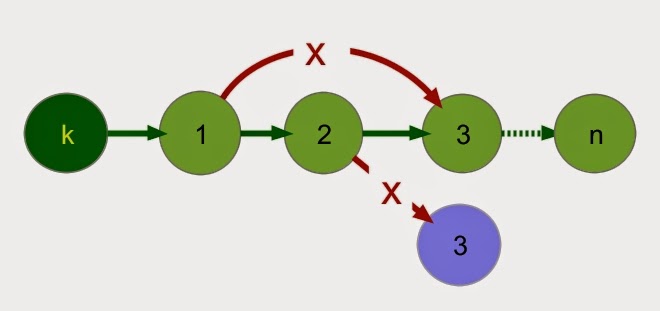
These axioms do not all derive from experience. Meditators report that in the rarefied mental activity of samādhi, mental events appear to occur one at a time, although what applies to an altered state of consciousness does not automatically apply to ordinary waking consciousness. And what presents itself to awareness is not the whole of our minds. The axioms about conditions and sequence, by contrast, are a priori abstract principles which reflect theories about how the mind ought to work, but which are opaque to experience. Like ancient Indian knowledge of human physiology, these early attempts at psychology have mainly historical interest. Here, however we will attempt to take Buddhist arguments on their own terms. We are not subjecting ancient knowledge to modern validity criteria in this essay (I will be doing so in the next essay). In this essay we will stipulate these axioms and work through the logical implications of them.

Explanations of karma are overwhelmingly presented in terms of a simplified model in which there is a single karma giving rise to a single stream of cittas and a single result.† It is assumed that the model will naturally scale up and remain valid, though as I will show below this assumption breaks down as soon as we consider more than one karma. Sometimes an allowance is made for the accumulation of karmas, but even then the model is presented in such a way as to imply that the process is simple. We will begin with the simplest case and see where it leads.

Let us say that karmaa produces cittaa1, and then, in series, cittaa2, cittaa3 up to cittaa(n), where 'n' can be any number. The final cittaa(n) in the sequence, at time n, can be understood in two ways. Firstly it might be just another of the same kind of citta as all the previous cittas and we can see it as exhausting the last of the momentum of the karma. Secondly it might be that cittaa1 up to cittaa(n-1) are just placeholders (vasana) with no real world effects and all of the consequences are bound up in the arising of cittaa(n) which delivers the full impact of the karma. We take this to be true, for example, for all those karmas which contribute to rebirth, but do not have other consequences. Variations on both options have been adopted by different schools and almost all explanations of karma adopt some variation on this model.


A Two Karma System.

Consider what happens if we perform karmab and set off a new stream, cittab, while the cittaa stream is still active. Here we are assuming that we can ignore all other mental activity for the sake of argument, though this would not be a valid assumption, we will address this below. If, according to axiom 1, we can only experience one citta at a time, then the a. and b. streams of cittas must find a way to share our minds. The most efficient way of doing this would be to alternate a1, b1, a2, b2... and so on. In this case, however, it would not be possible to argue that the stream of a cittas still forms an unbroken conditional sequence: cittaa2 is not longer a direct condition for cittaa3 because cittab2 has intervened. Therefore the model violates axiom 2 and has already broken down. It is vital for karma theory that no other citta intervenes in the conditioned process or the continuity is lost. The Theory of Karma does not survive scaling up from one to two active karmas. 

© 2006 by Sidney Harris
We might propose that the mind has a way of keeping track of different streams so that alternating cittas is allowed. This is not a very good argument. First, because it is ad hoc, i.e.  an arbitrary adjustment in response to a problem rather than emerging naturally from the parameters of the model. Second, because it introduces a black-box to the process, i.e. a complex mechanism that we can not see or understand, but which magically produces the precise result we need to save our theory. The black-box amounts to "then a miracle occurs" in the cartoon. Unfortunately Buddhist philosophy, especially karma theory, is very reliant of ad hoc rules and black-box processes.

For the sake of argument let us accept this possibility that the mind somehow keeps track of streams of cittas from different karmas (keeping in mind that we have accepted an unlikely and weak argument). What if karmaa is kuśala and karmab is akuśala? The result would be alternating kuśala and akuśala cittas, which is forbidden by axiom 4. The Theravādins considered this possibility and added an ad hoc rule that if a kuśala citta is in danger of being followed by an akuśala citta then a non-sensory resting-state (bhavaṅga) citta must intervene. Bhavaṅga cittas are avyākata. Unfortunately, as the Sarvāstivādins pointed out, this was not a solution to the problem because there's no more reason to accept that an avyākata citta can follow a kuśala citta, than to accept that an akuśala citta can. The axiom boils down to "like follows like" and thus the ad hoc interposition of bhavaṅga citta is not a solution, because avyākata is unlike either kuśala or akuśala. So even if the mind can keep track of cittas associated with different karmas, there is no way to accommodate axiom 4. But without axiom 4, karma becomes incoherent: results might end up being unlike their conditions.

The Sautrāntikas also saw this problem. Their solution was to propose that karmas did not produce active cittas until the final moment in time when the karma manifested its results. Until that point the effects of the karma existed only in potential form (vasana), like a seed (bīja). Just as a seed only germinates when there is warmth and water, karma only ripens when the conditions are right. This agricultural metaphor was enormously popular in ancient India and is invoked in all kinds of contexts. Here it amounts to an ad hoc, black-box rationalisation. It begs many questions, not least of which is, if the karma is a metaphorical seed, then what is the metaphorical granary in which it is stored? There is no existing category of process or entity which has this kind of function so yet another ad hoc addition must be made to the theory. Early Buddhism seems to have lacked the metaphor: THE MIND IS A CONTAINER. Early Buddhists also treated mental activity as an entirely transient (anitya) phenomenon, and had a well developed critique of any entity which was considered to persist beyond the existence of the conditions for its existence. There was nowhere to store karma.

The ideal of a "potential citta" is deeply problematic. How does it exist beyond the conditions which gave rise to it (specifically the karma)? How can it have no real-world effects and then at the last moment suddenly have a real world effect? How does it know when to become active? If an entity has no real world effects, how does the real world have effects on it to make it ripen? Many Buddhists were content to have an apposite metaphor, but a metaphor is not an explanation, and in this case the metaphor explains nothing.

The passive/active distinction ought, by extension of axiom 4, prevent one from producing the other because active and passive cittas must be different by nature (svabhāva, used in the earlier sense of defining characteristic). This problem is solved in some karma theories by the ad hoc addition of another kind of conditionality. This special form of conditionality allows a potential-type citta to give rise to an active-type citta (we experience the latter as vedanā, but not the former). In Theravāda theory there is a special ad hoc category of mental activity which occurs at only at the moment of death (cuticitta) and performs the black-box function of transmitting, instantaneously across any intervening space, all of the information about our active karma-processes to the being experiencing punarbahava, via another ad hoc category—relinking mental activity (paṭisandhicitta)—so that the baby is conceived and born in a realm appropriate to the actions of the deceased. Those who believed in an antarābhava argued that crossing space takes time, and described an interim between death and rebirth (I have discussed at length in previous essays). The antarābhava is one massive ad hoc black-box add-on to karma theory, whose main purpose was to explain how karma survives death.

Amongst those who did not go down the 'series of cittas' route of solving the problems associated with karma the most prominent are the Vaibhāṣikas. The Vaibhāṣikas earned their nickname, Sarvāstivāda, because they proposed that a dharma (a broader category that includes citta) caused by a karma, exists and is efficacious as a condition affecting both mind and body only in the present, but beyond the present it exists in a form that can only be perceived by the mind as a resultant citta (this axiom replaces axiom 2). Thus they argued (vāda) that dharmas always exist (sarva-asti), but are only sometimes effective. Arguments immediate sprang up about what was meant by "the present". Like the Sautrāntikas, the Sarvāstivādins have not solved the problem, they have only shunted it down the track a little. The sarva-asti-vāda does not explain how dharmas remain inactive for long periods of time until fruition. The most pertinent response came from Nāgārjuna, who complained that any dharma that did not cease when the conditions for it ceased violated the more fundamental principle of conditionality. In the formula imasmiṃ sati idaṃ hoti... imassa nirodhā idaṃ nirujjhati, when the condition ceases the effect must also cease. Thus anything caused by a karma that persists after the karma has ceased is tantamount to a permanently existing entity. It was presumably this logic that sent the Theravādins and others down the route of a series of cittas.

Nāgārjuna's own solution is that actor, karma, vipāka and sufferer are all just illusions: there are just flows of phenomena, and entities are like foam on water etc. On a relative level (saṃvṛti-satya) we see entities as existing, but at the ultimate level (paramārtha-satya) they do not exist (aka The Two truths). This highly abstract approach to karma satisfies many of the objections we've seen, but as Nāgārjuna's critics pointed out, on the basis of his own favourite text (Kātyāyana Sūtra), to argue that these things don't exist is no more appropriate than arguing that they always exist. Buddhaghosa agreed to some extent that no actor, but only actions could be found. What neither man managed to explain, was how morality made any sense whatever in an illusory world, filled with illusory 'beings', doing illusory actions, and reaping illusory consequences. Such a world is simply nonsensical and Nāgārjuna seems to have lost the argument over karma in pretty short order, so that despite the persistence of Madhyamaka sects into the present, most Mahāyāna Buddhists do not cite Nāgārjuna as an authority on karma, they cite Vasubandhu. 

Vasubandhu is responsible for the most famous of all ad hoc black-boxes in Buddhist, the 'storehouse' for storing karmic potential: the ālayavijñāna. Commentators seem to think that Vasubandhu himself, following his Sautrāntika inspirations, considered the ālayavijñāna as a metaphor, but apparently his successors hypostatised the metaphor and came to believe that it represented an entity. As an entity it breaks the fundamental Buddhist axiom disallowing permanent entities. Even as a metaphor it fails, precisely because it is ad hoc and a black box, and as such explains nothing. The ālayavijñāna comes to be associated with tathāgatagarbha, which quite openly equated with ātman in some late Buddhist texts. And thus some Buddhists simply capitulated to the need for an enduring entity to make sense of karma and the afterlife, despite the deep contradictions entailed. We've seen that such is also the case for arguments about the interim realm (antarābhava), mind-made bodies (manomayakāya) and gandharvas.


Multiple Karma Systems

However, so far we have only talked about a system of two citta streams. Consider that in each moment we are capable of forming an intention and acting. Theoretically we are capable of 1000s of karmas in an hour, 10's of 1000s in a day, and millions in a year. Of course not every action is karmic, and we don't produce karmas in every moment. Many moments are taken up with vipāka rather than karma. But potentially we can produce many millions of karmas across a life-time, most of which persist until our death when they exhaust themselves as conditions for a new being. It is very likely that an adult human will have millions of concurrent karma-initiated citta-streams operating at any given time.
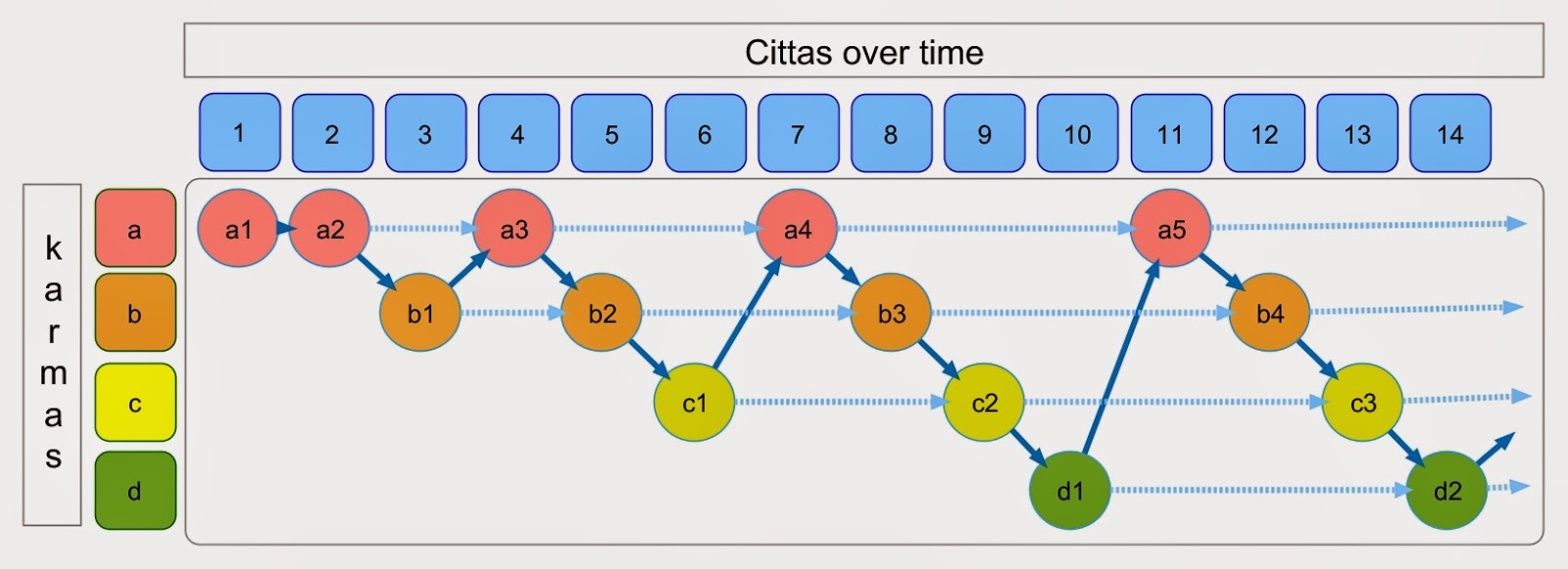

In this diagram a new karma is successively added after the second moment of each citta stream. Each stream must continue to generate new cittas of the same kind in a connected stream, but in order that all the streams can be accommodated they occur in the mind in an arbitrary sequence. Because each citta is a condition for the next, it's less and less likely that the subsequent citta will be in the same stream and not a parallel stream. The sequence here is:


In order to work out the precedence and order of cittas demanded by this situation (which is forced on us by the axioms of karma) we would have to add more ad hoc rules, since there is no order inherent in the model (the order shown above is entirely arbitrary).

In a two citta system the time duration between cittas of the same stream doubles (on average). From cittaa1 to cittaa2 is on average two moments. For every new karma we add to the model, the time between two cittas of the same stream increases geometrically. If a million karmas were active, which is easily conceivable, then the average time between moments of the same citta-stream would be a million moments. Depending on how we count moments this might be as long as two weeks, and the chances of two cittas related to the same karma occurring in succession would one in a million. If there are two weeks and a 999,999 other cittas between two cittas of the same stream, then their relationship as conditioner/conditioned has become purely notional. And, as Nāgārjuna correctly points out, any delay might as well be forever, because it violates pratītyasamutpāda.

Imagine a mind in which millions streams of cittas were competing to manifest: the result would surely be random mental activity with no relation to what was happening in the present. The world would be utterly confusing, since very few of our cittas could possibly relate to present sense experience. Everything would be disjointed. It would be impossible to make sense of the world, or for the contents of our minds to consistently reflect the world around us. Or if the bulk of the cittas were inactive, then our minds would be blank for weeks on end as our minds churned through inactive cittas one at a time. However we look at this, there would be no way for a Buddhist Theory of Karma, operating on an appropriately human scale, to logically connect intentions, actions and consequences and the rationale for our morality would be lost.

Another problem is that now a citta is conditioned by two previous cittas on most occasions: one in order to allow karma to work, and one to ensure strict sequence is obeyed. This contradicts the axiom that only one citta can be active at a time. In the diagram above, at time moment 11, citta a4 arises on the condition of citta d1 (which is immediately previous in temporal sequence) and citta a3 (which is the most recent in the karma sequence), but the latter is now operating from three moments of time from the past. As time goes on the cittas associated with a particular karma must bridge more and more time: minutes, hours, days, weeks, perhaps years, perhaps life times. We've seen that the Sarvāstivādin solution was to allow this, but that Nāgārjuna pointed it out that it is tantamount to eternalism to allow a citta to exist beyond the moment when its conditions have ceased. There's no way to make past cittas be conditions for present cittas beyond the immediately preceding moment. And if we allow two cittas, then why not three, or arbitrary many? What is to stop karmas producing infinitely many results? Why would the experience of vipāka bring an end to the consequences of any given karma?

A way around this is a form of cummulative conditionality. The Theravāda Abhidhamma proposes that a citta is able to condition the next citta in 24 ways. Note that two pairs of the 24 conditions are identical, but have different names, which is a sure sign of the model being unsystematic and ad hoc. If we allow this, then it's not necessary to preserve the identity of the streams. The main objective of this scheme is to have a weighted average of karma active at the time of death, which acts as the main condition for one's next rebirth. This eliminates the problem of breaking axiom 1 (one citta at a time). On face value it explains how the information about our actions is carried forward and our rebirth is appropriate to our most recent lifetime of actions.


However this is a lossy process, because as soon as the moment is past, the link between consequence and action is lost: cummulation destroys information about individual karmas, just as a water drop loses its identity if it falls into the ocean. Although in some texts we are taught not to expect one-to-one correspondences between actions and consequences, in others there is a precise relation between them, and such correspondence is necessary especially for karma which ripens in this life. As above, we have to be able to logically connect actions and consequences in order to be moral. It must be completely obvious to anyone who looks, that being good leads to benefit and being evil leads to harm. For this to happen we must be able to identify the consequences of actions in this life. Else morality is simply an article of faith. This is the much misunderstood lesson of the Kālāma Sutta for example.

This version of karma certainly explains how karma can accumulate and affect rebirth, but it destroys the direct link between action and consequence. Only sums-over-time and averages count. Being good on average results in a good rebirth, and being bad on average results in a bad rebirth. This loss of connection also eliminates the possibility of karma ripening in this lifetime, unless it is as the immediately subsequent citta (instant karma). In terms of the metaphysics of karma, this is a workable solution. The loss of karma ripening in this lifetime is probably a good trade off for preserving karma more generally (especially at death/rebirth). However in terms of morality it opens the door to calculations and trade offs: I can kill this kitten and, as long as I make appropriate offerings to the monks, I can still come out ahead. Since traditionally Buddhists mostly aim at a better rebirth, they can now consciously do evil and as long as it is balanced out, not expect any painful consequences. Generally speaking Buddhist moralists like to emphasise that we are responsible for all of our actions, that all our actions count, and that all our actions ought to be good. So while workable, in fact this solution is a moral disaster. What's more it undercuts the idealism which fuels the intense practice necessary for liberation.

So when we scale karma models up they fail spectacularly, at multiple points, and across the board. None of the simple models that Buddhists offer as explanations for karma are able to achieve their stated goal. All subsequent attempts to rescue the Theory of Karma have failed. On its own terms karma does not work.


Conclusion

The axioms that Buddhists use to define and delimit the theory of karma mostly derive from of an ideological program rather than resulting from careful study of nature. These axioms force Buddhists into incoherent or self-contradictory positions on karma that can only be addressed by ad hoc extensions and black-box processes. Those that were traditionally added, brought new metaphysical problems and beyond a certain point these are not addressed by the Buddhist tradition.

Simplistic models of karma break down when we add real-world complexity. What holds for one karma does not hold for two, let alone for a realistic number. This is not just poor abstract philosophy. People base their actions and their life choices on these ideas. If the argument presented here is correct, then karma is a poor basis for decision making because it doesn't make sense and doesn't explain how morality works. Furthermore karma is at the heart of Buddhism. As I have shown in previous essays, where there was a conflict between karma and the highly esteemed idea of dependent-arising (pratītyasamutpāda) it was always the latter that was altered to preserve the functionality of karma. Karma is primary. Without karma Buddhism unravels.

From the beginning there were at least two karma stories. One in which everyone is responsible for their actions and through observation of action and consequence can learn to be a better person. The promised reward of good behaviour was esteem and happiness, both in this life and the next. This message was delivered through folk tales, especially in the form of stories of the past lives of the Buddha and his companions and family: the Jātakas. The second story sought to ethicise the afterlife, i.e. to make morality hold over multiple lifetimes, without breaking the axiom of impermanence. This story gave rise to increasingly sophisticated metaphysical speculation. The two were never successfully reconciled, and the metaphysics became a mess of ad hoc extensions and black-box processes that in practice end up obscuring the link between action and consequence.

Initially the problems stimulated debate and doctrinal innovations amongst different Buddhist sects (as we find ample evidence for in our literature). The records of the debates leave us with the impression of a rich diversity of opinion and a lively critical atmosphere. They also supply us with pre-formulated critiques of all the existing models of karma. However, it seems that the impetus for new and better explanations ran out before the problem was solved.

The old question was always, "Karma must work, but how does it work?" Now we find ourselves asking, "How can karma possibly work, and what happens if it doesn't work?" 

~~oOo~~

This simplifying assumption of a single karma giving rise to a single stream of cittas and a single result is very similar to the simplifying assumption made by macro-economists trying to apply the micro-economic theory of supply and demand to a whole economy. They literally assume that the whole economy can be modelled by assuming a single product and a single consumer paying a single price. Clearly this is nothing like reality and as Prof Steve Keen has shown in his book Debunking Economics, this assumption has been repeatedly shown to be untenable. 


Bibliography

Anacker, Stefan. (1972) Vasubandhu's Karmasiddhiprakaraṇa and the problem of the highest meditations. Philosophy East and West. 22(3): 247-258.

Hayes, Richard P. (1989) Can Sense be Made of the Buddhist Theory of Karma. [Paper read at the Dept of Philosophy, Brock University]. http://www.unm.edu/~rhayes/karma_brock.pdf

Other observations are drawn from previous essays which can be found under the afterlife tab at the top of the page.

09 January 2015

Gandharva and the Buddhist Afterlife. Part II

In part one of this two-part essay we explored parts of the Brahmanical literature—i.e. the Vedas, Epics and Purāṇas—looking for precedents that might explain the dual nature of the gandharva in Buddhist literature. What we found, with some difficulty, was that precedents do exist in the Epic and Purāṇic texts, but that these only relate to the gandharva qua minor god, especially as celestial musician, and not to any role in conception. Despite the enthusiasm of modern commentators for imagining connections, it seems that the gandharva's role in conception is a Buddhist innovation with no roots in the existing mythology of India. Thus we will have to look closely at the textual tradition to see if we can say why such an innovation was necessary and why it took the form it did. 

Note that in Pali the word is spelled gandhabba (Sanskrit
rva regularly becomes assimilated to Pali bba). I'll use the Pali when specifically referring to Pali texts, but the Sanskrit for other purposes.


Gandharva in the Suttas and Sūtras

Gandhabba is fairly frequently mentioned in the Pali Canon. Almost always in the sense of a celestial musician and only seldom with respect to rebirth. The Dictionary of Pali Proper Names sums up the former sense:
"A class of semi-divine beings who inhabit the Cātummahārājika [Four Great Kings] realm and are the lowest among the devas (DN ii.212). They are generally classed together with the Asuras and the Nāgas (E.g., AN iv.200, 204, 207). Beings are born among them as a result of having practised the lowest form of sīla (DN ii.212, 271).
It is a disgrace for a monk to be born in the Gandhabba-world (DN ii.221, 251, 273f.). The Gandhabbas are regarded as the heavenly musicians, and Pañcasikha, Suriyavaccasā and her father Timbarū are among their number (DN ii.264)." [Online]
Pañcasikha ('five crests') is sometimes linked to the Mahāyāna bodhisattva Mañjuśṛī. The reference to him in the Sakkapañha Sutta (DN ii.263) is to pañcasikhaṃ gandhabba-devaputtaṃ; where deva-putta is literally 'son of the devas'. Indeed the Gandhabba Saṃyutta (SN 10) describes devas of the gandhabba group (gandhabbakāyikā devā); compare the use of kāyika (belonging to a kāya or group; compare with manomayakāya), where in Brahmanical texts deavs and gandharvas are always distinct. Gandhabbas may also live in fragrant parts of trees, i.e. roots, heartwood, softwood, bark, shoots, leaves, flowers, fruits, sap, and gandhagandhe or fragrant smells (SN 10.1). A virtuous person can be born amongst them simply by wishing it and by giving fragrant gifts (SN 10.2). In the Mahāsamaya Sutta (DN 20 PTS: D ii 257) one of the four great kings (caturmahārājā), Dhataraṭṭha (Skt Dhṛtarāṣṭra), king of the East, is lord of the gandhabbas (gandhabbānaṃ adhipati); similarly in the DN 32 Āṭānāṭā Sutta (DN iii.196-8). Gandharvas are associated with the sky. In the Aṅguttara Nikāya gandharvas are referred to as 'sky-goers' vihaṅgamo (AN ii.38); another name for a bird is vihaṅgo (viha 'sky' + ga < √gam 'go').

Thus for the most part the gandhabbas are simply minor gods, not unlike nāgas or yakṣas, somewhat reminiscent of the Epic gandharva. However in the Mahātaṇhāsaṅkhaya Sutta (MN 38; i.255-6) we have this very important, much discussed, passage:
Tiṇṇaṃ kho pana, bhikkhave, sannipātā gabbhassāvakkanti hoti... Yato ca kho, bhikkhave, mātāpitaro ca sannipatitā honti, mātā ca utunī hoti, gandhabbo ca paccupaṭṭhito hoti
Bhikkhus, when three come together there is entry of the embryo (gabbha)... and they are: the mother and father come together; the mother is in season; and a gandhabba is present.
The Madhyāgama version of this text is titled 嗏帝經 (= Sāti SūtraMĀ 201), Sāti being the main protagonist in the text, and this āgama being the product of a Sarvāstivāda sect.
Note: the CBETA Taishō edition of the Chinese Tripiṭaka has [口*荼] 帝經 instead. The formula [口*荼] is for a Chinese character that has not been included in the Unicode standard yet (see right); nor is it found in modern standard dictionaries. This is a regular problem for digitising ancient Chinese texts that include archaic characters. In this case the archaic character appears to be an ancient typo, since the Taishō footnotes here say that the Song, Yuan, and Ming editions have 嗏 instead and this seems to be correct. The character 嗏 was/is not in general use, but was designed at the time to represent the Sanskrit sound . My thanks to Sujato and Rod Bucknell of Sutta Central for help with this problem. 
The Chinese text says:
復次三事合會入於母胎,父母聚集一處、母滿精堪耐、香陰已至。
(T 1.26 769.b23-4)
Furthermore, three items combine to enter a woman's womb. Father and mother must come together in one place; the mother is fully able and ready to bear [a child]; a gandharva has already arrived.
What we notice here is that the role of the gandharva is not stated. All it says is that a gandharva must be present: Pāḷi paccupaṭṭhito, Ch 已至. The Pāḷi verb paṭi-upa√sthā can also mean 'attend, wait on', but here (and elsewhere) it takes the form of a passive past participle with an auxiliary copular 'to be' in the present indicative. Clearly the translators of MĀ, in choosing 至, understood this in terms of presence as well. And the character 已 indicating a completed action, which suggests they read the past participle as having a present perfect sense: has arrived; has waited upon.

A gandharva is in attendance or present, but the suttas do not say for what purpose. There is nothing here, for example, to suggest that this is not a celestial musician hovering around making sweet music, or euphemistically putting the juice in the soma (referring to RV 9.113.3 mentioned in Part I). Simply being present is not a very active or involved role. The only reason we take the role to be a more active one—a being in waiting—is that this is the traditional reading. For example in Buddhaghosa's commentary he glosses gandhabba as tatrūpagasatto 'a being (satta) arriving there'. And "Paccupaṭṭhito hoti" as:
na mātāpitūnaṃ sannipātaṃ olokayamāno samīpe ṭhito paccupaṭṭhito nāma hoti. Kammayantayantito pana eko satto tasmiṃ okāse nibbattanako hotīti ayam ettha adhippāyo.  (Papañcasūdani ii.310)
It doesn't mean 'stood by as the mother and father come together'; but, what was intended was, that a being is about to be reborn, set in motion by the mechanisms of kamma.
However, the role of the gandharva is never mentioned in canonical texts. 

As Anālayo (2008) notes, the Ekottarāgama partial counterpart to this sutta (EĀ 21.3) "does not employ the term gandhabba, but instead speaks of the external consciousness." Here the Chinese term is 外識, where 識 stands for vijñāna. There is no match for 外識 in the Digital Dictionary of Buddhism, so we just have to take it on face value: it is the vijñāna that is outside 外, which we presume means 'not yet joined the embryo'. (Setting aside from now the physiology of embryonic development). This suggests that someone must die at just the right moment, when the parents have sex and the mother is ovulating for conception to take place. Though why Buddhists would use the term gandharva for this is not clear either in Buddhist texts or in the secondary literature. The EĀ is probably a late product of a Mahāsāṃghika Sect, which seemingly did not believe in an antarābhava

The same Pāli passage from MN 38 is repeated in the Assalāyana Sutta (MN 93; ii.157). Here, seven Brahmin seers go to visit the Buddha and are challenged on their view that Brahmins are the highest social class. It is their view that three things are required for conception, one of them being a gandhabba. Their problem is that they don't know the social class of the gandhabba, and so in the Buddha's argument there is no continuity with their ancestors, and they cannot even be sure of their own lineage. This association of the view with Brahmins may be significant and I will return to this point.

This single passage, repeated at MN 38 and 93, seems to be the basis for the idea that the gandharva is a kind of spirit or soul which links a dead person with a newly conceived person. The Theravāda Abhidhamma view is that such a vehicle is unnecessary, or in fact forbidden, and yet the commentaries accept the idea of a being (satta) waiting to be reborn (MNA i.481f ); while at other times the suttas insist that a being is only ever a convenient fiction for a collection of khandhas (cf. the Vajira Sutta). Anālayo is at pains to explain that the Buddha's use of the term does not imply "substantialist notions" (97). On the contrary, I think that there is a substantialist notion in the interpretation of the "presence" of the gandharva. The way that some modern Buddhist writers interpret gandharva certainly seems to imply a substantial (i.e. real) being. The gandharva conceived of as a being-in-waiting appears to be a contradiction of basic Buddhist metaphysics, and is certainly a contradiction in terms of Abhidhamma.

MN 38 and 93 are often read in conjunction with another passage from DN 15 (ii.63:).
‘Viññāṇapaccayā nāmarūpa’nti iti kho panetaṃ vuttaṃ... Viññāṇañca hi, ānanda, mātukucchismiṃ na okkamissatha, api nu kho nāmarūpaṃ mātukucchismiṃ samuccissathā ti? No hetaṃ, bhante.
I have said that viññāṇa is the condition for nāmarūpa... for if, Ānanda, there was no descent of viññāṇa into the mother's belly, could nāmarūpa be produced in there? Indeed not, Sir.
It seems to be from this that we get the equation: gandhabba = viññāṇa. And note that EĀ 21.3 seems to bridge the two by replacing gandharva with vijñāna in the essential passage. Commenting on this apparent identification of gandharva and vijñāna, Bodhi says:
"Thus, we might identify the gandhabba here as the stream of consciousness, conceived more animistically as coming over from a previous existence and bringing along its total accumulation of kammic tendencies and personality traits." (2001: 1233-4, n.411). 
We might see it this way, but Bodhi does not say why we would. He is apparently thinking of the Sampasādanīya Sutta (DN 28) which refers to viññāṇasota 'a stream of viññāṇa', presumably a stream of moments of viññāṇa. In this sutta the meditator, by examining the body in minute detail attains four visions: 1. the body is made up of parts; 2. they fit together to make a body; 3. there is a stream of viññāṇa established in this world and the next (Purisassa ca viññāṇasotaṃ pajānāti, ubhayato abbocchinnaṃ idha loke patiṭṭhitañca paraloke patiṭṭhitañca); and 4. there is a stream of viññāṇa that is not established in either world (Purisassa ca viññāṇasotaṃ pajānāti, ubhayato abbocchinnaṃ idha loke appatiṭṭhitañca paraloke appatiṭṭhitañca). Walsh takes the latter to refer to arahants. Despite the reference to a stream of viññāna it's not entirely clear what this means in practice.

We've noted that elsewhere Bodhi seems amenable to an antarābhava, but it seems here that he is also sensitive to the inherent problem of this amenability. The demand of orthodoxy is that too much continuity implies a transmigrating soul (aka substantialist notions); too little continuity and kamma cannot work (kamma must accumulate). We've already explored how the Theravāda worldview provided an overall solution to these kinds of problems through the 24 paccayas (See Action at a Temporal Distance in the Theravāda) which Bodhi is no doubt well versed in. It seems many modern Theravādins are caught in this dilemma.

Ironically the Mahātaṇhāsaṅkhaya Sutta says specifically that thinking of viññāṇa as providing the continuity between lives is foolish. The Bhikkhu Sāti has the pernicious view (pāpika diṭṭhigata):
tadevidaṃ viññāṇaṃ sandhāvati saṃsarati, anaññan ti
It is just this viññāṇa and nothing else which runs through, and goes around [saṃsāra].
He further describes this viññāṇa as:
Yvāyaṃ, bhante, vado vedeyyo tatra tatra kalyāṇapāpakānaṃ kammānaṃ vipākaṃ paṭisaṃvedetī ti
It is that, sir, which speaks and feels, that which experiences the good and bad consequences of actions.
The Buddha describes Sāti as an idiot (moghapurisa) and explains that viññāṇa arises and ceases in dependence on conditions, an idea repeated in many places in the Tripiṭaka. Despite the claims of writers such as Harvey (1995) and Johansson (1979) to see it in the Pali, there is no continuity to be had through viññāṇa. The equation of gandhabba and viññāṇa is simply a mistake, albeit a traditional mistake perpetuated for millennia. Viññāṇa can only exist, to the extent a temporary mental event can be said to exist at all, in a moment of cognition. It must stop when the condition for it stops, i.e. when attention moves on as it does from moment to moment. (cf What is Consciousness?)

According to the standard Theravāda Abhidhamma model of rebirth there is no need for a gandhabba. At the moment of death the last moment of mental activity (cuticitta), gives rise to the first moment of mental activity (paṭisandhicitta) in another being and these two have the same sense object (ārammana). There is no interval between the two, one moment of citta gives rise to the next in an unbroken sequence. No vehicle of viññāṇa is required other than the old and new nāmarūpa respectively. There is no way to fit gandharva into this process of mental activity (cittavīthi). An electronic search of the Abhidhamma reveals no occurrence of the word gandhabba. The Abhidhammakāras dropped the idea of the gandharva. In fact we can go further and say that a gandharva as a being-in-waiting would wreck the Theravāda worldview through internal contradiction. At most what is required is someone about to die. In the moment of dying they spawn another moment of viññāṇa in an embryo somewhere else with no time interval (despite the spatial interval).  Of course many other sects developed views of rebirth that included a temporal interval, and this required an interim entity, which came to be associated with a gandharva.

The other problem with this is metaphysical. DN ii.63 suggests that viññāṇa is the condition for the nāmarūpa (conforming with the 12 nidānas). If we read viññāṇa as "consciousness" (though I'm not sure we should) then the metaphysics of this is to say that conciousness gives rise to body and not the other way around. But from elsewhere, especially discussions of antarābhava, we know that viññāṇa can only exist where there is already rūpa (it requires intact and functioning senses or ahīna-indriyā). At best viññāṇa and nāmarūpa arise in mutual dependence on each other as in the model in the Mahānidāna Sutta (DN 15). The conditionality model comes close to incoherence here.

The best we can do is argue that one word, viññāṇa, is being used in two completely unrelated ways (and neither with much reference to etymology). This is not impossible and there are other words of ambivalent meaning in Buddhism. On one hand we have the viññāṇa that arises from the interaction of sense object and sense faculty which is marked by impermanence, dissatisfaction and insubstantiality. On the other hand we have viññāṇa as that which gives rise to nāmarūpa in the chain of paṭiccasamuppāda but is apparently not dependent on sense object and sense faculty, begging the question of what it can possibly refer to in the Buddhist worldview.

In the three-lifetimes model of the twelve-nidānas, viññāna in the previous existence gives rise to nāmarūpa in the next. However the temporality of this is difficult to square. Viññāṇa is a momentary dhamma that arises and passes away more or less in the moment. The formula of paṭiccasamuppāda requires the presence of the condition for the effect (imasmiṃ sati, idam hoti), and that the effect ceases when the condition ceases (imassa nirodhā idaṃ nirujjhati). This would require that the previous being be still alive when the next being is conceived, but this simultaneity is disallowed by the necessity of them being sequential: the two beings cannot overlap or we would have the situation where a being effectively exists in two places, two bodies at once. And no, this is not permitted by quantum physics which only applies to sub-atomic particles.

There is also a spatial component to this problem. If the viññāṇa of the previous being is to be a condition for the next being then it must be present to act as a condition. Being present is problematic if the two beings are separated by any space at all. This was one of the arguments for antarābhava evinced by Vasubandhu: travelling through space takes an appreciable time. How can two events separated in space be present to each other? Something must happen in the time it takes for the cuti-citta to act as a condition somewhere else in space and give rise to a paṭisandhi-citta. The metaphysics of this proposition is quite complex and must be tackled at another time, but the objection is certainly a powerful one. 

For moderns who understand conception in terms of a sperm fertilising an egg and setting off cell-division that eventually results in the development of a brain capable of sustaining consciousness, none of this makes any sense. The first elements of the brain are in place by 3 weeks gestation, but it doesn't begin to function as a brain for another week. Not until the 8th week are all the major sub-organs of the brain in place. Mental functioning comes into existence slowly over a period of months in the womb, and takes several years of post-natal development to fulfil its potential. For example newborns have no Theory of Mind and thus an incomplete sense of self. This faculty develops only around age four years and should it fail to develop the results can be devastating to the individual and their ability to relate to others. The phenomenology of consciousness tells us that consciousness cannot be an all or nothing affair. No vital spark that transfers between lives has ever been detected, nor given what we know about human development would we even expect such a thing. Buddhist vitalism sometimes seems split between a vital spark of life and a vital spark of consciousness. Whether one can be the other is moot.


Beyond the Canon

As noted previously, it is in the《阿毘達磨大毘婆沙論》or Mahāvibhāṣā, a Sarvāstivāda Abhidharma commentary (T 27, no. 1545), that we see the first equation of  antarābhava, manomaya, gandharva and saṃbhavaiṣin (the last meaning 'being-in-waiting'). Unlike the Theravādins, the Sarvāstivādins embrace gandharva as the form of being in the antarābava.

This idea is taken up by Vasubandhu in his Abhidharmakośa and his auto-commentary, the ADK Bhāṣya. He asks: "What is the gandharva if not an intermediate state?" (antarābhavaṃ hitvā ko 'nyo gandharvaḥ ADKB 121, commentary on Kośa 3.12c). Anālayo (96) notes this passage as a reference to the three conditions in the Bhāṣya. Vasubandhu is citing a Sanskrit version of the Assalāyama Sutta (above). He notes that those who do not believe in an antarābhava (his "opponents") have a different version of this text in which gandharva is replaced by "a break-up of skandhas [i.e. someone dying] is present" (skandhabhedaś ca pratyupasthito bhavati instead of gandhabbo ca paccupaṭṭhito hoti). But he doubts the opponents could explain it. In his explanation, Vasubandhu says that the gandharva has five skandhas (which is consistent with the Pali description of a manomayakāya as rūpin).

References to gandharva in this sense are rare in Mahāyāna sūtras. Mostly the gandharvas are builders of celestial mansions (compare this with the Lalitavistara Sūtra where the devas offer a mind-made mansion to the Bodhisattva - See Manomayakāya: Mahāyāna Sources). There is some suggestion that these 'celestial mansions' might refer to certain cloud formations, but I've no unequivocal evidence of this. We recall that 'like a city of gandharvas' is a standard way of referring to something fantastic or illusory. 

Asaṅga mentions gandharva in his Yogācarabhūmi I 20.9-13 (cited by Wayman 1974: 238 n. 30)
gandharva ity ucyate gandena gamanād gandhena puṣṭaś ca |
It's called 'gandharva' because it moves by means of odours (gandha) and is satisfied by odours.
What can we conclude from this brief survey of non-Pali Buddhist sources on the gandharva? The tradition of equating the gandharva to the antarābhava seems to be a śāstric or commentarial tradition, rather than a sūtra tradition, that is to say it relies on commentarial exegesis of texts that are ambiguous. Once we accept the idea of an antarābhava, explanations are demanded and Buddhists drew on their existing mythology and terminology to fill the gap. But as the non-antarābhava traditions show, the ideas are not explicit or inherent in the existing traditions, but are shoe-horned into place post hoc.


Conclusions

Contra Anālayo, there's no doubt that some Buddhists, including some Theravādins, took gandharva to be something like a Vitalist 'spark of life', or worse a kind of consciousness that inhabits a new body - they viewed it as substantial (within a substance dualist ontology). This is, for example, Peter Harvey's view (1995). The difficulties presented by rebirth in the absence of a connecting entity sometimes seem to have overwhelmed Buddhist thinkers and caused them to lean towards eternalism, even when any interval between death and rebirth was denied. There is too much continuity in the idea of a being-in-waiting hanging around after death and it simply sounds like a soul, even if we refer to it as a "stream of consciousness", which ancient Buddhists did not. 

It's not at all clear from the preserved Early Buddhist texts alone what was intended by gandharva in the rebirth process. The presence (paccupaṭṭhita) of a gandharva is required for conception without ever specifying what that presence contributes. In retrospect it might well have meant that a fertility god must be present to bestow fertility on the union. Buddhists seem to have been aware of the role of semen in fertility, and to have understood that women were sometimes more and sometimes less able to conceive, and that a certain amount of randomness prevailed. Taken in isolation we might guess that they thought of the gandharva as a fertility god, in the same way that they attributed rain to the rain-gods (deve vassante). Such small gods seem to have been a fact of life to early Buddhists. However, extant Buddhist exegetical texts seem to universally take gandharva in this context to be some kind of being-in-waiting, with minor differences according to sect. We'll never know if the original intent was different from the conventional interpretation, because time has obscured almost all evidence. But the fact that different sects have different versions of this text which reflect their attitudes to antarābhava must make us suspect that some late editing has gone on. And we have no reason to trust one sect over another.

We noted above that in the Pali Assalāyana Sutta the idea of a gandharva having a role in conception is in fact attributed to Brahmins. In this text the main point is that social class as conceived by the Brahmins is not valid as they explain it, since they cannot explain the social class of the gandharva. Is it possible, then, that the gandharva as being-in-waiting is a Brahmanical idea? If so then perhaps the authors of the text saw the challenge to caste identity as more important than the challenge to a being-in-waiting? Then, later, later Buddhists misunderstood the context and took the absence of argument against gandharva as an affirmation (something modern scholars also do). Gombrich (2009) has showed that this process occurs in a number of other cases (see also my essay The Buddha and the Lost Metaphor). Anālayo also thinks this kind of conclusion is likely (98). However, we find nothing in the Brahmanical literature to support the idea that the term gandharva was Brahmanical. In fact the Brahmanical term for the connecting entity by the time Buddhism came along was almost always ātman, a term which has been widely studied and commented upon. I have not seen ātman and gandharva equated. As far as we can tell the Brahmins had no need of a gandharva in their view of conception and rebirth.

The question of why the Buddhists adopted this idea remains. The ancient Theravādins managed to avoid much of the metaphysical mess by being scriptural literalists: no antarābhava in the suttas means there is no antarābhava and therefore no need for a type of antarā-satta or interim being. They developed a version of karma which required instantaneous rebirth to maintain the flow of mental activity (viññāṇasota). Some modern Theravādins, including some bhikkhus, are trapped in the contradiction of affirming an interval between death and rebirth which flatly contradicts their underlying metaphysics. And contra everything said so far, most Theravādins still seem to accept on the basis of the texts cited above, that a gandharva is necessary for rebirth to take place, giving it an active rather than passive role.

By contrast, those Buddhist schools which accepted the idea of an antarābhava were left with trying to explain it. And in doing so they roped in a variety of other concepts like manomaya kāya and gandharva. A critical look at the issue shows that they never solved the problems created by the antarābhava. Every additional feature of the afterlife requires explanation and thus metaphysical speculation proliferates and never settles anything.

And this is the problem with all afterlife beliefs. They are all just speculative. Every time a new supernatural event or entity is added to the narrative to explain some existing gap, another gap opens up. When one explains the world using supernatural speculation, this explanatory gap is inevitable. At some point the religieux inevitably shrugs and says something like "well, you just have to take it on faith".

Inevitably Buddhists invoke meditative experience as the authority for their beliefs. I want to deal with the problem of generalising from unusual private experiences to a public supernatural reality in another essay, but the phrasing hints at the problem.

Buddhists are apt to invoke twenty odd centuries of pre-scientific profession of belief as an argument for rebirth. But this is no argument at all. Long held supernatural beliefs have often been shown to be wrong. For centuries people believed that fevers were caused by bad air (this is the literal meaning of malaria). But we now know that malaria is caused by a parasite carried by certain types of mosquito. To assert that bad air caused a fever would be ignorant at best. On the other hand many people still believe that cold damp air can cause the common cold or "a chill" as it's sometimes called. So perhaps we have some way to go.

~~oOo~~


Bibliography
Anālayo. (2008) 'Rebirth and the gandhabba.' Journal of Buddhist Studies 1: 91-105. Republished by Anālayo with corrections of publishing errors: http://www.buddhismuskunde.uni-hamburg.de/fileadmin/pdf/analayo/RebirthGandhabba.pdf
Cuevas, Bryan Jaré. (1996). 'Predecessors and Prototypes: Towards a Conceptual History of the Buddhist Antarabhava.' Numen 43(3): 263-302.
Doniger, Wendy O'Flaherty. (1981) The Rig Veda: An Anthology. Penguin. 
Dumézil, Georges. (1948) Mitra-Varuna: An Essay on Two Indo-European Representations of Sovereignty. (Translated by Derek Coltman 1988). Zone Books. https://archive.org/details/Mitra-varunaAnEssayOnTwoIndo-europeanRepresentationsOfSovereignty
Eggeling, Julius. (1885), Satapatha Brahmana Part II (Sacred Books of the East; 26), at sacred-texts.com 
Gombrich, Richard (2009). What the Buddha Thought. Equinox. 
Harvey, Peter (1995) The Selfless Mind: Personality, Consciousness and Nirvāṇa in Early Buddhism. Curzon. 
Hopkins, Edward Washburn. (1968) Epic Mythology. Biblo & Tannen. 
Johansson, Rune E. A. (1979) The Dynamic Psychology of Early Buddhism. (Scandinavian Institute of Asian Studies Monograph Series, no.37) Curzon. 
Mahony, William K. (1998) The Artful Universe: An Introduction to the Vedic Religious Imagination. SUNY Press. 
Panaino, Antonio. (2012) 'Gaṇdarǝba.' Encyclopaedia Iranica. Vol. X, Fasc. 3, pp. 267-269. http://www.iranicaonline.org/articles/gandareba-
Pokorny, Julius (1959) Indogermanisches etymologisches Wörterbuch. Bern: Francke, 1989. Adapted online: http://www.utexas.edu/cola/centers/lrc/ielex/
Sutherland, Gail Hinich, (1991) The Disguises of the Demon: The Development of the Yaksa in Hinduism and Buddhism. SUNY press.
Wijesekere, O. H. De A. (1945) 'Vedic Gandharva and the Pali Gandhabba.' University of Ceylon Review. 3(1) April: 73-107.
Wilson, Horace Hayman  (1840). The Vishnu Puranahttp://www.sacred-texts.com/hin/vp/vp039.htm 
Witzel, Michael (1999) 'Substrate Languages in Old Indo-Aryan (Rigvedic, Middle and Late Vedic).' Electronic Journal of Vedic Studies 5(1). 

02 January 2015

Gandharva and the Buddhist Afterlife. Part I

a gandharva serenades  Brahmā
Gandharvas play two distinct roles in Buddhist metaphysics. They are firstly minor gods usually depicted as musicians and secondly they are supposedly involved in human conception. Those Buddhists who believed in an antarābhava, or interim realm, adopted the idea of the gandharva (Pali gandhabba) as the form beings take in the antarābhava, though this bears no relation to the celestial musician. Those who did not believe still shoehorned the gandharva into the rebirth process, but were much more vague about what they meant. This essay and the next will summarise and critique some research into the history of the idea of gandharva with respect to the antarābhava

We have one quite thorough study of the gandharva by Oliver Hector de Alwis Wijesekere (1945). However Wijesekere indulges in a level of speculation, involving multiple shifting interpretations of the meanings of names and creative reading of myth, that is hardly acceptable by modern standards of scholarship. His is an imaginative reading, no doubt, but his exposition seems to be an attempt to create a mythology rather than describe one. His account is frequently tendentious, arguing towards the fixed goal that the Vedic texts explain the Pali references when they do not! For example he claims;
"...it is seen that most of the above discussed mythological associations of the Vedic notion of Gandharva are found [in the Pali Nikāyas] but in a more developed form..." (86)
This claim is not simply false, it is an outrageous over-statement that is completely at odds even with his own baroque reading of the Vedas. And yet it is typical of the tone of the whole article. The article is still useful for identifying relevant passages, but these all require careful and sober reconsideration in light of contemporary methods and studies of Vedic myth.

A subsequent study by Cuevas (1996: 279-281) is a useful start, but is far from comprehensive. It also suffers from a certain amount of speculation as to how to interpret Ṛgveda (RV) passages. Some of Cuevas's references to RV simply do not tally with the content he attributes to them.

So we must proceed with caution and with due attention to primary sources.


Etymology

It's not entirely clear what the name gandharva means. Georges Dumézil (1948) suggests an Indo-European ancestor *Guhondh-erwo- though he does not give a meaning for this root. Modern sources on Indo-European language do not list a root *Guhondh. He also links it via the Latin februo 'purify' to *Guhedh-rwo. There is a root *gwhedh in AHD, which means 'to ask, to pray' (bid is a rare cognate). However the dictionaries say that the origin of februo is uncertain, possibly related to 'fume' from PIE *dheu-.

Vasubandhu repeats a folk etymology of gandharva as gandhaṃ arvati 'it eats smells'. However modern dictionaries do not list 'eat' as a meaning of √arv. Monier-Williams, for example, lists this as a fanciful root meaning 'hurt, kill'; while Apte just has 'kill'. The name is various translated into Buddhist Chinese as 食香 (eater of odours), 尋香行 (one who goes in search of odours), 香陰 (fragrant secret?), 香神 (fragrant spirit), 尋香 (searching for odours), 樂天 (music god, heavenly musician), etc; and transliterated as 乾闥婆 (Middle Chinese gandalpa, Pinyin gāntàpó). (Digital Dictionary of Buddhism). The character 香 can mean 'smell, odour, fragrance, incense, etc.'. This suggests that the name was widely interpreted according to folk etymology.

Most Buddhist sources try to derive the name from gandha 'smell'. Sanskrit gandha is usually said to be from √ghrā 'to smell' and ghrāṇa 'nose' (i.e. the smeller) from a PIE root *ghrē- (PED sv gandha); possibly related to English fragrant though other sources derive this from PIE *bhrə-g-. Cognate words from *ghrē- are few and include Greek osphrainomai (ὀσφραίνομαι) 'to catch scent of, smell'; and Tocharian kor/krāṃ 'nose'.

Edward Washburn Hopkins (1968) says the Viṣṇu Purāṇa (1.5.44) derives the name from gam-dhara 'song maker' from √/√gai 'to sing' and √dhṛ 'to bear'. Unfortunately the Viṣṇu Purāṇa doesn't say this and the citation is to a different verse; and in any case dhara means 'bearer', not 'maker'. By contrast the translation by Wilson (1840: 41) has:
"The Gandharbas [sic] were next born, imbibing melody: drinking of the goddess of speech, they were born, and thence their appellation." 
This corresponds to VPu 1,5.46:
dhyāyato 'ṅgāt samutpannā gandharvās tasya tatkṣaṇāt |
pibanto jajñire vācaṃ gandharvās tena te dvija ||
VPu 1,5.46 ||
Which I understand to say:
The gandharvas have arisen at the same moment as his contemplation,
Born drinking Speech, those gandharvas are therefore twice born.
So not 'song-maker', or even 'song-bearer'; nor 'imbiber of melody', but in fact 'drinking speech' (pibanto vācam), i.e. imbibing speech at birth, noting that Vāc is the name of speech personified.

This is not to say that gaṃ-dhara is a stupid idea for an etymology of gandharva, because it isn't. If gaṃ comes from √ 'to sing' and dhar- from √dhṛ 'to bear' (with guṇa of the root vowel) and we form an adjective by adding the primary suffix -va we get to our goal without mangling the language. In practice the nasal in gaṃ- would change to gan when followed by dharva because of sandhi rules. In support of this derivation we can site primary derivative forms from √dhṛ such as dharuṇadhartṛdhartra and dharman (with suffixes -uṇa, -tṛ, -tra, -man). Against this idea is the fact that dharva is not a standalone word, or found in any other context in Sanskrit dictionaries.

Gaṃ-dharva seems no less plausible than deriving gandha from √ghrā, in fact it seems more plausible, in the sense there are fewer anomalous changes to explain: √ must lighten its root vowel; √ghrā on the other hand must lose aspiration, lose the liquid /r/, and lighten its root vowel, not to mention that -dha is not a standard suffix and would have to be derived from some other root such as √dhā. In terms of derivatives, √ghrā has forms ghrātṛ, ghrāṇa (suggesting that it doesn't undergo the kinds of changes being suggested by gandha).

In this case gandharva would mean 'a bearer of songs', which certainly fits the role assigned to them in the late Vedic and Epic literature.


Gandharva in the Ṛgveda

The name gandharva occurs just 20 times in the Ṛgveda (1028 hymns in about 10,000 verses).

  • book 1 - 2 references
  • book 3 - 1 reference
  • book 9 - 4 references
  • book 8 - 2 references
  • book 10 - 11 references

Roughly speaking, books 2-7 are considered the earliest layers, 1, 8 & 9 are middling, and book 10 latest. Thus the idea of gandharva appears to have some antiquity, but is of very minor interest to the early composers of RV. Gradually it became slightly more important, but was never central. The various mentions tap into different aspects of the gandharva (some of which seem incompatible). In citing RV I'll use the translations of Doniger (1981) as a reference point. Where the Sanskrit is clear enough I'll provide my own rendering, but RV is frequently obscure and beyond my linguistic level.

One of the tricky aspects of trying to essay this subject is that the sources are vague. So for example Cuevas (280) says that, "The Brāhmaṇic sources recount how Soma remained with the gandharvas, and how the gandharva Vivāsvat (the Vedic father of Yama and Yamī) had stolen the vital juice." However in most stories it is either Indra riding on an eagle who steals Soma (RV 4.36) or an eagle who steals Soma and gives it to Indra (RV 4.18). Elsewhere Vivāsvat is certainly said to be the father of the twins Yama and Yamī (RV 10.17; 10.10). And elsewhere e.g. RV 10.10.4(cd)  where Yama's twin sister, Yamī, is trying unsuccessfully to seduce him, Yama says:
gandharvó apsú ápiyā ca yóṣāsā́
no nā́bhiḥ paramáṃ jāmí tán nau
The gandharva and the maiden in the waters,
Is our supreme origin, that is our relationship.
If we follow the implication then Vivāsvat was a gandharva. On the other hand Doniger (1981: 250 n.8) comments that gandharva here is "Probably the sun, born of the waters, but perhaps just any gandharva." In fact Vivāsvat is usually a name for the sun.

Cuevas also cites RV 10.85 several times: the sūkta about the marriage of Sūryā (daughter of the sun). This sūkta also mentions Viśvāvasu and a gandharva plays a role. Doniger calls Viśvāvasu "a Gandharva who possesses girls before their marriage" (273 n.21 - commenting on 10.85.21). The associated verses (21-22) are an exorcism of Viśvāvasu. The marriage ritual seems to conceive of the bride Sūryā being married four times: to Soma, a gandharva, Agni, and a human, though it's not clear what the significance of this is. Doniger mentions that this is a template for marriage, and thus the ritual may conceive of all women going through this process of being married first to the gods and then her husband proper. At any rate the text is concerned to send the gandharva packing as an unwanted intrusion. We'll see that gandharvas sometimes possess people in  the Upaniṣads as well.

In the mid-Vedic period text, Śatapatha Brāhmaṇa (ŚB 3.2.4), we find another completely different myth of the stealing of Soma that is tied up with the character of Viśvāvasu. The Brāhmaṇas are commentaries on the ritual of the Vedas and date from the period after the composition of the Vedas and well before Buddhism (ca. 1000-800 BCE). In this story it is Gāyatrī who steals Soma, but afterwards she was carried off by the gandharva Visvāvasu (the names are close but different). The devas thinking "the gandharvas like women" sent Vāc to them and she returned with Soma. However the gandharvas proposed that the devas marry Soma while they married Vāc. And at this point we get the moral of the story. Gandharvas seriously recited the Vedas to Soma, while the devas frivolously sing and dance to attract Vāc. And this is why, according to ŚB, women are attracted to frivolous things, since they follow Vāc rather than Soma. (cf Eggelington). Commentators use this passage to characterise gandharvas generally as interested in women and all things sexual, though in fact the text tried to characterise them as serious and pious.

What both Wijesekere and Cuevas do is take all the stories as being of the same period and the same weight, as though a story from ŚB can be taken without any reservation or caveats as from the same body of literature as a story from RV. However, historically the Brāhmaṇa texts represent a very different phase of Vedic culture, many centuries removed, and while there are obvious relations, we must be very cautious about simply equating all Vedic literature. Unpicking the resulting mess from these studies is laborious and time consuming. Almost as much as doing it from scratch. And if the scholarly literature is confused in this way, then we can see why the popular literature is confused. And given the importance of the gandharva to understanding the Buddhist afterlife, this is salutary.

To carry on with our survey of the Ṛgvedic gandharva, we may say that the relationship of the sun and the waters is a little counter-intuitive, but in at least some Vedic cosmogonic myth the first substance to emerge from the primordial chaos is water, and from water all things are created, including the sun. Soma is said to combine fire and water and thus bestow immortality (RV 4.18, 4.26; Doniger 1981: 128). It is worth noting the similarities with the so-called twin-miracle (yamaka-pātihāriya) in which the Buddha expresses fire and water from his body while hovering in the sky.

One of the important observations on the Vedic gandharva is that it lives (or they live) in the antarīkṣa or interim realm, the liminal space between earth (pṛthivī) and heaven (svarga). They are also associated with Soma in various ways. We saw that some stories attribute the theft of Soma to gandharvas, but they are also seen to empower Soma, eg RV 9.113.3
parjányavr̥ddham mahiṣáṃ
táṃ sū́ryasya duhitā́bharat
táṃ gandharvā́ḥ práty agr̥bhṇan
táṃ sóme rásam ā́dadhur
índrāyendo pári srava
The buffalo raised by Parjanya (God of rain),
It was brought by the daughter of Sūrya (the sun);
The gandharvas have received it,
Placed the juice in Soma.
O drop, flow for Indra.
The juice in Soma is squeezed out and consumed. It not only makes the sacrifice efficacious, but also produces the drug which releases the imagination and the tongue of the kavi or poet. However this only complicates the picture of the gandharva's relationship with Soma. Soma is of central important to the ritual cult of the Brahmins, and thus to positively associate a divine entity with Soma is certainly to give it a certain cachet or importance. The trouble is that while both myths allow gandharvas a facilitating role with respect to Soma, it is different in each case.  Are they reflexes of a common myth or are they two distinct myths that happen to have been collected when the various Brahmin tribes combined their stories to form the Ṛgveda?

So far as I can tell there is only one Vedic sūkta, RV 10.177 (especially verse 2), which associates gandharva and the womb or garbha. Doniger links this sūkta with RV 10.123, which she describes as "strange and mystical" (190). The gandharvas reveal the secret name of the immortals (vidád gandharvó amŕ̥tāni nā́ma) and are carried up to heaven by their female partners the Apsaras. The story is partly about Indra (or an eagle) stealing Soma from the devas and thus is a further association of gandharva with Soma. The symbolism here is not at all obvious.
pataṃgó vā́cam mánasā bibharti
tā́ṃ gandharvó avadad gárbhe antáḥ
tā́ṃ dyótamānāṃ svaríyam manīṣā́m
r̥tásya padé kaváyo ní pānti || 10.177.2 ||
The bird carries speech in its mind,
The gandharva spoke that inside the womb;
That revelation shining like the sun,
The poets guard as a sign of cosmic order.
It's possible here that pataṃga 'bird' (literally 'goes by flying') refers to the gandharva, later as we'll see a Buddhist text refers to gandharvas as 'sky-goers' vihaṅgama. It's quite possible that birds were the inspiration for the gandharvas: little musical entities occupying and flying about in the sky. William K. Mahony (1998) interprets the bird as symbolising the sun on one level, the cosmic order (ṛta) on another, and also "the inner light of insight or visionary understanding residing with the poet's heart" (73; Cf. Wijesekere  78-80). The breadth of this reading also shows how the texts are wide open to interpretation. Some of this symbolism appears to be intended, but we always have the suspicion that the commentator sees what they wish to see because the references are vague enough to allow it.

There is really nothing in these Vedic stories that hints at a role for gandharvas in conception. Apart from the rather muddled way in which gandharvas appear (mirrored by their muddled treatment by scholars) we learn almost nothing that is relevant to our investigation of the role of the gandharva in conception or existence in the antarābhava.

In his article on the Pali gandhabba (= Skt gandharva) Anālayo (2008), citing a recent article by Thomas Oberlies, suggests that the Vedic gandharva "had the particular function of transmitting things from one world to another" and that it was a "god of transfer" (96). However, since the Buddhist gandhabba is a being to be born, rather than a god of conception, he concludes that the word gandhabba lost this connotation (96). Is Oberlies referring to the myth of stealing Soma? I cannot see any other example of gandharvas associated with transmission, but this can hardly be linked to conception. Oberlies's article is in German, so I cannot investigate the reasoning behind this claim, but I cannot see that the word gandharva ever had the connotation of "god of transfer". By contrast Cuevas says "gandharvas are not identified in the early Upaniṣads as transitional beings" (284).

We move now, perhaps 700 or 800 years forward in time from the composition of the Ṛgveda, depending on the dates assigned to the composition of our texts, to the (Pre-Buddhist) Early Upaniṣads. Here we are in an entirely different landscape. Brahmins lost the plant that produced the Soma drug and adopted a non-psycho-active substitute, the ritual became much more formalistic, and the focus of the Brahmanical religion had begun to shift from the cosmic harmony or ṛta, to the cosmic absolute or brahman. However various scholars have shown that Buddhist texts are cognizant of certain themes and ideas from this tradition, so it is a likely hunting ground for understanding.


Gandharva in the Early Upaniṣads

Generally speaking in the Upaniṣads, gandharvas are a form of non-human beings who occupy a realm located between the ancestor-realm (pitṛloka) in the sky (antarīkṣa) and heaven (svarga) where the devas live. Bṛhadāraṇyaka Upaniṣad (BU 3.6.1) describes the dependencies of the various realms, listed in order. We find the intermediate region woven on the basis of the gandharva world (gandharvaloka). This is in turn woven on the basis of worlds of the sun, moon, stars and devas, etc, with the ultimate basis being the worlds of brahman (brahmalokā plural). BU 4.3.33 compares the bliss experienced by various types of beings in various realms, with more refined beings experiencing 100 times more bliss than less refined beings. The order here is manuṣya, the world won by the ancestors (pitṝṇāṃ jitaloka), realm of the gandharvas (gandharvaloka), the gods of rituals (karmadevā), gods of generation (ājānadevā), the realm of the progenitor (prajāpatiloka), the realm of Brahman (brahmanloka). A similar statement is found in the Taittirīya Upaniṣad (TU 2.8). In the Kaṭha Upaniṣad (KaU 6.5) one may gain a body on the basis of realising Brahman. In this world it is like a reflection in a mirror; in the ancestor realm it is like a dream; in the gandharva realm like an image in water; and in the world of brahman it is like shadow and light. 

BU 3.3.1 describes a young woman possessed by a gandharva (gandharva-gṛhīta). Interesting the other protagonists learning the name of the gandharva ask him questions about the ends of the worlds (lokānāmantān). Contrast this with the possession we saw above at RV 10.85, which focuses on exorcising the gandharva. Similarly at BU 3.7.1 a man's wife is possessed by a gandharva who proceeds the question everyone present on the sacrifice (like a guru). In both cases the information gleaned from dialoguing with a gandharva is used to test Yājñavalkya, who of course always knows the answers to their questions.

Here the various associations of gandharvas found in the Ṛgveda are almost all lost. No sun, no Soma, no waters; not the father of Yama or any of that. Apart from the fact that gandharvas are beings who live in the sky, but are lower in the hierarchy than devas, there is nothing much here to inform our understanding of the gandharvas, and nothing at all that hints at a role in conception. Gandharvas remain in the background. However there is another body of myth and legend in the Epics, i.e. the Mahābhārata and Ramāyāna, and older Purāṇas where we often find themes and figures in common with Buddhist texts.


Other Vedic Literature

Ideally we would survey the gandharva in the Epics and Purāṇas, though the scale of the literature is enormous and largely unfamiliar to me. The dates of composition are doubtful and most likely stretch over many centuries. In the Mahābhārata we find gandharvas portrayed as celestial musicians. Finally a substantial connection to Buddhist gandharvas! A gandharva named Citrasena teaches music and dance to Arjuna for example in book three (Vanaparva  III, 44, 1793, 1795). However the gandharvas are also warriors who teach Arjuna the arts of war.

One of the themes in the modern comparative literature, Wijesekere dedicates several pages to this theme is the connection between gandharvas and centaurs. I have seen frequent casual references to kinnaras (or kiṃnara) as a sub-type of gandharva in the Mahābhārata, which seems to be a reference to MBh 2.10.14a "The gandharvas called kiṃnaras..." (किंनरा नाम गन्धर्वा) followed by a list of other 25 other names for gandharvas (translation here)On another occasion it might be interesting to compare this section of the Mahābhārata with the Āṭānāṭiya Sutta (DN 32) with which there seem to be superficial similarities. Equally there are frequent references to kinnaras as horse-headed, horse-faced (i.e. aśvamukha), or half-horse. Via Monier-Williams dictionary I located one reference to kiṃnaras as aśvamukha in a 7th Century work called Kādambarī (hardly relevant to early Buddhism). I'll return to this below.

We also find reference to gandharva-nagara 'city of gandharvas' in the Mahābhārata and other texts where is it stands for an illusion. To be like a city of the gandharvas is to be like a dream for example, or a magic show. This simile is also common in Buddhist works (See e.g. the Princeton Dictionary of Buddhism sv. gandharva-nagara)

When looking for the roots of the gandharva as it appears in Buddhist texts, the Epics and Purāṇas would seem to be more fruitful. We can tentatively say that the Vedas and Upaniṣads are the texts of religious specialists whereas the Epics have a more popular flavour. The former are full of metaphysical speculation; the latter focus on morality plays. The former are concerned with ultimate truths; the latter with cultural identity. These generalisations over-simplify the situation somewhat, but give a flavour of the main themes. The Indian Epics have much in common with the Greek Epics of Homer, with active gods, heroic humans and larger than life scale of actions; whereas the Ṛgveda might be likened to some of the Hebrew Psalms especially those which praise God.

That said I have not found any reference to a role in conception in any non-Buddhist text.


Gandharva as an Indo-European Phenomenon.

Wijesekere makes a great deal of the similarity of the Sanskrit gandharva and the Avestan gaṇdarǝba (variant spellings include gaṇdərəβa- or gaṇdaraβa-, where βa is an aspirated ba that we would usually write bha in Sanskrit; Wijesekere spells it gandharewa). Gaṇdarǝba was the name of a monster living in the lake Vourukaṧa. His epithet zairi-pāšna- meaning 'yellow-heeled' rather than "golden hooved" weakens Wijesekere's argument for links to centaurs.

Certainly the names are cognate. However, the stories about them seem unrelated and it's difficult to see any similarity beyond the name. This is also true when comparing gandharva in the Ṛgveda and the Upaniṣads, or any of these with the Buddhist gandharvas. Perhaps the name became a floating signifier for any kind of minor god? We do see this trend in other minor gods such as nāgas and yakṣas (See Sutherland 1991). For more on the possible connection, see Panaino (2012).

The suggested connection with the Greek Κένταυρος kéntauros (Latin centaurus) remains speculative. One argument for it was put forward by Georges Dumézil (1948: 29-30, 38), but like Wijesekere, Dumézil is rather too loose in his reasoning.  He simply asserts, with no citation, that "in later writings the (masculine plural) Gandharva are beings with horses' heads and men's torsos who live in a special world of their own." (28). As we've seen above this connection seems to rest on a single reference to kinnaras as aśvamukha and another single reference to gandharvas called kinnara. By page 38 he has forgotten how flimsy this reasoning is and further boldly asserts that gandharvas are "half-horse"! Presumably in the magical world he is thinking of, being half-horse is no barrier to flying through the air or playing a musical instrument. Hopkins (1968) also favours some relationship between gandharva and centaur, but he also seems to be stretching his evidence beyond breaking point.

Even if there is some connection based on these tenuous links, they don't seem to tell us anything about the Buddhist gandharva and its role in the continuity of the person through saṃsāra


Conclusions

In investigating gandharva we are struck by the almost ubiquitous confusion in the modern sources. This may be because the primary sources are limited in scope, vague in content, and from vastly different time periods. Far too little attention paid to the historical context of such mentions as we find. We simply cannot conflate early and late Vedic sources for example; nor Veda and Epic references. Adding all the vague references together does not clarify anything. What makes Wijesekere's account so difficult to read is that he makes no distinctions whatever between the stories: all are given equal weight. Where there is a disconnection or explanatory gap he fills it with a Romantic leap of imagination, weaving a narrative that owes as much to his own interpretation as it does to the text. 

The methods used for dealing with the gandharvas in literature are misleading. Instead, I propose that we pay attention to the many centuries between versions of the stories and identify the gandharva as a bit player whose role is altered from time to time. The roles are distinct rather than cumulative. The thief of soma is not the celestial musician and so on. All that links these characters and characteristics is the name. Gandharva is a mythic widget. Note also the Iranian and Indian stories of gandharva seem to be completely unrelated. So the name might be Indo-Iranian, but the being is not. It is an error to treat the name as a rubric for all the many qualities associated with it over the centuries. When the name gandharva takes on new characteristics, it sheds the old. In the case of the gandharva, the many facets are not compatible. The early and late Vedic literature, the Epics and Purāṇas, even the Zoroastrian Avesta, certainly know the gandharva, but the various versions of these beings have little if anything in common with each other, let along Buddhist usage (as will be more clear next week as we survey Buddhist texts). Vedic gandharvas are very minor gods, with shifting associated symbolism.

I've complained before about the tendency in modern scholarship to seek singularities in our narratives of the past (see Unresolvable Plurality in Buddhist Metaphysics?) and proposed an alternative to the 'evolutionary tree' metaphor in the braided river (see Evolution: Trees and Braids). The attempt to simplify a complex picture by positing a single originating point, or an overarching rubric falsifies the record. One name obscures considerable narrative complexity for a being that is only mentioned a handful of times.

Where there is some apparent crossover with Buddhist gandharvas it is in the Mahābhārata and the Purāṇas. The connection between Buddhist myth and the Mahābhārata has to date received far too little attention. Perhaps because the Mahābhārata is a massive corpus in its own right, the study of which is a specialist subject in its own right. However nothing in any of the sources surveyed sheds any light at all on the gandharva as interim being or its role in conception. This role seems to be entirely a Buddhist innovation.


~~oOo~~


Bibliography
Anālayo. (2008) 'Rebirth and the gandhabba.' Journal of Buddhist Studies 1: 91-105. Republished by Anālayo with corrections of publishing errors: http://www.buddhismuskunde.uni-hamburg.de/fileadmin/pdf/analayo/RebirthGandhabba.pdf
Cuevas, Bryan Jaré. (1996). 'Predecessors and Prototypes: Towards a Conceptual History of the Buddhist Antarabhava.' Numen 43(3): 263-302.
Doniger, Wendy O'Flaherty. (1981) The Rig Veda: An Anthology. Penguin. 
Dumézil, Georges. (1948) Mitra-Varuna: An Essay on Two Indo-European Representations of Sovereignty. (Translated by Derek Coltman 1988). Zone Books. https://archive.org/details/Mitra-varunaAnEssayOnTwoIndo-europeanRepresentationsOfSovereignty
Eggeling, Julius. (1885), Satapatha Brahmana Part II (Sacred Books of the East; 26), at sacred-texts.com 
Gombrich, Richard (2009). What the Buddha Thought. Equinox. 
Hopkins, Edward Washburn. (1968) Epic Mythology. Biblo & Tannen. 
Mahony, William K. (1998) The Artful Universe: An Introduction to the Vedic Religious Imagination. SUNY Press. 
Panaino, Antonio. (2012) 'Gaṇdarǝba.' Encyclopaedia Iranica. Vol. X, Fasc. 3, pp. 267-269. http://www.iranicaonline.org/articles/gandareba-
Pokorny, Julius (1959) Indogermanisches etymologisches Wörterbuch. Bern: Francke, 1989. Adapted online: http://www.utexas.edu/cola/centers/lrc/ielex/
Sutherland, Gail Hinich, (1991) The Disguises of the Demon: The Development of the Yaksa in Hinduism and Buddhism. SUNY press.
Wijesekere, O. H. De A. (1945) 'Vedic Gandharva and the Pali Gandhabba.' University of Ceylon Review. 3(1) April: 73-107.
Wilson, Horace Hayman  (1840). The Vishnu Purana. http://www.sacred-texts.com/hin/vp/vp039.htm 
Witzel, Michael (1999) 'Substrate Languages in Old Indo-Aryan (Rigvedic, Middle and Late Vedic).' Electronic Journal of Vedic Studies 5(1). http://www.ejvs.laurasianacademy.com/ejvs0501/ejvs0501article.pdf

Related Posts with Thumbnails