13 March 2015

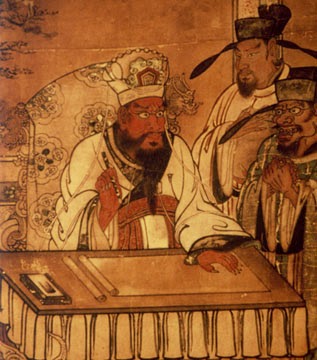
Yama and Hell

Japanese Yama (Enma)
as a Confucian administrator.
Yama is a fascinating figure. He rules over the afterlife, but is not one of the devas. Vedic myth names him as the first man to find his way to the realm of the ancestors (pitṛloka). He is thus a culture hero who opens the possibility of rebirth for Brahmin ritualists. The realm of ancestors starts off on the same level of the devas, and is progressively demoted until it becomes a place of torment and punishment. In parallel, the departed (preta) are transformed from the fortunate ones going to their ancestors, to a tortured group of ghosts stuck in limbo.

As we saw in an earlier essay, Yama has a twin sister Yamī. In fact the most likely meaning of the name Yama is 'twin'. Yama has a counterpart in Iranian myth called Yima and, in Avestan myth, the incest of the twins helps to found the human race. In the Ṛgveda the brother resists incest with his sister. I've written about the curious fact that the Pali suttas record that the Śākyas claim descent from a sibling incest mating, which I take to be evidence of their connection to Iran (see Possible Iranian Origins for the Śākyas and Aspects of Buddhism). Brother-sister incest was common amongst ancient Iranian royalty, a practice I believe them to have adopted on the Egyptian model. Some scholars have tried to link Yama to the Norse Ymir, but this is disputed.

Yama in RV 10.14 has two messengers which are brindle-coloured, four-eyed dogs (sārameyaú śuvā́nau caturakṣaú śabálau) with flared nostrils (urūṇasā́v). They wander among men, satisfying themselves on the breath of life (asu). However they are also keepers of the path (pathirákṣī)  and watch over men (nṛcákṣasau). Note that some authorities think that śabala (brindle) is cognate with Greek ḱerberos (spotted), the name of the Hades's 3-headed watchdog. Hades named his dog "Spot". The Buddhist Yama also two messengers though their form as dogs seems not to be mentioned.

Yama as we know him in early Buddhist texts is the ruler (rājan) of the rebirth destinations known as Niraya (Pali) or Naraka (Pāḷi & Sanskrit). PED derives niraya from nis+√i 'to go down' (nis- followed by a vowel become nir-). PED also cites a parallel in Buddhist Hybrid Sanskrit, though this is not listed in Edgerton's BHSD. However relating this to Classical and Vedic naraka is not straight forward. The vowels a and i are not interchangeable and the prefix nis or nir cannot simply become nar. It might work if there was an ancestral term such as nṛ or nara a real word meaning 'man, hero, person'. In secondary formations the vowel is strengthened to ra or ar. The word nṛ derives from an Indo-European root *ner and via Greek (a-nēr > andr) is the source of words such as androgynous, polyandrous, and philander. It comes into Sanskrit again as √nṛt 'to dance' (from the connotation of vigour). A naraka would then be something belonging to men or people, or heroic. And we can imagine Prakrit representing this as niraka. The substitution of -ya for -ka is conceivable as both can be adjectival. But this doesn't explain the nature of niraya/naraka. PED lists the etymology of naraka as "doubtful". I'll come back to this question after surveying the literature on Yama and Hell.


Yama in the Ṛgveda.

As a place of extreme suffering, the levels of Naraka are often referred to as "hell realms". One of the key early sources for the story of Yama as king of the afterlife is Ṛgveda 10.14.2:
yamó no gātúm prathamó viveda 
naíṣā́ gávyūtir ápabhartavā́ u |
yátrā naḥ pū́rve pitáraḥ pareyúr
enā́ jajñānā́ḥ pathíyā ánu svā́ḥ || 10.14.2 ||
Yama was first to discover this pasture that cannot be taken away.
Where our ancestor crossed over, all the born follow, by their own path.
As described here Yama seems to have been a man (or perhaps an earthly king) who was the first to discover the pitṛloka and be reborn (in heaven) along with his ancestors. Later in the Upaniṣads this is described as 'the world won by the ancestors' (pitṝṇāṃ jitaloka BU 4.3.33). Whether we should take this literally as representing the introduction of the idea of rebirth into Vedic cosmology or as a cosmogonical myth is not clear. Rebirth, though not absent as previously thought, is far from prominent in the Ṛgveda. Since rebirth is not a feature of Indo-European eschatology generally, it may be that as Indic speakers moved into the sub-continent they adopted a rebirth eschatology based on indigenous models. Rebirth does seem to be a regional feature of India thought. So taking this as a myth based on historical events is not entirely far-fetched.

There is a description of Yama's realm in a hymn to Soma (Ṛgveda 9.113.7-11). There an inextinguishable light (jyótir ájasraṃ) shines. It is a realm that is deathless and imperishable (amŕ̥te loké ákṣita). There heaven or the sky is bounded (avaródhanaṃ diváḥ) or perhaps "the inner apartment". It is the place where the dead are satisfied with sacrificial offerings (svadhā́ ca yátra tŕ̥ptiś ca). The refrain prayer of the Kavi in the deathless realm (amŕ̥te loké) is mā́m amŕ̥taṃ kr̥dhi "make me deathless". Which seems to be a prayer to be allowed to stay in Yama's realm instead of being reborn. As we will see in a subsequent essay the Ṛgveda is ambiguous on the question of the afterlife. This description is consistent with Vedic conceptions of heaven more generally. Thus the ancestors (pū́rve pitáraḥ), in this sūkta, seem to live in heaven.

We do find hell in the White or Śukla Yajurveda (30.5).
bráhmaṇe brāhmaṇáṃ kṣatrā́ya rājanyàṃ marúdbhyo váiśyaṃ tápase śūdráṃ támase táskaraṃ nārakā́ya vīraháṇaṃ pāpmáne klībám ākrayā́yā ayogū́ṃ kā́māya pum̐ścalū́m átikruṣṭāya māgadhám ||
For Brahman (Priesthood) he binds a Brahman to the stake; for Kshatra (Royalty) a Râjanya; for the Maruts a Vaisya; for Penance a Sûdra; for Darkness a robber; for Hell a homicide or a man who has lost his consecrated fire; for Misfortune a eunuch; for Venality an Ayogû; for Kâma a harlot; for Excessive Noise a Mâgadha. The Texts of the White Yajurveda, tr. Ralph T.H. Griffith, [1899], at sacred-texts.com
In the Śatapatha Brāhmaṇa (8th-6th century BCE?), as in the Bṛhadāraṇyaka Upaniṣad (sometimes considered to be an extra chapter of the ŚB), the dead are rewarded or punished according to their performance of the rituals. (Cuevas 271). By the time of the early Upaniṣads however the performance of rituals was seen as inferior to the performance of seeking ātman in one's heart (sometimes referred to as an internalised ritual). Ritual only leads to continued rebirth, whereas realisation of identity with ātman/brahman allowed the practitioner to escape birth and death all together. However there is still no sign of an afterlife destination in which wrong-doers are punished.

Yama in the Garuḍa Purāṇa (4th century CE?) is more like the Buddhist king of Hell as we find him in the Buddhist texts. The dead person is taken by the "High Way" and assumes a body formed from the funeral offerings (piṇḍa) and "feels hungry by day and night". The messengers of Yama are now torturers (Cuevas 271).


Is there Hell in the Ṛgveda Veda? 

Accounts of the afterlife in the Ṛgveda are far from unambiguous. Scholars have identified five Ṛgveda passages that might be a reference to hell: 2.29.6, 7.104.3, 9.73.8-9. 10.14.10-11, and 10.152.4 (Stausberg 2000: 219). The most suggestive passage is in sūkta 7.104 which calls on Indra and Soma to destroy an evil sorcerer (yātu) also called demon (rakṣa). In gāthā 3 the poet called on Indra and Soma:
índrāsomā duṣkŕ̥to vavré antár
anārambhaṇé támasi prá vidhyatam |
yáthā nā́taḥ púnar ékaś canódáyat
tád vām astu sáhase manyumác chávaḥ || 7.104.3 ||
O Indra and Soma, the evil doers were hurled into a pit which is beginningless darkness.
Not one returns from there, may your rage overpower them. [My translation]
Understanding this requires us to look at the context (a series of curses wishing harm and ill on an enemy) and the grammar of the sequence vavré antár anārambhaṇé támasi prá vidhyatam. The various translators produce similar translations:
  • Stausberg "... throw them forth the evil doers into the enclosure, into the anchorless darkness."
  • Doniger "... pierce the evil-doers and hurl them into the pit, the bottomless darkness."
  • Griffiths " plunge the wicked in the depth, yea, cast them into darkness that hath no support,"
It seems Stausberg is struggling with the vocab: 'anchorless' as a reading of anārambhaṇa is peculiar. Ārambhaṇa means 'take hold of, seize; beginning, commencement'. As an adjective anārambhaṇa must mean something like 'beginningless', or as we would say "bottomless". Also vavra is a place of hiding or concealment, a cavern, cave or hole (from √vṛ 'to conceal') so enclosure also seems peculiar. Doniger is trying too hard here, she elects to use both meanings of pra√vyadh, i.e. 'pierce' and 'hurl' (293), where 'hurl' seems sufficient. Griffiths seems to grasp the phrase, but his pseudo-Biblical language is anachronistic. If we step through the structure of padas a & b:
índrāsomā duṣkŕ̥to vavré antár anārambhaṇé támasi prá vidhyatam |
The verbal form, prá vidhyata, is a passive past participle. Note that in Vedic the pre-verb is not always directly connected to the root. In Classical Sanskrit this would be pravidhyata. Indra and Soma are addressed using the vocative case. They are being asked to do the action of hurling (pra√vyadh) [verbal form] the patient, i.e. evil doers (duṣkṛta), into (antar) a hole/pit (vivra) which is darkness (tamas). It is ambiguous on the face of it whether it is a pit which is bottomless or the darkness which is beginningless (and presumably endless). However in RV 1.182.6 (below) we find anārambhaṇé támasi and 'pit' substituted by waters (apsu) suggesting that 'beginningless darkness' was intended.

I don't see why any translators might have chosen to refer to vivra with the definite article. Why "the pit"? It makes this seem like a reference to a known entity. Which pit is the text referring to? In fact no such pit exists in the text. It makes a great deal more sense, given that we have no definite referent, to use the indefinite article 'a pit'.

So the poet is simply asking his gods to bury his enemies in a dark bottomless hole so that they cannot return. This perhaps leaves open the possibility that this poet believed in rebirth and he wanted his gods not only to kill his enemies, but to prevent them from being reborn (a more comprehensive curse! He also requests that the gods burn, crush, shatter, scorch, kill, exile, cut down the same enemies. This does not seem to be a reference to Hell, the poet wishes the gods to punish his enemy in the here and now rather than in the afterlife; if anything he wants to deny them an afterlife. The poet is saying "O Lord, smite my enemies." It's a common theme in these ancient tribal scriptures. We find similar curses in the Old Testament of the Bible and the Avestan Hymn to Mithra.

In his discussion Stausberg highlights RV 1.182.6 which uses some of the same terminology:
ávaviddhaṃ taugriyám apsú antár anārambhaṇé támasi práviddham |
cátasro nā́vo jáṭhalasya júṣṭā úd aśvíbhyām iṣitā́ḥ pārayanti || 
Four ships most welcome in the midst of ocean,
Urged by the Asvins, save the son of Tugra,
Him who was cast down headlong in the waters,
Plunged in the thick inevitable darkness. [Griffiths]
However the context is very different. Tugra is rescued after being "cast into the bottomless darkness of the waters" (apsú antár anārambhaṇé támasi práviddham). Our conclusion is the complete opposite of Stausberg's. The two passages are linguistically similar in describing a hole and the deep ocean as bottomless and dark, but there's still no hint of a post-mortem destination.

RV 10.14 is a key sūkta for Yama and also contains some references that have been read as referring to Hell. However they don't mention any of the usual ideas associated with Hell. Indeed the suggested passages end with "grant him good-fortune and health, O King." (rājan svastí cāsmā anamīváṃ ca dhehi) Which doesn't sound much like Hell.

RV 2.29.6 makes a request to several pairs of gods—the twin Ādityas, Varuṇa & Mitra, Indra & Maruts—to be forgiven failings and to be saved the destruction of wolves (nijúro vŕ̥kasya), and from a pit (kartā́d) and from falling (avapada). The later two don't seem to be construed together, the request is phrases as "from a pit" (in the ablative singular). Note that this is a different word for a pit and it has absolutely no context that might relate it to hell.

RV 9.73.8-9 looks more promising. In this sūkta Varuṇa, guardian of the cosmic order, (r̥tásya gopā́) is asked to drive the hated ones, who don't perform the rites, into a pit (ávā́juṣṭān vidhyati karté avratā́n 8d) and those who are incompetent with fall into a pit (átrā kartám áva padāti áprabhuḥ 9d), unlike the wise (dhī́rāś). The word for pit is karta as in RV 2.29. However is the pit anything supernatural here, or is it a pit? 

Finally 10.152.4 In pada b Griffiths reads ádharaṃ gamayā támaḥ as "Send [him] down to nether darkness" but adharaṃ and tamaḥ are not in the same case. If tamaḥ here is a noun, and the verb is √gam 'to go' then (as in the Life of Brian) the verbs of motion take the accusative: tamam. Here tamaḥ is a nominative singular. "Nether Darkness would translate" adharam tamam, but not adharam tamaḥ. If we take the pada as a whole:
yó asmā́m̐ abhidā́sati ádharaṃ gamayā támaḥ  
He who is dark (yo tamaḥ), treating us as inferior (asmā́m̐ abhidā́sati ádharaṃ) should be made to go (gamayā). 
Thus again the relationship to Hell is less than tenuous. And this sums up all of the evidence for Hell in the Ṛgveda. We can be fairly certain that the Ṛgveda has no conception of a afterlife realm of punishment that corresponds to Hell. We need to look more closely at what kind of afterlife the Ṛgveda does know: i.e. the pitṛloka, discovered by Yama, and the devaloka.


Pitṛloka & Devaloka. 

Initially the pitṛloka and the devaloka were more or less on the same level even when they were distinguished. It seems that the devaloka was not initially thought of as an afterlife destination. Humans were not reborn as gods. This may be a Buddhist innovation. Cuevas notes that the pitṛloka came to be demoted in height and status, becoming associated with the antarīkṣa (for the significance of vertical spatial metaphors see Metaphors and Materialism). By the time of the early Upaniṣads the pitṛloka is associated with "the moon, darkness, sacrificial activity and rebirth" whereas the devaloka is associated with "the sun, light, knowledge and immortality" (Cuevas 272). This is particularly seen in the passages regarding the five fire knowledge (pañcāgnividyā) that describe a number of after-life paths and destinations. By contrast going to the devas becomes the first step on a journey out of saṃsāra that culminates in going to Brahman.

click to embiggen


For a culture which sees the performance of ritual as determining one's afterlife destination there appears to be little or no need for a concept of Hell. The Vedas hint at a bad destination for enemies of the Brahmins, but it's not until the world is ethicised that an afterlife which punishes wrong doing is needed. And by punishment I mean something beyond the withholding of paradise from the inept ritualist. How and when Hell becomes part of Vedic cosmology and eschatology is not entirely clear and I have only a few scattered references to work from. There's not much to indicate that one could return to the human realm having been in Hell.

If we do not see hell as an afterlife destination in the Ṛgveda, then the obvious question is when do we see it in Indian literature? This is not a question I can answer yet.

We can now come back to the question of the meaning of niraya/naraka. In seeking to understand the word, such etymology as there is has sought a connection to Hell. However as we see originally Yama's loka was original not an underworld place of suffering at all. Indeed it was a place in the sky where one experienced (presumably joyful) reuniting with one's ancestors. It became the destination for men (nṛ) who performed the correct rituals. As such a name which was a collective adjective based on nṛ i.e. naraka or nāraka would make sense. We could then explain niraya as a dialectical variation. Against this explanation is the lack of any parallels. All the words starting with nir- in PED are derived from the suffix nis-. This fact suggests that niraya and naraka are two unrelated words. My hunch, however, is that they are related.


Hell in Zoroastrianism

Based on ideas first put forward by Michael Witzel I've speculated that the impetus to escape from a once happy rebirth eschatology was also influenced by Iranian (i.e. Zoroastrian) ideas. The vector for these ideas being an influx of Iranian tribes, including the Śākyas, whose culture gave rise to śrāmaṇa religions. Since we do not see Hell in Vedic, it's possible that the idea of Hell came from this same source. In order for this to be true the Vedic speaking people's had to leave Iran before the advent of Zoroastrianism which is difficult to date, but generally placed at about 1000 BCE.

However Hell is barely mentioned in the oldest Zoroastrian scriptures. As the Encyclopedia Iranica (EI) says:
Hell is not explicitly mentioned in the Gathas. There are only allusions made to it, if not in Yasna 31.20, at least in Yasna 46.11, where it is said that the soul and the daēnā of the wicked arriving at the Činwad Bridge (Av. činuuatō pərətu) will be guests in the “house of falsehood” (Av. drūjō dəmānā-), and in Yasna 51.13.The word hell, literally bad existence (Av. daožaŋᵛha-, Pahl. dušox, Pers. duzaḵ) only occurs in the later Avesta. 
When Hell is mentioned it is a place of torture in recompense for bad thoughts, words and deeds. Unfortunately for my conjecture the time-line is not yet clear, but the indications are that Hell developed at around the same time in Iran as it did in India.

The Iranian twin of Yama is a mythic King called Jamšid aka Yima. He is a culture hero, a king who ruled the world in a Golden Age. "Yima is said to be like the sun to look at among men (huuarə.darəsō maṧiiānąm; Yasna 9.4) and his life is immortal and “sun-filled” (xᵛanuuaṇt, Yasna 9.1)," (EI). As with Yama, the Iranian Yima is the son of a solar figure (Skt. Vivasvant, Av. Vīuuaŋᵛhant, “the one who shines far and wide”, and in this aspect he "made the world immortal",. How Yima bequeathed immortality and why humans are no longer immortal are not told in older texts and several versions of the story exist in later texts. Stories which connect Yima to Hell come rather late in the piece.
There are three references in the narratives above to Yima going to Hell: for his sins, in order to close the door to Hell so that death would be kept out, and in order to bring the paymān(ag) [right measure] out of Hell. (EI)
Paymān "is characteristic of Zoroastrian ethics and is discussed at length in the Middle Persian texts" (EI). So while the connection to Hell is not entirely clear, Yama is a figure common to both Indian and Iranian myth, giving him considerable antiquity. And in both mythic systems he is associated with extending the lives of humans: Yama through rebirth, and Yima through immortality. However both meet with a downfall: Yama becomes the ruler of Hell, and Yima sins and is sent to Hell as punishment. That there should be commonality in the earlier versions of the myth is not unexpected since we already know of parallels between the Ṛgveda and the Avesta, but that that developments of the myth should continue to follow parallel paths is intriguing. 


Yama in Buddhist Texts

Yama is mentioned in only a few texts. In an earlier essay on the history of Kamma I wrote:
Consider the Devadūta Sutta (MN 130, M iii.178) which explains how after death a being who has behaved badly might be reborn in hell (niraya); there they will be seized by the guardians of hell (nirayapālā), dragged before King Yama and cross-examined about their evil conduct of body, speech and mind. Unable to account for themselves, they are then condemned to horrific tortures which are graphically described. It is emphasised that "as long as that evil action is not destroyed, he does not die" (na ca tāva kālaṅkaroti yāva na taṃ pāpakammaṃ byantīhoti).
This is one of the most important occurrences. Another slightly different version of the story is found at AN 3.36, showing once again that the Pāḷi Canon is an incompletely merged anthology drawing on multiple retellings of the source material.

At SN 1.49 those who are stingy or hinder alms gathering are said to be reborn in Hell, as an animal or in Yama's realm (Nirayaṃ tiracchānayoniṃ, yamalokaṃ upapajjare), which is interesting. Recall that the departed (preta) where originally on their way to Yama's realm (yamaloka) to live with their ancestors (pitṛ), but the pretas became a kind of being in purgatory. Thus yamaloka here, as distinguished from niraya, might refer to the pretas. Bodhi also concludes this, but we don't know. Buddhaghosa's commentary is silent at this point.

At SN 1.33 we find Yama mentioned in an udāna uttered by a devatā:
Yo dhammaladdhassa dadāti dānaṃ,
Uṭṭhānavīriyādhigatassa jantu;
Atikkamma so vetaraṇiṃ yamassa,
Dibbāni ṭhānāni upeti macco ti.
The one who gives the gift of the received Dharma
Obtained though exertion and devotion
He crosses over Yama's river Vetaraṇī
That mortal one approaches the heavenly regions. 
The river Vetaraṇī is mentioned only one other time in the Suttanipata, Sn 674. It appears to be a river in Hell itself that the evil-doers fall into, and thus not much like the Styx, contra Bodhi in his translations notes on SN (2000: 364-5 n.67).

Finally Yama receives a passing mention: DN 13 (i.246) in a list of Vedic devas. This is not much to go on. Yama is a rāja, who rules over Hell, questions the souls of the dead, and has some messengers. This is broadly speaking the Vedic Yama.

Thus despite his later prominence in Buddhist myth, Yama is actually quite a marginal figure in the Nikāyas. Anālayo notes in his study of the Majjhimanikāya that Yama's role in the Buddhist texts has been reduced from active to passive so as to avoid a conflict with the doctrine of karma (2011: 748 n.303). Most of the later stories and images seem to depend on the Devadūta Sutta. This text was translated into Chinese five separate times (EA 32.4, T 86, T 42, T 43, MA 64) and there are a number of partial parallels ( T 24*, T 25*, T 212.9*, T 741*, DA 30*). The variations are discussed by Anālayo (2011: 747-53). A translation of MĀ 64 can be found in Bingenheimer, Anālayo and Bucknell (2013: 407).


Māra

It's worth saying a few words about Māra here, though he deserves his own essay. In contrast to Yama who presides over Naraka, Māra is an unrelated figure apparently emerging from non-Vedic tradition, along with Yakṣas and a goddess of good fortune known as Sirī (Skt. Śrī). The name derives from the causative form of the verb √mṛ 'die'; present verb mṛyate, causative mārayati. Thus māra is literally 'causing to die', or 'killing'. He's also known by the epithet pāpima 'evil one'. Māra is sometimes said to preside or rule over saṃsāra, and one of his biggest concerns is that people will escape saṃsāra. In this sense he stands for the repeated deaths that one must undergo in saṃsāra and all the associated grief. Māra uses the weapons of saṃsāra (desire, aversion, confusion), often in personified forms (his daughters represent desire and his army aversion). However though it might seem obvious to link Māra with Yama, there seems to be no connection between the two in practice. Yama is not evil in the way that Māra is. However Yama is sometimes written of as a personification of death, where he is called Mṛtyu 'Death'.

~~oOo~~


Bibliography
Ṛgveda texts taken from the metrically restored text by Karen Thomson and Jonathan Slocum. 
Anālayo (2011) A Comparative Study of the Majjhima-nikāya. Volume 2 (Studies of Discourses 91 to 152, Conclusion, Abbreviations, References, Appendix). Dharma Drum Publishing Corporation.
Bingenheimer, Marcus. Anālayo & Bucknell, Roderick S. (eds) (2013) The Madhyama Āgama (Middle Length Discourses) Vol. 1. (Taishō Vol. 2, no. 26). Bukkyo Dendo Kyokai America.
Cuevas, Bryan Jaré. (1996) 'Predecessors and Prototypes: Towards a Conceptual History of the Buddhist Antarabhava.' Numen 43(3): 263-302.
Doniger O'Flaherty, Wendy. (1981) The Rig Veda: An Anthology. Penguin
Jurewicz, Joanna. (2008) 'Rebirth eschatology in the Rgveda. In search for roots of transmigration.'  Indologica Taurinensia: The Journal of the International Association of Sanskrit Studies. 34: 183-
Skjaervo, Prods Oktor. (2012) 'Jamšid i. Myth of Jamšid.' Encyclopaedia Iranica. Vol. XIV, Fasc. 5, pp. 501-522. http://www.iranicaonline.org/articles/jamsid-i
Stausberg, Michael (2000). “Hell in Zoroastrian History.” Numen 56: 217-253. http://michaelstausberg.net/old_site/Texts/Stausberg%20Hell%20Numen%2056.pdf

06 March 2015

Seeing Blue.

Where does blue begin and end?
There's a meme that seems to come around again and again on the internet. It is that if a language has no word for a concept then that concept must be absent in that language. This naive reading has been applied to the colour blue for example. Some people noticed that ancient European writers, particularly the ancient Greeks, had a limited colour palette in their writing. Indeed many modern languages are rather lacking in colour terms. Until the 1540s there was no word for the colour orange in English, which is why we call people with ginger hair "red heads". This does not mean that we could not distinguish the colour of blood from the colour of ginger hair. It only means that they were in the same colour category. And when we did name the colour orange, we named it after the fruit, not the other way around. However, it seems journalists love this idea that the Ancient Greeks could not see blue and the idea lumbers around like a zombie eating brains: it gets knocked down, but is quite difficult to kill and reduces IQs.

Colour words do not correspond to objects or entities. Colours are broadly defined categories of perception. Categories are mental and linguistic structures that help us to organise how we perceive the world. We can use the category name to talk about all the members of a category at once without having to use tedious lists of inclusions and exclusions. This is usually possible because we interact with all members of a category in the same way.

In George Lakoff's powerful model of thinking about categories we define categories towards the middle of a taxonomical hierarchy and by relationship to a prototype. So dog seems like a "natural" category, whereas for every day use: mammal is too broad and includes too many non-dog examples that need to be excluded; while spaniel is too narrow because it leaves out too many dog examples like terrier. Dog as a category works because there are consistent ways that we interact with dogs that are common to all dogs and different from other common pets or wild animals. And also because this interaction is not something personal, but common to other people in our language group. Sometimes pet is a more convenient category: when renting out a house for example. Though we think of categories defined by forms or functions, one of the most important defining properties is how we interact either in fact or potentially with the entities.

When we think of 'dog' as a category we will have an internalised prototype that defines the category. And we judge other entities to be a member of our category to the extent that they resemble our prototype (this is an extension of Wittgenstein's family resemblances'). By definition some members may be more central and others more peripheral. Say our prototype is something like a German shepherd (left). we can acknowledge, as dogs themselves usually do, that both a chihuahua and a great dane are members of the category dog, despite their size. Similarly though a long muzzle is typical, we can acknowledge that dogs with mutated skulls that give them a squashed look (boxers, pugs) are still dogs. On the other hand despite being furry, carnivorous, quadrupeds, no kind of cat is is a member of the category dog. In Cambridge there is a couple who take their cat out on a lead. But even a cat on a lead is not a dog.

However, the prototype is not fixed or absolute. It is relative to many things, not least of which is how we interact with the category. With respect to dogs, a farmer or a hunter may think in terms of a working animal, a pet owner in terms of companionship, and so on. On the other hand in India dogs are often semi-domesticated urban scavengers - neither pets nor workers, but barely tolerable vermin. In some cultures dogs are seen as food.

It's possible for there to be doubt about membership at the periphery. Is a wolf a member of the dog category? Is a fox? The wild dog is another peripheral case: it looks like a dog, but we interact with it as a wild animal (to which category it belongs with wolf and fox) rather than as pet or worker. There is no upper or lower limit on how many categories we employ or the extent to which they overlap.

navy
royal
cobalt
azure
sapphire
beryl
electric
sky
turquoise
cerulean
teal
cyan
Our terms for colours are categories also. Typically for an English speaker the prototype for blue is the sky. This can get complicated because in England the sky is more often grey than blue, and when it is blue, it's often a very pale and washed out blue compared to where I grew up (about 15 degrees of latitude closer to the equator, about 1000ft above sea level, and with much less pollution). In some cultures lapis lazuli or the throat of a peacock are prototypes (the latter is important in India for example).

Other languages, including many living languages define their categories differently. And research has shown patterns in how languages categorise colours. Many languages for example put blue and green in one category. In ancient Chinese the word 青 qīng meant both blue and green, but also black. In this sense it appears to be similar to the Sanskrit śyāma which can mean black, dark, dark shades of blue or green. Used of people it refers to a dark complexion. So in fact, Śyāma Tārā is not Green Tārā, but Dark or Swarthy Tārā despite the fact that she is routinely depicted in bright hues.

Does this mean that those languages which lump blue in with other colours lack a concept of blue? Not necessarily. Because even blue is a broad category. I can distinguish many shades of blue, from cyan to navy, but I don't have words for all these colours. Similarly I can distinguish many shades of green from the almost yellow green of new spring leaves, to the dark blue-green of New Zealand jade. Think about all the distinctions of colours on a typical paint sampler that we have no words for, but for which arbitrary names have to be invented for marketing purposes. We also have at least one word for a colour that is made up, indigo. When Newton was describing the colours of the rainbows he created with prisms he wanted their to be seven colours to fit in with an alchemical scheme and so invented the colour indigo. What Newton called blue is what today we'd call cyan, and what he called indigo is deep blue like ultramarine or cobalt blue. In fact most English speakers shown swatches of these colours would call them both blue.

As Lakoff explains in his book on categorisation, Women, Fire and Dangerous Things, those languages that have four colour terms will have black, white, red and one of either yellow, blue or green (p.25). Now it seems that Ancient Greek was a four colour language.
"Empedocles, one of the earliest Ancient Greek color theorists, described color as falling into four areas, light or white, black or dark, red and yellow; Xenophanes described the rainbow as having three bands of color: purple, green/yellow, and red." (Ancient Greek Color Vision)
This fits the pattern noticed by colour perception research. The Greeks used four colour terms, roughly, white, black, red and yellow. So when Homer uses the phrase "wine dark sea" or describes the sky as "bronze", he is employing categories that are much broader than we currently use in English. In fact modern English has eleven basic colour categories:
"black, white, red, yellow, green, blue, brown, purple, pink, orange and gray."
This does not stop us seeing blueish green, yellowish red, reddish purple and other colours for which we have no name or category. Categories are as broad as are useful to us. And often colours are difficult to categorise. Blue-green colours for example may appear to be in different categories to different people. But there is no evidence to suggest any anatomical differences between speakers of languages with four or less colour terms and those with eleven.

Now colour perception is a feature of our particular sensory apparatus. We've seen recently with the example of "that dress" how the background against which we see something and the colour of the light illuminating it, affect how we perceive it. But vision does have an objective component because the physiology of it is the same for everyone. Light of particular wavelengths hits our retina and activates patterns of the three (sometimes four) kinds of colour sensing cone cells. Each of the cells responds to different frequencies of light.


The peaks of these curves are the same in all humans. This means that where languages have the same colour terms they tend to agree on where in the spectrum the prototype for that category lies. I presume this has applied at least since anatomically modern humans. Now of course turning the signals from our cone cells into the experience of colour is a process that happens in our brains. But it's not arbitrary. For people who are not colour blind the brain is set up for blue cone cells to respond to the same frequency of light. If I shine light with a frequency of 500 nm in your eyes, you'll perceive this in more or less the same way as every other human being regardless of language and culture. Linking the experience to a word is a function of language, but the ability of the language to translate the experience into words is always limited. People with four cones describe a far more vivid palette of colours (What it's like to see 100 times the colors you see). Some animals have cones sensitive to different wavelengths. In particular bees can see much shorter wavelengths - well into what we call the ultraviolet. While snakes can detect much longer wavelengths in the infrared (though not with their eyes)

Now, the story goes that because some languages lack a word that corresponds to the English word blue, and they treat what we call blue as a member of broader colour category, that this means that the speakers of that language could not see blue. This is like saying that because the English lack a word for schadenfreude that they do not enjoy the misfortunes of others, whereas in fact the laughing at the misfortunes of others is very popular here (it is perhaps the most important theme of English humour). So why does this suggestion keep surfacing?

The idea about the Greeks not being able to see blue can be traced to the 19th century British Prime Minister and amateur philologist William Gladstone. He published a long and highly regarded study of Homer's epics and noticed that Homer's colours did not match ours, the "wine-dark sea" being one of the well known examples (wine being reddish-purple in our language, a colour we never associate with the sea). Others joined in. More recently the idea that how we use language reflects how we perceive the world is called Linguistic Relativism. It is also known as the Whorf-Sapir Hypothesis because theories about it were postulated (separately) in the early 20th Century by linguistic Benjamin Lee Whorf and his teacher Edward Sapir (amongst others). Whorf in particular was interested in the way that grammar divided the world up into entities and activities. He discovered that some Indigenous American languages seem to not make the same kinds of distinctions. On the basis of this he hypothesised that these differences in grammar might affect how we see the world at a very deep level. How would the world appear to us, for example, if we did not divide it up into nouns and verbs. What if we only had verbs for example, if everything was seen as a process? Whorf asked is the world really is divided up into objects

Linguistic relativism comes and goes in the media. Every few years some journalist comes across Whorf or some other author and writes a piece about it. I should add that Whorf's essays make very good reading (they were collected into a book, Language, Thought and Reality, MIT Press, 1956). The "Greeks couldn't see blue" meme is a popular version of this and one can find many variations on the theme, on the internet, including a few other attempts to debunk it.

However, quite a bit of research has shown that because of the physical apparatus of seeing there is no room for relativistic effects in colour perception. All humans see colour in the same way, even though different languages categorise colours in different ways. Every (normally sighted) human being is capable of seeing millions of colours, most of which we don't have names for (which is where categories come in handy). And all this commonality is true of subsets with variations on the the normal pattern: people with four cones see similarly to each other; people who are red-green colour blind all see the same shades of grey and so on. In other words the research disproves idea that having no word for blue means one cannot see the colour blue. So basically the whole "can't see blue" thing comes down to a failure to read the research on colour vision.

Ironically if you do a simple image search on "Greece" the predominant colours in the results are white and blue, the colours of the modern Greek flag.


~~oOo~~


16 Feb 2016. See also, Bogushevskaya, Victoria. (2015). Qīng (青) in Chinese: when and why it means ‘green’, ‘blue’ or ‘dark’/‘black’, in Thinking Colours Perception, Translation and Representation [Edited by Victoria Bogushevskaya and Elisabetta Colla]. Cambridge Scholars Publishing, 26-44.

28 Mar 2017. 'Why don't Americans have a name for the color 'light blue?' Study finds unique color terms used in Japan, US.' Phys.org.

10 Sept 2025. "Large-scale color biases in the retinotopic functional architecture are region specific and shared across human brains." Journal of Neuroscience. 8 September. e2717202025; . https://doi.org/10.1523/JNEUROSCI.2717-20.2025.
 
See also Kavanagh, Katie. (2025). "My blue is your blue: different people’s brains process colours in the same way. A machine-learning tool can predict what colour a person is looking at when trained on the brain activity of others." Nature Articles.

27 February 2015

Rebirth in the Ṛgveda

Most modern discussions of the afterlife in the Vedas say that rebirth/reincarnation is not found in the Ṛgveda. Conventionally speaking, the first mention of rebirth in India literature is thought to be in the Bṛhadāraṇyaka Upaniṣad (4.4). This text was composed somewhat before Buddhism and probably in or near the kingdom of Kosala (within reach of the śrāmaṇa religions). The idea of karma in relation to rebirth is introduced by a king (kṣatriya) and many scholars take this to mean that the Brahmins adopted rebirth from a śrāmaṇa group.

Joanna Jurewicz has shown that despite the conventional understanding that there is evidence for belief in rebirth in the Ṛgveda. This essay will walk through her discovery and comment on the relevance for Buddhist rebirth. Jurewicz's discovery begins with by revisiting a well known passage in the Ṛgveda. In RV 10.16.5 we find this passage. I cite Wendy Doniger's translation to show the conventional understanding of this stanza.
áva sr̥ja púnar agne pitŕ̥bhyo yás ta ā́hutaś cárati svadhā́bhiḥ |
ā́yur vásāna úpa vetu śéṣaḥ sáṃ gachatāṃ tanúvā jātavedaḥ ||
Set him free again to go to the fathers, Agni, when he has been offered as an oblation in you and wanders with the sacrificial drink. Let him reach his own descendent, dressing himself in a life-span. O knower of creatures, let him join with a body. 
Here the dead person is treated like a sacrificial offering (āhuta) to the fire (agni). Agni transforms offerings into smoke and wafts them up to the sky where the devas live. Jurewicz makes the point that in Vedic eschatology the fathers or ancestors also dwell in the sky or heaven.

Jurewicz points about that pitṛbhyaḥ can either be dative and ablative and that all translators to date have read it as dative (to the fathers). But really there is no apriori reason not to read it as ablative (from the fathers).

Jurewicz analyses the verb ava√sṛj according to the principles of George Lakoff. She points out that the concrete meaning is 'untie' as in 'untie a bound captive, or a tethered animal'. Abstractly this can refer to forgiveness for wrongdoing. In a ritual context untying the animal means to sacrifice it, as the victim is bound to a post before being killed. The verb ava√sṛj can also refer to releasing an arrow. Jurewicz speculates that the bow-string might be seen as binding the arrow which is then release from captivity when the archer looses it (though 'to [let] loose' an arrow is also a metaphor in English and I think refers to the right hand hold (back) the bow-string and the arrow). Another sense of ava√sṛj is the releasing of the waters by Indra (RV 10.133.2, 8.32.25). In this usage the preverb ava takes its most obvious meaning of 'down'. When Indra releases the waters, rain pours down and rivers flow down from the mountains (an image also found in the Pāḷi Canon). Thus there is a strong argument for emphasising the reading of "release him down from the fathers again."

However we read pitṛbhyaḥ it raises the question of why the text asks Agni to do this again (punar). "Send him to the the fathers again" or "release him from the fathers again." One obvious reading is that the poet conceives of this happening repeatedly, i.e. that he believes that one is born, dies and goes to the ancestors repeatedly.

The other padas of the verse support this reading. Although śeṣa  (literally 'remainder') can mean what is left after the fire has burned out, in the Ṛgveda it definitely also means 'offspring'. In addition āyuḥ refers to a human life. In her consideration of the word svadhā, which qualifies the movement of the dead (ta ā́hutaś cárati svadhā́bhiḥ "The sacrificial offering proceeds with svadhā"), Jurewicz says "Most scholars in their translations choose words denoting will, right or autonomy." Doniger, by contrast relates svadhā to soma, the drug laced liquid imbibed as a stimulant and ladled onto the fire as an offering. However, Jurewicz argues that the main idea being conveyed here is 'contradictoriness'. This captures the sense that the unmoving dead body is none-the-less able to travel (as smoke from the fire) up to heaven.

Jurewicz proposes the alternate reading of the verse:
"Release him to his fathers and again down from them, who, poured into you, travels
according to his will. Let him who wears life come to his offspring. Let him join his
body, Jatavedas!"
On this reading the verse is quite clearly a reference to rebirth. Jurewicz's sensitivity to the nuances of the language allow us to see this verse in a new light. This does not exclude the other readings seen by other translators. Language does this. It covers a wide range of possibilities that are apparent to the community of speakers and which are often lost in translation. What we assume about the context may influence how we make editorial and translation decisions.

In my next essay I will explore the role of Yama in discovering the pitṛloka. Yama had to find his way there, and since the way there is the correct performance of the śrāddha or funeral rights, then this suggests a memory of the adoption of rebirth eschatology, probably in India, since Vedic speakers do not share this idea with anyone other Indo-Europeans.

The discovery of rebirth this early in Indian history is important. Because it means that if Vedic speakers did adopt rebirth from outside their immediate cultural sphere, as seems likely, they did so very early in their time in India. A broad consensus places the composition of the Ṛgveda in the time period 1500-1200 BCE. To my knowledge no one has suggested that śrāmaṇa culture can be found in the Vedic āryavarta or homeland in the Western Ganges Valley, nor is there evidence for śrāmaṇa culture at this early stage. It also suggests that some kind of rebirth eschatology was widespread in the Ganges Valley when the Vedic speakers arrived. And what was introduced in the Bṛhadāraṇyaka Upaniṣad was not rebirth per se, but the linking of rebirth to good (puṇya) and evil (pāpa) actions.

To my mind this is a blow to those who argue that rebirth was foreign to the Buddha and interpolated into Buddhism. An interesting parallel is the Brahmanical social institution of varṇa or class, that develops into jati or the system of caste. Buddhist texts often treat varṇa as foreign. There are many arguments about how and to whom it might apply. Brahmins insistence on being the best caste are regularly undermined. There are actual arguments about caste. No such arguments occur with rebirth as the focus. Similarly there are discussions about the role of Brahmā in the world. But rebirth is simply a background idea that is never challenged. There are those who explicitly reject any kind of afterlife (e.g. Prince Pāyāsi) but they are treated as misguided and untrustworthy.

When we discuss the appearance of Indic languages and culture in India we used to speak of invasions. The invasion theory has long been untenable. Most likely small, related bands of Indic speakers—Vedic and related dialects—began moving into the sub-continent and were assimilated by the existing population, leaving little genetic trace. In the language of the Ṛgveda we see many loan words from the Dravidian language family and quite a few from Munda (or Austro-Asiatic), structured in such a way as to suggest that Munda speaking people were met first. See Witzel (1999). This trickle of incomers from Iran and now Afghanistan has continued to the present, sometimes overshadowed by invasions proper (Alexander of Macedonia, the Kushans, etc). Rebirth like many features of Indian languages appears to be a regional feature of the Indian subcontinent. A few relics of the migration have been preserved, such as the retentions of the scheme of assessing morality by actions of the body, speech and mind, a scheme which comes from Zoroastrianism. 

~~oOo~~

Bibliography

Jurewicz, Joanna. The Ṛgveda, ‘small scale’ societies and rebirth eschatology. Oxford Centre for Buddhist Studies. http://www.ocbs.org/lectures-a-articles-ocbsmain-121/63-the-rigveda-small-scale-societies-and-rebirth-eschatology

Witzel, Michael. (1999) Substrate Languages in Old Indo-Aryan (Rgvedic, Middle and Late Vedic).
Electronic Journal of Vedic Studies. 5(1): 1-67.
http://www.ejvs.laurasianacademy.com/ejvs0501/ejvs0501article.pdf

20 February 2015

The Very Idea of Buddhist History

Uni of Washington
Alexander Wynne has been at the forefront of apologetics for taking the suttas at face value as historically accurate. He recently uploaded a copy of his 2005 article, The Historical Authenticity of Early Buddhist Literature, to academia.edu:

(2005) The Historical Authenticity of Early Buddhist Literature: A Critical EvaluationVienna Journal of South Asian Studies. 49: 35-70

Readers may know that there is a split in Buddhist studies. On one side are religious traditionalists and mainly British scholars (particularly Richard Gombrich and Wynne at Oxford) who see the early Buddhist texts as a more or less accurate account of Buddhist history. On the other side are religious sceptics (yours truly) and mainly American scholars (particularly Greg Schopen and Don Lopez) who don't think there is anything authentically historical in the suttas.

Wynne writes and argues well and is taking an active role in the debate. But he is far less critical than he ought to be of his sources and it's only by ignoring many of the problems that I'll set out below that he can stick to his conclusions. He places too much credence on the traditional narratives of Buddhism. 

We know this: there is a body of literature we associate with early Buddhism and the early phase of sectarian Buddhism. This literature is preserved, in a language we now call Pali, in major collections of manuscripts in Sri Lanka, Burma and Thailand, with minor collections in Laos, Vietnam and perhaps other places. Substantial parts of several other recensions are preserved in Middle-Chinese in China, Japan and Korea (the most influential modern edition of the Chinese Canon, the Taishō, is based on a recension preserved in Korean) both in manuscript form and in printed editions. Fragments of several recensions are preserved in Gāndhārī, Buddhist Sanskrit, and Tibetan collections.

There are clearly relationships between these recensions of the literature. Many of the actual sutta/sūtra texts are same or similar, though some are quite different. However at the level of Nikāya/Āgama collections, they only partially overlap. Even within the Pāḷi Nikāyas when a sutta is recorded twice in two different Nikāyas it is often different in significant ways. Similarly the various collections titled Vinaya only partially overlap (and to a lesser extent than the sūtras). The Abhidharma collections are all very different and even adopt different hermeneutic principles for interpreting the texts. Thus the collections seem to draw on a common body of texts, but to collate and interpret them differently. 

Scholars in favour of seeing this body of literature as "authentic" (a word we'll have to come back to and define) tend to portray the literature as fairly homogeneous and belonging to a specific region in space and time. They tend to accept the story told by the literature about it's own genesis. I find the reasons for doing so less and less convincing the more I read the literature. 


Dates

Here's the thing about dating. We can be reasonable certain about the date of Asoka because of his inscriptions. Mid 3rd century BC. All of the dates for Indian history in the first millennia BC are worked out (mostly guessed at) with respect to this single reference point. We assume that literature which does not know Asoka, was written before his time. The Pali Nikāyas and Vināya do not know Asoka. What's more they seem to describe a landscape of fortified cities and petty kings in which the later hegemons like the Kingdom of Magadha are just starting to flex their imperialistic muscles. Not only is there no sign of Asoka, there's no sign of the Mauryan dynast, Candragupta. The Magadhan capital is still Rājagṛha rather than Pāṭaliputta. Archaeology tells us that this form of geography began to emerge ca. 6th century BC. We've rediscovered ruins that correspond to the major civil and geographic reference points that seem to align with the Buddhist stories. The major exception of the on-going dispute over the location of Kapilavastu. If, as I suspect, the story of the Buddha's life is largely a later fiction, then the identity home town is also likely to be fictional - Kapilavastu is likely to have been a wattle & daub village. 

Given these points we assume that the early Buddhist texts were composed between ca. 6th-4th century BC. There is no way to date the texts absolutely. The oldest Buddhists texts are birch bark scrolls from Gandhāra dated roughly to the first century BCE. The oldest Pāli text is a metal plate from the 6th century, most of the manuscripts of the Pāli Canon are only a century or two old. We know from their texts that Brahmins of a slightly earlier period (associated with the exegetical Brāhmaṇa literature) thought the region the Buddha lived in was barbaric and an unsuitable place for Brahmins to live. None of the early Upaniṣads mention Buddhists and whereas Brahmins feature quite prominently in the early Buddhist texts. Many scholars think we can see hints at some knowledge of themes from the Upaniṣads in the early Buddhist texts. One major scholar, Johannes Bronkhorst, inverts this however and argues that the Upaniṣads must have been composed after the early Buddhist texts. Brahmins took some time to fully convert the central and eastern Ganges plain to their culture. In fact this happened after Asoka. But the early Buddhist texts record fairly frequent meetings with Brahmins and interesting phenomena like land grants by kings to Brahmins (where land = income). Buddhist texts also give a scattered, but overall fairly comprehensive, picture of the Brahmanical religion revolving around sacrificial fires and strong guru/disciple relationships. 

We don't know and cannot know if this is correct. The assumption by Gombrich and Wynn is that if the texts say something is so and we have no reason to doubt them, then we ought to take the texts as being accurate. I and others argue that we have every reason to doubt the texts and should never take them at their word, but should interrogate them to expose inconsistencies.

One of the major problems is that while these cities are known to exist and archaeological evidence for Buddhist activity is found in and around them, it all dates from many centuries after the period when we assume the Buddha to have lived. There's no clearly Buddhist archaeology that pre-dates Asoka. Given Buddhist's own stories this is quite surprising - we know for example that land was donated and structures created by rich followers. But all the structures discovered to date are from the period of Asoka or later. Attempts to interpret pre-Asokan dates are often obviously bogus.

Another problem is that by their own admission the texts were preserved orally for something like three centuries before being written down in Sri Lanka, ca. 100 BC. We don't know (I think) when the texts were written down in India. However we do have manuscripts of Buddhist texts from about the 1st century AD from Gandhāra, so at least by that point Buddhist texts were written. In some cases it's obvious from internal evidence that the texts were composed well after the period they purport to be an account of. Comparison of little details in the Chinese Canon suggests that it was closed to additions and emendation somewhat later than the Pali Canon, which perhaps suggests a later date for being committed to writing. This is a lot of conjecture however, and none of it testable with the present state of archaeology and paleography.

The texts represent an event horizon beyond which we cannot see much if anything with clarity. All dates, except Asoka are vague and/or speculative, if only because establishing relationships to Asoka is often an exercise in speculation. Any historical facts are smeared out and information is lost. We can say what kind of world is reflected in the texts, but we have a great deal of difficulty demonstrating a relationship between this story and reality. Contra Gombrich and Wynne I think we have every reason to doubt traditional narratives.


Cracks

My own recent work has been focussed on cracks in the facade of homogeneity and unanimity presented by many scholars. In particular I've tried to show that the idea that the Pali Canon represents a single tradition is not sustainable. The Pali texts are clearly collated from multiple oral lineages that have been inexpertly edited into several collections (nikāyas). Supposedly fundamental doctrines show a bewildering amount of diversity in the suttas. Details are often fudged or changed. And the approach to this by scholars has been to compose unifying narratives that gloss over internal inconsistency or try to demonstrate a linear development within the texts. I think this methodology is flawed from the start. Instead, I argue that it is precisely the flaws in our material that convey the most information about the history of the collection. We ought to be foregrounding flaws rather than explaining them away. And we have to consider that linear developments do not explain the divergences sufficiently well. 

My work on the Buddha's name for example shows that Siddhartha is a name attributed long after the time of Canon, and that if his family used a gotra name they used it extremely idiosyncratically and ahistorically (See What's in a Name pdf). If the head of the family was alive, he (i.e. Suddhodana) rather than his son ought to have been called Gautama. His son ought to have been Gautamaputra,  Gautamya, or some other diminutive (though of course they certainly did not speak or use Sanskrit!). On the other hand why were his mother and aunt called Gautamī? Gotras are exogamous marriage groups: Māyā and Prajāpati wouldn't have changed their gotra names on marriage, and nor could they have married within the Gautama gotra. And why are there so few other members of the Gautama clan in the Pāli? Other gotra names occur frequently. Gotra names are a tradition belonging to the strongly patriarchal Brahmins, though matrilineal names are not unknown, it's unlikely that the Buddha took his mother's gotra name (the matrilineal form Gautamiputra occurs in non-Buddhist contexts). Gautama is a gotra of considerable renown in the Vedic world. The patriarch, Gotama, was one of the poets who composed the Ṛgveda, and his descendents, the Gautamas, feature prominently as teachers and exegetes.  And yet the Śākyas were clearly not part of the Vedic milieu and at times the Buddha is portrayed as treating the Brahmins as crazy foreigners. The ascription of Brahmanical caste identity to the Buddha is almost certainly anachronistic, not to mention being somewhat variable. Though he is usually a Gautama, at least once he is said to be from the Āditya gotra. The Buddha's biography has been reworked to give him prestige in a Brahmin dominated world. This tells us that the biography was probably composed in a time of Brahmanical hegemony, which would place it after Asoka. And it happened in a way that was accepted and recorded by all Buddhists. This fact contradicts all other theories about the time period that the texts represent.

I've also discussed the contradictory biographical traditions in the suttas (see The Buddha's Biography). There are at least two biographies of the Buddha. In one he is a unmarried youth when he leaves home and his mother is still alive. In another he is a man of 29 whose mother died in childbirth. The youth is found in the Pāli version of the Ariyapariyesana Sutta and the 29 year old in the Chinese counterpart of the same text. Both stories cannot be true and we have no objective way of knowing which is. All we have is a general historical principle that Buddhist stories become more elaborate over time (there is clear evidence of this in the accurately dated Chinese translations). Thus, we usually assume that a less elaborate version of a story is (relatively) earlier than the same story in a more elaborate version. 


Ambiguity

Thus the suttas are at best an ambiguous source of information. Sometimes consistent with an early period centred on the 5th century BCE and yet at other times with a period some centuries after this. Many details of history found in the Canon are also contradicted in the Canon. This lack of internal consistency is not simply overlooked or explained away, it is presented as the opposite, as strikingly self-consistent. For the average Buddhist, almost inevitably falling into confirmation bias, the endorsement of their views by scholars of considerable reputation makes it all the harder to objectively evaluate the information at our disposal. 

The situation is probably that the suttas do not represent one period of history, but were composed over several centuries and that earlier texts form a template for later texts. Everything we know about later Buddhist texts, such as the Perfection of Wisdom texts, tells us that Indian Buddhists never stopped retelling and embellishing their stories. This is clear for example where we have multiple Chinese translations over the centuries: later translations of the same text are inevitably longer and more elaborate, often accumulating several chapters at a time. My observation of comparing Chinese and Pali texts is that this happened to a lesser extent with early Buddhist texts as well (see my translations and notes on the Chinese Spiral Path texts). 

However, we also know that words, phrases, sentences, paragraphs and sometimes even whole texts were recycled time and again. It's usually impossible to know which was the first use of any repeating unit. The end result is that suttas are frequently formulaic and repetitive. Many "suttas" are merely fragments of larger units. This would seem to fit a situation in which a relatively small number of texts were expanded and elaborated by story tellers who both used standard vocabulary and themes, and embellished stories as they saw fit. Versions of the stories diverged, sometimes to the point of seeming like a distinct story though usually with the same characters in the same setting.

In support of this is the surprising ambiguity in the technical vocabulary of Buddhism. All too often key terms are vaguely defined, ambiguous, or simply confused. Important words seem to be unhelpfully defined in multiple ways, so that each time the word appears one must pause and consider the context in order to understand. Important basic terms like dharma, vijñāna, and nāmarūpa fit this pattern. If this tradition traces back to a single person, then he was a far from being a philosophical genius. Rather the confusion in terminology argues against a founder figure who defined a jargon. It argues for a jargon that drew on many external sources and developed over time, often in independent groups, and was then roughly pulled together by some encyclopedist urge of the kind we often associate with empires. This may point to the reign of Asoka as a time when Buddhism first coalesced from a number of small, scattered, independent religious communities into a more systematic religion. On the other hand the existence of multiple recensions of the Canon argues for unevenness even in the process of consolidation. The sheer scale of the material that had been produced at this point defeated attempts to organise it into an homogeneous collection. What's more, probably quite quickly, at least two competing collections were created in different languages including Gāndhārī and Sanskrit. Gāndhārī was an important regional dialect; while Sanskrit is the prestige language of the Brahmins that did not come into widespread use until the Brahmin hegemony was well established and Sanskrit the language of the royal courts. However Gandhāra was also a centre for Sanskrit study and learning, being the home of Pāṇini, the most famous grammarian in Indian (and world) history.

It's not simply words that are confused in the suttas. There is the fundamental incompatibility of karma and pratītyasamutpāda. The former demands effects long after conditions have ceased, and the latter forbids it. Karma in the suttas is eternalistic by the standards of the suttas themselves (a point which Nāgārjuna notices even if modern scholars do not); while pratītyasamutpāda would prevent karma from working at all. I've outlined a few of the approaches that emerged to deal this problem in the Abhidharma period and after. Such fundamental metaphysical problems have been routinely ignored in Buddhist studies. The situation is analogous to the problem of skewed reporting in drug trials. Studies sponsored by drug companies have tended to only publish results when the results were positive. If a new drug scored badly, the research was simply not published. In this case meta-analysis would show an overall benefit. This has been particularly true, for example, for antidepressant medications. Many such medications are no better than placebo on average (and sometimes worse) when you take into account unpublished negative studies. While some work has been done comparing sectarian thinking, it seems to gloss over the problems they were trying to solve when they came up with their different ideas. 

Buddhist scholars seem loath to be critical of Buddhism. I notice the same phenomenon in Indian Philosophy generally: the field is still descriptive rather than critical. We don't go looking for major problems of the kind that I have outlined. We tend to cite previous descriptive work that has meticulously ironed out problems in our primary sources as proof of the overall coherence of Buddhist teaching. But even the first sectarian Buddhists did not find the metaphysics of early Buddhism coherent and invented new doctrines to deal with various problems. Written records of sectarian conflict on this issue emerged probably before the first millennium. And yet the question of why Buddhists felt the need to further explain their own doctrines and to argue quite so much as they did between schools of thought seems to be somehow underplayed. As though these ancient intellectual battles are of no contemporary interest. To my mind they are absolutely crucial to understanding the history of Buddhism.


Was the Buddha a Poor Philosopher?

An over-arching question here is: Was the Buddha a poor philosopher who could not articulate a coherent system of thought, even with the restrictions that he himself placed on epistemology? Was he like many of his contemporary disciples an anti-rationalist dedicated to subverting reasoned discussion? Or was the Buddhist tradition a syncretic mishmash from the beginning, in search of unifying narratives (like Siddhartha Gotama) from the beginning and only really finding sufficient coherence after some centuries had passed? Or is there some better answer to the philosophical mess we find in the suttas? 

To me Buddhism makes more sense if the story of the Buddha marks the culmination of a process of assimilating a wide range of cultural influences that is a new synthesis of religious ideas in India. In this we see the same kind of pattern in the advent of Tantra in the 6th century CE. Tantra is a grand synthesis of religious ideas, attitudes and practices that revitalising Indian religion, but older religious ideas are also conserved and propagated alongside. I argue that something like the Tantric synthesis happened in Indian in the 6th - 4th centuries BC, and that it took a long time for doctrines and narratives to settle into the familiar patterns. 

So where does this leave those of us who want to use the suttas as historical sources? It leaves us in a metaphorical minefield. There seem to be two main responses: smooth over and ignore the inconsistencies, or highlight and focus on them. The former argues that, at least to some extent the suttas are history. The latter that there is no history. Some straddle this divide. For example Anālayo has written cogently about the nature of oral traditions. Overall however I'm arguing for a change in method and a revision of all of what has passed for history to date.


Authenticity

I think the facts speak for themselves as long as we consider all of them. I said at the beginning that we would have to address the question of what authenticity means. In fact given the complexity of the problem I doubt a single definition of authenticity would suffice. The question is always authentic with reference to what? Is the Theravāda canon any more (or less) authentic than the other recensions just because by accident of history it survived seemingly intact?  Doesn't the massive amount of internal contradiction cast doubt on authenticity? Apparently for many scholars and traditionalists it does not. If the texts are an authentic record, then what are they an authentic record of? And more importantly when?

If the texts are written down centuries after the time they purport to represent, then are they authentic? Are the Pāḷi texts as authentic as history as, say Shakespeare? We presume they were composed orally and transmitted verbally for some centuries. Probably something like 12-15 generations passed if current guesses for the dates of the Buddha and the dates of writing are correct. There's no evidence that Buddhists used the mnemonic techniques that Brahmins used to accurately record the Vedas. It's just an oral literature passed on from generation to generation.

The different collections seem to reflect separate periods of relatively localised consolidation and stability after periods of sectarian diversity. In other words what precedes the period of canonisation is not unity, but diversity and conflict. What encourages us to think in terms of a big bang is the clearly fictional story of a founder. That story is clearly based in a period in which Brahmanical values are hegemonic, most likely some centuries after the life of the putative founder. We have no way of knowing whether this fiction is based on a true story. Nothing much is left when we strip out the clearly ahistorical details. At present we have no way to probe beyond the event horizon of the texts. And the date when any given text was composed is uncertain by several centuries at least, even if we do have a clue when it was written down.

The position we're in is analogous to trying to understand the history of Christianity when all we had to go on were Augustine's Confessions, Dante's Inferno and Milton's Paradise Lost. They are authentic in their own way and attempt to be true to the Christian Religion, but if we had nothing earlier we'd never reproduce the history that we do have. Our guesses would most likely be wide of the mark. 

~~oOo~~

13 February 2015

Harvey's Early Buddhist 'Life Principle' or 'spirit'.

National Geographic
In his book The Selfless Mind, Peter Harvey (1995: §6.5-6.12) makes a persuasive case for an early Buddhist 'life principle' (jīva) in the Pāli texts which is not permanent, but provides the necessary continuity between lives to allow karma to operate. As I read the later Buddhist traditions this jīva was universally repudiated and dropped from eschatological discourses, which has made me reluctant to admit the role implied for jīva in the early texts. This essay will explore this case, offer some criticism based on the texts, and re-examine it from a contemporary point of view. Ultimately I don't find Harvey's case compelling.

Jīva is from the verbal root √jīv 'live' which is cognate with Greek bio, Latin vivere (whence vital), and Old English cwic 'alive' (hence "the quick and the dead"). Jīva is a verbal noun, literally meaning 'living, alive' and it's used across many Indian traditions to mean 'that which causes a being to be alive', i.e. as spirit in the Vitalist sense. Most obviously it is the difference between a living being and a dead one, and this is important in the passages cited in The Selfless Mind.

Harvey is able to cite a number of passages in which the jīva is unchallenged and concludes that this amounts to an endorsement. I think this method is dubious. At the outset we must be cautious about who is consenting to what in these texts. For example if, say, Kumāra-Kassapa apparently accepts the reality of a jīva, does this amount to a Buddhist view? The Buddha is often portrayed taking the Socratic approach of stipulating his opponents beliefs and then introducing other themes, often through questions, which take the discussion in a different direction causing the belief to be either overturned or made irrelevant. Quite often the Buddha contrasts metaphysical theories by drawing attention to aspects of experience. But this absence of argument against an opposing metaphysics does not amount to an endorsement of the view. We should not mistake method for doctrine; or absence of disagreement for an endorsement. 

Harvey focusses on just such an issue: the identity of body (sarīra) and jīva. His first point (§6.5) is that the Mahāli Sutta contains a series of passages which say that a person who can attain any of the jhānas would not even ask the question. Harvey then segues into a discussion of the Sāmaññaphala Sutta passages about the mind-made body (DN i.76-77) from which he concludes
This suggests that one who is proficient at meditation is aware of a kind of life principle in the form of [viññāṇa]* (perhaps with some accompaniments), this being dependent on the mortal physical body.
* Harvey idiosyncratically, and I would say confusingly, translates viññāṇa as "discernment" throughout his book. Emphasis is in the original 
The catch here is that the manomayakāya is never, to my knowledge, equated with jīva across the entire extended literature of Buddhism. Thus it seems that Harvey is here introducing a new idea that does not occur in the Canon, but he is attributing it to the Canon. He reinforces this conclusion by pointing out that some beings with mind-made bodies do not eat solid food, but feed on joy. He leaves out that these 'beings' are in fact a particular species of deva. So the view is Harvey's rather than the suttakāras and it depends on devas being both real and representative. This conflation of manomayakāya and jīva is not justified on textual grounds.

The next piece of evidence Harvey puts forward is the Jain Sūtrakṛtāṇga version of the so-called "snake skin" simile, though he cites only the muñja/reed aspect of it (§6.6). (Compare my citation of the same passage in Manomaya Kāya: Pali Texts) The language surrounding these comments is carefully hedged, but the way Harvey continues, he is clearly convinced that what he says is true. His conviction is partly what makes the section so convincing on first read. The problem here is that we know that historically the Jains did believe in a jīva so we ought not be surprised to find a Jain sūtra discussing jīva. The surprise is that Harvey believes that this may throw light on the Buddhist view of jīva. The lack of a jīva in Buddhism has typically been seen as one of the features that distinguishes the two śrāmaṇa systems. So citing a Jain sūtra here can only confuse the issue. The Jain jīva does nothing at all to establish a Buddhist jīva.

We next move to the Pāyāsi Sutta (DN 23) which portrays a debate between a Prince of Kosala called Pāyāsi (§6.7). The text describes Pāyāsi as having developed an evil ideology (pāpakaṃ diṭṭhigataṃ) of this type:
natthi paro loko, natthi sattā opapātikā, natthi sukaṭakkaṭānaṃ kammānaṃ phalaṃ vipāko 
There is no other world, no reborn beings, and no fruit or result from actions well done or badly done. 
Harvey describes this view as "materialist" though this seems to be a misnomer. Before considering broader issues, we need to comment on the word opapātika. This is an adjectival form from upa√pad with the suffix -ka. The noun form is upapatti meaning 'reborn'. The word is taken to mean 'reborn with no visible cause' presumably on the grounds of usage or commentarial exegesis, and this is the usual translation. But the literal meaning of opapātika would be something like 'rebirth-able'. So sattā opapātikā on face value ought to mean that 'beings who are subject to rebirth', and in Buddhism that rebirth is dependent on ones actions. Thus Pāyāsi is not a materialist per se, his argument is not ontological but eschatological. If we must label the view then it is annihilationist. He doubts the afterlife, rebirth and karma - just as many modern Buddhists do. 

Now Prince Pāyāsi has come up with some enchantingly macabre ways of testing the idea of a jīva. He describes having a man sealed up in a clay pot, baked until dead, and then unsealed. And as the pot is unsealed the mouth is carefully watched to see if anything exits which might be the jīva and nothing is seen. In earlier essays about the manomayakāya I argued that it is always rūpin (possesses form) and thus must be visible. However Harvey uses this passage to argue that the jīva must be invisible. Thus jīva and manomayakāya cannot be the same thing, contra what Harvey has argued previously. Not seeing the jīva escape, Pāyāsi refuses to believe in it, which seems fair enough. As unsavory as his experiments are, Pāyāsi is an early empiricist. He's rather like Dr Duncan MacDougall, who weighed dying patients to see if there was a difference between the living and the dead.

At this point Kumāra-Kassapa (Harvey mistakenly has Mahā-Kassapa) offers a counter-argument. He argues that the princes attendants do not see his jīva entering and leaving his body while he sleeps, so why would he expect to see it entering and leaving a dead man. This is a very poor counter-argument for a life principle. For a start it equates sleep with being dead! Harvey appears to overlook that the life-principle is supposed to leave the sleeping person. If jīva really were a vitalistic life principle then this would be a contradiction. Thus jīva must mean something different here and the passage in fact contradicts Harvey's argument for a life principle.

It is important to note that the Buddha doesn't appear in this sutta. Usually if a monk says something important, the sutta will have the Buddha reinforce it at the end. Here, unusually, this does not happen. So whose views are being asserted here?

In the next section (§6.8), Harvey notices some similarities between this Pāḷi text and passages from the Bṛhadāraṇyaka Upaniṣad, especially BU 4.4 which is one of the earliest descriptions of rebirth in the Vedic Canon.  Harvey's translation of this passage is idiosyncratic and it's worth consulting the Sanskrit or perhaps Olivelle's translation to see this. For example the verb ut√kram does not mean 'ascend' but 'depart'; and anu-ut√kram similarly means 'to depart or follow after'. Harvey's mistake is a too literal rendering of the etymological meaning. 

It might have been interesting for Harvey to consider the previou section of BU (4.3) since it deals with dreaming. BU 4.3.9 says that a person (puruṣa) can be in one of two places: this world (idam lokam) or the other world (paraloka). But the dreamer stands at the place where the two meet (sandye), he is like, amongst other things, a fish that swims between the two banks of a river. In BU it is this puruṣa (aka ātman) that transmigrates from this world to that world, and the dreamer is in a kind of liminal state between worlds. This leads onto BU 4.4 and the description of rebirth. Here we find another simile that is taken up by later Buddhists (non-Theravādins), i.e. the caterpillar coming to the end of a blade of grass and reaching our to another and pulling itself over. The movement of the ātman to a new body is just the same according to BU. But of course as with the Jain argument, the (well known) Brahmanical belief in a transmigrating ātman is not evidence for a Buddhist jīva. If anything we see the texts being rather scathing about ātman, though we must be cautious here because no view on the ātman is ever put into the mouth of a Brahmin in the Buddhist texts. 

A passage from the Mahānidāna Sutta (DN 15) uses the same verbs: ut√kram 'departure' and ava√kram 'arrival' to describe the arrival or descent of viññāna into the mothers womb (§6.9). Indeed we've seen this passage in the discussion of gandhabba because it is the same one that is used to justify linking viññāna and gandhabba; and it is used by Harvey and others to argue that it is viññāna that transmigrates, not as an entity (for this would contravene other injunctions) but as a process. Here Harvey equates the process of viññāṇa transmigrating with the jīva. But we've already seen that conflating ideas and words that the Buddhist texts themselves do not is a doubtful methodology. Other Buddhist texts specifically deny that viññāṇa can transmigrate. The reason is simply. Viññāṇa arises in dependence on conditions and ceases when the conditions cease. One of those conditions is a set of functioning sense organs. If we are arguing that viññāṇa can arise independently of the body then we will have another major philosophical problem on the scale of making karma work. And we have seen that all of the major sects of Buddhism rejected the early Buddhist model of karma and substituted their own revisions. 

Invoking other parts of the Pāyāsi/Kassapa debate doesn't help Harvey's argument either (§6.10-11). Kassapa in particular argues that living things are lighter than dead things, just as hot iron is lighter than cold iron. This is simply false - the heat of iron does not affect its weight - even if it might have been accepted in ancient India as a fact. From this section Harvey draws out some key resemblances between the analogies discussed in the Pāyāsi Sutta, and despite the reservations identified harvey concludes (§6.12):
It can thus be seen that the 'life principle' or 'spirit' accepted by the 'early suttas' is 'vitality, heat and [viññāna]', or perhaps [viññāna] and the subtle 'mind-made body'. It consists of conditionally arisen changing processes, which are not identical with the mortal body, nor totally different from it, but partly dependent on it.' (95) 
All the scare quotes are in the original and with good reason. Harvey presumably knows that his conclusion is contra to Theravāda monastic orthodoxy, if not local Theravāda folk beliefs. Rather than arguing that jīva exists with the body as condition (a statement nowhere found in Pāli) most exegetes argue that the question of identity between jīva and sarīra is unanswerable. The inference we usually draw is that this is because the jīva doesn't exist. The Pali texts certainly understand that a dead body and a live body are different. 'Living' in this context is sometimes indicated by the related term jīvata (e.g. SN iv.214; MN iii.107). However where jīvata is used adjectivally, jīva is almost always a substantive noun. Harvey is certainly orthodox to argue that it must be a process, but this is not a point made in Pali, certainly not in the texts that he cites. There is no suggestion, for example that Kumāra-Kassapa understands jīva as anything other than an entity. Certain Pāyāsi believes jīva to be an entity. The texts Harvey cites in support of his idea of a non-substantive jīva all seem to disagree with him, well perhaps not all

One of the examples Harvey gives appears to argue that jīva must be a process, though none of the others do. This is the fire stick simile. An apprentice fire-worshipper is left in charge of the fire with no idea of how a fire is made. Instead of rubbing the fire sticks to rekindle the fire using friction, he tries to get fire out of the sticks by cutting them up with an axe (consistent with the view that things are made up of the four elements). Now, Harvey argues that this means that "the life principle is not a separate part of the person, but is a process which occurs when certain conditions are present." (94) However this simile is not about the jīva at all, but about the paraloka. The conclusion of the section of the sutta is:
Evameva kho tvaṃ, rājañña, bālo abyatto ayoniso paralokaṃ gavesissasi.
Just so, you, Prince, are foolishly, senselessly and unwisely seeking the other world.
Which is to say that this is an argument about trying to understand the other world by analysing this world. Like many dualists Kassapa is saying that a reductionist analysis of this world does not yield information about the other world. Since in most cases early Buddhist texts are reluctant to even discuss dualist views, let alone endorse them, then we have reason to be doubtful about this passage. Whose view is this? Given that it's never attributed to the Buddha, and given that we nowhere else find anything like this view attributed to the Buddha we ought to be cautious in reading this as an orthodox view. In any case Harvey has misinterpreted this passage and it is the only one that evinces support for the position that the jīva is a process rather than an entity. Quite clearly in these texts, as in Jain texts, the jīva is an entity. The Buddhist arguments against such entities are so well known as to need no rehearsing. Such entities are not possible in Buddhist metaphysics. 

I'm persuaded that one can find discussions of a jīva in the suttas. I'm not convinced that there is any argument for a jīva in the early texts. Next Harvey's argument strays into the territory of antarābhava which I have discussed at some length on this blog, so I'll stop here. 


Conclusion

It just goes to show that even argument made at some length and with supporting citations from Pāli cannot be taken on face value. The method used by a scholar making a claim must be scrutinised. Confronted with a counter-intuitive theory we must look for flaws in the logic of the argument, such as unreasonably conflating two ideas that are not explicitly conflated in the texts, such as citing evidence that does not show what it purports to show. I fear that this section of Professor Harvey's otherwise excellent survey of way "self" is used in the texts, suffers from classic confirmation bias. Only evidence supporting the proposition that there is a transmigrating "process" is considered, and no contrary evidence is cited.

The texts clearly and consistently speak of jīva as an entity, rather than a process and it is in this very idea that the roots of the Buddhist rejection of jīva lie. Of course a transmigrating "process" would rescue Buddhist karma & rebirth doctrines from inconsistency and indeed incoherence and thus we can see the attractiveness of such a belief. Sadly for this theory, what we lack is any explicit reference to the jīva as dependently arisen that might show that this is something Buddhists believed, rather than a clever, modern way to avoid the problems inherent in rebirth.

It's true, of course, that most Buddhists are Vitalists, almost by necessity since Buddhist morality depends on it. I've explored this at some length in a series of essays on Vitalism. And there are plenty of texts which, for example, seem to show a personal continuity between lives, even though a strict reading of Buddhist metaphysics elsewhere denies the very possibility. I've explored this fundamental contradiction in my essay Unresolvable Plurality in Buddhist Metaphysics. But there is no sign that they explicitly adopted a jīva to try to resolve this problem. Continuity seems to be a pragmatic device for teaching morality rather than a core belief.

~~oOo~~
Related Posts with Thumbnails