04 March 2006

Ego in the Spiritual Life

* note that I've used some diacritics in this essay and to see them properly you need to use a Unicode font.

Jayarava self-portait of an ego-maniac
self portrait
I'm a bit of a heretic when it comes to ego. A lot of Buddhists will tell you that ego is the root of all evil. This is simplistic, and, in the modern west, dangerously so. I like to oppose that idea by saying: "ego is absolutely essential in the spiritual life!"

Ego as a term came into being when Freud was translated into English in 1923. Freud himself used the German 'ich' which would normally be translated simply as 'I'. The use of Latin words to translate Freud made it seem that ego had the same sort of status as say metatarsus. Ego, however, is just an idea, a way of talking about a function of the psyche rather than any kind of actually existing entity.

The function Freud was referring to is rather complex. But simplistically it refers to our sense of selfhood. This sense of selfhood forms the basis for how we interact with the world. All human beings pass through a series of reasonably well defined developmental stages. Freud is often, perhaps unfairly, associated with a particular phase of development which he identified - the anal phase. We may disagree over the specifics of the stages, and there have been many models, but it is quite apparent that human beings develop over time, and that infants develop into mature individuals. These developments affect every aspect of the individual, although some may be perceived as being primary mental, and some primarily physical.

Our sense of selfhood appears quite early - around two years old. We become self-aware to some degree long before our bodies are fully developed. A little bit later, around age 3 or 4, comes our sense of other people as separate individuals. This is normal human development. If we fail to develop a sense of selfhood, then none of the rest of our development can proceed. Similarly if we do not develop a sense of people as separate individuals, then we cannot relate to them as people - they are either treated as extensions of our self, or not as people at all. Again all subsequent development is impeded by this lack. Without an ego, without the self-awareness function of the psyche we do not develop into fully functioning human beings.

It's common to hear someone who is bragging, or insistent on getting their own way, described as having a "big ego". However when I started thinking about this I realised that it’s not a matter of having too much ego. The reason people act to reinforce their sense of self is because they are insecure, they doubt their own existence as a self. What they need is not less ego, but more! R.D. Laing is rather out of fashion these days as the trends of treating emotional and behavioural oddities have moved towards chemical approaches. However he coined a very useful phrase: ontological security. By which he means a well defined sense of oursleves as concretely existing. In his book, The Divided Self, he argues that schizophrenia can be seen, in part at least, as an adaptive response from someone who lacks a sufficiently strong sense of ontological security. I find much to recommend this view.

But Buddhism says that the idea of self is false, and that self is at the root of craving and therefore the whole problem of evil in the world. Well sort of. The arguments over what Buddhist texts say about 'self', or indeed what the word itself means, fill many books. Scholars have come to a range of conclusions over what various schools of Buddhism have said about the existence of a self. The Pali texts, from my reading, seem to focus more on the preoccupations of selfhood (sakkāya-ditthi), rather than selfhood per se. And this makes sense to me, because if the absence of ego is a debilitating developmental problem, and the goal of Buddhism is the absence of ego, then Buddhism is creating a lot of vegetables! It is true that the Buddha said that phenomena lack an unchanging essence, but this statement is attacking the Upanishadic idea of a soul (ātta) which exists independently of mind and body, and is permanent and unchanging. I don't think that this is the same thing as a sense of selfhood in the sense that I am talking about it.

The approach of some Buddhists to feelings of insecurity regards selfhood, is to attack the ego with even more vigour. After all this is what the masters in the old stories do. But I think we are different in crucial ways from many of the great spiritual heros of the past. I think many of us have been held in arrested states of development. Our societies tend to encourage infantile behaviour, reward it even. Most of us have some way to go before our ego’s are strong enough to withstand the rigours of all-out spiritual practice. Paradoxically we must have a strong sense of self in order to contemplate a world in which we are not the most important being. If you tell someone with poor self-esteem that they have to kill off their ego, then you are asking for trouble.

I said earlier that our sense of other people as people is dependent on our sense of selfhood. That the early Buddhists knew this is shown by a verse in the Pāli Canon which suggests that by reflecting that all beings regard their sense of self just as preciously as we regard our own, we can develop the empathy which stops us harming them. [Samyutta Nikāya 3,8 (8) ] It is a rare passage to be sure, but it neither denies selfhood, nor demonises it.

There is no doubt that if we are self-preoccupied then it will be hard to be really happy. Getting caught up in the preoccupations of self does tend to be painful. However it doesn't seem practical to me to treat self-preoccupation by trying to annihilate any sense of self. It's interesting that in English we have the adjective selfless, which doesn’t mean 'lacking a self', but 'concerned for the welfare of others', or 'not being self-preoccupied'. Selflessness then need not say anything about whether or not we have a self, or an ego, but it does point to an attitude which seeks the benefit of others. Self-preoccupation, as I argued in my essays on the six perfections, is best tackled by becoming aware of other people as people. And for that we need to have a sense of selfhood.

So: ego is absolutely essential in the spiritual life!


See also these other Raves on the subject of Ego.

25 February 2006

The Last Words of the Buddha

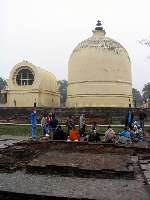
Image of a group of FWBO and TBMSG people on pilgrimage in front of the Parinibbana Stupa and Temple in Kushnigar
This blog post summarises a longer
essay on the Buddha's Last Words.
Last week we celebrated the Buddha's Parinibbana - his final death. The tradition tells us that nothing can be said about the existence or non-existence of the Blessed One after death. The cycle of birth and death, of suffering, has stopped for him. An account of the last days of the Buddha is contained in the Mahaparinibbana Sutta. Towards the end of the sutta the Buddha brings together any disciples in the area, and asks them if they have any doubts. None do. Then the Buddha gives them, and us, a final message:
vayadhammā sankhārā appamādena sampādethā
all things are perishable, through vigilance Awaken!
The full explanation of my translation is too long for this article, but I would like to look at one part of it: the word 'appamaadena'. This word is in the instrumental case so indicates the means by which an action is to be accomplished. It is by appamāda that sampādethā (from a verb, sampādeti, meaning firstly ‘to procure, to obtain’, and secondarily 'to strive'). Appamāda is translated in various ways but 'vigilance' seems to have become standard. However vigilance is not a perfect fit.

Appamāda has three parts: a + (p)p + mada.

The Pali English Dictionary gives two senses for mada: 1. intoxication, sensual excess; 2. pride, conceit. I'm going to focus on the first sense in this article.

Pa is a prefix which indicates forward motion in applied sense often emphasising the action as carried on to a marked degree or even beyond it’s mark. So if mada is drunk, then pamāda is blind-drunk! (the extra p is a common artefact in Pali compound words)

A is a prefix which makes a word mean the opposite.

So appamāda is not-blind-drunk. If you look through the Pali suttas you will see that appamada is used in connection with the objects of the senses: sights, sounds, smells, tastes, touchables, and thoughts. So in practice appamāda means not-blind-drunk on the objects of the senses. Isn't it true that we are easily intoxicated by the objects of our experience? Aren't we in fact mostly caught up in this world of our senses? Or a lot of the time aren't we caught up in the world of our thoughts? So the Buddha's final message was, sober up with regard to the senses and thoughts - don't let yourself get carried away. That's the way to strive, to obtain the goal, to Awaken!

Before we have much familiarity with spiritual practice it can hard to grasp that there is experience which is not centred on the senses. If we eliminate the five physical senses, and the mental sense which comprehends thoughts: then what is left? Nothing? We live in hedonistic times when it can seem that the pleasures of the senses is what makes life meaningful. Or we might spend our time avoiding sensations which we don't enjoy. The Buddha's final message is pointing away from the senses, but towards what?

In meditation we can take two basic approaches to the senses. We can just sit and watch the play of experience, and try not to get get caught up in it. This approach is sometimes likened to watching clouds drifting about the sky. One just sits and watches them coming and going, and doesn't invest any energy in them. Another approach is to actively withdraw from sensual experience through concentration on an object - frequently the breath. Doing this we find that in withdrawing from sense data our experience is blissful, and more satisfying. We may lose the sense of having a body, even lose the sense of having thoughts. The experience of meditation shows us that there is an alternative to being drunk on sensual data.

Both of these approaches to the senses open up all kinds of new possibilities to us. This is not easy to put into words, especially in English because we simply don't have the vocabulary. Pali and Sanskrit terms can help, but they are unfamiliar to people outside Buddhist circles. The Pali word jhana (sanskrit dhyana), for instance, is one that has been used for these states which go beyond the world of the senses. There are texts which describe the experience - often using similes. But the experiences are quite accessible, to some extent at least, for most people who are willing to meditate regularly.

So there is experience which is not mediated by our senses. But why does the Buddha use his last words to direct our attention towards this experience? Bliss is all very well, but is that really all that spiritual practice is about? The answer comes from the first part of his statement. It is because the nature of all things perceived by the senses (sankhārā) is to perish (vaya). Another possible translation of vayadhamma might be 'guaranteed to disappoint'. The objects of the senses as fascinating as they are, do not satisfy us. They are transient. By being focused on them we are constantly being disappointed, constantly let down, and it's a real drag isn't it?

So to sum up: if we want happiness (and we all do), then we need to free ourselves of addiction to intoxication with the objects of the senses, including thoughts, which are guaranteed to disappoint us. The reality of spiritual practice for most of us is that we can only slowly untangle ourselves from the senses, from thoughts. It's not easy because from the first we are totally immersed in this experience. But it is possible, and definitely worth it.

See also: my calligraphy of the Buddha's last words on visiblemantra.org.

18 February 2006

Belief: we are what we think.

examing beliefIn this second look at the subject of belief I'd like to examine a more positive aspect. I was sparked off by a BBC Radio program in the same week as a New Scientist issue (28 Jan 2006) with several articles about belief. Both sources had quite a lot to say about the belief in medical treatments.

Recently medical researchers have become much more interested in the placebo effect. This is the phenomena in which the belief that one has been given an effective medical treatment can have a beneficial effect, even when one is given a placebo, or dummy treatment. Placebo is Latin for "I shall be accepted". What is becoming clear is that the placebo effect is really quite remarkable. It is not a figment of our imagination and it can produce startling physical changes in our body. Covertly given placebo medicines do not work. The strength of the effect seems to be linked to expectations and strength of belief. One scientist thinks that it may be beneficial to err on the side of gullibility: "If you miss the tiger hidden in the grass, then you are always dead. If you always see tigers, you are always running away, but you're not dead". New Scientist p.39

Kathy Sykes, a scientist who investigated alternative medical treatments for a BBC documentary says in the Radio interview: "the power of placebo is enormous". She sites several examples including people who received placebo knee surgery and did just as well as those who had received the full treatment. The result, she suggests, may be down to the brain's expectation and reward system.

I have written about the way that I was able to think myself into a fight or flight response - with adrenaline charged, heart pumping fear! So what we believe is starting to look pretty important isn't it? The impact of belief is not simply psychological, but physiological.

The first line of the Dhammapada goes "manopubbangamaa dhammaa". The literal translation is something like 'mind precedes phenomena'. It's not a trivial exercise to translate this short phrase because mano and dhamma are complex terms that have no exact counterpart in English. But in a sense we could translate it by the phrase "you are what you think". It's not saying that thoughts literally create phenomena, that idea would not become current for several hundred years after the Dhammapada was composed. It is more of a psychological statement. Mano indicates the thinking mind, as distinct from more general consciousness (vijñana) or the heart (citta) in the poetic sense - although these terms can and are used interchangeably, and in different ways at different times. We can think of mano as that aspect of consciousness that supports opinions and views.

What's being said, then, is precisely that we can think of ourselves as being happy, as being free of suffering, and that it will have an effect. The modern research on the placebo effect confirms that this is the case. Buddhism of course goes further and says that if you wish the same for all beings, then that also is possible! The research tells us that the placebo effect is very powerful, and related to the strength of belief. If we believe that Buddhist practice will help us be better people, happier, more loving, then it probably will. If we believe the opposite then that is probably true as well. I'm not saying that practice is all placebo effect, but I think most experienced practitioners would agree that one's attitude to practice is vital. If you believe it won't work then you will have an uphill battle.

There were two words for belief in Pali: saddha means something like 'to place the heart upon'. We place our heart upon what we value. What we value is down to belief. Saddha is usually translated as faith. Ditthi means view or what we would call opinion or attitude. Our ordinary views and opinions weigh us down, cause us suffering. We place our heart on things that can never be satisfying. By reflecting on our views, by comparing what we believe to our actual experience of the world, we can come to what the Buddha called samma-ditthi or Perfect View. This is often translated as right-view, but samma is a bit stronger in connotation than 'right' suggests. When we see things as they really are, then we begin to place our heart upon the things that will really satisfy us. We will, in the traditional idiom, Go for Refuge to the Three Jewels.

Buddhism offers us a plethora of methods to observe our own beliefs, and to bring them into line wit Reality. These range from simple observation, through directed meditation, up to elaborate rituals. We may think of them as technologies of belief. Two weeks ago I suggested that all Buddhist methods amount to ways of paying attention. Paying attention, in the way I have described it, enables us to see how our beliefs condition our experience, to have a vision of Reality, and to enable us to align ourselves with that Reality. The tradition tells us that it is possible to entirely align one's beliefs with Reality: we call this Awakening.

Last week I pointed out where we can come unstuck in belief. This week I've pointed out how belief can work to help us. Given the way humans work we cannot avoid belief. I don't think it's possible to believe in nothing - that in itself is a belief! At worst we can be a victim of what we believe, at best we can radically change what we believe so that our world is forever transformed. The choice is ours.

11 February 2006

Belief: to kill or die for?

Muslim protestor - source The Epoch Times
I'm interested in belief at the moment. This essay and one next week will explore two aspects of belief, one rather negative, and one more positive.

Few people can be unaware that some people hold their beliefs so dear that they are willing to kill others who disagree with them. It's all too easy to treat this fact simplistically. Such a rigidly held belief can be difficult to understand at first sight. We are repulsed by the killer.

Killing for one's beliefs is not a new phenomena. It's been happening for the entire history of human kind. However we live in interesting times. Since the Enlightenment we have stopped believing in an omnipotent god. This seems only right and proper to me, but then I am a product of a rationalist-materialistic social and education system. There are two main responses to this decline in religion: credulity, and incredulity, both in fairly extreme versions. The first extreme is that we believe in everything: from Aliens living amongst us, to crystals that heal diseases, and dead spirits that speak to us from beyond the grave. The other extreme is that we don't believe in anything beyond our five senses. We are skeptical of anything we can't measure.

From either point of view we may find it difficult to understand the radically angry reaction from Muslims whose faith has been publically mocked. From one point of view all beliefs are the same, God = Allah = Jesus = Buddha = Mohammed = Snoopy the Dog, so why would you get all het up over one or the other. From the other point of view believe in God is a childish whimsy, at best. We're just not equipped to deal with someone who is so insistent on their point of view that they will kill anyone who tries to contradict them, or to have a laugh at their expense.

There is also a remarkable naivete in the reaction which says that because a newspaper from Denmark, or where-ever, mocks us, then the government of Denmark is responsible, and Danish citizens are one and all legitimate targets of our anger.

In response to recent events I was saying to myself that I could understand dying for a belief, but not killing for a belief. I said to myself that there were no grounds on which I would kill anyone. But this is not entirely true. I'd probably kill to save myself or a loved one from harm. I imagine that I'm capable of it under extreme circumstances. So this is interesting. What makes me prepared to kill under these circumstances? Well it's a view isn't it? A belief. I believe that my life is worth more than the person I'm protecting myself from. So perhaps killing for a belief is not so alien as I thought. Gulp!

Further more I said to myself that I certainly wouldn't kill anyone for mocking the Buddha. I'm not like those fundamentalist theists! But then I realised that I had been in some pretty heated arguments on this subject, had allowed myself, perhaps even willed myself, to be pretty angry over issues which were relatively petty. And actually there have been times when I felt, and even expressed a considerable amount of illwill towards people whose point of view I disagreed with. So it's starting to look like a matter of degree in which I differ from fundamentalists, not anything intrinsic. I just keep my anger in check to a greater extent. That's not trivial by any means. But the anger is not different from the anger of the terrorist!

I'm not saying here that I have sympathy with killers, or condoning killing in any way. What I'm saying is that the mental states I imagine a killer to be experiencing as a result of their strongly held views, are not alien to me. I recognise hatred in myself.

We all have experiences that we don't want. Our cherished beliefs are challenged, mocked, abused. We respond with anger, and we might even feel quite justified. These need not be religious beliefs. We may believe that saying please and thank, in the English manner, are absolutely essential, but run into someone from a culture where they don't even have words for these concepts! That person unwittingly falls foul of our belief system and whammo we hate them!

The Karaṇīya Metta Sutta tells us, Diṭṭhiñ ca anupagamma "And don't fall into views". In the contemporary idiom of the FWBO we might say: hold your opinions lightly. Beliefs can be constantly re-examined in light of experience. Particularly hatred. My observation is that words said in anger fail to reach their mark. Whatever I am trying to say, if I'm angry, then pretty much all I communicate is I am Angry. And people respond to this in various ways, but none of them involve weighing up my words or empathising with me. And why should they? I know my own reaction to anger is FEAR, and I just want to get away whenever I known someone is angry. Angry people are dangerous, they lash out, they say and do hurtful things. I'm not so very different from anyone else.

If however we hold our beliefs lightly, if we are open to other view points, then we are much less likely to react with anger when we meet an opposing belief. And this is important because if our beliefs are so rigidly held that we are enraged by opposition, then we may end up killing for our beliefs.

In this essay I have assumed that killing is a bad thing without ever justifying this proposition. And last week I suggested that if we are really paying attention then we won't be happy if we try to be happy at the expense of another person. For now I hope that you agree with these sentiments enough to follow along with the argument. Next week I'm going to look a little more at why what we believe is important, not only personally, but more cosmically speaking. This should help to fill out the picture somewhat.

~~oOo~~

*image by Chris Jackson/Getty Images.

05 February 2006

Practising the Dharma? What do I mean?

mixed image from dumbphotos.comI recently had an email from someone who read my Wikipedia article on Shingon and wanted to know more about it. (Had a look at the article recently and didn't recognise most of the text but that's the Wikipedia for you). I explained to him that I had read everything I could get my hands on, and I had done detailed study of Kukai's writing, but that I did not practice Shingon Buddhism, and therefore couldn't offer much more than what was in that article. My correspondent was interested in what I meant when I said "I practice the Dharma". Amongst Buddhists this kind of throw away line would probably not even get a second thought. We all assume we know what someone means by that kind of statement. But how do you explain it to someone who might not share your jargon or assumptions.

So I started thinking about what I meant when I said I practice the Dharma. At first I was tempted to go into complicated answers that involved lots of doctrinal categories: the path of ethics, meditation and wisdom was an early starter. But then I realised that this would just be gobbledegook to anyone without a few years of reading the same books as me. And unlike my knowledge of Shingon, my Dharma practice is not just book learning.

I do a variety of more formal Buddhist practices: meditation, puja, study, reflection, chanting, right-livelihood etc. But this wasn't going to be much use because each one of these exists in a context which requires explanation. So I started stripping things back to essentials. What is it that I am doing in all of these formal practices, and in the many informal practices I do?

And it came to me that what I do is I try to pay attention to things. This is the guts of what I wrote in an earlier post about my approach to the six perfections. From that perspective I pay attention to other people, to our mutual impact on each other. This produces not only a change in behaviour which promotes awareness, but also liberates energy. Then I can start paying attention to my own mind through meditation. Finally I can begin to pay attention to the nature of reality.

Another approach to this might be to start from my basic desire for happiness. This is something we all have. Even if, like me, we're not always sure we deserve happiness, we still want it. It goes beyond self-esteem and self-views. From this point of view what I am doing as a Buddhist is looking closely at the kinds of things that conduce to happiness and which don't. I also try to note how long that happiness lasts. For instance, a certain amount of dark chocolate does indeed make me feel happy and secure and less anxious. It really works. But it's a short lived happiness. And then there is the anxiety that I will run out of chocolate and the shops will be shut and I'll get a headache because I haven't had my fix lately. Now at present I might not be ready to stop eating chocolate as an antidote to anxiety, but I can still pay attention to the process. I can still observe the cycling between anxiety, eating, happiness, rising anxiety until the desire to eat is triggered again.

So, it became clear that what I do as a Buddhist is I try to pay attention to things, to my mental and emotional states, to other people, and to the real nature of reality. Which sounds a bit simplistic doesn't it? I mean what about the whole edifice of teachings, the profound philosophical doctrines, and, since I'm interested in Shingon, the initiations and lineages. I'm by no means finished thinking about all of this, but it strikes me that all of the superstructure of Buddhism is just an increasing elaborate way of making us pay attention. My impulse is to simplify things, to cut away all of the extrusions and look for what is essential.

In any case it's clear to me that one cannot simply take the Buddhist tradition on it's own terms. I've written about this as well in The Unity of Buddhism. Each strand of traditional Buddhism sees itself as the pinnacle, and other as provisional at best. This is alright when strands exists in relative isolation, but in the present we have access to so many of the strands, each with their unique contribution that it doesn't make sense to privilege one over the others.

The one major objection that I have come up with to this train of thought is that attention is an ethically neutral function. We can pay attention to unethical things as much as ethical. Just paying attention might not actually be enough. It might be necessary to add some qualifier. There is actually a traditional precedent for this - the Pali texts tell us to avoid ayoniso-maniskara, unwise attention.But again I think if we simply pay attention to the consequences of paying attention then it will become clear what things are better to focus on. This was the point of my essay on Imagination. It may be that we need to be reminded of the need for kindness, for kindly attention, from time to time.

It is possible that we might seek our own good at the expense of others. But if we are paying attention to others then we will be aware that they are suffering as a result of something we have done. I find this a very uncomfortable awareness. So if I am paying attention it seems unlikely that I could be happy by exploiting someone else. My happiness is tied up with the happiness of those people around me, and ultimately with all beings.

So what I mean when I say I practice the Dharma is: I pay attention to things. Simply that. And it has been very fruitful to date.

29 January 2006

Kukai : Buddhist hero of Japan

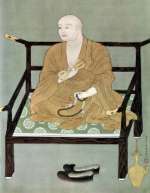
Image of KukaiIn this post I want to draw attention to and celebrate a Buddhist hero. Kukai is a figure so multi-sided, so multifaceted, that summing him up in a short essay is almost impossible. He is known by three main names, Kukai, Kobodaishi, and Odaishisama (or just Daishisama), and I will try to say a little something about each.

Kukai was the Buddhist monk who brought the Vajrayana teachings to Japan in 804. Not only was a dedicated and deeply realised spiritual practitioner, he was a gifted poet and calligrapher, a competent civil engineer, and a consummate political operator. At a time when heterodox people of any kind could sink without trace, he managed to radically alter not only the face of Japanese Buddhism, but the whole Japanese culture. His Shingon Buddhism was to dominate Japanese society for several centuries, and it is said that with Shingon came the Siddham script which in turn helped to give birth to the Japanese Kana. This in turn enabled an indigenous, vernacular literature to develop, since before this writing was all in Chinese and education in Chinese was denied to women and non-aristocrats. Shingon reinvigorated Japanese Buddhism which had become rather scholastic. Kukai's insistence that Awakening was possible in this very life was apparently novel, and was at first questioned. Without this basic premise however, Buddhist practice is just going through the motions.

Kobodaishi is the title bestowed on Kukai posthumously by the emperor. The title means 'Great Teacher who Spreads the Dharma'. Where Kukai is very much a man in history, Kobodaishi is something more. He is superhuman, and supra-historical. As happens with religious figures in any tradition, the stories about the many grew after his death. Feats and texts where attributed to him that he did not perform or write. This is not necessarily a falsification because myth has to have a vehicle and Kobodaishi happens to be an excellent vehicle for the Japanese mythic imagination. Kobodaishi then is an archetypal figure. He did not really die in 837, but retired to meditate until the advent of Maitreya the next Buddha. This resurrection myth is quite universal in character, Kukai, King Author, Christ, and probably Elvis Presley, will all be appearing again before long. The myth of renewal goes very deep in the human psyche. Shingon practitioners tend to refer to Kukai as Kobodaishi, indicating that 1200 years after his death it is probably the myth rather than the man that informs their practice. Ordinary humans can only inspire us so much. What really moves us are archetypal figures who seem to embody the deepest forces in the world and our psyches.

Odaishi-sama is an almost completely different character. He is one step further removed from Kukai the historical man. In a way we can see the process of myth making quite clearly in this change from Kukai, to Kobodaishi, to Daishi-sama. Daishi-sama is not associated with Kukai's signature form of Buddhism, Shingon, at all. He is the invention of 10th and 11th century wandering shaman-priests who had adopted large dollops of Pure Land Buddhism into their patter. They travelled the countryside practising medicine, soothsaying, and carrying out important rituals. Daishi-sama became a kind of saint to them, and like the Buddha Amitabha, it was said that if you chant his name then you will be reborn in the Western Paradise, Sukhavati, the Happy Land. There is little remaining of the historical character, but he is none the less an important folk figure. Many a person is devoted to the cult of Daishi-sama, chants his name and fervently believes in his saving grace. And why not?

Kukai is the pivot point of a great mythic cycle. From outside space and time Mahavairocana manifested beings to whom he could communicate. He gave Vajrasattva his initiation and asked him to pass it on to other beings. Vajrasattva, an entirely mythic being, then gave the initiation to Nagarjuna. Nagarjuna stands athwart the mythic and human realms. It is thought that he actually lived, and that there were likely to have been two people with that name separated by several hundred years. Or it is believed that he was a wizard who lived for 700 years. His biography is almost entirely made up of mythic elements. Nagarjuna initiated Nagabodhi, another semi-legendary figure, who gave the initiation to Vajrabodhi. Vajrabohi and the succeeding patriarchs of the Shingon lineage are genuine historical personages with relatively straight forward biographies. Skipping a couple of steps we find that Hui-kuo gave the initiation to Kukai making him the 8th Patriarch of the lineage. Then Kukai, after his death, undergoes a series of transitions to become Odaishisama, that is which lead him back into the mythic realm.

Kukai is a key figure in the history of Buddhism. His writings are lucid and fresh even after 1200 years. That many are available in good English translations is a cause for celebration. He is less well studied than he might be because Shingon has not done much proselytising outside of Japan. If you are interested in Japanese Buddhism, in mantra or vajrayana, then Kukai’s works are invaluable. Hakeda's Major works is a reliable translation, but there are also some in the BDK English Tripitaka published by the Numata Centre. Ryuichi Abe's The Weaving of Mantra is a difficult read at times due to the semiotics jargon that he uses, and I don’t entirely agree with his thesis, but it is invaluable as a more indepth study of Kukai. Taiko Yamasaki's Shingon: Japanese Esoteric Buddhism is a good introductory and can be published from Shingon Buddhist International. Engaging with Shingon practice is more difficult because teachers are hard to find in the West. However we can be inspired by Kukai's life, and his written works can help us to understand the Dharma more deeply.

For more info on Kukai see the Wikipedia article, which I can recommend because I wrote most of it (well originally it's all been altered now of course!).

22 January 2006

Giving Feedback

We're often in a position where we judge that it's necessary to give someone some feedback. It might be a work situation, or it maybe that one of our friends is doing something which we are sure they will regret. I find giving feedback quite difficult and have been surprised by the reactions I get sometimes. When I asked an acquaintance about this, he pointed me in the direction of the Vaca Sutta, which gives some advice about this situation.

"Bhikkhus, speech that is well spoken, not badly spoken, is blameless and worthy for the wise, has five characteristics. Which five?

It is spoken at the proper time. It is spoken truthfully. It is spoken gently. It is said in connection with the goal of Awakening. Speak with a heart [full] of loving kindness.

By these five factors is speech well spoken, not badly spoken, is blameless and worthy for the wise."

Anguttara Niakaya (V.198) My translation. See also Access to Insight

So when giving feedback we need to consider these five factors.

1. The proper time to speak
Pick your moment. Is it a good time for the other person? Is there time to follow up? Is this the right place? Public criticism is unlikely to be effective. Try to take into account the person's mental state - have they recently been getting a lot of criticism, have they been ill, had a bereavement? Are you in a good state? Is the other person ready to hear what you have to say? Sometimes we need to be prepared to wait.

2. Truthfulness
Stick to the facts, be straight forward. Do you know the facts? Stick to things that can be observed - don't make assumptions, and especially try to not second guess what someone else is thinking. Do no exagerate or minimise. Watch for your own biases - if you are angry you are unlikely to be able to do this for instance. It may mean that rather than criticising someone else when you are angry, that you apply the criteria to yourself and confess your anger instead!
Truth has a particular power in the Buddhist tradition. There are several stories where the speaking aloud of a simple truth, the sacca-kiriya or Act of Truth, changes the course of events. Angulimala, for instance, eases a woman's painful childbirth by stating that since his noble birth, he has not intentionally killed any living being. There are many Jataka stories with a similar theme.

Always keep in mind that the truth can be painful to hear, and that you might not posess the truth!

3. Softly and Gently
Speak gently and kindly. Be respectful. Calm, reasonable and clear. If you can't do this then reconsider giving feedback. Never swear or use harsh language. The reason for this is that if you start to yell and use harsh speech then you will almost certainly cause the other person to be defensive. They will rightly fear for their safety, because you are allowing your anger to control you. If your anger is controlling you then there is no telling what you might do!
Any drama that you bring to the situation will detract from the message that you are trying to get across. But recall that we are being truthful, so there is no need to go soft on the issue.

4. For the purpose of Awakening
Your goal in giving feedback should be the highest goal. If you are simply indulging your likes and dislikes then that is quite ignoble, according to the Buddha. You might ask yourself, who will benefit if I get the change of behaviour that I am seeking? Is it only me? How will the other person benefit if I tell them what I wish to tell them. In fact if you are simply trying to get someone to conform to your will, then you are doing them a violence.

If you are seeking a change in behaviour then offer a towards (desirable behaviour) and an away (undesirable behaviour) when asking for a change in behaviour. Just telling someone to stop doing something is less likely to work than asking them to start doing something else. But remember that they must be free to decline your request. Coercion of any kind will not conduce to the good.

Are you the right person to give the feedback - maybe it would be better coming from someone else?

5. From a loving heart
Your every word should come from Loving Kindness. This is not restricted to criticism of course but goes much much deeper. In fact you could almost say that if you are not communicating metta then better to do as Shantideva suggests and act like a block of wood. It may be that you need to hold back on giving your feedback until you have had a chance to develop a loving heart towards the other person, perhaps by putting them in the fourth stage of your mettabhavana.
So these are the five factors to consider. There will be times, of course, when it seems unwise to pause to reflect on all of these factors - if our friend is about to step into the road not having seen an approaching car for instance. In that case, of course, we simply act. But in most cases there is time to reflect, and it will be useful to do so.

Making connections with other people is vitally important to our well-being, but also to our Buddhist practice. Bungled feedback is a common way in which we fail to make connections, or we attenuate or even sever, the connections we already have. Repairing rifts, and restoring harmony in the Sangha takes much more time and energy than maintaining good communication.

14 January 2006

Imagination and Reality

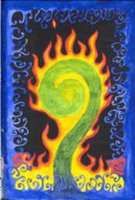
image of flaming koru - creativity imagination mental illnessIn this essay I want to look at one particular aspect of imagination. For many years I have been interested in the link between so-called mental illnesses and creativity. It is now well documented that people who are very creative are much more prone to depression, mania, delusions, and madness. We might all suffer from some form of these ourselves, and most will at some time suffer from the more serious manifestations of them.

Having looked at the various explanations of this phenomena there is one that stands out in my mind. Joe Griffin's theory is that imagination is the key. Creative people have very powerful imaginations. I want to explore this idea by using an example from my own life.

Some time ago I was sitting in my quiet Cambridge room reading. It was a fine day, I was in no possible danger. But I suddenly realised that my heart was racing, my breath was short and shallow, and my muscles were tensed. It was the fight or flight response. Given the almost idyllic setting, how did I come to be experiencing the primal animal response to threat. I have observed, at first hand, this response in the poor earthworms that were the subject of a sixth-form biology class. It is something shared by all life, to some extent.

I can reconstruct the events in my mind. Some weeks early a friend and community-mate had attended a retreat where he had had a blazing row with the study leader. In fact they had a series of very unpleasant exchanges. At the time my friend did not hesitate to lay the blame with the study leader.

It so happened that I was about to attend a retreat during which I knew that I would be studying with the same man. As I sat reading my mind drifted off into a fantasy - what might have been called a fancy 200 years ago. I imagined that I too was finding fault with the study leader, that we were disagreeing, were arguing, were clashing, and even coming to blows. At the point where I stormed out, my mind rewound the fantasy and played it through again, either the same or with a minor variation.

Now I have a pretty good imagination, and it seems as though I was able to make the images so realistic that my body began to prepare for action, just as though I was in the room with my enemy and about to come to blows. How long had this been going on? I'm not sure. Perhaps 10 or 15 minutes, perhaps 30. Over and over. A real fight might be over in a few seconds as I reacted and more than likely bolted. Then it would be over in fact. But in imagination I was not able to come to a conclusion. I kept going over and over it. And my imagining of the scene was so potent as to produce a physical response, a primal response which is designed to help me deal with real threats.

All of this without having met the man that I was imagining myself in conflict with. All this secluded in a quiet room far from any real threat.

And then I shook as I realised that I had in fact been doing this all of my life. Years of emotional difficulties, of recurrent depression and persistent anxiety, started to come into a new perspective. It was a turning point for me. Around that time it was clear that no-one was considering me for ordination. A year later things had completely turned around. By using this insight I was able to begin to really practice the Dharma. To work directly with my mental states and transform them.

One of the ways the Dharma works is by getting us to look into our habits of thinking. We habitually see ourselves as this sort of person, and not that. We like these things, but not those. These kind of people, but not those. These are just mental habits acquired over the years. One of my mental habits is to imagine the worst, to imagine that I will come into conflict with people and that they will try to hurt me. Once upon a time this was in fact true, but it is not true now. By looking into these habits, and seeing the consequences of them I have begun the process of gaining a choice in how I imagine the world. It is quite clear that how I imagine the world is critical to how I experience the world.

The final irony in this story is that I attended the retreat and met the study leader. He and I got on very well indeed. Real kindred spirits. My fears had been completely unfounded.
Related Posts with Thumbnails