06 May 2006

Suicide as a response to suffering

Ophelia drowns herself
When you dig into the the subject, you find that suicide is regarded with some ambivalence, and even confusion, by the Buddhist tradition. On one hand the principle of ahimsa, or non-violence, would seem to rule out suicide for Buddhists. On the other hand there are at least three cases of suicide in the Pali Canon where men commit suicide with no evil consequnences (they attain final nibbana and are not reborn). In Buddhaghosha's commentary to the vinaya it is said that a bhikkhu may stop taking food and die under certain circumstances. And at the extreme end of the scale we have the 1960's image of a Vietnamese monk immolating himself in order to gain religious freedom for his fellows.


A couple of years back I wrote a long essay on suicide and Buddhism. A version of this, which focuses on suicide in the Pali Canon, was published in the Western Buddhist Review. It's couched in the pseudo-objective language expected in an academic journal which is a shame in a way because I've realised that most of the people to whom I might wish to communicate on this subject won't read that kind of thing.

The apparent ambivalance with regard to suicide seems to stem from a belief that any act done with awareness, with kindness, and especially with non-attachment, is a skilful act that will not cause suffering. It seems pretty clear however that few of us are phlegmatic enough to contemplate taking our own lives with detachment.

I've seen death. My father died in 1990, all of my grandparents are dead, two uncles are dead, and a few friends and aquaintences too. I saw some of their corpses. I've watched bodies being burned on the ghats in Varanasi, and one friend cremated the same way in New Zealand. I've watched a sheep have it's throat cut and bleed to death. But death is still a mystery to me, and despite all the Buddhist rhetoric about it, I find I still fear it. I don't want to die. What sort of state would I need to be in to overturn this fear, to over-ride this powerful urge for continuation? The sacred texts recall several men cutting their throats in supremely positive states. I've contemplated suicide only when in a very negative states.

Looking at the whole thing pragmatically, that is to say not referring to doctrine but to experience, I'd have to say that suicide is, contrary to that old song, not painless. When I think about this I bring to mind Kent, a friend of my brother's, who killed himself out of despair in his twenties. It was very painful for me, and I only knew him a little. For my brother is was a devastating blow. We are all still mourning Kent's death which seemed such a waste. So whatever happened to Kent after he died, I can be sure that his actions resulted in pain for those who loved him.

My thoughts have been turning in this direction because recently several people I know have either been suicidal or have deliberately harmed themselves in some way. And in response I find myself echoing the words of that great hero of the Dharma, Sariputta, to Channa:

"Let the venerable channa not use the knife. Let the venerable Channa live. We want the venerable Channa to live! If venerable Channa lacks suitable food, I will go in search of suitable food for him; if he lacks suitable medicine, I will go in search of suitable medicine for him; if he lacks a proper attendant, I will attend him. Let the venerable channa not use the knife. Let the venerable Channa live. We want the venerable Channa to live!"
- Samyutta Nikaya III.2.4.8.
In my WBR article I noted that scholar Damien Keown, editor of the Journal of Buddhist Ethics, seemed to fudge the conclusion of his article on the subject: The Case of Channa. It's quite clear, from the text that he focuses on, that suicide by someone with no attachment to their body is not a cause of more suffering because Channa is not reborn, ie attains Nibbana. And yet Keown draws the general conclusion that suicide is unskilful. Having surveyed a much wider range of texts, many of which were if anything more open to suicide, I also found myself baulking at concluding that suicide is justified in some cases, even though the textual evidence supports such a conclusion.

The basic problem is that the vast majority of suicides and cases of self-harm are not carried out in state of love, generosity, calm, dettachment. They are carried out in despair, fear, and hatred. It seems likely that if you are in the fourth formless jhana, then it might just be possible to die with equanimity, but that in constricted states of suffering from which we want to escape, then suicide is unlikely to be a positive response.

All of this can be hard to get across to someone in despair. Despair is associated with a vastly reduced perspective. Often when we are down we cannot imagine that there is a way out, we don't see that things change. At the moment I'm exploring the way that awareness can change this. We naturally flinch from pain, and in the case where physical harm will result this is definitely a good thing. Emotional pain is something else though. We flinch from it, we don't want to experience strong and/or painful emotions, and there is some short term benefit from this. There are times when putting our emotions on hold can be useful or even necessary. But long term we cannot function that way. Bringing awareness to pain, especially emotional pain, does seem to help, especially in terms of creating a broader horizon and an awareness of how things change. I hope to be able to say more about this in time, but for now if you are in despair and contemplating suicide, then please seek help.

~~oOo~~

See also

Rottman J, Kelemen D, Young L. (2014). 'Purity matters more than harm in moral judgments of suicide: Response to Gray (2014).' Cognition. 2014, Jul 10. pii: S0010-0277(14)00118-8. doi: 10.1016/j.cognition.2014.06.008. [Epub ahead of print]
"Many people judge suicide to be immoral. We have found evidence that these moral judgments are primarily predicted by people's belief that suicide taints the soul and by independent concerns about purity. This finding is inconsistent with accounts that define morality as fundamentally based upon harm considerations."


29 April 2006

No guarantees

Sri Ramanamaharshi - Enlightened GuruWe had a conversation at the Cambridge Buddhist Centre the other night that parallels similar discussions I had in several places. Indeed I've asked the question myself before. Who is around now that is Awakened? And why to people keep fobbing me off when I ask the question?

My response is that this is a difficult question to answer. For a start, would we know an Awakened person if we met them? We might if we spent some time observing them. But in a chance or glancing encounter we may fail to recognise their special qualities. There are ample stories of this nature in the Pali Canon.

Then what would it mean for someone to say that someone they know is Awakened? Surely we would have to have an inordinate amount of trust in our informant for their words to make much difference in our lives. What would it mean if we ourselves said someone was Awakened?
What it comes down to, and this came out in our conversation, is that we want guarantees that the Dharma is going to make our lives better. Having someone who totally exemplifies the Dharma would make believing a lot easier. Where is the Buddhist messiah to save us from ourselves?

But actually the Dharma never really operated this way. The Buddha of the Pali Canon doesn't go around saying: take this on faith. The Dharma, he says, is ehipassiko. Ehipassiko literally means 'come and see'. And in a way this is better than having a messiah! What we do is we start to practice a little mindfulness and we evaluate the results. Most people, however difficult they find it, report that being a bit more mindful makes them a little happier, a little more alert, a little less stressed. We are then ready to take the next step whatever that might be for us.

We may need a teacher who can show us the next step, although often after some experience of practising, it is obvious to us what our next step should be. Often what we want is a teacher who has all the answers, who can advise us on every crisis, who can guide our every step. We want a messiah. We are not ready, willing, or able, to take personal responsibility for our consciousness. But having been given a few basic tools, most of us are quite capable of making progress in the Dharma.

The original model of practice in Buddhism was often very simple. Someone would meet the Buddha or one of his disciples, they would be given a Dharma talk in the course of which they became firmly convinced of the truth of the Buddhadharma. They would then be given a method of meditation, or a subject for reflection, and be sent off to practice. Alone in the jungle they would use this single tool to penetrate the nature of reality, Awaken to the truth of it, and then return to report on their findings. What we get these days, with some exceptions, is elaborate systems of practice with a bewildering variety of approaches, 1000's of books, and 1000's of Dharma talks, all giving us much to think about. Rather than the simple certainty of a straight forward approach, we get a plethora of ideas, most of which we cannot hope to put into practice.

There's really no point at all in reading about the highest yoga tantras if we cannot sustain basic mindfulness. Very few people would read a book on advanced physics before having thoroughly studied the foundations and expect to get anything out of it. There is a case for reading inspirational literature. The lives of Buddhist saints can be very inspiring. But lets face it, most of us need to be looking much closer to home.

The good news is that if we take this incremental approach to practice then we do make progress. And our confidence in the Dharma gradually increases, not on the basis of our guru's charisma or through blind faith, but from actually experiencing the results of practice first hand. My own confidence in the Dharma is not dependent on my teachers, nor on any external reference. I practice the Dharma because I know for myself that it does me good, and I include in this that it enhances my ability to be altruistic.

We don't need to have anxiety about whether our current teachers are awakened. No one can live our life for us, and even if we had a teacher who is Awakened, we'd still have to understand the teaching, and make the effort to practice. The only guarantee that we need comes from our own experience of practice. Doubts are resolved through practice, not through someone telling us it's OK.

22 April 2006

Armed forces and non-violence

NZ troops at Gallipoli
NZ Listener
Recently a man has been in the news. Mr Kember was rescued from being abducted in Iraq. He apparently did not express sufficient gratefulness to the army for rescuing him. His reasoning was, apparently that the army were the cause of his kidnap in the first place, and that had they not invaded Iraq a lot of killing and suffering might not have happened. This is all up for debate in the media and one can hear, see or read a variety of opinions on the subject. Will of ThinkBuddha.org has written some very salient articles on conditionality recently (1, 2, 3) . Isn't it interesting how, by focusing on different aspects of the infinite web of conditions, we can come to polar opposite conclusions about an event.

I wanted to look at one aspect of this web of conditions. The 25th of April is ANZAC Day in New Zealand (and in Australia). This is an interesting public holiday. On the surface it is a simple commemoration of the dead in both World Wars, and in particular the first. Below the surface however is another current. Ask any New Zealander and they will tell you that the New Zealanders' sense of identity as distinct from the English emerged during this time. Gallipoli stands out as representing the New Zealand experience of WWI - a futile, strategically useless attack on what may have been the strongest part of the Turkish defences. What Churchill was thinking is not clear to most people, and we might speculate that perhaps his heavy drinking started well before he became Prime Minister. The New Zealanders, who were, it must be said a minority on the beaches at Gallipoli, came to see themselves, like I do, as not English. Having spent four years living in England I can tell you that I get daily reminders that I am in a foreign culture.

ANZAC Day then is a day which celebrates national identity. And that identity has been bound up from the beginning with the military. Our National Anthem beseeches God to protect us from the shafts of strife and war.

About 12 years ago I became a Buddhist. Having spent my teenage years being convinced that Ronald Raygun was going to start a nuclear war with Russia, I didn't think much of the military. Buddhism reinforced these views. I became quite rabidly anti-military. I probably even, without any sense of irony, became angry about the activities of the military. I celebrated the father of New Zealand poet James K. Baxter. Archibald Baxter was a 'conshie', a conscientious objector, who refused to fight. He was tried, convicted and sent to the front in France. One of his punishments was to suspended by his thumbs above the trenches to provide the enemy with target practice. He survived and wrote a little book about it. I was deeply moved by Baxter's story, and convinced about the utter brutality of the army, and that there was nothing positive about the military at all.

Then one day I was walking down the main street in Auckland. I hadn't registered that it was close to ANZAC Day, and was a bit surprised to find myself watching a parade of old soldiers, some marching, some riding old military vehicles. Something made me look at these men. I saw old men, a bit stiff, a bit sombre, looking ahead, all wearing their medals. They had a sad dignity about them. And then something clicked and I saw how these men, these flesh and blood humans, had fought in wars half way around the world. They did so for different reasons. Some would have believed in the course, signed up and experienced a sense of fervour perhaps. Others would have been less willing. All survived but had watched friends and comrades being killed. I found myself moved by the sight of them. Tears welled up. These men had fought for me, foolishly perhaps, but they did so, and I felt some empathy for them.

Later I came across something written by Dharmacari Subhuti. He gave my relatively incoherent emotional response a more reasoned basis. Subhuti reminded me that I enjoy considerable freedom. That freedom was won, in part at least, by those old soldiers fighting Hitler in Europe. Whatever the rights and wrongs, whatever the conditions, I knew that I should feel grateful that some men had laid down their lives so that I could enjoy my freedoms today.

So I've come to have a more complex view of the military. I'm still resolutely opposed to violence, and to the use of force. But I recognise that others are not, that there are other people who are quite willing to use violence, and who are willing to fight, to kill, to achieve their ends. And I acknowledge that I want to be protected from being attacked and killed. So while I personally try to refrain from any acts of violence, and try to immediately confess any acts which stray into that territory, I would be a hypocrite if I maintained the view that the military is entirely evil. It would be hypocritical because I benefit from it.

The situation today is far from morally clear - we westerners appear to be benefiting from wars of aggression in the Middle East. I don't pretend to understand all of the arguments, and don't have space to go into any of that here. But I want to acknowledge that men and women have killed and died, so that I may enjoy the freedom to practise the religion of my choice - of which non-violence is the highest value. And that is one of the greatest koans of our times.

~~oOo~~

06 April 2006

Monk or Layman or what?

Men from the Western Buddhist Order in their ordination robesLast weekend I was away at a national gathering of the Western Buddhist Order in the UK. 340+ order members, a little less than half the UK order were there - practising together in harmony. So it seems fitting that this week I write about the Order. One of the aspects of our order which appears to cause consternation in some traditional Buddhists is that we are not a monastic order. So I'd like to spend some time looking at two related questions: Why did Sangharakshita found a non-monastic order? And, are we therefore a lay order?

The received tradition of Buddhism allows for two categories of Buddhists - the full-timer, or bhikkhu (literally one who begs), who is bald, robed, celibate and somehow engaged in spiritual practice; and the part-timer or householder who is mainly focused on business and family, and who's spiritual duty is to feed the full-timer. Reggie Ray notes, in Buddhist Saints in India, that Buddhist society was originally tripartite with the full-timers being either forest dwellers or settled monastics. We could say this reflects a social structure in India where the Brahmanas were relatively settled, and the Shramanas tended to dwell alone and wander about. Even if Reggie had not pointed this out, it is obvious if you spend some time reading the Pali Canon that there are indeed two quite distinct lifestyles amongst the bhikkhus. One constantly comes across the advice to dwell alone in the forest meditating, at the same time one reads about bhikkhus living enmasse in viharas.
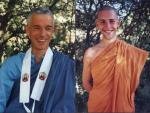
Eventually, perhaps because they recorded the texts, the settled monastic came to be seen in the texts as the ideal Buddhist in the Southern Buddhist countries. The Himalayan Buddhists, especially in the Nyingma school, have tended to have a more diverse social structure: for example they have married lamas and full-time practitioners who are not monks. Later, with the emergence of truly Japanese forms of Buddhism in the Kamakura period, the Japanese abandoned the vinaya which meant they could have married clergy, and that Zen monks could work for their living. However the meme that the bhikkhu is the ideal Buddhist is one that persists.

A Dharmacari and a monkSangharakshita spent nearly twenty years living in India, was ordained as a bhikkhu, and had plenty of opportunity to observe modern day bhikkhus. And what he saw was a lot of men going through the motions, shaving their heads, wearing robes, and refraining from meals after noon, but not actually attempting to Awaken. Although there may have been exceptions, formalism seems to have been the rule. We get a hint of why from Peter Masefield, an academic and Theravidan Buddhist, in his book Divine Revelation in Pali Buddhism, where he concludes that without the direct intervention of a Buddha that Awakening is impossible, and within a generation of the Buddha's parinibbana Arahants would have died out. Actually Masefield, despite his voluminous citations, has overlooked a vast number of examples which contradict his conclusions and the book is deeply flawed, although still in print. But if Awakening is not possible, then what is the point? The Tibetan Buddhists that Sangharakshita met did seem to have a living Buddhism. Despite the fact that many of them were not following the vinaya to the letter, or at all, they had a depth of practice that inspired Sangharakshita.

Another facet of Indian Buddhism was that the Mahabodhi Society was, at that time, run by Hindus. Anyone could be elected to the governing body and ambitious Hindus had muscled there way onto the executive, even though they were not Buddhists, and some were even antithetical to Buddhism. This prevented the society from functioning effectively.

Back in England in 1964, Sangharakshita found that nascent British Buddhism was thriving, but in a narrow way. It was all very genteel and quite sectarian. Sangharakshita found the insistence on strict Theravadin interpretation of Buddhism a bit stifling. Fortunately the English Sangha Trust decided to break off relations with Sangharakshita, which allowed him to start afresh.

After a two year return to India to wind up his affairs, and consult with his teachers, Sangharakshita returned to England with the blessing of his teachers,and set about starting a new Buddhist movement. He was sure that it was going to be run only by committed Buddhists. He was also sure that he wasn't interested in formalism.Initially Sangharakshita envisaged a hierarchy of ordinations from upasaka/upasika up to the Bodhisattva ordination. However he came to realise that since Going for Refuge was the primary act that made one a Buddhist that only one ordination, one witnessing of ones effective Going for Refuge, was necessary.

As a member of the Order I am someone who is acknowledged by my peers and preceptors to be practising effectively. I happen at the moment to have long hair; dress in jeans, teeshirts and trainers; do not have a sexual partner or children; have few possessions; live in a Buddhist community with six other men; work for a Buddhist charity; and consider myself a full-time (though far from perfect) practioner. I therefore combine aspects of the householder, and the bhikkhu, and indeed at times take up the life of a forest dweller for brief periods. Some traditionalists seem to struggle with this indeterminacy - I've been told, for instance, that because I don't follow the letter of the vinaya that I am a heretic that is distorting the Dharma. I guess it shows that fundamentalism is not something that theistic religions have a monopoly on.

So to sum up, the Western Buddhist Order is not an order of monks or lay people, it is an order of effective practitioners. This appears to be radical in the face of the monk/lay model. But that model has never been intrinsic to Buddhism, it's just a cultural norm, and one that may not be relevant any longer.

01 April 2006

A lesson in generosity

Kapil making chapattisLife has been overly complex of late, too busy, too much tension. I'm late sitting down to write this, and because I haven't had time to think, I'm wondering, what am I going to write about. At times like this I tend to go back to basics and so I turn my mind to gratitude and generosity, and find myself transported to India two years ago.

I was on pilgrimage with a party of thirty Europeans and Indians. Amongst the Indians was Kapil: shortish, mid-twenties, cheerful and energetic. We hit it off right away and spent much of the next three weeks hanging out together.

After a few days drinking in the peace of Sarnath, site of the first Dharma teaching and the founding of the Buddhist Sangha, we decided to venture into Varanasi - a 20 minute auto-rickshaw ride away. We took in the sights, the markets, the ghats took a boat ride on the Ganga. Varanasi is a bustling city. It was an important economic centre even in the time of the Buddha, and these days is considered a holy place by Hindus. It cost us the grand sun of Rs75 for the auto into town, Rs75 was slightly less than one English pound. But trying to get a return ride we found that the price had doubled. Being decadent Westerners, most of our companions just stumped up and soon only Kapil and I were left wandering along the ranks of autos in the dark. Kapil was not going to be ripped off! He shopped around and found a driver who would take us for Rs75.

Unfortunately the auto was extremely dilapidated, literally held together by string, and it was almost immediately apparent that it was much slower than anything else on the road. By the time we were on the outskirts of Varanasi the fog was coming down - it gets quite cold in northern India in mid-winter. Soon afterwards the headlamp of the auto faded, flickered and went out altogether. I'd seen enough of Indian driving and roads to be alarmed at the prospect of driving through a foggy night with no illumination. Thankfully we stopped. A bit of thumping and rattling got the lamp going again, but it was barely visible. Our 20 minute ride stretched out to almost an hour. By the time we got back to Sarnath I was cold, tired, and more than a little indignant. I paid the driver rather reluctantly, thinking that he had hardly earned it, and toyed with the idea of giving him less.

And then Kapil did something which startled me. He got talking to the driver, invited him over to the cafe and bought him a cup of chai. I looked again at the driver. He was thin, ragged, and looked exhausted. Suddenly it dawned on me that the trip had been a bit of a nightmare for him as well, and that he wasn't looking forward to the return.

It's a cliché but it's true that life is cheap in India. It's all too easy to fall by the wayside. Perhaps Kapil could relate to the plight of our auto driver because he himself had been born into the lowest strata of Indian Society. The hateful practice of untouchability was outlawed byIndia's first independent government, but Gandhi was no hero to the Dalits (oppressed) because he still believed in caste, still believed that a Hindu should follow his Dharma, or caste duty. It was the Dalit leader, Dr Ambedkar, and his followers who worked to benefit the Dalits. Kapil has opportunities today that his grandparents could never dream of, but upper caste Hindus still persecute Dalits in some places in India.

But actually there is no excuse for my failure to empathise with my fellow human being. Kapil's background was closer to that of the driver, but I had been on that same journey. Yet could not imagine that my discomfort was shared by the driver. This is something I come back to and reflect on frequently. Kapil is poor, has an uncertain income in a place were there is no social welfare, and yet he could be kind and generous. He was grateful for the effort of the driver. Another time in Sarnath our café was struggling to keep up with all the orders, and so Kapil ducked out to the kitchen to help them. He did the same again in Kushnagar, and this time I managed to photograph him making chapattis for us (pic above).

When I get too busy and self-centred, I try to think of Kapil and his plain and simple generosity. I'm his elder, and now I'm ordained and he is not; but he is my teacher. Jai Bhim Kapil.

25 March 2006

Kukai in China

Kukai's journey to ChinaI've not been thinking much about the Dharma per se this week. Most of my reflection time has been spent mulling over Kukai's trip to China in 804-6. It's a fascinating episode in the life of one of my very favourite historical Buddhists - yes one of my Buddhist heros!

Kukai had dropped out of mainstream life to practice as a freelance ascetic, which made him an outlaw in late 8th century Japan. Some years earlier he had written and circulated a satirical attack on the official confucianist doctines of the Imperial state. Having repudiated by word and deed the Imperial orthodoxy, he was the antithesis of an establishment figure.

So how did he come to be included in the diplomatic mission to Tang China in 804? Maybe his relatives pulled some strings, but historians love to point out that his family and clan were Aristocracy in decline, and probably had little influence with the court. It may have been because he volunteered to go on a mission which most people in the right mind did anything they could to get out of. Trips to China involved taking completely unsuitable craft across over 1000km of open ocean, where more often than not they were sunk by storms. It wasn't certain death, but two of the four boats in the fleet were lost in the first week. Kukai had volunteered because he figured that someone in China would be able to explain the Mahāvairocana Sutra to him.

The fact is that we don't know how Kūkai got on the boat, nor the circumstances of his ordination as a bhikṣu. But we know that he caught the boat, survived the storm, and charmed the pants off the Chinese when he got there. Kūkai's boat was blown 1600km south of it's intended destination. The port authorities at the out of the way port refused them permission to land. They sailed north to the city of Fu-chou where their boat was impounded and the crew forced to live in a swamp for a few weeks. Until Kūkai wrote a letter to the authorities that so impressed them that I organised proper accommodation for the rest of the mission - including the official ambassador and his staff. Kūkai again prevailed upon the Chinese when he was at first not permitted to travel to Chang-an the capital. Finally, after a month of travelling overland, and the death of the Chinese Emperor just a few weeks after their arrival, Kūkai managed to get himself posted to Xi-ming temple.

Xi-ming was the greatest temple in China, and contained one of the great libraries in history. It housed for instance the texts brought back from India by Xuan-zang and other Chinese pilgrims. It was the nexus of Chinese efforts to translated Buddhist texts, and Buddhist culture into Chinese. At Xi-ming Kūkai learned Sanskrit, in the space of a few weeks, from an ex-pat Indian monk who had himself been trained at Nalanada. He also studied poetry and calligraphy, and is a celebrated exponent of both arts.

Chang-an at this time was the largest city in the world, with more than a million inhabitants. The regular, tree lined streets were wide, clean, ordered, and foreigners could be seen everywhere. The Silk Rd was still open and Chang-an formed one end of it. It was one of those times in Chinese history which was very open to outsiders and their cultures. These were prosperous times and Buddhist temples in particular prospered. The wealth of the dozens of temples has been described as "incalculable". Amongst the Buddhist temples were of course Taoist and Confucian temples, but also a couple of Nestorian Churches (which gave a Jesuits a fright centuries later!), Manichean and Zoroastrian temples, as well as, possibly a mosque or two.

Kūkai had grown up in rural Japan, and after only a couple of years in the very much smaller capital city Nara, had absconded back to the wilderness. Kūkai even described himself as a child of nature. So what would it have been like for him to arrive in uber-urban Chang-an? What would the impact of this most cosmopolitan of cities?

All we really know is that Kūkai made excellent use of his time in Chang-an. He arrived back in Japan two years later, eighteen years earlier than expected, with a boatload of new scriptures, images and artefacts, but also with a new language and script, and with a new form of Buddhism. It would take almost the rest of his life, three decades, to firmly establish Shingon. But while Shingon waxed and waned in terms of influence on Japanese society, the thing that really revolutionised it was the idea of writing in a syllabic script. Until then all writing was in Chinese characters and most in the Chinese language and only the male aristocracy were suffered to learn Chinese. It is ironic that the most valuable thing that Kūkai brought back from China had been a way for the Japanese to free themselves of the Chinese cultural hegemony!

18 March 2006

No More Heros?

In a comment on my article about ego Will of thinkbuddha.org opined that celebrity Buddhist, Tina Turner, had it right when she sang "we don't need another hero". I've been thinking about this.

What is meant by this statement: we don't need another hero? Perhaps we could start by asking what is a hero? A hero, according to the OED is someone admired for their great deeds and noble qualities. Is Tina Turner saying that we no longer need to have people who we admire for their great deeds or noble qualities? Or is she saying that even if people do great deeds or have noble qualities, that we should not admire them?

And what, from a Buddhist point of view, are great deeds, and what are noble qualities? The basic noble qualities are generosity, love and wisdom. Any deed which is a manifestation of these qualities if termed skilful. We could say that any deed which exemplifies these qualities to a high degree is greatly skilful, and might therefore be considered a great deed, especially if it inspired others to emulation. What would it mean to not admire a skilful deed, either great or small; or to not admire the person who possessed these qualities? To not admire what is plainly admirable would be something of a paradox wouldn't it? Why would we not admire great acts of kindness for instance?

The OED adds that hero-worship is an excessive devotion to an admired person. This gives us a clue as to what might be Ms Turner might actually be saying. The key phrase is excessive devotion. If we admire someone for their skilful qualities, then what might constitute excessive devotion to them? Well, a hero might have faults as well as virtues. If we only see virtues, and don't see faults then we might become excessively devoted to our hero. Sometimes we can become so carried away by meeting someone who is apparently incredibly virtuous that we don't even look for their faults.

The opposite of this is to only see someone's faults, and is perhaps even a worse state of affairs. To begin to manifest virtues we need to develop an appreciation, almost an aesthetic appreciation for virtue - we need to see the beauty of virtue. If we are not attuned to virtue, to the positive qualities in ourselves and others, then we must surely fail to develop virtue ourselves.

To come at the statement from another angle, it's clear that people who are virtuous, who act from generosity, love and wisdom, who embody those basic virtues, are admirable: but do we need them? I've said that we need to acknowledge virtue when we see it, but do we need heroes? What about admiring the virtues of ordinary people? Why would we need someone who exemplifies a virtue when we can look around our circle of friends and see their ordinary virtue? It's not an either or proposition. We do need to acknowledge virtue whenever we see it - rejoicing in the merits of other is described by Shantideva as a "blameless source of pleasure, not prohibited by the virtuous, attractive to others in the highest degree" [Crosby and Skilton. The Bodhicaryavatara. p.57]. But we also need to see that the possibilities for developing virtue are endless, that we can go on cultivating generosity, love and wisdom infinitely. To get an idea of that potential we need an exemplar. We need someone who embodies virtue to a very high degree. A hero in other words.

In the modern west we have tended to be over-awed by spiritual teachers. It points to the state of arrested development I mentioned in my essay on ego. Many of us long for someone to come along and make everything better, to tell us what we should be doing, and to take responsibility for us. In other words we are like children who miss our parents. So we've tended not to look at the whole person, not even to look for weaknesses, and to be shocked and disappointed when they make an appearance. If you want to know the depths of this phenomena amongst Westerners then I'd recommend a book called Karma Cola, but Gita Mehta. At times funny, at others appalling, it recounts stories of Westerners travelling to India in search of wisdom but offering themselves up to the first man wearing a turban and a smile, and doing whatever he says, usually with disastrous results. The cola part of the title hints that at this time the Indians themselves, according to the author, were more interested Elvis and that famous cola flavoured fizzy drink.

The ancient Greeks had a pretty good handle on this. They admired virtue, but always gave their gods and heroes an 'Achilles' heel'. Nemesis was always waiting in the wings. The mythology of Buddhism can obscure the weaknesses of our gods and heroes. It's all too easy to get caught up in the ideal of perfection, and to expect that from our human heroes. Or we might become puffed up with self-preoccupied pride because our teacher is a Bodhisattva, as though that somehow says something about us; and then we are plunged into despair when they turn out to less than perfectly virtuous. Or we cynically refuse to acknowledge the virtue of someone who really is a Bodhisattva and thereby cut ourselves off from any benefit there may be from such an association.

So it seems to me that in contradistinction to 'Queen of Rock', that actually we do need another hero. We always will need another hero. But if we continue to act like children in respect of admirable people, then we'll most likely keep falling at clay feet. So if I was to write a song it might go: "we all just need to grow up".

11 March 2006

The Problem of Self-preoccupation

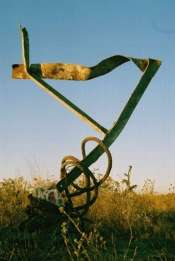
Sculpture 'Wing'Last week I wrote that self-preoccupation was something that keeps us from happiness. I'd like to go into this a bit more this week. I translated sakkaaya-ditthi as self-preoccupation. The literal translation is personality-views, or as one translator puts it, self-identify views . These are views like "I exist, I do not exist, I will exist in the future, I will not exist in the future, etc". The common feature of all of these are that they are pre-occupied with self. I've already spelled out one route away from self-preoccupation in my essay on the six-perfections. But why is self-preoccupation is problematic?

I live with six other Buddhist men in a large house in Cambridge, UK. One evening a few weeks ago we had our usual meal together, and then moved onto our weekly Wednesday business meeting. After one fairly straight-forward item we found ourselves navigating a bit of a minefield as three issues in a row were brought up which people felt uneasy or upset about. I find this stuff really difficult. I find conflict distressing, and the meeting was very uncomfortable for me. In reflecting on the best part of an hour of difficult communications, in what is typically a very harmonious household, one thing became clear: that personal preferences were at the heart of our difficulties. We all, me included, were holding out for what we wanted, for what made us feel comfortable. Often this is not a problem but on this night what we wanted did not coincide, what we wanted was in conflict with what the others wanted.

There is a powerful story of harmony in the Pali Canon called the Culagosinga Sutta. In this story three Buddhists live a very simple life together in a wood. They own very little, but what they do have is shared between them. They live "in concord, with mutual appreciation, without disputing, blending like milk and water, viewing each other with kindly eyes". [Bhikkhu Bodhi's translation] Each man makes sure that his friends' needs are met before he sees to himself. They practice acts of loving kindness with body, speech and mind, both in public and in private. And how is this concord achieved? Each one puts aside his own wishes and does what they the others wish to do. This is not too difficult for these men however because they share a spiritual vision and that guides all of their actions in anycase.

The strongest experience of harmony in my life so far was on my ordination retreat - four months in the mountains in Spain. A very regimented life. I struggled with it to be honest, but the level of harmony amongst us was remarkable because we were all giving up our preferences. It was a period of letting go of the familiar, and learning to live with what was: no running hot water for instance, or snakes slithering through the undergrowth, or blazing hot sun, or the absence of our favourite breakfast cereal. It was different for each of us, but grittily real. We also seemed very aware of the needs and wants of others. I recall feeling incredibly grateful to my friend Shantaka who regularly placed a cup of (decaf) coffee in front of me at breakfast, without my having to ask. To be seen and responded to in this kind of way is really delightful. I often felt a sense of chagrin at my own selfishness during the four months, and I came away with a resolution to be more helpful to others.

It's interesting to sit and hold these two experiences: one of discord, and the other of harmony, and reflecting on them in the light of the ideal portrayed in the Culagosinga Sutta. On the one hand I was largely self-preoccupied and that led to a painful situation. On the other I was willing to give up my self-preoccupation for the greater good and found that liberating. I once asked one of my mentors about the problem that we all face of the gap between our aspirations and how we actually behave. He told me that the way to bring them closer is through reflection. Well, I'm still reflecting, but I do find myself letting go of some of the small things and being happier as a result.
Related Posts with Thumbnails