29 July 2006

The Red Rite

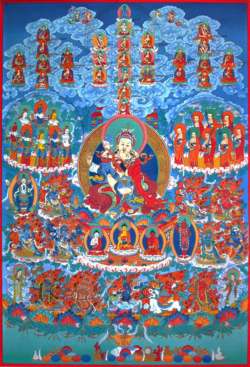
VajrayoginiRED demands our attention. The associations we have with it are powerful: blood, menstruation, sex, arousal, danger, life. The attention grabbing aspect of red means that it is employed in all kinds of warning signs and symbols. So powerful is this effect that it is difficult to see different shades of red together without feeling that they clash with each other.

In the mandala of the Five Buddhas the Buddha Amitābha is red and sits in the western quarter. He is associated with the element fire, and his wisdom is the discriminating wisdom - it sees things in their individuality, sees the detail of the world, and regards individual beings. And he is also associated with the tantric rite of fascination, the Red Rite. The 'tantric rites' are a set of magical practices of which there are several different sets. The one I know includes - purification, abundance, fascination, subduing, accomplishing; which are in turn associated with white, yellow, red, blue/black, and green; and with Vairocana, Ratnasambhava, Amitābha, Akṣobhya, and Amoghasiddhi - the Buddhas of the mandala.

These magic rites are not incidental to tantric Buddhism. Many people will try to say that they are added on, or secondary, but they feature frequently and prominently in tantric texts, and they are used in practice (according to Stephen Beyer who wrote the Cult of Tara). So how are we to understand the presence of what Snellgrove calls "vulgar magic" in Buddhism. In the Pali canon it is quite clear that the early Buddhists were very much against this kind of magic. There are several passages where the Buddha decries the practice of magic - especially that associated with the Atharvaveda. There is a clear distinction from the siddhis, the super-normal or psychic powers such as clear-audience, which are the results of profound meditation. These are relegated into second place compare to the great siddhi of Awakening, but the practice of magical spells is considered to be wicked. We must hold this along side the fact that in the Pali Canon there are magical texts, parittas, which when chanted are said to protect, for instance, from snake bite, or from attack by yakkhas and other demons. Angulimala performs a magical spell known as a "truth-act" or saccakiriya and relieves the suffering of a woman in labour in his eponymous sutta. Similarly the Mahayana sutras frequently assert that merely chanting the sutra is enough to protect the devotee from all kinds of harm. So we can't really pretend that magic is foreign to Buddhism, we just don't quite know where or how it fits.

Another feature of tantric magic which may be difficult to understand is the presence of what can only be called Hindu elements. For instance in the Tara Tantra, which is the ultimate source of the many Tara practices in Tibet, there is a lot of use of cow shit. This practice can only have come relatively late as the cow was not sacred in the Buddha's time, nor was it in the Vedas. So whence comes this foreign matter in our 'pure' Buddhism? As I've mentioned before the Indian practice was not so much to destroy heretics and competing faiths, but to assimilate them - this happened multiple times across all of the religions, and helps to account for a constant preoccupation in Buddhist scripture with distinguishing Buddhism from other faiths.

The Buddhist magical system has it's roots in the ancient Vedic religion. It is what anthropologists call "sympathetic magic", and works on the principle that the universe is divided into planes of being. The idea is that there are connections or correspondences (bandhu) between the various planes (loka or bhūmi), and it is possible to influence or control what is happening on the other planes by making changes in one of the other planes. In the Vedic practices one made ritual actions which were intended to control the gods, or to make changes in the physical world. This has many similarities to European style magic. Even in early Buddhism there is a clear association between the jhanas (Sanskrit dhyāna) and the devalokas, or god realms.

The Vedic religion gets a bad press from Buddhists, but there are aspects of it which are quite beautiful, and also shed light on Buddhist practice. The deva Agni was god of fire, the sun, the heat of digestion, of ritual, and of inspiration. As such he is a kind of counter-part to Amitābha. His name is cognate with the English word "ignite" and it was his role to transform the offerings made during rituals, and to transport them to the gods. But he was also bound to convey the blessing of the god back to the one who made the sacrifice - it was always a two way deal. Agni, then, operated in the liminal space between realms. He was, like the Greek Hermes and the angels of Abrahamic religions, a messenger between worlds or planes of existence. This explains his role in inspiration where we draw on our own depths, or perhaps make contact with the divine. As fire he transformed the physical offering into the ætheric substance which could be presented to the gods. The rite of fascination also operates in a liminal space - the space between individuals. It seeks to reduce that space, or to remove it all together, to draw beings together, so in a sense this is not just Amitābha magic, it is Agni magic!

The vulgar application of the Red Rite is as love magic. One uses the rite to obtain the love of the one desired. But coercing love does seem unethical - to say the least. So we come back to the issue of what is vulgar magic doing in Buddhism? My take on this, which is not necessarily traditional, is that the love magic is actually exoteric. The esoteric magic works within. I can't say whether magic works in the exoteric sense, I can say without any hesitation that the inner magic does work! I want to show how esoteric tantric magic might work by using two examples which are not particularly tantric:

In the seven factors of enlightenment the second factor is dhamma-vicaya - investigation of phenomena. In this scheme one becomes mindful, and then with mindfulness one investigates phenomena, and on the basis of that arises first energy, then rapture, tranquillity, samādhi and equanimity - and with the equanimity born of samādhi one is close to Awakening. What is required here, then, is interest. In order to spend time investigating the nature of phenomena, one must be interested, one must become fascinated with the minutiae of things. This is an application of the discriminating wisdom, and the act of doing it is a performance of the rite of fascination. In the kind of meditation where there is an object, we try to become so fascinated by the object that we cease to experience any distinction between our experience of ourselves and the object - and this closing of the gap is also the red rite.

My second example refers to a particular meditation practice: mettā bhavanā, the development of loving kindness. In the mettā bhavanā we seek to experience a sense of loving kindness for, and a solidarity with all beings. It is often taught as a beginners practice, but is actually profound in it's implications and has this esoteric significance that one is trying to at least attenuate, if not remove altogether, the sense of separate selfhood and self interest. What is happening in this meditation is that we are trying to will the well-being of others, without preference. And to do this we begin with ourselves, then focus on a friend, a neutral person, an enemy and then all of these together, and then all beings. Because we start with the particular and move towards the universal this is once again an application of the discriminating wisdom. We must experience this loving kindness in response to individual beings before we can attempt to universalise it, because love, kindness, well wishing are not abstract, but occur in relation to actual people. And the effect is to close the gap between ourselves and others - the red rite again!

By practising the Red Rite in meditation, we make changes in ourselves, and this in turn does actually result in changes in the objective phenomenal world. When we combine the practice of absorption with the investigation of phenomena, we do begin to see the impermanence and insubstantiality of the world - we do, in quite a straight forward way, begin to see things as they really are. And through the mettā bhavanā we can experience a narrowing of the gap - a person who we have found repulsive may seem neutral, or a dispute may be resolved because we are no longer actively hostile. This is the magic of Buddhist practice. It's not mumbo jumbo, it's not an illusion - things change when you take up practising Buddhism, and anyone can see for themselves.

Something I have left out is the space between the practitioner and their goal - this is another space in which the Red Rite can operate, eliminating the differences, for instance, between the yogin and their yiddam through constant repetition of the mantra. Perhaps I'll go into this in another essay.

I want to finish by restating something I've mentioned before about technology. The internet and the whole cellphone thing... they are about creating a sense of connection between human beings. Marshall Mcluhan said "the medium is the message". His idea was that the form of media tell us more about ourselves and our age than the contents of the media. When I look at the enormous energy (both figuratively and literally) going into our creation of communications networks what I see is a huge desire to commune. So, practice the red rite, the rite of fascination with life, with people, with things, and transform your experience of the world by narrowing the gap between 'you' and 'them'!

18 July 2006

Buddhism as a path of gracefulness

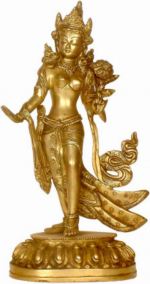
Standing TaraThis week I'd like to write about kaji. The word, as I have come to know it, is used by Kūkai in his writings as the Japanese equivalent of the Sanskrit word adhiṣṭhāna which literally means “basis". Kaji is translated by Yoshito Hakeda, in Kūkai : Major works as "grace". Now normally I get a but huffy about Christian words being used to translate Buddhist terms. So if I see abhiṣeka being translated as 'baptism', then I have this voice in my head going: nooooo! Sometimes it's out loud even. But in this case I rather like grace as a translation. Without getting into dictionary definitions I find that grace brings to mind two qualities: firstly bestowing of blessings, and secondly refinement and elegance.

Kukai explains kaji like this: ka is the compassion of the Buddha pouring our like the rays of the sun (Vairocana is an epithet of the sun in India); ji is the receptiveness of the devotee which accepts and retains the light of compassion as water retains the rays of the sun. Alternatively it is the faith (Japanese Shinjin, Sanskrit shraddha) of the devotee. So Buddhism works, in this way of talking about it, because the Buddhas offer to bestow a blessing on us, and we in turn need to be graceful in accepting, or even to be able to accept, that blessing.

The blessing of the Buddhas pours out everywhere, all the time, is sensible in every phenomena, it is in other words Shunyata, or Tathata. This seems to me to be the main point of departure from the Christian idea of God and grace. As I understand it God is supposed to sit up in heaven dispensing grace according to some scheme that cannot be understood, and that is meant to be taken somewhat literally. Kukai however seems to have a more sophisticated view of his god. Mahavairocana is all: all forms are his body, all sounds are his voice, and all mental activity is his mind, all being are simple manifestations of Him. He is omnipresent, omnipotent, omni-everything else. He is represented in human form in two main ways, according to which mandala is being referred to, with differing mudras and symbols; or he is depicted as particular Sanskrit syllables, particularly 'a' (the short 'a' sound as in the English word 'cut'); or as a symbol, such as a dharmachakra, on it's own. But at no time does one get the feeling that Kukai understands Mahavairocana to actually be these things. When he's banging on, as he does, about the Preaching of the Dharmakaya Buddha, I think we can be pretty sure he did not think of Mahavairocana as a radiantly white youth sitting on a lotus and actually talking. That image is there, but everything points to it as a symbol of some deeper reality. He says: "The subject is the object; the object the subject. The seeing is the seen, and the seen is the seeing. Nothing differentiates them" [Hakeda. Kukai : Major Works p.229-30].

The receptivity of the disciple, or ji, was what I was on about last week. As practicioners what we are doing, from this point of view, is opening ourselves up to experience the ka, the blessing of the Buddhas. Through practice we try to align ourselves with the Buddhas, to get onto their wavelength, and to 'be' like them, to the extent that they can be said to 'be' - it's more a matter of transcending being and non-being. And I think that to describe what we do as a cultivating grace works quite well really. We try to move gracefully, to speak gracefully, and, most difficult of all, to think gracefully. I must say that most days I feel about as graceful as a three legged mongrel dog, but I can appreciate the principle. And I can observe people who are more graceful than I and appreciate that grace that they have. The Buddha left a lot of instructions for acting gracefully. Most important to me are the Dasakusaladhamma - the Ten Graceful Ways of Acting, or as we call them in the WBO, somewhat prosaically I now realise, the "Ten Precepts". They re-occur several times in the Pali Canon, but interestingly enough the Shingon School also adopt the same list of ten as precepts. These precepts give a general outline of the way to act gracefully in body, speech and mind. Sangharakshita's The Ten Pillars is a better exposition of the precepts than I could give so if you want to follow this subject up just read his book.

Between us and the Buddhas, then, is a constant interaction, a transaction even. Kaji, Grace, is not the capricious gift of a God whose motivations defy understanding, on a servant who does not even deserve it: rather the Grace of the Buddhas is always given, to all without exception, in every place, at all times and in very moment; we need only have to become receptive to it in order to partake of it. This process is quite straight forward and open to everyone to pursue, although it is not always easy. The process is to train ourselves in gracefulness, to be graceful, and to become ever more graceful.

15 July 2006

The Sangha Refuge

I've been meaning to write something about the Sangha refuge for some time. The topic arose in the comments of a post on politics by Will Buckingham of thinkBuddha.org. I was arguing that one could not Go for Refuge to the Sangha of ordinary people, but only to the Arya or Noble Sangha. In response Will said:
"the problem is that, here and now, I have no idea who is arya in this doctrinal sense and who is not. Try as I might, I can only see more or less ordinary people. So where do I go for refuge? To go to refuge to an idea of the aryasangha seems to be rather limiting."
There are many possible rejoiners to this and I want to offer a couple of them. I think it is worth re-emphasising at this point that I believe, following my root teacher Sangharakshita, that Going for Refuge to the Three Jewels is the definitive Buddhist act, it is central to what Buddhism is, and it the unifying factor in all Buddhist practices. Going for Refuge is a hermeneutic device through which all of Buddhism may be understood. So this is not a trivial subject.

So, firstly if one is concerned not to Go For Refuge to an idea of something, then one must perforce Go for Refuge to something which is more than an idea, something which exists beyond the confines of our minds. This is much trickier than it seems at first. Of course one doesn't want to Go for Refuge to an idea, but when one starts to analyse one's experience, then what else is there? We interface with the world via our senses, and we perform mental gymnastics to make some sort of sense of the overwhelming jumble of impressions that flood in on us. In fact we do not ever simply relate to things as they are unless we see things as they are, and I don't know about you, but I don't think I'm quite there yet. So in Going for Refuge to something, we are constrained somewhat by the fact that we only have our mental pictures of things, coloured by our biases and conditioning. We only have ideas about things, we don't have things in themselves. This is a paraphrase of Yogacara idealism, which I would temper with a dose of Madhyamika logic: just because things are not real, doesn't mean that they are unreal. So we are left with a dilemma here. The solution, for me, is to Go for Refuge to my highest idea, my Ideal: the best and most wonderful idea that I can conceive of. I suppose that Will might say that this is hardly a satisfactory solution, and the practical help that a group of people offer is invaluable. But I think this is to mix two different arguments: ie the necessity of Going for Refuge, and the necessity of having Spiritual friends. I would say that both are important.

Personally I have already discovered the fallibility of the people in my Sangha - it never takes long does it? We might believe that our local Buddhist group can provide a refuge from Samsara, but I know of no one for whom this is a reality. We inevitably find our group wanting, and perhaps we go to another group seeking a refuge. And not finding it there, we move on again. For a refuge to be a true refuge, it must actually offer refuge. And what is a refuge? The Oxford Dictionary definition is quite simple: shelter from pursuit or danger or trouble. In the Buddhist sense we need shelter from craving, hatred, and delusion. So for a person, or group of people, to offer shelter from craving, hatred and delusion, they must have substantially overcome these evil influences in themselves. And this is as good a definition of the Arya Sangha as any I can think of. The Arya Sangha are those beings who have substantially overcome craving, hatred and delusion.

However this still leaves Will with a dilemma which he states thus: try as I might, I can only see more or less ordinary people. I sympathise with this to some extent. When I look at people I see... people. So where does one look in order to find beings who are a little more than ordinary? I look in two places. Firstly I look in the Buddhist scriptures, and especially in the Pali Canon. The Majjhima Nikaya is a good place to start since the people in them are quite recognisable in human terms, and against this backdrop the Buddha and the Arahants stand out, and shine. For some people the Mahayana Sutras are a great source of inspiration, but personally I find them a bit over the top, and less than respectful to some of my Pali Canon heros like Sariputta.

The other place I look is to my own imagination. I see the imagination as a threshold. Sometimes it's just 'fancy' and I'm just making stuff up. But other times my imaginings can begin to take on a life of there own, and I find myself in another realm. I thought the movie of C. S. Lewis's Narnia story a lot of sentimental bullshit with no great moral or logic, but I am struck just now by the metaphor of the wardrobe as a doorway into another realm where different rules apply and mythical creatures live. Funnily enough Will has just had a novel accepted for publication (Sadhu!) and is not a good novel a doorway into another realm, which through the application of imagination, we may inhabit for a little while? I find this quality of being transported will draw me back again and again to certain books: The Lord of the Rings, the Dune Trilogies, A Wizard of Earthsea, The Glass Bead Game, The Name of the Rose &c. The imagination, one might say, is the threshold of the Sambhoghakaya, and with some work one can begin to visit that realm and meet the Buddhas and Bodhisattvas "face to face" - many of the great Buddhist seers, such as Nagarjuna and Asangha, received teachings in this way, and the contents of these visions virtually define the Mahayana!

And of course the Buddhas and Bodhisattvas are reaching out to us all the time, waiting for us to to make contact with them. They are there in the tiniest mote of dust, and in the great oceans; in the sun and moon and stars; they are there in the rising and passing away of all things; the Buddha's voice is present in all sounds, and it is constantly singing the song of impermanence. If only we can open our hearts to them they are there. One doesn't see them with the eyes, one 'sees' them with the heart.

So why settle for less?

02 July 2006

White Tara's Realm

White TaraI'm just back from a week on retreat at the Rivendell Retreat Centre. It was very good to get away and experience life on retreat again. There were several stand out features of this retreat. It began with an all comers weekend looking at the Bodhisattva White Tara. Monday to Friday was an order retreat with only four of us staying on. We immediately plunged into a more intensive program of meditation, reflection and puja - immersing ourselves in the visualisation practice that we all share.

The four of us were relative strangers, two of the others were friends already, but I had not met the others, and neither had the fourth person. We were a mixed bunch: 3 men, 1 woman; 1 married with a family, one living with a partner, one living in a Buddhist community and celibate, one lodging but in a long term relationship; 1 homosexual, 3 heterosexual; 1 ordained 10 years, 3 ordained 2 years or less; two with tattoos, and 2 without. The week was extremely harmonious, and every one contributed both domestically and ritually. I was doing 3 hour-long sits, plus a long puja in the evening, as well as a lot of calligraphy, the others were doing more sitting. We were in silence from evening until lunch every day, and mostly doing our own thing when not meeting for meals or collective practice. It all just flowed naturally as though we had all known each other for many years.

I don't think that under other circumstances we would have come together at all, let alone in the way that we did. Every morning we chanted the Three Refuges and the ten precepts, and after a day or two it seemed to me that this was the root of everything. That we, a disparate bunch of strangers, could come together in the way we did was due to our common, explicit commitment to the Three Jewels. Not only did we give voice to that commitment in Pali evey morning, we spent our days making that commitment manifest and effective. And it was delightful. It was my first experience of the Western Buddhist Order in this way - as I'm just over one year old in the order. If we are all sincerely Going for Refuge to the Three Jewels, then we can have a rapport which goes beyond the incidental circumstances of our lives, beyond any superficial differences.

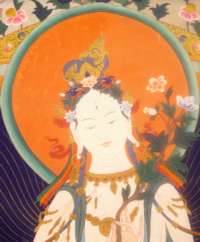
Of course we were all devotees of White Tara and this helped. The visualisation practices associated with White Tara are especially beautiful. Some of our pujas included the sadhana visualisations and created a real sense of being in Tara's realm. Over the shrine was a large White Tara Thangka and at times it did seem to shine with a kind of inner light. White Tara is, of course, white in colour. Her main characteristics are that she sits in the Vajrasana (or Diamond posture) which I associate with repose, stability, imperturbality. Her right hand is stretched out in the mudra of supreme giving, and Tara gives what you most need. Her left hand is held to her heart, lightly grasping a spray of blue night lotuses: the mudra is fearlessness and one of the special attributes of Tara is that she saves us from fear. In each palm, in the soles of her feet, and in the centre of her forehead are eyes so that she has 7 in all. The eyes represent Tara's wisdom which sees things as they really are. Sometimes they are said to enable Tara to see what needs to be given where. Also associated with wisdom are the five gems that she wears in a tiara in her hair - the five wisdoms of the Buddhas are her decoration. Finally above her head, or sometimes actually tucked into her headress, is Amitayus (Infinite Life) who is a reflex of the Buddha Amitabha (Infinite Light) the red Buddha of the western quarter who represents compassion. The symbolism is very rich! As with all Bodhisattvas, White Tara's body is made of light, and she appears in the clear blue sky of Shunyata seated on white lotus.

It's difficult to pin down exactly what the status of Bodhisattvas is. Are the real in the sense that this table top is? Or are they just imaginary? Or are they gods or angels or devils? I don't have the answers to those questions. I certainly have felt White Tara's presence in my life, and once or twice caught a glimpse of her. In setting out to meet her I go through the usual meditative process of calming my mind and body down, and engaging my imagination. But an actual meeting with Tara goes beyond imagination and takes on a life of it's own. It's as though the imagination is simply a gateway into another realm...

All in all it was a very positive week, which I certainly needed. A year on from ordination I received a very strong confirmation that despite any difficulties I may encounter, that I am on the right path, and in the right Order, and even in the right country (for now). I felt a lot of gratitude to Sangharakshita, Sona, Nagabodhi and my other spiritual friends and teachers; and to my protectress, Tara.


om tare tuttare ture svaha

11 June 2006

Hope

Self-portraitI've been going through a rather bleak, albeit creative, period lately - a bit of a crisis really. My dilemma is that I have a day job which pays the bills but which is dull and uninspiring, and I have this other job which involves managing my various websites, writing raves, and doing various art and music projects, which is enormously inspiring and fulfilling, but which currently doesn't pay anything. Actually that's not quite right because my 'hobbies' actually cost me money. Much of my 'work' is not self-centred, but involves creating resources for my my Sangha - a Yahoo discussion group here, an online newsletter there, and most recently an extensive website on the calligraphy of mantras and seed syllables.

And I find it difficult to see how I can turn my 'work' into a livelihood. As well as being worn out from doing two jobs, and feeling stuck, I have experienced quite a lot of despondency lately. I'm told, but have never found the source, that despondency is a form of laziness. That it's just giving into self-pity. And that is true to some extent. But to me there is something more to it. I think despondency is failure to see that things change.

Which brings me to my theme this week. In order to maintain my energy and enthusiasm in the face of adversity I have to believe that I can win, that I can through my labours at least make headway against the current which drags me along - the current of worldly values, of conformity, of negativity, of greed, hatred and delusion. And why? Because if there is no possibility of making progress then striving is pointless. Back in the days before ethics committes, a bunch of psychologists tormented dogs by giving them electric shocks. Some were able to stave off being shocked by doing some action such as pressing a lever. However if the lever stopped working, they soon gave up trying. The dogs just became gibbering wrecks who cowered in corners and accepted the torture with a whimper - ie the dogs understood that nothing they did could stop the torture, and they just gave up. I'm thankful that we now have ethics committees, but it I think this example, gross as it is, graphically illustrates the point. We need hope that things can change and/or that we can change them.

Now this identifies me as someone who does not hold with the style of Buddhist practice in which there is no goal, no need to do anything, just be, blah blah. There are a number of ways in which I find this approach unsatisfactory. When I have asked people espousing this view why they bother to practice I have never had a sensible answer. And this is crucial because these people often practice a lot. Why bother to spend all that time sitting if there is no point? Anyway I ain't one of them.

The possibility of making progress - how ever we define progress - is important. This kind of basic Buddhism really works for me: there is suffering (yes there sure is!); there is a source of suffering which is ______ (choose your poison); there is an end to suffering, which involves removing the poison; the way to end suffering is the Noble Eight-fold Path. Leaving aside a detailed exposition on the Eightfold path, isn't that a great concept for anyone who is suffering? That suffering can end is highly motivating for me. The Eeyores who focus on the first of the Noble Truths, are missing the whole point. The Noble Truths as a set really do get me excited because they offer hope. They acknowledge suffering (unlike some of the 'no goal' kin, who also espouse a sort of no 'suffering' deal as well) and then they offer some hope that suffering - this present suffering as well as any possible future suffering - can stop.

At this point we're just taking it on faith. It sounds good, and we've got the cheque book out and we're keen to sign up to this whole Eightfold Path deal. Can't wait. But the Dharma isn't quite like that. What happens next is a bit more refined. Someone, or maybe even a book, says "OK, do a little of 'this', and see what happens". 'This' may be meditation, or sutra chanting, or basic mindfulness, or puja, or just being gratuitously kind and generous. So we do a little, and we find that ... we feel a bit different... a bit better/happier/saner (or whatever). Now this is really exciting because not only do we have Sacred Scripture, and Holy Water, and maybe some exotic guru, but we have actual personal experience of the path working for us. We don't need to believe anything which makes no sense, which feels wrong, or which runs counter to our experience - perhaps this is why Buddhism got a reputation as a rationalist philosophy. Actually some of the practices are pretty weird, and some of the traditional beliefs are just as dodgy as anything in the Bible, but the important thing is not what you believe or don't believe, it's how you practice and the fruits of that practice.

I think the most important insight that comes from practice is that actions have consequences - ie what we do, or don't do, influences the future. The world is not just a totally random series of events, and neither is it rigidly determined. We have influence to the extent that we choose our actions, and we have choices to the extent that we are aware. And, I would say, we have hope to the extent that we are aware and able to make choices.

So when I lose sight of this important insight - that things change, and that I can at the least influence that change - then I just give up and, like those poor bloody hounds, sit in a corner and whimper. This is Mara temporarily winning the battle against the Bodhisatta (if I may be so bold as to cast myself in that role). Fortunately I seem to have some kind of keel these days that flips me right-side up after a bit. I call this Saddha - the faith that things can change and that I can influence that change in the direction of Awakening. Saddha, is a specific kind of hope born of practice and observation. This is the benefit of practice, that a habit of awareness gives you choices in any situation. In any life the winds of the world can blow strongly, and temporaily overwhelm us. But by building up awareness over years, we lay down a keel that will right us eventually.

It's good to be right-side up again, and to be full of hope and inspiration. Awareness is revolutionary, eh!

03 June 2006

Authentic Happiness

Recently I've been reading Martin Seligman's book Authentic Happiness. Seligman is a psychologist (as opposed to a psychotherapist) which is to say that he is a scientist who studies the psyche. Psychology typically focuses on dysfunction and negative emotions, but Seligman had a change of heart about 10 years ago and started studying positive emotions, and has developed what he calls "Positive Pscyhology".

Something that has stood out for me is Seligman's summary of what scientific (ie controlled, double blind etc) studies have shown is the importance of nature and the environmental factors, and in particular the way past experience, especially childhood experiene, impacts on the adult psyche. Freud famously associated adult unhappiness (I'm going to use this term very loosely!) with childhood unahppiness - the events of our childhood, so the theory goes, shape the person that we are. This approach assumes that we are all born as a tabula rasa on which events write out the person that we will become.

And so eventually, after decades of just accepting this on face value - because after all it sounds quite reasonable doesn't it? - some psychologist went looking for the effect. They studied children, followed them into adulthood, and most interestingly searched out twins that had been raised apart, and adopted children. And what they found is the events, the traumas even, of childhood are actually very poor predictors of adult success and happiness. Seligman says: "The major traumas of childhood may have some influence on adult personality, but only a barely detectable one. Bad childhood events, in short, do not mandate adult troubles". [Authentic Happiness p.67]. The studies seem to show that rather than events and upbringing (ie nuture), our response to past events is highly correlated to how our parents responded, suggesting a genetic (ie nature) link. This is reinforced by stydying mono-zygotic twins raised apart who are always more alike to each other than to other siblings however they were raised, and by studies of adopted children who are always more like their birth parents than their adopted parents.

This genetic link is important because it is how we respond to our memories, how we think, reflect on, and consider, our memries which is a strong conditioning factor in whether we are happy or not. We are born with a predisposition to dwell on the past in positive or negative ways. However Sleigman's whole book is predicated on the premise that it is possible to change this response. Scientific studies, again, show that it is possible to recognise that dwelling on painful past events is causing us to suffer, and that by changing our focus - Seligman highlights the importance of gratitude for instance - we can change our experience of that past and be happier. So depsite being born with certain tendencies we have the capacity to over-ride these and substitute more positive tendencies.

Now this rave is written by a Buddhist and with Buddhists in mind, and anyone who knows a bit about Buddhism is going to be finding this quite a familiar idea. There's no suggestion that Seligman is a Buddhist, he's working this out from studying people. Interesting, eh?

Seligman goes on to discuss other things that do or don't make for happy people. More money, material possessions, more education, gender, class and geography are poor predictors of happiness. Some of the poorest people in the world report being no less happy than some of the richest, although there is some geographical variation in this: the poor in the third world, and typically happier then the poor in the first world.

One factor which is a good predictor of happiness is religosity. Religious people do tend to be happier, and the more religious they are the happier they report themselves to be. There is some objective evidence for this as well since they tend to be healthier and more long lived, and to have lower levels of "mental illness". So why should religious people be more happy? It turns out to be related to hope. Religious people aremore optimistic about the future - and isn't a lot of religion aimed at this? Buddhism too is soteriological and teleological in it's outlook. We practice in order to experience less suffering, in order to have more meaningful life. And we achieve it, so we are happier. Well more or less and on average anyway.

This aspect of hope is one that interests me and one that I'd like to come back to at some point. Because one school of Buddhist thought suggests that thinking about the future at all is counter productive and that we just need to live in the present moment and be fully accepting of whatever is happening. Pema Chodron, perhaps a little tongue in cheek, goes so far as to suggest that we adopt the aphorism: Abandon hope [in When Things Fall Apart]. Although I rate the Ven Pema highly, I'm not so keen on this approach. I think if there is something we can reasonably do about our pain and suffering then we should go ahead and do that. Simply staying in pain and being equanamous about it seems eminently impractical. If you are on fire it makes more sense to jump in a lake, than to stand there reflecting that from the ultimate point of view there is no fire and no pain (or whatever).

Anyway I'm enjoying Authentic Happiness. The book is backed up by a good website where you can take the myriad psychological tests that appear in the book, and it keeps track of your responses over time to see if things do actually change. His other book Learned Optimism also sounds intriguing.

27 May 2006

Studying the Dharma

The Scholar by Domenico Feti (b. ca. 1589, Roma, d. 1623, Venezia)Today I want to look at some aspects of the study of the Dharma. This is one of my main practices, and one of my favourite acitivities. Study as a practice has both great benefits and great pitfalls. Studying texts tends to be seen as a poor substitute for 'real practice', but I want to try to show that this is poorly informed.

Buddhism is very much a heterodox tradition, full of contradictions and different approaches. Without an historical perspective on the development of Buddhism it is difficult to make sense of these contradictions. So for instance I can't take seriously the statements of successive Buddhist sects which suggest that all other sects teachings are merely provisional and that this new teaching is the "True Teaching of the Buddha". I think of this as not taking the tradition on its own terms. In terms of outlook I am in the Mahayana camp, informed by the Vajrayana, but in terms of how I actually practice I am what has been called, rather rudely, a Hinayanist. If I bought into the various Mahayana or Vajrayana critiques of early Buddhist practices then I would probably feel a bit insecure. But I do not accept those critiques because having looked at the Mahayana critique, for instance, I can see that it is aimed at a caricature, and that later Buddhist writers had no idea about how the early Buddhists actually practiced. Similarly with the Vajrayana's claim that their teachings were delivered by the Buddha himself, but only to disciples of superior ability, it seems clear that this cannot have been the case. Later Buddhism was the product of interaction with other religious traditions both within and without India. In India this was the norm - traditions heavily influenced each other, cults were assimilated (as they were by the Greek and Romans), and especially after about 800 BCE exploration was encouraged.

So here we are in the present with all these stories, practices, and cultural presentations of the Buddha's Dharma. One approach in the West has been to adopt a sectarian appraoch - to take on Zen, or Tibetan, or Theravadin, Buddhism holisbolis. On the other hand some people try to look critically at the traditions and to take what seems useful, and to adapt it to the present time and place. This seems to me to be the best approach. Otherwise we loose sight of the way the presentation of the Dharma has, sometimes radically, changed over the centuries and mistake one particular form of it as being superior to the others when it may simply be different. My inclination is not to accept any practice as being superior to any other practice. So when a Tibetan Lama tells me that the instructions for painting thangkas were given by Shakyamuni Buddha and cannot be deviated from, I have to weigh that against archeological evidence that images of the Buddha were not made for several centuries post-parinibbana, and evidence from the books that I have that Tibetan images of the Buddha vary dramatically across time, place and tradition.

When it comes to texts in translation we are in even more difficult territory. I got interested in this area when comparing Stephen Bachelors's translation of the Bodhicaryavatara from the Tibetan version, with Marion Matics' translation from the Sanskrit. Although the general drift of the two was similar, the details vary considerably. We tend to see a text as a static document - both Judeo-christian culture and the various Buddhist traditions encourage this view of texts. But Buddhist texts were usually living, growing documents. The Pali texts were not written down for several centuries and show signs of having been edited even before that time. Pali was not the language of the Buddha, and so they have gone through at least one translation, and manuscripts with significant differences, not to mention copyists errors exist. The Mahayana texts frequently exist in several different versions and there seems to have been a tendency to incorporate more and more material into them, and to restruct the verses and chapters according to schemes unknown.

This situation led me to learn a little Pali and to start to delve into the Pali texts. I realised for instance that there exists no completely satisfactory of the Karaniya Metta Sutta - there is no one translation which manages to convey all the subtleties which lurk in the Pali words, and even the two dozen or so that I have collectively fail to convey certain aspects. Umberto Eco has referred to translation as "a negotiation". It is a compromise between many competing goals. Lately I have been working with translations of Kukai texts. Kukai wrote in an elaborate form of ancient Chinese, but is frequently translated into English from Japanese translations of the original Chinese. In a small number of cases I have two or more translations which I can compare. One translator has gone out of his way to convey the meaning of the texts, and another seems to have stuck to the literal meaning of the words, but is idiosyncratic in his choice of English equivalents. Another seems to find an easy middle way between these two approaches; and yet I am sure that in at least one case his choice of English words is motivated by trying to prove a particular aspect of the thesis which underlies his book, and this skews the meaning towards one that I feel sure was not intended by Kukai. I recommend Yoshito Hakeda's translations if anyone is interested.

So in studying Buddhism we are faced with some major challenges. Buddhists traditions are sectarian and literalist. We face great uncertainty: for instance the margin of error for dates are frequently given in centuries - the birth of the Buddha being a case in point. Texts were once living documents that changed over time and place, were edited by sectarians, and are often only known to us via multiple translations, all of which leaves the 'meaning' very fuzzy. But this is just like life isn't it? What we assume to be essential and permanent turns out not to be so. Through studying with this kind of critical eye we are confronted with the nature of reality, and by immersing ourselves in study we can begin to see things as they really are.

13 May 2006

Wesak

The full-moon this month marks the 2550th anniversary of the most crucial moment in the biography of the Buddha - his Awakening to the true nature of things. For some Buddhists the Wesak festival marks not only this, but also his birth and death. All over the world under the full-moon there will be solemn ceremonies, lively pujas, silent meditation, a huge variety of celebrations.

While every aspect of the Buddha's biography has some significance, his Awakening is the reason that we remember him at all. Buddha is often translated as "Enlightened" but this English word, with all it's baggage from the intellectual movement of 18th century Europe, is not at all related to the original word. Buddha, and the related word bodhi, come from a root which means awake. So a Buddha is one who has awakened, and bodhi is to be awake.

'Awakened' is a metaphor which hints at the nature of the Buddha's experience on the full-moon day in may 2550 years ago. It suggests that before this experience he was asleep. The experience of going from sleep to awakening, in the ordinary sense, is significant. In sleep we are not conscious of the world around us, the world of the senses. We alternate between deep sleep in which we are barely conscious at all, and dream sleep in which we experience a different level of reality. In dreams the usual rules of our world, rules of physics or chemistry etc do not apply. In dreams we can meet the past or the future. When we awaken there is a definite sense of crossing a threshold. The transition from sleep to waking can leave us disoriented for a time. Then when we are awake we are aware of the data of our senses, and we experience the world as being more or less sequential and ordered. We, generally speaking, do not meet the past or the future, and the laws of physics hold true. The details are moot, of course, but the experience of going from sleep to waking is one that is common to everyone, and one that is marked and distinct.

So waking is a metaphor for what happened to the Buddha. One of the ways the Buddhist tradition speaks of this difference is the three marks or lakkhanas. When we are asleep we see the world as substantial, permanent, and a source of pleasure. However when we wake up we see that things are impermanent, insubstantial, and are a source of suffering.

We do tend to see things as permanent. We can catch the view that things are permanent in, for instance, our shock at the death of a friend or relative. We have always known that they would die, and yet we are shocked and surprised when they die. This sense of surprise is a result of having an unconscious expectation that they would not die. We resist change, and this again exposes the view that things ought not to change. Change is the fundamental condition of the universe. And because everything whatsoever changes, there can be no unchanging thing - no essence which transcends form and function. This is particularly important in the case of people. We are often said to have an eternal soul or essence which transcends our physical life and death, even our repeated life and death. But if there was one thing in the universe which did not change then the whole universe would freeze solid. This is because everything in the universe is dependent on the other things to create the conditions for existence. This means that if one thing is changing, then everything is forced to change. And if one thing did not change the whole universe would freeze solid because it would inhibit the changing of other things.

It is not that phenomena are inherently or fundamentally a source of suffering. They are a source of suffering because of the false expectations that we have of them. If we expect phenomena to be permanent, transcending form and a source of pleasure, then we are constantly disappointed. If however if we align our expectations with the true nature of things - impermanent and insubstantial - then phenomena may still cause us pain (if we stub our tow on them for instance), but it's not inevitable.

So this is one way of talking about the way in which the Buddha woke up under the full-moon in May 2550 years ago. Happy Wesak.

Sabbe satta sukhi hontu
Related Posts with Thumbnails