22 November 2007

The Green Rite

Some time ago I was in the British Museum where they have a number of stone carvings from the stupa at Amaravati. The carvings are old and worn but you can still see the exquisite skill with which they were created and get a sense of the wonder that the stupa must have been. What an extraordinary focus for feelings of devotion that stupa must have been. The friend I was with, and I, could occasionally make out details from stories which the carving depicted. At one point as I walked along I saw a very worn carving but which stood out very clearly as being a story from the Pali Canon about the Buddha. It showed the Buddha, barely visible through the wear, standing in front of an elephant that was clearly kneeling before him in supplication.

In the story the Buddha’s cousin Devadatta, who wishes to succeed the Buddha as leader of the monks, arranges for a large bull elephant in rut to be let loose in the market place as the Buddha is walking through it. The elephant is enraged and charges about causing havoc and everyone runs for their lives. However the Buddha stands his ground. The elephant sees the Buddha, a slight figure, standing there and charges towards him. The Buddha simply stands his ground and as the elephants gets closer he lifts his hand and holds it palm outwards. Radiating loving kindness towards the elephants he is totally unafraid of death, or being hurt. As the elephant approaches it is overcome by the outpouring of love and fearlessness in his direction , he slows, and then comes to a standstill. And then he bends down and places his head on the ground at the feet of the Buddha.

This is the archetype of the Green Rite, the Rite of Fearlessness. The Green rite is associated with the Buddha Amoghasiddhi whose names means infallible success. His mudra is the mudra of fearlessness. Notice that the hand is not extended like a policeman stopping traffic. The hand is held palm outwards at the heart - it is not a command, or a demand. It is an offering.

The Green Rite is not one of the original Tantric Rites. For instance the Mahāvairocana Abhisambodhi Uttara Tantra has pacifying (white), enriching (yellow), subduing (red), and fierce (black) rites. The Four Rites correspond to an old Vedic classification the varṇas. They correspond to the four basic castes as outlined in the Puriṣa Sūkta of the Rig Veda for instance: Brahmin, Kṣatriya, Vaisya, and Śudra. However when Ratnasambhava and Amoghasiddhi joined Amitābha and Akṣobhya on the mandala two more rites were added - for instance the Tara Tantra has six.

In the Rogue Elephant story the Buddha pacifies the Elephant by radiating maitri or love - which could be seen as an example of the Red Rite. This demonstrates the way the Dharma transcends any particular teaching. However underlying the Love of the Buddha is his transcendental Insight - his knowledge and vision of how things are. It is from this direct knowledge that his fearlessness arises, and that makes all his actions successful. The Buddha knows that he has nothing to lose, that even death itself does not terrify him the way it does the rest of us. He sees everything as it is and therefore does not cling to any experience, nor push any away. Any action undertaken from this point of view is bound to succeed, because success is judged in terms of results, and acting from insight guarantees a positive result.

For ordinary mortals the Buddha left guidelines for acting until direct insight guides our actions. These are the various ethical or moral teachings. These vary from the "ordinary common sense" approach which is typified in the early verses of the Metta Sutta, to the the long lists of precepts in the Bhikṣu Pratimokṣa, and find a sublime expression in the Ten Skilful actions (dasa-kusala-karma) which form the Ten Precepts of the Shingon School and the Western Buddhist Order. Once again there are cross-overs with the other rites, but the special quality of the Green Rite is that it is active. Whereas in the White Rite for instance we may say that it focuses on purity and refraining from evil actions; in the Green Rite we must actively express love and kindness. If Gratitude and Generosity are the key aspects of the Yellow Rite, then we may say that acts of kindness and selfless love are the marks of the Green Rite.

Meeting fear is a key part of the spiritual life. As we practice we are very likely to find fear arising. The Green Rite tells us the way to deal with fear. It is to dwell in love, to radiate love, and to act out of love. Acting from love guarantees success, because in Buddhist terms success is acting with love.

01 November 2007

The Essence of all Mantras

I declare that A
is the essence of all mantras,
and from it arise mantras without number;
and it produces in entirety the Awareness
which stills all conceptual proliferations.

The Mahāvairocana Abhisaṃbodhi Tantra
translated by Stephen Hodge (XVIII.3, p.326-7)


I was fortunate enough to attend a lecture by Professor Richard Salomon recently. He heads up the Early Buddhist Manuscripts Project which is based around Kharoṣṭhī script manuscripts from Gāndhāra and in the Gāndhāri language. These texts which are held in the British Library are very old, dating to the 1st or 2nd century common era. Gāndhāra is a very interesting area, having been the entry point to India for immigrants, traders, and invaders for many centuries. So it was a very rich and diverse culture. Kharoṣṭhī was the first script used to write India languages, and that it was derived from the version of the Aramaic script used by various Persian conquerors. In Kharoṣṭhī there is one sign for an initial vowel - the short a. To indicate other vowels one uses diacritic marks, in the same was that medial and final vowels are indicated by diacritic marks on consonant signs. Kharoṣṭhī was later displaced by Brahmī from which all modern Indian scripts (as well as most South-east Asian scripts, and the various forms of Tibetan writing)

Regular readers will be aware that I've been interested in the Arapacana alphabet for a while. One of the features of the Arapacana is that is has only one initial vowel sign. Professor Salomon has shown that this is almost certainly because it was the alphabet of the Gāndhāri language which was written in Kharoṣṭhī. It seems that this is a related to the absence of initial vowels in the Aramaic script - they are not used in Semitic languages. When designing a script to write Buddhist texts one needs to be able to write initial vowels, for instance: evam mayā śutam (Thus have I heard which begins all Buddhist sūtras). Brahmī scripts use a different sign for each vowel (although long vowels are indicated with diacritics marks in most cases).


Kharoṣṭhī vowels
a i u e o ṛ aṃ
Kharoṣṭhī created a single vowel sign on the model of the consonant signs - it is simply 'a' if unadorned, but can become any vowel with diacritic marks.


The quote at the beginning of this post may not be familiar, but the sentiment might be. The letter a has this special place in Buddhist thought and practice. One explanation is that the letter a, when added to the beginning of most Sanskrit nouns, it turns them into their opposite: vidya is knowledge, while avidya, is ignorance. This allows us to use the letter a to stand for the Truth which cannot be fully comprehended by language: it is possible to negate any definite statement about the transcendental (including this one!).

However I don't think this alone accounts for the notion that the letter a is the source of all mantras, if only because the a- prefix for verbs usually indicates the imperfect past tense rather than any sense of negation. Another idea relates to the way that Indic alphabets attach an inherent short letter a to each consonant. So the Sanskrit consonants are written as syllables or phonemes - called akṣara - (e.g. ka kha ga gha ṅa); not simply letters (e.g. k kh g gh ṅ). As in Kharoṣṭhī, medial and final vowels are indicated by diacritic marks. This is quite a good way of looking at it, but there is still a slight flaw which involves the vowels.


Sanskrit vowels in Siddhaṃ script
a ā i ī u ū e ai
o au aṃ aḥ ṛ ṝ ḷ ḹ
अ आ इ ई ए ऐ
ओ औ अं अः ऋ ॠ ऌ ॡ
The vowels, except for ā, aṃ and aḥ , can't really be considered to derive from the letter a. All vowels are similar in that they are voiced similarly - differences in sound are due to shifts in the tongue and lips changing the resonant frequency of the vocal track, but it doesn't seem to be enough to consider, say, the letter ī to derive from the letter a. Graphically the vowels are mostly not related to the shape of the letter a either. This is all true of the Brahmī derived scripts. It is not quite true for Kharoṣṭhī however because of the single initial vowel.

My suggestion is that the special function of the letter a in Buddhism is a relic of the Gāndhāra area. It is only in Kharoṣṭhī that all signs for letters derive from, or contain, the short a.

One piece of supporting evidence comes from the Sūtra of Perfect Wisdom in 25,000 Lines. This sutra was probably composed in the 2nd or 3rd century, and is preserved in a variety of Sanskrit originals, as well as in Tibetan and Chinese translations. In the sūtra the alphabet is used as a mnemonic for a series of reflections on the nature of phenomena. Each letter is indicated by a keyword starting with that letter; and each word is the basis for a line of verse. Being a Sanskrit text one might expect the Sanskrit alphabet to be used, but it is not. The alphabet is a partially Sanskritised version of the Arapacana alphabet. Even in the fully Sanskritised version of this practice - present for example in the Mahāvairocana Abhisaṃbodhi Tantra - the vowels are sometimes left off so we have the Sanskrit consonants, but the letter a as the only vowel. The tradition is preserved and the trail seems to lead back to Gāndhāra, at least on Indian soil.

I say "on Indian soil" because the use of alphabetical verses, that is to say verses in which the first letter of the first word of each line are in alphabetical order (a kind of acrostic) is unknown in pre-Buddhist India. Verses were organised by length, and by numerical schemes, but not alphabetically. Verses were arranged alphabetically in Semitic cultures, so there are Old Testament psalms and Manichean hymns with verses in alphabetical order. Which brings us around in a circle to the Semitic origins of Kharoṣṭhī.

The letter a, then , is the source of all the other letters in the alphabet; and the alphabet is the source of all the mantras - hence the composer(s) of the Mahāvairocana abhisaṃbodhi Tantra could say that "from [a] arise mantras without number".

If you'd like to learn to write the letter a in the Siddhaṃ script then visit my other website: visiblemantra.org

image: Siddha letter a from AKARA : The Quest for Perfect Form
(although it looks identical to one in John Steven's book Sacred Calligraphy in the Eastempty img for amazon associates, p43.)

17 September 2007

The Heart Sūtra - Indian or Chinese?

In this post I want to call attention to an important article, now over 15 years old, but with hardly any recognition outside academic circles. The article is:

Nattier, Jan. (1992). "The Heart Sutra : a Chinese apocryphal text?"Journal of the International Association of Buddhist Studies. Vol. 15 (2), p.153-223. https://journals.ub.uni-heidelberg.de/index.php/jiabs/article/view/8800

Jan Nattier (left) is Associate Professor of Religious Studies, Indiana University, and a scholar of great merit and interest. The article is a fine example of contemporary scholarship, meticulously reasoned, well structured, and typically for Nattier, well written. This last is a strong feature of Nattier's published work - she can write very well. However the article also offers a startling conclusion with wide implications for Buddhists.

The main argument of the article is that the Heart Sutra was composed in China, incorporating some verses from the Chinese version of the Large Prajñāpāramita text, and back translated into Sanskrit sometime in the 7th century. Nattier also offers an explanation for the two different versions, one longer and one shorter, of the Heart Sutra. Page references are to Nattier's article.

Nattier focuses initially on the shorter version of the Heart Sutra. This has several problematic features which distinguish it from sutras generally and the other Prajñāpāramita sutras in particular:

  • it does not begin with "thus have I heard"
  • there is is no audience reaction at the end of the sutra
  • the Buddha makes no appearance 
  • Avalokiteśvara, the bodhisattva of compassion makes an unexpected appearance, while the usual characters of Prajñāpāramita sutras (such as Subhuti) do not
  • the sutra contains a mantra, which few other Prajñāpāramita sutras do, and then only the later tantric sutras. 

Any explanation of the origin of the Heart Sutra should provide some insights into these oddities, and Nattier's article does just this.

It has been known for centuries that the lines beginning with "form is not other than emptiness" and ending with "no knowledge and no attainment" are quoted from the Pañcaviṃśatisāhasrikā Prajñāpāramita , or Perfection of Paragnosis in 25,000 Lines (hereafter the Large Sutra). The first reference to this borrowing is in a Chinese commentary from the 7th century [note: this is a reference ot the commentary by Kuiji, T 1710]. 

Nattier spends quite some space looking at the various versions of these lines. They occur in four places:

  • Sanskrit Large Sutra (using the oldest extant manuscript from Gilgit)
  • Chinese Large Sutra (trans. by Kumarajiva)
  • Sanskrit Heart Sutra (Conze's critical edition)
  • Chinese Heart Sutra (trans. Hsuan-tsung)

Nattier makes several comparisons. Firstly the Chinese Heart Sutra and the Chinese Large Sutra. These are laid out side by side and even without being able to understand the Chinese characters, it is obvious that they are virtually identical. Next the Sanskrit Heart Sutra and the Chinese Heart Sutra are compared and we find a "virtual word for word correspondence" (p.160). However comparing the Sanskrit Large Sutra and the Sanskrit Heart Sutra we find many differences of vocabulary and word order, although the meaning is synonymous. An example is:

Sanskrit Large Sutra : (na)anyad rūpam anyā śunyata / nānya śunyatānyad rūpa
Sanskrit Heart Sutra : rūpān na pṛthak śunyatā / śunyatāyā na pṛthag rūpam

In the list of negated dharmas [i.e. not arising, not ceasing], the Sanskrit Large Sutra uses singular verbal forms, is more repetitious and slightly longer; while the Sanskrit Heart Sutra uses plural adjectival forms, and is shorter and more succinct. Almost every word, barring some very well known technical terms such as śunyata, are different. Conze explains the differences in repetition as a process of summarising, however Nattier contends that this runs counter to the general Indian tendency to elaboration. In any case the changes in vocabulary are unprecedented and "there is no straight forward way to derive the Sanskrit Heart Sutra from the Sanskrit Large Sutra, or vice versa." (p.167)

The best way to understand the progression is that the verses moved from the Sanskrit Large Sutra to the Chinese Large Sutra, and thence into the the Chinese Heart Sutra, and finally into the Sanskrit Heart Sutra. Which is to say that it is far more plausible on philological grounds that the Sanskrit Heart Sutra is a translation of the Chinese rather than the other way around.

Nattier proceeds to marshal supporting evidence for this conclusion beginning by considering known examples of back-translation - these are plentiful in Mongolian scriptures apparently. An important sign of back-translation is the choice of "unmatched but synonymous terms" (p.170). Also there may be occurrences of incorrect word order, grammatical errors point to the under lying language. In this case the evidence points to the Chinese Heart Sutra as being a likely intermediary between the Sanskrit Large Sutra and the Sanskrit Heart Sutra: where the former has nirodha (extinction), the latter has kṣayo (destruction) while the Chinese Heart Sutra has chin [i.e. jìn 盡] which can be a translation of either. This turns out to be true for each synonym in the Sanskrit texts.

Historical evidence also supports the argument. Indian commentaries* cannot be dated to before the 8th century, while there is no independent evidence such as quotes in other texts which might place it earlier. By contrast Chinese commentaries are definitely dated in the 7th century, and "..the existence of the Heart Sutra is attested in China at least a century before its earliest known appearance in India" (p.174)

* i.e. the Indo-Tibetan commentaries; there are no Indian commentaries. 

However, there are still some problems. In particular, the Chinese were usually very particular when composing apocryphal texts, taking a lot of effort to make them look like Indian sutras, and yet the Heart Sutra clearly lacks many important features. Nattier cites a Japanese study (by FUKUI Fumimasa) which she says make a strong case for reconsidering the Chinese title of the Heart Sutra: hsin ching [i.e. Xīn jīng 心經]. Fukui says this should be understood not as saying that the text is the heart, or essence of the Prajñāpāramita tradition, but rather represents a dhāraṇī scripture, i.e. simply a text to be chanted. It is clear that this has indeed been the function of the text since its earliest mentions. The missing attributes (such as the "thus have I heard") are less of a problem if we accept that the text is not even attempting to be a sutra.

Most of the remaining problems occur in the portion of the text which surrounds the quoted verses - what Nattier calls "the frame". She seeks to show that it is plausible for the frame to have been composed in China. For instance the presence of Avalokiteśvara: this is quite consistent with devotional Buddhism in South West, 7th century China, and his presence is less surprising if the text is a devotional text for chanting rather than the essence of the Prajñāpāramita tradition. The presence of the mantra also marks out the Heart Sutra as different. Nattier points out that the mantra is present in at least three other Chinese texts, and the epithets of the mantra also exist independently. (p.177). The point being that the presence of a mantra need not rule out a Chinese origin.

I think this is the only place where Nattier misses a trick. Donald Lopez, for instance, has commented on the lack of coherence between the mantra and the text.

"The question still remains of the exact function of the mantra within the sutra, because the sutra provides no such explanation and the sadhanas make only perfunctory references to the mantra". - Lopez. The Heart Sutra Explained. p.120.

The mantra is not of a piece with the sutra, but appears to have been tacked on. Further Alex Wayman has noted that commentaries on the text lack coherence:

"The [commentators] seemed to be experiencing some difficulty in exposition, as though they were not writing through having inherited a tradition about the scripture going back to its original composition" - Secret of the Heart Sutra p.136

These observations only strengthen the impression of a text appearing suddenly without a history of exegesis to be referred to. But, back to Nattier's article...

Another feature which supports the idea that the frame was written in China relates to phrases such as satyam amithyavāt which Conze translates as: "[It is] true. For what could go wrong". This is clearly an awkward phrase both in Sanskrit and in English translation. The Chinese—chen shih pu hsü  [i.e. Zhēnshí bùxū 真實不虛] or "genuine, not vain"—however is "entirely natural in Chinese". As Nattier says:

"The Heart Sutra thus diverges from anticipated Sanskrit usage, offering instead a precise replication of the word order of the Chinese" (p.178)

The final mystery is the existence of the two versions of the sutra. The evidence is good that the short version was the one which was most prominent version in China. All of the extant Chinese commentaries are based on the Hsüan-tsang's (or Xuanzang) 'translation' of the short version. If we accept the idea that the sutra was back-translated into Sanskrit after being composed in China, then the long version makes sense in the face of Indian criteria for authenticity - which include the appropriate opening, the presence of the Buddha, and the audience reaction to the discourse. The long version supplies all these features that are missing from the short version. From the Indian point of view the short version is not a sutra at all - which fits with the idea that it was not intended to be one.

On purely philological grounds it seems that the Heart Sutra was composed in China around the lines quoted from the Chinese version of the Pañcaviṃśatisāhasrikā Prajñāpāramita. Internal textual evidence supports this conclusion, as do historical considerations. In short everything points in the direction of the Heart Sutra being a Chinese liturgical text which only became a sutra on being back translated into Sanskrit, probably in India in the late 7th century. What is more, the most problematic features of the sutra become comprehensible if we accept this view.

Nattier spends several pages exploring the role of Hsüan-tsang in the popularisation of the text: it was certainly a favourite of the pilgrim/translator, and he did know it before he left on his trip to India. It seems likely, though it is not proven, that it was Hsüan-tsung himself who introduced the text to India and translated it into Sanskrit when he discovered that the Indians lacked it. We know that exactly this happened in the case of another Chinese apocryphal text, the Awakening of Faith in the Mahāyāna, which he translated into Sanskrit during his stay at Nālandā.

To those amused, or perhaps alarmed, by this apparent forgery, Nattier points out that "it is now becoming clear that the Chinese were avid producers as well as consumers of Buddhist sutras... and indeed evidence is accumulating for an important backwash of Chinese Buddhist influence into Central Asia" (p.181). Though the Heart Sutra may be an apocryphal text:

...this in no way undermines the value that the text has held for Buddhist practitioners. "Whatever is conducive to liberation" - so the Buddha is said to have told his followers - "that is my teaching" (p.199).

Nattier's article is a fantastic example of the kind of careful and exacting scholarship which marks her out. The conclusions are monumental, and yet eminently accessible. I highly recommend reading the article. Her work deserves a wider audience, and her conclusions should be informing our understanding of Buddhist history, both social and textual. One thing is clear from this, and her other publications, we Buddhists cannot afford to be fundamentalists when it comes to texts!

~~oOo~~

[lightly edited for style, 8 Feb 2025]

10 September 2007

Kukai Bibliography

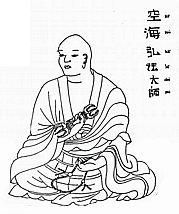
If you are interested in Kukai (空 海) and only know English then your choice of reading material can seem quite limited, especially if you only look at what is in print right now. There are of course a number of websites but these largely parrot what is found in Hakeda and Yamasaki. I wrote the current Wikipedia article on Kukai a couple of years back using pretty much those same sources, with additional notes from Abe. (Note there are moves afoot to abridge my text, so it may already look different).

So where to go to get more depth on The Daishi when there are all too few Shingon teachers outside of Japan? This is my working bibliography of English language sources on Kukai, with some annotations. All of this stuff is available through interlibrary-loan in the UK, and probably Europe and the US; and some of it is available on the web. If you don't know about interlibrary-loan ask your local library to explain it.

Abé, Ryūichi.
  • 'Scholasticism, exegesis and ritual practice : on renovation in the history of Buddhist writing in the early Heian Period. in Adolphson, M, et a. (eds) Heian Japan : centers and peripheries. Honolulu : University of Hawai'i Press, 2007
  • The Weaving of Mantra: Kūkai and the Construction of Esoteric Buddhist Discourse. New York : Columbia University Press, 1999.[Something of a mixed blessing this book. Unrivalled for detail in places, and with very helpful part translations of some of the major works and many minor works. An excellent companion to Hakeda's Major Works but not a place to start. However it is frequently drowned in the jargon of semiotics and thereby made obscure. I also have a sneaking suspicion that Abe has misunderstood the Buddhist attitude to vijnana in making it a source of meaning rather than a source of delusion, or confusion. Not for the faint hearted.]
  • Saichō and Kūkai : a conflict of interpretation. Japanese journal of religious studies. 1995 22(1-2) p.103-137.[A revisionist look at the relationship between these two pivotal figures in Japanese history suggesting that personal feelings had less to do with their split than political aspirations]

Arai, Yūsei [Abbot]. Shingon Esoteric Buddhism : a handbook for followers. (Kōyasan, Japan : Kōyasan Shingon Mission, 1997).[A good glimpse into modern day lay Shingon. Note that Shingon nowadays incorporates a strong Pure Land theme, and the focus for lay people is not "Awakening in this very existence", Kukai's catch cry, but praying to Odaishisama for rebirth in Sukhavati. The process of this change is brought out in Statler and others.]

Benn, C. China’s golden age : everyday life in the Tang dynasty. Oxford University Press, 2002.[Benn offers us a detailed glimpse of the Changan that Kukai would have visited - fantastically wealthy, ethnically diverse and cosmopolitan, and more densely populated that Manhattan Island!]

Borgen, R. The Japanese Mission to China 801-806. Monumenta Nipponica, Vol 37(1), 1982, p.1-28.[The full story of Kukai's journey to China with many details not included in other accounts, part translations of the Ambassador's report to the Emperor, and Kukai's letter to the Governor of Fukien. Borgen's account of the journey is essential reading for this very important aspect of Kukai's biography.]

Deal, W. E. 'Hagiography and history : the image of Prince Shōtoku' in Tanabe, G.J. (ed.) Religions of Japan in practice. Princeton, N.J., Princeton University Press : 1999. [In terms of background to Kukai it is important to understand Prince Shōtoku and his legacy.]

de Bary Theodore Wm. [Ed]. Sources of Japanese Tradition. [vol 1.]. New York : Columbia University Press, 1958, 1964.[Valuable history and part translations of some of Kukai's better known works.]

Gardiner, D. L.
  • 'Japan's first Shingon ceremony' in Tanabe, G.J. (ed.) Religions of Japan in practice. (Princeton, N.J., Princeton University Press : 1999)
  • Transmission problems : the reproduction of scripture and Kūkai’s “opening” of an esoteric tradition. Japanese Religions, 28(1) 2003, p.5-68.
  • Metaphor and Mandala in Shingon Buddhist Theology. Sophia: International Journal for Philosophy of Religion, Metaphysical Theology and Ethics, 47/1: 43-55, April 2008.
  • Transcendence and Immanence in Kûkai's Thought. Esoteric Buddhist Studies: Identity in Diversity, Proceedings of the International Conference on Esoteric Buddhist Studies. Koyasan University, Japan, Septermber, 2006), March 2008, Koyasan University
see also Gardiner's publications page at Colorado College website.

Gibson, M and Murakami, H. Tantric poetry of Kukai (Kobodaishi) : Japan's Buddhist saint. New York, White Pine Press : 1987.[Not as interesting or useful as I had hoped. The work of two enthusiastic scholars of literature with a relatively shallow understanding of Kukai and Shingon. However there is so little of Kukai's poetry available in English that it is worth having. See also Green. Hakeda translates a fair amount of poetry in Major Works as well.]

Giebel, R. W. (trans.) Shingon texts. [BDK English Tripitaka 98 I-VII]. Berkeley, Ca. Numata Center for Buddhist Translation and Research, 2004.[Giebel's translations appear to stick close to the text, but this does not make for good readable English. It leads him for instance to employ neologisms such as 'inexponibility', 'differentiatingly', and 'intercorrespondent' in order to find a single English word for each one in Chinese. Some seem gratuitous such as esoteric sutras being 'veridical' rather than truthful. Key technical terms are sometimes translated with no footnotes, so that the translations are unreadable unless you either know already what the text says, or are deeply versed in Buddhist jargon and can guess the underlying term. What, for instance, are the discourses of the Dharma-Buddha? Another example is the terms used in the more sophisticated esoteric version of the 'Trikaya doctrine'. Frustratingly text names are translated into idiosyncratic English with only a reference to the Taisho edition of the Chinese Canon. Thus the well known Dasabhumika Sutra, becomes the Treatise on the [Ten] Stages (T26.133c-134a). It is not at all clear who the intended audience is. This makes Giebel valuable only as a check on other more felicitous translations. Read Hakeda instead, and then Abe. The one good point is that he translates all of the quotes in the Benkenmitsu nikyō ron : The difference Between Exoteric and Esoteric Buddhism, which Hakeda does not]

Grapard, Allan G. 'Precepts for an emperor' in White, David Gordon. Tantra in practice. University of Princeton Press, 2000, p.147-164.A translation of the text Kukai wrote for the abhisheka ceremony of Heizei, the sometime rebellious former emperor turned bhikshu. Useful as comparison with Abe's commentary on this text as it relates to the Benkenmitsu nikyō ron.]

Green, Ronny. The Mysterious Mirror of Writing: Kūkai’s Poetry and Literary Theory. Unpublished manuscript. Available: http://www.ronnygreen.us/kukaipoetry.htm[Probably the only critical work on Kukai's poetry in English. See also on Ronny's website excerpts from unpublished book length biographies of Kūkai and Gyoki ]

Hakeda, Y.S.
  • Kūkai : major works : translated and with an account of his life and a study of his thought. (New York : Columbia University Press, 1972).[The one book that no one interested in Kukai can do without. Continues to stay in print fortunately. Probably the best biography to date, and of course Hakeda's excellent translations of Kukai's writing. This is the bible as far as I'm concerned. That said you may need to do some background reading (Such as Snodgrass for instance, and Yamasaki) and interpretation to understand Kukai. In his translation Hakeda does not get in the way as is the case for Giebel and Abe. ]
  • The religious novel of Kūkai. Monumenta Nipponica, Vol 20(3/4), 1965, p.283-297.[Discusses the Sango Shiiki as a literary text, ie a novel. Many of the insights in this paper are incorporated into Major Works]
  • (trans.) Awakening of Faith. (New York : Columbia University Press, 199?).[This is a text which was very influential on Kukai's thinking - for instance you can see the influence in the structure of the Sokushin jōbutsu gi : Attaining Enlightenment in this Very Existence]

Hare, Thomas Blenman. Reading writing and cooking : Kūkai’s interpretive strategies. The Journal of Asian Studies. 49(2) May 1990, p.253-273.[Problems of language and meaning; includes the best description of the Kokūzō gumonji no hō practice which Kūkai undertook when he left university.]

Haresaku, Masahide. Encounter with an empathic, personal god : a seminar on Shingon Mikkyō. [Trans. Paul L. Swanson]. Bulletin (Nanzan Institute for Religion & Culture). No.5, 1987, p.2635.

Henshall, K.G. A history of Japan : from stone age to superpower. (2nd ed.) (New York : Palgrave Macmillan, 2004)

Hinonishi Shinjō. "The Hōgō (Treasure Name) of Kōbō Daishi and the development of beliefs of associated with it," Japanese Religions. 2002, v. 27 (1), pg 5-18. (Translated by William Londo)[Fascinating little article which traces the history of the Kūkai Mantra: namu daishi henjō kongō.]

Hisao Inagaki. Kūkai's "Principle of Attaining Buddhahood with the Present Body," in Payne, R.k. (ed) Tantric Buddhism in East Asia. Boston, Wisdom : 2006. p.99-118. [Another translation of the classic Sokushin jōbutsu gi]

Hodge, S. (trans.) The mahā-vairocana-abhisambodhi tantra : with Buddhaguhya’s commentary. (London : Routledge Curzon, 2003).
[By far the best English translation of this most important Shingon text. Hodge works from the Tibetan translation which has minor differences, mostly structural, to the Chinese, but includes the seminal commentary and summary by Buddhaguhya. The introduction contains much useful information and I found myself wishing that Hodge had allowed more space for it. It lacks an index which would have been useful. ]

Hori, Ichiro. On the concept of hiriji (holy-man). Numen. 5 (2) 1958, p.128-160.
[Kukai is of course famous as a mountain ascetic (yamabushi) and this paper delves into the Japanese tradition of seeking out lonely peaks for meditation, and discusses Kukai's predecessors as well as both Saicho and Kukai as yamabushi.]

Kasulis, T.P. Reference and Symbol in Plato's Cratylus and Kukai's Shojijissogi. Philosophy East and West, 32 (4), Oct., 1982, p.393-405. Available online: http://ccbs.ntu.edu.tw/FULLTEXT/JR-PHIL/kasulis3.htm[The problem of how words function as symbols/signs is at the forefront of contemporary philosophy, and this paper compares theories from ancient Greece and medieval Japan.]

Keenan, L. K. En the Ascetic in Tanabe, G.J. (ed.) Religions of Japan in practice. (Princeton, N.J., Princeton University Press : 1999).[More on of Kukai's main yamabushi predecessors - see also Hori]

Kimbrough, R. Keller. Reading the miraculous power of Japanese poetry : spells, truth acts, and a medieval Buddhist poetics of the supernatural. Japanese Journal of Religious Studies 32 (1) 2005, p.1-33.

Kitagawa, J. M. Kūkai as master and saviour in Reynolds, F.E. and Capps, D. (eds) The biographical process : studies in the history and psychology of religion. (Mouton : The Hague, 1976).

Kiyota, Minoru. Shingon Buddhism : theory and practice. (Los Angeles : Buddhist Books international, 1978)

Matsuda, Willaim J. 2003. The founder reinterpreted: Kūkai and Vraisemblant narrative. 
MA Thesis. University of Hawaii. http://scholarspace.manoa.hawaii.edu/handle/10125/7110

Orzech, Charles. The legend of the iron stupa in Lopez, Donald S. [ed.] Buddhism in practice. Princeton University Press. 1995.

Rambelli, F.
[Rambelli writes from a hard-core semiotics point of view, which is to say he is concerned with the relationship of 'signs' to the 'things'. Ironically semiotics jargon is frequently and bizarrely obscure and difficult for the lay person. Rambelli is also fond of neologisms: Kukai is 'polyhedrical'; and two words are "synonymical variants" of each other rather than simply synonyms. Not for the faint hearted, and I recommend boning up on semiotics for a few months in advance.]
  • - The semiotic articulation of Hosshin Seppō : an interpretive study of the concepts of mon and monji in Kūkai’s mikkyō in Astley, I. (ed) Esoteric Buddhism in Japan. (Copenhagen : The Seminar for Buddhist Studies, 1994). p.17-36.
  • - True words, silence, and the adamantine dance : on Japanese mikkyō and the formation of the Shingon Discourse. Japanese journal of religious studies. 1994 21(4) p.373-405.[I'm not convinced that Rambelli's approach in this paper - to the extent that I understand it of course - is workable. Is the contemporary semiotic model capable of comprehending the way Kukai understood "meaning"? I think of Foucault's ideas in the Order of Things on how epistemology changed amongst the intellectuals of renaissance Europe away from resemblance as a source of knowledge, toward difference. Both Rambelli, and I think Abe, seem to place too much emphasis on difference in interpreting Kukai: his world view was one in which resemblance was the key to knowledge. Rambelli seems to overlook to implications of all dharmas being marked by shunyata for instance!]

Reader, I. Legends, miracles, and faith in Kōbō Daishi and the Shikoku Pilgramage in Tanabe, G.J. (ed.) Religions of Japan in practice. Princeton, N.J., Princeton University Press : 1999[Summary of some of the legendary material which constellates around Kukai]

Rouzer, Paul. “Early Buddhist Kanshi : court, country, and Kūkai”. Monumenta Nipponica. 2004, 59(4) : 431-61.

Shiba, Ryotaro.
Kūkai the universal : scenes from his life. New York, ICG Muse Inc. 2003.[Appalling novel based very loosely on the life of Kukai in which Kukai becomes a carousing and boozing wideboy freely indulges in pleasures of the flesh! The translation doesn't help with several infelicitous coinings such as baptism for abhisheka. Although Shiba is a celebrated author of historical novels in Japan, this is more novel than historical. Don't bother.]

Snodgrass, A. The Matrix and Diamond World Mandalas in Shingon Buddhism. India, Aditya Prakashan : 1997.[Important book. A very good introduction to Shingon doctrine, and a very detailed survey of the two mandalas. One idiosyncrasy is that uses dhāraṇī as the general term rather than mantra. This is in line with some of Kukai's thinking, but not a general practice. In print in India]

Statler, O. Japanese pilgrimage. London : Picador, 1984.[One of the best sources of legendary material about Kukai - an aspect of him that is badly neglected by English speaking academics. Out of print, but 2nd hand copies do pop up from time to time.]


Takasaki Jikidō. “Kōbō Daishi (Kūkai) and Tathāgatagarbha Thought”. Acta Asiatica. 1985. 47 : 109-129

Tanabe, G.J.
  • 'The founding of Mount Kōya and Kūkai's eternal meditation' in Tanabe, G.J. (ed.) Religions of Japan in practice. Princeton, N.J., Princeton University Press : 1999
  • Kōbō Daishi and the art of esoteric Buddhism. Monumenta Nipponica. 1983, 38 (4), p.409-12.

Toby, Ronald, P. “Why Leave Nara? Kammu and the transfer of the Capital. Monumenta Nipponica. 1985. 40(3) : 331-347.

Tōno, Haruyuki.
Japanese Embassies to T'ang Cina and their ships. Acta Asiatica. 1995 69: p39-62

Totman, C.
A history of Japan. (Blackwell, 2005).

Wayman, A and Tajima, R. The enlightenment of Vairocana. Delhi : Motilal Banarsidass, 1998.[I don't get Wayman, don't follow his arguments, don't see why he highlights the things he does. I haven't found his contribution very helpful. Tajima is more accessible but wildly and uncritically sectarian. Overall you could probably give this a miss. Hodge's introduction and translation is far more comprehensible]

Yamasaki, T. Shingon : Japanese esoteric Buddhism. Fresno, C.A. : Shingon Buddhist International Institute, 1988.[A very good introduction to Kukai and Shingon. Slightly frustrating in that Japanese terminology is used throughout with no links to Sanskrit, which makes it difficult to link it with the wider Buddhist tradition. Expensive on Amazon etc, but still in print and available at a reasonable price from the publisher - they may be slow to respond however.]

Yamamoto, Chikyo. Mahāvairocana-Sūtra : translated into english from Ta-p’I-lu-che-na ch’eng-fo shen-pien chia-ch’ih ching, the Chinese version of Subhākarasimha and I-hsing AD 725. New Delhi : International Academy of Indian Culture, 1990.[A disappointing translation from the Chinese version. The English text is often impenetrable at times when Hodge is perfectly clear. A potential high point is the inclusion of the Siddham script calligraphy of all mantras, by a respected calligrapher. However the calligraphy appears to be quite poor, is not well reproduced, and is frequently not in accordance with the roman transliteration (I didn't have enough patience to work out which was incorrect). If you are not sentimental about the Chinese vs Tibet version issue, and want a single translation of this important text, then go for Hodge.]
(Updated 17-7-2009)

03 September 2007

The Blue Rite

The Blue Rite is also called The rite of subduing or overcoming. Sometimes it is known as the Black Rite or the Rite of Destruction, but that is in another context from the one that I am considering. This is the magical rite performed by Akṣobhya the blue Buddha of the eastern quarter, and which is related to the story of the defeat of Mara. What is being subdued are the poisons, in this context the demons, of greed, hatred and doubt as they occur within us. When we experience very strong hatred or greed then that does have a demonic feel to it. Under their influence we lose the ability to choose our actions, we may well behave in ways that we are later ashamed of.

I want to be very clear here that I do not advocate applying this, or any other, rite to other people! Unless we have a very clear understanding of, and love for, the other person; a high level of trust; and a lot of skill and experience it is not advisable to start practising any of the rites on others. In any case our own inner demons, our own greed, hatred, and doubt, give us plenty of material to work with.

One can immediately say that there might be a general approach to subduing all demons, based on the response of the Buddha to Mara, which is simply not to respond to them. If we do not respond to greed it has no power over us; if we do not act on hatred it cannot hurt us; if we are confident in our practice then doubt has no purchase on our minds. So this is the first level of defence against demons - not reacting. The story of the defeat of Mara shows how powerful not reacting can be.

Padmasambhava was a great subduer of demons. He would fight them with magic, often neutralising their magic with his own, but then he would always give them an initiation, a secret name, and a treasure to guard. In other words these demonic, or perhaps more accurately chthonic forces within us, which can threaten to overwhelm us and defeat us, are energies that can be harnessed and put to good use in other ways. The same demon that causes us to hate, can function as a protector. In a psychological sense our demons are often just adaptations to extreme situations. For instance if we grow up with a lot of violence, then we will adapt to protect ourselves from that violence, and may even become violent ourselves. The energy that protects me from violence, may have violence at it’s root. This is not a justification for violent behaviour however. It is important not to lose sight of the transformation which demons undergo at the hands of Padmasambhava - when subdued and named they become Dharma protectors, and guarders of our treasures.

Padmasambhava had a very potent weapon in his battles against the demons. He had what in Tibetan is known as a purbha – a demon dagger. The demon dagger is used to pin down demons. It has a blade or point which emerges from the mouth of a mythical beast which is a mix of a crocodile and a fish: called a makara. Above the makara is usually the head of a Buddha which has multiple faces. And finally either the head of a horse, or a the end of a vajra. The Buddha head reminds us of the purpose of the purbha – it is not a weapon designed to hurt people, but to help release us from the grip of a demonic energy. With the purbha you pin down the demon so that you can have a conversation with it. Padmasambhava took this opportunity to give the demons a secret name and a treasure to guard. This is a useful procedure with demons, and contrasts sharply with the image of the Archangel Michael, or later St George, killing the dragon - I'll come back to this in the next paragraph. So one thing we might do when we wish to work with the Blue Rite is to make ourselves a demon dagger. We can build in symbols of power and strength which resonate for us. This may help us to get into communication with our demons, to see that they really want to protect us, and to help us find better ways of going about it.

Another way of thinking about this came to me the other day. I was reminded of the scene early in the story of Peter Pan. His shadow had come loose and is causing trouble. He meets Wendy who helps him to catch his shadow and she sews it back on for him. Jung talked about those aspects of our psyche which we do not accept as being our 'shadow'. The qualities which are not accepted need not be bad. For many years I was unwilling to take on the artistic side of my self and would not give it attention. If we take this kind of view of things then we treat the expressions of greed, hatred and doubt as coming from the psychic shadow. In the Jungian view they are unacknowledged bits of ourselves which have taken on a kind of autonomy. A demon dagger helps us to pin them down, so that we can reclaim them, sew them back on. If the demon is really just an unassimilated part of our own psyche, then we don’t want to kill it, we want, like Padmasambhava, to convert this rebellious energy into some more useful form.

The main idea, then, is that the Blue Rite, is the rite of overcoming and subduing hindrances to spiritual progress; the conversion of demonic forces into Dharma protectors. It is a way of working with inner demons which block our Awakening.

22 August 2007

Early Mandalas

One of the most distinctive features of esoteric Buddhism is the Mandala. Buddhism generally speaks of the person as consisting of body, speech and mind. The Buddha also has three aspects, although these are esoteric rather than mundane. The three aspect of the Buddha are known as the triguhya or three mysteries. These three mysteries correspond to the three aspects of the person. The mysteries of body, speech and mind in the ordinary person correspond to mudra, mantra, and mandala for the Buddha. So mandala represents the mind mystery of the Buddha.

There are many different mandalas, varying across time and text. Each however shares certain features. Mandala literally means circle, and Buddhist mandalas are typically in the form of a circle, or contain as a main feature an encircled area. At the centre of the mandala is the figure of a Buddha - who may be represented as a person, a symbol or a syllable. Surrounding the Buddha will be a number of other figures. If the Buddha in the centre of the mandala represents the cosmic principle of Awakening, then the other figures represent some aspect of Awakening.

Amongst scholars there is some debate about when esoteric Buddhism began. Some like Ronald Davidson argue that tantra proper is a feature of the 7th century. Others point to antecedents from earlier periods of both Buddhism and other religious traditions. For example the Golden Light Sutra is thought to belong to the 3rd or 4th century (it was first translated into Chinese in 414) and it contains what appears to be a mandala of four Buddhas. In the better known version of the sutra, that translated by Emmerick, the mandala appears in a Mahayana context without the usual esoteric features. There is another version of the Sutra, noted by Huntington [1], which makes it clear that the mandala is intended to feature in a meditation practice. This makes it seem more closely related to esoteric Buddhism, and adds weight to the "early tantra" theory. This kind visualisation is much older than we may think. There is, for example, a similar kind of practice in the Rig Vidhāna, a Brahminical text from fourth century BCE. [2]

We usually think of the five fold mandala - with a central Buddha surrounded by four other Buddhas - as being distinctively Buddhist. Early mandalas used a three fold symmetry. The five fold mandala emerges only in the 7th or 8th century in texts which the Tibetans call Yoga tantras. However I have discovered another five fold mandala in an unexpected place. Brhadaranyaka Upanisad III.9 describes the gods and their supports as occupying the centre and the four compass points: Agni occupies the centre, with Soma, Aditya, Yama, and Varuna occupying the north, east, south and west respectively. The list appears in a longish discussion between Yajnavalkya and Vidagdha Shakalya about how many gods there are. The Brhadaranyaka Upanisad is considered to be pre-Buddhist partly because the Buddha of the Pali Canon quotes from it, and satirises it in several places, e.g. the Tevijja Sutta, DN 13.

I think we have here a clear precedent for the type of mandala which becomes important in Buddhism many centuries later. This should come as no great surprise as we know, and I have tried to highlight this in my blog, that Indian religious traditions are quite free in adopting and adapting the practices and ideas of their 'competitors'.

What does this tell us about the origins of esoteric Buddhism? I think the best way to view esoteric Buddhism is that it was a grand synthesis of many religious traditions, with Mahayana Buddhism providing a framework, that occurred in the mid 6th century as a response to the socio-political and religious needs of the times. The fact that we find precedents may not be significant in determining the time of birth for esoteric Buddhism for this reason. To speak for instance of an Upanisadic mandala, or a Mahayana dharani as proto-tantric seems to create the wrong impression of the process. Sawn timber is not a proto-table for instance. Professor Ryuchi Abe makes a similar point in his discussion of the introduction of esoteric Buddhism to Japan. [3] Yes, many elements later incorporated into esoteric Buddhism existed before Kukai arrives back from China in 806. However Abe argues that there was no conception of "esoteric" Buddhism, no esoteric context in which those elements could exist. Buddhism in Japan up to 806 had been Mahayana Buddhism despite the widespread and frequent use of dharanis in ritual, and even translations of esoteric texts. Without the esoteric teachings such artefacts could only be interpreted through the lens of Mahayana Buddhism. This is further born out in several of Kukai's earlier works in which his main aim to establish the esoteric teachings as valid - Benkenmitsu nikyō ron, The difference Between Exoteric and Esoteric Buddhism, being one of the more important texts.

So Mandalas are quintessentially Buddhist, but have a history which pre-dates their use in esoteric Buddhism. Context is important in understanding any aspect of Buddhism.


Notes:
  1. Huntington, John C. 1987. Note on a Chinese text demonstrating the earliness of tantra. JIABS 10 (2) p.88-98.
  2. Patton, Laurie. 2005. Bringing the gods to mind : mantra and ritual in early Indian sacrifice. Berkeley, University of California Press. p.30
  3. Abe, Ryuchi. 1999. The weaving of mantra : Kukai and the construction of esoteric Buddhist discourse. New York : Columbia University Press
image: Kyoto Journal

23 July 2007

Arapacana Alphabet Bibliography

Arapacana in Siddham Script
I've been continuing to explore the so-called Mystical Alphabet over the last few weeks. Rather than writing things up here, I've been adding to my Visible Mantra website. Now see also my book Visible Mantra, which has a lot more information on the Arapacana including comparisons of the various Chinese translations of the Arapacana in the Large Perfection of Wisdom Sūtras. I'd like to draw attention to various bits of that site here, and to post a selection from my bibliography covering the alphabet.

As you may know the Arapacana Alphabet is used as a mnemonic in Buddhism: each letter expands into a word, which itself expands into a phrase which encapsulates some insight into the nature of experience. So:

the letter a expands into
the word anutpanna and this in turn expands to
akāro mukhaḥ sarvadharmāṇāṃ ādyanutpannavāt

The translation of which is:

"The letter A is a door to all dharmas because they are originally unarisen".

The background theory of this statement is covered on Visible Mantra on the page called Dharma Doors. I have also created a calligraphy project based on this phrase. Additional aspects are discussed on pages devoted to a alphabet calligraphy project, and on the Mañjuśrī mantra page. There is much more that could be said about this phrase as it moves from it's source as an insight meditation subject in the Pañcaviṃśatisāhasrikā Prajñāpāramita Sūtra, to the Mahāvairocana Sūtra where it takes on a tantric character, and then into the final phase in the yogini tantras, such as the Hevajra Tantra, where it becomes a mantra in it's own right.

oṃ akāro mukhaṃ sarvadharmāṇāṃ ādyanutpannavāt āḥ hūṃ phaṭ svāhā

Various pages in Visible Mantra covering seed syllables take the theory of mantra in a slightly different direction, initially established by Upanishadic sages. Blog posts on hrīḥ, dhīḥ are now supplemented by the Visible mantra page on hūṃ, which gives a very short account of Kūkai's text Ungi gi - The Meanings of the Seed Syllable Hūṃ. The oṃ page now features the greatest range of variations of writing styles - and there are more to come.


Bibliography of sources directly related to the Arapacana Alphabet.

Bays, G. (1983). The Lalitavistara Sūtra. 2 vol. The Voice of the Buddha: the beauty of compassion. Berkeley: Dharma Publishing.

Brough, John. (1977). The arapacana syllabry in the old Laita-vistara. Bulletin of the School of Oriental and African Studies. 40 (1), p.85-95.

Clear, Thomas. (trans.) 1989. Entry into the realm of reality : the text : a translation of the Gandavyuha, the final book of the Avatamsaka Sutra. Boston : Shambala.

Conze, E. 1975. (trans.) The large sutra on perfect wisdom : with the divisions of the Abhisamayālankāra. Delhi : Motilal Banarsidass.

Conze, E. 1978. The prajñāpāramita literature. (2nd rev. ed.) Tokyo : The Reiyukai.

Davidson, R. M. 1995. The Litany of names of Mañjuśrī in Lopez, Donald S. [ed.] Religions of India in Practice. University of Princeton Press.

Farrow, G.W. and Menon, I. 1992. The concealed Essence of the Hevajra Tantra : with the commentary Yogaratnamālā. Delhi : Motilal Banarsidass, 2001 printing.

Gethin, Rupert. 1992. The mātikās : memorizations, mindfulness, and the list in In the mirror of memory : reflections on mindfulness and remembrance in Indian and Tibetan Buddhism. State University of New York Press, p.149-172

Gyatso, Janet. 1992. Letter magic : a Peircean perspective on the semiotics of Rdo Grub-chen’s dharani memory in In the mirror of memory : reflections on mindfulness and remembrance in Indian and Tibetan Buddhism. State University of New York Press, 1992, p.173-213

Hakeda, Y.S. 1972. Kūkai : major works : translated and with an account of his life and a study of his thought. New York : Columbia University Press

Lamotte, Étienne. 1958. History of Indian Buddhism : from origins to the Śaka era. [trans. 1988 Sara Webb-Boin] Louvain-la-neuve : Université Catholique de Louvain

Mukherjee, B. N. 1999. Arapacana : a mystic Buddhist script in Bhattacharya, N. N. (ed) Tantric Buddhism New Delhi : Manohar Publishers & Distributors. p.303-317.

Salomon, Richard.
1990. New evidence for a Gāndhārī origin of the arapacana syllabary. Journal of the American Oriental Society. Apr-Jun, vol.110 (2), p.255-273.

1993. An additional note on arapacana. Journal of the American Oriental Society. Vol.113 (2), p.275-6.

1998. Indian Epigraphy: A Guide to the Study of Inscriptions in Sanskrit, Prakrit, and the other Indo-Aryan Languages. New York, Oxford University Press.

2004. An Arapacana Abecedary from Kara Tepe (Termez, Uzbekistan). Bulletin of the Asia Institute. Vol. 18, p. 43-51.

2006. Kharoṣṭhī syllables used as location markers in Gāndhāran stūpa architecture. Pierfrancesco Callieri, ed., Architetti, Capomastri, Artigiani: L’organizzazione dei cantieri e della produzione artistica nell’asia ellenistica. Studi offerti a Domenico Faccenna nel suo ottantesimo compleanno. (Serie Orientale Rome 100; Rome: Istituto Italiano per l’Africa e l’Oriente, 2006), pp. 181-224.

2016. Siddham Across Asia: How The Buddha Learned His ABC. 23nd J. Gonda Lecture 2015. Royal Netherlands Academy of Arts and Science. https://www.knaw.nl/nl/actueel/publicaties/siddham-across-asia-how-the-buddha-learned-his-abc


Scharfe, Harmut. 2002. Kharoṣṭhī and Brāhmī. Journal of the American Oriental Society. 122 (2), p.391-3.

Skilling, Peter. 1996. An arapacana syllabry in the Bhadrakalpika-sūtra. Journal of the American Oriental Society. 1996, Vol.116 (3), p.522-3

Strauch, Ingo. 2007. The Bajaur collection: A new collection of Kharoṣṭhī manuscripts. A preliminary catalogue and survey (in progress). Available online [pdf]. See especially p.37-40.

Wayman, A. 1985. Chanting the names of Mañjuśrī : the Mañjuśrī -nāma-samgīti : Sanskrit and Tibetan texts. Delhi : Motilal Banarsidass, [1999].

Yerushalmi, Dan. (2007). Devotional, Covenantal and Yogic — Three Episodes in the Religious Use of Alphabet and Letter from a Millennium of Great Vehicle Buddhism in: Sergio La Porta and David Shulman, eds., The Poetics of Grammar and the Metaphysics of Sound and Sign, Jerusalem Studies in Religion and Culture series no. 6. Brill, 201-229. https://www.academia.edu/3790540/Devotional_Covenantal_and_Yogic_Three_Episodes_in_the_Religious_Use_of_Alphabet_and_Letter_from_a_Millennium_of_Great_Vehicle_Buddhism

~~oOo~~


31 August. A further note on this subject. I've just discovered the Bajaur Collection website which describes a collection of Kharoṣṭhī manuscripts discovered in Pakistan in the site of a old Monastery. Amongst the texts is fragment 5 which is:
"the only hitherto known Gāndhārī text arranged according to the sequence of the Arapacana syllabary. In addition, it is the only Gāndhārī text preserving an almost complete specimen of this alphabet which later on became widely popular in Mahāyāna and Vajrayāna circles."
This is a very important find! It confirms much of what Prof. Richard Salomon has been proposing in his papers (see above), and may give us further insight into the use of alphabet based mnemonics. What the text says I still don't know... watch this space.


24 Nov. Sound files from my evening at the Cambridge Buddhist Centre, 1 Nov 2007.
15/3/08. I've just added a page to visblemantra.org which pulls out the bits of the Pañcaviṃśatisāhasrikā Sūtra related to the Wisdom Alphabet meditation, with a few added comments.

14 July 2007

The Seed Syllable of Great Compassion

Seed Syllable Hrih, symbolising the Buddha's Compassion
In a previous article I looked into the seed syllable of Perfect Wisdom. Wisdom is always matched and balanced by compassion in Buddhism so I thought I'd take a look at the seed syllable of Amitābha, the Buddha of Compassion, hrīḥ or ह्रीः or ཧྲཱིཿ, pronounced /hriːh/ (IPA). Hrīḥ is also the seed syllable for the Bodhisattva Avalokiteśvara or as the Tibetans call him Chenrezig, who is closely associated with Amitābha. In the system of Tantra magic they are all associated the with the Red Rite.

However even less is written about hrīḥ than about dhīḥ. One source is Lama Govinda's book The Foundations of Tibetan Mysticism. Despite the fact that he was a friend of my main Buddhist teacher, and his book is recommended by some of my Buddhist friends, I've come to be wary of Govinda's interpretations. His exegesis on mantra is informed more by Upanishads than Buddhist texts, as is evident from the sources which he quotes on the subject. The Buddhist view on mantra has some distinctions from the Vendantic. With the caveat let's look at what Govinda says.

By the time of the Buddha, the Vedantic scholar priests were beginning to break magical syllables such as oṃ into their theoretical component parts. They also adopted the diphthongised version of the syllable, i.e. auṃ  (ओं > औं or ॐ). So it's a common place thing to see auṃ analysed as a + u + ṃ or anusvāra (the nasalisation symbol). This practice was also adopted by Vajrayana Buddhists, though Buddhists stuck with oṃ. So we would expect hrīḥ to be analysed into four part: ha + ra + ī + ḥ, i.e. visarga or aspirated vowel symbol. Govinda however says that as the Tibetans seldom pronounce the visarga (which is usually described as a soft echo of the preceding vowel) and that they analyse only three sounds. H according to this scheme symbolises : "the breath, the symbol of all life"; while R is "the sound of fire", and I is "the vowel of high intensity and stands for the highest spiritual activity and differentiation".[1]

Later Govinda describes hrīḥ as the "inner voice, the moral law within us, the voice of conscience, of inner knowledge" which suggests that he is linking it with the Vedic word hrī (Pali hiri). The form hrīḥ would be the nominative singular, i.e. hrī as subject. Hrī is defined as "modesty" and occurs in the list of 51 positive mental events in the Sarvāstivādin Abhidharma. Modesty is mentioned in the Mahāvairocana Abhisambodhi Tantra (MAT):
A son or daughter of good family who has modesty will quickly achieve two factors in this very world: they will not do what should not be done and they will be praised by the Holy Ones. There are a further two: the will realize what they have not yet realized and they will gain companionship with the Bodhisattva's and Buddhas. There are a further two: they will abide in moral discipline and they will attain birth as humans and gods.[2]
I'm not sure of the link with the qualities of compassion or with Amitābha or Avalokiteśvara. However hrīḥ, like Amitābha, also according to Govinda, involves solar symbolism. He links this with what he calls the emotional principle of goodness, compassion and sympathy, as well as with the illuminating aspects of the sun: light, making things visible, the faculty of perception, of direct vision. In a flight of poetic imagination, and forgetting that he has omitted the visarga (), he describes hrīḥ as "a mantric solar symbol, a luminous, elevating, upwards moving sound composed of the pranic aspirate [ie the visarga], the fiery R... " and the high vowel which he says "expresses upwards-movement, intensity", etc.[3]

Unfortunately Govinda offers no source for this. The association for ra, or raṃ, is an Vedantic one, but the others may well be Govinda's own interpretation. What he writes about 'i' sounds as if it is influenced by 20th century Phonetics which describes the long ī as the "unrounded-high-front vowel".

This kind of analysis is possible in esoteric Buddhism. According to the MAT, 'H' is hetu or cause in the sense of original cause, and 'R' is raja or defilement - the point being that dharmas lack either. The MAT doesn't do vowels and doesn't have anything to say about the visarga. But Kūkai treats the alphabet more comprehensively: H is cause, R is taint, I is senses, and Visarga is release. [4] This kind of analysis has its roots in the Prajñāpāramitā or Perfection of Wisdom tradition and is found in the larger texts like the Perfection of Wisdom in 25,000 lines. Before that there are links back to the Abhidharma tradition.

Amitābha being incredibly popular in the wake of Pure Land Buddhism, his seed syllable can be found everywhere in Japan - including rather ironically decorating samurai swords and other war gear.


~~oOo~~


References
  1. Govinda, Lama. 1959. Foundations of Tibetan Mysticism. (London : Rider). p.183, note 1.
  2. Hodge, Stephen. 2003. The Maha-Vairocana-Abhisambodhi Tantra : with Buddhaguhya’s commentary. (London : RoutledgeCurzon). p.168. (=MAT vi.9)
  3. Govinda, ibid p.231.
  4. Abe, Ryuchi. 1999. The Weaving of Mantra. (New York : Columbia University Press). p.291-2

Some of my calligraphy of hṛīḥ


My calligraphy website has more examples of hrīḥ


Related Posts with Thumbnails