20 August 2010

A Parody of Vedic Belief

Professor Richard Gombrich has been at the fore-front of pointing out that late Vedic beliefs are parodied in the Buddhist scriptures. [1] He has demonstrated in a series of erudite articles that the Buddha must have known the body of teachings that underlie the early Upaniṣads - especially the Bṛhadāranyka (BU) and Chāndogya (CU). This is not to say that these actual texts would have been known to him, because most scholars believe them to be later distillations anyway (rather like the Buddhist texts), but that the beliefs we read in them were known. What kinds of evidence do we have for this thesis? I've been researching what kinds of views we find in the mouths of Brahmins in the Pāli texts and hope at some point to publish the results. My finding so far is that no Brahmin appears to espouse the kinds of views about ātman/brahman that we would associate with the Upaniṣads. However we do find something like those views being put into the words of Brahmā (i.e. God) himself for instance in the Kevaddha Sutta. [2]

In the BU 1.4.10 we find this passage (Olivelle's translation)
In the beginning this world was only brahman, and it knew only itself (ātman), thinking: "I am brahman." As a result it became the whole. Among the gods, likewise, whosoever realized this, only they became the Whole. It was the same also among the seers and among the humans. Upon seeing this very point, the seer Vāmadeva proclaimed: "I was Manu, and I was the sun." This is true even now. If a man knows "I am Brahman" in this way, he becomes this whole world.
Anyone interested in the Sabba Sutta should pay close attention to this verse as this is also the context for that sutta - Olivelle's 'Whole' is a translation of Sanskrit sarvaṃ = Pāli sabbaṃ - but for this essay I want to draw attention to the phrase "I am brahman": ahaṃ brahmāsmi. This is seen by Vedic believers as a kind of credo. It sums up the path according to the sages of the Upaniṣads which is that the realisation that you are brahman is the highest realisation. In this realisation one becomes this whole world (sa idaṃ sarvaṃ bhavati).

In the Pāli Kevaddha Sutta the householder Kevaddha approaches the Buddha to encourage him to perform some miracles and thereby attract followers. The Buddha says that not how he operates. How he does operate is spelled out in the long passage that is repeated in all 13 of the first of the Dīgha Nikāya suttas, but this segues into a story of a monk who, desiring to know where the elements cease without remainder. In order to answer the question he attains super human states of consciousness in meditation and visits the realms of the various devas, moving up the scale until me meets Brahmā himself. Posed the question Brahma can only reply:
"ahamasmi, bhikkhu, brahmā mahābrahmā abhibhū anabhibhūto aññadatthudaso vasavattī issaro kattā nimmātā seṭṭho sajitā vasī pitā bhūtabhabyānan" ti.

"I am, bhikkhu, Brahmā, Great Brahmā, unconquered conqueror, omnipotent, Lord over all, maker and creator, the highest, controller of the cosmic order, and father of all beings past, present and future."
Note that Brahmā doesn't answer the question. It turns out that he doesn't know the answer, but has to keep up appearances because the other gods believe it is true that Brahmā is the omnipotent creator. He takes the monk to one side to explain this and point him back in the direction of the Buddha.

But notice how he starts his answer. If we leave out the 'bhikkhu' he says: ahamasmi brahmā. Compare this to the Sanskrit: ahaṃ brahmāsmi. That the Pāli is a reference to the BU, or at least to the body of teaching recorded in that text, is clear. Although the BU was not written down for many years after the Buddhist texts, the scholarly consensus is that BU represents a body of teachings that predate the Buddha by several centuries. Given the flexibility of syntax in the two languages we are looking at the same statement. Exactly the same except that the Sanskrit has an ambiguity - brahmāsmi can be read as brahma asmi or brahmā asmi i.e. as the neuter or masculine. The first is the abstract universal essence of the cosmos that manifests as ātman in the individual; the second is the masculine creator god. The first usage in BĀU 1.4.10 is the context of a neuter pronoun 'it' (tad), while the second is in the context of a masculine pronoun 'him' (sa), so both senses could be being used here! Gombrich observes that the Buddha has selected the less abstract, and therefore less sophisticated, of the two, i.e. Brahmā as creator god, and that this helps to contribute to the overall sense of this being not just a polemic, but a parody. Johannes Bronkhorst has been very critical of Gombrich's interpretation of this kind of reference as evidence of the Buddha's sense of humour, [3] but personally I think this example is funny. On the one hand the realisation "I am Brahmā" encapsulates the highest goals of religion; and on the other the statement is just an egotistical and deluded claim with no basis.

The ideal of union with Brahmā (brahmasahavyatā) is also found in the Tevijja Sutta (DN 13) where we find the Buddha informing some hapless Brahmins Vāseṭṭha and Bhāradvaja [4] that though there own teachers are ignorant of the way leading to this goal, that:
brahmānaṃ cāhaṃ, vāseṭṭha, pajānāmi brahmalokañca brahmalokagāminiñca paṭipadaṃ
I know Brahmā, Vāseṭṭha, and Brahmā's domain, and the way leading to Brahmā's domain.
The Buddha then teaches the meditations we have come to know as the brahmavihāra 'dwelling with Brahmā', though the name is not used here. Brahmavihāra is actually a synonym of brahmasahavyatā. It would be like walking into a Christian church and asking "How many of your priests have been face to face with God? None? I have, and I can tell you how to be in His presence. You don't have to die and go to heaven, you can dwell in heaven right now!" - and teaching the mettābhāvanā! I've often wondered what would happen if we took the Buddha's approach to theistic religion. Forget about opposition and proving that God exists, but just roll with it and teach Buddhism in Christian terms. I think most of us are too afraid of losing our religion, and perhaps lack confidence in our methods, to even try this. And, of course, it would require one to be truthfully in that state of dwelling with God (brahmavihāra). But it is what the Buddha appears to have done.

To those people who claim that Buddhism is a religion which tolerates all views this must come as a shock. Not only did the Buddha not tolerate wrong views, he actively went about subverting them and making fun of people who held them. There are times when the Buddha of the Pāli Canon makes Richard Dawkins seem like an appeaser.


Notes
  1. Professor Gombrich's contribution is summed up in his book What the Buddha Thought. References to his individual papers can be found there. The observations I make here has been observed by him previously, but I'm putting them in my own words.
  2. also Kevaṭṭa Sutta. Dīgha Nikāya 11. PTS D i.211. Translation that follows is mine. Pāli text from CST.
  3. Especially in his book Greater Magadha: Studies in the Culture of Early India.
  4. These two show up in various retellings of this story at e.g. DN 13, MN 98, and Sn 3.9. I haven't yet done a detailed comparison, but I'm working on it.
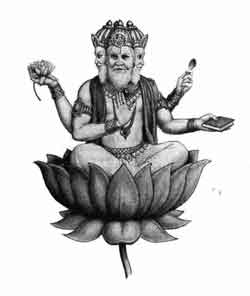
image: Brahmā from adishakti.org

13 August 2010

A Pāli Verse

Kalahavivāda Sutta - Sutta-nipāta, verse 876I've been working on Pāli texts a lot lately. Every now and then I throw caution to the wind and try something from the Sutta-nipāta - the oldest part of the canon, but also some of the most difficult grammar and syntax, and mostly in verse. After quite a bit of work, consulting first the commentaries and then K.R Norman's translation notes I managed to sort out Sn 876 which is the second to last verse of the Kalahavivāda (Quarrels & Disputes) Sutta (Sutta-nipāta iv.11). Since this was quite involved I thought my notes might give some insights into some of the difficulties one finds in translating. The Pāli is:
a|Ettāvataggampi vadanti heke,
b|yakkhassa suddhiṃ idha paṇḍitāse;
c|Tesaṃ paneke samayaṃ vadanti,
d|anupādisese kusalā vadānā.
The verse is in reply to a question from what seems to be an anonymous group of people. These 'suttas' are not introduced by Ānanda saying 'evaṃ me sutaṃ', nor do they set the scene, so the context is obscure. However the earlier part of the sutta is questions about dependent arising and desire. All of the questions on this subject are answered, then the interrogators say they have one more question. Since the answer is phrased in terms of the question, it should become clear what the question was as we proceed.

Firstly some Pāli lexiography/morphology needs to be explained
  • ettāvataggampi is most likely ettāvata aggaṃ api
  • heke is an Eastern, or Māgadhan, form of eke 'some' (nominative plural). [1] This form is not in PED.
  • paṇḍitāse is according to Norman a nominative plural "there can be no doubt that -āse is derived from the Vedic -āsas ... and -e < -as is an Eastern form, sometimes called a Māgadhism". (note 7, p.150; note 876 p.362)
  • paneke had me foxed for a while until I saw the sandhi. It is pan' eke or pana eke.
  • vadānā is a form which is in PED. It derives either from the ātmanepāda or the passive form of √vad (PED sv vadati towards the bottom of the entry). It is a present participle with the meaning 'being called, so-called). Ireland mistakes it for vadana 'says'. And Norman and Thanissaro translate 'who say they are' rather than 'are called', i.e. they give it a clearly active reflective sense of 'call themselves'. Norman references the Critical Pāli Dictionary entry on anupādisesa which says "i. e. those who pretend to be 'an-upādi-sesa' kusalavādā samānā, Pj = Nidd-a;". [2]
So note the predominance here of 'Eastern' forms which do not become standard Pāli, but fade out of use. These are not the kind of differences that would make Eastern and Western dialects mutually incomprehensible. Just minor differences like a Londoners dropping their h's (ironically pronounced haitch) or making the 'd' in London a glottal stop: Lon'on.

From here working out the cases and conjugations is relatively straight forward. However this is verse and so the syntax is more difficult to work out. I like to look for words in the same case, as these words usually go together. So clearly heke and paṇḍitāse go together: 'some of the wise'.

Putting it altogether took quite a lot of thought. In pada's a & b clearly heke paṇḍitāse vadanti is a unit 'some of the wise say'. If we ignore for the minute the indeclinables we find yakkhassa suddhiṃ aggaṃ. This could be 'the highest purity of the yakkha'. However we now bring in ettāvatta 'so far, to this extent', we find other possibilities. The sentence could be 'the highest purity of the yakkha is to this extent' (Norman adds ...[only] to this extent). The English is not very good, but the sense would seem to be that the highest purity of the yakkha only goes so far.

Perhaps it would help us to know who or what the yakkha is? Thanissaro and Ireland (see below) translate this as 'the spirit', which seems to me to give entirely the wrong connotation in English. It allows the reader to think in terms of their own 'spirit' (in a New Age sense), or in terms of 'spirits'. Yakkha could at the outside be 'a spirit' but not 'the spirit'. I think yakkha here is the Buddha, spoken of in the abstract - i.e. the ideal person. [3] In the sutta immediately previous to this (Purābheda Sutta: Sn iv.10) the subject is the uttamaṃ naraṃ 'supreme man', another synonym for the religious ideal. The one before that (Māgandiya Sutta iv.9) discusses purity and characterises the ideal man as a 'nāga'. In the Pasūra Sutta (iv.8) the ideal is dhona - a word of doubtful etymology, but meaning 'purified'. The Buddha is also called ādiccabandhu 'kinsman of the Sun' (surely a Vedic term!) and mahesi (i.e. mahā-ṛṣi) 'great seer'. The context here is people from various religious backgrounds asking the Buddha questions about religious ideals. Some of the pre-, or non-, Buddhist terminology they use is carrying over, though not all of it is retained by Buddhists. [4]

So the question could be about the extent to which purification is possible, and the Buddha in his reply is saying "yes, some people think purity is limited", i.e. that no escape from saṃsāra is possible (this was the view of some Brahmins for instance). Another way to view the phrase is to see it as being about the extent of purification of the Buddha himself. Norman translates "...that the supreme purity of the yakkha is to this extent [only]..." (p.115) So if the yakkha is the Buddha then the question might not be abstract, but concrete. They might be asking about the Buddha's own state. However the following verse is very much phrased in abstract terms. Where to slot the idha 'here' is a minor problem, though as perplexing as all the rest. I put it where it seems to make most sense in English, but this is probably the foible of an amateur!

If you look at the accompanying image you will see that I've mapped out the flow of the sentence as I understand it (I had to do this to understand it!). I think pada a& b say:
some here who are wise say that,
the purity of the yakkha is highest to this extent [only].
Pada's c & d are hardly less puzzling. But if we work through it, order emerges. We have a pronoun in the nominative plural (eke) along with a verb in the 3rd person plural (vadanti) so this means 'some say'. The pronoun tesaṃ (plural dative or genitive) seems to fit: 'some of them'. Also in the nominative plural we have kusalā vadānā giving us 'some who call themselves experts say'. Now anupādisese looks like an accusative plural and samayaṃ looks like an accusative singular, though Norman says "there is no reason we should not take [anupādisese] with samayaṃ".

I haven't mentioned these last two words before so let's do it now. Anupādisesa is a compound of a + upādi + sesa: and means not (a) having fuel (upādi) remaining (sesa). This references the fire metaphor and suggests someone who has not only extinguished the fires of greed, hatred and delusion, but who has no more fuel on which they might be reignited. Much was later made of this distinction by Theravāda exegetes, but I think it simply makes a distinction between a living Arahant (who still has the fuel of his senses, which could potentially fuel a fire) and the state of an Arahant after death when no more fire is possible. The -e ending is not explained by Norman or other authorities (so perhaps it was obvious to them, and not to me). Other translators seem in fact to take it as an accusative singular.

Samayaṃ can mean 'time' or 'condition'; or sometimes 'congregation'. Now, the commentator in the Sutta-nipāta-aṭṭhakatha (aka Paramattha-jotikā II) glosses samayaṃ by ucchedaṃ - ie. reads it as a statement of nihilism. Not even the redoubtable Mr Norman can make sense of this! It more obviously suggests that the so-called experts say there is a 'time for' or 'condition of' anupādisese, i.e. of no-fuel-remaining, or complete liberation from greed, hatred, and delusion.

The next verse is an elaboration of the Buddha's view in terms of understanding that experience is dependent on contact etc. It expands on the theme of anupādisese rather than introducing a whole new topic.

So my whole translation then is:
Some here who are wise say that:
The purity of the yakkha is the best to this extent [only].
However, some of them who call themselves experts reply
It is the condition of no-fuel-remaining.
By way of contrast here are some other translations.

Norman:
"Some wise men here do say that the supreme purity of the yakkha is to this extent [only], but some of them, who say they are experts, preach that there is a time for [quenching] with no grasping remaining." [5]
John Ireland
"Some of the learned do declare purification of the spirit as the highest. But contrary to them some teach a doctrine of annihilation. Those clever ones declare this to be (final liberation) without basis of life's fuel remaining" [6]
Bhikkhu Thanissaro
"Some of the wise
say that just this much is the utmost,
the purity of the spirit is here.
But some of them,
who say they are skilled,
say it's the moment
with no clinging remaining." [7]
Dhīvan
This is what some clever people say about it,
that the purity of the individual is best to this extent.
But some of them, who call themselves experts,
teach that there comes a time when there is no grasping left. [8]
~~||~~

Notes
  1. I think this is with reference to forms that appears in Aśokan and later inscriptions. These showed dialectical variations like heke/eke.
  2. Cf Sn 888: Yeneva bāloti paraṃ dahāti, tenātumānaṃ kusaloti cāha; Sayamattanā so kusalo vadāno, aññaṃ vimāneti tadeva pāva. Norman: "on account of what he considers his opponent to be a fool, on that account he calls himself a expert. Calling himself an expert, he despises the other, [and yet] he speaks in that very same way." (pg.116)
  3. Norman tacitly acknowledges that yakkha refers to the Buddha (just as Nāga often does) in his note to verse 478 (p.260) and says he prefers to leave it untranslated, though without saying why (which is a rare omission for him). An interesting question is in what culture was a Yakkha (S. Yakṣa) seen as a high status being? Certainly not in Vedic culture, and not in later Buddhist culture.
  4. I note in passing that none of these discussions are in terms of ātman or brahman. I have been wondering lately whether there are any discussions in the Pāli which directly reflect these concerns.
  5. Norman reads upādi as 'grasping', but cf PED sv upādi "= upādāna, but in more concrete meaning of "stuff of life", substratum of being, khandha; only in combn. with ˚sesa (adj.) having some fuel of life (= khandhas or substratum) left, i. e. still dependent (on existence), not free, materially determined". By contrast CPD merely has: 'attachment'.
  6. Ireland's notes point out that "The term 'spirit' (yakkha) is equivalent here to 'being' or 'man." I don't think translating "the spirit" conveys this. (see also note8) Note also that Ireland follows the commentary in taking samayaṃ as 'nihilism'.
  7. Thanissaro also opts to translate yakkha as 'the spirit' (see comments in note 6 and 8 and in the text) and upādi as 'clinging'.
  8. Dhīvan's rendering of yakkha as 'individual' is interesting here - it universalises the statement without creating the kinds of problems introduced by terms such as 'spirit'. This is supported by PED sv yakkha (7): "Exceptionally the term 'yakkha' is used as a philosophical term denoting 'individual soul'... "ettāvatā yakkhassa suddhi (purification of the heart)".

References

Pāli texts
All from Chaṭṭha Saṅgāyana Tipitaka Version 4.0 (CST4).
  • Kalahavādasuttaṃ. Sutta-nipāta (PTS Sn 876).
  • Kalahavivādasuttavaṇṇanā, Suttanipāta-aṭṭhakathā (PTS Pj ii.550f)
  • Kalahavivādasuttaniddeso, Mahāniddesapāḷi (PTS Nidd I i.254f)
Translations
  • Dhīvan. Kalahavivādasutta Discourse on Quarrels and Disputes (triṣṭubh). Unpublished translation.
  • Ireland, John D. (trans) "Kalaha-vivada Sutta: Further Questions"(Snp 4.11). Access to Insight, June 14, 2010, http://www.accesstoinsight.org/tipitaka/kn/snp/snp.4.11.irel.html.
  • Norman, K.R. (trans) The Group of Discourses (Sutta-Nipāta). 2nd ed. Pali Text Society, 2001. [Norman's notes supply relevant sections from the commentaries in the Mahāniddesa (Nidd I) and the aka Paramattha-jotikā II (Pj II).]
  • Thanissaro. (trans) 'Kalaha-vivada Sutta: Quarrels & Disputes' (Snp 4.11). Access to Insight, June 8, 2010, http://www.accesstoinsight.org/tipitaka/kn/snp/snp.4.11.than.html.
Related Posts with Thumbnails