13 August 2010

A Pāli Verse

Kalahavivāda Sutta - Sutta-nipāta, verse 876I've been working on Pāli texts a lot lately. Every now and then I throw caution to the wind and try something from the Sutta-nipāta - the oldest part of the canon, but also some of the most difficult grammar and syntax, and mostly in verse. After quite a bit of work, consulting first the commentaries and then K.R Norman's translation notes I managed to sort out Sn 876 which is the second to last verse of the Kalahavivāda (Quarrels & Disputes) Sutta (Sutta-nipāta iv.11). Since this was quite involved I thought my notes might give some insights into some of the difficulties one finds in translating. The Pāli is:
a|Ettāvataggampi vadanti heke,
b|yakkhassa suddhiṃ idha paṇḍitāse;
c|Tesaṃ paneke samayaṃ vadanti,
d|anupādisese kusalā vadānā.
The verse is in reply to a question from what seems to be an anonymous group of people. These 'suttas' are not introduced by Ānanda saying 'evaṃ me sutaṃ', nor do they set the scene, so the context is obscure. However the earlier part of the sutta is questions about dependent arising and desire. All of the questions on this subject are answered, then the interrogators say they have one more question. Since the answer is phrased in terms of the question, it should become clear what the question was as we proceed.

Firstly some Pāli lexiography/morphology needs to be explained
  • ettāvataggampi is most likely ettāvata aggaṃ api
  • heke is an Eastern, or Māgadhan, form of eke 'some' (nominative plural). [1] This form is not in PED.
  • paṇḍitāse is according to Norman a nominative plural "there can be no doubt that -āse is derived from the Vedic -āsas ... and -e < -as is an Eastern form, sometimes called a Māgadhism". (note 7, p.150; note 876 p.362)
  • paneke had me foxed for a while until I saw the sandhi. It is pan' eke or pana eke.
  • vadānā is a form which is in PED. It derives either from the ātmanepāda or the passive form of √vad (PED sv vadati towards the bottom of the entry). It is a present participle with the meaning 'being called, so-called). Ireland mistakes it for vadana 'says'. And Norman and Thanissaro translate 'who say they are' rather than 'are called', i.e. they give it a clearly active reflective sense of 'call themselves'. Norman references the Critical Pāli Dictionary entry on anupādisesa which says "i. e. those who pretend to be 'an-upādi-sesa' kusalavādā samānā, Pj = Nidd-a;". [2]
So note the predominance here of 'Eastern' forms which do not become standard Pāli, but fade out of use. These are not the kind of differences that would make Eastern and Western dialects mutually incomprehensible. Just minor differences like a Londoners dropping their h's (ironically pronounced haitch) or making the 'd' in London a glottal stop: Lon'on.

From here working out the cases and conjugations is relatively straight forward. However this is verse and so the syntax is more difficult to work out. I like to look for words in the same case, as these words usually go together. So clearly heke and paṇḍitāse go together: 'some of the wise'.

Putting it altogether took quite a lot of thought. In pada's a & b clearly heke paṇḍitāse vadanti is a unit 'some of the wise say'. If we ignore for the minute the indeclinables we find yakkhassa suddhiṃ aggaṃ. This could be 'the highest purity of the yakkha'. However we now bring in ettāvatta 'so far, to this extent', we find other possibilities. The sentence could be 'the highest purity of the yakkha is to this extent' (Norman adds ...[only] to this extent). The English is not very good, but the sense would seem to be that the highest purity of the yakkha only goes so far.

Perhaps it would help us to know who or what the yakkha is? Thanissaro and Ireland (see below) translate this as 'the spirit', which seems to me to give entirely the wrong connotation in English. It allows the reader to think in terms of their own 'spirit' (in a New Age sense), or in terms of 'spirits'. Yakkha could at the outside be 'a spirit' but not 'the spirit'. I think yakkha here is the Buddha, spoken of in the abstract - i.e. the ideal person. [3] In the sutta immediately previous to this (Purābheda Sutta: Sn iv.10) the subject is the uttamaṃ naraṃ 'supreme man', another synonym for the religious ideal. The one before that (Māgandiya Sutta iv.9) discusses purity and characterises the ideal man as a 'nāga'. In the Pasūra Sutta (iv.8) the ideal is dhona - a word of doubtful etymology, but meaning 'purified'. The Buddha is also called ādiccabandhu 'kinsman of the Sun' (surely a Vedic term!) and mahesi (i.e. mahā-ṛṣi) 'great seer'. The context here is people from various religious backgrounds asking the Buddha questions about religious ideals. Some of the pre-, or non-, Buddhist terminology they use is carrying over, though not all of it is retained by Buddhists. [4]

So the question could be about the extent to which purification is possible, and the Buddha in his reply is saying "yes, some people think purity is limited", i.e. that no escape from saṃsāra is possible (this was the view of some Brahmins for instance). Another way to view the phrase is to see it as being about the extent of purification of the Buddha himself. Norman translates "...that the supreme purity of the yakkha is to this extent [only]..." (p.115) So if the yakkha is the Buddha then the question might not be abstract, but concrete. They might be asking about the Buddha's own state. However the following verse is very much phrased in abstract terms. Where to slot the idha 'here' is a minor problem, though as perplexing as all the rest. I put it where it seems to make most sense in English, but this is probably the foible of an amateur!

If you look at the accompanying image you will see that I've mapped out the flow of the sentence as I understand it (I had to do this to understand it!). I think pada a& b say:
some here who are wise say that,
the purity of the yakkha is highest to this extent [only].
Pada's c & d are hardly less puzzling. But if we work through it, order emerges. We have a pronoun in the nominative plural (eke) along with a verb in the 3rd person plural (vadanti) so this means 'some say'. The pronoun tesaṃ (plural dative or genitive) seems to fit: 'some of them'. Also in the nominative plural we have kusalā vadānā giving us 'some who call themselves experts say'. Now anupādisese looks like an accusative plural and samayaṃ looks like an accusative singular, though Norman says "there is no reason we should not take [anupādisese] with samayaṃ".

I haven't mentioned these last two words before so let's do it now. Anupādisesa is a compound of a + upādi + sesa: and means not (a) having fuel (upādi) remaining (sesa). This references the fire metaphor and suggests someone who has not only extinguished the fires of greed, hatred and delusion, but who has no more fuel on which they might be reignited. Much was later made of this distinction by Theravāda exegetes, but I think it simply makes a distinction between a living Arahant (who still has the fuel of his senses, which could potentially fuel a fire) and the state of an Arahant after death when no more fire is possible. The -e ending is not explained by Norman or other authorities (so perhaps it was obvious to them, and not to me). Other translators seem in fact to take it as an accusative singular.

Samayaṃ can mean 'time' or 'condition'; or sometimes 'congregation'. Now, the commentator in the Sutta-nipāta-aṭṭhakatha (aka Paramattha-jotikā II) glosses samayaṃ by ucchedaṃ - ie. reads it as a statement of nihilism. Not even the redoubtable Mr Norman can make sense of this! It more obviously suggests that the so-called experts say there is a 'time for' or 'condition of' anupādisese, i.e. of no-fuel-remaining, or complete liberation from greed, hatred, and delusion.

The next verse is an elaboration of the Buddha's view in terms of understanding that experience is dependent on contact etc. It expands on the theme of anupādisese rather than introducing a whole new topic.

So my whole translation then is:
Some here who are wise say that:
The purity of the yakkha is the best to this extent [only].
However, some of them who call themselves experts reply
It is the condition of no-fuel-remaining.
By way of contrast here are some other translations.

Norman:
"Some wise men here do say that the supreme purity of the yakkha is to this extent [only], but some of them, who say they are experts, preach that there is a time for [quenching] with no grasping remaining." [5]
John Ireland
"Some of the learned do declare purification of the spirit as the highest. But contrary to them some teach a doctrine of annihilation. Those clever ones declare this to be (final liberation) without basis of life's fuel remaining" [6]
Bhikkhu Thanissaro
"Some of the wise
say that just this much is the utmost,
the purity of the spirit is here.
But some of them,
who say they are skilled,
say it's the moment
with no clinging remaining." [7]
Dhīvan
This is what some clever people say about it,
that the purity of the individual is best to this extent.
But some of them, who call themselves experts,
teach that there comes a time when there is no grasping left. [8]
~~||~~

Notes
  1. I think this is with reference to forms that appears in Aśokan and later inscriptions. These showed dialectical variations like heke/eke.
  2. Cf Sn 888: Yeneva bāloti paraṃ dahāti, tenātumānaṃ kusaloti cāha; Sayamattanā so kusalo vadāno, aññaṃ vimāneti tadeva pāva. Norman: "on account of what he considers his opponent to be a fool, on that account he calls himself a expert. Calling himself an expert, he despises the other, [and yet] he speaks in that very same way." (pg.116)
  3. Norman tacitly acknowledges that yakkha refers to the Buddha (just as Nāga often does) in his note to verse 478 (p.260) and says he prefers to leave it untranslated, though without saying why (which is a rare omission for him). An interesting question is in what culture was a Yakkha (S. Yakṣa) seen as a high status being? Certainly not in Vedic culture, and not in later Buddhist culture.
  4. I note in passing that none of these discussions are in terms of ātman or brahman. I have been wondering lately whether there are any discussions in the Pāli which directly reflect these concerns.
  5. Norman reads upādi as 'grasping', but cf PED sv upādi "= upādāna, but in more concrete meaning of "stuff of life", substratum of being, khandha; only in combn. with ˚sesa (adj.) having some fuel of life (= khandhas or substratum) left, i. e. still dependent (on existence), not free, materially determined". By contrast CPD merely has: 'attachment'.
  6. Ireland's notes point out that "The term 'spirit' (yakkha) is equivalent here to 'being' or 'man." I don't think translating "the spirit" conveys this. (see also note8) Note also that Ireland follows the commentary in taking samayaṃ as 'nihilism'.
  7. Thanissaro also opts to translate yakkha as 'the spirit' (see comments in note 6 and 8 and in the text) and upādi as 'clinging'.
  8. Dhīvan's rendering of yakkha as 'individual' is interesting here - it universalises the statement without creating the kinds of problems introduced by terms such as 'spirit'. This is supported by PED sv yakkha (7): "Exceptionally the term 'yakkha' is used as a philosophical term denoting 'individual soul'... "ettāvatā yakkhassa suddhi (purification of the heart)".

References

Pāli texts
All from Chaṭṭha Saṅgāyana Tipitaka Version 4.0 (CST4).
  • Kalahavādasuttaṃ. Sutta-nipāta (PTS Sn 876).
  • Kalahavivādasuttavaṇṇanā, Suttanipāta-aṭṭhakathā (PTS Pj ii.550f)
  • Kalahavivādasuttaniddeso, Mahāniddesapāḷi (PTS Nidd I i.254f)
Translations
  • Dhīvan. Kalahavivādasutta Discourse on Quarrels and Disputes (triṣṭubh). Unpublished translation.
  • Ireland, John D. (trans) "Kalaha-vivada Sutta: Further Questions"(Snp 4.11). Access to Insight, June 14, 2010, http://www.accesstoinsight.org/tipitaka/kn/snp/snp.4.11.irel.html.
  • Norman, K.R. (trans) The Group of Discourses (Sutta-Nipāta). 2nd ed. Pali Text Society, 2001. [Norman's notes supply relevant sections from the commentaries in the Mahāniddesa (Nidd I) and the aka Paramattha-jotikā II (Pj II).]
  • Thanissaro. (trans) 'Kalaha-vivada Sutta: Quarrels & Disputes' (Snp 4.11). Access to Insight, June 8, 2010, http://www.accesstoinsight.org/tipitaka/kn/snp/snp.4.11.than.html.

06 August 2010

What Did the Buddha Mean by 'World'?

earth in handsI have been working on a commentary to the Kaccānagotta Sutta (SN 12.15, PTS Sii.16.) and considering the term loka, usually translated as 'world', and how the Buddha used it; especially in the context of the compound lokasamdaya 'origin of the world'. In my research I found a trail already followed by Bhikkhu Bodhi in the notes to his Saṃyutta Nikāya translation. I will work through these texts myself, offer my own translations and observations, but leave Bhikkhu Bodhi the last word, since he got there before me.

Our first text is the Discourse of Going to the End of the World. [1] Here an odd question is raised:
kena cāvuso lokasmiṃ lokasaññī hoti lokamānī?
And by what, friend, in the world is one a perceiver and cogniser of the world?
The answer is that one is a perceiver and cogniser of the world by the six sense organs in the world. On one hand this is obvious - one perceives 'the world' through the senses - however the senses themselves are in the world (lokasmiṃ). Bhikkhu Bodhi points to SN 2.26 for an explanation. This is the Rohitassa Sutta. [2] Here the young deva, Rohitassa, asks the Buddha:
yatha nu kho bhante na jāyati na jīyati na mīyati na cavati na upapajjati, sakkā nu kho so, bhante, gamanena lokassa anto ñātuṃ vā daṭṭhum vā pāpuṇituṃ vā ti?

Is there a way by travelling to know, or see, or to reach, the end of the world where one is not born, grow old, die; where is is no death and rebirth?
The answer is no. One cannot reach the goal by actually travelling. I take this to mean that the Buddha is not talking about a place, that the language of the 'path' is only a metaphor. So the world being talked about is not the physical world, not the external objective world. He then makes a statement which might be familiar:
Na kho panāhaṃ, āvuso, appatvā lokassa antaṃ dukkhassa antakiriyaṃ vadāmi. Api ca khvāhaṃ, āvuso, imasmiṃyeva byāmamatte kaḷevare sasaññimhi samanake lokañca paññapemi lokasamudayañca lokanirodhañca lokanirodhagāminiñca paṭipadanti.

However, I, friend, there is no making an end of disappointment, without reaching the end of the world. And, friend, it is right here in this 'fathom long' [3] body endowed with perception and cognition that I declare the world, the origin of the world, the cessation of the world, and the way leading to the cessation of the world.
So this reinforces the idea that 'the world' is not 'the world' as we usually think about it, but the kind of world we refer to when we refer to some who "lives in a world of their own" - a subjective world. If we turn to Buddhaghosa's commentary [4] at this point (as Bhikkhu Bodhi does in his notes) we find that he links loka with dukka and associates the four truths of the noble ones with the world, the origin and cessation of the world and the way to the cessation of the world. Buddhaghosa then says:
Iti – ‘‘nāhaṃ, āvuso, imāni cattāri saccāni tiṇakaṭṭhādīsu paññapemi, imasmiṃ pana cātumahābhūtike kāyasmiṃ yeva paññapemī’’ti dasseti.

Thus he should see: ' I do not, friend, declare these four truths in grass and wood, but I declare them only in this body of the four great elements'.
Now this is presented as a quote from the Buddha, but modern databases make it easy to show that it does not occur in the Pāli texts that have come down to us. So we must be cautious in how we use it. With this caveat I may say that this the most unequivocal statement that the Buddha is unconcerned with the objective world, but only with the subjective world, that I know of. What in effect Buddhaghosa, at least, is saying is that paṭicca-sammupāda is not intended to apply to the external world, but to one's world of experience - to the processes of perception (the senses) and cognition (the mind) located within the body.

In the World Sutta [5] the Buddha asks the rhetorical question: "what is the origin of the world". His answer is a well known formula:
Cakkhuñca paṭicca rūpe ca uppajjati cakkhuviññāṇaṃ. Tiṇṇaṃ saṅgati phasso. Phassapaccayā vedanā; vedanāpaccayā taṇhā; taṇhāpaccayā upādānaṃ; upādānapaccayā bhavo; bhavapaccayā jāti; jātipaccayā jarāmaraṇaṃ sokaparideva-dukkhadomanassupāyāsā sambhavanti. Ayaṃ kho, bhikkhave, lokassa samudayo.

With the eye and forms as condition, eye-consciousness arises. The coincidence of the three is contact. On the basis of contact there are sensations, which give rise to desires. Desires are fuel which supports becoming. [6] With becoming there is birth, and from birth old-age, and death, grief, lamenting, misery, dejection, and trouble are produced. This, monks, is the origin of the world.
This is a portion of the nidāna chain (the most useful and relevant part) which we normally associate with the arising of dukkha. Here the world is more or less equivalent to dukkha. Note that 'the world' comes into being on the basis of contact between sense organ and sense object - forms. Here forms are not part of 'the world', they are part of the conditions which give rise to the world - this is a very important distinction. The nidānas do not give rise to forms, they give rise to the experience, the world of suffering.

The conclusion of this exploration is, I hope, clear and I will leave it to Bhikkhu Bodhi to articulate it:
"The world with which the Buddha's teaching is principally concerned is 'the world of experience,' and even the objective world is of interest only to the extent that it serves as that necessary external condition for experience" [7]

~~||~~

Notes
  1. Lokantagamana Sutta (SN 35.116, PTS S iv.93)
  2. Rohitassa Sutta (SN 2.26, PTS S i.61; also AN 4.45, PTS A ii.47)
  3. 'fathom long carcass' is (I think) Mrs Rhys David's translation of byāmamatte kalebara which has a great ring to it: but byāma refers to 'an arm-span' which is typically somewhat less than a fathom or six feet. Kaḷevara (or kaḷebara) is 'the body'. It also means 'a corpse or carcass', but a dead body is seldom "endowed with perception and cognition"
  4. Rohitassa Sutta Vaṇṇanā (SA i.116)
  5. Loka Sutta (SN 12.43, PTS S ii.73)
  6. upādāna is typically translated as 'clinging'. This is neither bad doctrine, nor bad philology. However Richard Gombrich has shown how the word more literally means 'the thing which supports a active process' i.e. fuel. The equation that "desire fuels becoming" is part of the metaphor of fire, which characterises becoming (bhava) as like a fire which can only continue when there is fuel. In my opinion it makes more sense. I've written more on the use of the metaphor of fire in these essays: Everything is on fire! and Playing with Fire.
  7. Bodhi. Connected Discourses p. 394, n.182.

image: earth in hands from Worthington Libraries.

30 July 2010

Some Additional Notes

Here are two follow up notes to previous essays, one on the -e ending in mantras, another on the name Gotama; and lastly a brief note on dating the Canon.


1. The -e Ending in Mantras.

In March 2009 I wrote Words in Mantras That End in -e. In that essay I revisited some of the ideas about what the -e ending might signify, especially with respect to the Heart Sūtra mantra. Kern, Conze and other Sanskritists have seen it as a feminine vocative singular, though of course there are other grammatical possibilities. [1] I speculated that the -e ending was simply a masculine nominative singular, and that the mantras were composed in a region of India which employed that ending as opposed to Classical Sanskrit -as/-aḥ or Pāli -o. Recently I stumbled on an article by Signe Cohen which adds something to the picture. I know Cohen from her excellent linguistic analysis of the Upaniṣads: Text and Authority in the Older Upaniṣads. This book is particularly important for the understanding it brings of the internal struggles apparent especially in the Bṛhadāranyka Upaniṣad which has Yajurveda sages in direct competition and victorious over Ṛgveda sages. However in 2002 Cohen published a short article on the -e ending:
On the Buddhist Hybrid Sanskrit/Middle Indic Ending "-e" as a 'Magadhism', Acta Orientalia Vol. 63 (2002), p.67-9.
This article points out that although the -e form for the masculine nominative singular does indeed occur in the North East of India, it is in fact far more widespread. This has partly been obscured as editors of Sanskrit texts have 'corrected' the text for critical editions. Patrick Olivelle complains of the same problem with the Upaniṣads in his article:
'Unfaithful transmitters: philological criticism and critical editions of the Upaniṣads,' in Language Texts and Society, Firenze University Press, 2005. (p. 285f) [originally published in Journal of Indian Philosophy 26, 1998: 173f.]
Western Editors, believing Indian pandits to be incompetent, silently emended unusual spellings. However as Olivelle points out, those pandits were far from incompetent, likely to be well versed in Pāṇini, and to know a 'wrong' form when they saw one. Indian scholars tended to preserve dialectical and archaic variants, being inherently more conservative in relation to texts they saw as sacred. To the European scholar of a certain era nothing but their own objectivity was sacred. While we may not accept the pandits explanations of such variant forms (which are frequently ascribed to the peculiarities of Vedic or given mystical significance) they were at least not so over-confident as to 'correct' them. As such, modern critical and printed editions of the Upaniṣads often obscure the history of the text by removing evidence, and reproducing previously corrected texts without question.

Cohen notes that in fact the -e form is found all over North India, and especially in Sanskrit loan words in Tocharian. She concludes:
"The common assumption that the -e ending is an Eastern Dialect form must be seriously questioned. Rather than being a specifically Eastern Dialectical feature found sporadically in other parts of India due to eastern influence, it appears that the -e ending was widespread, especially in Buddhist Sanskrit, that it must be considered a standard form, next to the -o ending." [p. 68; my italics]
My conjecture is that Buddhist mantras were composed in Prakrit or Buddhist Hybrid Sanskrit rather than Classical Sanskrit, and that words ending in -e in mantras are simply nominative singular forms, the gender of the words in the mantra having no relationship to the gender of the deity - and in the case of the Heart Sūtra there is no deity anyway.

~~~~

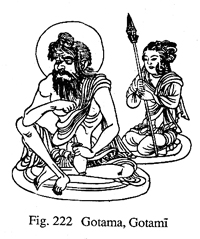
2. The Name Gautama

In my essay What Was the Buddha's Name? I drew attention to the quirk of history which left the Buddha, a kṣatriya by tradition but possibly a non-āryan, with an ostentatiously Brahmin gotra-, or clan-name: Gautama (meaning 'descended from Gotama, the one with the most cows go'). However more than half a century ago D.D. Kosambi offered a different take on this subject in a review published in 1953:
D.D. Kosambi. 'Brahmin Clans'. Journal of the American Oriental Society, Vol. 73, No. 4 (Oct. - Dec., 1953), pp. 202-208.
He points to two brief Pāli passages which suggest that Gautama (Pāli: Gotama) is not the Buddha's gotra name. The first is from the Therīgāthā verses of the Buddha's maternal aunt and foster mother. She says (Th 2 162)
Bahūnaṃ vata atthāya, māyā janayi gotamaṃ;

Truly for the many, Māyā gave birth to Gotama
Kosambi's point here is that the names Māyā and Gotama are on the same level - i.e. they are both first names. This is to read the text quite literally, and I'm a bit doubtful about doing that. Compare for instance the case of the Brahmin boy Uppatissa, son of Rūpasārī, better known as Sāriputta 'son of (Rūpa)sārī'.[2] However Kosambi points out that neither does the Buddha's wife become known as Gotamī in any tradition. The fact that Mahāpajāpati, his mother's sister, is called Gotamī also suggests that it is not the Buddha's clan-name since the names pass pass down patrilineally (though I think Kosambi here is thinking in terms of Brahminical social rules which required Brahmins to marry outside their gotra). Kosambi also notes that bhikkhus are sakiyaputta not gotamaputta. He does not attempt to explain why the future Buddha might be named after Vedic sages however, which still strikes me as odd.

Kosambi's other text is the Pabbajjā Sutta [Sn 3.1] in which King Bimbisāra asks the Buddha where he is from. The Buddha replies that he comes from the country of Kosala, and:
Ādiccā nāma gottena, sākiyā nāma jātiyā;
Tamhā kulā pabbajitomhi, na kāme abhipatthayaṃ.

Called Ādiccā by clan, called Sākiya by caste [jāti]
I went forth from that family, not longing for pleasures.
The phrase only occurs once in the canon, but elsewhere the Buddha says that the Sākiya consider rājā okkāka their ancestor [Ambaṭṭha Sutta, DN 3, PTS D i.92-3] and Pāli okkāka is Sanskrit ikṣvāku a king of the ādityā [P. ādiccā] gotra. The suggestion then is that the Buddha's name was in Sanskrit Gautama Ādityā; and Pāli Gotama Ādiccā. The Buddha is also sometimes called Āṅgirasa which according to the Dictionary of Pāli Names was a tribe which included the Gautama gotra. My reading of some of the DOPN references suggests that āṅgirasa was being used as an adjective (e.g. 'shiny like the sun') rather than a name. Against the passage above Kosambi also cites the Mahāpadāna Sutta [Dn 14, PTS ii.3]
Ahaṃ, bhikkhave, etarahi arahaṃ sammāsambuddho gotamo gottena ahosiṃ.

I bhikkhus, now worthy, fully awakened, was of the Gotama gotra. [3]
This phrase occurs 3 times in the suttas, all in the Mahapadāna. Kosambi refers to this as "the first interpretation of Gotama as the Buddha's gotra name... obviously a late formation under Brahmin influence". Indeed it is so obvious that Kosambi provides no evidence for his conjecture, nor does he consider the possibility that both statements about gotra are "late formations". Contrarily we find the name Gotama being used in the last two chapters of the Sutta-nipāta which are generally considered to be the oldest layers of the Pāli Canon.

It is still a puzzle as to why the Buddha even has a gotra name, let alone a Brahmin one (which both Gautama and Ādityā are). He was not a Brahmin. I don't think Kosambi solved the mystery, but he provided an interesting additional view point. One last observation of my own is that though the Buddha meets Brahmins from many other gotra lineages, he never seems to meet a Gautama Brahmin. This is despite the fact that the two ancestors Gotama and Bharadvāja are mentioned together in Bṛhadāranyka Upaniṣad 2.2.4, and Gautama the Buddha meets more than a dozen Brahmins from the Bhāradvāja lineage, who mostly seem to live in Kosala (see e.g. DN 3, 13, 27, 32, but throughout the nikāyas).

18 Aug 2011
I've been looking at Brahmins in the Canon and thinking about the Buddha's Brahmin surname. No other males with the gotra name "Gautama" are found in the Pāli Canon, though there are several women. I think the facts we have might be explained if the Buddha's mother and her sister were of the Gautama clan, and married Sudhodana who was a Śākya. Gautama in other words is actually Gautamaputra, Son of Gautamī; on the same model as Śāriputra is the Son of (his mother) Śārī.


6 Sept. Extra note

Snodgrass, vol.2 p. 471
In the Garbhadhātu Maṇḍala of the Shingon school, associated with the Mahāvairocana Abhisaṃbodhi Tantra (MAT), there is a figure called Gautama (or Gotama; Japanese: Kudonsen 瞿曇仙). This is the Vedic Gautama and he attends on the god Agni. Adrian Snodgrass suggests that he is the subject of many hymns in the Ṛgveda, though this is not correct as far as I know. He is, however, credited as the author of some of them. Snodgrass translates from Dainichikyōsho (Śubhakarasiṃha's commentary on the MAT):
"The hermit-ascetic Gotama [sic], flying in the sky at well, let fall two drops of sweat upon the earth, and the earth gave birth to sugar cane. Warmed by the sun, the sugar cane gave birth to two children, who became Śākya kings"*
These two are the progenitors of the clan which 'Siddhartha' was born into. Gautama has a consort called Gautamī. I have not yet found the connection between the 'sugar cane' clan (Kansho) and the Śākya clan, though it may rest on a Chinese (mis)translation. In any case it that MAT includes the Vedic Gautama alongside the many other Vedic gods and important figures. Note that this story glosses over the fact that Gautama is a brahmaṇa, while the Buddha is usually referred to as a kṣatriya.

* see Snodgrass, Adrian. The Matrix and Diamond World Mandalas in Shingon Buddhism, vol. 2, p. 470.


~~~~

3. Dating the Canon.

The Assalāyana (MN 93) is a lengthy discussion between the eponymous Brahmin and the Buddha about the claim by Brahmins to be the best class (brāhmaṇo'va seṭṭho vaṇṇo). [4] Amongst the various arguments the Buddha puts forward is the relativist argument that some countries only have two classes, viz. ayyo and dāsa, i.e. noble and slave. [MN 93.5] These two countries (janapada) referred to are Yona and Kamboja. Various maps put Kamboja in different places, but it was supposedly north and west of Gandhāra. Shrimali centres it on the Kabul River (which flows through the Hindu Kush mountains from what is now Afghanistan to join the Indus) [5] Yona is thought to refer to Bactrian Greeks even further west. As the DOPN says:
The name is probably the Pāli equivalent for Ionians, the Baktrian Greeks. The Yonas are mentioned with the Kambojas in Rock Edicts v. and xii of Asoka, as a subject people, forming a frontier district of his empire.
These Greeks are thought to have been descendants of garrisons left by Alexander of Macedon. And this gives us our date. [6] At the time of the Buddha the Persian Achaemanids ruled as far east as the Indus River - i.e. including Gandhāra. We can confidently date Alexander's Indian campaign as part of his assault on and destruction of the Achaemanid Empire, to 327-326 BCE. If yona means 'Greek', then MN 93.6 cannot have been written before this date. Dates of the Buddha are less certain but the most recent research points to his death being circa 400 BCE, some 70 odd years before Alexander. Greek cultural influence remained for some time with post-Mauryan Dynasty Gandhāra being ruled by what is termed an 'Indo-Greek' dynasty from ca. 180 BCE - 10 CE. Greek aesthetic ideals heavily influenced Gandhāra art for some centuries, so that the first anthropomorphic images of the Buddha, produced in that region during the Kushan period (ca. 75-241 CE) showing obvious Hellenistic features.

Note 7 May 2017 - to the best of my knowledge the Greeks never used Ionian as a general label. It was always a specific reference to Greeks who lived in Ionia - modern day Turkey. Moreover, the Greeks in question were Macedonians from Macedonia and that is probably how they referred to themselves. However, the Persians may have used Ionian as a general term for Greeks. If the Pāḷi Canon is using a Persian term for Greeks then this suggests that it was incorporated before Alexander. In which case the date goes back to being very vague indeed. 

~~||~~

Notes
  1. for instance -e can signify a masculine or neuter locative singular of a noun or past-participle in -a, such as gata (past-participle of gacchati).
  2. I don't want to multiply examples needlessly but Moggallana's given name was Kotila (after his village, just as Upatissa was called after his village). Kassapa (tortoise) is a very common name in Pāli perhaps because it was a gotra name as well. It seems that calling people by clan or family names, or epithets was a common practice.
  3. Note that Walsh translates this as a present (I am) when the verb is clearly past-tense; the Buddha left his clan, class, and caste behind when he went forth.
  4. D ii.148. Note that he continues "the other class is defective" (sometimes in this pericope the plural is used 'the other classes'). The Pāli being: hīno añño vaṇṇo. Here the term hīna is clearly being used pejoratively in a caste context. See also my Hīnayāna Reprise.
  5. Shrimali, Krishna Mohan. The Age of Iron and the Religious Revolution : c.700-c.350 BC. (A People's History of India: 3A). New Dehli, Tulika Books. 2007. Map p.85.
  6. I haven't found any reference to this fact, but I presume someone else has already noticed this.
Related Posts with Thumbnails